
Daily Archives: October 15, 2009

Israel is becoming a diplomatically crippled nation

Disengaging from Israel

The historic reconciliation agreement signed Saturday between Turkey and Armenia constitutes further testament to the positive changes undergone by Turkey in recent year. A government with an Islamic orientation was able to impressively promote two highly sensitive issues for Turkish public opinion: Recognizing the cultural rights of the Kurdish minority and normalizing ties with Armenia.

The strong sense of Turkish nationalism previously prevented any compromise with the Kurds, for fear this will open the door for boosting their national demands and in turn for a renewed territorial disintegration by Turkey.

Tayyip Erdogan’s administration realized that it is precisely openness towards the Kurdish minority that will prompt a greater sense of belonging among them and weaken their aspiration to join other Kurdish areas, mostly in Iraq.

Erdogan faced a similar choice vis-à-vis Armenia: Perpetuating the frozen status-quo in the ties with Turkey’s neighbor would have boosted the global Armenian campaign for recognition of the massacre committed by the Turks as an organized and methodical genocide. Turkey would have been faced with all the possible implications of such recognition, especially if it would have also been backed by the US Congress.

Erdogan decided to preempt this blow, and while taking advantage of the weak Armenian economy (which suffered gravely as result of the closure of its borders with Turkey and Azerbaijan) managed to secure (with Swiss mediation) a reconciliation agreement that is difficult for both for the Turks and for the Armenians – yet postpones to an unknown future date the question of addressing the Armenian holocaust and entrusts future research on its scope in the hands of historians. [continued…]

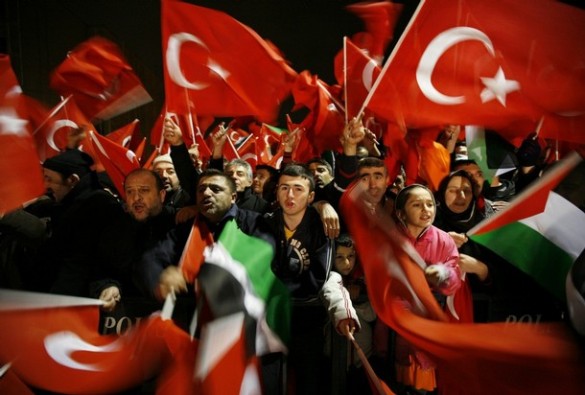
Editor’s Comment — The writer notes “the fact that precisely at a time when Turkey reaches out to its past enemies, the Turkish administration is adopting an increasingly hostile policy vis-à-vis its former great ally – Israel” and he cites this as a justification for Turkey’s entry into the European Union being blocked.

It’s interesting that an Israeli should be advising the EU who it should or should not be willing to consider as a future member. Of course Israelis who are concerned about keeping Turkey out of the EU merely need to do their bit in helping foment anti-Muslim bigotry across Europe to ensure that the Turks won’t get a fair hearing.

While Eldad Beck clearly admires Erdogan’s diplomatic successes, he falls back on an old cliche in assuming that the Turkish leader is merely taking advantage of popular hostility towards Israel in order to advance his political goals. The assumption, as always, is that such hostility would either not exist or be of minor proportions were it not being fomented. Israel remains the perpetual victim of a bad press.

The real lesson that Israelis should be drawing from observing Turkey is to note how stark the difference is between a diplomatically and democratically empowered nation as it pursues a policy of regional engagement, versus the inevitable isolation that Israel now faces as a diplomatically crippled nation.

It turns out that having just one friend isn’t enough.

Israel’s growing isolation

… we have to recognize the fact that should the trend of isolation continue, we shall have to pay a heavy price – first and foremost on the economic front.

More than ever before, Israel’s growth and employment situation hinge on exporting goods to the global market. In case of isolation, we will find it difficult to engage in international trade, attract foreign investments, and acquire the credit we need.

The isolation will also undermine us strategically, as it would encourage Hezbollah, Hamas, Syria and Iran to provoke us. This is based on the assumption that the Israeli government will shy away from ordering the IDF to operate against them in full force, for fear of another Goldstone Report and possibly even UN Security Council sanctions.

Moreover, the isolation also serves to increase Israel’s depends on the American Administration to a dangerous degree; this dependence is too heavy as it is. [continued…]


(Part One and Part Two)

Facebooktwittermail

Allies push Israel for Gaza probe

Allies push Israel for Gaza probe

Israel has come under pressure from its allies to investigate UN allegations of possible war crimes by its army during its Gaza offensive last winter.

Britain’s UN envoy urged Israel to hold “full, credible and impartial” investigations, echoing similar calls from his US and French counterparts. [continued…]

U.N. rights body considers condemning Israel on Gaza

Israeli and Palestinian leaders should launch investigations of alleged war crimes in Gaza to help rebuild trust and support peace, the U.N. High Commissioner for Human Rights said on Thursday.

At the opening of a U.N. Human Rights Council meeting on the issue, Navi Pillay said that all sides of the Middle East conflict were continuing to violate international law and voiced concern that transgressors are being left unpunished.

“A culture of impunity continues to prevail in the occupied territories and in Israel,” she told the 47-member body, calling for “impartial, independent, prompt and effective investigations into reported violations of human rights and humanitarian law.” [continued…]

In Gaza, actress Mia Farrow voices ‘outrage’ over blockade

Mia Farrow said Thursday she was outraged by conditions for children in the Gaza Strip after a blockade that has stretched for more than two years and a large-scale Israeli offensive against Hamas last winter.

The 64-year-old American actress also criticized Gaza militants’ rocket attacks on southern Israel, saying stopping them could lead to more international aid for the impoverished coastal strip. [continued…]

Facebooktwittermail

Why Palestinians have lost faith in Obama

Why Palestinians have lost faith in Obama

For a man who is sometimes seen as the Palestinian politician that the Israelis and the Americans like best, Prime Minister Salaam Fayyad was in a strikingly robust mood during a two-hour press conference in Ramallah yesterday. While too polite to criticise the Obama administration, he nevertheless had a clear message in the wake of the failure by the US to persuade the Israeli government of Benjamin Netanyahu to grant a freeze on Jewish settlement construction in the West Bank as a precursor to serious negotiations.

He suggested that the Palestinian leadership no longer had much interest in a “process for the sake of a process” and he questioned what Mr Netanyahu’s “equivocal” endorsement of a Palestinian state really meant.

Mr Fayyad had been much struck by a report from the Jerusalem Centre for Public Affairs, arguing that the 60 per cent of the West Bank controlled by Israel and designated as Area C under the Oslo accords, including the Jordan Valley, should not be handed over in any peace deal. If the Israeli establishment was envisaging a “Mickey Mouse state” along these lines, he said, then “it looks like it would not come close to what we have in mind.” [continued…]

Yishai: Deporting foreign children preserves Israel’s Jewish identity

Interior Minister and Shas Party chairman Eli Yishai plans “to muster all of Shas’ political power on the issue of the foreign workers,” he told Haaretz on Tuesday.

During a conversation with Prime Minister Benjamin Netanyahu on Monday, Yishai warned that if the cabinet rejects his demand that children of foreign workers not be given residency or citizenship in Israel, he will abdicate responsibility for the Immigration Authority, which is currently in his ministry’s purview, to the Prime Minister’s Office, and foment a coalition crisis to boot. [continued…]

Facebooktwittermail

A new role for Turkey

A new role for Turkey

When Turkish officials land in bitterly divided countries like Lebanon or Afghanistan or Pakistan, every faction is eager to talk to them. No country’s diplomats are as welcome in both Tehran and Jerusalem, Moscow and Tblisi, Damascus and Cairo. As a Muslim country intimately familiar with the region around it, Turkey can go places, engage partners, and make deals that the United States cannot.

This new Turkish role holds tantalizing potential. Before Turkey can play it fully, though, it must put its own house in order. That is one reason its leaders were so eager to resolve their country’s dispute with Armenia.

Turkey has one remaining international problem to resolve: Cyprus. Then it must solidify its democracy at home. That means lifting restrictions on free speech and fully respecting minority rights not just those of Kurds, whose culture has been brutalized by decades of repression, but also those of Christians, non-mainstream Muslims, and unbelievers.

Under other circumstances, Egypt, Pakistan, or Iran might have emerged to lead the Islamic world. Their societies, however, are weak, fragmented, and decomposing. Indonesia is a more promising candidate, but it has no historic tradition of leadership and is far from the center of Muslim crises. That leaves Turkey. It is trying to seize this role. Making peace with Armenia was an important step. More are likely to come soon. [continued…]

Facebooktwittermail

Experts say Iran may be ready for a nuclear deal

Experts say Iran may be ready for a nuclear deal

In contentious, high-stakes negotiations, deals are possible when both sides have a chance to declare victory, and that point may have been reached.

“If the Iranian endgame is to keep enrichment, and if the United States’ endgame is to make sure there are no nuclear weapons in Iran, then it can be a win-win,” said Trita Parsi, author of a book on Iran and president of the National Iranian American Council, an independent advocacy group in Washington. “Those who have been criticizing the administration for compromising or giving Iran a concession, they are wrong. It is not a concession to adjust to an unchanging reality.”

For Iran, this is not exactly about compromising — which it has shown little appetite for — as much as cooperating. For the West, it is not about winning concessions but about developing verifiable assurances that Iran is not producing weapons.

“I think the Iranians are simply in no mood to accept any serious limits on the expansion of their program,” said Flynt Leverett, director of the Iran Project at the New America Foundation. “From their point of view, they already suspended enrichment for almost two years, from 2003 to 2005, and from their perspective, they got nothing for that and they’re not going to do that again.”

But Mr. Leverett said Iran sees “that by expanding, they’ve gotten the attention of the international community and they have cards to play.”

And that may have been Iran’s primary goal from the start.

There are many analysts inside and outside Iran who say that Tehran’s objective has been to master — or at least appear to master — the process of preparing nuclear fuel, fashioning a warhead and providing the means to deliver that warhead, but not actually to build a weapon. [continued…]

‘Israel may attack Iran after December’

Israel is making preparations to carry out military attacks in Iran after December, a French magazine reported overnight Wednesday.

According to the report in Le Canard Enchainé quoted by Israel Radio, Jerusalem has already ordered high-quality combat rations from a French food manufacturer for soldiers serving in elite units and has also asked reservists of these units staying abroad to return to Israel.

The magazine further reported that in a recent visit to France, IDF Chief of General Staff Lt.-Gen. Gabi Ashkenazi told his French counterpart Jean-Louis Georgelin that Israel was not planning to bomb Iran, but might send elite troops to conduct activities on the ground there. [continued…]

Editor’s Comment — So, the bombing plans have now been shelved. Instead, Israel is going to send in commandos?

I kind of doubt it. The first problem is getting them in. I suppose the Kurds might oblige. But is Israel willing to risk seeing any of its soldiers taken prisoner and put on trial or used as human shields?

Facebooktwittermail

Stanley McChrystal’s long war

Stanley McChrystal’s long war

In his initial assessment of the country, sent to President Obama early last month, McChrystal described an Afghanistan on the brink of collapse and an America at the edge of defeat. To reverse the course of the war, McChrystal presented President Obama with what could be the most momentous foreign-policy decision of his presidency: escalate or fail. McChrystal has reportedly asked for 40,000 additional American troops — there are 65,000 already here — and an accelerated effort to train Afghan troops and police and build an Afghan state. If President Obama can’t bring himself to step up the fight, McChrystal suggested, then he might as well give up.

“Inadequate resources,” McChrystal wrote, “will likely result in failure.”

The magnitude of the choice presented by McChrystal, and now facing President Obama, is difficult to overstate. For what McChrystal is proposing is not a temporary, Iraq-style surge — a rapid influx of American troops followed by a withdrawal. McChrystal’s plan is a blueprint for an extensive American commitment to build a modern state in Afghanistan, where one has never existed, and to bring order to a place famous for the empires it has exhausted. Even under the best of circumstances, this effort would most likely last many more years, cost hundreds of billions of dollars and entail the deaths of many more American women and men.

And that’s if it succeeds. [continued…]

An inconvenient truth teller

Joe Biden had a question. During a long Sunday meeting with President Obama and top national-security advisers on Sept. 13, the VP interjected, “Can I just clarify a factual point? How much will we spend this year on Afghanistan?” Someone provided the figure: $65 billion. “And how much will we spend on Pakistan?” Another figure was supplied: $2.25 billion. “Well, by my calculations that’s a 30-to-1 ratio in favor of Afghanistan. So I have a question. Al Qaeda is almost all in Pakistan, and Pakistan has nuclear weapons. And yet for every dollar we’re spending in Pakistan, we’re spending $30 in Afghanistan. Does that make strategic sense?” The White House Situation Room fell silent. But the questions had their desired effect: those gathered began putting more thought into Pakistan as the key theater in the region. [continued…]

Why Joe Biden should resign

It’s been known for a while that Biden has been on the other side of McChrystal’s desire for a big escalation of our forces there — the New York Times reported last month that he has “deep reservations” about it. So if the president does decide to escalate, Biden, for the good of the country, should escalate his willingness to act on those reservations.

What he must not do is follow the same weak and worn-out pattern of “opposition” we’ve become all-too-accustomed to, first with Vietnam and then with Iraq. You know the drill: after the dust settles, and the country begins to look back and not-so-charitably wonder, “what were they thinking?” the mea-culpa-laden books start to come out. On page after regret-filled page, we suddenly hear how forceful this or that official was behind closed doors, arguing against the war, taking a principled stand, expressing “strong concern” and, yes, “deep reservations” to the president, and then going home each night distraught at the unnecessary loss of life.

Well, how about making the mea culpa unnecessary? Instead of saving it for the book, how about future author Biden unfetter his conscience in real time — when it can actually do some good? If Biden truly believes that what we’re doing in Afghanistan is not in the best interests of our national security — and what issue is more important than that? — it’s simply not enough to claim retroactive righteousness in his memoirs. [continued…]

Facebooktwittermail

Obama’s delusion

Obama’s delusion

Long before he became president, there were signs in Barack Obama of a tendency to promise things easily and compromise often. He broke a campaign vow to filibuster a bill that immunised telecom outfits against prosecution for the assistance they gave to domestic spying. He kept his promise from October 2007 until July 2008, then voted for the compromise that spared the telecoms. As president, he has continued to support their amnesty. It was always clear that Obama, a moderate by temperament, would move to the middle once elected. But there was something odd about the quickness with which his website mounted a slogan to the effect that his administration would look to the future and not the past. We all do. Then again, we don’t: the past is part of the present. Reduced to a practice, the slogan meant that Obama would rather not bring to light many illegal actions of the Bush administration. The value of conciliation outweighed the imperative of truth. He stood for ‘the things that unite not divide us’. An unpleasant righting of wrongs could be portrayed as retribution, and Obama would not allow such a misunderstanding to get in the way of his ecumenical goals. [continued…]

Facebooktwittermail

Russia: We’ll nuke ‘aggressors’ first

Russia: We’ll nuke ‘aggressors’ first

Russia is weighing changes to its military doctrine that would allow for a “preventive” nuclear strike against its enemies — even those armed only with conventional weapons. The news comes just as American diplomats are trying to get Russia to cut down its nuclear stockpile, and put the squeeze on Iran’s suspect nuclear program.

In an interview published today in Izvestia, Nikolai Patrushev, the secretary of the Kremlin’s security council, said the new doctrine offers “different options to allow the use of nuclear weapons, depending on a certain situation and intentions of a would-be enemy. In critical national security situations, one should also not exclude a preventive nuclear strike against the aggressor.” [continued…]

Facebooktwittermail