Daily Archives: December 1, 2009

America’s Afghan can-do folly

Going beyond necessity

Over the course of eight years in Afghanistan, the United States has failed to demonstrate an ability to make a clear distinction between what it wants to do and what it can do. In many ways this represents a failing embedded in the American can-do spirit.

Will should never be confused with skill.

As Rory Stewart has pointed out:

The language of modern policy does not help us to declare the limits to our power and capacity; to concede that we can do less than we pretend or that our enemies can do less than we pretend; to confess how little we know about a country like Afghanistan or how little we can predict about its future; or to acknowledge that we might be unwelcome or that our presence might be perceived as illegitimate or that it might make things worse.

As President Obama finally rolls out his long-awaited war strategy today, it’s fair to assume that it will be carefully studied by the Taliban’s leading commanders, but has Obama given as close attention to their pronouncements?

Ahmed Rashid notes:

Mullah Mohammed Omar, the Taliban leader, has already issued a long message to the world, pre-empting Mr. Obama’s speech and pouring detailed scorn on many of the points that the President is likely to make. He called upon his fighters to continue the jihad and drive out foreign forces from Afghanistan, as “the arrogant enemy is facing both defeat and disgrace.”

Mullah Omar’s 10-page message, delivered by e-mail to journalists in English and two Afghan languages on the eve of Eid, the major religious festival in the Muslim calendar that celebrates the end of the hajj, is an unprecedented propaganda blitz.

His cleverly worded text mixes Koranic injunctions to continue the jihad and appeals to Afghan patriotism and nationalism, which had helped previous Afghan generations defeat the British Empire and the Soviet Union.

Here are just a couple of noteworthy segments:

Afghanistan is our home and nobody negotiates with anyone about the ownership of their home and about how to share sovereignty and management responsibilities of their home. Nobody will give up their right to be the owner of their home and nobody will wilfully lose their authority in their own home. The foreigners have taken over the home of the Afghans by force and cruelty. If they want a solution to the problem, they should first end their occupation of Afghanistan.

Addressing his own fighters he says:

Pay special attention to targeting occupiers, their mercenaries and important targets only while launching martyrdom (self-sacrificing) operations. It is a religious duty of every Muslim to avoid harming ordinary people. There is no Islamic justification for killing and injuring ordinary people nor is there any space in our holy religion for such an act.

The cunning enemy wants to defame mojahedin by launching bloody attacks among the people (in religious centres, mosques and similar places) and then call their attacks martyrdom attacks. Mojahedin should be vigilant about enemy tactics and never engage in this kind of activity.

You should prioritize pleasure of Allah and wellbeing of your oppressed nation. You should respect elders and prominent figures and be kind to youngsters. Ensure justice in social affairs and make sure that everyone’s rights are upheld.

America’s foreign misadventures now, as so often in the past, are spurred by a missionary zeal. However cynical many a policymaker’s motives might be, there are plenty of young Americans on the ground who sincerely believe that they are in Afghanistan to help. But as Nick Mills wisely observes:

… the great conundrum of our efforts in Afghanistan is, the more we try to fight for the Afghans, the more we seem to fight against them. There are ways to help the Afghans, but occupying their country with an army isn’t one of them.

Ever since the Pottery Barn Rule was invoked to underline America’s moral responsibility for the fate of Iraq, we have been burdened by a false sense of duty — a duty to set right what we have fractured.

What we should instead keep in mind is what might be called the Rear End Rule: if you slam in to the back of someone else’s car, don’t expect the owner of the other car to be grateful when you solemnly promise to repair the damage yourself. Where there’s a will there isn’t always a way.


Facebooktwittermail

How many Muslims has the U.S. killed in the past 30 years?

How many Muslims has the U.S. killed in the past 30 years?

Contrary to what Friedman thinks, our real problem isn’t a fictitious Muslim “narrative” about America’s role in the region; it is mostly the actual things we have been doing in recent years. To say that in no way justifies anti-American terrorism or absolves other societies of responsibility for their own mistakes or misdeeds. But the self-righteousness on display in Friedman’s op-ed isn’t just simplistic; it is actively harmful. Why? Because whitewashing our own misconduct makes it harder for Americans to figure out why their country is so unpopular and makes us less likely to consider different (and more effective) approaches.

Some degree of anti-Americanism may reflect ideology, distorted history, or a foreign government’s attempt to shift blame onto others (a practice that all governments indulge in), but a lot of it is the inevitable result of policies that the American people have supported in the past. When you kill tens of thousands of people in other countries — and sometimes for no good reason — you shouldn’t be surprised when people in those countries are enraged by this behavior and interested in revenge. After all, how did we react after September 11? [continued…]

Editor’s Comment — After 3,000 Americans died on 9/11, the event was universally described as “an attack on America”.

After several hundred thousand Muslims have been killed, it should cause no dismay that many of the survivors would likewise call this “a war on Islam”.

Except — and this is where the Friedmans jump in — they weren’t killed for being Muslims. They were mostly killed because they happened to be in the wrong place at the wrong time.

This is how we attempt to shed the moral burden of our actions. We tell the survivors that their loved ones strayed into the periphery of our intentions. They were not killed by mistake but because they came within what we deemed to be an acceptable margin of imprecision.

This is how we sweep lives away.

And we should ask: Is there any less callous disregard in the casual indifference of a drone-operator for whom human beings are ant-like figures scurrying across a colorless monitor screen, than there is in the murderous intent of a suicide bomber?

Facebooktwittermail

Washington can give an Israeli attack on Iran the red light

Washington can give an Israeli attack on Iran the red light

On August 2, 1990, almost a year after the fall of the Berlin Wall and the end of the Iron Curtain divide, Iraq invaded Kuwait. Within months, the George H. W. Bush administration carefully assembled a coalition of states under the UN flag and defeated the Iraqi army and restored Kuwait’s ruling family, the House of Sabah. The Bush senior administration saw particular value in ensuring that the international coalition contained numerous Arab states. But to get the Arab’s to join a war alongside the US and against another Arab power, Israel needed to be kept out of the coalition.

This turned out to be a tricky issue, particularly when Saddam Hussein hurled thirty-four Scud missiles at Tel Aviv and other Israeli cities, in an obvious attempt to lure Israel into the war. Then-National Security Advisor, General Brent Scowcroft, told me in an interview that the United States told Israel “in the strongest possible words” that it needed to keep itself out of the Iraq operation because Israeli retaliation would cause the collapse of Washington’s alliance against Iraq.

For the government of Prime Minister Yitzhak Shamir, this was a very tough decision. Saddam’s missile attacks damaged Israel’s public morale; the country’s otherwise lively and noisy capital quickly turned into a ghost town. Bush sent Undersecretary of State Lawrence Eagleburger to Israel to assure Israeli leaders that the United States was doing all it could to destroy the Iraqi missile launchers.

But neither the Israel Defense Forces nor the Ministry of Defense was convinced. Instead, a feeling prevailed among Israel’s leaders that Washington was untrustworthy and that it could not be relied upon when it came to Israel’s existence. Bad blood was created between Israel and the United States, according to Efraim Halevi, the former head of the Mossad. Washington’s protection of Israel was ineffective, and the image that Israel was relying on the United States for protection was hard to stomach for ordinary Israelis. Shamir’s decision to accommodate the Americans was extremely unpopular, because it was believed that it “would cause irreparable damage to Israel’s deterrent capabilities,” Halevi told me. To make matters worse, people around Shamir felt that the United States did not reward Israel for, in their view, effectively enabling the coalition to remain intact by refusing to retaliate against Iraq.

Just as Israeli retaliation against Iraq in 1991 would have been devastating for the US, an Israeli preventive attack against Iran today would spell disaster for US national security. [continued…]

A defiant Iran vows to build nuclear plants

Iran angrily refused Sunday to comply with a demand by the United Nations nuclear agency to cease work on a once-secret nuclear fuel enrichment plant, and escalated the confrontation by declaring it would construct 10 more such plants.

The response to the demand came as Iran’s president, Mahmoud Ahmadinejad, said his cabinet would also order a study of what it would take for Iran to further enrich its existing stockpile of nuclear fuel for use in a medical reactor — rather than rely on Russia or another nation, as agreed to in an earlier tentative deal.

On Monday, Russia, a sponsor of the nuclear agency’s resolution, said it was “seriously concerned by the latest statements from the Iranian leadership,” according to news reports. France, which also supported the resolution by the United Nations International Atomic Energy Agency in Vienna last week, said Iran should be given a “last chance” to discuss the future of its nuclear program, Reuters reported. But, referring to the agency by its initials, Foreign Minister Bernard Kouchner said Monday, “The fact that Iran persists in ignoring the demands of a big independent agency like the I.A.E.A., that’s very dangerous.”

The agency’s move also drew criticism from a former Iranian president and still influential politician, Ali Akbar Hashemi Rafsanjani, who said the demand had been made “out of sheer spite,” the state-run broadcaster, Press TV, said Monday. “This resolution targets the entire panoply of Iran’s feats and accomplishments in nuclear research and technology,” he said, urging that Iran respond with “active diplomacy on the international scale.” [continued…]

Iran seizes five British sailors to raise stakes in stand-off with West

Diplomatic tension between Britain and Iran deepened yesterday with the news that Tehran is holding five British sailors after their yacht apparently strayed into Iranian waters.

The Foreign and Commonwealth Office said that the crew members were taken from their yacht Kingdom of Bahrain on November 25 after she was stopped by Iranian naval vessels while sailing from Bahrain to Dubai.

Sources named the five Britons as Oliver Smith, 31, an experienced sailor from Southampton, as well as Sam Usher, Oliver Young, 21, from Saltash in Cornwall, Luke Porter, 21, from Weston-super-Mare and Dave Bloomer, a presenter on Radio Bahrain. Mr Porter is reported to have spoken to his father Charles yesterday. [continued…]

Senior cleric denounces Iranian militia for crackdown

Iran’s most senior cleric denounced the role of the volunteer militia force known as the Basij in the crackdown against protesters, saying the force’s actions were against religion and “in the path of Satan.”

The cleric, Grand Ayatollah Hossein Ali Montazeri, condemned the force in a statement posted on an opposition Web site, mowjcamp.com, decreeing that “the assailants have acted against religion and must pay blood money” to those who were wounded or to their families.

It was the harshest criticism of the militia to date by the ayatollah, who has sided with the opposition leaders. The Basij militia has played an instrumental role in the crackdown; the opposition has said that at least 73 people have been killed since the post-election protests began in June. [continued…]

Facebooktwittermail

Omar Barghouti and George Fletcher debate BDS

Omar Barghouti and George Fletcher debate BDS

At the beginning of November Omar Barghouti and George Fletcher debated BDS at Columbia University. The event was moderated by Laura Flanders from GRITtv, who posted this great video of the event. Check it out. [continued…]

The battle for Israel’s soul

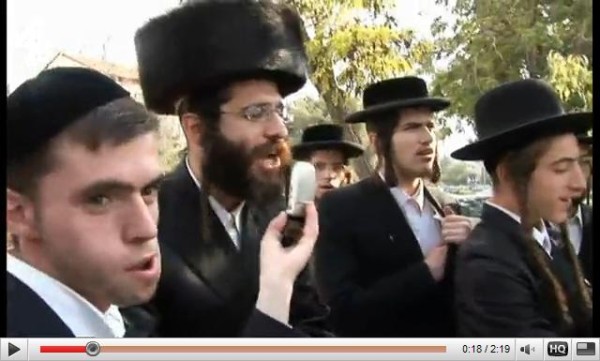
Unreported World travels to Israel to reveal how the rapid growth of Jewish ‘fundamentalists’ is creating tension within Israeli society and endangering any negotiations on a peace deal with the Palestinians.

Reporter Evan Williams and director Alex Nott begin their journey in the Mea Sharim district of Jerusalem. It’s the heartland of ultra-Orthodox Jews known as the Haredi, or ‘those who fear God’. They find a poor, overcrowded part of the city where everyone is wearing clothes in the style of 18th-century Europe, from where most of their ancestors came. ‘We are the real Jews,’ says one community leader, ‘everyone else in Israel just happens to be born Jewish.’

Many of the Haredi sects were almost wiped out in the Holocaust. But their numbers are growing fast. Haredi are the fastest growing segment of Israeli society, with many families having as many as eight children. ‘Every 20 years we have a community that is growing at eight or nine times,’ says one of the Haredi men to Williams. ‘It means we are growing in size and influence.’

Many Haredi men in Israel don’t work as they receive government subsidies to spend their entire lives studying the Torah and religious texts. One Rabbi from the Reform wing of Judaism tells Williams that, because Haredis are exempt from military service and heavily subsidised, they are creating huge tensions within the country. [continued…]

Facebooktwittermail

My compatriots’ vote to ban minarets is fuelled by fear

My compatriots’ vote to ban minarets is fuelled by fear

It wasn’t meant to go this way. For months we had been told that the efforts to ban the construction of minarets in Switzerland were doomed. The last surveys suggested around 34% of the Swiss population would vote for this shocking initiative. Last Friday, in a meeting organised in Lausanne, more than 800 students, professors and citizens were in no doubt that the referendum would see the motion rejected, and instead were focused on how to turn this silly initiative into a more positive future.

Today that confidence was shattered, as 57% of the Swiss population did as the Union Démocratique du Centre (UDC) had urged them to – a worrying sign that this populist party may be closest to the people’s fears and expectations. For the first time since 1893 an initiative that singles out one community, with a clear discriminatory essence, has been approved in Switzerland. One can hope that the ban will be rejected at the European level, but that makes the result no less alarming. What is happening in Switzerland, the land of my birth?

There are only four minarets in Switzerland, so why is it that it is there that this initiative has been launched? My country, like many in Europe, is facing a national reaction to the new visibility of European Muslims. The minarets are but a pretext – the UDC wanted first to launch a campaign against the traditional Islamic methods of slaughtering animals but were afraid of testing the sensitivity of Swiss Jews, and instead turned their sights on the minaret as a suitable symbol. [continued…]

Swiss minaret ban may signal new right-wing surge

While Switzerland’s Muslim community of some 300,000 is relatively small there is wider concern about immigration in a country where foreigners make up more than a fifth of the total 7.7 million population.

Nationwide voter turnout was about 53 percent, higher than a more usual 35 to 45 percent, and 22 of 26 cantons, or provinces, voted in favor of the initiative. The decision went against recent polls, which had indicated a slim majority opposed a ban.

There was marked division between urban areas like Zurich and French-speaking areas — which are traditionally more liberal — and rural, German speaking cantons like Schaffhausen, where some 70 percent of voters supported the initiative.

“It represents a two finger gesture against the towns, foreigners, the powerful, the better educated and the like. The pattern of voting confirms that,” said Swiss culture and politics expert Jonathan Steinberg of the University of Pennsylvania. [continued…]

Facebooktwittermail