Daily Archives: December 21, 2009

The legacy of the people’s ayatollah: Montazeri

The ayatollah’s inspiration

“If you’re going to ask me questions about my regrets, plan to spend the next month or so in my house!” Those were the words with which Ayatollah Hussein Ali Montazeri greeted me when I interviewed him at his home in the holy city of Qum four years ago. He was then 83 years old and could look back on a life in which he’d served as a founding father of the Islamic Republic only to become its most vocal critic. More recently, especially in the last seven months of protest and crackdowns following the disputed June 12 reelection of President Mahmoud Ahmadinejad, Montazeri has emerged as the authoritative voice of religious opposition to a supposedly religious regime. He has been lionized as an idealist speaking truth to those in a power structure riddled with cynical and corrupt ideologues. For many Iranians, Montazeri became more than a hero, more than an ayatollah; he was truly, as Shiites say, a source of emulation.

On Sunday, Iranian state news agencies announced that Montazeri had died at 87 of natural causes, and at first they didn’t even want to call him an ayatollah. The paranoid regime in Tehran did its best to discourage people from attending his funeral on Monday. All major newspapers received a letter from Iran’s Ministry of Culture and Islamic Guidance about how to play down Montazeri’s death. The ministry even sent some agents to the printers to make sure that newspapers listened to its orders, according to one newspaper editor. They ordered the telecommunications company to slow the speed of Internet connections, and they shut down mobile phones in Qum for several hours, eyewitnesses said.

Iran’s Ministry of Intelligence warned political activists not to attend the burial service next to Qum’s Masuma shrine. The police and the Revolutionary Guards arrested others before they reached the city. Two Iranian journalists reported that security forces with riot shields and truncheons ringed Montazeri’s house, and the streets were full of police in uniform and in plain clothes carrying walkie-talkies and stun guns. The Basij militia connected to Iran’s increasingly powerful Revolutionary Guards corps attacked buses full of mourners, and the regime’s partisans and thugs filled the main mosque in Qum rather than let a memorial service be held there. But according to eyewitnesses, hundreds of thousands of people came to the city anyway. [continued…]

Cleric’s death, torture case jolt Iran

Iran’s opposition seized upon the death of one of the Islamic republic’s founding fathers — a revered ayatollah who was also a fierce critic of the nation’s leadership — to take to the streets in mourning.

Tens of thousands of Iranian mourners–many chanting protest slogans–joined the funeral procession Monday for Grand Ayatollah Hossein Ali Montazeri, who had described government crackdowns as the work of power-hungry despots.

Iranian authorities have barred foreign media from covering the processions in the holy city of Qom for Ayatollah Montazeri, who died Sunday at age 87. But witnesses said many mourners shouted protest cries including “Death to the Dictator” in displays of anger against Iran’s ruling establishment.

There were no immediate reports of serious clashes from the witnesses, who spoke on condition of anonymity because of fears of arrest by Iranian authorities. Some opposition Web sites noted scuffles and violence, but the reports couldn’t immediately be confirmed.

On Monday, access to the Internet in Iran was slow, and cellular telephone service was unreliable. The government has periodically restricted communications in an attempt to prevent protesters from organizing.

The death of Ayatollah Montazeri, who passed away in his sleep, was only one of two surprises to shake Iran over the weekend.

Hours earlier, on Saturday, military prosecutors alleged that prison guards tortured to death at least three student protesters in July, contradicting months of denials by top leaders. The reversal is one of the biggest blows to Tehran’s credibility since government protests first erupted six months ago.

Either development, by itself, would provide a rallying point for the opposition, which claims last summer’s presidential election was a fraud and is demanding a political overhaul. Together, they represent the widening array of challenges facing the Iranian regime. [continued…]

The remarkable life of Iran’s bravest cleric

Born in 1922 to a poor but pious family, he studied not only with Ayatollah Khomeini but with Grand Ayatollah Borujerdi, easily the most esteemed Shiite leader of his time. In Shiite clerical hierarchy, the stature of your teachers is a significant measure of your own stature. Montazeri’s pedagogical pedigree was singular for it combined the unmatched erudition of Boroujerdi with the political bravura of Khomeini. Moreover, Montazeri had been relentless in fighting on the side of his mentor throughout the ’60s and ’70s when Khomeini lived in exile. After the victory of the revolution, he had emerged clearly as the second most powerful man in Iran. The 1986 decision to name him the successor to Khomeini codified in law what was already evident in practice.

Tensions between Khomeini and Montazeri began when someone on Montazeri’s staff leaked the story of secret deals between Iran and the United States–what turned out to be the Iran-Contra Affair. Khomeini executed the staffer, despite protestations from Montazeri. A few months later, as the nation learned of Khomeini’s ill health, Montazeri learned of mass executions in prisons on the order of Khomeini. Prisoners serving time on earlier charges were to be retried–in procedures often lasting no more than a few minutes–and executed if found to be still opposed to the regime. Instead of keeping a pragmatic silence and awaiting Khomeini’s death, as many of his advisors recommended, Montazeri wrote a harshly worded letter to Khomeini condemning the orders, saying that this is not the kind of revolution they had fought for together.

This time, the price for protesting murder and moral perfidy was the direct wrath of Khomeini. Montazeri was not only stripped of all his power, but ridiculed in the press by many, including Khomeini’s son, as an imbecile–a country bumpkin at best, unwittingly used and abused by “enemies of Islam.” The media began a vicious campaign of character assassination against Montazeri, the man Khomeini had not long before called “the essence of my life” and a “pillar of Islam.” [continued…]

Iran-Iraq standoff over oil field ends

Iraq said Sunday that Iranian soldiers who had been occupying part of a disputed Iraqi oil field had withdrawn, ending a three-day standoff that had strained relations between the countries.

But Labeed Abawi, Iraq’s deputy foreign affairs minister, said some Iranian troops remained in Iraq late Sunday. “They withdrew from the field, but they are not completely out of Iraqi territory,” he said.

Mr. Abawi said representatives of the two countries planned to meet soon to try to agree on the precise border in the vicinity of the Fakka field in Maysan Province in southeastern Iraq.

Iran’s state news media said Sunday that the Iranian troops had returned to their border post, but that the soldiers had never crossed into Iraq.

Iraq claims that it dug oil wells on the Fakka field during the 1970s before the Iran-Iraq war. But Iran says the area near the well that its soldiers had occupied — known as Well No. 4 — is on the Iranian side of the border.

At least four other oil fields in Iraq are within several hundred yards of the Iranian border or straddle the line.

Border disputes between the countries, which set off the 1980-88 Iran-Iraq war, have become more common in recent months as Iraq has moved to sell development rights to fields near the Iranian border, including Fakka. [continued…]


Facebooktwittermail

Hamas using English law to demand arrest of Israeli leaders for war crimes

Hamas using English law to demand arrest of Israeli leaders for war crimes

The Islamist group Hamas is masterminding efforts to have senior Israeli leaders arrested for alleged war crimes when they visit European countries including Britain, a top Hamas official involved in the effort has told The Times.

The claim comes amid continuing diplomatic fallout after a British arrest warrant was issued last week against Tzipi Livni, who served as Foreign Minister during Israel’s Gaza offensive last winter. The warrant was withdrawn when it became clear that Ms Livni, now leader of the opposition, was not in the country. Its existence apparently prompted her to cancel a trip to attend a meeting in London.

President Peres described the incident as “one of the greatest political mistakes” that Britain could have made and calling for the law to be changed. “Everything is based on … a hostile majority public opinion,” he said last week. “The British promised they would fix this and it is time that they do so.” [continued…]

The democratic value of universal accountability

In important global dynamic today bridges the worlds of politics, morality and violence. Societies are grappling with the challenge of how to hold accountable the political leaders who are accused of various degrees of criminal behavior, including war crimes, torture — even genocide or crimes against humanity. The most outrageous cases are tried in special international tribunals or at the International Criminal Court. Other cases reflect more contested situations and raise critical issues of the universality of ethics and law.

Two cases last week in the United States and Israel are interesting in this respect, because these two countries remind us twice a week — and more often in war time and on patriotic national holidays — that they are democracies whose values should be spread around the world. Well, the world at the receiving end of their moral munificence frequently asks an important question to which it has yet to receive a clear answer:

Are the United States and Israel subject to the same standards of accountability for their behavior as everyone else in the world, or do they operate at a higher plane of impunity when it comes to using violence to kill, torture, and invade or occupy other peoples? [continued…]

Facebooktwittermail

Settler activist: ‘We are preparing a series of surprises’ for the army

Settler activist: ‘We are preparing a series of surprises’ for the army

ight-wing activists began preparing on Sunday for a fight against the planned demolition of structures built in contravention of the 10-month freeze on construction in West Bank settlements.

The demolition plans were described in an internal Israel Defense Forces memo detailing the intelligence-gathering methods to be used to detect freeze violations. The memo was leaked to the press on Sunday.

One of the issues that most concerns right-wing activists is the IDF’s plan to jam cell-phone signals, so as to prevent settlers from telling other protesters where to demonstrate against implementation of the freeze. Activists have begun consulting with experts on how to overcome the signal jamming.

The memo shows the IDF is focusing on how to deal with problems it has faced in the past, a right-wing activist said on Sunday.

“The army is preparing for yesterday’s war, but we won’t fight it on its turf,” he said. “We are preparing a series of surprises and events that it won’t be prepared for.” Continue reading

Facebooktwittermail

Likud MK: Annex West Bank, consider citizenship for Palestinians

Likud MK: Annex West Bank, consider citizenship for Palestinians

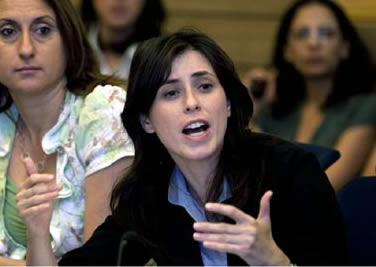
Knesset Member Tzipi Hotovely, one of the leading dissenting voices in the Likud faction opposing the policy adopted by Prime Minister Benjamin Netanyahu, said Sunday that the territories should be annexed to Israel.

“Israeli law should be applied on the Judea and Samaria region,” Hotovely said during a conference in the Interdisciplinary Center in Herzliya and stated she did not rule out granting citizenship to Palestinians.

The MK explained that “Judea and Samaria are a part of the land of Israel,” and blamed the Palestinians for the failure of the political process. “We strongly wish to get a divorce, but the other side doesn’t want to separate.”

Hotovely told Ynet later in the evening, “It’s unthinkable that Jews in Judea and Samaria would live under occupation and under a military regime. The distorted policy, which states that every construction permit must be approved by the defense minister harms the most basic rights.

“It’s time to lift the question mark over Judea and Samaria and view the people living there as citizens with an equal status. Thinking ahead, strategically, we should consider granting gradual citizenship to Palestinians based on loyalty tests.” [continued…]

Editor’s Comment — Tzipi Hotovely, at 31 the youngest member of the Knesset, is younger than the occupation. Small wonder that she regards Israel’s control of the West Bank as irreversible. Her proposal to consider granting Palestinians citizenship if they pass a “loyalty test” obviously bears no relationship to the one-state solution that many anti-Zionists favor. Indeed, the Jewish claim to Greater Israel she is expressing has embedded in it a hubris that goes beyond that of the average Zionist — she seems to be implying that Jews could still exercise control over a Jewish state even if they were in a minority. Old hands in the conflict will no doubt dismiss her views as naive, but I have to wonder whether or not she is simply saying what a majority of her generation of Jewish Israelis already think.

Israel continues its assault on Palestinian nonviolent leaders

Israel’s campaign against Palestinian nonviolent grassroots activists is continuing. The latest leader to be arrested is Jamal Juma’. Juma’ has been the coordinator of the Palestinian Grassroots Anti-Apartheid Wall Campaign since 2002. His arrests follows those of Mohammad Othman, who had been promoting BDS in Europe, and Abdallah Abu Rahmah a leader of the weekly nonviolent protests against the wall in Bil’in. [continued…]

Facebooktwittermail

Somalia is greatest victim of President Bush’s War on Terror

Somalia is greatest victim of President Bush’s War on Terror

AQfghanistan and Iraq have monopolised the headlines but Somalia is arguably an even greater victim of George W. Bush’s ill-conceived and lamentably executed War on Terror. America’s interventions have proved so catastrophic that its best hope of salvaging something from the wreckage is a president it chased from power three years ago, who controls a few square miles of a country three times the size of Britain.

It has delivered a people that practised a moderate form of Islam into the hands of religious extremists. Its efforts to combat terrorism have turned Somalia into a launchpad for global jihad. Somalia is now the ultimate failed state whose mayhem threatens to destabilise the region and whose pirates maraud the vital shipping lanes off its shores. Its people endure Africa’s worst humanitarian crisis.

During the Cold War, the US pumped arms into Somalia to counter Soviet support for neighbouring Ethiopia. In 1991 clan warlords ousted the dictator Siad Barre and turned that arsenal on each other. In 1992 President Bush Snr sent in the Marines to help its suffering people — a venture that ended in the Black Hawk Down debacle, a humiliating US withdrawal and a dozen more years of anarchy as the feuding warlords ran amok. [continued…]

Facebooktwittermail

How ‘Iran’s stooge’ turned out to have a mind of his own

How ‘Iran’s stooge’ turned out to have a mind of his own

Is it time for the Gulf countries, especially Saudi Arabia, to drop their caution towards the Iraqi prime minister Nouri al Maliki and his cabinet, and embrace a neighbour currently emerging from years of tyranny followed by civil strife?

Gulf reservations are understandable. Mr al Maliki was a member of the United Iraqi Alliance (UIA) parliamentary bloc, the predecessor of the Iraqi National Alliance (INA), a coalition of Shiite, mainly Islamist, parties. Fearing Iranian dominance over Iraq, Saudi Arabia distanced itself from him.

By the time of the parliamentary elections in December 2005, the UIA consisted mainly of the Supreme Council for the Islamic Revolution in Iraq (ISCI), Mr al Maliki’s Dawa party, its splinter group Dawa Iraq Organisation, and the Fadhilah party. Other groups known for their close ties with Iran, such as Moqtada al Sadr’s candidates and Ahmed Chalabi’s Iraq National Congress (INC), ran independently. [continued…]

Facebooktwittermail