Daily Archives: December 22, 2009

Cleric’s funeral becomes protest of Iran leaders

Cleric’s funeral becomes protest of Iran leaders

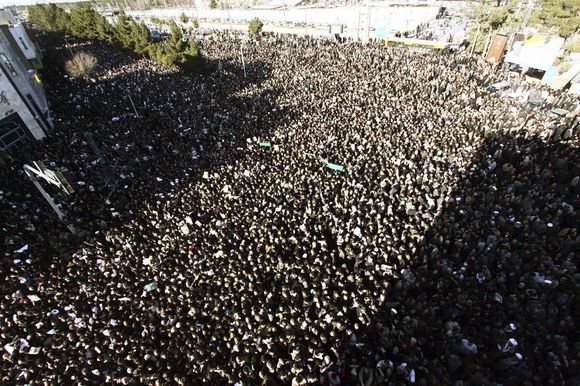
The funeral of a prominent dissident cleric in the holy Iranian city of Qum turned into a huge and furious antigovernment rally on Monday, raising the possibility that the cleric’s death could serve as a catalyst for an opposition movement that has been locked in a stalemate with the authorities.

As mourners carried the body of the cleric, Grand Ayatollah Hossein Ali Montazeri, tens of thousands of his supporters surged through the streets of Qum, chanting denunciations of the leadership in Tehran that would have been unthinkable only months ago: “Our shame, our shame, our idiot leader!” and “Dictator, this is your last message: The people of Iran are rising!” [continued…]

Karroubi: Iran’s problems should be solved by its own people

President Ahmadinejad has betrayed the Iranian Revolution, violated the country’s Constitution and may be unable to serve his full term, his most vocal opposition rival has told The Times.

In a surprising twist, however, Mehdi Karroubi warned the West against exploiting the regime’s weakness to strike a deal to halt a nuclear programme that was, he insisted, for peaceful purposes.

“Nuclear science and achieving peaceful nuclear technology is a right reserved for all NPT [Nuclear Proliferation Treaty] members,” he said. “We ask Western governments not to use this internal situation as a bargaining chip with the present Iranian Government to reach agreements which would undermine the rights of the Iranian people.”

He also urged the West against trying to help the opposition in its battle against the regime, saying that such efforts would “pave the way for suppression and accusations of dependency on foreigners”. He added: “The challenges in this country should be solved by its own people.” [continued…]

Facebooktwittermail

US forces mounted secret Pakistan raids in hunt for al-Qaida

US forces mounted secret Pakistan raids in hunt for al-Qaida

American special forces have conducted multiple clandestine raids into Pakistan’s tribal areas as part of a secret war in the border region where Washington is pressing to expand its drone assassination programme.

A former Nato officer said the incursions, only one of which has been previously reported, occurred between 2003 and 2008, involved helicopter-borne elite soldiers stealing across the border at night, and were never declared to the Pakistani government.

“The Pakistanis were kept entirely in the dark about it. It was one of those things we wouldn’t confirm officially with them,” said the source, who had detailed knowledge of the operations. [continued…]

Welcome to Pashtunistan: the aim of America’s secret war?

Few people by now can be unaware of Blackwater, later known as Blackwater Worldwide and now as Xe. The private security agency formed in 1997 and based in North Carolina is owned by Erik Prince, a former member of the US Navy Seal special forces, and has long-standing links with both the CIA and the FBI.

Its presence in Pakistan has been an open secret for some years. The investigative journalist and writer Jeremy Scahill, an authority on Blackwater and author of the bestselling Blackwater: the Rise of the World’s Most Powerful Mercenary Army, revealed last month that it has been there since 2006. He says Blackwater is being employed for covert ops, essentially intended to target high-value al Qa’eda leaders, including Osama bin Laden, but it has also assisted in providing information for drone attacks and has kidnapped suspects and transported them covertly to the US for interrogation.

In other words, it is an American agency with a licence to kill or kidnap, thus exonerating official American agencies that might one day be held accountable. (Although personally I doubt if the CIA will ever be held accountable. I continue to aver that it is the only real rogue intelligence agency in the world. Mossad might enjoy liberty of action for any operation, but it cannot undertake one without the approval of the Israeli prime minister: no such restriction applies to the CIA.) [continued…]

Facebooktwittermail

Gaza’s civilians still unable to rebuild one year after ‘Operation Cast Lead’

Gaza’s civilians still unable to rebuild one year after ‘Operation Cast Lead’

The international community has betrayed the people of Gaza by failing to back their words with effective action to secure the ending of the Israeli blockade which is preventing reconstruction and recovery, say a group of 16 leading humanitarian and human rights groups in a new report released today (22 December) ahead of the anniversary of the start of Israel’s military offensive in Gaza (27 December-18 January).

The Israeli authorities have allowed only 41 truckloads of all construction materials into Gaza since the end of the offensive in mid-January, warn the groups, which include Amnesty International, CAFOD, Christian Aid, Medical Aid for Palestinians, Mercy Corps and Oxfam International. The task of rebuilding and repairing thousands of homes alone will require thousands of truckloads of building materials, they add.

Little of the extensive damage the offensive caused to homes, civilian infrastructure, public services, farms and businesses has been repaired because the civilian population, and the UN and aid agencies who help them, are prohibited from importing materials like cement and glass in all but a handful of cases, says the report. [continued…]

Doctor admits Israeli pathologists harvested organs without consent

Israel has admitted pathologists harvested organs from dead Palestinians, and others, without the consent of their families – a practice it said ended in the 1990s – it emerged at the weekend.

The admission, by the former head of the country’s forensic institute, followed a furious row prompted by a Swedish newspaper reporting that Israel was killing Palestinians in order to use their organs – a charge that Israel denied and called “antisemitic”.

The revelation, in a television documentary, is likely to generate anger in the Arab and Muslim world and reinforce sinister stereotypes of Israel and its attitude to Palestinians. Iran’s state-run Press TV tonight reported the story, illustrated with photographs of dead or badly injured Palestinians. [continued…]

Challenge to the Jewish Taliban

A struggle for the character of the Western Wall, this city’s iconic Jewish holy site and central place of worship, is under way, and it is being fought with prayer shawls and Torah scrolls.

On Friday, sheets of rain obscured the Old City’s ancient domes. But by 7 a.m. about 150 Jewish women had gathered at the Western Wall to pray and to challenge the constraints imposed on them by traditional Jewish Orthodoxy and a ruling by the Israeli Supreme Court.

Under their coats many of the women, supporters of a group of religious activists called Women of the Wall, wore a tallit, or fringed prayer shawl, a ritual garment traditionally worn only by men. Some wore their prayer shawls openly, an illegal act in this particular setting that can incur a fine or several months in jail. [continued…]

MK Tibi: Israel is democratic for Jews, but Jewish for Arabs

he Knesset Law and Constitution Committee conducted a heated debate Tuesday on two parallel law proposals that would enable certain communities in Israel to handpick their residents.

The proposals come amid controversy over a number of Jewish communities in the north who have refused entry to Arabs wishing to reside there.

The laws proposed by MKs Israel Hasson and Shai Hermesh (Kadima) and the committee’s chairman MK David Rotem (Yisrael Beiteinu) circumvent the High Court decision that the reception committees are illegal.

MK Ahmed Tibi condemned the bills, which passed a preliminary vote a few weeks ago, claiming they would only allow systemic racism to take hold.

“This law is like pissing in mid-air,” said Tibi. “Racism is starting to be legislated in the statute book. There is an influx of racist law proposals; you aren’t even ashamed of yourselves.”

“This country is Jewish and democratic: Democratic towards Jews, and Jewish toward Arabs,” Tibi said, adding that that if Israel’s declaration of independence was to be voted on in the Knesset today, it would not pass.

The proposals were actually meant to enable communal settlements, like moshavim, to disqualify candidates on grounds of economic status or incompatibility with the settlement’s lifestyle. The debate quickly developed, however, to the fact that the committees would be able to prevent Arab landowners from building on community land.

Facebooktwittermail

Lebanon drama adds act with leader’s trip to Syria

Lebanon drama adds act with leader’s trip to Syria

In any other part of the world, a new prime minister’s visit to a neighboring country would be a fairly routine event. But Prime Minister Saad Hariri’s trip to Syria over the weekend has been treated here as a kind of Lebanese national drama, the subject of almost endless commentary in newspapers and television shows.

It is not that anything really happened. Mr. Hariri and President Bashar al-Assad of Syria exchanged some thoroughly forgettable diplomatic banter and posed for photographs.

Instead, the trip epitomized a national story with anguished, almost operatic dimensions: a young leader forced to shake hands with the man who he believes killed his father. And it served as a reminder of this region’s deep attachment to political symbolism.

For many Lebanese, the visit was a measure of Syria’s renewed influence over Lebanon after years of bitterness and struggle since the Syrian military’s withdrawal in 2005. That withdrawal came after Mr. Hariri’s father, former Prime Minister Rafik Hariri, was killed in a car bombing that many here believe to have been ordered by Syria.

The withdrawal was a blow to Syrian prestige, and afterward Saad Hariri seemed to have the entire Western world at his back as he built a movement for greater Lebanese independence and pushed for an international tribunal to try his father’s killers.

But since then, the United States and the West have chosen to engage with Syria, not isolate it. And Saudi Arabia, which has long backed Mr. Hariri and competed with Syria for influence here, reconciled with the Syrians earlier this year, leaving them a freer hand to guide politics in Lebanon as they once did. [continued…]

Facebooktwittermail
