Monthly Archives: July 2012

Syria fighting widespread, spills into Lebanon

Reuters reports: Syria’s conflict spilled further into Lebanon on Saturday when mortar fire from government forces crashed into villages in the north, killing two women and a man after rebels crossed the border for refuge, residents said.

In contrast with Turkey, which openly harbors rebels fighting to topple Syrian President Bashar al-Assad, Lebanon was not expected to respond militarily and has played down the effect of regular clashes along the frontier.

But rebels have used north Lebanon as a base and Assad’s forces have at times bombed villages and even crossed the border in pursuit of militants, threatening to inflame tensions in Lebanon given a long history of Syrian domination there.

Residents of Lebanon’s Wadi Khaled region said several mortar bombs hit farm buildings five to 20 km (3 to 12 miles) from the border at around 2 a.m. At midday villagers reported more explosions and said they heard gunfire close to the border.

In the village of al-Mahatta, a house was destroyed, killing a 16-year-old girl and wounding a two-year old and a four-year old, family members told Reuters. A 25-year-old woman and a man were killed in nearby villages, residents said.

The Lebanese army issued a brief statement about the incident. There was no immediate response from the prime minister or the foreign ministry, both of whom have expressed fears that Lebanon could be dragged into the conflict.

Facebooktwittermail

Syria: How important is the Tlass defection?

Joshua Landis answers this question: Absolutely important – The Tlass family has been at the heart of the regime from the beginning. They are the keystone of the Sunni-Alawi alliance that has cemented the regime for 4 decades.

Abdul Halim Khaddam and the Tlass family were the two leading Sunni families in the state from the beginning, when Hafiz al-Assad, the architect of the regime, built the structures that have endured since. Bashar preserved the blueprint drawn up by his father.

Vice President Khaddam defected in 2005. His departure sent a shudder through the regime, but this time is different. The Tlas defection sends the sign that the regime is done for. No longer is this uprising merely about angry young men in the countryside. It has reached to the very top. The elite Sunnis are looking for the exit door – but it will be hard to replicate this defection. Manaf got the golden parachute into Paris. His family is all out – his father, brother, wife and children. He planned this carefully. He has the power and the means.

Other generals have no bodyguards, no visas, no money…. It will be a long and painful process for most to defect.

What is more the Alawite officers have their backs to the wall.

The regime will not just collapse. This is not “The Tipping Point” but it is very significant for morale. It sends a message: the game is up.

A statement by General Manaf Tlass: As issued by international press and media, I have just left Syria.

With the will to remain faithful to my military principles and loving feelings towards Syria, I have always tried to fulfill my duty with rightness, in order to preserve unity for Syria and its people.

I did not joined the armed forces to see this army harm its own people, without giving systematically a chance to political solutions.

Thus, because I was in complete opposition with the unjustified violence and crimes committed by Assad’s regime in the past months, I was progressively dismissed from my place of duty in the armed forces.

Today, I call for all my comrades in armed forces, whatever their rank in the hierarchy, who are dragged into this fight against their Syrian fellows and against their own ideals, to end supporting this regime.

I recognize the legitimacy of the fight of the opposition members to the regime, particularly the ones on the ground. In this respect, let me be grateful to those who made it possible for me to leave the Syrian territory where my own person and family were threatened.

In the coming days, I will make a statement on my motives and the possibilities that the future offers me.

Long life to Syria!

General Manaf Tlas

Facebooktwittermail

WikiLeaks: PR firm tried to buff Syria’s image after crackdown

The Los Angeles Times reports: A New York-based public relations firm tried to help the Syrian government “brand” its reforms last year as media reported its crackdown on protesters, according to an email released Friday by WikiLeaks.

The firm, Brown Lloyd James, had earlier helped arrange a rosy profile of Syrian first lady Asma Assad in Vogue magazine that praised her as “the freshest and most magnetic of first ladies.” It had been paid $5,000 a month for that work, according to a Foreign Agents Registration Act document.

Months later, in a memo last May to one of her aides, the firm advised Syria that it needed to buff up its image abroad as decidedly unflattering stories of mass arrests and alleged killings spread in the press.

“Mass arrests of activists, protesters and in some cases males older than 15 have skyrocketed, with thousands held in detention centers where human rights activists say they have been subjected to physical and mental abuse,” the Los Angeles Times reported eight days before the firm sent its memo. A later article said dissidents claimed a mass grave filled with slain protesters had been found in the south.

The public relations firm said Syria suffered from “an imbalance in its communications approach” that had failed to reassure the Syrian people and outsiders that it was genuinely pursuing reform.

“Syria seems to be communicating with two hands. One is offering reform and the other, rule of law. Rule of law is a fist. Reform is an open hand. Right now the fist appears to the outside world, and probably to many Syrians, as though it is ten times bigger than the outstretched palm,” the firm wrote in its email, which WikiLeaks dated to May 19, 2011. “They must be brought into better balance.”

Brown Lloyd James added that the Obama administration had not demanded regime change and clearly wanted the leadership in Syria to survive, saying “criticism has been relatively muted.” It warned, however, that the U.S. tone had grown harsher in recent weeks and could be nearing a tipping point.

Facebooktwittermail

Protests and tears of joy as Libyans rush to vote

Reuters reports: Crowds of joyful Libyans, some with tears in their eyes, parted with the legacy of Muammar Gaddafi on Saturday as they voted in the first free national election in 60 years.

But in the eastern city of Benghazi, cradle of last year’s uprising and now seeking more autonomy from the interim government, protesters stormed polling stations and burned hundreds of ballot papers.

Libyans are choosing a 200-member assembly which will elect a prime minister and cabinet before laying the ground for full parliamentary elections next year under a new constitution.

Candidates with Islamic agendas dominate the field of more than 3,700 hopefuls, suggesting Libya will be the next Arab Spring country – after Egypt and Tunisia – to see religious parties secure a grip on power.

In Benghazi, witnesses said protesters stormed a polling station just after voting started and publicly burnt hundreds of ballot slips in a bid to undermine the election’s credibility.

One local election commission worker said two other polling stations in Benghazi had also had their ballots boxes looted.

At one polling station hit by the protests, a man was shot in the arm, local election official Ismail Al-Mjbali told Reuters. Blood from the attack stained the floor and the man had been taken to hospital, Mjbali said.

In the capital Tripoli, voting was smooth. A loud cry of “Allahu akbar” (“God is greatest”) went up inside a polling station there as the first woman cast her vote in a converted school building abuzz with the chatter of queueing locals.

“I can’t describe the feeling. We paid the price, I have two martyrs in my family. I am certain the future will be good, Libya will be successful,” Zainab Masri, a 50-year-old teacher, said of her first experience of voting.

“I am a Libyan citizen in free Libya,” said Mahmud Mohammed Al-Bizamti. “I came today to be able to vote in a democratic way. Today is like a wedding for us.”

Majdah al-Fallah flashes a broad smile and pumps the hands of shoppers in downtown Tripoli as she works potential voters on the campaign trail ahead of Libya’s landmark national assembly elections on Saturday.

A doctor by trade who lived in Ireland for years, Fallah is running for the Justice and Construction Party, the political arm of the Muslim Brotherhood which is tipped to do well. But her small team of election helpers often find the going tough.

“Sometimes when I give out the flyer some people reject it or take it and then rip it up in front of me because there are women on it,” said Huthaifa al-Harram, a 20-year-old male backer of Fallah and another female candidate on the same ticket.

“People say, ‘I don’t think women should play a role in the government – they don’t know what to do’,” Harram added.

Facebooktwittermail

Manaf Tlas: Syrian regime ‘taking country to Hell’

BBC News reports: Sources close to Brigadier General Manaf Tlas, who met him days before he deserted, told the BBC he was very angry about what was happening in Syria and accused the regime of “taking the country to Hell”.

“If I were him, I would have done an [former Turkish leader and political reformer Kamal] Ataturk or resigned the second month the uprising began,” the sources quoted him saying of Bashar al-Assad, before he left for Turkey.

A commander in the elite Republican Guard, Gen Tlas is the highest ranking official – and the first from President Assad’s inner circle – to desert since the uprising began in March 2011.

Gen Tlas had been under partial house arrest since May 2011 because he opposed the regime’s response to the uprising.

He was the first government official to meet the opposition, back in March 2011, seeking to open a dialogue and find a political solution to the crisis.

He was also involved in reconciliation efforts in rural Damascus – mainly in Douma and Daraya and Tal – as well as in Homs and his home town Rastan.

Brig Gen Tlas met residents of several towns and helped obtain the release of many of their prisoners, even taking families from Douma to meet President Assad, who promised them a peaceful solution.

But Rastan was the turning-point for Manaf Tlas.

In May 2011, power and mobile networks were cut off in Rastan in preparation for an attack on the city by the official forces. Manaf Tlas ordered the services to be restored and promised the protesters they had the right to demonstrate peacefully.

Celebrating this, protesters chanted his name, which was enough to anger Maher al-Assad, Bashar’s brother and head of the Republican Guard, who ordered Manaf Tlas to stay at home.

Gen Tlas continued going to his base but no longer with any power to issue orders.

Hours after his desertion was announced, his house was ransacked by a mob, under the watch of the army, eyewitnesses said.

The BBC has spoken to members of Gen Tlas’ family, but they refused to comment.

His wife, Thala Khair, and other family members, are in Paris.

Many people within the opposition see Manaf Tlas as someone who has not been involved in bloodshed and believe he could play an important role in a transitional phase in rebuilding the military establishment.

Members of the Free Syrian Army (FSA) who defected from the military, are said to hold hopes for Gen Tlas as a reputed army figure.

Facebooktwittermail

Leading Syrian general has ‘defected and is on his way to Paris’

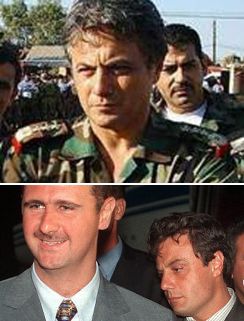
Brig. Gen. Manaf Tlass

The New York Times reports: Opponents of President Bashar al-Assad of Syria met with their international sponsors here on Friday to intensify pressure for his removal, buoyed by word that Brig. Gen. Manaf Tlass, a commander in the elite Republican Guard, close friend of the president and a member of the Damascus aristocracy, had defected and fled the country.

French Foreign Minister Laurent Fabius told the meeting that a “senior official” and commander of the Republican Guard had “defected and is on his way to Paris.” Ministry officials confirmed that Mr. Fabius was referring to General Tlass but did not say whether the Syrian general would join the talks.
[…]
Much attention at the meeting on Friday seemed certain to be devoted to General Tlass’s intentions.

Within the Damascus leadership, “Manaf is one of the regime’s main figures,” said Bashar al-Heraki, a member of the Syrian National Council, the umbrella political group in exile. “It is a negative sign for this regime,” Mr. Heraki said. “It has started to lose control.”

As one of the government’s most prominent Sunni Muslims, the elder General Tlass helped to disguise the fact that Hafez al-Assad relied on an inner circle composed mostly of his own minority Alawite sect.

The elder General Tlass was also said to have played a key role in the anointment of Bashar al-Assad as his father’s heir after his firstborn son, Basil, died at the wheel of his Mercedes in 1994.

At the official memorial service for Basil, the elder General Tlass was quoted as saying that he could see the light of Basil’s eyes shining from Bashar’s. Bashar soon became the heir apparent, ending his medical career and enrolling for military training, where the elder General Tlass promoted him and where his elevation into the officer corps coincided with that of Manaf’s.

In the second generation of the elite, families with two sons often divided their roles, with one going into business and the other joining the armed forces. It was true of Bashar’s first cousins, the Makhloufs, and it was true for the Tlass family.

Firas Tlass became a business tycoon, while Manaf — a charismatic figure — was promoted to a one-star general in the Republican Guards, one of the core units used in attempts to crush the current uprising. Maher al-Assad, the president’s younger brother, heads the praetorian force where Manaf served.

The president and Manaf were sometimes seen eating out together in Damascus.

“He’s a close friend to Bashar,” Mr. Heraki said. “So it is not only a strong strike against the regime, but the strongest message yet to Bashar that he is no longer safe, and a message to other officers thinking about defecting.”

Other opposition figures were less charitable, suggesting that General Tlass fled only to try to save the family’s substantial fortune as the government collapses.

The Tlass family came from Rastan, a predominantly Sunni Muslim city near Homs that has been under assault as a center for defecting officers. As the siege intensified, the Tlass family gradually left the country. Mustafa Tlass was said to have left for Paris in March, citing the need to seek medical treatment, while Firas was believed to be pursuing his business interests from the United Arab Emirates. He has kept a low profile, declining interview requests.

Manaf was believed to have at least one son enrolled at the American University of Beirut, where his wife also lived, and the reported defection came after the school year had ended.

Facebooktwittermail

For one top Syrian defector, a path less traveled

The Wall Street Journal reports: On his final day at Syria’s oil ministry in Damascus, Abdo Husameddin tried to avoid raising suspicions: He stayed to sign off on some paperwork, he said, chatted with the oil minister and left at 5 p.m.

That March evening, the deputy oil minister started a three-day covert journey to Turkey, hosted at safehouses across the country and guarded by fighters opposed to President Bashar al-Assad. A year into the country’s uprising, he became the highest-ranking official to defect from the Syrian government.

In the weeks that followed, all of Mr. Husameddin’s assets and bank accounts in Syria were frozen, he said in an interview with The Wall Street Journal. Months later, Turkish security agents still sometimes escort him around his new host country, warning him that even abroad, he faces a threat from Syrian intelligence agencies, he said.

Syria’s conflict has left up to 15,000 people dead, and has in recent months devolved into what some international diplomats have characterized as a civil war. Soldiers have defected at an increasing pace, including a Syrian air force pilot who flew his jet to Jordan last week. The government typically doesn’t comment on defections but called the air-force pilot who defected to Jordan a “traitor.”

On Thursday, Syrian media said a brigadier general from a family with close ties to President Assad had fled to Turkey in what would be the conflict’s highest-level military defection.

But far fewer of the regime’s high civilian officials have abandoned the regime. That fact has complicated efforts by the Syrian opposition to persuade world powers that it has legitimate leaders in line should President Assad fall. By contrast, in Libya’s recent conflict, a procession of high-profile ministry and diplomatic defectors provided the foundation of the opposition to Moammar Gadhafi and later of Libya’s transitional government.

President Assad’s top security, ministry and military officials have proven fiercely loyal, and many come from the president’s Alawite minority. But the 1.2 million civil servants in Syria’s state institutions are, like broader society, polarized between pro- and anti-regime Syrians, according to Mr. Husameddin and current and former Syrian officials who corroborated much of his account of the dynamics at the country’s state offices.

Mr. Husameddin attributes the lack of high-level defections largely to stepped-up security measures, a characterization echoed by other, lower-level state employees who have turned against the Assad regime. Safe passage out of the country is becoming increasingly tricky, Mr. Husameddin said, and there are few incentives to risk uprooting families and livelihoods to join a fragmented opposition.

Many state employees in Syria have turned against the regime but are staying in their jobs, he added, saying they are “defecting silently.”

“When the regime falls, we need these people,” he said. “We don’t want the state to collapse. In fact, they will be beneficial in the next phase.”

Regime officials say the lack of high-profile civilian defections reflects the loyalty of government workers and their determination to defeat what they see as a terrorist insurgency. The government hasn’t commented on Mr. Husameddin’s defection. The oil ministry didn’t return requests to comment.

Regional powers have even raised the prospect of offering tens of millions of dollars to woo potential defectors from government, said two people familiar with such offers. “A lot of money is being paid to ply people away,” said one of these people. “But there’s also the thinking that some people should be kept in place for the day after.” [Continue reading…]

Facebooktwittermail

America’s war on Iran: the plan revealed

At Open Democracy, Paul Rogers writes: The United States is more seriously preparing for military action against Iran than is widely realised. An attack – obviating the need for one by Israel – may not be immediate and is not yet certain, but it is being intensively planned.

The third round of talks between Iran and the “P5+1” group, held in Moscow on 18-19 June 2012, ended in stalemate. A formal process will continue at a lower level, but amid an atmosphere of continuing mutual suspicion and in a situation where United States electoral politics work against compromise. Iran believes that most of the P5+1 is bargaining that sanctions increase their impact until Tehran bends to its will, whereas Washington holds that it is the Iranians who are happy to prolong matters while they accelerate uranium enrichment (see “Syria and Iran: a diplomatic tunnel“, 25 June 2012).

Alongside these calculations, at least some European (especially German) politicians recognise that any substantial delay in negotiations could well create the space for a unilateral Israeli military strike on Iran, an act that would inaugurate a lengthy period of deep instability and perhaps an intensely destructive war.

The high European commitment to diplomacy over Iran has in part been motivated by the risk of Israel attacking Iran. There is little doubt that Israel would be prepared to make such a move at a time of its choosing. It is of even greater concern to the Europeans, then, that indications have emerged in recent weeks of the Pentagon’s own serious engagement in comprehensive multi-option war-planning.

The belief underpinning this hawkish approach seems to be that a short, sharp military action directed very precisely at Iran’s nuclear and missile facilities is the only way to force a weakened Iran to “come in from the cold” and – once and for all – abandon its nuclear ambitions.

There is no settled consensus in elite US circles about to handle the Iran problem. Several powerful voices, including within the Pentagon, argue that the best option is to continue the mix of sanctions and sustained cyber-warfare (the latter in collaboration with Israel). Others, however, argue that there is a need to plan for war, with the question of optimum timing a central issue (see David Fulghum, “Bombing Iran: U.S. military planners ponder when a kinetic attack might make sense“, Aviation Week, 25 June 2012).

The Pentagon advocates of a strike on Iran believe that the early part of 2013 might be the best moment. In their eyes, this offers three advantages. First, the presidential and congressional elections of November 2012 would be out of the way, with nearly two years to the next mid-sessional elections; thus any political controversy would have plenty of time to diminish. Second, the months between now and the point of decision would make clear whether there was any possibility of a political compromise. Third, keeping the war option open – and informing the Israelis well in advance – would make a lone Israeli attack less likely. The most hardline of the US planners hold the view that it is much better that the US “does the job properly” than lets Israel, with its much smaller forces, take the lead. [Continue reading…]

Facebooktwittermail

Israel threatens to carpet bomb Southern Lebanon

Haaretz reports: No less than four times in the past ten days, senior officials in the IDF’s Northern Command briefed representatives of the Israeli and foreign press.

The IDF’s Northern Command gave its fourth press briefing in ten days on Thursday. The many meetings, as well as the identical messages that emerge from them, do not appear to be coincidental.

The commander of the IDF’s 91st Division, Brigardier-General Hertzi Halevy, who met Thursday with reporters near the border, had some of the harshest words.

Should another Lebanon war break out, Halevy told the reporters, a week before the sixth anniversary of the second Lebanon war, it would require the IDF to enter Lebanese territory with a mighty force, and bring about the destruction of many villages.

“Lebanon will sustain greater damage than that done during the second Lebanon war,” he said.

“The response will need to be sharper, harder, and in some ways very violent. After the Goldstone Report, people in the international community and in Israel thought that battle in a densely populated area could be carried out in a nicer way.It cannot be nice. Without the use of great force, we will find it difficult to achieve our aim, and the enemy should also know that. ”

Halevy’s threats are nothing new. For four years now, Israel is threatening to torch Lebanon should Hezbollah create a cross-border provocation. In October 2008, the Northern Command chief at the time, Gadi Eizenkot, presented what he called the “Dahiya doctrine.”

In the next confrontation, Eizenkot said at the time, Israel will expand the destruction capability it showed when it bombed Dahiya, the Shiite quarter in Beirut.

“In every village from which shots were fired toward Israel, we will impose disproportional force and cause great damage and destruction. As far as we’re concerned, these are military bases,” Eizenkot said in 2008.

The significance of Halevy’s comments, then, lies not in their content but in their timing. Given the assessments that Israel is likely to attack Iranian nuclear facilities in the coming months ¬ and the possibility that the ramifications of the civil war underway in Syria (for instance, the possible transfer of chemical weapons from the Assad regime to Hezbollah) could lead to an escalation in Lebanon, Israel is sending a clear signal to Hezbollah leader Hassan Nasrallah.

The message is this: Sit quietly, this issue is too big for you to get involved in. If you dare harm us, in the name of defending the honor of Syria or Iran, you will pay a steep price that Lebanon will not be able to withstand.

Since Lebanon has only recently finished recovering from the damages it sustained in the Second Lebanon War, this threat seems to be significant. The Dahiya doctrine, the 2012 version: The coming weeks will tell if Israel’s threatening statements were received on the Lebanese side of the border.

Facebooktwittermail

Israel’s control of access to water

Israel controls the access to water from the Jordan River to the Mediterranean Sea. Its disproportionate allocation of water, the settlements’ takeover of natural springs, and the prohibition against maintaining and constructing water cisterns in the West Bank without Israeli permits make water a sparse commodity for Palestinians. The image below is a detail from an illustration in a series of infographics on Palestinian civilian life under occupation. See the complete infographic: Visualizing Occupation — Distribution of Water.

Facebooktwittermail

Islamophobia: A bipartisan project

Deepa Kumar writes: When the New York Times ran its story on Obama’s “kill list,” showing the president poring over names of people to potentially assassinate in drone strikes, it sparked a controversy. The content of that controversy was not over this extraordinary revelation about Obama’s use of power but rather over the leaking of state secrets, which Republicans accused him of doing to bolster his re-election campaign. Some liberal commentators (at Salon, The Nation etc.) were rightfully horrified and condemned such activity. But the Democrats – and much of the liberal establishment — remained silent.

Deep in the Times article, another shocking revelation that hasn’t received as much attention as the “kill list” is the Obama administration’s effort to erase the deaths of some innocent victims by categorizing “all military-age males in a strike zone as combatants.” This excludes them from the civilian casualties count, allowing the administration to claim that civilian casualties have been minimal. All Muslim men in “combat zones” in Afghanistan, Pakistan, Somalia and Yemen have been presumed to be terrorists, and therefore worthy of death, simply for being of “military age.”

How did we get to a place where innocent Muslim men can be killed with impunity around the world with little public outcry? The short answer is that Muslims have been long been constructed as “terrorists” upon whom righteous terror can be rained. The image of the Muslim enemy in the US is not new. While Hollywood and television play a key role in conveying that image to the public, they did not create it. The “Muslim enemy” is inextricably tied to a long history of US imperialism. [Continue reading…]

Facebooktwittermail

Judge helped Egypt’s military to cement power

The New York Times reports: Even as they promised to hand authority to elected leaders, Egypt’s ruling generals were planning with one of the nation’s top judges to preserve their political power and block the rise of the Islamists, the judge said.

Tahani el-Gebali, deputy president of the Supreme Constitutional Court, said she advised the generals not to cede authority to civilians until a Constitution was written. The Supreme Court then issued a decision that allowed the military to dissolve the first fairly elected Parliament in Egypt’s history and assure that the generals could oversee drafting of a Constitution.

The behind-the-scenes discussions, never publicly disclosed, shed new light on what some have called a judicial coup. From the moment the military seized control from President Hosni Mubarak, the generals “certainly” never intended to relinquish authority before supervising a new Constitution, Judge Gebali said.

The military council’s plan to cede authority was premised on first establishing the Constitution, the judge said, so the generals “knew who they were handing power to and on what basis. That was the point.”

When the military first seized power, it positioned itself as a guardian of the peaceful revolution, a force that was aimed at helping achieve the goals of a democratic Egypt. Demonstrators in Tahrir Square chanted that the people and the military were one, and there were promises of a quick transition to civilian control.

But the evidence since then has piled up demonstrating that the military had never intended to fully submit to democratically elected authority.

Now as Egypt’s new, popularly elected president, Mohamed Morsi of the Muslim Brotherhood, tries to fashion a role for himself as head of state, he is facing a military council that retains virtually all executive and legislative authority. The generals have again pledged to transfer power after a new Parliament is elected and a Constitution drafted. [Continue reading…]

Facebooktwittermail

Egyptian apathy on human rights

Tim Sebastian writes: I doubt very much if Mohamed Morsi knows the name Natasha Smith — still less what happened to her in Cairo’s Tahrir Square as tens of thousands of his supporters cheered his victory last week as president.

A 21-year-old student journalist from Britain, she had gone into the square to document the celebrations. She was modestly dressed and with a male companion.

Confronted by a jeering mob, the two became separated. She was attacked, subjected to repeated sexual abuse and stripped naked in front of hundreds of people. Eventually a group of Egyptians came to her aid — but the damage had already been done.

At almost exactly the same time, across the Nile, a 42-year-old Egyptian woman left a hotel — again modestly dressed in long-sleeved shirt and trousers — and headed through the hooting, drum-thumping streets to her car. She had not gone far before a middle-aged man appeared out of the darkness and spoke to her.

“You will not be allowed to dress like that in the New Egypt,” he warned. “Times have changed.”

I mention these incidents not because abuse and harassment are rare in Egypt, but because they now — for the first time — fall under the purview of an Islamist president, committed to ruling with a moral and religious compass.

The extent, therefore, to which the Morsi administration is ready to protect the rights of individuals, will go a long way toward determining what kind of Egypt emerges under his aegis over the months and, maybe, years to come. [Continue reading…]

Sebastian’s op-ed ends with these comments from an Egyptian election observer: “I do not fear the Muslim Brotherhood,” she says softly. “I do not fear the army. I fear my own people — their mentality. They will not defend my rights.”

As much as this might present a bleak image of Egypt, I have to wonder whether or not the same concern might be expressed about any population around the world. Universally, the defense of human rights seems to be a minority concern.

Facebooktwittermail

Syrian regime’s top Sunni defects — General Manaf Mustafa Tlass flees to Turkey

Joshua Landis writes: General Manaf Tlass, one of Syria’s top Sunni military figures from the inner-circle of Bashar al-Assad, has defected.

For 16 months the opposition has been complaining that elite Sunnis have not defected. That complaint can now, officially, be put to rest if the stories of Manaf’s flight prove to be true. In March it was rumored that he had led with his father and brother, but those stories were false.

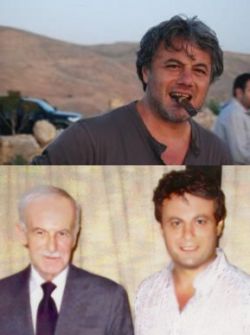
Manaf Tlass with cigar and with Hafez al-Assad

Manaf Tlass, the son of ex-Defense Minister (1972 – 12 May 2004), Mustafa Tlass, has fled the country. Mustafa Tlass was instrumental in smoothing the way for Bashar to assume power after the death of his father.

When Hafez al-Assad died in June 2000, his son Bashar was immediately promoted in military rank by Defense Minister Mustafa Tlass. He was also made secretary-general of the Baath Party whereas Manaf became a member of the Party’s Central Committee and an officer in the Republican Guard.

On Tuesday, all of Syria was buzzing that Manaf had defected but there was no confirmation. His Honda had supposedly turned up in the Rukn ad-Din neighborhood of Damascus, but he was no where to be found. Rumors of his possible defection were wide-spread on Twitter.

Syria-Steps, an on-line news source in Syria that is known for being pro-regime, has just confirmed the rumors. It claims:

أكد مصدر أمني رفيع المستوى “لسيرياستيبس” فرار العميد مناف مصطفى طلاس إلى تركيا..
“A highly placed source in intelligence has confirmed that General Manaf Mustafa Tlass has fled to Turkey.”

Manaf Tlass’s father and brother, Firas who is a leading businessman, are believed to be out of the country. The father had gone to Paris on the pretext of getting medical attention. Firas is said to be in Dubai. It is not clear where the women and children of his family are.

Manaf Tlass was a close confidant of Bashar from his earliest days and part of his inner circle or “shille”, which included people, such as his cousins Rami and Hafiz Makhlouf, Mudar al-Assad (son of Rifaat), Nader Qala’i (ex-CEO of Syriatel and business partner to Rami) Yazan Aslan (son of Ali Aslan, Chief of Staff)

Manaf is as handsome as a movie star and carried a lot of authority. He was a true military guy and had spent his entire life in the military, unlike Bashar. People close to him say that when he walked into a room, all eyes turned to him. Not only did women find him attractive, but men did as well. He carried himself with an air of self-confidence and authority. He is smart, dashing and cunning.

The word is that Manaf had been told to solve the Harasta and Duma problems (the growing uprising on the outskirts of Damascus). He did a good job by negotiating with the opposition leaders in both suburbs, agreeing that both government forces and opposition would pull back. The Alawi leadership said “no, that is not how we are going to do this.” They pushed him aside and came down like a ton of bricks on the opposition in both neighborhoods, in an effort to assert state authority and crush the uprising through military means.

Manaf supported a policy of negotiation, flexibility and compromise. He was overruled by the military leadership and has since looked for a way out. [Continue reading…]

Meanwhile, today Wikileaks released 25 emails from Syria (more to come).

Facebooktwittermail