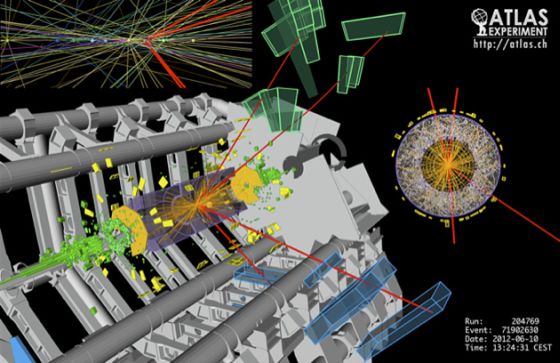
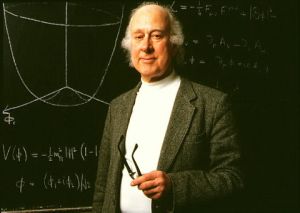
Rhett Allain, an Associate Professor of Physics at Southeastern Louisiana University, talks about how to discuss the Higgs boson announcement in the classroom — especially with non-science majors.
Given that those of us who don’t understand particle physics have not spent years wondering whether a missing piece to the Standard Model would ever be discovered, it’s discovery will lead many to question the value of finding this elusive particle.
This could be the question the students start with. It is a great opportunity to talk about the nature of science. In short, the answer is that the Higgs boson isn’t used for anything.
Chad Orzel (@orzelc) likes to say “Science is the most fundamental human activity.” I like to change this around and say “We do science, because we are human.” This is really part of my favorite quote from Robert Heinlein:
“A human being should be able to change a diaper, plan an invasion, butcher a hog, conn a ship, design a building, write a sonnet, balance accounts, build a wall, set a bone, comfort the dying, take orders, give orders, cooperate, act alone, solve equations, analyze a new problem, pitch manure, program a computer, cook a tasty meal, fight efficiently, die gallantly.”
Looking for the pieces of Standard Model is a human activity – just like painting the Mona Lisa. Why is just about everyone interested in black holes? Is there a practical use for black hole technology? Ok – maybe there could be, … [but] I doubt it is in the near future. We (humans) are interested in black holes because we are humans and that’s what we do.
Will there be “spin off” technologies from these high energy particle accelerators? Of course – but that’s not the goal. Will there be technologies based on the Higgs boson? Possibly, but that’s not the reason (and it will be a long way away).
To legitimize science by saying we do science because we are human, doesn’t to my mind go to the heart of the issue of value.
One can say — as many have — that we fight wars because we are human. But this doesn’t give value to war — it merely suggests that war might be unavoidable. (Whether it is unavoidable is a debate for another occasion.)
Instead of addressing the question about the value of science by just talking about science, it might be better to talk about the nature of value.
From the materialistic vantage point of American culture, the value of science is invariably measured through its utility. Will it provide us with faster computers, more fuel-efficient cars, new medicines or new materials? Will it make us wealthier?
The assumption about value is that the value of A is the fact that it can produce B.
This notion of productive value is insidious and it blinds us to something we all instinctively know but easily forget: the things of greatest value have intrinsic value — they need no justification.
We don’t dance to go somewhere. A song doesn’t rush to its conclusion. Beauty is not enhanced by ownership. Curiosity should not be extinguished by knowledge.
To want to understand the nature of the universe is to possess a desire that needs no justification.