Monthly Archives: July 2012

Mahmoud Jibril, a force for moderation in Libya

Luke Harding reports: It was once a place you ventured in a tin helmet, with your fingers stuffed in your ears. After the fall of Tripoli last August, rebels celebrated by firing round after round of bullets into the night sky. The debris of battle and revolution was everywhere.

There are no weapons to be seen in Martyrs’ Square now. Instead the square has been turned into a children’s playground with a Superman bouncy castle, a toy train, and outdoor table football. There is a market with women’s clothes and shoes. Other stalls sell kalashnikovs – the plastic variety – and cups of mint tea.

Sitting in a cafe across from the square’s imposing Ottoman palace, Saad Kamur explained that he had voted for Mahmoud Jibril in Libya’s historic election. Jibril, a 60-year-old US-educated political scientist, appears to have won a landslide victory in the poll on Saturday, defying predictions that Islamists would sweep to power in Libya, as they have done elsewhere.

“He’s moderate. And experienced,” Kamur said. “I don’t think the others were capable of running a government.” Kamur, a Tripoli businessman, said observers who predicted that Libya would go the way of Egypt and Tunisia – now run by religious parties – had misinterpreted the national mood, and Libya’s prevailing centrism.

“Libyans are open to the outside world. Many have studied abroad. They haven’t seen anything positive yet from Islamist governments,” he suggested. As for the election, in which he cast his first ever vote at the rather belated age of 52, he said: “Nobody imagined it would go this smoothly.”

Abdul Muntasar, a purveyor of squeaky dog-toys for eight dinars each, said he liked Jibril because he was nothing like Libya’s previous ruler Muammar Gaddafi, who was caught and killed last October.

“Jibril isn’t a man trying to seize power,” he said. Ahmed Ibrahim, a tourist visiting from provincial Al-Jufra, chipped in: “He’s educated, on the side of democracy.”

Indeed, Libya’s new leader has a reputation as a pragmatic moderate.

He attracted votes from all points on the country’s political compass: from liberals and the educated in Tripoli; from tribesmen in the desert south; and – in an arguably hopeful sign for reconciliation – from disgruntled former supporters of the previous regime.


Facebooktwittermail

Egypt’s military and president escalate their power struggle

The New York Times reports: Egypt’s highest court and its most senior generals on Monday dismissed President Mohamed Morsi’s order to restore the dissolved Parliament as an affront to the rule of law, escalating a raw contest for supremacy between the competing camps.

The power struggle reflected dueling claims to Egypt’s emerging politics, with each side trying to frame the debate as a contest for ideals, legitimacy and democracy. The generals, backed by the court, argue that the new president must respect legal precedents and the institutions of the state. The new president, in turn, is calling on the generals to respect a popular will that was expressed through free elections.

But at its core, the fate of this Parliament is another chapter in the long-running battle between the Muslim Brotherhood and the military that intensified when the generals dissolved the legislature last month based on a court order and seized all lawmaking and executive authority.

The response by the military and the court on Monday threw Egypt into a new phase of political turmoil, with the prospect of a presidency weakened even further, a legislative vacuum and a bitter split at the highest levels of government. And it revived ideological rifts that many people hoped would quiet with the election of a new president.

Mr. Morsi, who was the Brotherhood’s candidate, called on Sunday for the Islamist-led Parliament to return, staking his new presidency on the outcome of the conflict. The body’s speaker scheduled a session for Tuesday, but it was unclear how many lawmakers would appear, or whether the security forces would try to block them, as they did once before. And Parliament’s ability to pass laws is already in doubt, given the court ruling that led to its dissolution.

Mr. Morsi, hemmed in by the generals’ near monopoly on power, moved after just nine days in office. His bold decree was a gamble that he could wrest legislative authority from the military and enhance his popular credibility.

Facebooktwittermail

Syria, jihad and the boys from Tunisia’s Ben Guerdane

The National reports: Khared Zawi is finishing his restaurant lunch and watching television, transfixed as the newsreader’s voice reports atrocious violence in Syria over amateur video of explosions and corpses.

“It’s not acceptable,” says the young Tunisian from behind his wispy beard. “No human on this planet will accept it, and no Arab.”

In crushing a nationwide uprising, Bashar Al Assad has insulted Islam by destroying mosques while followers of the Syrian president’s Alawite branch of Shia Islam have killed Sunni Muslims, Khared says. “I’m supporting the guys fighting Bashar.”

During the 16 months in which peaceful pro-democracy protests became a bloody and increasingly sectarian conflict between government forces and rebels, Syria has become a focal point of outrage across the Arab world, and a trickle of young men embracing militant Sunni Islam have gone to fight there.

As many as 12 of them may be from this dusty Tunisian border town. Their families woke up one day to find a son or brother mysteriously vanished. Some of the missing loved ones disclosed their destination with a single telephone call to say they were in Turkey and heading for Syria. In at least one case, a terse phone call from a stranger said the young man was dead.

Facebooktwittermail

Turn off your computer and your phone

Tony Dokoupil writes: Before he launched the most viral video in Internet history, Jason Russell was a half-hearted Web presence. His YouTube account was dead, and his Facebook and Twitter pages were a trickle of kid pictures and home-garden updates. The Web wasn’t made “to keep track of how much people like us,” he thought, and when his own tech habits made him feel like “a genius, an addict, or a megalomaniac,” he unplugged for days, believing, as the humorist Andy Borowitz put it in a tweet that Russell tagged as a favorite, “it’s important to turn off our computers and do things in the real world.”

But this past March Russell struggled to turn off anything. He forwarded a link to “Kony 2012,” his deeply personal Web documentary about the African warlord Joseph Kony. The idea was to use social media to make Kony famous as the first step to stopping his crimes. And it seemed to work: the film hurtled through cyberspace, clocking more than 70 million views in less than a week. But something happened to Russell in the process. The same digital tools that supported his mission seemed to tear at his psyche, exposing him to nonstop kudos and criticisms, and ending his arm’s-length relationship with new media.

He slept two hours in the first four days, producing a swirl of bizarre Twitter updates. He sent a link to “I Met the Walrus,” a short animated interview with John Lennon, urging followers to “start training your mind.” He sent a picture of his tattoo, TIMSHEL, a biblical word about man’s choice between good and evil. At one point he uploaded and commented on a digital photo of a text message from his mother. At another he compared his life to the mind-bending movie Inception, “a dream inside a dream.”

On the eighth day of his strange, 21st-century vortex, he sent a final tweet — a quote from Martin Luther King Jr.: “If you can’t fly, then run, if you can’t run, then walk, if you can’t walk, then crawl, but whatever you do, you have to keep moving forward” — and walked back into the real world. He took off his clothes and went to the corner of a busy intersection near his home in San Diego, where he repeatedly slapped the concrete with both palms and ranted about the devil. This too became a viral video.

Afterward Russell was diagnosed with “reactive psychosis,” a form of temporary insanity. It had nothing to do with drugs or alcohol, his wife, Danica, stressed in a blog post, and everything to do with the machine that kept Russell connected even as he was breaking apart. “Though new to us,” Danica continued, “doctors say this is a common experience,” given Russell’s “sudden transition from relative anonymity to worldwide attention — both raves and ridicules.” More than four months later, Jason is out of the hospital, his company says, but he is still in recovery. His wife took a “month of silence” on Twitter. Jason’s social-media accounts remain dark.

Questions about the Internet’s deleterious effects on the mind are at least as old as hyperlinks. But even among Web skeptics, the idea that a new technology might influence how we think and feel — let alone contribute to a great American crack-up — was considered silly and naive, like waving a cane at electric light or blaming the television for kids these days. Instead, the Internet was seen as just another medium, a delivery system, not a diabolical machine. It made people happier and more productive. And where was the proof otherwise?

Now, however, the proof is starting to pile up. The first good, peer-reviewed research is emerging, and the picture is much gloomier than the trumpet blasts of Web utopians have allowed. The current incarnation of the Internet — portable, social, accelerated, and all-pervasive — may be making us not just dumber or lonelier but more depressed and anxious, prone to obsessive-compulsive and attention-deficit disorders, even outright psychotic. Our digitized minds can scan like those of drug addicts, and normal people are breaking down in sad and seemingly new ways. [Continue reading…]

Facebooktwittermail

Bashar al Assad’s war on terrorism

Most estimates agree that more than 15,000 Syrians have been killed since the uprising began. Whatever the make-up of the armed opposition, everyone agrees that the only forces in Syria with tanks and heavy artillery belong to the Syrian army. Damage to buildings in many cities caused by shelling by these forces has been widely seen. Yet, President Bashar al-Assad now claims that the majority of the casualties in the conflict are government supporters who have been killed by “terrorists.”

Here’s my question for anyone who anyone who casts a critical eye on the global war on terrorism: why would you not be even more skeptical about Syria’s war on terrorism?

Robert Mackey has posted an interview of Assad conducted in English by Jürgen Todenhöfer, a former member of the German Parliament who is an outspoken critic of Western foreign policy in the Muslim world.

Mr. Todenhöfer also interviewed Mr. Assad during a previous reporting trip to Syria, late last year. After that visit, the German author wrote in a report for Frankfurter Allgemeine Zeitung: “Paradoxically, it is Bashar al-Assad who could most likely achieve a peaceful transition toward democracy, because he still has the power and still holds the authority among the majority of the population.”

In that same article, Mr. Todenhöfer also criticized foreign media reports on Syria and the armed rebels. “According to my personal experiences in Damascus, Dara’a, Homs and Hama,” he wrote, “at least half of the reports on Syria are simply false – almost like before the Iraq war.” He added that the “guerrilla commandos, whose methods differ little from those of the state’s security services,” have “robbed the revolution of its innocence and also harmed the peaceful demonstrators who have the historical merit of having initiated the process of democratization.”

Mr. Assad’s comments in the new interview included the accusation that Syrian rebels — whom he described as “an amalgam of Al Qaeda” and drug-smuggling criminals — were responsible for the recent massacre in Houla. He also claimed that the “armed gangs” who carried out the killings had worn government uniforms to frame forces loyal to him.

Meanwhile, The Guardian reports: Kofi Annan has declared his third round of talks with Bashar al-Assad as “constructive” and suggested his stillborn plan to stop the violence in Syria may yet be revived.

The UN special envoy to Syria said on Monday that a fresh approach to end the conflict would be put to the Syrian opposition, but offered no further details.

The centrepiece of the former UN chief’s plan announced in April was a ceasefire by both sides that never took hold. Instead, the violence in Syria has escalated, with daily death tolls over the past two months approaching those seen during the bloodiest days of Iraq’s civil war six years ago.

Before Monday’s summit, the Syrian president described Annan’s plan as good. After the two-hour meeting, Assad’s aides couched the the talks as “constructive and good”.

Facebooktwittermail

Abbas aide: Palestinian leader signs off on exhuming Arafat’s remains over controversy

The Associated Press reports: Palestinian President Mahmoud Abbas has given his permission to exhume the remains of his predecessor, Yasser Arafat, a top aide said Monday, days after a Swiss institute reported finding elevated traces of a radioactive substance on the late leader’s belongings.

The findings by Switzerland’s Institute of Radiation Physics were inconclusive, but revived speculation that Arafat was poisoned.

The legendary Palestinian leader died Nov. 11, 2004 in a French military hospital, a month after falling violently ill at his government compound in the West Bank town of Ramallah.

The Swiss institute has said it would need to examine Arafat’s remains for conclusive findings, though a clear-cut outcome is not assured because of the decay of the substance, polonium-210, over the years. Last week, Abbas said he was willing, in principle, to allow an autopsy, provided he receives permission from religious authorities and Arafat’s family.

Arafat was buried in a mausoleum that has become the centerpiece of the Ramallah compound where Abbas’ headquarters are located. The exhumation would create a huge spectacle that could upset some devout Muslims, though there seems to be a widespread desire among Palestinians to determine the cause of death.

Abbas aide Saeb Erekat said Monday that the Palestinian president has decided to invite the Swiss experts to Ramallah in order to examine the remains. “We are on the way to an autopsy,” Erekat told The Associated Press.

Erekat said a Palestinian medical expert would contact the Swiss institute later Monday or Tuesday to offer the invitation. Erekat said an autopsy could be conducted as soon as the Swiss team arrives. There was no immediate comment from the institute.

Arafat’s widow, Suha, has repeatedly called for exhuming the remains. She worked closely with the Arab satellite TV station Al-Jazeera, which conducted an investigation into Arafat’s death and received permission from her to submit her husband’s belongings for testing. The top Muslim cleric in the Palestinian territories has also given his blessing to exhuming the remains.

Arafat’s nephew, Nasser al-Kidwa, has been cool to the idea of an autopsy but signaled he will not stand in the way.

“Our belief was always that it was an unusual death, and most likely he (Arafat) was poisoned. Now all indications say he was poisoned,” al-Kidwa told AP. Al-Kidwa, a former Palestinian envoy to the United Nations, heads the Yasser Arafat Foundation and is the custodian of Arafat’s memory.

Erekat suggested that Abbas was firm in his decision to move forward.

Polonium-210 is a highly lethal substance, and less than 1 gram (0.04 ounces) of the silver powder is sufficient to kill. Because polonium-210 decays rapidly, experts have been divided over whether testing Arafat’s remains would provide a solid clue eight years after his death.

To say that less than 1 gram would be fatal is literally true and grossly misleading. One microgram, which is one millionth of a gram — an amount no larger than a speck of dust — is lethal.

Facebooktwittermail

Egypt parliament set to meet, defying army

Reuters reports: Egypt’s parliamentary speaker said the chamber would reconvene on Tuesday after the new, Islamist president risked a showdown with the generals by quashing their decision to dissolve the assembly last month.

Quoted by the state news agency on Monday, Saad al-Katatni, who like President Mohamed Mursi hails from the long-suppressed Muslim Brotherhood, said the lower house would sit from noon (0600 EDT) on Tuesday, defying the army’s order to dismiss parliament a month ago, based on a court ruling.

Mursi issued his decree to recall parliament on Sunday barely a week after he took office. That threatened fresh uncertainty for a nation whose economy is on the ropes and where many are anxious for calm after 17 turbulent months since the fall of Hosni Mubarak.

“Early confrontation,” wrote Al-Akhbar newspaper, summing up Mursi’s decision which could end a brief honeymoon with the military council, led by Field Marshal Hussein Tantawi.

Yet Mursi and Tantawi showed no hint of discord on Monday when the president, as he did last week, attended a military parade. Seated next to each other, Mursi and Tantawi turned to each other in a brief jovial exchange, television images showed.

The military council which had run Egypt since Mubarak was toppled in February 2011 sought to trim the president’s authority before handing over to Mursi on June 30. It had dissolved parliament and taken legislative power for itself.

Mursi’s decision hands those powers back to a parliament packed with his Islamist allies. He also ordered new elections for parliament – once a constitution is passed by referendum.

Al-Masry Al-Youm reports: The Supreme Constitutional Court declared that all its verdicts are final and immune against appeals, stressing that it will not be a party to any political dispute.

The announcement came in the wake of a decision by President Mohamed Morsy to reinstate the People’s Assembly, which the court dissolved in mid-June because parts of the electoral law were unconstitutional.

The court, in a statement published by state news agency MENA, stressed that its sole mission is to defend the constitution against any encroachment and practice judicial scrutiny of the constitutionality of laws and regulations.

While hailed by Muslim Brotherhood supporters, Morsy’s move stirred controversy among other political groups that considered it a coup against the rule of law.

Facebooktwittermail

In Libya vote, coalition party headed by former transition chief claims lead

The Los Angeles Times reports: A political coalition led by the former National Transitional Council’s de facto prime minister has claimed an early lead in Libya’s national election to replace the government of fallen longtime dictator Moammar Kadafi.

The National Forces Alliance, which appeals to secularists and moderate Islamist sensibilities, said that early exit polls showed it securing sizable majorities in the party vote for a national assembly. The coalition is headed by Mahmoud Jibril, an American-educated political scientist who once served as an economic advisor for Kadafi.

The NFA’s polling claims, made by Secretary General Faisal Krekshi, were backed up by the rival Muslim Brotherhood’s Justice and Construction Party.

“The National Forces Alliance achieved good results in some large cities except Misrata,” the Muslim Brotherhood’s Justice and Construction Party’s Mohammed Sawan told AFP. “They have a net lead in Tripoli and in Benghazi.”

High National Election Commission officials refused to confirm Krekshi’s claims.

“We are all waiting and we have nothing to suggest that one party is ahead of others,” the commission’s head Nouri al-Abar told journalists.

Official results are expected later this week.

Election officials said about 60% of eligible voters turned out on Saturday for a vote that was largely incident-free and hailed by foreign observers as free and fair.

Facebooktwittermail

Iran warns of regional ‘catastrophe’ if no political solution is found to Syria crisis

The Associated Press reports: An Iranian official has warned of a “catastrophe” in the Middle East if no political solution is found to the 16-month crisis in Syria.

Deputy Foreign Minister Hossein Amir Abdollahian also says Syria has a strong army and is able to defend itself from attack alone without Iran’s help.

Iran is Syria’s closest ally and has stood by President Bashar Assad’s regime through the uprising against his rule.

Abdollahian spoke at a press conference in Amman, Jordan, Sunday.

His comments follow an acknowledgement by special envoy Kofi Annan that the international community’s efforts to find a political solution to the escalating violence in Syria have failed.

Reuters reports: Syria’s navy fired live missiles from ships and helicopters over the weekend, state media said on Sunday, in an exercise aiming at showcasing its ability to “defend Syria’s shores against any possible aggression”.

Syrian television aired video of a variety of missiles being fired from launchers on land and from ships and showed the Syrian Defence Minister Dawud Abdallah Rahijia in attendance.

“Naval Forces conducted an operational live fire exercise on Saturday, using missiles launched from the sea and coast, helicopters and missile boats, simulating a scenario of repelling a sudden attack from the sea,” Syrian news agency SANA said, adding manoeuvres would continue for several days.

Opposition figures have been calling for a no-fly zone and NATO strikes against Syrian forces, similar to those carried out in Libya last year which enabled rebel ground forces to end the rule of Muammar Gaddafi.

But while President Bashar al-Assad has faced sanctions and international condemnation over his crackdown on dissent which has left thousands dead, major Western and Arab powers have shied away from the idea of direct military action.

Facebooktwittermail

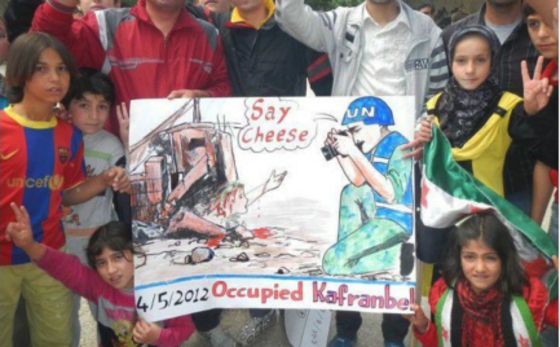
The banners from Kafranbel, a town in northwestern Syria

Foreign Policy: A town in northwestern Syria has become the creative center of the revolt against President Bashar al-Assad. Since the beginning of the uprising, the residents of Kafr Anbel have drawn signs that skewer the Assad regime and express outrage that the world has not done more to stop the killing in Syria.

The signs come in two basic varieties. Some are cartoons, often drawing their inspiration from Western movies or TV shows, which lampoon the Syrian government and its allies, notably Russian President Vladimir Putin. Others are straightforward, text-only banners that call for NATO intervention in Syria or arming the rebel Free Syrian Army (FSA). Many of the signs are written in English.

Raed Fares, an activist in Kafr Anbel, explained to FP that the town’s residents chose to draw in English, rather than Arabic, explicitly to reach an international audience. “It’s very important to send our message to all the world,” he said. “And English is the public language.”

Facebooktwittermail

Message to Presbyterians: ‘If you truly want to help the Palestinian people, I urge you to listen to what they are asking for’

Anna Baltzer gave the following testimony to the Presbyterian Church (USA) Middle East Peacemaking Committee on Monday, July 2, 2012: Friends, I am not up here as a Jew to tell that it’s okay for you to divest. Because you do not need my permission to do whatever you think is the righteous thing to do. You don’t need anybody’s permission.

I realize that divestment is controversial. That’s okay. Slavery was controversial. The Church was divided. Desegregation was controversial. Especially in the South, people were afraid of damaging relationships if they spoke out for desegregation. But the Presbyterian Church supported an end to segregation before it was common. I urge you to honor that legacy by acting today out of love and compassion rather than fear of what others will say.

You are being told that action against the occupation will estrange you from the Jewish people. But the occupation is fundamentally contrary to our shared values of equality and justice.

There is nothing Jewish about racial profiling with Hewlett Packard bioscanners.
There is nothing Jewish about protecting stolen land with Motorola technology.
There is nothing Jewish about demolishing Palestinian homes with Caterpillar bulldozers.

And to claim that ending cooperation with these human rights violations means ending cooperation with Judaism, or Jews, draws a very dangerous parallel. There is a sea change happening. Jews are divided on this issue. You have to follow your own conscience.

Facebooktwittermail

Israel divestment campaigns gain momentum in U.S.

Mitchell Plitnick reports: A resolution at the General Assembly of the Presbyterian Church (USA) to divest from three corporations which provide equipment used to maintain Israel’s occupation of Palestinian lands failed by a mere two votes on Thursday.

Yet despite this apparent setback, the movement to divest from such corporations has gained tremendous momentum in recent weeks.

On Jun. 25, Morgan Stanley Capital Index (MSCI) announced that it had removed the Caterpillar corporation from its index of socially responsible companies, due in part to the use of its equipment to violate the human rights of Palestinians in the West Bank.

As a result, the leading retirement assets management firm for workers in the academic, research, medical and cultural fields, TIAA-CREF divested from Caterpillar. Activists in the Boycott, Divestment and Sanctions (BDS) movement against the Israeli occupation hailed this as a major victory, as TIAA-CREF had been the target of a divestment campaign for several years.

The TIAA-CREF decision raised hopes among pro-Palestinian activists that the Presbyterian Church (USA) would also choose to divest from three corporations – Caterpillar, Hewlett-Packard and Motorola Solution – which their Israel-Palestine Mission Network (IPMN) had identified as profiting from Israeli violations of Palestinian human rights.

If the Presbyterians passed a divestment resolution they would become the first mainstream Christian church body to do so.

But major Jewish institutions lobbied hard, as they have in previous years, to defeat the Presbyterian divestment initiative, and they succeeded, albeit by the narrowest of margins. The final vote was 333 against the resolution, 331 in favour and two abstentions.

The narrow margin of defeat, however, provided substantial encouragement to some BDS activists. [Continue reading…]

Facebooktwittermail

Egypt President Mohammed Mursi reverses parliament ban

BBC News reports: Egypt’s President Mohammed Mursi has ordered parliament to reconvene, a month after it was dissolved by court order amid a row over voting systems.

The Supreme Court had ruled parliament unconstitutional because two voting systems had been used in the election.

The military, which was then running the country, enforced the dissolution.

But Mr Mursi, whose Muslim Brotherhood won most parliamentary seats, said the chamber should reconvene until a new election could be held.

Facebooktwittermail

Libya election: Count under way after historic vote

BBC News reports: Vote-counting is under way after Libya held its first free national election for 60 years on Saturday.

The first results are expected on Monday, with some unofficial exit polls suggesting a liberal alliance was doing better than Islamist parties.

Sunday has been declared a holiday, amid celebrations after a largely peaceful election with a 60% turnout.

The 200-member assembly will choose the first elected government since Col Gaddafi came to power in 1969.

On voting day there were pockets of unrest in the east, where there are fears the region will be under-represented in the new temporary assembly being elected.

Reuters reports: Swept up in the euphoria of Libya’s first free national vote in six decades, voters in the eastern city of Benghazi braved anti-election protests on Saturday to pour into polling stations.

But the mood of celebration should not fool anyone: in the city that was the cradle of last year’s uprising against Muammar Gaddafi and remains the hub of Libya’s lucrative oil sector, the revolution is far from over yet.

Long a political hotbed that nurtured earlier attempts to unseat Gaddafi, Benghazi is now the focal point of a widespread sense among easterners that post-Gaddafi authorities are still neglecting their region economically and socially.

Many queuing to cast their ballots in Benghazi said they were using their votes simply to back candidates in a new interim assembly whose main policy drive will be to demand greater political representation for the region.

“We were able to get rid of the regime of Muammar Gaddafi with all his power and resources,” local women’s rights activist Salwa Homi said of the insurgency which, with the help of NATO bombs, ended 42 years of hardline Gaddafi rule.

“Don’t you think we can do the same to a few people we’ve elected ourselves?”

Nearly 18 months ago, the arrest of human rights activist Fethi Tarbel sparked a riot in Benghazi that triggered a civil war, the fall of Tripoli 1,000 km (630 miles) to the west and ultimately the capture and killing of Gaddafi himself.

The immediate bone of contention now is the fact that the east will get only 60 out of 200 seats in the new assembly being voted in on Saturday and which will appoint a new prime minister and prepare the ground for parliamentary elections in 2013.

But the bigger issue is what status Libya’s second-largest city will have in the new country taking shape and what stake it will have in national oil supplies currently running at 1.6 million barrels a day – the bulk of which are in the east.

“We contributed the most blood and the most sacrifice to the country and to the revolution,” Hamed al-Hassi, a former rebel who leads a military body originally charged with securing the east but which has since fallen out with the interim government.

“The country will be in a state of paralysis because no one in the government is listening to us,” said Hassi.

Facebooktwittermail

Fossil fuel industry has plan to save itself and put others at risk

Peter Montague and Steve Horn write: Most Americans are now convinced that climate change is real because dramatic evidence keep piling up – searing heat waves, multiyear droughts, record-setting wildfires, unprecedented tornadoes and Biblical floods.

Furthermore, there’s now widespread agreement among scientists that humans are causing these problems by burning fossil fuels (coal, oil, natural gas), thus emitting carbon dioxide (CO2) gas, which acts like a blanket, warming the planet.

One obvious solution: use fossil fuels far more efficiently (doing the same work with less energy), thus drastically reducing CO2 emissions. Wherever we use lights, heat or motors, we could greatly enhance efficiency.

Furthermore, efficiency could improve quickly – the National Academy of Sciences said recently we could cut the nation’s energy use 20 percent by 2020 and 30 percent by 2030 using technologies that are available and affordable today. David Goldstein has shown how we could cut national energy use more than 80 percent in ten to 20 years, creating many thousands of good jobs while saving trillions of dollars in reduced fuel costs – enough to fund a modern, renewable energy system.

One crucial caveat: the people who would benefit least from efficiency are the purveyors of fossil fuels – they’d sell less product, reducing their profits. For them, efficiency is a threat, not an opportunity.

In response, fossil fuel corporations have devised their own plan to mitigate global warming while burning more and more coal, oil and natural gas. Their plan is called “carbon capture and sequestration,” or CCS, for short.

In a nutshell, the plan would capture CO2 as a gas, pressurize it into a liquid, pipe it to a suitable location and then pump it a mile below ground, hoping it will stay there forever. You may not have heard of it, but the CCS plan is chugging along worldwide. [Continue reading…]

Facebooktwittermail

Higgs boson: A cause for celebration. But will it be our last great discovery?

When 30 years ago the Large Hadron Collider was first proposed, its construction was far from certain. Robin McKie writes: The US was then planning the Superconducting Super Collider (SSC), an underground tunnel – 54 miles in circumference – round which protons would be hurled at energies three times those generated by those in the LHC. Why construct an inferior device, critics asked?

But the SSC proved to be a debacle. Individual congressmen initially backed it because they hoped it would be built in their state. But after Texas was selected, those outside the state lost interest. Costs soared and the SSC, now friendless, was cancelled. So the US put its money into the international space station, a project of no scientific value but which upset no vested interests.

After its rival disappeared, the case for the LHC looked stronger. Yet it still took a decade of negotiations to get Cern’s member nations to agree to build it. Eventually a deal was signed – only for Britain, following its 1993 economic crisis, and Germany, reeling under the cost of reunification, to renege. In both cases, last-minute deals saved the project, although Llewellyn Smith says it had balanced, several times, on the edge of extinction. “It was touch and go on a number of occasions. It could so easily not have happened.”

And that point has clear implications for the LHC. If its giant detectors produce evidence of Higgs bosons and little else in its lifetime, particle physicists will struggle to persuade the world they need a bigger machine to probe even further into the structure of matter, a point stressed by the Nobel prize-winning physicist Steven Weinberg.

“My nightmare is that the LHC’s only important discovery will be the Higgs,” says Weinberg. “Its discovery was important. It confirms existing theory but it does not give us any new ideas. We need to find new things that cry out for further investigation if we are to get money for a next generation collider.”

Candidate discoveries would include particles that could explain the presence of dark matter in the universe. Astronomers know that the quarks, electrons and other forms of normal matter found on Earth can only explain about a sixth of the mass of the universe. There is something else out there. Scientists call it dark matter but cannot agree about its nature. A particle, as yet undetected, that permeates the cosmos, might be responsible.

As Weinberg says: “What could be more exciting than finding a particle that makes up most of the universe’s mass?” Certainly, finding hints of dark matter would help scientists get the billions they will need for a next generation collider. But if they find no exotic fare like this, they will flounder.

This point is backed by [Sir Christopher] Llewellyn Smith [Cern’s director general in the 1990s]. “The only real case for a next generation device would be the discovery of a phenomenon that the LHC could only just detect but could not study properly. We will have to wait and see if something like that happens. Certainly, it will give scientists plenty to do at the LHC for the next few years.”

As to the nature of that next generation device, by far the most likely candidate would be a linear – as opposed to a circular – accelerator which would fire electrons in straight lines for miles before smashing them together. A world consortium of experts, including Lyn Evans, has already been set up to create plans. But until the LHC produces results, its design will remain uncertain. “It is quite conceivable that we have reached the end of the line,” adds Llewellyn Smith. “Certainly, unless someone comes up with an unexpected breakthrough, it is hard not to conclude we have come about as far as we can with accelerator technology.” After 50 years of whizzing sub-atomic particles along tunnels before battering them together, we appear to be approaching the limits of this technology.

And even if the technical hurdles can be overcome, the political issues may be insurmountable. Battles over local interests will inevitably strike again. Scientists will then have to use other methods to study the fabric of the cosmos: powerful, space-based telescopes that could peer back into the early universe. On their own, these are unlikely to produce major breakthroughs. As a result, when LHC has completed its work next decade, we may face a long pause in our progress in unravelling the universe’s structure.

Facebooktwittermail