Umar Khan writes: The results of the first elections of Libya in over four decades have been emerging gradually and there almost certainly will still be major surprises ahead. There has already been a one big one. Before the poll, it was widely expected that the Muslim Brotherhood-linked Justice and Construction Party (J&C) would emerge as the largest party in the National Congress.
However, it is now clear that Mahmoud Jibril’s National Forces Alliance (NFA) is leading in the party lists and will have the lion’s share of the 80 seats reserved in the congress for political parties. In several constituencies, it took as much as ten times the votes won by J&C which came a poor second.
However, after subsequent predictions that Jibril’s National Forces Alliance (NFA) would therefore gain a majority in the 200-seat congress, the picture that is emerging in regard to the 120 seats reserved for individual candidates is rather different. Candidates linked to other parties and genuine independents appear to have won the majority there.
These 120 seats are likely to determine the fate of the future congress.
The results of the party list seats have clearly surprised the J&C leadership. They say they were unable to effectively counter 42 years of propaganda by Qaddafi that portrayed them as traitors and extremists. They accept the fact that they did not win as many seats on party lists as they expected but also claim they are confident of gaining the same number of seats as the NFA because of the success of their individual candidates.
Author Archives: News Sources
Libya: Five thousand still in militia-controlled detention centres as deadline for handover passes
Libya Herald reports: An estimated 5,000 people are still being held in militia-run detention facilities, two days after the deadline to hand them over to government control expired, Human Rights Watch said today.
Under Law 38, the ministries of interior and defence were required to refer all “supporters of the former regime” currently detained by militias to the competent judicial authorities by 12 July, provided sufficient evidence existed against them to bring a charge.
HRW accused the government of “a lack of political will” in challenging militias over the issue, and said it had “shied away from using force” as a way of compelling them to comply.
“We are not saying they should use force”, insisted Tripoli-based researcher Hanan Salah, when asked if HRW was advocating military action by the government to enforce its mandate, “we are just saying that they haven’t”.
The rights group claimed that some detainees were “subjected to severe torture” and that it receives new allegations of abuse “on a weekly basis”.
In addition, HRW has estimated that 4,000 detainees are now being held in state custody under the authority of the Ministry of Justice across eight regions.
There’s no hiding it: Citizens United wasn’t about “speech” — it was about takeover of American democracy
Bill Moyers and Michael Winship write: In all the hullabaloo over the Supreme Court’s decision on health care, another of its rulings quickly fell off the public radar. Before deciding the fate of the Affordable Care Act, the Court announced it would not reconsider Citizens United, the odious 5-4 decision two years ago that opened our elections to unlimited contributions.
Within minutes of that announcement, right-wing partisans were crowing about the advantage they now own, an advantage not due to ideas or personalities but to the sheer force of money. They were remarkably candid and specific.
Here’s what Fred Barnes wrote in The Weekly Standard about the Senate race in Missouri:
For three weeks in May, Republican super-PACs took turns attacking Democratic senator Claire McCaskill in TV ads. Republicans hadn’t held their primary — it’s not until August 7 — but McCaskill wound up trailing all three of the GOP candidates in polls. Now McCaskill, unnerved, is struggling to recover… That’s what super-PACs can do. When they emerged in 2010 and worked in tandem, they were a critical force in the Republican landslide in the congressional elections. This year they’re playing an even bigger role. The size and reach of their efforts dwarf what they did two years ago.
Attaboy, Fred, for telling it like it is, for exposing the hoax that the Court’s original decision was about “free” speech. No, it’s about carpet bombing elections with all the tonnage your rich paymasters want to buy. [Continue reading…]
Clinton tries to wield infuence she doesn’t have in Egypt
The Associated Press reports: The head of Egypt’s military took a tough line Sunday on the Muslim Brotherhood, warning that he won’t let the fundamentalist group dominate the country, only hours after U.S. Secretary of State Hillary Rodham Clinton urged him to work with Egypt’s elected Islamist leaders.
Clinton’s visit to Egypt underscored the difficulty Washington faces in trying to wield its influence amid the country’s stormy post-Hosni Mubarak power struggles.
Islamist Mohammed Morsi, a longtime Brotherhood figure, was sworn two weeks ago as Egypt’s first democratically elected president. Led by Field Marshal Hussein Tantawi, the military handed over power to him June 30 after ruling Egypt for 16 months. The military, however, dissolved the Brotherhood-led parliament and stripped Morsi of significant authorities in the days before his inauguration, while retaining overwhelming powers for itself, including legislative power and control of the writing of a new constitution.
The United States is in a difficult spot when it comes to dealing with post-Mubarak Egypt — eager to be seen as a champion of democracy and human rights after three decades of close ties with the ousted leader despite his abysmal record in advancing either.
This has involved some uncomfortable changes, including occasional criticism of America’s longtime faithful partners in Egypt’s military as it grabs more power and words of support for Islamist parties far more skeptical of U.S. intentions in Egypt and the rest of the Middle East.
That has fueled accusations among some Egyptians who back the military or oppose Islamists that Washington is promoting the rise of the Brotherhood to power. Protesters chanting against the U.S. — sometimes reaching several hundred — have sprung up at several sites where Clinton visited this weekend. On Sunday, protesters threw tomatoes, water bottles and shoes at her motorcade as she left a ceremony marking the opening of a new U.S. consulate in the Mediterranean city of Alexandria.
Fiercest fighting yet reported inside Damascus
Reuters reports: Opposition fighters battled Syrian government forces in Damascus into the early hours of Monday in what residents described as the fiercest fighting yet inside the capital.
Activists said the fighting spread from the south of the city to a second area as night fell. At least five people were killed and dozens wounded, locals said.
The spread of fighting came as U.N. peace mediator Kofi Annan was due to fly to Moscow for a two-day visit in which he will meet Russian President Vladimir Putin who has resisted Western calls to increase pressure on Syrian leader Bashar al-Assad.
Numerous Damascus residents contacted by Reuters said they could hear loud explosions, persistent gunfire and sirens wailing overnight, and described the fighting as the worst so far of the 17-month uprising against Assad.
Thick black smoke was visible above the Damascus skyline in live Internet video links. Government troops closed the airport road, activists said.
“I can’t believe it, it sounds incredibly close. I hear shooting and other stuff, like blasts. I can hear the sounds of ambulances rushing past. I am so afraid. People may die tonight,” said a resident contacted by telephone in a district close to the fighting.
Activist Samir al-Shami, who spoke to Reuters by Skype from Damascus, said the fighting was under way in the al-Tadamon district in the capital’s south, after sustained battles began at nightfall on Saturday in the nearby Hajar al-Aswad district.
“There is the sound of heavy gunfire. And there is smoke rising from the area. There are already some wounded and residents are trying to flee the area,” he said, using Skype to show live video images of smoke visible over the skyline.
“There are also armored vehicles heading towards the southern part of the neighborhood,” he said.
Another activist reached by Skype said the fighting later spread to al-Lawan, a neighborhood on the southwestern outskirts of the capital.
A third activist, who also asked not to be identified, said: “We’ve been expecting things to worsen in Damascus after the army crushed the rebellions in some of the suburbs, like Douma outside the capital. There were thousands of fighters in some of those suburbs. Some of them were killed but a lot of them fled and they’ve been heading to the capital itself.”
Assad is using al Qaeda to conduct bombings, says former Syrian ambassador
Nawaf Fares, the former Syrian ambassador to Iraq, gave an interview with The Sunday Telegraph: Mr Fares’s most damaging allegation is that the Syrian government itself has a hand in the nationwide wave of suicide bombings on government buildings, which have killed hundreds of people and maimed thousands more. By way of example, he cited the twin blasts outside a military intelligence building in the al-Qazzaz suburb of Damascus in May, which killed 55 people and injured another 370.
“I know for certain that not a single serving intelligence official was harmed during that explosion, as the whole office had been evacuated 15 minutes beforehand,” he said. “All the victims were passers by instead. All these major explosions have been have been perpetrated by al-Qaeda through cooperation with the security forces.”
Such allegations have been aired in general terms by the Syrian opposition before, and Mr Fares would not be drawn on what exact proof he had. He is, however, better placed than many to make such claims. One of the reasons for his rise in President Assad’s regime was that he is a senior member of the Oqaydat tribe, a highly powerful clan whose population straddles the Syrian-Iraq border. Following the fall of Saddam Hussein in 2003, their territory became part of the conduit used by Syria to smuggle jihadi volunteers into Iraq, with Mr Fares playing an important role.
“After the invasion of Iraq in 2003, the regime in Syria began to feel danger, and began planning to disrupt the US forces inside Iraq, so it formed an alliance with al-Qaeda,” he said. “All Arabs and other foreigners were encouraged to go to Iraq via Syria, and their movements were facilitated by the Syrian government. As a governor at the time, I was given verbal commandments that any civil servant that wanted to go would have his trip facilitated, and that his absence would not be noted. I believe the Syrian regime has blood on its hands, it should bare responsibility for many of the deaths in Iraq.”
He himself, he added, knew personally of several Syrian government “liaison officers” who still dealt with al-Qaeda. “Al-Qaeda would not carry out activities without knowledge of the regime,” he said. “The Syrian government would like to use al-Qaeda as a bargaining chip with the West – to say: ‘it is either them or us’.” [Continue reading…]
Video: Interview with one of Syria’s highest-profile defectors, Nawaf Fares, former ambassador to Iraq
Rebels’ exiled wives ‘waiting for the day of Assad’s doom’
Suha Maayeh reports: For Aysha, a 28-year-old Syrian refugee in Jordan, her small Nokia cell phone is a lifeline to a loved one on the front lines of the uprising against Syrian President Bashar al-Assad.
It’s the only way she can contact her husband, who goes by the nom de guerre Abu Layla. They talk almost every day. He has joined the ranks of the Free Syrian Army (FSA), leaving her with their three children and making her one of many “rebel wives” keeping the faith on the other side of the border. It has been two weeks since she last saw him.
Aysha often rode on the back of her husband’s motorcycle before he went off to war, her black niqab flowing behind her as he drove. Now her world is a lot less glamorous. She spends most of her day at home — a box-like three-bedroom rented apartment, dotted with mattresses and featuring only one small window — taking care of her three daughters, mopping floors, and hand-washing the laundry. The apartment was paid for with money scrounged together from local charities, sympathizers, and their Jordanian neighbors, and their daily survival is dependent on this private aid.
The stresses of refugee life, which include hosting her in-laws, have taken their toll on Aysha. She has lost weight since her husband rejoined the front lines — partly due to worry, partly because she doesn’t have enough money to buy food. Sitting on a mattress in her sparsely furnished apartment in this dusty Jordanian border town, she admits she doesn’t know when she’ll see her husband again.
“My fate is with the Free Syrian Army,” she says with resignation.
Aysha is the eldest of her five sisters — one of three who fled to Jordan due to their husbands’ revolutionary activities, while the other two reside in Syria and send money when they can. She lived in the southern Syrian city of Daraa and arrived in Jordan in May 2011, a month after her husband escaped from Syria. Abu Layla, who was a leader of an anti-Assad group in Daraa and distributed machine guns to the rebels, was arrested for two weeks last year for his involvement in the revolt. He bribed an official at the Syrian border to ensure his wife and daughters safe passage into Jordan.
It’s a painful story, shared by thousands of other Syrian women who fled the violence. The escalating violence in Syria — opposition groups place the death toll at over 17,000 — has resulted in a swelling wave of refugees to Jordan, Lebanon, and Turkey. UNHCR, the U.N. refugee agency, estimates that it has assisted almost 100,000 Syrian refugees in these countries since the revolution kicked off in March 2011 — more than double the number it had assisted just three months ago. In Syria itself, at least 500,000 people have been internally displaced, according to the Syrian Arab Red Crescent. Many of these refugees inside and outside Syria live in dire conditions, and aid organizations have struggled to bring in badly needed relief.
Jordan may have opened its doors to Syrians — accommodating 140,000 since the revolt broke out, by its own figures — but that doesn’t mean life is easy for the refugees there. In recent months, hundreds have crossed the border illegally on a daily basis. Once they arrive, they are taken to an overcrowded, run-down shelter in Ramtha known as the “Bashabsheh” — named after the family that owns it — before they are sent onward to three other transit facilities. Security and military defectors stay at a different shelter in the northern city of Mafraq, for their own safety. They are only allowed a few days’ freedom to see their families. [Continue reading…]
Signs of a transitional moment in the Israeli-Palestinian dynamic
Noam Sheizaf writes: There are growing signs that the occupation/Palestinian issue is undergoing one of its transitional moments, after which new forces will be at play. On the surface, things are as static as they could be: Inside Israeli society, there is a total denial of the occupation – the Levy committee’s report being just one aspect of it. No major political forces are offering any new idea that could end the occupation. In fact, even the old ideas – a Palestinian state, for example – are no longer discussed. I heard President Shimon Peres say at the Presidential Conference that we should wait, and things will happen in the longer run. The guy is 89, what long run is he talking about?
The same goes for the international community and the American administration. There is a widespread understanding that the peace process has ended, but no serious alternative has emerged. Diplomats see their mission today as “not making things worse.” In part, they are playing into Israeli hands, since it’s Israel that has an interest in maintaining the status quo. It has many benefits and none of the costs that a change would bring. This is the reason Netanyahu is willing to give some lip service to the two-state solution and demands direct talks, but not much more.
But the Israeli right’s years in power are bearing fruits, and expansionist forces are trying to change the paradigm under which Israeli sovereignty in the West Bank operates. (Netanyahu himself is moving in both directions.) After more than four decades of military occupation and two decades of control by proxy, mainstream forces within the Israeli bureaucracy and political system are flirting with the idea of full sovereignty in the occupied territory. The center and the left oppose this trend, so a strange paradox emerges: The “soft” left, which was the traditional force of change in Israel, is engaged in a rearguard battle to maintain the current model of occupation, while the mainstream right, and not just the settlers, is becoming a force of change.
I think progressive Israelis should give more thought to this dynamic.
It also seems that several forms of Palestinian opposition to the occupation are reaching their expiration date. The small unarmed protests in the villages that had many internationals and several Israelis participating were focused mainly on the effect of the fence of rural communities, but now the separation barrier is almost completed and international focus is shifting to other places in the region. (It’s hard to use civil rights tactics to highlight the plight of the Palestinians against the occupation when Syrians are slaughtered in the hundreds nearby. The issues are not related, but this is how the international debate works.) It’s also clear that as long as the Palestinian Authority continues to prevent the unarmed protests from spreading to the cities, the demonstrations, important as they may be for local communities, won’t have much of an effect on the fate of the occupation. [Continue reading…]
Red Cross ruling raises questions of Syrian war crimes
Reuters reports: The Red Cross now views fighting in Syria as an internal armed conflict – a civil war in layman’s terms – crossing a threshold experts say can help lay the ground for future prosecutions for war crimes.
The International Committee of the Red Cross (ICRC) is the guardian of the Geneva Conventions setting down the rules of war, and as such is considered a reference in qualifying when violence has evolved into an armed conflict.
The independent humanitarian agency had previously classed the violence in Syria as localized civil wars between government forces and armed opposition groups in three flashpoints – Homs, Hama and Idlib.
But hostilities have spread to other areas, leading the Swiss-based agency to conclude the fighting meets its threshold for an internal armed conflict and to inform the warring parties of its analysis and their obligations under law.
“There is a non-international armed conflict in Syria. Not every place is affected, but it is not only limited to those three areas, it has spread to several other areas,” ICRC spokesman Hicham Hassan told Reuters in response to a query.
“That does not mean that all areas throughout the country are affected by hostilities,” he said.
The qualification means that people who order or commit attacks on civilians including murder, torture and rape, or use disproportionate force against civilian areas, can be charged with war crimes in violation of international humanitarian law.
For most of the 17-month-old conflict, the ICRC has been the only international agency to deploy aid workers in Syria who deliver food, medical and other assistance across frontlines.
All fighters caught up in an internal armed conflict are obliged to respect international humanitarian law, also known as the law of armed conflict, according to the ICRC. This includes specific sections of the 1949 Geneva Conventions.
“What matters is that international humanitarian law applies wherever hostilities between government forces and opposition groups are taking place across the country (Syria),” Hassan said. “This includes, but is not necessarily limited to Homs, Idlib and Hama.”
Andrew Clapham, director of the Geneva Academy of International Humanitarian Law and Human Rights, said the ICRC assessment of the conflict, which he shared, was important.
“It means it is more likely that indiscriminate attacks causing excessive civilian loss, injury or damage would be a war crime and could be prosecuted as such,” Clapham told Reuters.
Arming the Syrian revolutionaries
Having just attended the Hay Literature Festival in Beirut, Robin Yassin-Kassab writes: I spent one inspiring evening with a group of Syrian revolutionaries, supporters of the Free Syrian Army who confound the stereotypes propounded by the regime and picked up on by certain infantile leftists. Far from being Salafists and tools of imperialism, these were secular men and women (one of Christian background) sharing a flat and ideas, drinking whiskey and mate, reflecting on the surging movement of the recent past and checking internet updates on the immediate present. They were well-informed, intelligent, and nuanced in their thinking (at one point we discussed the nature of evil and the complex question of individual culpability). They had seen nasty things, yet talking to them made me surprisingly buoyant. They believed they were winning their fight.
At the end of May, Yassin-Kassab wrote: It’s too early to be certain, but it does seem that Qatari and Saudi promises to arm the opposition, or at least to fund arms purchases, are being fulfilled. The United States is reportedly helping to “coordinate” this process. After 15 months of slaughter and sectarianism, I find myself in the novel position of welcoming this vague intervention.
The dangers of foreign-funded civil war are many and obvious. Saudi Arabia and Qatar are not democracies, and Saudi and Qatari “investors” will not willingly invest in democracy. Private Gulf and other Islamist investors are likely to channel money to groups that understand the conflict in nakedly sectarian terms. The United States, one would expect, will also be doing its best to cultivate clients friendly to American and Israeli interests in the region.
I doubt that any outside power will be able to impose its candidate at the end. The balance of power in the region is currently too contested to allow one side a conclusive victory. But it’s almost certain that the country’s future leaders will be not civilians but military heroes. That’s because it’s almost certain that the conflict will be settled not by talking, but by guns. To the victor goes the spoils.
The overbearing role of armed men has been one of Syria’s curses since the foundation of the postcolonial state. A greater, and related, curse has been sectarianism — a monster now well and truly out of the bag and prancing in all its naked ugliness. Just as the regime managed to project a veneer of intelligence before the uprising by deploying urbane spokespeople and co-opted “intellectuals,” so it was long able to pose as the secular defender of Syria’s delicate social balance. Beneath the surface lay the reality: Syria is just another Levantine postcolonial regime — every bit as much a product of Sykes-Picot as the Zionist power structure. As the French appointed Maronites to rule Lebanon, they created “an army of minorities” that would rule Syria. The system has not been secularist but sectarian-secularist: Alawis overwhelmingly staff the upper ranks of the security and intelligence services, the most powerful branches of state whose permission is required for everything, from renting a building to opening a street stall. Though unfavored Alawis remain poor and marginalized, those with family connections to the security services are favored for jobs and other opportunities. The brooding social tensions this caused were set aflame when the regime began arming Alawi thugs and sending them into Sunni cities to kill, rape, and humiliate. Eyewitnesses from the town of al-Houla report that the people who cut the throats of children during the massacre were uniformed Alawis from a neighboring village.
In this context, the popular chant of the revolution — “the Syrian people are one” — sounds to many like an empty slogan. The damage is already done. It’s already too late for a happy ending. The civil war is here, and the longer the stalemate lasts the deeper the trauma will be. This is why I support supplying weapons to the Free Syrian Army. Let’s get it over with as soon as possible.
The regime deploys tanks, missile batteries, and helicopter gunships, and is aided and resupplied by Iran and Russia. Syrians have the right to defend themselves, and the right to the means to defend themselves. Most of the country, especially the Sunni heartland, has been reduced to something worse than Gaza. Syrians are fighting anyway — not for ideology, but for survival. They won’t stop fighting. Eventually they will win, although the field of their victory will be the smoking ruin of a poor and bitterly divided country. At some point before that, key sections of the military and the Alawi community will realize they have no hope of victory, and will either flee or switch sides. I would prefer this moment to come in a year’s time or sooner, not in another decade. Arming Syria’s guerrillas is the only way to bring about that result.
The struggle against the toxic politics of casualty numbers in Syria
Hana Salama writes: The way that death toll figures are often presented in press and media reports might lead one to think that we don’t (and can’t) know very much about the deadly violence in Syria. Many reports of casualty figures either carry the disclaimer “unverified” or cite widely differing numbers for individual incidents, an example being 23 to 100 for the killings in the village of Mazraat al-Qubeir.
This contributes to an overall perception that deaths in the Syrian conflict are essentially unverifiable – a perception reinforced by the UN, which stated that it had stopped reporting Syrian casualty figures after December 2011 on the grounds that they were becoming “too difficult to verify”.
But is this perception well grounded? We at the campaign Every Casualty think not.
Despite the chaotic escalation of violence, civil society groups operating both within and outside Syria have continued to systematically record deaths on a daily basis. Although the work of these groups is often questioned on the grounds that they are part of the political opposition to the Assad regime, the data they produce should be judged by the data collection and verification methods they adopt and by how transparent they are about their methods and the nature of their sources.
Take verification first. One of the Syrian groups, Insan, has been recording violent deaths in Syria since 2006, using what it calls a multiple-source verification process. Other groups such as Syria Tracker, Syrian Network for Human Rights, the Syrian Observatory for Human Rights and the Violation Documentation Centre, have been collecting and compiling casualty information in different parts of the country, resolutely compiling the information they receive from local activists and local co-ordination committees as the security situation worsens. This includes names of the dead, often accompanied by videos of their funerals and pictures.
Despite limited access to crisis areas in Syria and the very significant security risks, whenever possible this casualty information is fed back to the affected local population for corroboration and correction. Moreover, these organisations are aware of each other’s work and often compare their casualty records. [Continue reading…]
Details of a battle challenge reports of a Syrian massacre
The New York Times reports: New details emerging Saturday about what local Syrian activists called a massacre of civilians near the central city of Hama indicated that it was more likely an uneven clash between the heavily armed Syrian military and local fighters bearing light weapons.
The United Nations observers still on the ground in Syria sent a team in 11 vehicles to the village of Tremseh on Saturday to investigate what had happened, said Sausan Ghosheh, the spokeswoman for the monitors in Damascus, the capital.
Their initial report said the attack appeared to target “specific groups and houses, mainly of army defectors and activists,” Ms. Ghosheh said in a statement. It said a range of weapons had been used, including artillery, mortars and small arms.
The report seemed to indicate that some people had been killed at close range — it said there were pools of blood and blood spatters in several houses along with bullet cases. The team also found a burned school and damaged houses.
The number of casualties remains unclear, it said, but the United Nations team planned to return on Sunday to continue investigating.
Before the United Nations team entered the town, a combination of videos, televised confessions of numerous captured fighters and reports from activists outside the area all indicated that a battle on Thursday between the military and local fighters in Tremseh, a village of 11,000 people about 22 miles northwest of Hama, resulted in a slaughter of rebel forces.
The videos that have emerged so far online, the source of much of the information on any fighting that is available outside Syria, have shown the victims to be young men of fighting age. One showed 15 bodies. Another one, said to show a group of reinforcements being sent to Tremseh, also showed a group of young men in civilian clothes carrying their personal weapons.
There were also new questions about the death toll, with initial figures from activists of more than 160 and other reports putting the toll at more than 200. The Syrian Observatory for Human Rights, an opposition group based in Britain that has a network of contacts in Syria, said that it had been able to confirm only 103 names, and 90 percent of them were young men. There were no women’s names on the list of 103 victims obtained from activists in Homs.
Is Assad dangling WMD bait?
(Update below.)
As much as Bashar al Assad pushes the narrative that he is quelling unrest spawned by foreign agitation, he is also sending a strong message to his challengers. That is, that he has the power to act with impunity, confident that whatever atrocities his forces commit, these actions will never do more than provoke verbal condemnations from outside powers. Indeed, each time there is a massacre, the international expressions of outrage ring increasingly hollow. Condemnation slides into acquiescence.
The same principal — looking for ways to bait the U.S. and its allies and highlight their unwillingness to intervene — may be at play behind a report that Syria’s weapons of mass destruction are on the move. Assad knows that after Iraq, no one in Washington can talk about WMD without being viewed with suspicion. Moving chemical weapons around at this time can therefore serve a dual purpose: it’s another way of trying to sow fear in the opposition, but it also forces Obama administration officials to face questions they’d rather not answer — such as, would Assad’s use of WMD be a red line that would make U.S. military intervention in Syria inevitable.
Keep in mind that as Assad calculates different strategies for survival, the more unrest he faces, the more appealing direct foreign intervention becomes. Nothing would bolster Assad’s credibility more inside Syria than if he could rally the nation to fend off foreign aggression.
The Wall Street Journal reports: Syria has begun moving parts of its vast arsenal of chemical weapons out of storage facilities, U.S. officials said, in a development that has alarmed many in Washington.
The country’s undeclared stockpiles of sarin nerve agent, mustard gas and cyanide have long worried U.S. officials and their allies in the region, who have watched anxiously amid the conflict in Syria for any change in the status or location of the weapons.
American officials are divided on the meaning of the latest moves by members of President Bashar al-Assad’s regime.
Some U.S. officials fear Damascus intends to use the weapons against the rebels or civilians, potentially as part of a targeted ethnic cleansing campaign. But other officials said Mr. Assad may be trying to safeguard the material from his opponents or to complicate Western powers’ efforts to track the weapons.
Some said that Mr. Assad may not intend to use the weapons, but instead may be moving them as a feint, hoping the threat of a chemical attack could drive Sunnis thought to be sympathetic to the rebels from their homes.
Whatever the motivation, the evidence that the chemical weapons are coming into play could escalate the conflict in Syria, some fear. “This could set the precedent of WMD [weapons of mass destruction] being used under our watch,” one U.S. official said. “This is incredibly dangerous to our national security.”
The Obama administration has begun to hold classified briefings about the new intelligence. U.S. officials are particularly worried about Syria’s stocks of sarin gas, the deadly and versatile nerve agent. The officials wouldn’t say where weapons have been moved.
The new intelligence comes as the U.S. and its allies step up pressure on Russia to join an international drive to dislodge Mr. Assad from power. But the new information could cut both ways, officials said: It could bolster calls for international action to remove Mr. Assad, but also underline the risks of intervening against a military armed with weapons of mass destruction.
“This shows how complex this is,” a second official briefed on the matter said.
The Syrian government denied the chemical stockpiles have been moved.
“This is absolutely ridiculous and untrue,” said Syria’s foreign ministry spokesman, Jihad Makdissi. “If the U.S. is so well-informed, why can’t they help [U.N. envoy] Kofi Annan in stopping the flow of illegal weapons to Syria in order to end the violence and move towards the political solution?”
The White House, the Central Intelligence Agency and the Pentagon declined to comment.
Damascus is believed to possess one of the largest stockpiles of chemical and biological weapons in the Middle East. Syria never signed the 1992 Chemical Weapons Convention, the arms-control agreement that outlaws the production, stockpiling and use of such weapons.
Despite the new intelligence, U.S. officials said they believe that the weapons remain under Syrian government control.
The State Department reiterated U.S. warnings: “We have repeatedly made it clear that the Syrian government has a responsibility to safeguard its stockpiles of chemical weapons, and that the international community will hold accountable any Syrian officials who fail to meet that obligation,” said spokeswoman Victoria Nuland.
Syrian opposition leaders said that rebels have confiscated equipment from Syrian forces apparently meant to protect them during a chemical weapons attack.
Syria has long had the capability of placing its chemical agents in artillery shells and Scud missiles, U.S. officials have said. But chemical and biological weapons are difficult to deploy effectively. Sarin, for example, can be used either as a gas or to poison water supplies because it is heavier than air, but is hard to control when used as a weapon against a crowd of people.
The weapons are a danger not only to opponents, but also to the government’s own forces. In 2007, an accident at a chemical-weapons facility involving mustard gas killed several Syrians.
U.S. officials have held discussions with the Jordanian military, working on plans to have Jordan’s special operations forces secure the chemical and biological sites in the event that Assad’s government falls.
Because of the faulty intelligence about Saddam Hussein’s weapons of mass destruction that were used to justify the Iraq war, U.S. officials are extremely cautious about using reports of Mr. Assad’s chemical stockpiles to support military intervention.
Some U.S. officials briefed on the matter said the information isn’t conclusive on what Mr. Assad’s forces intend to do with the weapons. These officials said the moves may be aimed at safeguarding the materials from enemies, rather than a sign Mr. Assad is preparing to use them.
Officials point out that Mr. Assad remains in power today largely because of international disagreement over how to handle the crisis. If he used a chemical weapon, they said, Western allies would likely rally around plans to more aggressively intervene and topple him from power.
But some American officials, who hold the view that the U.S. needs to do more to protect the Syrian population, fear that the chemical weapons have been moved in so they can be available for government-allied forces to use, should the rebels make further gains or the Syrian state begin to fall apart.
“The regime has a plan for ethnic cleansing, and we must come to terms with this,” the first U.S. official said. “There is no diplomatic solution.”
Update — Reuters reports: The Syrian government denies carrying out the operation, first reported by the Wall Street Journal, and there is no firm word on the materials involved. Syria’s undeclared [chemical weapon] stockpile reportedly includes sarin nerve agent, mustard gas and cyanide.
But the reports contribute to an impression of crumbling government control in parts of Syria, and are likely to heighten international concern about the security of what is believed to be the Middle East’s largest chemical weapons stockpile.
An Israeli official said however the movements reflected an attempt by President Bashar al-Assad to make “arrangements to ensure the weapons do not fall into irresponsible hands”.
“That would support the thinking that this matter has been managed responsibly so far.”
So, while the word from Damascus is that “terrorists” armed with “Israeli-made machine guns” conducted the massacre in Tremseh yesterday, the word from Tel Aviv is that Syria’s chemical weapons are nothing to worry about so long as they remain in the responsible hands of the government.
There might be a certain amount of truth in that statement. Still, it’s not exactly the rhetoric one might expect from a representative of an alliance that is supposedly gunning for Assad’s downfall. On the contrary, it reflects the fact that Israel would be much happier to see Assad remain in power.

Eight ways America’s headed back to the robber-baron era
Erik Loomis writes: Over the past 40 years, corporations and politicians have rolled back many of the gains made by working and middle-class people over the previous century. We have the highest level of income inequality in 90 years, both private and public sector unions are under a concerted attack, and federal and state governments intend to cut deficits by slashing services to the poor.
We are recreating the Gilded Age, the period of the late 19th and early 20th centuries when corporations ruled this nation, buying politicians, using violence against unions, and engaging in open corruption. During the Gilded Age, many Americans lived in stark poverty, in crowded tenement housing, without safe workplaces, and lacked any safety net to help lift them out of hard times.
With Republicans more committed than ever to repealing every economic gain the working-class has achieved in the last century and the Democrats seemingly unable to resist, we need to understand the Gilded Age to see what conservatives are trying to do to this nation. Here are 8 ways our corporations, politicians and courts are trying to recreate the Gilded Age. [Continue reading…]
Time for fossil fuel industry and consumers to pay for climate change

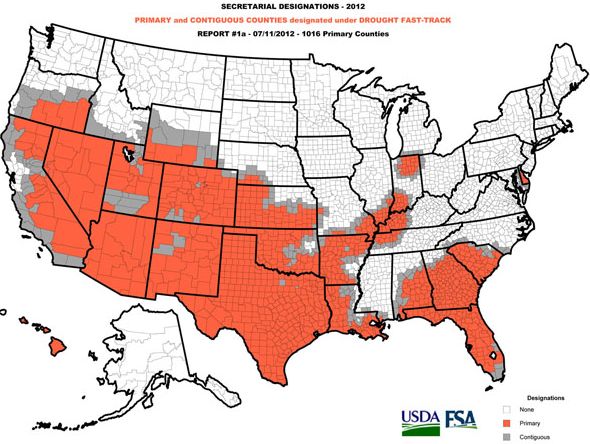
2012 drought - the worst 'natural' disaster in U.S. history
Myles Allen writes: The climate may have changed this week. Not the physical climate, but the climate of the climate change debate. Tuesday marked the publication of a series of papers examining the factors behind extreme weather events in 2011. Nothing remarkable about that, you might think, except, if all goes well, this will be the first of a regular, annual assessment quantifying how external drivers of climate contribute to damaging weather.
Some of these drivers, like volcanoes, are things we can do nothing about. But others, like rising levels of greenhouse gases, we can. And quantifying how greenhouse gases contribute to extreme weather is a crucial step in pinning down the real cost of human influence on climate. While most people think of climate change in terms of shrinking ice-sheets and slowly rising sea levels, it is weather events that actually do harm.
This week also saw a workshop in Oxford for climate change negotiators from developing countries. Again, nothing remarkable about that except, for the first time, the issue of “loss and damage” was top of the agenda. For years negotiations have been over emission reductions and sharing the costs of adaptation. Now the debate is turning to: who is going to pay for damage done?
It is a good time to ask, since the costs that can unambiguously be attributed to human-induced climate change are still relatively small. Although Munich Re estimates that weather events in 2011 cost more than $100bn and claimed many thousands of lives, only a few of these events were clearly made more likely by human influence. Others may have been made less likely, but occurred anyway – chance remains the single dominant factor in when and where a weather event occurs. For the vast majority of events, we simply don’t yet know either way.
Connecting climate change and specific weather events is only one link in the causal chain between greenhouse gas emissions and actual harm. But it is a crucial link. If, as planned, the assessment of 2011 becomes routine, we should be able to compare actual weather-related damage, in both good years and bad, with the damage that might have been in a world without human influence on climate. This puts us well on our way to a global inventory of climate change impacts. And as soon as that is available, the question of compensation will not be far behind.
The presumption in climate change negotiations is that “countries with historically high emissions” would be first in line to foot the bill for loss and damage. There may be some logic to this, but if you are an African (or Texan) farmer hit by greenhouse-exacerbated drought, is the European or American taxpayer necessarily the right place to look for compensation? As any good lawyer knows, there is no point in suing a man with empty pockets.
The only institution in the world that could deal with the cost of climate change without missing a beat is the fossil fuel industry: BP took a $30bn charge for Deepwater Horizon, very possibly more than the total cost of climate change damages last year, and was back in profit within months. Of the $5 trillion per year we currently spend on fossil energy, a small fraction would take care of all the loss and damage attributable to climate change for the foreseeable future several times over.
Such a pay-as-you-go liability regime would not address the impacts of today’s emissions on the 22nd century. Governments cannot wash their hands of this issue entirely. But we have been so preoccupied with the climate of the 22nd century that we have curiously neglected to look after the interests of those being affected by climate change today.
So rather than haggling over emission caps and carbon taxes, why not start with a simple statement of principle: standard product liability applies to anyone who sells or uses fossil fuels, including liability for any third-party side-effects. There is no need at present to say what these side-effects might be – indeed, the scientific community does not yet know. But we are getting there.
Building on Libya’s electoral success
Sean Kane writes: Libya’s elections did not need to be perfect, but the country plainly needs a popularly elected government to tackle the difficult and unpopular decisions involved in building the new state. The polls thus could have been judged a success merely by taking place without major disruption, a test they aced with flying colors following reports of 65 percent turnout and over 98 percent of polling centers opening without incident. Around the country, the long-awaited vote was justifiably treated as cause for national celebration.
But the seeds for political contention at the next stage may have been sown in the run-up to the polls. Less than 48 hours prior to elections, the National Transitional Council (NTC) stripped the to be elected national congress of its core mandate: supervising the drafting of Libya’s new constitution. Rather than being appointed by the new congress, the constitutional commission actually drafting the charter will theoretically now be directly elected in a second set of polls that give all parts of the country equal representation. This legal bombshell risks acrimony later this year between different parts of the country as well as rejection by the newly ascendant political parties, who on paper find themselves in charge of a congress suddenly relegated to bystander status on constitutional matters.
A Libyan proverb has it that “laws are made in Tripoli, observed in Misrata and die in Benghazi.” It captures Tripoli’s status as the seat of government, the highly organized nature of the commercial port city of Misrata, and the hotbed of activism that is Benghazi. True to form, as a long-running center of opposition to Qaddafi’s rule, Benghazi was the birthplace of the Libyan revolution. It should not then be a surprise that the city sees itself as the watchdog of the revolution and the new authorities in Tripoli.
Normally the vigilance of Benghazi is a healthy thing, helping the country avoid a return to the excessive concentration of power and wealth in Tripoli that marked the Qaddafi regime. But somewhere in the last few months Benghazi took a wrong turn. Following the revolution it was the most stable and institutionally advanced city in Libya, but now residents describe it as increasingly troubled. The city has become a locus of aggressive street actions by federalism supporters, seemingly politically motivated assassinations, and had its international presence targeted by small groups of Islamist militants. Underlying all of this is a deep current of resentment of the more wealthy and populous Tripoli.
Libya has of course been no stranger to unrest since the triumph of its revolution in October, 2011. But what is happening in Benghazi is qualitatively different. Other clashes around the country have generally been micro-conflicts, locally contained and concerned with parochial issues rather than larger ideology or proposed alternatives to the new order.
This is not the case among backers of an Islamic emirate or with the harder core of federalism supporters in eastern Libya. The latter include the self-declared Barqa Council (Barqa is the Arabic name for Libya’s eastern region), who periodically threaten separation from the rest of the country. Both groups have been willing to go outside of the political process to pursue their respective visions. And while high electoral turnout in the East was an emphatic demonstration that neither faction has widespread support, both have shown an ability to exploit broader regional feelings of maltreatment to act as violent spoilers. [Continue reading…]