Author Archives: News Sources

Minister hints at Israeli role in ‘Flame’ virus

The Jerusalem Post reports: In comments that could be construed as suggesting that Israel is behind the “Flame” virus, the latest piece of malicious software to attack Iranian computers, Vice Premier Moshe Ya’alon on Tuesday said that “whoever sees the Iranian threat as a serious threat would be likely to take different steps, including these, in order to hurt them.”

Speaking in an interview with Army Radio, Ya’alon further hinted that Jerusalem was behind the cyber attack, saying “Israel is blessed to be a nation possessing superior technology. These achievements of ours open up all kinds of possibilities for us.”

The virus, dubbed “Flame,” effectively turns every computer it infects into the ultimate spy. It can turn on PC microphones to record conversations taking place near the computer, take screenshots, log instant messaging chats, gather data files and remotely change settings on computers.

Security experts from the Russian Kaspersky Lab, who announced Flame’s discovery on Monday, said it is found in its highest concentration in Iranian computers. It can also be found in other Middle Eastern locations, including Israel, the West Bank, Syria and Sudan.

The virus has been active for as long as five years, as part of a sophisticated cyber warfare campaign, the experts said.

It is the most complex piece of malicious software discovered to date, according to Kaspersky Lab’s senior security researcher Roel Schouwenberg, who said he did not know who built Flame.

Facebooktwittermail

Julian Assange loses appeal against extradition

The Guardian reports: Julian Assange has lost his appeal against extradition to Sweden at the supreme court.

By a majority of five to two, the justices decided that a public prosecutor was “judicial authority” and that therefore his arrest warrant had been lawfully issued.

But lawyers for the WikiLeaks founder submitted an urgent request to the supreme court asking for permission to challenge one of the points made in the judgment.

Assange, who is facing charges of sexual assault and rape, was not in court. There was no legal requirement for him to be present. According to his solicitor, Gareth Peirce, he was stuck in traffic.

The court granted Assange’s lawyers 14 days to present their arguments that crucial issues related to Article 31 of the Vienna convention, on which the majority of the justices based their decision, were not raised during the hearing.

Facebooktwittermail

Tony Blair and the Murdochs: a family affair

Michael Wolff writes: I can connect a few more Blair-Murdoch dots, beyond what Blair offered this week to the Leveson inquiry.

By the time Tony Blair flew out to Hyman Island in 1995 to address a News Corp conference, Murdoch was sick of the Tories. He believed that he had lost his preferential position with John Major’s government – so assiduously courted with Margaret Thatcher – that he was condescended to, and wasn’t taken seriously.

Blair was right in his testimony: Murdoch isn’t out to cut deals with his political allies. He’s not lobbying. Yes, he’ll expect to be able to call on you if need be (for a deal as big as BSkyB, for instance), but mostly, he’s looking for a much more pervasive sense of comfort and confidence. What he wants is: 1) access – a near-constant availability to him, his executives, and his editors; 2) receptivity – you’ve got to take the Murdoch worldview into account; treat it seriously; cross it cautiously; and understand the power behind it.

The Blair gambit – perhaps, the key gambit of his career – was to try to offer this to Murdoch. [Continue reading…]

Facebooktwittermail

MEK: Terrorists? Us?

Owen Bennett-Jones writes: The story of the People’s Mujahedin of Iran, also known as the Mujahedin e Khalq (MEK), is all about the way image management can enable a diehard enemy to become a cherished ally. The MEK is currently campaigning to be officially delisted in the US as a terrorist organisation. Once off the list it will be free to make use of its support on Capitol Hill in order to become America’s most favoured, and no doubt best funded, Iranian opposition group.

The last outfit to achieve something similar was the Iraqi National Congress, the lobby group led by Ahmed Chalabi that talked of democracy and paved the way for the US invasion of Iraq by presenting Washington with highly questionable ‘evidence’ of weapons of mass destruction and Saddam Hussein’s links with al-Qaida. Then, as George Bush took the US to war, all that remained for the INC and its leaders was to sit back and prepare for government. Many in Washington believe that, for better or worse, the US will go to war with Iran and that the MEK will have a role to play. But first they will have to persuade Hillary Clinton to take the group off the US’s official terrorist list. Some of Clinton’s officials are urging her to keep the MEK on it but some of the big beasts in Washington are angrily demanding that she delist. After an exhaustive inter-agency process the MEK file is now in her in-tray. Recent State Department statements indicate that she is likely to delist the group.

Formed in the 1960s as an anti-imperialist, Islamist organisation with socialist leanings, dedicated to the overthrow of the shah, the MEK originally stood not only for Islamic revolution but also for such causes as women’s rights – an appealing combination on Iran’s university campuses. It went on to build a genuine popular base and played a significant role in overthrowing the shah in 1979. It was popular enough for Ayatollah Khomeini to feel he had to destroy it; throughout the 1980s he instigated show trials and public executions of its members. The MEK retaliated with attacks on senior clerical leaders inside Iran.

Fearing for their lives, MEK members fled first to Paris and later to Iraq, where Saddam Hussein, desperate for allies in the war with Iran, provided them with millions of dollars of funding as well as tanks, artillery pieces and other weapons. He also made land available to them. Camp Ashraf became their home, a citadel in the desert, 80 kilometres north of Baghdad and an hour’s drive from the Iranian border. Since the 1970s, the MEK’s rhetoric has changed from Islamist to secular, from socialist to capitalist, from pro-revolution to anti-revolution. And since Saddam’s fall it has portrayed itself as pro-American, peaceful and dedicated to democracy and human rights. Continual reinvention can be dangerous, however, and the new, pro-Iranian Iraqi government is under pressure from Tehran to close down Camp Ashraf, which has grown over three decades to the size of a small town. And it’s not just Iran. Many Iraqis too bear grudges against the MEK, not only for having worked alongside Saddam Hussein but also for having taken part in his violent suppression of the Kurds and Shias. [Continue reading…]

Facebooktwittermail

The face of collateral damage

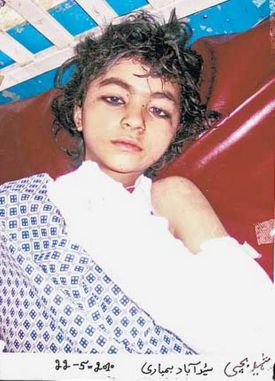
Jefferson Morley writes: Around midnight on May 21, 2010, a girl named Fatima was killed when a succession of U.S.-made Hellfire missiles, each of them five-feet long and traveling at close to 1,000 miles per hour, smashed a compound of houses in a mountain village of Mohammed Khel in North Waziristan along the Afghanistan-Pakistan border. Wounded in the explosions, which killed a half dozen men, Fatima and two other children were taken to a nearby hospital, where they died a few hours later.

Behram Noor, a Pakistani journalist, went to the hospital and took a picture of Fatima shortly before her death. Then, he went back to the scene of the explosions looking for evidence that might show who was responsible for the attack. In the rubble, he found a mechanism from a U.S.-made Hellfire missile and gave it to Reprieve, a British organization opposed to capital punishment, which shared photographs of the material with Salon. Reprieve executive director Clive Stafford Smith alluded to the missile fragments in an Op-Ed piece for the New York Times last fall. They have also been displayed in England.

“Forensically, it is important to show how the crime of murder happened (which is what it is here),” said Stafford Smith in an email. “One almost always uses the murder weapon in a case. But perhaps more important, I think this physical proof — this missile killed this child — is important to have people take it seriously.”

In the religious rhetoric used by al-Qaida’s online allies, Fatima was a “martyr.” In a statement quoted by Long War Journal, the al-Ansara forum said the senior al-Qaida commander Mustafa Abu Yazid had been killed in a “convoy of martyrs on the road with his wife and three daughters and his granddaughter; men, women and children; neighbors and loved ones.” But Fatima was not Yazid’s daughter, according to Noor, who reported from the scene. She was the daughter of another man who lost two wives and three children in the barrage.

In the euphemistic jargon of Washington, Fatima was “collateral damage” in the successful effort to assassinate Yazid, an Egyptian jihadist also known as Saeed al-Masri. In disregard for the official secrecy that envelops the drone war, U.S. intelligence officials leaked the classified details of the attack, telling the New York Times that they considered Yazid to be al-Qaida’s “No. 3 leader.” Relying on similar sources, the Washington Post said that al-Masri was the group’s “chief organizational manager.” Unlike other news organizations reporting on the attack, neither the Post nor the Times mentioned that women and children had been killed in the attack. [Continue reading…]

Facebooktwittermail

Europe and the Greeks: Save us from the saviours

Slavoj Žižek writes: Imagine a scene from a dystopian movie that depicts our society in the near future. Uniformed guards patrol half-empty downtown streets at night, on the prowl for immigrants, criminals and vagrants. Those they find are brutalised. What seems like a fanciful Hollywood image is a reality in today’s Greece. At night, black-shirted vigilantes from the Holocaust-denying ne0-fascist Golden Dawn movement – which won 7 per cent of the vote in the last round of elections, and had the support, it’s said, of 50 per cent of the Athenian police – have been patrolling the street and beating up all the immigrants they can find: Afghans, Pakistanis, Algerians. So this is how Europe is defended in the spring of 2012.

The trouble with defending European civilisation against the immigrant threat is that the ferocity of the defence is more of a threat to ‘civilisation’ than any number of Muslims. With friendly defenders like this, Europe needs no enemies. A hundred years ago, G.K. Chesterton articulated the deadlock in which critics of religion find themselves: ‘Men who begin to fight the Church for the sake of freedom and humanity end by flinging away freedom and humanity if only they may fight the Church … The secularists have not wrecked divine things; but the secularists have wrecked secular things, if that is any comfort to them.’ Many liberal warriors are so eager to fight anti-democratic fundamentalism that they end up dispensing with freedom and democracy if only they may fight terror. If the ‘terrorists’ are ready to wreck this world for love of another, our warriors against terror are ready to wreck democracy out of hatred for the Muslim other. Some of them love human dignity so much that they are ready to legalise torture to defend it. It’s an inversion of the process by which fanatical defenders of religion start out by attacking contemporary secular culture and end up sacrificing their own religious credentials in their eagerness to eradicate the aspects of secularism they hate.

But Greece’s anti-immigrant defenders aren’t the principal danger: they are just a by-product of the true threat, the politics of austerity that have caused Greece’s predicament. The next round of Greek elections will be held on 17 June. The European establishment warns us that these elections are crucial: not only the fate of Greece, but maybe the fate of the whole of Europe is in the balance. One outcome – the right one, they argue – would allow the painful but necessary process of recovery through austerity to continue. The alternative – if the ‘extreme leftist’ Syriza party wins – would be a vote for chaos, the end of the (European) world as we know it.

The prophets of doom are right, but not in the way they intend. [Continue reading…]

Facebooktwittermail

Most Houla massacre victims executed says U.N.; Western states expel Syrian diplomats

Al Arabiya reports: Fewer than 20 of the 108 people confirmed as having been killed in the “appalling massacre” in the Syrian town of al-Houla died from artillery and tank fire, the United Nations human rights office said on Tuesday, as each of France and Australia announced expelling the Syrian envoys over the massacre.

Survivors have told U.N. investigators that most of the other victims died in two bouts of summary executions carried out by pro-government Shabbiha militia in the nearby village of Taldaou, U.N. rights spokesman Rupert Colville said, according to Reuters.

“I believe at this point, and I would stress we are at very preliminary stages, that under 20 of the 108 can be attributed to artillery and tank fire,” he told a news briefing in Geneva, adding that 49 children and 34 women were among the victims.

Colville told reporters that most of the other victims were summarily executed in two separate incidents. He said the conclusions of the U.N. monitors are corroborated by other sources, The Associated Press reported.

Bloomberg reports: Western governments today announced the expulsion of top Syrian diplomats as United Nations envoy Kofi Annan met President Bashar al-Assad to express horror at the massacre of more than 100 people in Houla.

French President Francois Hollande said the Syrian ambassador was to be expelled, hours after Australia announced a similar move, citing the May 25 killings in Houla. Britain is sending home the most senior Syrian diplomat in London, the Press Association reported, while Germany and Italy are planning the same step, Sueddeutsche Zeitung said. Spain is withdrawing the credentials of the Syrian ambassador, DPA reported, while Canada said all remaining diplomats are being told to leave.

The Guardian reports: An 11-year old boy has described how he smeared himself in the blood of his slain brother and played dead as loyalist gunmen burst into his home and killed six members of his family during the start of a massacre in Houla, central Syria.

The young survivor’s chilling account emerged as Russia continued to blame both Syrian troops and opposition militias for the weekend rampage in the town that left at least 116 people dead and prompted fresh outrage against the regime’s crackdown.

It comes on the eve of Kofi Annan’s scheduled meeting on Tuesday in Damascus with Syria’s president, Bashar al-Assad, which is seen as the last hope of salvaging the UN special envoy’s failed peace plan.

Speaking to the Guardian, the young survivor said government troops arrived in his district at around 3am on Saturday, several hours after shells started falling on Houla.

“They came in armoured vehicles and there were some tanks,” said the boy. “They shot five bullets through the door of our house. They said they wanted Aref and Shawki, my father and my brother. They then asked about my uncle, Abu Haidar. They also knew his name.”

Shivering with fear, the boy stood towards the back of the entrance to his family home as gunmen then shot dead every family member in front of him.

“My mum yelled at them,” said the boy. “She asked: ‘What do you want from my husband and son?’ A bald man with a beard shot her with a machine gun from the neck down. Then they killed my sister, Rasha, with the same gun. She was five years old. Then they shot my brother Nader in the head and in the back. I saw his soul leave his body in front of me.

“They shot at me, but the bullet passed me and I wasn’t hit. I was shaking so much I thought they would notice me. I put blood on my face to make them think I’m dead.”

Facebooktwittermail

In Egypt, a revolution at the crossroads

Omar Ashour writes: Everything about Egypt’s revolution has been unexpected, and the first-round results in the country’s first-ever competitive presidential election are no different. The rise of former president Hosni Mubarak’s last prime minister, General Ahmad Shafiq, who will enter the presidential runoff alongside the Muslim Brotherhood candidate Mohamed Morsi, has raised eyebrows across the political spectrum. So did the meteoric rise of the Nasserist candidate Hamdin Sabbahi to third place, and the fourth-place finish of Abdel Moneim Aboul Fotouh, who was backed by liberals and hard-line Salafi Islamists alike.

Egypt’s voters overwhelmingly chose the revolution over the old regime and shattered the myth that the push for change is an urban, middle-class, Cairo-based phenomenon: The eight revolutionary candidates received more than 16.4 million votes. But their failure to unite on a single platform directly benefited Gen. Shafiq, who unexpectedly won 5.9 million votes (assuming no election-rigging).

Gen. Shafiq’s success shocked many revolutionaries. “He is a murderer. His place is in jail, not on top of Egypt after the revolution,” said one activist. Indeed, Gen. Shafiq has been linked to multiple cases of corruption and repression, including the “battle of the camels” on Feb. 2, 2011, when Mr. Mubarak’s henchmen attacked Tahrir Square, killing and wounding protesters.

The rise of Gen. Shafiq is explainable in some areas. In Upper Egypt, “more than 60% of Copts voted for him,” a source close to the Coptic Orthodox Church said, and in Coptic-majority areas the pro-Shafiq vote exceeded 95% because he is widely perceived as a bulwark against Islamism.

Moreover, many state employees (around 5.1 million of them are eligible to vote) and their families supported Gen. Shafiq, owing either to direct instructions from their bosses or to the perceived threat of creeping Muslim Brotherhood influence on government bureaucracies. And Gen. Shafiq received financing and support from Mr. Mubarak’s National Democratic Party (NDP), as well as from business and security interests that benefit from the status quo.

But this was not enough to explain Mr. Morsi’s defeat in the Muslim Brotherhood’s traditional strongholds. In Sharqiya, a bastion of hard-core Muslim Brotherhood support with 3.5 million voters, Gen. Shafiq defeated Mr. Morsi by more than 90,000 votes. In Gharbiya governorate, another Muslim Brotherhood stronghold, he beat Mr. Morsi by more than 200,000 votes. [Continue reading…]

Meanwhile, Reuters reports: A group of Egyptian protesters set fire to the campaign headquarters of presidential candidate Ahmed Shafiq in Cairo on Monday, the state news agency reported, after the ex-prime minister made it into the second round of the vote.

The privately-owned Al-Hayat channel broadcast images of a the fire at Shafiq’s campaign office in the Cairo district of Dokki, saying it had been caused by a group of protesters. It said there were no injuries.

Facebooktwittermail

How can a better understanding of sacred values help us resolve intergroup conflicts?

Scott Atran writes: Humans define the groups to which they belong in abstract terms. Often they strive for lasting intellectual and emotional bonding with anonymous others, and make their greatest exertions in killing and dying not to preserve their own lives or to defend their families and friends, but for the sake of an idea—the transcendent moral conception they form of themselves, of “who we are.” This is the “the privilege of absurdity; to which no living creature is subject, but man only’” of which Hobbes wrote in Leviathan. In The Descent of Man, Darwin cast it as the virtue of “morality … the spirit of patriotism, fidelity, obedience, courage, and sympathy” with which winning groups are better endowed in history’s spiraling competition for survival and dominance. Across cultures, primary group identity is bounded by sacred values, often in the form of religious beliefs or transcendental ideologies, which lead some groups to triumph over others because of non-rational commitment from at least some of its members to actions that drive success independent, or all out of proportion, from expected rational outcomes.

For Darwin himself, moral virtue was most clearly associated not with intuitions, beliefs, and behaviors about fairness and reciprocity, emotionally supported by empathy and consolation—which constitute nearly the entire subject matter of recent work in the philosophy, psychology, and neuroscience of morality—but with a propensity to what we nowadays call “parochial altruism”: especially extreme self-sacrifice in war and other intense forms of human conflict, where likely prospects for individual and even group survival had very low initial probability. Heroism, martyrdom, and other forms of self-sacrifice for the group appear to go beyond the mutualistic principles of fairness and reciprocity.

Whether for cooperation or conflict, sacred values, like devotion to God or a collective cause, signal group identity and operate as moral imperatives that inspire non-rational exertions independent of likely outcomes. In interviews, experiments, and surveys with Palestinians, Israelis, Indonesians, Indians, Afghans, and Iranians, my research with psychologists Jeremy Ginges and Douglas Medin finds that offering people material incentives (large amounts of money, guarantees for a life free of political violence) to compromise sacred values can backfire, increasing stated willingness to use violence toward compromise. This research, supported by the U.S. Department of Defense and the National Science Foundation, shows that backfire effects occur both for sacred values with clear religious investment (Jerusalem, Shariah law) and those with initially none (Iran’s right to nuclear capability, Palestinian refugees’ right of return). [Continue reading…]

Facebooktwittermail

Wall Street ditches Obama, backs Romney

CNN reports: Hell hath no fury like a woman scorned — but what about a Wall Street titan?

Deep-pocketed financiers have abandoned President Obama and are flocking to Mitt Romney in droves, providing more donations to his campaign than any other industry except retired workers. (And that’s not really an industry.)

Individuals who work in the securities and investment industry have given the Romney campaign $8.5 million through the end of April, according to data from the Center for Responsive Politics.

Over the same time period, Obama has brought in only $3 million from securities and investment workers, and the industry is only the campaign’s fifth largest source of funds.

“They have basically ditched Obama,” said John Dunbar, the managing editor for politics at the Center for Public Integrity. “Romney is just a much friendlier candidate if you are a banker.”

The absence of Wall Street love is a departure from the norm for the Obama campaign. In 2008, then-Senator Obama raised almost $16 million from Wall Street. John McCain, the Republican nominee, received donations totaling only $9 million.

No doubt the Obama campaign will play this to their advantage, casting Romney as the banksters’ candidate — ignoring the fact that Obama has been a very banker-friendly president.

Facebooktwittermail

Researchers find vulnerability that could allow spying in Chinese chips used by U.S. army

Update below.

The Next Web reports: A team of researchers from Cambridge University say they have found evidence that a Chinese-manufactured chip used by US armed forces contains a secret access point that could leave it vulnerable to third party tampering.

The researchers tested an unspecified US military chip — used in weapons, nuclear power plants to public transport – and found that a previously unknown ‘backdoor’ access point had been added, making systems and hardware open to attack, the team says.

Cambridge University researcher, Sergei Skorobogatov, explains:

We scanned the silicon chip in an affordable time and found a previously unknown backdoor inserted by the manufacturer. This backdoor has a key, which we were able to extract. If you use this key you can disable the chip or reprogram it at will, even if locked by the user with their own key.

This particular chip is prevalent in many systems from weapons, nuclear power plants to public transport. In other words, this backdoor access could be turned into an advanced Stuxnet weapon to attack potentially millions of systems. The scale and range of possible attacks has huge implications for National Security and public infrastructure.

While the initial research is a concern, a number of question marks remain over the findings before further conclusions can be drawn.

It is unclear if the access point is isolated to the chip that was tested or whether Skorobogatov and his colleagues have stumbled upon a larger trend. Likewise, it remains possible that the modified back door access could have been created by the US armed forces themselves.

Update: Robert David Graham says that while the Cambridge researchers “did find a backdoor in a popular FPGA chip, there is no evidence the Chinese put it there, or even that it was intentionally malicious.” He provides a detailed technical analysis explaining how he reaches this conclusion.

Facebooktwittermail

Meet ‘Flame’, the massive spy malware infiltrating Iranian computers

Wired reports: A massive, highly sophisticated piece of malware has been newly found infecting systems in Iran and elsewhere and is believed to be part of a well-coordinated, ongoing, state-run cyberespionage operation.

The malware, discovered by Russia-based anti-virus firm Kaspersky Lab, is an espionage toolkit that has been infecting targeted systems in Iran, Lebanon, Syria, Sudan, the Israeli Occupied Territories and other countries in the Middle East and North Africa for at least two years.

Dubbed “Flame” by Kaspersky, the malicious code dwarfs Stuxnet in size – the groundbreaking infrastructure-sabotaging malware that is believed to have wreaked havoc on Iran’s nuclear program in 2009 and 2010. Although Flame has both a different purpose and composition than Stuxnet, and appears to have been written by different programmers, its complexity, the geographic scope of its infections and its behavior indicate strongly that a nation-state is behind Flame, rather than common cyber-criminals — marking it as yet another tool in the growing arsenal of cyberweaponry.

The researchers say that Flame may be part of a parallel project created by contractors who were hired by the same nation-state team that was behind Stuxnet and its sister malware, DuQu.

“Stuxnet and Duqu belonged to a single chain of attacks, which raised cyberwar-related concerns worldwide,” said Eugene Kaspersky, CEO and co-founder of Kaspersky Lab, in a statement. “The Flame malware looks to be another phase in this war, and it’s important to understand that such cyber weapons can easily be used against any country.”

Early analysis of Flame by the Lab indicates that it’s designed primarily to spy on the users of infected computers and steal data from them, including documents, recorded conversations and keystrokes. It also opens a backdoor to infected systems to allow the attackers to tweak the toolkit and add new functionality.

The malware, which is 20 megabytes when all of its modules are installed, contains multiple libraries, SQLite3 databases, various levels of encryption — some strong, some weak — and 20 plug-ins that can be swapped in and out to provide various functionality for the attackers. It even contains some code that is written in the LUA programming language — an uncommon choice for malware.

Kaspersky Lab is calling it “one of the most complex threats ever discovered.”

“It’s pretty fantastic and incredible in complexity,” said Alexander Gostev, chief security expert at Kaspersky Lab.

Flame appears to have been operating in the wild as early as March 2010, though it remained undetected by antivirus companies. [Continue reading…]

Symantec adds: Based on the number of compromised computers, the primary targets of this threat are located in the Palestinian West Bank, Hungary, Iran, and Lebanon. However, we have additional reports in Austria, Russia, Hong Kong, and the United Arab Emirates. These additional reports may represent a targeted computer that was temporarily taken to another region–for example, a laptop. Interestingly, in addition to particular organizations being targeted, many of the compromised computers appear to be personal computers being used from home Internet connections.

Facebooktwittermail

After calling African migrants a ‘cancer’, Israeli politician apologizes — to cancer patients

Haaretz reports: Likud MK Miri Regev, who came under fire last week after calling African migrants “a cancer” in Israeli society, apologized for the first time for her comments on Sunday, opting, however, to leave the migrants out of her apology.

Regev’s controversial comments came during a violent rally staged by residents of Tel Aviv’s south – where many African migrants live – to protest rising crime rates in the area. In the rally, the Likud MK said “the Sudanese are a cancer in our body.”

She was later criticized for inflaming the protesters, with angry demonstrators later going on to attack African passers-by and journalists, breaking into and looting shops associated with the African migrant community and shattering car windshields.

At the time, Regev condemned “any violence from any side, but I understand the rage and hurt of the residents, of the families that live there. They tell us: ‘Help us. We are being humiliated, look how we live, we are afraid to leave the house.'”

However, speaking to Israeli media outlets over the weekend and on Sunday, Regev chose to apologize for calling the Sudanese a cancer, opting however, to direct her apology to Holocaust survivors and cancer patients.

“When I compared the migrant worker phenomenon to cancer I was referring to the way the phenomenon had spread, and not anything else. If anyone took it otherwise and was consequently offended, I apologize and I surely did not intend to hurt either Holocaust survivors or cancer patients,” she said.

Facebooktwittermail

Syrian army being aided by Iranian forces

The Guardian reports: A senior commander in Iran’s Revolutionary Guards has admitted that Iranian forces are operating in Syria in support of Bashar al-Assad’s regime.

Ismail Gha’ani, the deputy head of Iran’s Quds force, the arm of the Revolutionary Guards tasked with overseas operations, said in an interview with the semi-official Isna news agency: “If the Islamic republic was not present in Syria, the massacre of people would have happened on a much larger scale.”

Isna published the interview at the weekend but subsequently removed it from its website.

It quoted Gha’ani as saying: “Before our presence in Syria, too many people were killed by the opposition but with the physical and non-physical presence of the Islamic republic, big massacres in Syria were prevented.”

Facebooktwittermail