David Cole writes: Sometimes I think being American means never having to say you’re sorry. On Wednesday, May 2, the US Court of Appeals for the Ninth Circuit, a federal appeals court in San Francisco, unanimously dismissed a lawsuit against former Justice Department lawyer John Yoo by José Padilla, the US citizen picked up at O’Hare Airport and held in military custody as an “enemy combatant” for three and a half years, during which he says he was subject to physical and psychological abuse.
As an official in the Justice Department’s Office of Legal Counsel from 2001 to 2003, Yoo wrote multiple memos designed to deny “enemy combatants” legal protections that might get in the way of our holding them incommunicado, depriving them of sleep, slamming them into walls, forcing them into painful stress positions, and waterboarding them. Padilla alleged that Yoo’s memos provided the basis for his years in detention, of which twenty-one months were in incommunicado isolation, and authorized his captors to subject him to abuse. As a result, he claims, he was threatened with death and serious physical abuse; shackled in painful stress positions for hours at a time; administered psychotropic drugs; denied medical care; and exposed to extreme temperatures.
The court dismissed the case before the truth of these allegations could be tested. It reasoned that even if Padilla’s allegations were true, it was not “clearly established” that his treatment violated the Constitution, and therefore the suit must be dismissed. John Yoo could not even be sued for the nominal damages of one dollar that Padilla and his mother sought as a way of emphasizing that their desire was for vindication of their rights, not remuneration. [Continue reading…]
Author Archives: News Sources
U.S. Treasury claim of Iran-al-Qaeda ‘secret deal’ is discredited
Gareth Porter reports: The U.S. Treasury Department’s claim of a “secret deal” between Iran and Al-Qaeda, which had become a key argument by right-wing activists who support war against Iran, has been discredited by former intelligence officials in the wake of publication of documents from Osama bin Laden’s files revealing a high level of antagonism between Al-Qaeda and Iran.
Three former intelligence officials with experience on Near East and South Asia told IPS they regard Treasury’s claim of a secret agreement between Iran and Al-Qaeda as false and misleading.
That claim was presented in a way that suggested it was supported by intelligence. It now appears, however, to have been merely a propaganda line designed to support the Barack Obama administration’s strategy of diplomatic coercion on Iran.
Under Secretary of Treasury David S. Cohen announced last July that the department was “exposing Iran’s secret deal with Al-Qaeda allowing it to funnel funds and operatives through its territory.” The charge was introduced in connection with the designation of an Al-Qaeda official named Yasin al-Suri as a terrorist subject to financial sanctions.
The Treasury claim has been embraced by the right-wing Weekly Standard and others aligned with hardline Israeli views on Iran, as primary source evidence of an alliance between Iran and Al-Qaeda.
But Paul Pillar, former national intelligence officer for Near East and South Asia, told IPS the allegation of a “secret deal” between Iran and Al-Qaeda “has never been backed up by any evidence that would justify such a term” and that it is “a highly misleading characterisation of interaction between Iran and Al-Qaeda….”
Video: Austerity, the euro crisis and the U.S.
The risks of recruiting members of al Qaeda
The Washington Post reports: For al-Qaeda’s affiliate in Yemen, the volunteer seemed ideal. He was willing to die in a suicide operation, and he had travel papers that would allow him to board a U.S.-bound flight.
It was a perfect dangle, in the parlance of spycraft, and al-Qaeda in the Arabian Peninsula took the bait.
The group’s bombmaker fitted the man with a new version of a nonmetallic “underwear bomb.” What he didn’t know was that the would-be martyr was an agent run by Saudi Arabia. And the man turned the device over to his Saudi handlers inside Yemen.
The Saudis flew the bomb out of the country on a noncommercial jet and handed it over to American officials in an unidentified third country, according to Mustafa Alani, director of security and defense studies at the Gulf Research Center in Jiddah, Saudi Arabia, who has close contacts with the kingdom’s intelligence and counterterrorism agencies. A U.S. official confirmed aspects of his account.
The informant was one of several operatives sent into Yemen over the past two years with Western passports and other documents designed to attract the attention of a terrorist group that is determined to attack the United States, U.S. and Western intelligence officials said Wednesday.
One official described the effort to disrupt the airline plot as part of a broader use of operatives with “clean skins” who can pass themselves off as militants capable of traveling into Europe or the United States.
As part of the effort, the Saudis have used fledgling al-Qaeda operatives who were temporarily detained, as well as individuals who have entered the country’s rehabilitation program, which seeks to turn militants against terrorist groups.
The effort has focused on flipping low-level and aspiring jihadis, according to a former U.S. intelligence official familiar with the operation, which was revealed in news reports Monday.
It’s worth remembering that al Qaeada has demonstrated that it can be as adept in the art of deception as are the intelligence agencies. As the Washington Post reported in January, 2010:
The suicide bomber who killed seven CIA operatives in Afghanistan last week was a Jordanian informant who lured intelligence officers into a trap by promising new information about al-Qaeda’s top leadership, former U.S. government officials said Monday.
The attacker, a physician-turned-mole, had been recruited to infiltrate al-Qaeda’s senior circles and had gained the trust of his CIA and Jordanian handlers with a stream of useful intelligence leads, according to two former senior officials briefed on the agency’s internal investigation. His track record as an informant apparently allowed him to enter a key CIA post without a thorough search, the sources said.
The bomber, identified as Humam Khalil Abu-Mulal al-Balawi, was standing just outside an agency building on the base Wednesday when he exploded a bomb hidden under his clothes, killing the seven Americans along with a Jordanian officer who had been assigned to work with him. Six CIA operatives were wounded.
The agency has declined to publicly identify the victims, a mix of career officers and contractors with backgrounds ranging from law enforcement to military Special Forces.
Details about the suicide bomber’s identity provided jarring insight into how a vital intelligence post in eastern Afghanistan was penetrated in the deadliest attack on the CIA in more than 25 years. Initial reports suggested that the bomber was an Afghan soldier or perhaps a local informant who had been brought onto the base for debriefing.
Instead, the new evidence points to a carefully planned act of deception by a trusted operative from a country closely allied with the United States in the fight against al-Qaeda. U.S. and Jordanian officials had come to regard Balawi as trustworthy, former officials said, despite a history of support for Islamist extremism — a point of view he appeared to endorse in an interview with an al-Qaeda-affiliated publication as recently as this past fall.
“He was someone who had already worked with us,” said a former U.S. counterterrorism officer who discussed the ongoing investigation on the condition of anonymity. The official said Balawi had been jointly managed by U.S. and Jordanian agencies and had provided “actionable intelligence” over several weeks of undercover work along the Afghanistan-Pakistan border.
Video: West ‘fatigued’ over Syria
Sorry! The lifestyle you ordered is currently out of stock
Teacher Liam Taylor leads Occupy London tours every couple of weeks through Canary Wharf, the privately-owned, guarded riverside oasis of wealth in Tower Hamlets where nine of the world’s biggest banks trade, lend and advise clients.
Bloomberg reports: Bank security guards in London lock the doors when they see Liam Taylor coming.
At a time of protests in March 2011, the secondary school teacher and a dozen others pushed through the revolving doors of Barclays Plc’s headquarters in the Canary Wharf financial district of London. He led placard-waving chants to protest bonuses and tax avoidance.
The British bank was handing out 65.5 million pounds ($106 million) to eight executives, including Chief Executive Officer Robert Diamond, whom Taylor has never met. Meanwhile, the council of the poverty-mired surrounding London neighborhood of Tower Hamlets was slashing 72 million pounds from its taxpayer- funded budget.
Here, where two worlds collide, the 26-year-old umbrella- toting teacher plays an active role in the Occupy London protest movement. Tower Hamlets has one of the highest rates of young people receiving jobless benefits in London, the highest proportion of poor children and older people in England and the worst child poverty in the U.K.
In its midst is Canary Wharf, a privately owned, guarded riverside oasis of wealth where Taylor leads Occupy tours every couple of weeks. Nine of the world’s biggest banks trade, lend and advise clients here. His message: This is where the wealthy 1 percent enrich themselves by avoiding tax, racking up debt, selling risky investments and using public funds for bailouts. They do so at the expense of the remaining 99 percent, who bear the burden of higher taxes and fewer public services, he says.
“These huge glass towers you can see around us are all in Tower Hamlets, and yet Tower Hamlets remains the borough with the highest rate of child poverty,” says the soft-spoken Taylor, who has blue eyes and cropped red hair. “The bonuses are being paid out of money which should have been paid in tax to provide public services.”
Canary Wharf is the base for companies that pay some of the highest salaries in the world. They include Barclays and HSBC Holdings Plc of the U.K., Switzerland’s Credit Suisse Group AG and the European operations of U.S.-based Citigroup Inc., JPMorgan Chase & Co., Morgan Stanley and Bank of America Corp.
Protests over economic inequality erupted around the world again last week. After a year of Occupy and trade union demonstrations in London, the sense of unfairness is growing as support for the U.K. government erodes. The ruling coalition of Conservative and Liberal Democrat parties lost hundreds of seats in last week’s local-council elections, although London’s Conservative Mayor Boris Johnson retained office.
British austerity measures are taking effect just as the U.K. enters its first double-dip recession since the 1970s. The budgets of Tower Hamlets and the deprived boroughs of Hackney and Newham were cut the most among London neighborhoods last year while wealthy Richmond-upon-Thames’s was reduced the least.
Income inequality among working-age people has risen faster in the U.K. than in any other wealthy Western country since 1975, according to the Paris-based Organization for Economic Cooperation & Development. London and the finance industry are the driving forces behind the rise, according to Mark Stewart, an economics professor at the University of Warwick.
“There is a groundswell of increasing concern with the scale of inequality,” says Richard Wilkinson, coauthor with Kate Pickett of the book, “The Spirit Level.” They make the case that more-unequal societies have lower life expectancies and more mental illness, violence, teenage pregnancies and incarceration, resulting in less trust.
Nowhere is the divide between rich and poor more evident than in Tower Hamlets and Canary Wharf. Many of Canary Wharf’s 95,000 workers travel to and from the skyscrapers on trains that pass under or over the 240,000 residents of Tower Hamlets. Taylor’s students say commuters on trains look right through them. A four-lane highway and railway separate Canary Wharf from the rest of the borough. There are guarded checkpoints for cars.
Canary Wharf’s shiny underground malls are decked with advertisements for products including a Citigroup (C) account for those with an “international lifestyle.” The grubby streets of Tower Hamlets feature empty spaces covered with graffiti: “Sorry! The lifestyle you ordered is currently out of stock.” [Continue reading…]
Why profiling Muslims is a dumb idea
The bigotry that has made many Americans afraid of Muslims has been reinforced by people like Sam Harris who, because he seems smart, has led others to believe that profiling Muslims in airport security is just a matter of common sense.
To his credit, at least Harris was rational enough to allow someone else explain to him why he’s wrong and post the following on his own website, explaining why profiling makes no sense.
Bruce Schneier writes: Why do otherwise rational people think it’s a good idea to profile people at airports? Recently, neuroscientist and best-selling author Sam Harris related a story of an elderly couple being given the twice-over by the TSA, pointed out how these two were obviously not a threat, and recommended that the TSA focus on the actual threat: “Muslims, or anyone who looks like he or she could conceivably be Muslim.”
This is a bad idea. It doesn’t make us any safer—and it actually puts us all at risk.
The right way to look at security is in terms of cost-benefit trade-offs. If adding profiling to airport checkpoints allowed us to detect more threats at a lower cost, than we should implement it. If it didn’t, we’d be foolish to do so. Sometimes profiling works. Consider a sheep in a meadow, happily munching on grass. When he spies a wolf, he’s going to judge that individual wolf based on a bunch of assumptions related to the past behavior of its species. In short, that sheep is going to profile…and then run away. This makes perfect sense, and is why evolution produced sheep—and other animals—that react this way. But this sort of profiling doesn’t work with humans at airports, for several reasons.
First, in the sheep’s case the profile is accurate, in that all wolves are out to eat sheep. Maybe a particular wolf isn’t hungry at the moment, but enough wolves are hungry enough of the time to justify the occasional false alarm. However, it isn’t true that almost all Muslims are out to blow up airplanes. In fact, almost none of them are. Post 9/11, we’ve had 2 Muslim terrorists on U.S airplanes: the shoe bomber and the underwear bomber. If you assume 0.8% (that’s one estimate of the percentage of Muslim Americans) of the 630 million annual airplane fliers are Muslim and triple it to account for others who look Semitic, then the chances any profiled flier will be a Muslim terrorist is 1 in 80 million. Add the 19 9/11 terrorists—arguably a singular event—that number drops to 1 in 8 million. Either way, because the number of actual terrorists is so low, almost everyone selected by the profile will be innocent. This is called the “base rate fallacy,” and dooms any type of broad terrorist profiling, including the TSA’s behavioral profiling.
A web of privilege supports this so-called meritocracy
Gary Younge writes: Shortly after Mitt Romney’s failed 2008 campaign for the Republican nomination his son Tagg set up a private equity fund with the campaign’s top fundraiser. One of the first donors was his mum, Anne. Next came several of his dad’s financial backers. Tagg had no experience in the world of finance, but after two years in the middle of a deep recession the company had netted $244m from just 64 investors.
Tagg insists that neither his name nor the fact that his father had made it clear he would run for the presidency again had anything to do with his success. “The reason people invested in us is that they liked our strategies,” he told the New York Times.
Class privilege, and the power it confers, is often conveniently misunderstood by its beneficiaries as the product of their own genius rather than generations of advantage, stoutly defended and faithfully bequeathed. Evidence of such advantages is not freely available. It is not in the powerful’s interest for the rest of us to know how their influence is attained or exercised. But every now and then a dam bursts and the facts come flooding forth. [Continue reading…]
The rise of the Occupy movement makes it clear the institutional church has failed

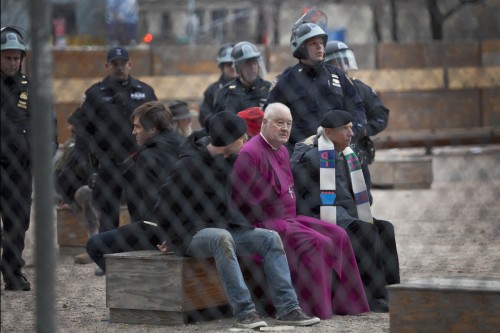
Chris Hedges writes: Retired Episcopal Bishop George Packard was arrested in Vietnam Veterans Memorial Plaza in New York City on Tuesday night as he participated in the May 1 Occupy demonstrations. He and 15 other military veterans were taken into custody after they linked arms to hold the plaza against a police attempt to clear it. There were protesters behind them who, perhaps because of confusion, perhaps because of miscommunication or perhaps they were unwilling to risk arrest, melted into the urban landscape. But those in the thin line from Veterans for Peace, of which the bishop is a member, stood their ground. They were handcuffed, herded into a paddy wagon and taken to jail.
It was Packard’s second arrest as part of the Occupy protests. Last Dec. 17 he was arrested when he leapt over a fence in his flowing bishop’s robe to spearhead an attempt to occupy a vacant lot owned by Trinity Church in lower Manhattan. The December action by the Occupy movement was a response to the New York City Police Department’s storming and eradication of the encampment in Zuccotti Park. Packard will appear in court in June to face the trespassing charge that resulted. Now, because of this second arrest, he faces the possibility of three months in jail.
Packard’s moral and intellectual courage stands in stark contrast with the timidity of nearly all clergy and congregants in all of our major religious institutions. Religious leaders, in churches, synagogues and mosques, at best voice pious and empty platitudes about justice or carry out nominal acts of charity aimed at those bearing the weight of resistance in the streets. And Packard’s arrests serve as a reminder of the price that we—especially those who claim to be informed by the message of the Christian Gospel—must be willing to pay to defy the destruction visited on us all by the corporate state. He is one of the few clergy members who dare to bear a genuine Christian witness in an age that cries out in anguish for moral guidance.
“Arrests are not arrests anymore,” Packard said as we talked Friday in a restaurant overlooking Zuccotti Park in New York. “They are badges of honor. They are, as you are taken away with your comrades, exhilarating. The spirit is calling us now into the streets, calling us to reject the old institutional orders. There is no going back. You can’t sit anymore in churches listening to stodgy liturgies. They put you to sleep. Most of these churches are museums with floorshows. They are a caricature of what Jesus intended. Jesus would be turning over the money-changing tables in their vestibules. Those in the church may be good-hearted and even well-meaning, but they are ignoring the urgent, beckoning call to engage with the world. It is only outside the church that you will find the spirit of God and Christ. And with the rise of the Occupy movement it has become clear that the institutional church has failed. It mouths hollow statements. It publishes pale Lenten study tracts. It observes from a distance without getting its hands dirty. It makes itself feel good by doing marginal charitable works, like making cocoa for Occupy protesters or providing bathrooms from 9 to 5 at Trinity Church’s Charlotte’s Place. We don’t need these little acts of charity. We need the church to have a real presence on the Jericho Road. We need people in the church to leave their comfort zones, to turn away from the hierarchy, and this is still terrifying to a lot of people in the church and especially the church leadership.” [Continue reading…]
The corporate media’s attempt to kill the Occupy movement
Michael Corcoran and Stephen Maher write: This May Day brought the explosive global resurgence of Occupy, one of the most significant social movement in decades. In New York City, the heart of global capitalism and center of the movement, the New York Civil Liberties Union estimated that 30,000 demonstrators took part in a massive rally and march down Broadway, led by a score of city taxicabs. As has become alarmingly common for a country that constantly proclaims its zealous devotion to democracy, the day ended with brutal police violence and arrests.
The visible success of Occupy in creating a space for the voice of the people impelled uncontrolled thousands to pour onto the streets of New York City, Oakland, and elsewhere around the country and across the world on May Day, in the start of what US organizers have called an “American Spring.” Touting its message of class solidarity–“we are the 99 percent” – Occupy has revealed the profoundly undemocratic nature of a democratic consensus expressed by corporate-sponsored political representatives, demanding direct popular involvement in areas of social and political life normally dominated by ruling class power.
The powerful rejuvenation of the Occupy movement, however, was used by the US media – owned by the very same interests that Occupy directly threatens – as an opportunity to finally kill the Occupy movement and marginalize the voices of its participants. Since September, the mainstream press in the US has systematically ignored and demonized the Occupy movement. The nakedness of the class bias in this case, however, was especially jarring: the size and significance of the protests were downplayed, reports of police brutality were largely ignored, and the movement was portrayed as violent and dangerous. Many of the most prominent US news outlets, such as The New York Times, practically ignored the protests altogether. These shameful distortions by the corporate press display the function of the media as an organ of the rule of “the 1 percent,” and reveal how threatened elites are by organized, direct action and democratic participation.
Meet the former right-wing blogger who realized conservatives are crazy
Joshua Holland writes: For years, Charles Johnson was a prominent right-wing “war-blogger.” On his site, Little Green Footballs, he coined the term “anti-idiotarian,” wrote frequently of a “leftist-Islamist axis,” called Daily Kos founder Markos Moulitsas “a fanatical, deadly enemy of Western civilization” and inspired the hawkish Israeli journalist Gil Ronen to gush, “If anyone ever compiles a list of Internet sites that contribute to Israel’s public relations effort, Johnson’s site will probably come in first, far above the Israeli Foreign Ministry’s site.” His comments section became an infamous hotbed of xenophobia and wingnuttery.
That was then and this is now. Visit LGF today, and you’ll find posts decrying his former fellow travelers’ knee-jerk Islamophobia, debunking the Breitbrats’ steaming piles of nonsense and defending the Obama administration against scurrilous charges from Fox News. Johnson has undergone a remarkable political transformation over the past five years, but it didn’t come without a cost; he is now among the top targets of the right blogosphere – an apostate drawing an enormous amount of venom from people he once considered his allies. [Continue reading…]
In Libya, the captors have become the captive
The New York Times reports: One night last September, a prisoner named Naji Najjar was brought, blindfolded and handcuffed, to an abandoned military base on the outskirts of Tripoli. A group of young men in camouflage pushed him into a dimly lit interrogation room and forced him to his knees. The commander of the militia, a big man with disheveled hair and sleepy eyes, stood behind Najjar. “What do you want?” the commander said, clutching a length of industrial pipe.
“What do you mean?” the prisoner said.
“What do you want?” the commander repeated. He paused. “Don’t you remember?”
Of course Najjar remembered. Until a few weeks earlier, he was a notorious guard at one of Col. Muammar el-Qaddafi’s prisons. Then Tripoli fell, and the same men he’d beaten for so long tracked him down at his sister’s house and dragged him to their base. Now they were mimicking his own sadistic ritual. Every day, Najjar greeted the prisoners with the words What do you want? forcing them to beg for the pipe — known in the prison by its industrial term, PPR — or be beaten twice as badly. The militia commander now standing behind him, Jalal Ragai, had been one of his favorite victims.
“What do you want?” Jalal said for the last time. He held the very same pipe that had so often been used on him.
“PPR!” Najjar howled, and his former victim brought the rod down on his back.
I heard this story in early April from Naji Najjar himself. He was still being held captive by the militia, living with 11 other men who had killed and tortured for Qaddafi, in a large room with a single barred window and mattresses piled on the floor. The rebels had attached a white metal plate onto the door and a couple of big bolts, to make it look more like a prison. Najjar’s old PPR pipe and falga, a wooden stick used to raise prisoners’ legs in order to beat them on the soles of the feet, rested on a table upstairs. They had gotten some use in the first months of his confinement, when former victims and their relatives came to the base to deliver revenge beatings. One rebel laughed as he told me about a woman whose brother had his finger cut off in prison: when she found the man who did it, she beat him with a broom until it broke. Now, though, the instruments of torture were mostly museum pieces. After six months in captivity, Najjar — Naji to everyone here — had come to seem more clown than villain, and the militiamen had appointed him their cook. Slouching in an armchair among a group of rebels who smoked and chatted casually, Najjar recounted his strange journey from guard to prisoner. “One of the visitors once broke the PPR on me,” he told me.
“Naji, that wasn’t a PPR; it was plastic,” one rebel shot back. “You could beat a pig with a PPR all day, and it wouldn’t break.” Besides, he said, the visitor in question had a ruptured disc from one of Naji’s own beatings, so it was only fair. The men then got into a friendly argument about Naji’s favorite tactics for beating and whether he had used a pipe or a hose when he gashed Jalal’s forehead back in July.
The militia’s deputy commander strolled into the room and gave Najjar’s palm a friendly slap. “Hey, Sheik Naji,” he said. “You got a letter.” The commander opened it and began to read. “It’s from your brother,” he said, and his face lit up with a derisive smile. “It says: ‘Naji is being held by an illegal entity, being tortured on a daily basis, starved and forced to sign false statements.’ Oh, and look at this — the letter is copied to the army and the Higher Security Committee!” This last detail elicited a burst of laughter from the men in the room. Even Naji seemed to find it funny. “We always tell the relatives the same thing,” one man added, for my benefit: “There is no legal entity for us to hand the prisoners over to.”
Libya has no army. It has no government. These things exist on paper, but in practice, Libya has yet to recover from the long maelstrom of Qaddafi’s rule. The country’s oil is being pumped again, but there are still no lawmakers, no provincial governors, no unions and almost no police. Streetlights in Tripoli blink red and green and are universally ignored. Residents cart their garbage to Qaddafi’s ruined stronghold, Bab al-Aziziya, and dump it on piles that have grown mountainous, their stench overpowering. Even such basic issues as property ownership are in a state of profound confusion. Qaddafi nationalized much of the private property in Libya starting in 1978, and now the old owners, some of them returning after decades abroad, are clamoring for the apartments and villas and factories that belonged to their grandparents. I met Libyans brandishing faded documents in Turkish and Italian, threatening to take up arms if their ancestral tracts of land were not returned.
What Libya does have is militias, more than 60 of them, manned by rebels who had little or no military or police training when the revolution broke out less than 15 months ago. They prefer to be called katibas, or brigades, and their members are universally known as thuwar, or revolutionaries. Each brigade exercises unfettered authority over its turf, with “revolutionary legitimacy” as its only warrant. Inside their barracks — usually repurposed schools, police stations or security centers — a vast experiment in role reversal is being carried out: the guards have become the prisoners and the prisoners have become the guards. There are no rules, and each katiba is left to deal in its own way with the captives, who range from common criminals to Seif al-Islam el-Qaddafi, the deposed leader’s son and onetime heir apparent. Some have simply replicated the worst tortures that were carried out under the old regime. More have exercised restraint. Almost all of them have offered victims a chance to confront their former torturers face to face, to test their instincts, to balance the desire for revenge against the will to make Libya into something more than a madman’s playground. [Continue reading…]

Syria’s election charade could trigger yet more unrest
Jane Kinninmont writes: Middle Eastern rulers are well acquainted with the arts of cosmetic reform. But Syria’s electoral charade is only likely to anger the opposition. On Tuesday, the UN peace envoy to Syria, Kofi Annan, gave a sobering press conference saying that torture in Syria was worsening, that the government still appeared to be using heavy weapons, and that there is a high risk of civil war. His spokesman added that there are credible reports that Syrians who speak to the UN observers – who number just 60 – are at risk of being arrested or even killed.
The same day, the head of the Red Cross said 1.5 million Syrians were in need of humanitarian aid; and opposition activists at the London-based Syrian Observatory for Human Rights said more than 800 people, mostly civilians, have been killed since the internationally brokered “ceasefire” began on 25 April. The Turkish prime minister, Recip Erdogan, said there had been 10,000 deaths, 25,000 refugees in Turkey and 100,000 in Jordan, and that President Bashar al-Assad’s regime is “finished”.
Meanwhile, in Damascus, officials enthused about the country’s parliamentary election, held on Monday. The ever-friendly Tehran Times described the “environment of democracy” and quoted the interior minister saying there were “no problems, except some minor things that usually occur in elections”. The Syrian government will be hoping that the election will help it to regain legitimacy and marginalise an opposition it continues to brand as terrorists and thugs. It follows a February referendum on constitutional amendments that – in theory – ended the one-party rule of the Syrian Ba’ath, and limited any holder of the presidency to a maximum of two seven-year terms (Assad has been in office for 12 years). The government also formally lifted the emergency law that had been in place in Syria for decades. But in the context of the uprising and the subsequent state-led violence, it’s clear these “reforms” are too little, too late.
Annan sounds Syria civil war warning
Al Jazeera reports: Kofi Annan, the international envoy, has said his six-point peace plan for Syria is a “possible last chance to avoid civil war”.
Annan, the UN-Arab League envoy entrusted with bringing an end to the violence, said on Tuesday that world powers shared a “profound concern” that Syria’s violence was escalating into civil war.
He said they had pledged to deploy 300 truce monitors to Syria by the end of the month.
Addressing the UN Security Council from the Swiss city of Geneva via video-link, Annan said there had been “a spate of bombings that are really worrying” and that the UN mission, mandated with monitoring a April 12 ceasefire in the country, “is the only remaining chance to stabilise the country”.
The peace bid was not an “open-ended” opportunity for Syrian President Bashar al-Assad, Annan said.
“There is a profound concern that the country could otherwise descend into full civil war, and the implications of that are frightening,” he said.
Annan said failure to prevent a civil war “will not only affect Syria, it will have an impact on the whole region”.
A plan to turn on the peace process or start a war?
A month ago, Shaul Mofaz, the then newly-elected leader of Israel’s Kadima party said, “I intend to replace Netanyahu,” and insisted, “I will not join his government.” Some time between then and now, he changed his mind.
The New York Times reports: The chairman of the opposition in the Israeli Parliament agreed early Tuesday morning to join the government of Prime Minister Benjamin Netanyahu, a surprise move that staves off early elections and creates a new unity coalition with a huge legislative majority, according to a spokesman for the chairman.
The spokesman, Yuval Harel, said that Shaul Mofaz, the newly elected head of the centrist Kadima Party, would become a special minister in Mr. Netanyahu’s cabinet “in charge of the process with the Palestinians.” Two other conditions of the agreement, which Mr. Harel said would be announced at a 10:30 a.m. news conference on Tuesday, were that the Parliament would pass legislation to require national or military service of all Israeli citizens, including ultra-Orthodox Jews, and to overhaul the electoral process itself. The agreement is scheduled to run until late next year.
Mr. Harel said that Mr. Mofaz, a former defense minister and military chief who ousted Tzipi Livni in last month’s Kadima primary, met with Mr. Netanyahu “at midnight at the prime minister’s home in Jerusalem and they signed a contract.”
“It was at the initiation of both sides,” Mr. Harel added. “This is the best way to get influence.”
Mr. Netanyahu had said in a speech to the convention of his right-leaning Likud Party on Sunday night that he wanted early elections to avoid the instability of a campaign season stretching more than a year. With his coalition divided over how to replace a law expiring Aug. 1 that exempted many religious Jews from military service, it seemed that the current government had decided to disband. Elections were scheduled for Sept. 4 rather than when the government’s term expires, in October 2013.
The deal, which was first reported online by The Jerusalem Post, came after the Israeli Parliament took the first steps Monday to dissolve itself. “Moments before the dissolution of the Knesset, a hasty meeting to establish a national unity government,” Carmel Shama-Cohen, a Likud member of Parliament, wrote on his Facebook wall.
With Kadima’s 28 seats in Parliament, Mr. Netanyahu will have a government that includes 96 of the 120 lawmakers, covering a broad section of the political spectrum.
A spokesman for the prime minister’s office said he could not confirm the online reports of the deal. But Mr. Harel said that Mr. Mofaz met in the early hours with the members of his faction and that they had all approved it, though the chairman is the only Kadima member who will get a minister’s portfolio and join in Mr. Netanyahu’s closed cabinet forums.
If taking over a peace process that has been hopelessly stalled seems a dubious prize, Mr. Harel said it would soon be proven otherwise. “That’s part of the deal,” he said. “To turn on the process.”
Larry Derfner writes: Why does a national leader decide to scrap new elections that he and everyone else knows he’s going to win by a landslide, which is what Bibi did last night? Because he’s got important work to do and he wants what’s called “industrial peace” – or, as Netanyahu himself put it, “stability.” Our national leader wants to bomb Iran’s nuclear facilities and he’s waiting for the right opportunity to do so – when the Obama administration is hard put to stop him, meaning sometime between now and the November 2 U.S. presidential elections. Starting such a war is going to require every gram of attention and effort Bibi can call forth, and he doesn’t want the pressure of elections and forming a new government as (huge) distractions, which he would have had from now into October if he’d gone ahead with elections in September. Now, without those elections and with an absolutely unshakable coalition, he can give his full concentration to saving Israel from annihilation, as he sees it.
In preparation for war against Iran, U.S. set to give Israel largest grant of military aid ever
Following a decision by the U.S. House of Representatives Defense Appropriations Subcommittee which just approved over $948 million in funding for Israel’s anti-missile defense programs, Israel will receive a record $4 billion in military aid in 2013.
The Jewish Press reports: Approximately $679 million of the funding will go to the Iron Dome, thanks in large part to legislation initiated last month by Reps. Ileana Ros-Lehtinen (R-Fla.) and Howard Berman (D-Calif.), chairwoman and ranking Democrat on the House Foreign Affairs Committee, respectively.
The remaining $269 million will go to Israel’s other anti-missile initiatives: the short-range David’s Sling ($149.7 million), and the current long-range Arrow anti-ballistic missile system and its successor the Arrow 3 ($119.3 million). These projects, unlike the Iron Dome, are joint Israel-US projects.
While the increase in funding for the Iron Dome was expected, with the Department of Defense stating in March that it “intends to request an appropriate level of funding from Congress to support such acquisitions based on Israeli requirements and production capacity,” the funding for the other projects represents an increase of $169 million over the Obama administration’s proposed number.
Bahrain may not be Syria, but that’s no reason for activists to turn a blind eye
David Wearing writes: A violent crackdown on a broad-based, pro-democracy movement is, with the best will in the world, never going to be the easiest thing to defend. Nor is the staging of a major international sporting event in the country in question, when the regime is obviously going to try to use that event to help launder its reputation in the eyes of the world. Still, it remains inevitable that, when power and profit are at stake, the indefensible will be loudly defended. So it proved with last month’s Bahrain Grand Prix.
One recurring theme in the efforts to deflect criticism of the race was the line that there are worse places than Bahrain. Sheikh Khalid bin Ahmad Al Khalifa, the regime’s foreign minister, tweeted: “If any here to cover ugly bloody confrontations, go to syria. Here we have a grand Prix to enjoy”. Formula One supremo Bernie Ecclestone advised journalists to “Go to Syria and write about those things because it’s more important than here”.
Even David Cameron, while dodging the question of whether the race should proceed and making the standard noises about the importance of Britain’s ally undertaking political reforms, echoed the line when he said: “I think we should be clear: Bahrain is not Syria.”
The retort from Ecclestone and the Bahraini foreign minister, that worse things are happening elsewhere, also happens to be a favourite of the Israeli state and its defenders. A week before the Bahrain Grand Prix, activists arriving in Israel to protest about its treatment of the occupied Palestinians were presented with a letter from the prime minister’s office, noting that they had not chosen to protest against the Syrian or Iranian regimes, or against Hamas’s rule in Gaza, but instead had chosen “the Middle East’s sole democracy, where women are equal, the press criticizes the government, human rights organizations can operate freely, religious freedom is protected for all and minorities do not live in fear”.
Activists and journalists who draw attention to Israeli human rights abuses are by now well accustomed to hearing this argument being made, sometimes with the accompanying insinuation that Israel is being “singled out” for more sinister reasons. It is interesting to see this rhetorical device being employed in both these situations, and of course, fairly obvious problems apply in each case. [Continue reading…]
Secret U.S. program releases high-level Taliban prisoners in exchange for pledges of peace
The Washington Post reports: The United States has for several years been secretly releasing high-level detainees from a military prison in Afghanistan as part of negotiations with insurgent groups, a bold effort to quell violence but one that U.S. officials acknowledge poses substantial risks.
As the United States has unsuccessfully pursued a peace deal with the Taliban, the “strategic release” program has quietly served as a live diplomatic channel, allowing American officials to use prisoners as bargaining chips in restive provinces where military power has reached its limits.
But the releases are an inherent gamble: The freed detainees are often notorious fighters who would not be released under the traditional legal system for military prisoners in Afghanistan. They must promise to give up violence — and U.S. officials warn them that if they are caught attacking American troops, they will be detained once again.
There are no absolute guarantees, however, and officials would not say whether those who have been released under the program have later returned to attack U.S. and Afghan forces once again.
“Everyone agrees they are guilty of what they have done and should remain in detention. Everyone agrees that these are bad guys. But the benefits outweigh the risks,” said one U.S. official who, like others, discussed the issue on the condition of anonymity because of the sensitivity of the program.