Lee Fang reports: A few years go, a media firestorm erupted over the urban “Stop Snitchin” campaign promoted by gangs and a few hip hop icons. Stop Snitchin refers to the effort to intimidate informants to prevent them from cooperating with police about gang violence or drug trafficking schemes. Rapper Cam’ron received heavy scrutiny for endorsing the trend during an interview on the issue for CBS’s 60 Minutes.
A new Stop Snitchin campaign to deter would-be informants, in this case against people speaking up against crimes on Wall Street, is quietly taking shape, this time far from the media’s eye.
Financial experts and academics agree that strong whistleblower regulations could have prevented the Bernie Madoff Ponzi scheme and indeed much of the financial crisis if employees at firms engaged in fraudulent activity had spoken up early or had reported complex crimes to the appropriate authorities. Employees at firms at the center for the financial crisis, including troubled lender Countrywide, have cited intimidation and other illicit tactics as the reason few people spoke up as whistleblowers. Since the old whistleblower laws provided for weak legal protections for informants and relatively rare rewards, the Dodd-Frank financial reform law passed last year revamped the system with new rights for informants blowing the whistle on financial crimes.
Bank lobbyists and Fox News, however, have made such protections enemy number one.
Jason Leopold reports: In 2002, not long after he was subjected to so-called “enhanced interrogation techniques” by Bruce Jessen and James Mitchell, psychologists under contract to the CIA, high-value detainee Abu Zubaydah made about ten drawings depicting the torture he endured while in custody of the agency.
One of the drawings Zubaydah had sketched captured in incredible detail the waterboarding sessions he underwent. Another drawing showed him being chained by his wrists to the ceiling of a CIA black site prison where he was held and another showed him strapped to a chair and being doused with water as part of a sleep deprivation program, according to two counterterrorism officials who have seen Zubaydah’s drawings.
Zubaydah drew the pictures of the torture techniques he was subjected to on a sheet of paper measuring about 8 x 11 inches and on pieces of paper about the size of an index card. In some instances, Zubaydah drew several of the torture techniques on a single piece of paper.
Zubaydah’s “artwork is very detailed right down to the straps that were used when he was on the waterboard and almost looks like a photograph,” said one of the counterterrorism officials, who requested anonymity in order to discuss classified material.
Brent Mickum, Zubaydah’s attorney, previously told Truthout that in the absence of the 92 interrogation videotapes, which the agency destroyed, the drawings Zubaydah made contain the best description of the torture techniques used against him while he was being held at the agency’s black site prison facilities.
“These are a good group of drawings and he is a pretty good artist,” Mickum told Truthout last year. Mickum said he is prohibited from discussing the contents of Zubaydah’s drawings because it remains classified. However, he said, “the depictions would be of interest” and agreed that Zubaydah “can draw and with great detail.”
Additionally, Zubaydah wrote poetry, short stories, and articles while in CIA custody. The content of his writing, however, is not known.
But the CIA refuses to release any of his drawings or writings and won’t even acknowledge that those materials actually exist. If Zubaydah’s drawings and writings do exist, the CIA said, it would be part of the agency’s “operational files,” which means “records and files detailing the actual conduct of [CIA’s] intelligence activities.”
If Bashar Al Assad is going to survive the current unrest he will need, in the first place, new media advisors. On Sunday, August 21, as Libyan revolutionaries were pouring into Tripoli, they put him in a living room with two interviewers from state TV. The quietness of the setting brought out his lisp, his too-small chair brought out his school-boy awkwardness, and the subservience of the interviewers somehow encouraged his habit of trying too hard to be the self-composed sovereign, the cause of all causes in Syria. Let no one assume that I was not born to lead in a time of crisis, he tried to say with his demeanor of ultra-calm self-confidence.
Early in the interview, he spoke of Syria’s geographical “position,” by which he meant its proximity to Israel. If NATO were to attack Syria, he would bring out Syria’s weaponry, “some of which they [NATO] don’t know about,” and this would produce a “result” which they (the West? Israel? who?) could not bear. His tone of voice was soft, almost sleepy. He was invoking a potential apocalypse. Did he have any notion of what he was suggesting? It seemed he hadn’t given much thought to the issue.
Performances like this tend to remind audiences in Syria of what Bashar Al Assad wanted to be when he had the choice: There was an ophthalmologist’s career in London in the offing, a pretty English wife, and a string of healthy Anglophone children.
The balance of the interview couldn’t have been good for Assad’s career. For five months now, the elite military units have been fanning out across Syria, roaming the countryside, entering cities at will, killing the inhabitants, and, by the way, filming themselves doing so. Ten thousand of the most unspeakable videos on YouTube accuse him, as do Obama, Merkel, Cameron, Sarkozy, and King Abdullah in Saudi Arabia (who never accuses anyone). The people he most needs to speak with, the demonstrators, no longer have any interest in talking to him. Their latest chant: “Not a word! No discussion! Get away from us, o Bashar!”
“We are at a transitional stage,” said the president in his interview. He spoke for 45 minutes about the reviews he planned for the constitution. Would Article 8 be reviewed on its own or would the review of this plank, which ensures single party rule, be part of a more comprehensive review?
He hadn’t decided. He had, however, committed to “a path of political reform” from “the first weeks of the demonstrations.” As the chief politician, he was leading the nation along this path. Yes, there were armed gangs who were trying to assert their own agenda. He had delegated the task of dealing with them, he said, to the appropriate institutions. “The political solution,” he repeated several times, “is the only one for Syria.”
As the president spoke, the interviewers didn’t bat an eye, but everyone in Syria knows that the snipers on the rooftops are themselves the political solution. Their commanders decide which cities to attack; they themselves decide who lives and who dies. The more they shoot, the more they drive Syria into the abyss.
If the president had been willing to speak about the doings of these troops—which mosque will they surround tomorrow? which cities will they attack?—the larger public in Syria might have watched this interview. But as everyone there knows, the institutions to which the president referred are not quite his own. They operate under the control of the president’s younger brother, Maher, and a coterie of ultra-loyal generals who have served the Assad family since the current president was a child. The president controls politics; these people control the nation.
By discoursing on constitutional reviews and committee processes, the president made it seem as though he didn’t understand that these have no relevance any longer. By refusing to acknowledge the power the snipers exercise over the nation, he made it seem as though he didn’t care or didn’t know what was happening in the streets.
The truth is that in each of Bashar Al Assad’s four public appearances since the beginning of the uprising in March, he has exhibited exactly this cluelessness. By now, the public has accepted it. The president inhabits another planet. Who cares?
A nation teetering on the edge of civil war does not need or want a weakened, irrelevant president. Maher and the generals of 40 years tenure surely know this. When Assad falters on national TV, the country looks leaderless. When it looks leaderless, the demonstrators are encouraged. This prompts Maher and the generals to grasp after greater control of the cities. When they grasp, the president must appear on TV to say that it is he, after all, who stands at the head of the political system. The more he makes irrelevant points like this, the more the country’s confidence in him deteriorates. This isn’t just a media advisor problem. There is something of the death spiral in the current scenario. Maher awaits.
Pro-democracy protests which swept the Arab world earlier in the year have erupted in eastern Saudi Arabia over the past three days, with police opening fire with live rounds and many people injured, opposition activists say.
Saudi Arabia last night confirmed there had been fighting in the region and that 11 security personnel and three civilians had been injured in al-Qatif, a large Shia city on the coast of Saudi Arabia’s oil-rich Eastern Province. The opposition say that 24 men and three women were wounded on Monday night and taken to al-Qatif hospital.
The Independent has been given exclusive details of how the protests developed by local activists. They say unrest began on Sunday in al-Awamiyah, a Shia town of about 25,000 people, when Saudi security forces arrested a 60-year-old man to force his son – an activist – to give himself up.
Ahmad Al-Rayah, a spokesman for the Society for Development and Change, which is based in the area, said that most of the civilians hit were wounded in heavy firing by the security forces after 8pm on Monday. “A crowd was throwing stones at a police station and when a local human rights activist named Fadel al-Mansaf went into the station to talk to them and was arrested,” he said.
Mr Rayah added that “there have been protests for democracy and civil rights since February, but in the past the police fired into the air. This is the first time they have fired live rounds directly into a crowd.” He could not confirm if anybody had been killed.
Palestinians moved a step closer to full membership of the U.N. cultural agency on Wednesday when its board decided to let 193 member countries vote on admission this month.
The latest move in a Palestinian quest for statehood recognition drew a swift rebuke from the United States and Israel, which both argue that the way to create Palestine is through negotiations, and a cool response from France.
In September, Palestinian President Mahmoud Abbas applied to the Security Council for full membership of the United Nations, ignoring a U.S. warning that it would veto the move, as well as threats from members of the U.S. Congress to restrict American aid to the Palestinians.
At UNESCO, the U.N. Educational, Scientific and Cultural Organization, 40 representatives of the 58-member board voted in favor of putting the matter to a vote, with four — the United States, Germany, Romania and Latvia — voting against and 14 abstaining, a source at the agency told Reuters.
That set the scene for a membership vote at UNESCO’s General Conference, a meeting that runs from October 25 to November 10 and involves all 193 members of the agency, based in Paris.
It also raised questions about whether Washington might be required by U.S. law to cut off funding for the agency if it were to accept the Palestinians as a member. The United States pays 22 percent of UNESCO’s dues, the State Department said.
A small crowd of Palestinian protesters accosted an American diplomatic delegation visiting the West Bank Tuesday, blocking a convoy of vehicles, chanting “shame on you” and hurling a shoe — a deeply insulting gesture in Arab culture.
The Americans, including employees of the consulate in Jerusalem, were on their way to a U.S. reception in town of Ramallah meant to reaffirm cultural and educational ties with the Palestinians.
But relations have grown strained recently, with Palestinians disappointed over President Barack Obama’s handling of Mideast peace efforts. They say he is not tough enough on Israel and are also upset over U.S. vows to block their attempt to receive full membership at the United Nations.
Members of Congress have already put a hold on $200 million in economic assistance to the Palestinians to dissuade them from pushing forward with the U.N. request. Officials have also hinted that aid could be cut altogether if the Palestinians proceed with their plans. The U.S. provides some $500 million a year to the Palestinians.
The activists involved in the demonstration, which was organized on Facebook, called for a boycott of the U.S. reception. They held banners reading, “No for the American funds,” ”Veto America” and “Obama, your vision is shortsighted.”
Right-wing violence in Israel is always provoked by something, we’ve been told. The murders of Palestinian laborers and Israeli Arab bus passengers by two settlers during the disengagement from Gaza was provoked, of course, by the disengagement from Gaza. The drive-by murders of Palestinians during the second intifada were provoked by the second intifada. The Rabin assassination and the two-year hate campaign that preceded it were provoked by the Oslo accord and Palestinian terror attacks. The Hebron massacre by Baruch Goldstein was provoked by the Oslo accord and Palestinan terror attacks. The Jewish terror underground of the early 1980s, involving shootings of Palestinian mayors and college students, as well as an attempt to bomb a Palestinian bus and a plot to blow up the Temple Mount, was provoked by the pullout from Sinai following the peace treaty with Egypt.
There’s always a reason, supposedly. Jewish blood is being spilled by terrorists, the Left is giving the country away to the enemy, the settlers and their allies are being driven to extremes, they’re being backed against the wall, so they’re lashing out in desperation.
This is a popular notion in this country. So why has settler violence been going through the roof again, most recently in Sunday night’s “price tag” torching of a mosque in the Galilee Bedouin village of Tuba Zangaria? Life for Jews in Israel and the West Bank has never been safer than it’s been for the last few years. Palestinian security forces have been working with the Shin Bet and Israeli army to shut down terror, to throw Hamasniks in jail, to even keep big protest rallies from taking place.
Meanwhile, the peace process couldn’t be deader. The Israeli government could hardly be more right-wing. The administration in Washington could hardly be more craven, while Congress has become indistinguishable from the Yesha Council.
Settler violence has continued to increase in recent months, mostly within the West Bank but inside Israel as well. Attacks on Palestinian property—notably olive trees, agricultural land and mosques—and physical attacks have intensified.
Tensions in the run up to the Palestinian bid for statehood at the UN and the demolition of the illegal settler outpost of Migron are the most recent reasons for the spike in settler violence.
A settler car hit two nursing students, 19-year-old Ahlam Bilal Hamad and her 18-year-old sister, Saja, on the road from Ramallah to Nablus on 4 October. The car hit the girls as they were crossing the street, the girls said. They have both been hospitalized.
A Jewish settler ran over a Palestinian man this morning near Frush Beit Dajan, a village east of Nablus in the northern West Bank, local sources said.
On Monday morning Jewish extremists burnt down a mosque in the Bedouin village of Tuba Zangariya in the northern Galilee. The building was completely gutted and most of the Korans inside destroyed. The attackers left a message on the wall reading, “Price tag. Palmer. Revenge,” in reference to the death of a Jewish settler named Palmer who was killed in a car crash near Hebron recently. The Israeli police declared the crash was caused by youth throwing stones at the car.
Last month, settlers from the illegal Esh Kodesh outpost set fire to a mosque in Kusra, a village near the West Bank city of Nablus, also labeled as a “price tagging attack.”
In June, Jewish extremists attacked a mosque in the Bedouin village of Ibtin, near the mixed Palestinian-Jewish city of Haifa, on Israel’s northern coastline.
In addition to arson attack on mosques, settlers routinely destroy Palestinians’ olive trees, uprooting or burning them. In the first week of September, for example, OCHA reported the destruction of 390 olive and grape trees, bringing the number of destroyed trees to 6,680 since the start of 2011.
Over 500 olive trees were burned in Ramallah and Hebron on Saturday night, Maan news reported.
83 dunams of land has been burned and 40 dunams of agricultural land flooded in the month of September, Maan also reported.
The Shin Bet, Israel’s security and intelligence body, has discovered evidence of the formation of terrorist cells among settler communities, whose primary objective is the targeting of Palestinians and Israeli peace activists, the Independent reported in September.
Sources from the Shin Bet have said extreme right wing activists are attempting to deter defense officials and civil servants by using intimidation and smear campaigns against them, Haaretz reported on Monday.
According to Haaretz, defense officials have said that well known far right activists have been involved in the attack on mosques in the West Bank, 12 of whom have been banned from entering the Palestinian territories.
Dr. Mustapha Barghouti commented, “What we are witnessing now is organized terrorist settler groups that are attacking Palestinian civilians. These attacks are planned and organized, their goal to terrorize Palestinian communities.”
“Their aim is to frighten civilians, especially people in villages, to force them to leave their land and frighten them into not returning,” he added.
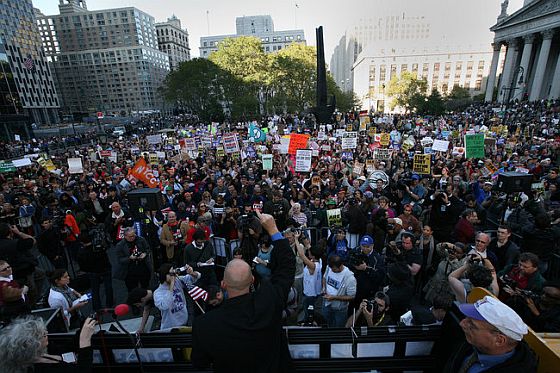
The Occupy Wall Street protest got reinforcements on Wednesday, when several major unions joined in a march and a rally.
If the idea of camping out on Wall Street doesn’t have mass appeal, “we are the 99%” that has been shortchanged by bankers and corporate power and an unrepresentative political system, is a message of solidarity that resonates across America.
New York Times: Stuart Appelbaum, an influential union leader in New York City, was in Tunisia last month, advising the fledgling labor movement there, when he received a flurry of phone calls and e-mails alerting him to the rumblings of something back home. Protesters united under a provocative name, Occupy Wall Street, were gathering in a Lower Manhattan park and raising issues long dear to organized labor.
And gaining attention for it.
Mr. Appelbaum recalled asking a colleague over the phone to find out who was behind Occupy Wall Street — a bunch of hippies or perhaps troublemakers? — and whether the movement might quickly fade.
So far, at least, it has not, and on Wednesday, several prominent unions, struggling to gain traction on their own, made their first effort to join forces with Occupy Wall Street. Thousands of union members marched with the protesters from Foley Square to their encampment in nearby Zuccotti Park.
“The labor movement needs to tap into the energy and learn from them,” Mr. Appelbaum, president of the Retail, Wholesale and Department Store Union, said. “They are reaching a lot of people and exciting a lot of people that the labor movement has been struggling to reach for years.”
Ezra Klein: Right now, the protests are at a tipping point. The unions and MoveOn.org are mounting a sympathy march this afternoon. Van Jones’s Rebuild the Dream and Russ Feingold’s Progressives United are blasting messages of support. Prominent elected Democrats such as Rep. John Larson, Chairman of the House Democratic Caucus; Rep. Louise Slaughter, ranking member on the House Rules Committee; and Sen. Jeff Merkley have all applauded the movement.
What these Democrats and liberal-activist groups are looking for is something similar to what conservatives found in the tea party: an opportunity to recharge and rebrand. Governance exhausts a movement. The compromises sap it of its purity; the institutional ties rob it of its authenticity; and in times when the American people are unhappy, the consequences undermine its agenda. In 2009, that’s where the Republicans were. The Bush administration had left them identified with an unpopular president, yoked to a terrible economy and discredited as a governing force. So they stopped being Bush Republicans and became Tea Party Republicans.
In 2011, elected Democrats and activist groups affiliated with the Democratic Party are in a similar situation. They’ve compromised on their agenda. They’re yoked to a terrible economy and an unpopular president. They’ve watched the grass-roots energy migrate to the tea party right. They no longer hold the mantle of change. And here, all of a sudden, comes Occupy Wall Street, which seems to have tapped into the zeitgeist, and the slogan “We are the 99 percent,” which is something every liberal message man in town wishes he had come up with. You can see the appeal.
That isn’t to say these groups are trying to co-opt Occupy Wall Street. They’re not. Or, at least, they don’t think they are. They just want some of that grass-roots magic, too. They see a space opening up for aggressive, populist organizing, and they want in on it.
The Plum Line: “I’m really encouraged by what I’m seeing. People around the country are finally organizing to stand up to the huge influence of corporations on government and our lives. This kind of citizen reaction to corporate power and corporate greed is long overdue.”
That’s Russ Feingold, who spoke with me yesterday in order to voice his strong support for Occupy Wall Street, making him one of the most prominent liberal Democrats in the country to endorse the protests. Feingold’s strong backing will be seen as significant by the movment’s supporters, because thus far few elected Dems have publicly voiced support for it.
Feingold’s career has been all about fighting the influence of corporate money over politics — he championed campaign finance reform, opposed deregulation and voted against Obama’s Wall Street reform bill because it didn’t go far enough — so he has an interesting perspective on the budding movement.
Feingold rejected the argument — made even by some of Occupy Wall Street’s sympathizers — that it has failed to articulate a clear message or agenda, arguing that the coalescing of outrage itself is the story and the message here, even if it seems incohate at times.
“The guys who are protesting are not filing legal briefs,” he said. “They are expressing the populist, genuine view that people have been ripped off. It’s a fundamental identification of the fact that people are getting taken for a ride by powerful interests who are getting away with murder.”
Washington Post: Prominent House Democrats are embracing the Occupy Wall Street protests as demonstrations are spreading across the country and gaining support from traditional progressive institutions. Democratic leaders in Congress say that there’s a lot to like about movement’s central message that corporate greed is fueling a growing income gap. And the enthusiasm from Democrats in Washington suggests that they think this sentiment will resonant across the country.
Describing the protests as “serious” and “encouraging,” Rep. Peter Welch (D-Vt.) praised the sentiment motivating Occupy Wall Street and called for Congress to take heed. “It’s got a clear message, and that is frustration with the way that business is being done, the way that wealth is tilting towards the high end and the middle class is shrinking. And that message needs to be given,” Welch, a member of the Congressional Progressive Caucus, told me on Wednesday. What’s more he added, “it’s a real grassroots, citizens-led initiative. It’s not a top-down effort, it’s bottom up. In that sense, I think it’s very similar to the tea party.”
Other progressive Democrats are even more enthusiastic. “I’m so proud to see the Occupy Wall Street movement standing up to this rampant corporate greed and peacefully participating in our democracy,” said Rep. Louise Slaughter (D-NY). The co-chairs of the Progressive Caucus, Reps. Keith Ellison and Raul Grijalva, issued a joint statement to express “solidarity” with the movement, describing themselves as inspired by the mass movement. “We join the calls for corporate accountability and expanded middle-class opportunity,” they wrote. “The silent masses aren’t so silent anymore. They are fighting to give voice to the struggles that everyday Americans are going through,” added Rep. John Larson in his own statement supporting Occupy Wall Street.
Time: As the momentum surrounding the Occupy Wall Street protest grows, so too has the urge to frame it in the context of other struggles around the world. Already, Zuccotti Park, the patch of Lower Manhattan taken over for weeks now by the protesters, has been hailed as an American Tahrir Square, a font for a “U.S. autumn” as that plaza in Cairo was for the Arab Spring. Days of action and protest have been dubbed “days of rage,” a gesture to recent, far bloodier episodes of dissent on the streets of Syria, Yemen, Bahrain and elsewhere in the Middle East. When some 700 activists were detained while marching across the Brooklyn Bridge over the weekend, they were, according to some reports, “kettled” — a tactic used by London’s Metropolitan Police against student demonstrators frequently over this past year. And a colleague of mine asked whether the protesters were the left’s answer to the far-right U.S. Tea Party.
Yet no parallel seems more apt than what’s been taking place immediately across the Atlantic in Spain. The indignados, the outraged, have massed in Madrid and other cities across the country since May, furious at the debt-ridden nation’s turn toward austerity measures at a time of over 20% unemployment and enraged by the haplessness and incapacity of political leaders and prevailing global economic institutions to stave off catastrophe. The occupations of iconic squares like Madrid’s Puerta del Sol are in some sense the template followed now by American protesters in a growing number of cities — around 148, according to organizers in Lower Manhattan — across the United States.
“We see ourselves as the continuation of this global movement,” says Patrick Bruner, who, at the time of writing, was the designated press secretary of Occupy Wall Street. “And it’s now springing up in a place where most of the world’s problems originated — Wall Street.” Not surprisingly, sensing the importance of what’s transpiring in Manhattan, organizers in Spain have already called for Oct. 15 to be a global day of action.
Who are we? Well, who are you? If you’re reading this, there’s a 99 percent chance that you’re one of us.
You’re someone who doesn’t know whether there’s going to be enough money to make this month’s rent. You’re someone who gets sick and toughs it out because you’ll never afford the hospital bills. You’re someone who’s trying to move a mountain of debt that never seems to get any smaller no matter how hard you try. You do all the things you’re supposed to do. You buy store brands. You get a second job. You take classes to improve your skills. But it’s not enough. It’s never enough. The anxiety, the frustration, the powerlessness is still there, hovering like a storm crow. Every month you make it is a victory, but a Pyrrhic one — once you’re over the hump, all you can do is think about the next one and how much harder it’s all going to be.
They say it’s because you’re lazy. They say it’s because you make poor choices. They say it’s because you’re spoiled. If you’d only apply yourself a little more, worked a little harder, planned a little better, things would go well for you. Why do you need more help? Haven’t they helped you enough? They say you have no one to blame but yourself. They say it’s all your fault.
They are the 1 percent. They are the banks, the mortgage industry, the insurance industry. They are the important ones. They need help and get bailed out and are praised as job creators. We need help and get nothing and are called entitled. We live in a society made for them, not for us. It’s their world, not ours. If we’re lucky, they’ll let us work in it so long as we don’t question the extent of their charity.
We are the 99 percent. We are everyone else. And we will no longer be silent. It’s time the 1 percent got to know us a little better.
Were you ever at a lynching? Were you ever someplace where an unbridled mob was beating you and your friends and then chasing you to beat you again? Were you ever the victim of wild violence before the blind eyes of policemen who ignored your desperate calls for help? Have you ever felt abandoned? The following story begins with blood, but its point is the abandonment.
What happened Friday afternoon at the entrance to the settlement of Anatot was a pogrom, a lynching. There’s no other way to describe an event in which hundreds of large men are wildly beating and pursuing a nonviolent group of male and female activists for an extended period of time. There’s no way to convey to those who weren’t there the threatening sense of the approaching dark – not in words, not in pictures, not even in video.
They came to destroy, to break, perhaps even to kill. They used their hands, their fists and their teeth, along with stones, pipes and knives. They aimed for the photographers, the women, for the young and the old alike. They brought individuals down to the ground and assaulted them as they lay there, surrounded. They pounced on the hindmost of those trying to flee as they pursued their battered victims.
And all this was taking place before the very eyes of the police, who didn’t do a thing to prevent people from being hurt. It all passed, as usual, in a thunderous silence.
Assaf Sharon, from Sheikh Jarrah Solidarity, provides more background.
For decades, the Israeli government and police force have passively allowed settlers to act violently against Palestinians and Israelis who protest the occupation. Last Friday, when a mob of settlers attacked a group of Palestinian farmers and Israeli solidarity activists outside the settlement of Anatot, a new level of collusion was reached: not only did the police not act to stop the mob of settlers, but indeed many of the settlers in the mob were themselves out-of-uniform policemen and state employees. The press was silent. The occupation has found a new way to silence non-violent resistance and dissent.
At first glance, Anatot is a pastoral gated community close to Jerusalem, inhabited by law-abiding citizens, many of whom are employed by the Civil Administration and the police.
But despite its benign appearance, Anatot is a settlement, located in Palestinian territory occupied in 1967. Anatot was built in 1982 on land allocated by the Israeli government, and inexpensive housing was offered to police officers and other government employees in order to encourage them to live and work in the otherwise unattractive area known by the Israeli government and settlers as “Judea and Samaria,” and by the rest of the world as the West Bank.
Like many other settlements, Anatot is surrounded by a separation fence that envelops acres of privately-owned Palestinian land. Six years ago, the residents of Anatot decided to expand their settlement southward. They neither requested nor received government permits to expand. They simply rerouted the settlement’s fence to encompass additional private Palestinian land, including land owned by a farmer named Yassin el-Rafa’i and his family, who are citizens of Israel.
For years, settlers from Anatot have regularly harassed el-Rafa’i. On multiple occasions, settlers have uprooted el-Rafa’i’s trees and otherwise damaged his property, including poisoning his well with animal carcasses. El-Rafa’i has filed numerous complaints with the local police, but to no avail. The police have consistently refused to address el-Rafa’i’s complaints, or to take any action whatsoever to restrain the settlers’ continued harassment.
Last Friday (9/30/2011), a group of a dozen Israeli activists from The Sheikh Jarrah Solidarity Movement, Ta’ayush, and other groups, went to visit Yassin el-Rafa’i and his wife Iman, in order to hear their story and to express friendship and solidarity. While the activists were getting ready to go home, a crowd of nearly a hundred settlers from Anatot surrounded the el-Rafa’i family and the Israeli activists. The mob of settlers quickly grew violent, and began to attack Iman, Yassin and the Israeli activists with fists, rocks and clubs. Three people were hospitalized, including Yassin and Iman, and several activists were detained for interrogation.
During the entire incident, uniformed police officers were present, and did nothing to stop or restrain the mob, despite the activists’ repeated pleas for intervention. Not a single settler was detained or arrested. No journalists were present, and the majority of the evidence was destroyed by the attackers, who specifically targeted cameras, breaking or stealing them and beating the photographers.
That evening, a group of about 40 Israeli activists returned to Anatot, to protest the brutalities committed earlier that day. The activists held a nonviolent demonstration in front of the settlement’s locked gate, while hundreds of settlers amassed on the other side. Some had participated in the afternoon’s violent attack, and some were soldiers and police officers in civilian dress: a horde of men seething with hatred and hungry for violence.
The settlers demanded that the gates be opened, and charged at the activists, again with fists, rocks, and clubs. The police officers in uniform that were present did nothing to restrain the crowd. One of the attackers tried a number of times to stab activists with a knife. When we tried to get away from the place, the attackers chased us, chanting “Death to Arabs!” and “Death to leftists!” They were accompanied by a group of uniformed police officers. About 10 demonstrators were injured, three of whom were evacuated for medical treatment. Six cars were seriously damaged or destroyed. On one of them a Jewish star, a Magen David, was incised.
Despite the attack, which was caught in stills and in video, the police did not arrest a single rioter.
Quartet envoy Tony Blair has been the target of stinging criticism of late from officials close to Palestinian Authority leader Mahmoud Abbas. There have even been murmurs that Abbas’ officials may formally request Blair’s removal.
While Blair’s Quartet role, which he took up the day he left office as UK prime minister in 2007, has undoubtedly been harmful to the Palestinian people and to any semblance of international law, it would not be enough to call for Blair to go.
It is the Quartet itself – an ad hoc committee of US, EU and Russian officials, and the UN Secretary General, that monopolises the so-called “peace process” – that has destroyed what little credibility the United Nations has left on the question of Palestine.
It functions as a front that launders Israeli and American demands as UN and “international” positions, sidelining international law and countless resolutions declaring myriad Israeli actions to be grave breaches of the Geneva Conventions.
To begin to restore UN credibility, Secretary General Ban Ki-moon should end UN membership, funding and support for the Quartet. If he doesn’t, UN member states should demand that he do so.
In May 2008, a unit of Koch Industries Inc., one of the world’s largest privately held companies, sent Ludmila Egorova-Farines, its newly hired compliance officer and ethics manager, to investigate the management of a subsidiary in Arles in southern France. In less than a week, she discovered that the company had paid bribes to win contracts.
“I uncovered the practices within a few days,” Egorova- Farines says. “They were not hidden at all.”
She immediately notified her supervisors in the U.S. A week later, Wichita, Kansas-based Koch Industries dispatched an investigative team to look into her findings, Bloomberg Markets magazine reports in its November issue.
By September of that year, the researchers had found evidence of improper payments to secure contracts in six countries dating back to 2002, authorized by the business director of the company’s Koch-Glitsch affiliate in France.
“Those activities constitute violations of criminal law,” Koch Industries wrote in a Dec. 8, 2008, letter giving details of its findings. The letter was made public in a civil court ruling in France in September 2010; the document has never before been reported by the media.
Egorova-Farines wasn’t rewarded for bringing the illicit payments to the company’s attention. Her superiors removed her from the inquiry in August 2008 and fired her in June 2009, calling her incompetent, even after Koch’s investigators substantiated her findings. She sued Koch-Glitsch in France for wrongful termination.
Koch-Glitsch is part of a global empire run by billionaire brothers Charles and David Koch, who have taken a small oil company they inherited from their father, Fred, after his death in 1967, and built it into a chemical, textile, trading and refining conglomerate spanning more than 50 countries.
Koch Industries is obsessed with secrecy, to the point that it discloses only an approximation of its annual revenue — $100 billion a year — and says nothing about its profits.
Not even Egypt’s interim military rulers know when they plan to relinquish power to a new civilian government, the United States ambassador to Egypt, Anne W. Patterson, said Tuesday.
Speaking at a news conference here with Defense Secretary Leon E. Panetta after he met with the Egyptian military leaders, Ms. Patterson offered an unusually candid assessment of the haze over Egypt’s path toward democracy after the revolution that ousted President Hosni Mubarak eight months ago.
Asked if American officials knew whether the Egyptian military council intended to turn over power at the seating of a newly elected Parliament in March, or the planned adoption of a new constitution later in 2012, or the election of a president some months beyond that, Ms. Patterson said, “I don’t think, frankly, the military knows or anyone else knows.”
“This process has really been fraught with uncertainty from the very beginning and decisions are often made on a day-to-day basis, so I would expect that to continue for a while,” she added.
Western nations have lamented China and Russia’s vetoes of a UN Security Council resolution condemning Syria’s crackdown on anti-government protests.
France said it was a “sad day” for Syria, while the US ambassador to the UN expressed “outrage”.
The resolution had been watered down to try to avoid the vetoes, dropping a direct reference to sanctions.
Meanwhile, Syrian TV has broadcast images of a woman it said Amnesty International had declared dead.
The proposed resolution, drafted by European states, was the latest effort to pressure Syria over a crackdown in which the UN estimates more than 2,700 people have been killed.
Dressed in rags and holding a cellphone, Muammar Gaddafi sits in the shade of an oasis palm in the southern Libyan desert. He gazes wistfully at signs that say “Niger 450 km”, “Burkina Faso 2,700 km”, “Algiers, 650 km”.
The cartoon, displayed on an easel in the lobby of Tripoli’s Mahari hotel, raises a smile from patrons checking their AK-47 assault rifles and machine pistols in the wooden gun rack behind the security desk.
Just about no one knows where the former leader is hiding, six weeks after Libya’s revolution finally broke his hold on the capital in an operation coordinated with NATO and Arab powers.
His aides and some of his sons scattered to provincial strongholds, where at least two — Mutassem and Saif al-Islam — are now believed to be fighting for their survival, respectively in Gaddafi’s coastal home town of Sirte and the inland town of Bani Walid.
Of their father, there is little trace.
But by coincidence rather than design, the mocking portrait of Gaddafi in the Mahari, temporary home to senior revolutionary fighters, illustrates neatly the working assumptions that lie behind the manhunt.
Such clues as exist seem to point south, placing the 69-year-old close to the country’s southern borders with sub-Saharan Africa.
And, as the drawing suggests, those who are tracking him suspect he is seeking a refuge in a Sahelian or sub-Saharan country, the regions where the man who called himself Africa’s “King of Kings” cultivated allies for decades.
A move abroad would place him at risk of arrest by African countries which are signed up to The Hague war crimes court. Many suggest he could outfox his pursuers by hiding in plain sight in an urban setting in Libyan’s north — a tactic employed successfully for years by al Qaeda leader Osama bin Laden until his killing by U.S. forces in Pakistan in May.
But in many respects the Sahara makes sense.
It may look near-empty from the map, but the world’s biggest desert serves as a contraband superhighway, especially at night when fewer eyes — including satellites — are watching.
The 69-year-old may now calculate he can vanish among the smugglers, shepherds, bandits, illegal migrants and militants who roam this part of Africa without a trace.
From what could be Gaddafi’s last refuge, Reuters reports:
Many residents of Sirte, Muammar Gaddafi’s birth-place, blame Libya’s new rulers and their Western allies for the death and destruction unleashed on their city by weeks of fighting.
Most are reluctant to talk openly about their allegiances, for fear they will be branded as members of a pro-Gaddafi fifth column. Yet their anger and bitterness is clear.
“This country has been built around one man. If he is over, Libya will be over,” said a resident who gave his name as al-Fatouri, standing outside his home on the outskirts of Sirte.
“Gaddafi is like a picture frame. When part of the frame is hit, the whole picture will be destroyed, Libya will be destroyed,” he said.
Sirte is the sternest test yet of the ability of the interim government, the National Transitional Council (NTC), to win over Gaddafi’s tribe and prevent it from mounting an Iraq-style insurgency that would destabilise Libya and the region.
While most cities captured by NTC forces have rejoiced, or at least given that impression, Sirte is different because it is home to members of Gaddafi’s tribe who genuinely back him.
“Let them look for Muammar, but do not kill 50,000 people to change the regime,” said Fatouri. “It is not worth it that thousands die in Sirte for Muammar. This is what saddens us.”
Fatouri said he, like thousands of other people from this city on the Mediterranean coast, had fled his home days ago because of the fighting. He decided later to come back.
“We refuse to leave, we don’t want to suffer… We would rather die here than leave our houses and suffer,” he said.
As he spoke, the sound of shelling and heavy machine guns reverberated around him and a crowd of locals gathered.
“They (NTC forces) used to start their day with bombing us, and finish it with bombing us… The kids used to hear the shelling like music,” said another resident standing nearby.
It began as the brainchild of activists across the border in Canada when an anti-consumerism magazine put out a call in July for supporters to occupy Wall Street.
Now, three weeks after a few hundred people heeded that initial call and rolled out their sleeping bags in a park in New York’s financial district, they are being joined by supporters in cities across the US and beyond.
Armed with Twitter, Facebook and shared Googledocs, protesters against corporate greed, unemployment and the political corruption that they say Wall Street represents have taken to the streets in Boston, Los Angeles, St Louis and Kansas City.
The core group, Occupy Wall Street (OWS), claims people will take part in demonstrations in as many as 147 US cities this month, while the website occupytogether.org lists 47 US states as being involved. Around the world, protests in Canada, the UK, Germany and Sweden are also planned, they say.
The speed of the leaderless movement’s growth has taken many by surprise. Occupytogether.org, one of several sites associated with the protest, has had to be rebuilt to accommodate the traffic.
OWS media spokesman Patrick Bruner said: “We have on our board right now 147 US cities. I don’t know whether they are occupied or they are planning on being occupied. My guess would be over 30 cities are occupied.”
The original call by the Canadian magazine Adbusters to occupy Wall Street drew hundreds of protesters on 17 September and 2,000 attended a march the following Saturday. But the movement, which organisers say has its roots in the Arab spring and in Madrid’s Puerta del Sol protests, has been galvanised by recent media attention.
Scott Stringer, the Manhattan Borough President, writes:
As the Occupy Wall Street protests stretch into their third week, New Yorkers may still be confused about who the protestors are and what exactly they want. But there should be no mistaking the fears and concerns that motivate them — and continue to bring more into the streets. It would be a mistake to dismiss them as a noisy, disaffected fringe movement, because the grievances that drive them touch a deepening chord with millions of other Americans.
Simply put, many of the protestors are angered by the feeling that government hasn’t done enough to stem the tide of economic fall-out caused by the last recession. They are outraged that millions of Americans from all walks of life are unable to find or keep jobs. They are vocal about the widening chasm between rich and poor in our country. And they believe the government has turned a deaf ear to the fact that today’s middle class must struggle harder every year to keep its head above water.
The empirical basis for the protesters’ angry slogans is not hard to find. For generations, worker wages rose in lockstep with productivity. From 1947-1979, productivity increased 119% while hourly compensation increased 100%. But since 1980, compensation has stagnated, growing only 8%, while productivity has raced along at 80%.
We don’t need to look beyond the Hudson for evidence of this widening inequality. As the Census Bureau recently revealed, my own borough of Manhattan has the largest income gap of any county in the United States, with top 20% of earners making close to 38 times as much as the bottom 20%. For the first time since 2000, more than one in five New Yorkers is living below the federal poverty line ($22,350 for a family of four). The percentage of children suffering in poverty is even worse — a staggering 30%. At the same time, the top 1% of Americans own 35% of the nation’s wealth. As the protesters’ signs say, “We are the other 99%.”
As some of America’s biggest corporations push for a tax holiday on more than $1tn of overseas profits, a new survey has revealed that the last time such a measure was tried it ended in the loss of hundreds of thousands of jobs.
The study could be a setback to the aggressive push by a coalition of American businesses, called Win America, which includes big-name firms like Apple, Google and Pfizer. The group has employed more than 160 lobbyists to push its agenda, claiming that the companies will use the tax break to bring back money overseas and invest it in building new facilities and creating jobs.
But a report carried out by the Washington-based Institute for Policy Studies has examined the last time such a move was carried out. That was in 2004, when a similar scheme allowed 843 firms to cut their tax rate on repatriating overseas profits from 35% to 5%.
The firms then brought home $312bn and avoided paying $92bn in government taxes in return for a promise to create jobs. The measure was called the American Job Creation Act.
However, the IPS study measured the actions of some of the largest firms who took advantage of the tax holiday, and found that 58 of them had then slashed 591,000 jobs. The companies accounted for a massive 70% of the repatriated funds, and saved around $64bn they would have otherwise paid out in taxes. The firms included Ford, Pfizer, Eastman Kodak, General Electric and Verizon.
YouTube videos for an operation called Invade Wall Street first appeared on Monday, calling for online activists to download specific software necessary to carry out a denial of service attack against the New York Stock Exchange on October 10. One video, titled "A Message to the Media," said the group had chosen "to declare war against the New York Stock Exchange," adding, "on October 10th, NYSE shall be erased from the Internet." The video carries the Anonymous logo and comes from a YouTube user called The Anonymous Message. The same user has uploaded 13 other videos since joining YouTube in July, including a threat last week to carry out a cyber-attack of the New York Police Department which doesn't seem like it happened.
But on Twitter, where the #InvadeWallStreet hashtag first gained traction on Monday via Anonymous-related accounts, a backlash now warns would-be participants that the attack is a set-up aimed at reaping bad press for Anonymous and the Occupy Wall Street protest. A widely circulated statement warns that "many of our brothers and sisters have gone down in the fight for using such tactics, like the WikiLeaks defendants who took down Visa, Paypal, and Mastercard which led to mass arrests." Another points out that the video "proposes you use depreciated tools that have known flaws," such as a low-orbit ion cannon, a denial of service tool Anonymous members have been busted for using.
A Twitter account called AnonyOps, which has approximated an official Anonymous mouthpiece in the past, broadcast this message on Tuesday: "#invadewallstreet #IWS possibly a psyop? … Don't get roped in by those who want 2 see #occupywallstreet fail.
New forms of activism that have evolved in the Arab world in 2011 are being picked up by activists in the West, speakers at the Third Arab Bloggers’ Meeting have affirmed.
The meeting is the first since the uprisings began, and brings some of the most prominent bloggers in the region together for a three-day gathering.
Previous meetings were held in Lebanon. This year, the event was brought to Tunisia, the country where the spree of uprisings began.
Ten months on, as Tunisia heads to an election that is set to rewrite the rules of its political system, protest movements are blazing far beyond the region.
The innovative use of technologies and methods of dissent that had been used so effectively by Tunisian and Egyptian protesters, in particular, were being picked up in Europe and the US, according to Zeynep Tufekci, a professor at the University of North Carolina.
The forms of civic activism emerging in the region were influencing protesters in other parts of the world, becoming a model for Western countries where citizens had seen an erosion of democracy in recent years, she said.
The parallels between the Tahrir Square protests and the “Occupy Wall Street” movement in the US were clear.
“This is really a very hopeful time in history,” she said.
This website or its third-party tools use cookies, which are necessary to its functioning. By closing this banner, you agree to the use of cookies.