Author Archives: News Sources

Whose side is Obama on?

James Galbraith, speaking at the ADA Education Fund’s Post-election Conference at the Harvard Kennedy School, said:

I want to raise a hard question — a question on which Americans are divided. It seems to me, though, we will get nowhere unless we realize where we are, what has actually happened, and what the future most likely holds.

Recovery begins with realism and there is nothing to be gained by kidding ourselves. On the topics that I know most about, the administration is beyond being a disappointment. It’s beyond inept, unprepared, weak, and ineffective. Four and again two years ago, the people demanded change. As a candidate, the President promised change. In foreign policy and the core economic policies, he delivered continuity instead. That was true on Afghanistan and it was and is true in economic policy, especially in respect to the banks. What we got was George W. Bush’s policies without Bush’s toughness, without his in-your-face refusal to compromise prematurely. Without what he himself calls his understanding that you do not negotiate with yourself.

It’s a measure of where we are, I think, that at a meeting of Americans for Democratic Action, you find me comparing President Obama unfavorably to President George W. Bush.

Facebooktwittermail

WikiLeaks and the Espionage Act

WL Central reports:

Today, Jennifer Robinson, one of the lawyers for Julian Assange, told The Guardian that the US government may be about to press charges against Julian Assange under the Espionage Act. She said that the legal team had heard from “several different US lawyers rumours that an indictment was on its way or had happened already, but we don’t know”. Ms Robinson told ABC News that “Our position of course is that we don’t believe it (the Espionage Act) applies to Mr. Assange and that in any event he’s entitled to First Amendment protection as publisher of Wikileaks and any prosecution under the Espionage Act would in my view be unconstitutional and puts at risk all media organizations in the U.S.”

Rumours about the possibility of Julian Assange having been indicted by a grand jury, whose proceedings are secret, have been circulating for a while. The Christian Science Monitor had a few days ago quoted Stephen Vladeck, an expert in national security law at American University, who said that an empaneled grand jury could have already been considering the case. “We wouldn’t know what they’re doing until the whole thing is concluded,” he said. The Monitor also quoted CNN legal expert Jeffrey Toobin, who said “I would not be at all surprised if there was a sealed arrest warrant currently in existence.”

Prominent civil rights attorney Harvey A. Silverglate, who worked on the Pentagon Papers case, also raised the possibility in an interview with NECN, while also pointing out that prosecution would be extremely difficult, and for many reasons not in the interest of the United States government.

As we previously covered, the legal consensus appears to be that a prosecution under the Espionage Act would be both difficult and dangerous for the United States, notably with regards to First Amendment protections (also see: EFF, ACLU.)

The US Congressional Research Service published on December 6 a report titled “Criminal Prohibitions on the Publication of Classified Defense Information” [PDF]:

This report identifies some criminal statutes that may apply, but notes that these have been used almost exclusively to prosecute individuals with access to classified information (and a corresponding obligation to protect it) who make it available to foreign agents, or to foreign agents who obtain classified information unlawfully while present in the United States. Leaks of classified information to the press have only rarely been punished as crimes, and we are aware of no case in which a publisher of information obtained through unauthorized disclosure by a government employee has been prosecuted for publishing it. There may be First Amendment implications that would make such a prosecution difficult, not to mention political ramifications based on concerns about government censorship. To the extent that the investigation implicates any foreign nationals whose conduct occurred entirely overseas, any resulting prosecution may carry foreign policy implications related to the exercise of extraterritorial jurisdiction and whether suspected persons may be extradited to the United States under applicable treaty provisions. (emphasis ours)

The report’s conclusion states: “Thus, although unlawful acquisition of information might be subject to criminal prosecution with few First Amendment implications, the publication of that information remains protected.”

A new poll finds that only 31% of Americans believe that the publication of secrets is protected by the First Amendment.

This implies that most Americans have unquestioningly swallowed the line that the boundaries that circumscribe freedom for the press are those defined by the US government. The government defines the terms of national security and the press must not challenge those definitions.

In other words, the press should have as much freedom as the government sees fit.

In other words, the press can enjoy the same amount of freedom that a well-trained dog enjoys once it has learned to never strain at its leash.

In other words, most of the Americans who say that America is at war in order to protect our freedom, see that freedom as being akin to the freedom of a domesticated animal.

We know how to bark, how to wag our tails and how to catch treats.

Facebooktwittermail

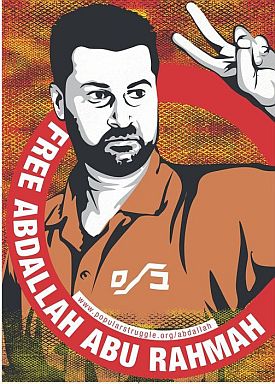
A message from Israeli military prison on International Human Rights Day

Majida Abu Rahmah writes:

A year ago tonight, on International Human Rights Day, our apartment in Ramallah was broken into by the Israeli military in the middle of the night and I was torn away from my wife Majida, my daughters Luma and Layan, and my son Laith, who at the time was only nine months old.

As the coordinator of the Bil’in Popular Committee against the Wall and Settlements I was convicted of “organizing illegal demonstrations” and “incitement.” The “illegal demonstrations” refer to the nonviolent resistance campaign that my village has been waging for the last six years against Israel’s Apartheid Wall that is being built on our land.

I find it strange that the military judges could call our demonstrations illegal and charge me for participating in and organizing them after the world’s highest legal body, the International Court of Justice in The Hague, has ruled that Israel’s wall within the occupied territories is illegal and must be dismantled. Even the Israeli supreme court ruled that the Wall’s route in Bil’in is illegal.

I have been accused of inciting violence: this charge is also puzzling. If the check points, closures, ongoing land theft, wall and settlements, night raids into our homes and violent oppression of our protests does not incite violence, what does?

Despite the occupations constant and intense incitement to violence in Bil’in, we have chosen another way. We have chosen to protest nonviolently together with Israeli and International supporters. We have chosen to carry a message of hope and real partnership between Palestinians and Israelis in the face of oppression and injustice. It is this message that the Occupation is attempting to crush through its various institutions including the military courts. An official from the Israeli Military Prosecution shamelessly told my Attorney, Gaby Lasky, that the objective of the military in my prosecution is to “put an end” to these demonstrations.

Facebooktwittermail

Israel faces tougher line from EU after former heads call for Palestinian state

The Guardian reports:

Twenty-six European grandees have urged the EU to adopt a tougher stance towards Israel including taking “concrete measures” and exacting “consequences” over continued settlement building on occupied land, which they say is illegal under international law.

The former EU leaders said that in the face of “the ongoing deterioration of the situation on the ground”, the EU, in co-operation with other international bodies, should put forward a “concrete and comprehensive proposal for the resolution of this conflict”. A deadline of April 2011 for progress in peace talks between Israel and the Palestinians should be set, after which the international community should intervene.

“Time to secure a sustainable peace is fast running out,” said the group, which includes former EU commissioner Chris Patten, former EU foreign policy chief Javier Solana, former Irish president Mary Robinson and another nine former heads of state. It sent a letter to EU president Herman van Rompuy, foreign affairs chief Catherine Ashton and all EU heads of government before a meeting of foreign ministers on Monday, saying: “It is clear that without a rapid and dramatic move … a two-state solution, which forms the one and only available option for a peaceful resolution of this conflict, will be increasingly difficult to attain.”

Facebooktwittermail

A cyber shot heard round the world

When the stalwart pillar of the establishment, the New York Times, publishes a serious report on Anonymous, it’s fitting to conclude — as does John Perry Barlow from the Electronic Frontier Foundation– that the group has indeed fired a “shot heard round the world.”

They got their start years ago as cyberpranksters, an online community of tech-savvy kids more interested in making mischief than political statements.

But the coordinated attacks on major corporate and government Web sites in defense of WikiLeaks, which began on Wednesday and continued on Thursday, suggested that the loosely organized group called Anonymous might have come of age, evolving into one focused on more serious matters: in this case, the definition of Internet freedom.

While the attacks on such behemoths as MasterCard, Visa and PayPal were not nearly as sophisticated as some less publicized assaults, they were a step forward in the group’s larger battle against what it sees as increasing control of the Internet by corporations and governments. This week they found a cause and an icon: Julian Assange, the former hacker who founded WikiLeaks and is now in a London jail at the request of the Swedish authorities investigating him on accusations of rape.

“This is kind of the shot heard round the world — this is Lexington,” said John Perry Barlow, a co-founder of the Electronic Frontier Foundation, a civil liberties organization that advocates for a freer Internet.

Facebooktwittermail

From Judith Miller to Julian Assange

Jay Rozen says: “Our press has never come to terms with the ways in which it got itself on the wrong side of secrecy as the national security state swelled in size after September 11th.”

Noting that the New York Times did eventually look back at its own role in the build-up to the war in Iraq, Rozen says:

[T]he Times did not look at the problem of journalists giving powerful officials a free pass by stripping names from fear-mongering words and just reporting the words, or of newspapers sworn to inform the public keeping secrets from that same (misinformed) public, of reporters getting played and yet refusing to ID the people who played them because they needed to signal some future player that the confidential source game would go on.

In its look back the Times declared itself insufficiently skeptical, especially about Iraqi defectors. True enough. But the look back was itself insufficiently skeptical. Radical doubt, which is basic to understanding what drives Julian Assange, was impermissible then. One of the consequences of that is the appeal of radical transparency today.

Simon Jenkins got at some of this in a Guardian column on Wikileaks: “Accountability can only default to disclosure. As Jefferson remarked, the press is the last best hope when democratic oversight fails.” But at the nadir the last best hope failed, too. When that happens accountability defaults to extreme disclosure, which is where we are today. The institutional press isn’t driving it; the wilds of the Internet are. To understand Julian Assange and the weird reactions to him in the American press we need to tell a story that starts with Judy Miller and ends with Wikileaks.

Facebooktwittermail

Iranians want nuclear arms, US survey finds

Agence France Presse reports:

Many Iranians are worried about international nuclear sanctions but also want the country to have atomic weapons, according to a survey by a US institute revealed Wednesday.

The poll, carried out by Charney Research for the International Peace Institute, a New York-based think tank, also indicated that most Iranians voted for President Mahmoud Ahmadinejad in a controversial June 2009 election that many countries said was fixed.

Forty-seven percent of Iranians said sanctions ordered by the United Nations, and by individual countries, were having a big impact, said the poll of 700 people carried out in early September. Fifty three percent believed it is Iran’s major foreign policy problem.

But 71 percent of Iranians want the country to have nuclear weapons and only 21 percent opposed such a move. Lead researcher Craig Charney said this compared to 52 percent support for nuclear weapons and 42 percent opposition in a similar poll in 2007.

The fourth round of sanctions was passed by the UN Security Council in June this year. Iran refuses to halt uranium enrichment but has denied the West’s accusations that it is seeking a nuclear bomb.

Charney said the study shows “you can’t just propose the grand bargain and expect Iranians to accept it straight away.”

With international tensions rising, the poll indicated that the number of people who were pro-United States had fallen from 34 percent in 2008 to eight percent now. Sixty-eight percent believed that if there was an attack on Iran, it would come from the United States.

Facebooktwittermail

Israel progresses down the path to isolation

Peter Beinart facetiously congratulates Benjamin Netanyahu now that he’s thwarted President Obama’s Middle East peace efforts.

Now all you have to worry about is…Argentina. You see, Argentina just recognized a Palestinian state on 1967 borders. Brazil did so days earlier. Uruguay and Paraguay are expected to follow suit, and then Bolivia and Ecuador. Oh, and you have a small problem with rock stars: last year Elvis Costello and Carlos Santana cancelled Israel gigs because of the occupation, and more seem poised to follow. Dock workers are another worry: from Sweden to South Africa, they keep protesting the occupation and the Gaza blockade by refusing to offload Israeli goods. And then there’s Hanna King, the 17-year-old Swarthmore freshmen who along with four other young American Jews disrupted your speech last month in New Orleans because, as she told Haaretz, “settlements…are contrary to the Jewish values that we learnt in Jewish day school.” You should probably expect young Jews like her to protest all your big American speeches from now on.

I know, I know. You consider all this unfair, and in some ways it is. But when you’ve been occupying another people for 43 years, confiscating more and more of their land and denying them citizenship while providing it to your own settlers, it doesn’t do much good to insist that things are worse in Burma. Your only effective argument against the Elvis Costellos and Hanna Kings was that you were trying to end the occupation. That’s where Obama came in. As long as the U.S. president seemed to have a chance of brokering a deal, his efforts held the boycotters and protesters and Palestinian state-recognizers at bay. When Brazil and Argentina recognized Palestinian independence, the American Jewish Committee’s David Harris declared it “fundamentally unhelpful to the Arab-Israeli peace process.” But what if there is no peace process? What’s your argument then? Maybe you can tell the Ecuadorians that Israel deserves Hebron because Abraham bought land there from Ephron the Hittite.

Rest assured, the Obama administration won’t go along with these efforts to punish and isolate you. It may even denounce them. But as you may have noticed, the world doesn’t listen to America like it used to. Non-Americans have grown tired of hearing that only the U.S. can broker a deal, especially because you’ve now shown that to be false. And so the dam preventing countries and institutions from legitimizing Palestine and delegitimizing Israel may soon break. You didn’t like the American way? Get ready for the Brazilian way.

Facebooktwittermail

Putin and Lula express support for Assange

Agence France Presse reports:

Vladimir Putin on Thursday led a growing band of international leaders voicing support for WikiLeaks’ boss Julian Assange, describing his detention in Britain as “undemocratic”.

The Russian prime minister’s broadside came as hackers escalated their cyber war on opponents of the whistleblower website, setting their sights on Amazon.com.

“Why was Mr. Assange hidden in jail? Is that democracy? As we say in the village: the pot is calling the kettle black,” Putin said in response to a question on Russia’s undemocratic image in US embassy cables leaked by the website.

His comments echoed Brazil’s President Luiz Inacio Lula da Silva, who expressed “solidarity” with Assange, blasting the Australian activist’s arrest as a blow against “freedom of expression.”

Assange has “exposed a diplomacy that had appeared unreachable,” said Lula, who criticized the failure of other governments to challenge Assange’s detention.

“They have arrested him and I don’t hear so much as a single protest for freedom of expression,” he said.

The Guardian adds:

Russia has suggested that Julian Assange should be awarded the Nobel peace prize, in an unexpected show of support from Moscow for the jailed WikiLeaks founder.

In what appears to be a calculated dig at the US, the Kremlin urged non-governmental organisations to think seriously about “nominating Assange as a Nobel Prize laureate”.

“Public and non-governmental organisations should think of how to help him,” the source from inside president Dmitry Medvedev’s office told Russian news agencies. Speaking in Brussels, where Medvedev was attending a Russia-EU summit yesterday , the source went on: “Maybe, nominate him as a Nobel Prize laureate.”

Facebooktwittermail

WikiLeaks reveals Shell’s grip on Nigerian state

The Guardian reports:

The oil giant Shell claimed it had inserted staff into all the main ministries of the Nigerian government, giving it access to politicians’ every move in the oil-rich Niger Delta, according to a leaked US diplomatic cable.

The company’s top executive in Nigeria told US diplomats that Shell had seconded employees to every relevant department and so knew “everything that was being done in those ministries”. She boasted that the Nigerian government had “forgotten” about the extent of Shell’s infiltration and was unaware of how much the company knew about its deliberations.

The cache of secret dispatches from Washington’s embassies in Africa also revealed that the Anglo-Dutch oil firm swapped intelligence with the US, in one case providing US diplomats with the names of Nigerian politicians it suspected of supporting militant activity, and requesting information from the US on whether the militants had acquired anti-aircraft missiles.

Facebooktwittermail

Why Assange and Wikileaks have won this round

Ian Welsh writes:

The odd thing about Wikileaks is that their success has been assured, not by what they leaked, though there is some important information there, but by their enemies.

The massive and indiscriminant overreaction by both government and powerful corporate actors has ensured this, and includes but is not nearly limited to:

  • Shutting down Wikileaks servers, starting with the Amazon server
  • Stopping domain name server propagation
  • Paypal refusing to send payments
  • VISA and Mastercard refusing to process payments
  • The Swiss Bank PostFinance shutting down Assange’s account
  • Senator Lieberman pressuring firms over Wikileaks
  • The odd behavior of prosecutors in the Assange rape accusations/case

Wikileaks and Assange have now been made in to cause celebres. If corporations and governments can destroy someone’s access to the modern economy as they have Wikileaks, without even pretending due process of the law (Paypal, VISA, Mastercard, Amazon, etc… were not ordered by any court to cut Wikileaks) then we simply do not live in a free society of law, let alone a society of justice.

Meanwhile, the Associated Press reports:

WikiLeaks’ payment processor said Thursday that it was preparing to sue credit card companies Visa and MasterCard over their refusal to process donations to the secret-spilling website.

Andreas Fink, the CEO of Iceland’s DataCell ehf, told The Associated Press that he would seek damages from the American financial companies over their decision to block WikiLeaks funds.

“It’s difficult to believe that such a large company as Visa can make a political decision,” Fink said in a telephone interview from Switzerland. In an earlier statement, his company had defended the WikiLeaks, saying that “it is simply ridiculous to think WikiLeaks has done anything criminal.”

Facebooktwittermail

The accusations against Assange

Kate Harding writes:

You don’t have to be a conspiracy theorist to find the timing of Interpol’s warrant for the arrest of WikiLeaks founder Julian Assange, who turned himself in to British authorities today, curious. The charges — “one count of unlawful coercion, two counts of sexual molestation and one count of rape,” according to a statement from Scotland Yard — were brought against him in Sweden last August, yet he suddenly graduated to “most wanted” status just after releasing over a thousand leaked diplomatic cables in late November? It would be irresponsible of journalists, bloggers and average citizens of countries most eager to plug the gushing WikiLeaks not to wonder if those dots connect.

Still, as the New York Times put it, “there is no public evidence to suggest a connection,” which some members of the public seem to find unbearably frustrating. With no specific target for their suspicions and no easy way to find one, folks all over the blogosphere have been settling for the next best thing: making light of the sexual assault charges and smearing one of the alleged victims.

By Sunday, when Keith Olbermann retweeted Bianca Jagger’s link to a post about the accuser’s supposed CIA ties — complete with scare quotes around the word “rape” — a narrative had clearly taken hold: Whatever Assange did, it sure wasn’t rape-rape. All he did was fail to wear a rubber! And one woman who claims he assaulted her has serious credibility issues anyway. She threw a party in his honor after the fact and tried to pull down the incriminating tweets. Isn’t that proof enough? The only reason the charges got traction is that, in the radical feminist utopia of Sweden under Queen Lisbeth Salander, if a woman doesn’t have multiple orgasms during hetero sex, the man can be charged with rape. You didn’t know?

As of today, even Naomi Wolf — Naomi Effin’ Wolf! — has taken a public swipe at Assange’s accusers, using her status as a “longtime feminist” to underscore the absurdity of “the alleged victims … using feminist-inspired rhetoric and law to assuage what appears to be personal injured feelings.”

Wow. Admittedly, I don’t have as much experience being a feminist as Wolf has, but when I see a swarm of people with exactly zero direct access to the facts of a rape case loudly insisting that the accusation has no merit, I usually start to wonder about their credibility. And their sources.

Laura Flanders: When Interpol cares about sexual assault

Facebooktwittermail

How the US and China colluded to undermine Copenhagen climate summit

Der Spiegel reports:

Last year’s climate summit in Copenhagen was a political disaster. Leaked US diplomatic cables now show why the summit failed so spectacularly. The dispatches reveal that the US and China, the world’s top two polluters, joined forces to stymie every attempt by European nations to reach agreement.

In May 2009 the Chinese leaders received a very welcome guest. John Kerry, the powerful chairman of the Senate Foreign Affairs Committee, met with Deputy Prime Minister Li Keqiang in Beijing. Kerry told his hosts that Washington could understand “China’s resistance to accepting mandatory targets at the United Nations Climate Conference, which will take place in Copenhagen.”

According to a cable from the US embassy in the Chinese capital, Kerry outlined “a new basis for ‘major cooperation’ between the United States and China on climate change.”
At that time, many Europeans were hoping the delegates at the Copenhagen summit would agree climate-change measures that could save the planet from the cumulative effects of global warming. But that dream died pitifully in mid-December 2009, and the world leaders went their separate ways again without any concrete achievements. Confidential US diplomatic cables published by WikiLeaks now show just how closely the world’s biggest polluters — the United States and China — colluded in the months leading up to the conference. And they give weight to those who have long suspected that the two countries secretly formed an alliance.

Facebooktwittermail

US effort to limit Sadr bloc’s influence in new Iraqi government

Christian Science Monitor reports:

The US is warning that it could cut substantial funding to Iraq’s Health, Education, and Transport ministries if the anti-American Sadr bloc is given those cabinet posts in a new government being formed by Prime Minister Nouri al-Maliki.

The comments by a senior US embassy official were the clearest public statements yet of US determination to try to limit the influence of the Sadr movement if it continues to rebuff American overtures. The hardline Shiite bloc won the single biggest number of seats in the Iraqi parliament in March 7 elections but refuses to meet with American officials.

“We accept and understand there are going to be Sadrist ministers, but some of the ministries that have been mentioned in the press as potentially going to the Sadrists happen to be ministries that we look at very closely,” said the embassy official in an interview with the Monitor on Saturday. “We hope that if Sadrists are able to head those ministries, they will be able to take a more pragmatic approach than they have in the past, because it would be a terrible shame for the Iraqi government and the Iraqi people if we were no longer able to run the very substantial education programs we’re running in Iraq.”

The official, speaking on condition of anonymity, cited the education, health, and transport ministries as those which could become impossible to support if the Sadrists continued to oppose dealing with the US. He declined to specify which Iraqi ministries the US would have no problem in seeing the Sadr bloc running.

Facebooktwittermail

Court ruling gives Obama power of judge, jury and executioner

The New York Times reports:

A federal judge on Tuesday threw out a lawsuit that had sought to block the American government from trying to kill Anwar al-Awlaki, a United States citizen and Muslim cleric in hiding overseas who is accused of helping to plan attacks by Al Qaeda’s branch in Yemen.

The ruling, which clears the way for the Obama administration to continue to try to kill Mr. Awlaki, represents a victory in its efforts to shield from judicial review so-called targeted killings, one of its most striking counterterrorism policies.

In an 83-page opinion, Judge John D. Bates said Mr. Awlaki’s father, the plaintiff, had no standing to file the lawsuit on behalf of his son. He also said decisions about targeted killings in such circumstances were a “political question” for executive branch officials to make — not judges.

Judge Bates acknowledged that the case raised “stark, and perplexing, questions” — including whether the president could “order the assassination of a U.S. citizen without first affording him any form of judicial process whatsoever, based the mere assertion that he is a dangerous member of a terrorist organization.”

Jameel Jaffer, a lawyer for the American Civil Liberties Union, said: “If the court’s ruling is correct, the government has unreviewable authority to carry out the targeted killing of any American, anywhere, whom the president deems to be a threat to the nation.” He said: “It would be difficult to conceive of a proposition more inconsistent with the Constitution, or more dangerous to American liberty.”

Facebooktwittermail

There’s a war going on inside America

Robert Reich writes:

The deal the President struck with Republican leaders is an abomination.

It will cost $900 billion over the next two years — larger than the bailout of Wall Street, GM, and Chrysler put together, larger than the stimulus package, larger than anything that’s come out of Washington in years.

It makes a mockery of deficit reduction. Worse, the lion’s share of that $900 billion will go to the very rich. Families with incomes of over $1 million will reap an average of about $70,000, while middle-class families earning $50,000 a year will get an average of around $1,500. In addition, the deal just about eviscerates the estate tax — yanking the exemption up to $5 million per person and a maximum rate of 35 percent.

And for what?

Wealthy families won’t spend nearly as large a share of what they get out of this deal as will middle-class and working-class families, so it doesn’t do much to stimulate the economy.

The deal further concentrates income and wealth in America — when it’s already more concentrated than at any time in the last 80 years.

Facebooktwittermail

How Israel and the US benefited from the murder of Rafik Hariri

Who has benefited most from the assassination of Rafik Hariri in Beirut in 2005? As the International Court of Justice arrives at its version of events, Dyab Abou Jahjah, writing in Open Democracy, finds confirmation in WikiLeaks for pointing us in a different direction.

Lebanon nowadays seems much bigger than it actually is. In a way this is no surprise for a country that always was a playground for regional and international agendas and a laboratory for testing any new formula in the area. However, this time, Lebanon is much more than that. Since 2006 it has become clear to all serious observers that this country is the focal point of a strategic divide, or more accurately the strategic divide in the Middle East. By virtue of the victory of Hezbollah against Israel in 2006, the Lebanese resistance has become a major factor in tipping the balance in favour of the Syrian/Iranian influence in the region as against that of the American/Israeli-led project. The latter project aims at further fragmenting political and social regional structures based upon sectarian and ethnic divisions, in order to create a new Middle East in which – to put it simply – Israel can play boss over everybody.

The Iranian and the Syrian regimes naturally oppose this scheme as it targets them in the first instance, but Iran at least also opposes this for ideological reasons. For the surge of the neo-conservative ‘creative chaos’ strategy in Iraq and beyond, the war against Lebanon in 2006 was supposed to be the final blow to any resistance, especially as this occurred at a time when Iraqi resistance was starting to be divided, weak and marginal, and the American grip over Iraq was growing stronger. Hezbollah’s defeat of the Israeli onslaught stopped the American surge in its tracks. The tide has started to turn since that moment: since then, both the Lebanese resistance and its Syrian and Iranian allies have been strengthened.

At this point, for the Americans and the Israelis a new priority was established: to destroy Hezbollah by any means necessary. This conclusion is confirmed by one of the documents lately published on wikileaks where the heads of the CIA and the Mossad are to be observed contemplating a possible augmentation of the pressure on Syria to make it take its distance from Iran, in order eventually to weaken Hezbollah. In that conversation between Meir Dagan and Frances Townsend, Dagan conveys to his American counterpart the “advantage of such an approach” – that, “the legal ground is already in place for action by the UNSC.” It is in this context that one must read the actions of the international tribunal investigating the death of Rafik Hariri and the indictment of Hezbollah that it will be releasing shortly.

Facebooktwittermail

Truth in chains

Chris Floyd writes:

Well, they got him at last. WikiLeaks founder Julian Assange, the target of several of the world’s most powerful governments, turned himself into British authorities today and is now at the mercy of state authorities who have already shown their wolfish – and lawless – desire to destroy him and his organization.

It has been, by any standard, an extraordinary campaign of vilification and persecution, wholly comparable to the kind of treatment doled out to dissidents in China or Burma. Lest we forget, WikiLeaks is a journalistic outlet – just like The New York Times, the Guardian and Der Spiegel, all of whom are even now publishing the very same material – leaked classified documents — available on WikiLeaks. The website is also a journalistic outlet just like CNN, ABC, CBS, Fox and other mainstream media venues, where we have seen an endless parade of officials – and journalists! – calling for Assange to be prosecuted or killed outright. Every argument being made for shutting down WikiLeaks can – and doubtless will – be used against any journalistic enterprise that publishes material that powerful people do not like.

And the leading role in this persecution of truth-telling is being played by the administration of the great progressive agent of hope and change, the self-proclaimed heir of Martin Luther King and Mahatma Gandhi, the winner of the Nobel Peace Prize, Barack Obama. His attorney general, Eric Holder, is now making fierce noises about the “steps” he has already taken to bring down WikiLeaks and criminalize the leaking of embarrassing information. And listen to the ferocious reaction of that liberal lioness, Sen. Dianne Feinstein, who took to the pages of Rupert Murdoch’s Wall Street Journal to call for Assange to be put in prison – for 2,500,000 years:

When WikiLeaks founder Julian Assange released his latest document trove—more than 250,000 secret State Department cables—he intentionally harmed the U.S. government. The release of these documents damages our national interests and puts innocent lives at risk. He should be vigorously prosecuted for espionage.

“The law Mr. Assange continues to violate is the Espionage Act of 1917. That law makes it a felony for an unauthorized person to possess or transmit “information relating to the national defense which information the possessor has reason to believe could be used to the injury of the United States or to the advantage of any foreign nation.” … Importantly, the courts have held that “information relating to the national defense” applies to both classified and unclassified material. Each violation is punishable by up to 10 years in prison.

So there you have it. Ten years for each offense; 250,000 separate offenses; thus a prison term of 2.5 million years. Naturally, tomorrow the same newspaper will denounce Feinstein for being such a namby-pamby terrorist-coddling pinko: “Why didn’t she call for Assange to be torn from limb to limb by wild dogs, as any right-thinking red-blooded American would do!?”

Facebooktwittermail