Author Archives: News Sources

Wikileaks and the long haul

Clay Shirky writes:

Like a lot of people, I am conflicted about Wikileaks.

Citizens of a functioning democracy must be able to know what the state is saying and doing in our name, to engage in what Pierre Rosanvallon calls “counter-democracy”*, the democracy of citizens distrusting rather than legitimizing the actions of the state. Wikileaks plainly improves those abilities.

On the other hand, human systems can’t stand pure transparency. For negotiation to work, people’s stated positions have to change, but change is seen, almost universally, as weakness. People trying to come to consensus must be able to privately voice opinions they would publicly abjure, and may later abandon. Wikileaks plainly damages those abilities. (If Aaron Bady’s analysis is correct, it is the damage and not the oversight that Wikileaks is designed to create.*)

And so we have a tension between two requirements for democratic statecraft, one that can’t be resolved, but can be brought to an acceptable equilibrium. Indeed, like the virtues of equality vs. liberty, or popular will vs. fundamental rights, it has to be brought into such an equilibrium for democratic statecraft not to be wrecked either by too much secrecy or too much transparency.

As Tom Slee puts it, “Your answer to ‘what data should the government make public?’ depends not so much on what you think about data, but what you think about the government.”* My personal view is that there is too much secrecy in the current system, and that a corrective towards transparency is a good idea. I don’t, however, believe in total transparency, and even more importantly, I don’t think that independent actors who are subject to no checks or balances is a good idea in the long haul.

If the long haul were all there was, Wikileaks would be an obviously bad thing. The practical history of politics, however, suggests that the periodic appearance of such unconstrained actors in the short haul is essential to increased democratization, not just of politics but of thought.

We celebrate the printers of 16th century Amsterdam for making it impossible for the Catholic Church to constrain the output of the printing press to Church-approved books*, a challenge that helped usher in, among other things, the decentralization of scientific inquiry and the spread of politically seditious writings advocating democracy.

This intellectual and political victory didn’t, however, mean that the printing press was then free of all constraints. Over time, a set of legal limitations around printing rose up, including restrictions on libel, the publication of trade secrets, and sedition. I don’t agree with all of these laws, but they were at least produced by some legal process.

Unlike the United States’ current pursuit of Wikileaks.

Facebooktwittermail

Visa and Mastercard are happy to transfer donations to the Ku Klux Klan, but not WikiLeaks

The BBC reports:

Visa Europe has begun suspending payments to whistle-blowing website Wikileaks ahead of carrying out an investigation into the organisation.

It follows a similar move by rival payments processor Mastercard on Tuesday.

Charles Arthur, the Guardian’s technology editor, points out that while MasterCard and Visa have cut WikiLeaks off you can still use those cards to donate to overtly racist organisations such as the Knights Party, which is supported by the Ku Klux Klan.

The Ku Klux Klan website directs users to a site called Christian Concepts. It takes Visa and MasterCard donations for users willing to state that they are “white and not of racially mixed descent. I am not married to a non-white. I do not date non-whites nor do I have non-white dependents. I believe in the ideals of western Christian civilisation and profess my belief in Jesus Christ as the son of God.”

Facebooktwittermail

The arrest of Julian Assange

Outside the court, Assange’s lawyer Mark Stephens said:

WikiLeaks will continue. WikiLeaks is many thousands of journalists around the world. A renewed bail application will be made.

We have heard the judge today say that he wishes to see the evidence himself. He was impressed by the fact that a number of people were prepared to stand up on behalf of Mr Assange. In those circumstances I think we will see another bail application.

They [those offering surety] were but the tip of the iceberg. This is going to go viral. Many people believe Mr Assange to be innocent, myself included. Many people believe that this prosecution is politically motivated.

I’m sure that the British judicial system is robust enough not to be interfered with by politicians and that are judges are impartial and fair. I hope I can say the same about Swedish prosecutors in the future.

In an op-ed appearing today in The Australian, Assange wrote:

The US diplomatic cables reveal some startling facts:

The US asked its diplomats to steal personal human material and information from UN officials and human rights groups, including DNA, fingerprints, iris scans, credit card numbers, internet passwords and ID photos, in violation of international treaties. Presumably Australian UN diplomats may be targeted, too.

King Abdullah of Saudi Arabia asked the US Officials in Jordan and Bahrain want Iran ‘s nuclear program stopped by any means available.

Britain’s Iraq inquiry was fixed to protect “US interests”.

Sweden is a covert member of NATO and US intelligence sharing is kept from parliament.

The US is playing hardball to get other countries to take freed detainees from Guantanamo Bay . Barack Obama agreed to meet the Slovenian President only if Slovenia took a prisoner. Our Pacific neighbour Kiribati was offered millions of dollars to accept detainees.

In its landmark ruling in the Pentagon Papers case, the US Supreme Court said “only a free and unrestrained press can effectively expose deception in government”. The swirling storm around WikiLeaks today reinforces the need to defend the right of all media to reveal the truth.

Glenn Greenwald writes:

According to The New York Times’ Brian Stelter, Matt Lauer — when announcing Assange’s arrest in London this morning — proclaimed: “The international manhunt for Julian Assange is over” — as though Assange is Osama bin Laden or something. I don’t know if it’s sheer empty-headedness or excessive servile-to-power syndrome — probably both, as is usually the case — but that claim is both painfully dumb and misleading. There was no valid arrest warrant in England for Assange until yesterday; he then immediately turned himself into British law enforcement. There was no “international manhunt.” How long before Matt Lauer and his friends start featuring playing cards with all the WikiLeaks Villains on the them (“and here we have Julian Assange, the Terrorist Mastermind, who is the Ace of Spades!”)? Answer: as soon as the Government produces them and hands them to the media with instructions to use them.

The one thing WikiLeaks did not need to leak — it spills out freely of its own accord — is the venality of American journalism.

And for those in the press corps who find it difficult to contain themselves from expressing their personal disdain for Assange, Jack Shafer appropriately commented: “sure, he’s a pompous egomaniac sporting a series of bad haircuts and grandiose tendencies. And he often acts without completely thinking through every repercussion of his actions. But if you want to dismiss him just because he’s a seething jerk, there are about 2,000 journalists I’d like you to meet.”

Facebooktwittermail

The Carmel catastrophe is burning all illusions in Israel

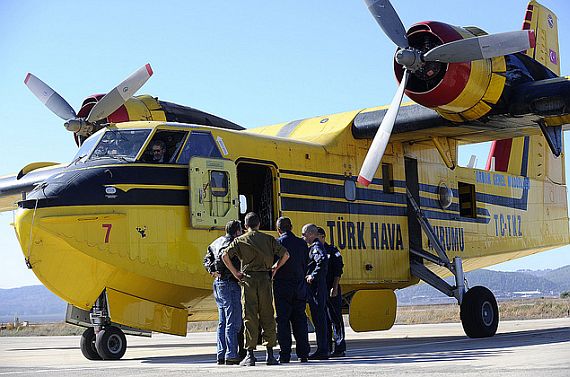
Turkish firefighters arriving in Israel after Netanyahu declares, 'We do not have what it takes to put out the fire, but help is on the way.'

Max Blumenthal puts the Carmel forest fire in context.

“When I look out my window today and see a tree standing there, that tree gives me a greater sense of beauty and personal delight than all the vast forests I have seen in Switzerland or Scandinavia. Because every tree here was planted by us.”
– David Ben Gurion, Memoirs

“Why are there so many Arabs here? Why didn’t you chase them away?”
– David Ben Gurion during a visit to Nazareth, July 1948

Four days after Israeli Prime Minister Benjamin Netanyahu announced plans to place thousands of migrant workers in a prison camp deep in the Negev Desert because, as he claimed, they pose a “threat to the character of [the] country,” a burning tree trunk fell into a bus full of Israeli Prison Service cadets, killing forty passengers. The tree was among hundreds of thousands turned to ash by the forest fire pouring across northern Israel, and which now threatens to engulf outskirts of Haifa, Israel’s third-largest city. Over the last four days, more than 12,300 acres have burned in the Mount Carmel area, a devastating swath of destruction in a country the size of New Jersey. While the cause of the fire has not been established, it has laid bare the myths of Israel’s foundation.

Israelis are treating the fire as one of their greatest tragedies in recent years. A friend who grew up in the Haifa area told me over the weekend that he was devastated by the images of destruction he saw on TV. His friend’s brother was among those who perished in the bus accident. Though he is a dedicated Zionist who supported Netanyahu’s election bid in 2008, like so many Israelis, he was furious at the response — or lack of one — by the government. “Our leaders are complete idiots, but you already know that,” he told me. “They invested so much to prepare for all kinds of crazy war scenarios but didn’t do anything to protect civilians from the basic things you are supposed to take for granted.”

On 3 December, Netanyahu informed the country, “We do not have what it takes to put out the fire, but help is on the way.” To beat back the blaze, Bibi has had to beg for assistance from his counterpart in Turkey, Recep Tayyip Erdogan, the Western-backed Palestinian Authority and Israel’s American and British patrons. Israel is a wealthy country which boasts to the world about its innovative spirit — its US-based lobbyists market it as a “Start-Up Nation” — but its performance during the forest fire revealed the sad truth: its government has prioritized offensive military capacity and occupation maintenance so extensively that it has completely neglected the country’s infrastructure, emergency preparedness and most of all, the general welfare of its citizens.

Facebooktwittermail

The war on free speech

John Naughton writes:

‘Never waste a good crisis” used to be the catchphrase of the Obama team in the runup to the presidential election. In that spirit, let us see what we can learn from official reactions to the WikiLeaks revelations.

The most obvious lesson is that it represents the first really sustained confrontation between the established order and the culture of the internet. There have been skirmishes before, but this is the real thing.

And as the backlash unfolds – first with deniable attacks on internet service providers hosting WikiLeaks, later with companies like Amazon and eBay and PayPal suddenly “discovering” that their terms and conditions preclude them from offering services to WikiLeaks, and then with the US government attempting to intimidate Columbia students posting updates about WikiLeaks on Facebook – the intolerance of the old order is emerging from the rosy mist in which it has hitherto been obscured. The response has been vicious, co-ordinated and potentially comprehensive, and it contains hard lessons for everyone who cares about democracy and about the future of the net.

There is a delicious irony in the fact that it is now the so-called liberal democracies that are clamouring to shut WikiLeaks down.

Consider, for instance, how the views of the US administration have changed in just a year. On 21 January, secretary of state Hillary Clinton made a landmark speech about internet freedom, in Washington DC, which many people welcomed and most interpreted as a rebuke to China for its alleged cyberattack on Google. “Information has never been so free,” declared Clinton. “Even in authoritarian countries, information networks are helping people discover new facts and making governments more accountable.”

She went on to relate how, during his visit to China in November 2009, Barack Obama had “defended the right of people to freely access information, and said that the more freely information flows the stronger societies become. He spoke about how access to information helps citizens to hold their governments accountable, generates new ideas, and encourages creativity.” Given what we now know, that Clinton speech reads like a satirical masterpiece.

Facebooktwittermail

Israel on Iran: So wrong for so long

Justin Elliot looks back at Israel’s repeated predictions that Iran would soon acquire nuclear weapons.

Officials at the U.S. Department of State, we learned from the secret cables released by WikiLeaks last week, have serious questions about the accuracy — and sincerity — of Israeli predictions about when Iran will obtain a nuclear weapon. As one State official wrote in response to an Israeli general’s November 2009 claim that Iran would have a bomb in one year: “It is unclear if the Israelis firmly believe this or are using worst-case estimates to raise greater urgency from the United States.”

So we thought this was as good a time as any to look at the remarkable history of incorrect Israeli predictions about Iran — especially given that the WikiLeaks trove is being used to argue that an attack on Iran is becoming more likely.

According to various Israeli government predictions over the years, Iran was going to have a bomb by the mid-90s — or 1998, 1999, 2000, 2004, 2005, and finally 2010. More recent Israeli predictions have put that date at 2011 or 2014.

Facebooktwittermail

Biggest threat to Iraq comes from closest US ally — Saudi Arabia

The Guardian reports:

Iraqi government officials see Saudi Arabia, not Iran, as the biggest threat to the integrity and cohesion of their fledgling democratic state, leaked US state department cables reveal.

The Iraqi concerns, analysed in a dispatch sent from the US embassy in Baghdad by then ambassador Christopher Hill in September 2009, represent a fundamental divergence from the American and British view of Iran as arch-predator in Iraq.

“Iraq views relations with Saudi Arabia as among its most challenging given Riyadh’s money, deeply ingrained anti-Shia attitudes and [Saudi] suspicions that a Shia-led Iraq will inevitably further Iranian regional influence,” Hill writes.

“Iraqi contacts assess that the Saudi goal (and that of most other Sunni Arab states, to varying degrees) is to enhance Sunni influence, dilute Shia dominance and promote the formation of a weak and fractured Iraqi government.”

Hill’s unexpected assessment flies in the face of the conventional wisdom that Iranian activities, overt and covert, are the biggest obstacle to Iraq’s development.

Facebooktwittermail

Al-Qaida is the least of impoverished Yemen’s problems

Ian Black writes:

It is hard to know where to start when looking at unhappy Yemen’s many problems – but one thing is certain: the threat of resurgent al-Qaida terrorism that so preoccupies the US and other western countries is not its biggest one.

The poorest country in the Arab world, Yemen is running out of oil and water and suffers from catastrophically high population growth. Its largely tribal society has more in common with underdeveloped African countries than its wealthy Gulf neighbours, who tend to view it as a source of dangerous instability.

Stunning scenery and architecture once made it a magnet for adventurous western tourists, but kidnapping and terrorism have damaged its image and shrunk its foreign currency earnings. President Ali Abdullah Saleh, in power since 1978, is a classic Arab strongman – although he presides over a republican system more democratic than most in a region of hereditary monarchies. He has described ruling Yemen’s 24 million people as “dancing on the heads of snakes”.

The Guardian reports:

The president of Yemen secretly offered US forces unrestricted access to his territory to conduct unilateral strikes against al-Qaida terrorist targets, the leaked US embassy cables reveal.

In a move that risked outraging local and Arab opinion, Ali Abdullah Saleh told Barack Obama’s deputy national security adviser, John Brennan, in September 2009: “I have given you an open door on terrorism. so I am not responsible,” according to a secret dispatch back to Washington

In reality, despite the offer of an “open door”, Yemen has restricted access for US forces in order to avoid playing into the hands of Saleh’s domestic critics.

The Guardian reports:

Yemen’s long-serving president, Ali Abdullah Saleh, emerges from the US embassy cables as a perplexing partner in the “war on terror” who flits from disdain for the Americans to congeniality while all the time wrestling to keep a lid on the simmering tensions in a country that he warns is on the brink of becoming “worse than Somalia”.

The 64-year-old, who has ruled Yemen for half his life, is variously labelled as “petulant” and “bizarre” in his negotiations with US security officials who met him in Yemen on several occasions in 2009 as concern grew about al-Qaida’s resurgence in the country.

In a series of three meetings Saleh painted a picture of himself as a leader on the brink of disaster whose policies are marked by unpredictable volatility, while maintaining a relaxed, almost debonair manner. At one stage he met the US ambassador and a senior CIA man at his country retreat “relaxed in an open collar white shirt and dark trousers” while “above his left eye were visible the traces of a cut he suffered in a fall on the deck of the swimming pool at the presidential palace in Sana’a”.

Facebooktwittermail

Odious NGO Monitor smears Electronic Intifada, tries to cut funding

At Mondoweiss, Cecilie Surasky writes:

NGO Monitor was captured perfectly in The Forward by liberal jewish thinker Leonard Fine who said it was “an organization that believes that the best way to defend Israel is to condemn anyone who criticizes it.” But now, no longer satisfied with its McCarthyite efforts to not just condemn, but actually take down respected human rights organizations, it is seeking to stop critical funding of the Electronic Intifada, a key media source for information and analysis about the Israeli-Palestinian conflict.

Electronic Intifada (EI) is a pioneering online news outlet that has been an essential resource for activists, scholars and journalists since its inception in 2002. Its coverage is unapologetically sympathetic to the Palestinian struggle for human rights, grounded in an understanding of international law and universal human rights. Years before the current proliferation of blogs and alternate news sources, EI was there first, providing a much needed antidote to one-sided mainstream news coverage of Israel and Palestine. And they continue to provide original reporting and news and analysis you still can’t get anywhere else.

Which perhaps is why NGO Monitor has made the preposterous claim that EI is “an anti-Semitic website,” stunningly based on the fact that one staffer is a supporter of the BDS movement and executive director, Ali Abunimah, in his non EI-related speaking engagements, “calls for a one-state solution to the Israeli-Palestinian conflict and routinely uses false apartheid rhetoric.” Really? This is what they’ve got?

Facebooktwittermail

Carmel inferno proves Israel can’t afford war with Iran

Aluf Benn writes:

The enormous blaze that broke out on the Carmel will be remembered as the Yom Kippur War of the Fire and Rescue Service, who were not prepared to counter a disaster of such magnitude.

Yesterday it turned out that Israel is not prepared for war or a mass terrorist strike that would cause many casualties in the home front. The warning of the outgoing Military Intelligence Chief, Amos Yadlin, that the next war will be a lot more difficult than past experiences, and that Tel Aviv will be a front line, was not translated into the necessary preparation by the authorities assigned the protection of the civilians.

Under such circumstances, it is best for Israel not to embark on war against Iran, which will involve thousands of missiles being fired on the home front.

After the Second Lebanon War, which exposed how pathetic the civil defense system was, reports were written, exercises were held, but everything broke down under the stress of a real emergency on the Carmel range − an area that already experienced the trauma of Hezbollah missiles.

Yesterday Israel asked for help from Cyprus and Greece, and the air force traveled to France to bring fire retardants to make up for the material that had run out. In war time, it is doubtful whether Israel will be able to rely on the generosity and largess of its neighbors.

Joseph Dana adds:

Despite Israel’s international call for aid to help fight the raging wildfires in the north of the country, the Israeli army had plenty of extra soldiers to suppress the weekly unarmed demonstrations in Nabi Saleh, Ni’ilin and Bil’in. Instead of diverting all available resources to suppressing the fire, the government continued to devote resources to suppressing Palestinian non-violence in the West Bank. Even American neoconservative pundits have taken note of Israel’s reckless policy of resource management as displayed with the wildfire crisis. How long will the international community support these reckless decisions by the Israeli government? Why would the Israeli government make the decision to provoke unarmed Palestinian demonstrations with the negligent use of rubber bullets and tear gas at a time of national crises?

Facebooktwittermail

Why should Iran trust President Obama?

Flynt Leverett and Hillary Mann Leverett write:

In the run-up to a new round of nuclear talks between the P5+1 and Iran on Monday, Western commentators are re-hashing old arguments that the Islamic Republic is either too politically divided or too dependent on hostility toward the United States for its legitimacy to be seriously interested in a nuclear deal. From this perspective, the Obama administration has been more than forthcoming in its efforts to “engage” Tehran; the obstacles to diplomatic progress are all on the Iranian side.

But a sober examination of the Obama administration’s interactions with Iran since President Obama took office in 2009 reveals a dismaying mix of incompetence and outright duplicity that has done profound damage to American interests and credibility. In light of this record, the question is not whether the United States should have any confidence it can productively engage the Islamic Republic. The real question is: why should Iranian officials believe they can trust President Obama and his administration to deal with them straightforwardly and with a genuine interest in finding a diplomatic solution to the nuclear standoff?

The recent release of the Wikileaks cables confirms the assessment we have been offering since May 2009: The Obama administration has failed to follow up on President Obama’s early rhetorical overtures to Tehran with bold steps and substantive proposals to demonstrate its seriousness about rapprochement. Strategic engagement — think Nixon and China — is not the same as “carrots and sticks”. In fact, strategic engagement requires a self-conscious effort by the United States to put “sticks” aside in order assure Iran that it is serious about realigning relations. And that is something the Obama administration has never been willing to do. (Obama’s vague letters to Iran’s Supreme Leader, Ayatollah Ali Khamenei — dispatched as Obama ignored two letters sent by Iranian President Mahmoud Ahmadinejad — were seen in Tehran as just the latest U.S. attempt to “game” Iran’s political system rather than to come to terms with it.)

Facebooktwittermail

Obama and GOPers worked together to kill Bush torture probe

David Corn reports:

In its first months in office, the Obama administration sought to protect Bush administration officials facing criminal investigation overseas for their involvement in establishing policies the that governed interrogations of detained terrorist suspects. A “confidential” April 17, 2009, cable sent from the US embassy in Madrid to the State Department—one of the 251,287 cables obtained by WikiLeaks—details how the Obama administration, working with Republicans, leaned on Spain to derail this potential prosecution.

The previous month, a Spanish human rights group called the Association for the Dignity of Spanish Prisoners had requested that Spain’s National Court indict six former Bush officials for, as the cable describes it, “creating a legal framework that allegedly permitted torture.” The six were former Attorney General Alberto Gonzales; David Addington, former chief of staff and legal adviser to Vice President Dick Cheney; William Haynes, the Pentagon’s former general counsel; Douglas Feith, former undersecretary of defense for policy; Jay Bybee, former head of the Justice Department’s Office of Legal Counsel; and John Yoo, a former official in the Office of Legal Counsel. The human rights group contended that Spain had a duty to open an investigation under the nation’s “universal jurisdiction” law, which permits its legal system to prosecute overseas human rights crimes involving Spanish citizens and residents. Five Guantanamo detainees, the group maintained, fit that criteria.

Soon after the request was made, the US embassy in Madrid began tracking the matter. On April 1, embassy officials spoke with chief prosecutor Javier Zaragoza, who indicated that he was not pleased to have been handed this case, but he believed that the complaint appeared to be well-documented and he’d have to pursue it. Around that time, the acting deputy chief of the US embassy talked to the chief of staff for Spain’s foreign minister and a senior official in the Spanish Ministry of Justice to convey, as the cable says, “that this was a very serious matter for the USG.” The two Spaniards “expressed their concern at the case but stressed the independence of the Spanish judiciary.”

Facebooktwittermail

John F Kennedy’s opposition to secrecy

The President and the Press: Address before the American Newspaper Publishers Association
President John F. Kennedy, Waldorf-Astoria Hotel, New York City, April 27, 1961

Ladies and gentlemen, the very word secrecy is repugnant, in a free and open society, and we are as a people, inherently and historically, opposed to secret societies, to secret oaths and secret proceedings.

We decided long ago that the dangers of excessive and unwarranted concealment of pertinent facts far outweigh the dangers which are cited to justify it.

Even today there is little value in opposing the threat of a closed society by imitating it’s arbitrary restrictions.

Even today there is little value in ensuring the survival of our nation, if our traditions do not survive with it.

And there is very grave danger that an announced need for increased security will be seized upon by those anxious who wish to expand it’s meaning to the very limits of official censorship and concealment.

That I do not intend to permit, to the extent that it is in my control.

And no official of my administration whether his rank is high or low, civilian or military, should interpret my words here tonight, as an excuse to censor the news, to stifle dissent, to cover up our mistakes, or to withhold from the press and the public the facts they deserve to know.

For we are opposed, around the world, by a monolithic and ruthless conspiracy, that relies primarily on covet means for expanding it’s fear of influence, on infiltration instead of invasion, on subversion instead of elections, on intimidation, instead of free choice, on guerrillas by night, instead of armies by day.

It is a system which has conscripted, vast human and material resources into the building of a tightly knit, highly efficient machine that combines military, diplomatic, intelligence, economic, scientific, and political operations.

Its preparations are concealed, not published. It’s mistakes are buried, not headlined. Its dissenters are silenced, not praised. No expenditure is questioned. No rumor is printed. No secret is revealed.

No president should fear public scrutiny of his program. For from that scrutiny comes understanding. And from that understanding comes support or opposition, and both are necessary.

I am not asking your newspaper to support an administration. But I am asking your help in the tremendous task of informing and alerting the American people. For I have complete confidence in the response and the dedication of our citizens whenever they are fully informed.

I not only could not stifle controversy from your readers — I welcome it. This administration intends to be candid about its errors. For as a wise man once said, “an error doesn’t become a mistake until you refuse to correct it”.

We intend to accept full responsibility for our errors and we expect you to point them out when we miss them. Without debate, without criticism, no administration and no country can succeed. And no republic can survive.

That is why the Athenian lawmaker Solon decreed it a crime for any citizen to shrink from controversy. And that is why our press was protected by the first amendment, the only business in America specifically protected by the constitution, not primarily to amuse or entertain, not to emphasize the trivial and sentimental, not to simply give the public what it wants, but to inform, to arouse, and to reflect, to state our dangers and our opportunities, to indicate our crises and our choices, to lead, mould, and educate and sometimes even anger public opinion.

This means greater coverage and analysis of international news, for it is no longer far away and foreign, but close at hand and local. It means greater attention to improved attention to greater understanding of the news, as well as improved transmission, and it means finally, that government at all levels, must meet its obligation, to provide you with it’s possible information, outside the narrowest limits of national security.

And so it is to the printing press, to the recorder of man’s deeds, the keeper of his conscience, the courier of his news, that we look for strength, and his assistance, confident that with your help, Man will be what he was born to be: free and independent.

Facebooktwittermail

Moscow’s bid to blow up WikiLeaks

Philip Shenon writes:

American intelligence and law-enforcement agencies, outraged by their inability to stop WikiLeaks and its release this week of hundreds of thousands of sensitive U.S. diplomatic cables, are convinced that the whistleblowing website is about to come up against an adversary that will stop at nothing to shut it down: the Russian government.

National-security officials say that the National Security Agency, the U.S. government’s eavesdropping agency, has already picked up tell-tale electronic evidence that WikiLeaks is under close surveillance by the Russian FSB, that country’s domestic spy network, out of fear in Moscow that WikiLeaks is prepared to release damaging personal information about Kremlin leaders.

“We may not have been able to stop WikiLeaks so far, and it’s been frustrating,” a U.S. law-enforcement official tells The Daily Beast. “The Russians play by different rules.” He said that if WikiLeaks and its founder, Julian Assange, follow through on threats to post highly embarrassing information about the Russian government and what is assumed to be massive corruption among its leaders, “the Russians will be ruthless in stopping WikiLeaks.”

Facebooktwittermail