An editorial in the Washington Post says: “What Russia is sponsoring and doing” in the Syrian city of Aleppo “is barbarism,” U.S. Ambassador to the United Nations Samantha Power said on Sunday. She’s right: For days, Russian and Syrian planes have rained bombs — including white phosphorus, cluster munitions and “bunker-busters” designed to penetrate basements — on the rebel-held side of the city. Hundreds of civilians have been killed; as many as half are children. U.N. special envoy Staffan de Mistura described “new heights of horror.” Ms. Power said that “instead of helping get lifesaving aid to civilians, Russia and [Syria] are bombing the humanitarian convoys, hospitals and first responders who are trying desperately to keep people alive.”
It goes without saying that this war-crimes-rich offensive, which Syria’s U.N. ambassador said is aimed at recapturing east Aleppo, has shredded the Obama administration’s attempt to win Russian and Syrian compliance with a cessation of hostilities. So naturally reporters asked senior officials as the attack was getting underway how the United States would respond. “I don’t think . . . this is the time to say where we will go from here,” one answered. Said another: “We’re waiting to see what the Russians come back with.”
In other words: Hem, haw.
By Monday, the administration’s response seemed clear: It will hotly condemn the assault on Aleppo, but do absolutely nothing to stop it. On the contrary, Secretary of State John F. Kerry insisted he will continue to go back to the regime of Vladimir Putin with diplomatic offers, hoping it will choose to stop bombing. “The United States makes absolutely no apology for going the extra mile to try and ease the suffering of the Syrian people,” he grandly declared after a meeting Thursday on Syria. By “extra mile,” he doesn’t mean actual U.S. steps to protect civilians — just more futile and debasing appeals to Moscow.
The Putin and Bashar al-Assad regimes are well aware that the only U.S. action President Obama has authorized is diplomatic, and that they are therefore under no pressure to alter their behavior.[Continue reading…]
Author Archives: News Sources
Bunker-buster bomb reports may mark new stage in Russia’s Syrian assault
Patrick Wintour writes: The recent claims by the Syrian opposition and the United Nations that Russia is using bunker-buster bombs in Aleppo would, if proven, confirm that a new, more destructive phase in the Russian assault on rebel forces is under way, and that the diplomatic track is effectively closed.
The bombs – capable of destroying underground shelters and command centres – would also suggest Russia is determined to bring the months-long siege of Aleppo to a speedy end, and that they have high-grade intelligence of the whereabouts of Syrian opposition positions.
Justin Bronk, research fellow at the defence thinktank RUSI, explained that bunker-busters are a very specific kind of destructive precision weaponry. “They show up as very different-shaped craters. They go very deep and explode deep underground so they tend to leave deeper but less wide craters than other bombs.”
He added it was very unlikely Russia would use such specific bombs at random or simply to blitz a city since they are very expensive and require specific targeting intelligence to be worth using. If they hit an underground shelter the number of deaths would be huge, but it would be much lower than other generalised heavy bombs if no specific target had been located. [Continue reading…]
Turkey’s post-coup crackdown hits Kurds
The Wall Street Journal reports: A post-coup crackdown in Turkey has expanded into the restive Kurdish minority’s heartland, exacerbating tensions after a rare show of solidarity by Kurdish lawmakers with the democratically elected government.
Turkey’s Education Ministry suspended 11,285 teachers this month for allegedly supporting Kurdish separatists. The government also removed by decree 24 elected mayors from pro-Kurdish parties accused of aiding the outlawed Kurdistan Workers’ Party, or PKK.
President Recep Tayyip Erdogan says the moves are part of a campaign against Kurdish terror groups, billing it as the biggest operation yet against the PKK. But the fresh crackdown worries some in Turkey and its Western allies that the policies are stoking ethnic rivalries, rather than capitalizing on a brief sense of national unity to negotiate an end to the PKK’s three-decade uprising.
As F-16s attacked the national assembly during the July 15 coup attempt, Kurdish lawmakers stood there in solidarity with other lawmakers and joined an extraordinary parliament session to adopt a resolution in defense of democracy.
But even as Mr. Erdogan has warmed relations with two other opposition parties, he has ignored Kurdish overtures and the government has ruled out peace talks.
Prosecutors have pressed on with PKK-related terrorism charges against dozens of lawmakers from the pro-Kurdish People’s Democratic Party, or HDP, while Mr. Erdogan dropped some 1,500 charges against other opposition lawmakers for insulting the president.
“There is a systematic embargo against us,” said Figen Yuksekdag, co-chair of the HDP. “If the HDP is ostracized, that will raise the risk of a coup and civil war.” [Continue reading…]
Che Guevara era in Latin America closes as FARC signs peace deal with Colombian government
The Guardian reports: In their 52-year fight against the Colombian state, Farc rebels used assault rifles, shrapnel-filled gas canisters, homemade landmines and mortar shells.
Those weapons are now set to be silenced forever as part of a historic peace deal with the government, to be signed on Monday. Once the demobilisation of the Revolutionary Armed Forces of Colombia is complete, their arsenal will be melted down into three monuments that will mark the end of Latin America’s longest-running conflict – and decades of armed uprisings in the region.
“This is an agreement with the last of the great guerrilla movements that emerged in the context of the cold war,” said Gonzalo Sánchez, director of the National Centre of Historical Memory in Bogotá. “There might be other episodes, but strategically the armed project, the armed utopia, is closing its cycle with Farc.”
Like many other Marxist and Maoist followers of the “armed struggle”, the Farc were inspired by the audacious exploits of Fidel Castro and Che Guevara, who set out to Cuba on the rickety fishing vessel Granma with just 80 men in 1956, and went on to overthrow dictator Fulgencio Batista three years later.
It was certainly not the first armed rebellion in Latin America, which had witnessed numerous bloody independence campaigns against Spain in the 19th century and a smattering of communist militias in the 1940s. But the Cuban rebels’ success ignited a fresh blaze of revolutionary fervour across the continent that was fuelled by cold war politics, military coups, US backing for rightwing dictators and the murderous suppression of more moderate leftwing activists. [Continue reading…]
Jonathan Glennie writes: Assuming Colombia does vote for peace, there are three priorities.
First, a huge peace dividend must be felt by all sections of society. Those who have suffered under the poverty and inequality that has accompanied the prolonged civil war need to feel this most. Then there will be the “no” voters, who still need convincing that a decisive rejection of violent conflict is the best way forward for Colombia, and who could yet stand in the way of a successful peace.
Second, the already significant focus on improved governance, accountability and democratic institutions must continue. These areas have suffered greatly as people of violence have taken control of important levers of power. Only gradually, and with care, can corruption be rooted out.
Finally, a focus on security is needed. The development sector has sometimes failed to appreciate the importance of investing in policing and security interventions. However, in a post-conflict situation where people are expecting less violence but the threat of more is just around the corner, security has to be a key priority. It is incredibly difficult to get right – especially as Colombia’s security services have themselves been strongly implicated in corrupt and violent practices – but it cannot be ignored.
For these reasons and many others, the international community will be needed more than ever if Colombians vote “si”. Rather than exiting the scene as though the job were done, international agencies – both official and non-governmental – should be doubling or tripling their presence and levels of investment. The history of Colombia and of countless other conflict countries shows that a return to violence of some kind is, depressingly, a likely scenario. [Continue reading…]
More than 9 in 10 people breathe unhealthy air, WHO study says

The New York Times reports: The World Health Organization said on Tuesday that 92 percent of people breathe what it classifies as unhealthy air, in another sign that atmospheric pollution is a significant threat to global public health.
A new report, the W.H.O.’s most comprehensive analysis so far of outdoor air quality worldwide, also said that about three million deaths a year — mostly from cardiovascular, pulmonary and other noncommunicable diseases — were linked to outdoor air pollution. Nearly two-thirds of those deaths are in Southeast Asia and the Western Pacific region, compared with 333,000 in Europe and the Americas, the report said.
“When you look out through the windows in your house or apartment, you don’t see the tiny little particles that are suspended in the air, so the usual perception is that the air is clean,” Rajasekhar Balasubramanian, an air quality expert at the National University of Singapore who was not involved in the study, said in a telephone interview on Tuesday.
“But the W.H.O. report is a clear indication that even in the absence of air pollution episodes, the concentrations of particles suspended in the air do exceed what’s considered to be acceptable from a health viewpoint,” he said. [Continue reading…]
In push on Aleppo, Syria and Russia seem ready to apply their kill-all-who-resist strategy
The New York Times reports: Make life intolerable and death likely. Open an escape route, or offer a deal to those who leave or surrender. Let people trickle out. Kill whoever stays. Repeat until a deserted cityscape is yours.
It is a strategy that both the Syrian government and its Russian allies have long embraced to subdue Syrian rebels, largely by crushing the civilian populations that support them.
But in the past few days, as hopes for a revived cease-fire have disintegrated at the United Nations, the Syrians and Russians seem to be mobilizing to apply this kill-all-who-resist strategy to the most ambitious target yet: the rebel-held sections of the divided metropolis of Aleppo.
The killing and destruction in Syria, of course, has stupefied much of the world over the past five years. But it could pale in comparison with a military assault to retake all of Aleppo, once Syria’s largest city and still home to about two million people, roughly 250,000 of them in rebel-held territory.
A takeover battle could mean “a slow, grinding, street-by-street fight, over the course of months, if not years,” the United Nations special envoy for Syria, Staffan de Mistura, warned on Sunday, speaking at an emergency Security Council session on Syria, in which outright confrontation replaced any effort to find diplomatic common ground.
East Aleppo would be by far the biggest and most fortified area that government forces had sought to retake with scorched-earth tactics of siege and bombardment — called “starve-or-submit,” after slogans scrawled outside besieged areas by pro-government militiamen. [Continue reading…]
Russia accused of war crimes in Syria at UN security council session
The Guardian reports: Russia has been directly and repeatedly accused of war crimes at the UN security council in an unusually blunt session, as hopes of any form of ceasefire were flattened by the scale and ferocity of the Syrian regime’s assault on eastern Aleppo.
The war crimes accusations centred on the widespread use of bunker-busting and incendiary bombs on the 275,000 civilians living in the rebel-held east of the city, weapons that Moscow’s accusers say were dropped by Russian aircraft.
“Bunker-busting bombs, more suited to destroying military installations, are now destroying homes, decimating bomb shelters, crippling, maiming, killing dozens, if not hundreds,” Matthew Rycroft, the UK ambassador to the UN, said during the emergency security council session on Syria on Sunday.
“Incendiary munitions, indiscriminate in their reach, are being dropped on to civilian areas so that, yet again, Aleppo is burning. And to cap it all, water supplies, so vital to millions, are now being targeted, depriving water to those most in need. In short, it is difficult to deny that Russia is partnering with the Syrian regime to carry out war crimes.” [Continue reading…]
Vox reports: One of the most disturbing features of the war in Syria — and there are many, many disturbing features of the war in Syria — has been the repeated attacks on medical facilities and personnel by Russian and Syrian government forces. The nonprofit advocacy group Physicians for Human Rights has called it “the worst campaign against health care anywhere in the world in recent memory.”
The latest attack came Wednesday, when four medical workers were reportedly killed and a nurse critically injured in an airstrike on a medical clinic in a village near the besieged Syrian city of Aleppo. The London-based Syrian Observatory for Human Rights claims the strike was carried out by either Syrian or Russian warplanes.
This attack follows on the heels of a massive bombing of a United Nations humanitarian aid convoy on Monday that killed one aid worker and approximately 20 civilians, and destroyed at least 18 of the 31 aid trucks. US intelligence officials believe Russian forces carried out that airstrike.
Those attacks have been the rule, not the exception. [Continue reading…]
How the White Helmets of Syria are being hunted in a devastated Aleppo
Jared Malsin reports: It should have been a banner month for the White Helmets. The acclaimed Syrian volunteer rescue group is the subject of a documentary that was released on Netflix on Sept. 16. The organization is up for the Nobel Peace Prize next month, and a raft of celebrities including George Clooney, Ben Affleck and Justin Timberlake petitioned the prize committee in support of the group’s nomination. On Sept. 22, the White Helmets, who are known inside Syria as the Civil Defense, won the Right Livelihood Award, also known as the “alternative Nobel,” honoring the volunteers for their bravery in rushing to the aid of Syrian civilians under relentless bombardment. The group claims to have rescued some 60,000 people since 2013.
But now, the White Helmets have become the targets of that bombing. In the besieged rebel-held section of the city of Aleppo, at least three of the group’s four operations centers were damaged by airstrikes in one night. Many of their vehicles were destroyed. A fire station was heavily damaged. Even the rescue center featured in the Netflix documentary was destroyed.
The bombing was the heaviest in months, part of of a new military offensive by the regime of President Bashar al-Assad against the rebel enclave. “Right now people are crying from under the rubble in al-Mashhad, in al-Sukari, in Ansari. We couldn’t respond because we don’t have any vehicles,” says Ammar al-Selmo, a civil defense captain, referring to three eastern Aleppo neighborhoods during a phone interview on Friday. He said two of the four civil defense centers were put out of operation. [Continue reading…]
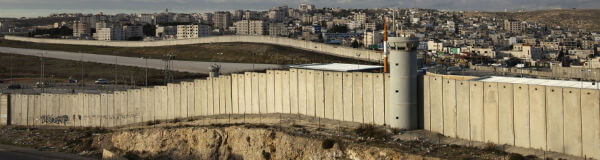
Donald Trump links his Mexico border wall plan to Israel’s ‘successful’ Apartheid wall

The Guardian reports: Donald Trump attempted to draw parallels between Israel’s separation barrier and his much-touted border wall pledge on Sunday after both presidential nominees met the Israeli prime minister, Benjamin Netanyahu.
In Trump’s hour-long meeting with Netanyahu at his Trump Tower penthouse, the two reportedly discussed “at length Israel’s successful experience with a security fence that helped secure its borders”, according to the Trump campaign.
Israel’s separation barrier, which runs for 440 miles (700km) near or along the 1949 armistice lines set after Israel’s war for independence, is a fence of most of its length. In contrast, Trump has pledged to build a wall of concrete and rebar as high as 55 feet (17 metres) along the nearly 2,000 mile border between the US and Mexico.
The meeting was the first of two that Netanyahu held with presidential candidates on Sunday, the day before the first presidential debate. Contrary to custom both meetings were closed to the media, the Trump campaign has prevented reporters from any access to his meeting with Netanyahu and aides to the Israeli prime minister reportedly went on to insist Clinton’s campaign abide by the same rules Trump insisted upon.
According to a readout provided by the Republican’s campaign, the nominee signaled support for the controversial moving of the US embassy from Tel Aviv to Jerusalem, as the real estate developer “acknowledged that Jerusalem has been the eternal capital of the Jewish people for over 3,000 years, and that the United States, under a Trump administration, will finally accept the long-standing Congressional mandate to recognize Jerusalem as the undivided capital of the State of Israel”. [Continue reading…]
Russia, jailer of local separatists, welcomes foreign secessionists
The New York Times reports: Russia may jail its own separatists, but that did not hinder a nominally independent Russian organization from laying out the welcome mat on Sunday for an oddball, global troupe of liberation movements, including, improbably, four from the United States.
The official name of the government-funded gathering, held within sight of the Kremlin, was “The Dialogue of Nations.” Its stated goal was to affirm the right to self-determination while demonizing globalization.
The unofficial goal seemed to be to support groups, however marginal, that might help rattle Western governments. The main talking points, particularly those vilifying the United States for the violent aftermath of uprisings in the Middle East and Ukraine, echoed a standard Kremlin argument.
Nate Smith, a 36-year-old country-music performer and information-technology consultant representing a group called the Texas Nationalist Movement, summed up the theme of the conference.
“We have gathered from around the world to discuss the principle and the future of self-determination in direct contradiction to those seeking a global solution to the people of the world,” he told the conference. “Much like the people of Catalonia, the people of Ireland, the people of Puerto Rico and many other peoples that are represented at this conference, we believe that the best people to govern Texas is the Texan people.” [Continue reading…]
Obama’s failed ‘Asian pivot’ leaves China ascendant
Simon Tisdall writes: Tsai Ing-wen is new to the job and the strain is beginning to show. Elected president of Taiwan in a landslide victory, she took office in May, buoyed by high approval ratings. Yet in a few short months, Tsai’s popularity has plunged by 25%. The reason may be summed up in one word: China. Suspicious that Tsai’s Democratic Progressive party, which also won control of parliament, harbours a pro-independence agenda, Beijing suspended official and back-channel talks with its “renegade province” and shut down an emergency hotline.
More seriously, for many Taiwanese workers, China also curbed the lucrative tourist trade, which brought millions of mainland visitors to the island during the accommodating presidency of Tsai’s predecessor, Ma Ying-jeou. Cross-strait investment and business have also been hit.
Tsai faces contradictory pressures. The public wants the benefit of closer economic ties with China but Beijing’s intentions are rightly distrusted by a population that increasingly identifies itself as Taiwanese, not Chinese. Given President Xi Jinping’s ominous warnings that reunification cannot be delayed indefinitely, China’s military build-up and hawkish suggestions that Beijing may resort to force, Taiwanese ambivalence is wholly understandable.
This dilemma – how to work constructively with a powerful, assertive China without compromising or surrendering national interests – grows steadily more acute. It is shared by states across the east and southeast Asian region. From Indonesia and the Philippines to Vietnam, Japan, Seoul, Malaysia and Singapore, the quandary is the same. But the answers proffered by national leaders are different and sometimes sharply at odds. [Continue reading…]
Obama’s failed legacy on child soldiers
Josh Rogin writes: President Obama will leave office having failed to use the tools at his disposal to make significant progress on getting child soldiers off the battlefield. That’s the consensus among human rights groups who point to the fact that for six consecutive years, the Obama administration has subverted U.S. law requiring the president to sanction foreign governments that force children to fight.
As early as this week, the administration will announce for the final time a list of waivers and exemptions to the Child Soldiers Protection Act, a law passed in 2008 that forbids the United States from giving military aid to any foreign government that systematically uses children in its armed forces. According to officials involved in the process, the president will either fully or partially waive sanctions for every abuser country that receives U.S. military assistance.
It’s a familiar pattern the president has followed each year since 2010, the first year he was required to sanction abuser countries under the law. The Obama administration has given more than $1.2 billion in military assistance and arms to governments that use child soldiers since the law was enacted and withheld only $61 million, according to the Stimson Center. The president’s final decision on waiving sanctions under the law is due Oct. 1. [Continue reading…]
375 top scientists warn against voting for Trump
Huffington Post reports: Hundreds of the world’s leading scientists, including famed physicist Stephen Hawking, warn in an open letter Tuesday that a Donald Trump win in November would prove disastrous to global efforts against climate change.
The Republican presidential nominee, who once claimed global warming is a hoax “created by and for the Chinese,” vowed in May that he would “cancel” the historic Paris climate agreement.
Opting out of that pact, write the 375 members of the U.S. National Academy of Sciences, including 30 Nobel Prize winners, would have “severe and long-lasting” consequences, both for the planet and for the United States’ credibility. [Continue reading…]
Why the International Criminal Court is right to focus on the environment
By Tara Smith, Bangor University
The International Criminal Court is not known for prosecuting people responsible for huge oil slicks, chopping down protected rainforests or contaminating pristine land. But these people may now one day find themselves on trial in The Hague.
The move was announced by chief prosecutor Fatou Bensouda in a recent policy document that contains a new and welcome focus on the prosecution of individuals for human atrocities that are committed by destroying the environment in which we live and on which we depend.
The document doesn’t change the law applied by the court. There is no new crime of ecocide for instance. Instead, it sets out the types of cases that the court will now select and prioritise for prosecution. These will include the illegal exploitation of natural resources, cases of environmental destruction, and “land grabbing”, where investors buy up vast areas of poor countries.
The International Criminal Court, or ICC, has already shown a willingness to apply its laws to situations involving environmental destruction. Between 2009 and 2010, then-prosecutor Luis Moreno Ocampo successfully obtained arrest warrants from the court against the president of Sudan, Omar Al-Bashir, for acts of genocide, war crimes and crimes against humanity. Among other acts, these alleged crimes involved the contamination of wells and water pumps in Darfur to target and destroy certain groups of people. Al-Bashir’s trial has not yet commenced as he continues to evade arrest.
The best ways to deal with the refugee crisis
David Miliband writes: In July 1941, Albert Einstein, ten months a US citizen, wrote Eleanor Roosevelt from his Saranac Lake retreat to register “deep concern” at the policies of her husband’s administration. A “wall of bureaucratic measures” erected by the State Department, “alleged to be necessary to protect America against subversive, dangerous elements,” had, he wrote, made “it all but impossible to give refuge in America to many worthy persons who are the victims of Fascist cruelty in Europe.”
Einstein asked the First Lady to raise this “truly grave injustice” with the president, but his appeal had limited effect. Paranoia that refugees would, if granted entry to America, turn on their host and spy for its enemies persisted. The annihilation the following year of some 2.7 million Jews—nearly half of all Jewish victims of the Holocaust—could not dispel this prejudice. Nor did the killing in 1942 result—amid economic depression, the battle against the Axis, and strains of popular and political xenophobia—in a US response to the refugees’ plight. The American “wall” against refugees would remain largely standing until the beginning of 1944, the year before the Allied victory.
The source of Einstein’s vexation that summer has returned to public life. We are again seeing a double assault against some of the world’s most vulnerable people. Their character and intentions are often impugned and they are denied dignified refuge. A day after American-born Omar Mateen’s June 12 attack on the Pulse nightclub in Orlando, Florida, Donald Trump, the Republican presidential nominee, warned of “a better, bigger version of the legendary Trojan horse,” declaring: “We have to stop the tremendous flow of Syrian refugees into the United States—we don’t know who they are, they have no documentation, and we don’t know what they’re planning.”
Trump’s claims are myth, not fact. Of the nearly 5.5 million people who have fled the conflict in Syria during the past five and a half years, around 10,000—less than 0.2 percent of the total Syrian refugee population—have been resettled in the US from Syria’s neighbors this year. We know who they are, because refugees are the single most vetted population entering the US. The UN Refugee Agency (UNHCR) registers, documents, and verifies the claim of all those whom it refers to the government for resettlement. The Department of Homeland Security, the Department of Defense, the Federal Bureau of Investigation, and multiple intelligence agencies then conduct interviews, gather detailed biographical and biometric data, and carry out a range of background checks on every candidate before they receive clearance to travel to the US. The entire process takes between eighteen and twenty-four months. There is no harder route into the US. [Continue reading…]
The failed cease-fire has just made things worse in Syria
Business Insider reports: The Obama administration is often criticized for its lack of action on Syria, but in some cases, doing nothing might be better than a cease-fire gone wrong.
Hassan Hassan, a fellow at the Tahrir Institute for Middle East Policy and an expert on Syria, warned that public opinion on the US is already so low inside Syria that a failed deal is dangerous to US credibility in the future.
“It’s something the American administration, the Obama administration, is not realizing,” Hassan told Business Insider. “That every time they try something that is not a perfect solution or … not a good solution, half-solution, obviously flawed, the situation after that option fails is much worse than before it failed. So sometimes not trying is better than trying something bad, something flawed.” [Continue reading…]
Syrian activist barred from travel after UK seizes passport at Assad’s request
The Guardian reports: British authorities have confiscated the passport of a prominent Syrian critic of Bashar al-Assad at the request of the government in Damascus, effectively preventing her from travelling and blocking her work as an activist.
Zaina Erhaim, an award-winning journalist and campaigner based in Turkey, had her passport taken away by UK border officials when she landed at Heathrow airport. After more than an hour of questioning, they told her that the document had been reported stolen.
The complaint came from the government she has been campaigning against for years. “I expect to be harassed inside my country,’ Erhaim told the Observer. “I know that if I went home I would be killed, but now I find that Assad’s arm can even reach to the UK. This is a dictator pursuing a journalist.”
A receipt that Erhaim was given for the passport states: “Document reported as stolen.” Erhaim, who is travelling to the UK for an event with the BBC’s Kate Adie at the Kew literary festival, said it contained her name, photograph and fingerprint. Erhaim had previously used the passport without problems to travel to the UK in April, when she collected the Index on Censorship’s Freedom of Expression Journalism award for her work. She had also travelled on it without any problems across Europe. [Continue reading…]
Syria bombings leave 1.75 million without running water in Aleppo
The Guardian reports: Heavy bombardment of the rebel-held eastern area of Aleppo has left about 1.75 million people without running water, the United Nations has said.
Intense attacks on Friday prevented repairs to the city’s damaged Bab al-Nayrab pumping station, which supplies water to 250,000 people in the eastern parts of the city, according to the UN’s children’s agency, Unicef.
In retaliation, the nearby Suleiman al-Halabi station, which pumps water to 1.5 million people in the west of Aleppo, was switched off, it said. [Continue reading…]