Author Archives: News Sources

Will Latin America finally rebuke Venezuela?

Christopher Sabatini writes: At least on paper, both Europe and the Americas seem equally committed to being democracies-only clubs, willing to defend and preserve the rule of law in member nations. In practice, however, it may be unfair to compare the perplexing web of regional Latin American organizations with the European Union. The juxtaposition of the EU’s recent statement of concern over the rule of law in Poland and the long-overdue response by Latin American and Caribbean governments to the decades-long political crisis festering in Venezuela is a striking case in point.

On June 1, after more than five months of discussion with the Polish government elected in October 2015, the European Commission issued an opinion expressing its concerns over the new conservative government’s packing of the country’s constitutional tribunal and changes to the public broadcasting law.

Compared to Venezuela, which has suffered from a steady two-decade-long erosion of its democratic checks and balances, Poland’s peccadilloes are pretty small stuff. Since his assumption of the presidency in 1999, former president Hugo Chávez and then his handpicked successor Nicolas Maduro (elected with a slim 1.5 percent margin in 2013 after Chávez died from cancer), have diminished democratic institutions, politicized the state, harassed and imprisoned political opponents, and closed down independent media.

There appeared a slight ray of hope in December 2015 when the unified opposition bloc — defying a biased electoral system — won what appeared to be a super majority of two-thirds of the National Assembly.

The hope, though, was short-lived. Before the new legislature could be seated, the pro-government electoral commission refused to accept the victories of the deputies from Amazonas province (three of whom were opposition and one Chavista), alleging pre-electoral violations, thus denying the opposition its super majority.

The only constitutional means of resolving the country’s deep polarization and the unpopularity of the government is a recall referendum triggered by 20 percent of voters. Earlier this year, citizens collected several million signatures requesting such a referendum. The effort, though, has been mocked by the president and vice president and the decision of whether to allow citizens to continue to collect more signatures is in the hands of the solidly pro-government electoral commission (the Comisión National Electoral — CNE).

Venezuela’s slide into authoritarianism has elicited hardly a collective peep from the region’s many multilateral organizations, almost all of them purporting to defend democracy and human rights. In fact, Latin America and the Caribbean may have the distinction of being the most heavily networked, multi-lateralized, summit-oriented region in the world. There’s the 70-year-old Organization of American States (OAS) and its inter-American system of human rights, the Southern Cone Common Market (MERCOSUR), and the more recent creations of the Union of South American Republics (UNASUR) and the Community of Latin American and Caribbean States (CELAC) — all of which count Venezuela as a member, and are supposedly committed to defending and protecting democracy and human rights. [Continue reading…]


Facebooktwittermail

Severe food insecurity widespread in Yemen

FAO-WFP reports: Vast swathes of Yemen – 19 out of 22 governorates – are facing severe food insecurity according to a new joint assessment by the UN and partners, which warns that the situation within affected areas is likely to deteriorate if conflict persists.

The latest Integrated Food Security Phase Classification (IPC) analysis confirms that over half the country’s population is living in “crisis” or “emergency” levels of food insecurity, with some governorates seeing as much as 70 percent of their population struggling to feed themselves.

At least 7 million people – a quarter of the population – are living under Emergency levels of food insecurity (Phase 4 on the five-tiered IPC scale). This reflects a 15-percent increase since June 2015. A further 7.1 million people are in a state of Crisis (Phase 3). [Continue reading…]

Facebooktwittermail

There’s a new tool to take down terrorism images online — but social media companies are wary of it

The Washington Post reports: President Obama suggested that extremist information spread online inspired a Florida man to commit the deadliest mass shooting in U.S. history at a gay nightclub in Orlando last week — the latest in a long line of terrorist attacks in which Islamist propaganda played some role in radicalizing the assailant.

Now a Dartmouth College researcher and a nonprofit group say they have created a technology that can help Internet companies instantly detect images and videos generated by terrorists and their supporters and remove them from their platforms.

It is, they say, a way to cleanse popular online sites of gory videos and propaganda from the Islamic State, which is also known as ISIS and Daesh, that can serve to incite and inspire people to commit acts of violence.

“If you could search out the beheading videos, or the picture of the ISIS fighter all in black carrying the Daesh flag across the sands of Syria, if you could do it with video and audio, you’d be doing something big,” said Mark Wallace, chief executive of the Counter Extremism Project (CEP), a nonpartisan policy group. “I believe it’s a game-changer.”

The White House has signaled its support. “We welcome the launch of initiatives such as the Counter Extremism Project’s National Office for Reporting Extremism (NORex) that enables companies to address terrorist activity on their platforms and better respond to the threat posed by terrorists’ activities online,” said Lisa Monaco, President Obama’s assistant for homeland security and counterterrorism.

But a number of major social media companies are wary of the idea. They say there is no clear consensus in the United States, and globally, as to what constitutes a terrorist image, and they might end up expunging material posted by researchers or media organizations. And, they say, once a database is created, governments around the world will place additional data requests on them — and some countries’ will probably demand the removal of legitimate political content under the guise of fighting terrorism. [Continue reading…]

Facebooktwittermail

China’s plan to cut meat consumption by 50% cheered by climate campaigners

The Guardian reports: The Chinese government has outlined a plan to reduce its citizens’ meat consumption by 50%, in a move that climate campaigners hope will provide major heft in the effort to avoid runaway global warming.

New dietary guidelines drawn up by China’s health ministry recommend that the nation’s 1.3 billion population should consume between 40g to 75g of meat per person each day. The measures, released once every 10 years, are designed to improve public health but could also provide a significant cut to greenhouse gas emissions.

The Chinese Communist party has found unusual allies among Hollywood celebrities, with actor Arnold Schwarzenegger and director James Cameron involved in a series of new public information adverts encouraging Chinese people to consume less animal flesh to help the environment.

Should the new guidelines be followed, carbon dioxide equivalent emissions from China’s livestock industry would be reduced by 1bn tonnes by 2030, from a projected 1.8bn tonnes in that year.

Globally, 14.5% of planet-warming emissions emanate from the keeping and eating of cows, chickens, pigs and other animals – more than the emissions from the entire transport sector. Livestock emit methane, a highly potent greenhouse gas, while land clearing and fertilizers release large quantities of carbon. [Continue reading…]

Facebooktwittermail

Global warming’s evil twin: ocean acidification

Climate Reality reports: Our oceans are an incredible carbon sink — they absorb about 25 percent of the carbon dioxide humans produce every year. But this is changing sea surface chemistry dramatically: when carbon dioxide is absorbed by the ocean, it dissolves to form carbonic acid. The result, not surprisingly, is that the ocean becomes more acidic, upsetting the delicate pH balance that millions and millions of organisms rely on.

Since the Industrial Revolution, our seas have become about 30 percent more acidic, a rate not observed in 300 million years. This has a wide range of consequences for marine ecosystems, as well as for the billions of people who depend on the ocean for food and survival. [Continue reading…]

Facebooktwittermail

Brexit may lead to the destruction of ‘Western political civilization’ warns European Council president

The New York Times reports: The rest of the European Union nations are looking at the possibility of a British departure from the bloc with disbelief, trepidation and anguish. But they are also preparing to retaliate.

If Britons do vote in a referendum on Thursday to leave the European Union, they can expect a tough and unforgiving response, with capitals across the Continent intent on deterring other countries from following the British example, European officials and analysts said.

In other words, Britain will be made to suffer for its choice.

With other issues pressing, including Greek debt, the migrant crisis and terrorism, the largest and most powerful European nations will want clarity, and are not likely to tolerate a long period of post-referendum confusion.

“In is in — out is out,” the powerful German finance minister, Wolfgang Schäuble, told Spiegel magazine. “I hope and believe that the British will ultimately decide against Brexit. The withdrawal of Britain would be a heavy loss for Europe.”

The president of the European Council, Donald Tusk, spoke apocalyptically about a British exit, or “Brexit,” to the German tabloid Bild. He said all members of the European Union would suffer, as would the postwar structure of Europe that had kept the peace.

“Why is it so dangerous?” Mr. Tusk asked. “No one can foresee what the long-term consequences would be. As a historian, I fear that Brexit could be the beginning of the destruction of not only the E.U., but also of Western political civilization.” [Continue reading…]

Facebooktwittermail

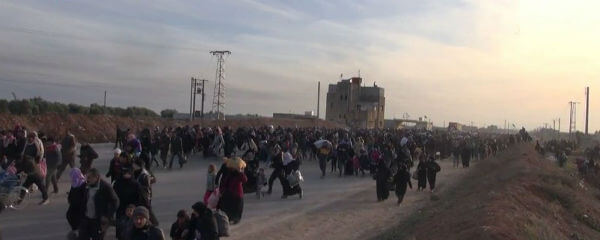
Record 65 million displaced by global conflicts, UN says

flight-from-Aleppo

The New York Times reports: More people are on the run than ever before in recorded history, the United Nations said in a report released Monday.

They include those fleeing marauders in South Sudan, drug gangs in Central America, and the Islamic State in the Iraqi cities of Mosul and Falluja. While most are displaced within their own countries, an unprecedented number are seeking political asylum in the world’s rich countries. Nearly 100,000 are children who have attempted the journey alone.

All told, the number of people displaced by conflict is estimated to exceed 65 million, more than the population of Britain.

The new figures, part of the United Nations refugee agency’s Global Trends Report, come as hostility is surging toward migrants and refugees in the Western countries where they are seeking sanctuary and relief.

The European Union has shown signs of fracturing over how to handle the influx of people crossing the Mediterranean Sea.

The United Nations high commissioner for refugees, Filippo Grandi, expressed alarm on Sunday about what he described as a “climate of xenophobia that is very worrying in today’s Europe.” [Continue reading…]

Facebooktwittermail

The translators promised visas but made into refugees by the U.S. Army

Julius Motal reports: Working for the US Army in Afghanistan can get you killed, but there’s a silver lining.

The US Army offers its Afghan translators the right to request the Special Immigration Visa (SIV). It’s a program initiated by the US to help certain foreign employees leave their home countries and get on a path to permanent residency in the states—usually for protection from groups like the Taliban. For the last four years, the program has been renewed in the National Defense Authorization Act. This year, however, both the House of Representatives and the Senate failed to vote for the allocation of more visas, which could imperil remaining applicants.

Through that program, Muhammad, a former US Army translator in Afghanistan that I met in the port of Piraeus, Greece, should already be in the US. But like several other forgotten Afghan translators who served the United States, his visa has not come through. After being laid off by his army base in 2014, Muhammad fell into a bureaucratic gap between the United States’ promises to its employees in Afghanistan, and its rocky attempt to withdraw from the country.

Muhammad applied for the SIV in 2014. He was rejected in May 2015. According to the rejection email, his application was ruled invalid on the grounds of “Lack of faithful and valuable service.” Muhammad says that’s because he was fired—but not for lack of faithfulness or value. 2014 was simply the year that the Obama administration started closing army bases, in an early phase of withdrawal from Afghanistan. With fewer bases and fewer troops, fewer translators were needed. Muhammad was downsized by government contractor Mission Essential.

So in January 2016, he decided to make a go of it on his own. He paid $5,500 in smuggling fees to be trafficked from Afghanistan to Iran, from Iran to Turkey, and then from Turkey to Greece. By the time he arrived in the port of Piraeus in March, the 22-year-old’s life had been reduced to the phone in his pocket, the clothes on his back, and a sheaf of papers from his job with the United States Army.

His service and his perfect English together, in theory, put him in a better position than most refugees, but because he is Afghan, he isn’t even eligible for any of the expedited European relocation measures that the Syrian and Iraqi refugees sheltering in the port can claim. [Continue reading…]

Facebooktwittermail

Jo Cox was working on report on anti-Muslim attacks before her death

The Guardian reports: Jo Cox, the MP who was killed outside her constituency office on Thursday, was going to warn of an increase in anti-Muslim attacks – particularly against women – it has emerged.

She was planning to address parliament later this month to introduce a report she had been working on with the Islamophobia watchdog Tell Mama (Measuring Anti-Muslim Attacks), the group’s director said. The study is expected to conclude that there were about 80% more attacks on Muslims in Britain in 2015 than the year before.

“She met us to talk about how people could report attacks; particularly women in her constituency,” said the founder and director of Tell Mama, Fiyaz Mughal, on Sunday.

The report is the latest in an annual series on the prevalence of Islamophobic attacks. “We were hoping she would highlight the impact on Muslim women; particularly given the targeting [that exists],” Mughal said. “The majority [of incidents] at street level were [on] women and she was going to raise that.” [Continue reading…]

The Guardian reports: Sayeeda Warsi, the former chair of the Conservative party, has said she will no longer support the campaign to leave the European Union just days before the referendum, accusing it of “hate and xenophobia”.

Warsi said the positive case for leaving the EU had been neglected by the official campaign, though leading leave campaigners have denied she was ever an active participant in the campaign.

“Why is it people like me, instinctively Eurosceptic who feel the EU needs reform … feel they now have to leave leave?” she told BBC Radio 4’s Today programme on Monday. “Because day after day what are we hearing? The refugees are coming, the rapists are coming, the Turks are coming.”

Warsi’s intervention came amid a slew of news around the referendum campaign, with car manufacturers, Richard Branson and premier league football clubs urging a vote for remain. [Continue reading…]

Facebooktwittermail

For Muslims like me, Trump’s words are toxic

Bim Adewunmi, a journalist from the UK now living in America, writes: I am Other, and the worlds I know most intimately are becoming increasingly uncomfortable, but I still have the luxury of the option of packing my bags and returning to the also-troubled land from whence I came (London, for the obtuse). I think about that option when I see Americans say that they are not going to vote, either in protest at what they call a rigged process, or more worryingly, because Trump is “what we deserve”, a slap in the face to shock America into a corrective overhaul of its cultures and systems.

Here’s what I think: His usefulness as the most “necessary” jolt back to common sense is severely limited and/or massively overrated. To be “sitting this election out” reeks of a repugnant sort of privilege. The damage that life under would-be President Trump would introduce does not lie in the not-too-distant Future; it is in the Right Now, under Presumptive Presidential Candidate Trump.

It is the noxious idea of a fictitious Great American past, which allows citizens to incite hatred and fear, and stoke it to such a tempo that it leaves those most at risk in a state of constant terror. [Continue reading…]

Facebooktwittermail

Trump has ripped the mask off the GOP pretense on racism

Sasha Abramsky writes: eight years after Obama’s extraordinary electoral victory, Donald Trump is stoking a racial violence, a seething, bubbling, street-violent animus last whipped up so overtly by a presidential candidate in 1968, by the segregationist George Wallace.

Trump has repeatedly re-tweeted, thus endorsing, White Supremacist tweets, launched a vicious verbal assault on Mexican-Americans, made sweeping anti-Muslim statements that, if one were to substitute “Jew” for “Muslim,” would not have been out of place in early Nazi propaganda, and has, in the process, racked up endorsements from a who’s who of white nationalists and neo-fascist groups.

It’s not that that animus hasn’t long been there; it’s just that, since the civil rights era, politicians have calculated that subtlety wins out over naked bigotry, that it’s somehow more palatable to the great mass of middle-of-the-road voters. Hence the rise of what came to be described as “dog whistle politics,” a coded appeal to racial hatreds that could be heard and clearly understood by those it was aimed at while being plausibly denied when politicians were publicly called out for it.

Neither party can claim to have been immune to this. On the Democratic side, Bill Clinton, for example, despite his great popularity amongst African American voters and his reputation as a post-segregationist, liberal Southern governor, sought to shore up his conservative credentials with tough-on-crime policies and welfare reforms that disproportionately impacted black Americans.

But, by and large, once the national Democratic Party broke with its southern segregationist wing and embraced Lyndon Johnson’s civil rights agenda in the mid-1960s, it was the GOP, employing what Richard Nixon termed “the Southern Strategy,” that utilized race-resentment politics in the crudest, most personal, of ways. After all, millions of white Americans were largely unreconciled to the civil rights revolution, and for a party willing to pander to their bigotries, there were rich electoral pickings to be had. [Continue reading…]

Facebooktwittermail

Trump’s baseless assimilation claim about Muslims in America

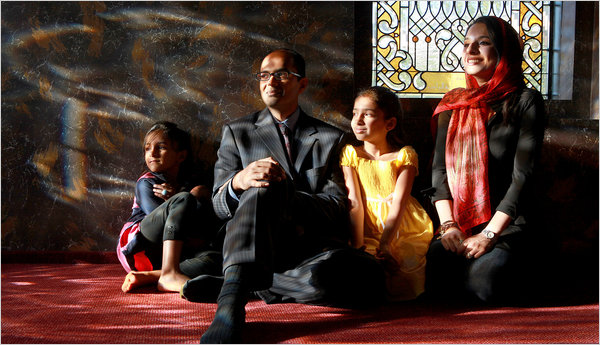
Dr. Ferhan Asghar at a Muslim center in West Chester, Ohio, with his wife, Pakeeza, and daughters Zara, left, and Emaan.

Dr. Ferhan Asghar at a Muslim center in West Chester, Ohio, with his wife, Pakeeza, and daughters Zara, left, and Emaan.

FactCheck.org reports: Donald Trump made a baseless claim that assimilation among Muslim immigrants in the U.S. is “pretty close” to “nonexistent.” Trump offered no support for his claim, but the Pew Research Center, which conducted detailed surveys in 2011, concluded that “Muslim Americans appear to be highly assimilated into American society.”
Scholars on Islam that we spoke to also dismissed Trump’s claim as “bizarre,” absurd” and inconsistent with their observations of a Muslim community that they say is — for the most part — well integrated into American culture and identity.

Let’s dig into the highlights of some of Pew’s specific findings:

  • Muslims are more likely than other immigrants to become U.S. citizens. Four out of five Muslim Americans are U.S. citizens, including 70 percent of those born outside the U.S. That is a much higher rate than the broader immigrant population in the U.S., as 47 percent of all foreign-born are citizens.
  • Nearly three-quarters of Muslim Americans (74 percent) believe that “[m]ost people can get ahead if they are willing to work hard.” That rate of optimism is higher than the general public, 62 percent.
  • A roughly similar percentage of Muslims and Christians in the U.S. say they think of themselves first as either Muslim (49 percent) or Christian (46 percent). Among white evangelicals, 70 percent said they identify first as Christian. A higher percentage of Christians as a whole say they identify as Americans first, 46 percent, compared with 26 percent among Muslim Americans. But Muslim Americans were more likely (18 percent versus 6 percent) to say they considered themselves Muslim and American equally.
  • A majority of Muslim Americans (56 percent) responded that most Muslims who come to the U.S. want to adopt American customs and ways of life, while 20 percent said those Muslim immigrants want to be distinct from the larger American society (16 percent said they wanted to do both).
  • About half of Muslim Americans say that only some or hardly any of their close friends are Muslims, while half say most or all of their close friends are Muslims.
  • More than six in 10 Muslim Americans see no conflict between being a devout Muslim and living in a modern society, almost identical to the rates among U.S. Christians.
  • Half of Muslim immigrants say they display the American flag at home, at the office or on the car, and 33 percent of native-born Muslims reported doing so as well. Overall, displaying the American flag is less common among Muslim Americans (44 percent) than among the population as a whole (59 percent).

[Continue reading…]

Facebooktwittermail

Trump thinks Muslims don’t ‘assimilate.’ He should have met my grandfather

Huda Al-Marashi writes: My Iraqi immigrant grandfather used to have a small novelty shop where he sold hair accessories, lipstick-shaped erasers and noisy, battery-operated toys. He soon learned enough English phrases to complete a business transaction. All other communication he handled with gestures and the warmest smile.

During his many hospital stays in the last years of his life, his nurses would always tell me he was their favorite patient. They’d pat his hand and say he was just the sweetest. They understood this about a man who said no more to them than “How are you” and “Thank you.”

Last week, Sean Hannity posed a question to Donald Trump about how to vet the hearts of Muslims coming to the United States. Trump replied: “Assimilation has been very hard. It’s almost, I won’t say nonexistent, but it gets to be pretty close. And I’m talking about second and third generation — for some reason there’s no real assimilation.” (Maybe this explains Trump’s support for profiling Muslim, which, on Sunday, he called “common sense.”)

Assimilation is a contentious concept among those who study immigration. (How does one measure assimilation, especially when most of the qualities associated with being assimilated have more to do with assuming aspects of Anglo-Saxon culture than with actual social integration?) Sociological considerations aside, the suggestion that Muslims in the United States have not assimilated is simply not correct. [Continue reading…]

Facebooktwittermail

The Trump campaign is becoming an outright catastrophe

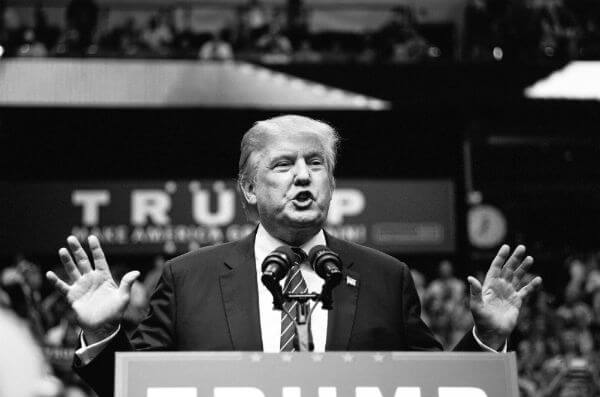
trump-bw

Paul Waldman writes: While he could manage a stunning turnaround, at the moment Trump seems to have put together one of the worst presidential campaigns in history. Let’s take a look at all the major disadvantages Trump faces as we head toward the conventions:

A skeletal campaign staff. Trump succeeded in the primaries with a small staff whose job was to do little more than stage rallies. But running a national campaign is hugely more complex than barnstorming from one state to the next during primaries. While the Clinton campaign has built an infrastructure of hundreds of operatives performing the variety of tasks a modern presidential campaign requires, the Trump campaign “estimates it currently has about 30 paid staff on the ground across the country,” a comically small number.

Not enough money, and little inclination to raise it. Trump hasn’t raised much money yet, and he doesn’t seem inclined to do so; according to one report, after telling Republican National Committee Chairman Reince Priebus that he’d call 20 large donors to make a pitch, he gave up after three. Fundraising is the least pleasant part of running for office, but unlike most candidates who suck it up and do what they have to, Trump may not be willing to spend the time dialing for dollars. Instead, he’s convinced that he can duplicate what he did in the primaries and run a low-budget campaign based on having rallies and doing TV interviews. As he told NBC’s Hallie Jackson, “I don’t think I need that money, frankly. I mean, look what we’re doing right now. This is like a commercial, right, except it’s tougher than a normal commercial.” It’s not like a commercial, because in interviews Trump gets challenged, and usually says something that makes him look foolish or dangerous. But he seems convinced that his ability to get limitless media coverage, no matter how critical that coverage is, will translate to an increase in support.

Outgunned on the airwaves. As a result, Democrats are pouring money into television ads attacking Trump and promoting Clinton with no answer from the other side. As Mark Murray reported yesterday, “So far in June, Clinton and the outside groups backing her have spent a total of $23.3 million on ads in the battleground states of Colorado, Florida, Iowa, Nevada New Hampshire, North Carolina, Ohio and Virginia.” And how much have Trump and his allies spent on ads in those states? Zero. Nothing. Nada. [Continue reading…]

Facebooktwittermail

Control and fear: What mass killings and domestic violence have in common

Amanda Taub writes: One of the first things we learned about Omar Mateen, the gunman in the nightclub massacre in Orlando, Fla., was that his ex-wife said he had beaten her severely until she left him in 2009.

If it sounds familiar that a gunman in a mass shooting would have a history of domestic violence, it should.

In February, Cedric Ford shot 17 people at his Kansas workplace, killing three, only 90 minutes after being served with a restraining order sought by his ex-girlfriend, who said he had abused her. And Man Haron Monis, who holed up with hostages for 17 hours in a cafe in Sydney, Australia, in 2014, an episode that left two people dead and four wounded, had terrorized his ex-wife. He had threatened to harm her if she left him, and was eventually charged with organizing her murder.

When Everytown for Gun Safety, a gun control group, analyzed F.B.I. data on mass shootings from 2009 to 2015, it found that 57 percent of the cases included a spouse, former spouse or other family member among the victims — and that 16 percent of the attackers had previously been charged with domestic violence.

Social scientists have not settled on an explanation for this correlation, but their research reveals striking parallels between the factors that drive the two phenomena.

There are, of course, a tangle of factors behind every murder, especially terrorism inspired by foreign groups. But research on domestic violence hints at a question that often arises from seemingly inexplicable events like Mr. Mateen’s massacre of 49 people at an Orlando nightclub — what drives individuals to commit such mass attacks? — and sheds light on the psychology of violence. [Continue reading…]

Facebooktwittermail

Venezuelans ransack stores as hunger grips the nation

The New York Times reports: With delivery trucks under constant attack, the nation’s food is now transported under armed guard. Soldiers stand watch over bakeries. The police fire rubber bullets at desperate mobs storming grocery stores, pharmacies and butcher shops. A 4-year-old girl was shot to death as street gangs fought over food.

Venezuela is convulsing from hunger.

Hundreds of people here in the city of Cumaná, home to one of the region’s independence heroes, marched on a supermarket in recent days, screaming for food. They forced open a large metal gate and poured inside. They snatched water, flour, cornmeal, salt, sugar, potatoes, anything they could find, leaving behind only broken freezers and overturned shelves.

And they showed that even in a country with the largest oil reserves in the world, it is possible for people to riot because there is not enough food.

In the last two weeks alone, more than 50 food riots, protests and mass looting have erupted around the country. Scores of businesses have been stripped bare or destroyed. At least five people have been killed. [Continue reading…]

Facebooktwittermail

How did Brazil go from rising BRIC to sinking ship?

By Steven M. Helfand, University of California, Riverside and Antônio Márcio Buainain, Universidade Estadual de Campinas

Most of the headlines in recent weeks have focused on Brazil’s troubling political crisis. But the country is also in the midst of a deep economic recession.

The economy has been shrinking since the second quarter of 2014. It contracted by 3.8 percent in 2015 and is expected to shrink by a similar amount this year. Earlier this month, the Organisation for Economic Co-operation and Development (OECD) said it sees the recession continuing into 2017.

Yet it was only in 2009 – in the middle of the global financial crisis – that the Economist magazine featured a story entitled “Brazil takes off,” with a photo of the Corcovado – the iconic statue of Christ that overlooks Rio de Janeiro – launching like a rocket. That article emphasized why Brazil deserved to be one of the “BRICs” – the rapidly growing economies including Russia, India and China that now account for nearly 25 percent of global GDP.

How could the outlook for Brazil have changed so rapidly? Is this sort of boom and bust unprecedented or a recurring theme in Brazil’s history?

In this article, we provide a historical perspective on the current economic crisis, relying on our own scholarship and years of analysis of the Brazilian economy.

Continue reading

Facebooktwittermail

Why the Western-backed assault on ISIS in Iraq and Syria is failing

Shiraz Maher writes: The first signs of a Western-backed attempt to recapture Raqqa, ­Islamic State’s de facto capital in Syria, came a fortnight ago when fighter jets dropped leaflets over the city telling residents to leave. “The time has come,” the warnings read, alongside an illustration of residents evacuating the city as incoming forces overran IS fighters.

Although up to half of Raqqa’s residents fled when IS first took control of the city in 2014, the militants have made it ­increasingly difficult for the people who stayed behind to leave. Following the US-led coalition’s warnings of an impending attack, however, the jihadis relaxed their restrictions on movement. Citizens were allowed to disperse into the nearby countryside. The idea was to spare them whatever onslaught was planned against Raqqa while keeping them within IS territory.

Ever since the latest offensive against IS began in Syria and Iraq in late May, it has become clear that the group will not concede territory easily around Raqqa – or elsewhere. It might lose small villages from time to time, but all of its major urban centres remain well fortified. Few observers expect them to fall any day soon. IS has too much invested in Raqqa, as well as Mosul in Iraq. Occupying the cities fuels the group’s prestige by projecting the impression of ­viable statehood and by allowing it to house fighters and military equipment. [Continue reading…]

Facebooktwittermail