Author Archives: News Sources

U.S. officials say American Muslims repeatedly report extremist threats

Reuters reports: Muslim-Americans have repeatedly informed authorities of fellow Muslims they fear might be turning to extremism, law enforcement officials say, contrary to a claim by presumptive Republican presidential nominee Donald Trump this week.

“They don’t report them,” Trump said in a CNN interview on Monday, in the wake of the mass shooting at an Orlando nightclub of 49 people by an American Muslim who claimed allegiance to Islamic State. “For some reason, the Muslim community does not report people like this.”

But FBI director James Comey said, “They do not want people committing violence, either in their community or in the name of their faith, and so some of our most productive relationships are with people who see things and tell us things who happen to be Muslim.

“It’s at the heart of the FBI’s effectiveness to have good relationships with these folks,” Comey said at a press conference following the Orlando shootings. [Continue reading…]

Facebooktwittermail

What Obama actually thinks about radical Islam

Jeffrey Goldberg writes: It is not a new practice for critics of President Obama to question his commitment to the fight against Islamist terrorism, but Donald Trump, the presumptive Republican presidential nominee, has cast doubt on Obama’s commitment to this struggle in uniquely florid and bizarre ways. On Tuesday, he claimed that Obama “prioritizes” America’s enemies over the American people; on Monday, he insinuated that Obama is sympathetic to the Islamic State terror group. (Read the previous sentence again and ask yourself: How has it come to this?)

Trump’s recent statements about Obama grow from a neurotic belief in the president’s malevolent otherness: On ISIS, Trump said, Obama “doesn’t get it, or he gets it better than anybody understands.” Barack Obama, to Donald Trump, is, and will forever be, the Manchurian President — Manchuria, by way of Kenya, with a detour in Raqqa.

It is true that Trump’s critique of Obama’s handling of terrorism is, among other things, analysis-free and comprehensively unserious, but it is also true is that there are non-hysterical critiques to be made, and not only critiques that concern Obama’s reluctance to describe the threat as one posed by “radical Islam” (a reluctance the president addressed on Tuesday). Critics to Obama’s right fault him for prematurely withdrawing American troops from Iraq, and for not doing enough to prevent Syria from becoming a safe haven for ISIS. His reluctance to involve the U.S. more systematically in the Syrian civil war, the argument goes, has allowed jihadists to fill the vacuum created by the absence of the world’s sole superpower. Some critics on the right also argue that Obama blanches when confronted by the ugly truth about Muslim dysfunction and extremism; political correctness, in this view, hamstrings the president, and makes him obtuse. Critics to Obama’s left, on the other hand, argue that he is killing too many people, particularly through the use of drone strikes, and that his policies are distressingly of a piece with those of his Republican predecessor. The over-militarization of the so-called war on terror, that argument goes, exacerbates a problem that has already been hyped by “Islamophobic” fearmongers. [Continue reading…]

Facebooktwittermail

Donald Trump accused of using his charity as a political slush fund

The Daily Beast reports: The Trump Foundation, Donald Trump’s nonprofit organization, is under fire for allegedly operating as more of a political slush fund than a charity. The foundation is accused of violating rules prohibiting it from engaging in politics — prompting ethics watchdogs to call for public investigations.

On numerous occasions this year, Trump’s campaign work and his foundation work have overlapped — putting himself at risk for penalties and his charity at risk of being shut down.

It’s the latest example of Trump courting controversy: not merely through inflammatory rhetoric, but also through private dealings that raise serious legal questions — all of which indicate how he might govern if elected president of the United States. [Continue reading…]

Facebooktwittermail

Armitage to back Clinton over Trump

Politico reports: Richard Armitage, the deputy secretary of state under George W. Bush, says he will vote for Hillary Clinton over Donald Trump, in one of the most dramatic signs yet that Republican national security elites are rejecting their party’s presumptive nominee.

Armitage, a retired Navy officer who also served as an assistant secretary of defense under Ronald Reagan, is thought by Clinton aides to be the highest ranking former GOP national security official to openly support Clinton over Trump.

“If Donald Trump is the nominee, I would vote for Hillary Clinton,” Armitage told POLITICO in a brief interview. “He doesn’t appear to be to be a Republican, he doesn’t appear to want to learn about issues. So I’m going to vote for Mrs. Clinton.” [Continue reading…]

Facebooktwittermail

If Omar Mateen was gay, it makes his LGBT nightclub attack more homophobic

Jay Michaelson writes: If Mateen turns out to have been repressing his sexuality, that makes the attack more about homophobia, not less. Now what we have is not a gay-hating radical Islamist but a self-hating gay man who found in Islamist ideology a way to express his animus at everyone and everything.

Nor is this unique to Islam. When Christian fundamentalist Ted Haggard preached vitriolic sermons against homosexuality, it was because of — not despite — his furtive sex dates with a drug-dealing gay masseur. When former senator Larry Craig inveighed against the evils of equality, it was because of — not despite — his own shame around soliciting men for sex in public restrooms.

That is why study after study has shown that the more homophobic one is, the more likely one is to have repressed homosexual desires. If you’re battling your demons in private, you’re going to battle them in public too.

It is also why repressed gay people seek out fundamentalist religion in the first place. Religious fundamentalism sublimates the repressed sexual urge into religious zeal. In its Christian, Muslim, and Jewish forms, it insists that we are all struggling with evil urges that must be assiduously repressed. And its restrictions on sexual expression, coupled with often single sex male environments, work just fine for those who couldn’t express their sexuality in an “acceptable” way anyway.

Once again, that is as true for “celibate” Catholic priests as it is for ultra-Orthodox Jews as it is for born-again evangelicals as it is for newly radicalized Muslims. The logic of fundamentalist religion is the logic of repression and sublimation, of projecting one’s own inner struggles onto the screen of the theological.

I know this from personal experience. For 10 years, I lived my life as a closeted, Orthodox Jew. I wasn’t closeted because I was Orthodox; I was Orthodox because I was closeted. [Continue reading…]

Facebooktwittermail

After Orlando, gay rights moves off diplomatic back burner

The New York Times reports: For years, diplomats were more comfortable talking about nuclear warheads than sexual orientation.

Sexual orientation was one of those subjects burdened with too many cultural sensitivities. American officials, even if they wanted to advance it on the diplomatic agenda, were wary of offending their allies, not least in the Islamic world.

The attack on a gay nightclub in Orlando, Fla., moved the needle.

In its aftermath, the United States corralled an unlikely group of countries to support a United Nations Security Council statement that condemned the attack for “targeting persons as a result of their sexual orientation.” Even Egypt and Russia — not known for embracing their gay and lesbian citizens — signed on, after what diplomats called intense consultations.

Earlier in the day, the United States delivered a pointed rebuke to countries that block gay rights at the United Nations, urging them to “contribute more than condolences and condemnations” after the Orlando attack.

And American embassies in several countries, including India, which still has an anti-sodomy law on the books, draped themselves in the colors of the rainbow flag that signifies gay pride.

The Security Council statement, which was drafted by the United States and issued Monday, carries no legal weight. But it is the first time that the powerful institution, with the capacity to authorize wars, weighed in on sexual orientation.

Homosexuality is still a crime in 73 of the world’s 193 countries, according to the International Lesbian, Gay, Bisexual, Trans and Intersex Association; in 13, the death penalty can be applied. In some countries, like Egypt, laws against “debauchery” are used to target gays. Russian law prohibits what it calls “propaganda on nontraditional sexual relationships,” which critics call a thinly veiled measure to harass gay men and lesbians.

“We’re hopefully moving into an era when gross acts of violence are condemned by global leaders rather than when violence motivated by sexual orientation or gender identity” is “dismissed as irrelevant or unworthy,” said Jessica Stern, the executive director of OutRight Action International, an advocacy group.

Still, she said, the United States will be able to sway others only if it can protect its own citizens. “The more we demonstrate respect for Muslim Americans and the more violence we prevent domestically by passing meaningful gun control, the more credible we are likely to be as a global leader,” she said. [Continue reading…]

Facebooktwittermail

Orlando massacre: The shooter was an American

Mohammed Fairouz writes: In the early hours of Sunday morning, a young aquaintance through my inner circle of friends was shot and killed in Orlando. He was 32 years old. I saw his mother crying on TV.

I am incandescent with rage and overcome with grief.

I have never held a gun in my life and I probably never will. I do not feel as though I’m missing out on anything. No civilian needs an assault rifle. Period.

The shooter was not a ‘US citizen of Afghan descent’ as the press describes him. It’s a passable description on a technical level, but it is not a fundamentally true one. He was a Floridian and an American. The town in which he was born, New York City, is as American as apple pie. The Florida town in which he was raised is as American as apple pie. The assault weapon that he used to kill those people is as American as apple pie.

We have to acknowledge this. We have to look in the mirror and admit that we have a problem and we have to fix our problem.

The men who drafted the US Constitution understood that, like all functioning constitutions in the world, it would need to be a dynamic document. The founders were also men who, naturally, made mistakes with that document; mistakes like enshrining slavery into the original version. It took a bloody civil war to fix that mistake. But laws are made by us: flawed, mortal, human beings. And that is why they are in need of constant study, revision and change. [Continue reading…]

Facebooktwittermail

The Orlando shooter may have been gay? The gay community isn’t surprised

Dave Cullen writes: My mantra after every mass-shooting tragedy is and always will be: don’t jump to conclusions too quickly, especially on motive. It’s healthy to discuss possibilities, particularly as the evidence piles up, but remember that early facts often turn out to point in the wrong direction. The media and even the president lunged way too quickly to assume that the Orlando massacre was an act of international terrorism, which it may or may not have been. Today we’re all asking a different question: Was the shooter gay? A rapidly accumulating set of evidence — including reports that he had been to Pulse in the years prior to the shooting — suggests that he was, or that he was still struggling with gay urges. But he might also just have been casing the place.

The idea that the killer, Omar Mateen, was gay himself may sound baffling, and much of the national media has treated it that way in the day or so since news of his bar-hopping habits surfaced. But it’s no surprise to most gay people. Many of my gay friends assumed as much from the beginning, and predicted this before the first scraps of evidence surfaced. It sounds as if he was a self-loathing gay — which is almost the same as saying he was just coming to terms with being gay. Has anyone ever discovered his gayness and not wanted to tear it out of himself?

Most of us haven’t just known that guy, we’ve been that guy. I never touched a man, or admitted how badly I wanted to, until I was 28. That initiated a seven-year bi phase, which I called “experimenting” for the first half, even after a friend said, “Experimenting? How many times do you need to rerun the experiment?” I had slept with at least a hundred men by then. Still not convinced. Hmmm.[Continue reading…]

Facebooktwittermail

For 50 years voters have been denied an honest debate on immigration. Now we’re paying the price

Gary Younge writes: During the 1964 election Harold Wilson spent a day campaigning in London marginals, addressing crowds from the back of a lorry. Invariably he would be harangued by bigots demanding the repatriation of nonwhite people. Wilson faced the hecklers down. “Whom should we send home? The nurses in our hospitals? The people who drive our buses. Where would our health service be without the black workers who keep it going?” According to the late Paul Foot: “These questions were greeted with great roars of approval from the crowd, and the hecklers were silenced.”

Elsewhere that year a notorious election campaign in Smethwick, near Birmingham, saw the Tory candidate, Peter Griffiths, slug his way to victory on an anti-immigration ticket buoyed by the slogan: “If you want a nigger for a neighbour vote Labour.” When asked to disown that sentiment Griffiths replied: “I would not condemn anyone who said that. I regard it as a manifestation of popular feeling.”

Labour won the election nationally, with a 3.5% swing, but lost in Smethwick because of a 7.2% swing against them. Later, in his diaries, the Labour minister Richard Crossman concluded that since Smethwick: “It has been quite clear [for Labour] that immigration can be the greatest potential vote-loser for the Labour party”.

For the last 50 years the British political class has refused to engage intelligently with the issue of immigration. The Tories brazenly stoke popular prejudice (Margaret Thatcher: “swamped by people with a different culture”; Michael Howard: “Are you thinking what we’re thinking?”) while Labour cravenly submits to it (Tony Blair’s bulldog; Ed Miliband’s mug).

Wary of making arguments that are moral or fact-based, Labour sought not to counter inflammatory rhetoric but to indulge it. The Tories understand that fear of immigration is how they get votes; Labour understand that’s how they lose them. The upshot is that precious few in the country understand what immigration is for, what drives it, or who benefits from it and why. [Continue reading…]

Facebooktwittermail

Global markets are trembling at the prospect of Britain leaving the EU

Politico reports: Voters in the United Kingdom could deliver a sharp jolt to the global economy and the 2016 U.S. presidential race next week.

Recent polls show strong momentum in Great Britain in favor of abandoning membership in the European Union when the nation votes in a referendum next Thursday, an event that could send global markets plunging, damage the fragile U.S. economy, presage the demise of the EU itself and present a fresh headache for Hillary Clinton in her effort to keep the White House in Democratic hands.

“If the U.K. chooses to leave next week there will be a lot of immediate volatility in markets,” said Megan E. Greene, chief economist at Manulife in Boston. “But you could also end up having an existential threat to the European Union and then the impact on the United States would be even bigger and the market dislocations that follows would be much larger.”

None of this would be welcome news for the Hillary Clinton campaign, which is already facing one destabilizing event in the Orlando massacre and could soon be faced with a second shock.

Clinton is counting on a strengthening U.S. economy to help her defeat presumptive Republican nominee Donald Trump in the fall. But a vote in favor of the U.K. leaving the EU, especially if it’s followed by similar movements in Italy, France and other EU nations, could damage a U.S. economy that grew at just a 0.8 percent rate in the first quarter by driving stock prices lower, pushing the dollar higher, sapping investor and consumer confidence and damaging critical U.S. trading partners.

“The big question here is to what extent this fuels a much bigger phenomenon in anti-establishment movements across Europe, that’s where the real uncertainty is,” said Mohamed A. El-Erian, chief economic adviser at Allianz. “Brexit itself could knock a little bit off of U.S. GDP. For a bigger impact, you would need big recessions all across Europe.”

Global markets are already trembling at the prospect of Britain leaving the EU. [Continue reading…]

Facebooktwittermail

Most Americans have a negative view of Donald Trump

The Washington Post reports: In the latest sign Americans are dreading their general election options — and particularly one of them — negative views of Donald Trump have surged to their highest level of the 2016 campaign, according to a new Washington Post-ABC News poll.

Trump’s unfavorable rating, in fact, far surpasses Hillary Clinton’s even as the presumptive Democratic nominee receives her worst ratings in more than two decades in public life.

The poll finds 70 percent of Americans have an unfavorable view of Trump, including a 56 percent majority who feel this way “strongly.” Negative ratings of Trump are up 10 percentage points from last month to their highest point since he announced his candidacy last summer, nearly reaching the level seen before his campaign began (71 percent). [Continue reading…]

Facebooktwittermail

Obama challenges GOP talking points and explains why ‘radical Islam’ is not a useful term

The media called this statement by President Obama a ‘tirade’ — I’d call it a disquisition, with a hint of frustration born from the fact that the people who need to digest this information are mostly idiots.

Huffington Post reports: President Barack Obama said Wednesday that he refuses to describe the Islamic State and al Qaeda as groups fueled by “radical Islam” because the term grants them a religious legitimacy they don’t deserve.

“They are not religious leaders; they are terrorists,” Obama said during remarks at a White House event on countering violent extremism. “We are not at war with Islam. We are at war with people who have perverted Islam.”

Obama said the Islamic State in Syria and Iraq, also known as ISIS or ISIL, is “desperate” to portray itself as a group of holy warriors defending Islam. It counts on that legitimacy, he said, to propagate the idea that Western countries are at war with Islam, which is how it recruits and radicalizes young people. [Continue reading…]

Facebooktwittermail

The sectarianism of ISIS: Ideological roots and political context

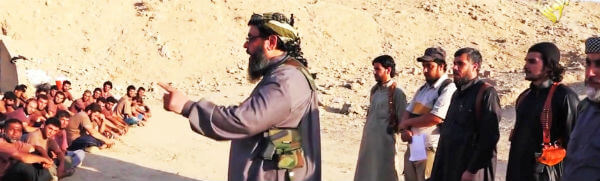
ISIS-instructor

President Obama’s rebuke yesterday of the Republican’s use of the phrase, “radical Islam,” was good as far as it went. Yet this debate about ISIS, which views it as either the violent heart of Islam or as an utterly un-Islamic perversion of the religion, is simplistic and misleading on both sides.

Hassan Hassan writes: The Islamic State’s extreme ideology can be viewed as the product of a slow hybridization between doctrinaire Salafism and other Islamist currents.

Many of the extremist religious concepts that undergird the Islamic State’s ideology are rooted in a battle of ideas best understood in the context of Saudi Arabia’s Sahwa (Islamic Awakening) movement in the 1970s, and a similar movement in Egypt, as well as in other countries. In those countries, the interplay of Salafi doctrinal ideas and Muslim Brotherhood–oriented political Islamic activism produced currents that still resonate today. Indeed, the commingling of Salafism and Brotherhood Islamism accelerated in the wake of the Arab uprisings of 2011, filling the void left when traditional religious establishments failed to respond adequately to the aspirations and grievances of the Arab masses. The Islamic State and other Islamist and jihadi groups seized the opportunity to enforce their vision of the role of Islam.

In Saudi Arabia and in Egypt, the marriage of traditional Salafism and political Islam produced new forms of Salafism that were influenced by, and critical of, both movements. Political Islam became more conservative and Salafism became politicized.

In many instances, Salafi concepts were substantially reinterpreted, appropriated, and utilized by a new generation of religious intellectuals who started to identify with a new movement. In Saudi Arabia, the Sahwa generation moved away from the Najdi school, the adopted name for the Wahhabi clerical establishment.

The practice of takfir, or excommunication after one Muslim declares another an infidel or apostate, became increasingly prominent, first during the 1960s in Egypt and then after the first Gulf War in the 1990s when veterans of the jihad in Afghanistan began to apostatize Saudi Arabia for hosting and supporting Western troops to fight Iraq’s then leader, Saddam Hussein.

Politically submissive Salafism, which had rejected political rebellion, began to give way to political takfirism that carries the banner of caliphate, jihad, and rebellion. At the same time, the growing influence of Salafi ideals led to the Salafization of the Muslim Brotherhood.

Sayyid Qutb, an Islamist theorist and leading member of the Egyptian Muslim Brotherhood in the 1950s and 1960s, drew on Salafi ideals to create an all-embracing takfiri ideology. Qutb argued that Muslim-majority societies are living in a state of jahiliyya (pre-Islamic obliviousness). He believed that all ideologies—including capitalism, communism, and pan-Arabism—have failed, and that the only system that will succeed globally is Islam. Qutb considered Islam the only reference for society (known as hakimiyya, or sovereignty of God), and he urged Muslim youth to reject their societies and lead change.

Qutbism provided a political ideology that introduced Islamic supremacism and nationalism, and that rejects many aspects of modern Muslim society and political regimes. It took conservative ideas and molded them to serve as the foundations of a political ideology that has little sympathy for views that deviate from Qutb’s understanding of the Islamic way of life. It is inward-looking and prioritizes internal threats over foreign threats.

Qutbist concepts such as hakimiyya and jahiliyya shape the Islamic State’s dealings with the religious and ethnic communities it controls. The Islamic State believes that local populations must be converted to true Islam and that Muslims can accuse one another of apostasy without adhering to traditional clerical criteria, which stipulate a series of verification measures to ensure the apostasy of an accused person. The group also believes in the Qutbist idea that Muslims have fundamentally deviated from the true message of Islam and that correcting this deviation will require a radical, coercive revolution. [Continue reading…]

Facebooktwittermail

Killing twice for ISIS and saying so live on Facebook

The New York Times reports: He stabbed an off-duty police officer and left him bleeding to death on his own doorstep. He forced his way inside the home and stabbed and killed the officer’s female companion. He then sat down and videotaped himself live on Facebook declaring allegiance to the Islamic State, according to the French law enforcement authorities.

Sitting just behind him was the couple’s son, a terrified 3-year-old boy, of whom Larossi Abballa, the killer, said dismissively, “I have not decided what to do with him,” according to David Thomson, a French journalist for Radio France Internationale and the author of a book on jihadists who saw Mr. Abballa’s online posts before they were taken down.

The events that unfolded between about 8 p.m. and midnight on Monday — when elite police forces broke into the house in the small town of Magnanville, fatally shot Mr. Abballa, 25, and rescued the boy — were the second time within 48 hours in which a person appearing to act alone claimed to kill in the name of the Islamic State.

In the attacks in both Magnanville and Orlando, Fla., the killers had more than just brushed up against the authorities before, in what has become a distressingly familiar pattern — from the set of attacks in Paris in November, to those in Brussels in March and beyond. The Orlando gunman, Omar Mateen, had been interviewed twice by the Federal Bureau of Investigation for his possible links to terrorism, and Mr. Abballa had been convicted for having links to a terrorist network and served about two years in jail before being released.

Further complicating the job of protecting Western nations are governments’ dual goal of preserving civil liberties while trying to make people feel secure.

The attack in France was shocking not only to neighbors in Magnanville, about 35 miles from Paris, but across the country because it underscored that extremist attacks can happen in the most ordinary places, above all in those where people believe they are safe.

Mr. Abballa’s Facebook post from Monday night made clear that he wanted to terrify and destroy those he deemed “unbelievers,” people he had come to hate. He also wanted to encourage other lone wolves to do the same.

“It’s super simple,” he said, looking into the camera. “It’s enough to wait for them in front of their offices; don’t give them any respite. Know this, whether you are a policeman or a journalist, you will never feel calm again. One will wait for you in front of your homes. This is what you have earned.”

Boasting that he had “just killed a policeman and I just killed his wife,” he called on fellow believers to give priority to killing “police, prison guards, journalists.” He specifically named several writers and journalists, adding rappers to the list because, he said, they “are the allies of Satan.”

Even more chillingly, he warned that jihadists had “reserved some other surprises for the Euro; I am not going to say more.’’

“The Euro will be a cemetery,” he said, referring to the Euro 2016 soccer tournament being played over the next several weeks in 10 French cities.

It was unclear whether Mr. Abballa had specific knowledge of a potential attack on the matches or the crowds gathered for them.

The version of the video released by the Islamic State’s Amaq news agency was trimmed by a couple of minutes to omit images of the boy and Mr. Abballa’s references to him. On Twitter, opinion was divided between those who thought the images of a defenseless child were tasteless even by the standards of the Islamic State’s hardened propagandists and those who speculated that the extremist news agency did not want to show Mr. Abballa as unwilling to kill a child. [Continue reading…]

Facebooktwittermail

The torturers taking on ISIS in Fallujah

The Daily Beast reports: Twenty-three days after the Iraqi security forces started a major operation aiming to retake besieged Fallujah, the forces are still fighting to control the first neighborhood of the Anbar city.

Much of the murkiness surrounding the battle to expel ISIS from Fallujah, which lies 64 kilometers to the west of Baghdad and has long been a cynosure of the Sunni insurgency, has to do with who, exactly, is doing the fighting. And that’s a question that touches on Iraq’s ever-parlous sectarianism.

The United States insists that Shia militias, many of whom are avowedly Islamist and fighting for their own version of holy war, must not enter Fallujah and should instead confine their activities to the outskirts or suburbs of the city. The Pentagon has been providing air cover only on the south and western fronts where professional counterterrorism forces, the Iraqi army units, Sunni tribal forces and local police have operated. The northern front, where the militias and Iraq’s Federal Police are located, have seen no U.S. air strikes.

Perhaps for that reason, the south has seen more progress. Al-Shuhada, a neighborhood at the southern doorstep of Fallujah, is still contested with fierce clashes between Iraqi Security Forces and ISIS jihadists. Although earlier statements by Iraqi commanders were claiming they have completely controlled al-Shuhada neighborhood, Sabah Numan, spokesperson of elite Counter-Terrorism Service (CTS), told The Daily Beast, “We are currently in the first al-Shuhada neighborhood and we have been able to liberate 90 percent of it.”

Yet recent violations against Sunni civilians fleeing ISIS’s captivity in the north have complicated efforts to press on.

According to an official investigation carried out by the Anbar governorate, at least 49 people have been killed by Shia militias in two towns: Saqlawiyah, 8 kilometers northwest of Fallujah, and Al-Karmah, 16 kilometers northeast of the city. Additionally, 643 men have been declared missing between June 3 and June 5. The investigation records that have been signed by Sohaib al-Rawi, the governor of Anbar province, also state that “all detainees have been subject to severe collective torture.” Iraq’s Defense Minister Khalid al-Obeidi tweeted, “Harassment of IDPs is a betrayal of the sacrifices of our brave forces’ liberation operations to expel Daesh [ISIS] from Iraq.” [Continue reading…]

Facebooktwittermail

Orlando shooter Omar Mateen was gay, former classmate says

Palm Beach Post reports: A former classmate of Omar Mateen’s 2006 police academy class said he believed Mateen was gay, saying Mateen once asked him out.

Officials say Mateen shot and killed 49 people and injured 53 others at an Orlando nightclub early Sunday morning.

The classmate said that he, Mateen and other classmates would hang out, sometimes going to gay nightclubs, after classes at the Indian River Community College police academy. He said Mateen asked him out romantically.

“We went to a few gay bars with him, and I was not out at the time, so I declined his offer,” the former classmate said. He asked that his name not be used.

He believed Mateen was gay, but not open about it. Mateen was awkward, and for a while the classmate and the rest in the group of friends felt sorry for him. [Continue reading…]

Reuters reports: Two U.S. officials, both of whom have been briefed regularly on the investigation and requested anonymity to discuss it, said that if it emerged that Mateen led a secret double life or had gay impulses that conflicted with his religious beliefs, it might have been a factor in explaining his motive.

“It’s far too early to be definitive, and some leads inevitably don’t pan out, but we have to consider at least the possibility that he might have sought martyrdom partly to gain absolution for what he believed were his grave sins,” one of the officials said. [Continue reading…]

Facebooktwittermail

To be outed in the worst possible way

Matt Thompson writes: I’m a son of immigrants, and a gay man who grew up in Orlando in the ’80s and ’90s. My earliest visits to gay clubs in the city were clandestine operations, and let me tell you, it is difficult to be undercover-gay while dressing appropriately for a night out with the boys. On a trip to Parliament House or the gay night at Firestone, I’d be petrified that one of my friends from church or my Christian school might recognize me, and word would somehow filter back to my family. It seemed fortunate that the clubs I visited were, for the most part, cloistered away from the party district downtown where my straight friends might be dancing. I’ve never been to Pulse, which opened years after I moved away from Orlando, but even at my most closeted moment, I might have risked dressing for the disco on that tucked-away corner of South Orange Ave.

My gay friends from that time and place in my life have similar stories — we’re children of immigrants, once closeted and fearful of how our families would react when they found out. I can’t stop thinking about the possibility that someone like us was hurt or murdered at Pulse on Sunday morning, outed in the very worst way, in a phone call every family dreads. For some parents, such a call would be a double heartbreak.

I have no idea whether it happened, but the mere potential that it might is wrenching. A New York Times story about the 49 people who died on Sunday tells the story of one young man whose parents in Mexico don’t know about his boyfriend of roughly three years. He escaped the massacre, but his boyfriend did not.

I have many queer friends whose American roots are generations deep, but who struggled as much as my friends and I did to reveal themselves to their families. Yet I’ve found this experience most common among those friends of mine who were also born to immigrants. [Continue reading…]

Facebooktwittermail