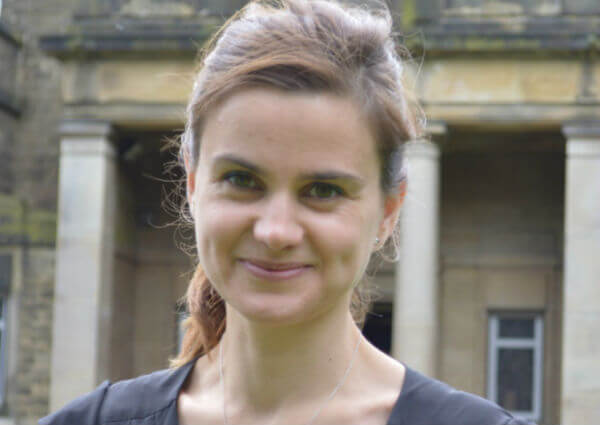
BBC Arabic social media producer Nader Ibrahim says: “Minutes after the sad news about Jo Cox was announced, Syrian activists took to social media to express their grief.
“This tweet by the white helmets, or the Syrian civil defence forces, is quite significant since they are literally on the ground operating inside.”
Ibrahim adds that the sadness expressed from people in Syria for a British MP is significant. He says: “It is quite surprising to see Syrians, from inside Syria, in a war-torn country, with limited access in a lot of its places to the outside world, tweeting and talking about a British MP who is half way across the world.
“This is especially because a lot of Syrians feel like they’ve been let down by the West and the international community for not taking enough action to stop the war in their country. So to see them mourning a western MP is quite a thing.” [Continue reading…]
Southern Poverty Law Center reports: According to records obtained by the Southern Poverty Law Center Mair was a dedicated supporter of the National Alliance (NA), the once premier neo-Nazi organization in the United States, for decades. Mair purchased a manual from the NA in 1999 that included instructions on how to build a pistol.
Mair, who resides in what is described as a semi-detached house on the Fieldhead Estate in Birstall, sent just over $620 to the NA, according to invoices for goods purchased from National Vanguard Books, the NA’s printing imprint. Mair purchased subscriptions for periodicals published by the imprint and he bought works that instruct readers on the “Chemistry of Powder & Explosives,” “Incendiaries,” and a work called “Improvised Munitions Handbook.” Under “Section III, No. 9” (page 125) of that handbook, there are detailed instructions for constructing a “Pipe Pistol For .38 Caliber Ammunition” from components that can be purchased from nearly any hardware store.
The NA may be best-known for the work of its now-deceased founder, William Pierce, a former physics professor who also wrote racist novels. One, The Turner Diaries, tells the post-apocalyptic fictional story of a white man fighting in a race war that may have provided inspiration for Oklahoma City bomber Timothy McVeigh. [Continue reading…]
Neal Ascherson writes: In less than a week, the United Kingdom of Great Britain and Northern Ireland could be tearing up its European treaties and backing into Atlantic isolation.
The slogan “Take back control!” has been showing up everywhere in the last two weeks. It’s about sovereignty: the idea that unelected bureaucrats in Brussels, not the Westminster Parliament, make the laws of England. Above all, it means taking control of the country’s frontiers. This would break decisively with a sacred principle of the European Union: the free movement of people, which, for more than 20 years under the Schengen Agreement, has allowed Europeans to travel among member states without passport checks, and live and work in those countries with no visa requirements.
With fateful timing, the latest official figures for net migration to Britain, published at the end of May, showed the second-highest annual number on record, 333,000 in 2015; European Union nations accounted for more than half of that figure. This was far higher than government targets, and played directly into the Leave campaign’s refrain about “uncontrolled immigration.”
Is it a baseless panic? Many European countries tolerate far higher levels of immigration. Scotland, with a new community of some 55,000 Poles, actively encourages it. In England, support for Brexit and for the xenophobic U.K. Independence Party is often in inverse proportion to the scale of the problem: The fewer immigrants there are in a town, the louder the outcry against foreigners. In contrast, polling in inner London, where about four out of 10 inhabitants are now foreign-born, shows a clear preference for staying in Europe.
The English, normally skeptical about politics, have grown gullible. Both sides pelt the voters with forecasts of doom should the other side win. None are reliable, and the Leave figures have been especially deceitful. Remainers predict an economic armageddon of lost growth, a devalued pound and withered City of London. The Leavers’ Conservative leaders, assuming the mantle of a government in waiting, promise that “their” Britain could cover all the lost European subsidies and grants to farmers, poor regions, universities and schools. Evidence that they could find these additional billions is scant.
But there are deeper motives here than anxiety about the exchange rate or banks in London decamping to Frankfurt. Behind Brexit stalks the ghost of imperial exception, the feeling that Great Britain can never be just another nation to be outvoted by France or Slovakia. There’s still a providential feeling about Shakespeare’s “sceptred isle” as “this fortress built by Nature.” Or as an old Royal Marines veteran said to me, “God dug the bloody Channel for us, so why do we keep trying to fill it in?” [Continue reading…]
Seth Stevenson writes: We know about Donald Trump’s on-camera persona as the star of The Apprentice: his tyrannical management style, his gruff demeanor, his terse catchphrase. But what was Trump like between takes, when the cameras were off but the crew was watching?
Slate reached out to find people who’d worked on The Apprentice during Trump’s tenure. Most people we contacted declined to talk, citing nondisclosure agreements they’d signed as a condition of their employment on the show. But three were willing to speak — as long as we didn’t use their names. And one spoke to us on the record.
What do they recall about Trump’s on-set behavior? It’s a lot like his campaign behavior. [Continue reading…]
Al Jazeera reports: In early May, hundreds of detainees at Syria’s Hama central prison went into a week-long revolt to protest against the planned transfer of five inmates to the notorious Sednaya prison near Damascus, purportedly so that they could be executed.
The prisoners, many of whom are held without charge, rioted in solidarity.
Seven prison guards were taken hostage. Prisoners demanded “basic rights,” including a fair trial or release.
A deal, however, was soon reached resulting in the release of 83 prisoners held without charge.
Two weeks later, a similar scene played out again when inmates captured a high-ranking police officer to protest at what they say was the government’s reneging on an earlier deal to release several hundred political detainees.
Inmates have previously demanded the restoration of electricity and water amid food shortages and serious medical conditions among prisoners, according to to UK-based Syrian Observatory for Human Rights.
Both incidents highlighted the plight of thousands of detainees who are languishing in government prisons in appalling conditions. Both rights groups and opposition negotiators had hoped the first Hama standoff would push Syria’s forgotten detainees back to the forefront of the Syria peace talks. [Continue reading…]
Hassan Hassan writes: For the first time since U.S.-led coalition operations began two years ago, almost all of the group’s vital strongholds in Syria, Iraq, and Libya have come under serious pressure. In a recent statement, Abu Muhammad al-Adnani, the group’s spokesman, even alluded to the fact that followers should be prepared for losses, from Sirte to Mosul.
But while the group’s performance has hit an all-time low, its appeal does not seem to have diminished. CIA Director John Brennan recognizes this fact: “Despite all our progress against ISIL on the battlefield … our efforts have not reduced the group’s terrorism capability and global reach,” he told the Senate Intelligence Committee on June 16, using another term for the Islamic State. “[A]s the pressure mounts on ISIL, we judge that it will intensify its global terror campaign to maintain its dominance of the global terrorism agenda.”
Brennan also confirmed that the CIA had found no “direct link” between Omar Mateen, the gunman in Orlando, and the Islamic State. This is no surprise, as Mateen does not seem to fit familiar patterns of dogmatic support for the group. In the space of three years, he had supported Hezbollah, al Qaeda, and the Islamic State. His profile suggests that he belongs in the category of sympathizers who are only superficially influenced by the organization’s ideology, but who nonetheless can be inspired to carry out attacks in its name.
Such sympathizers are not driven by the Islamic State’s military successes, such as the takeover of Mosul in the summer of 2014. The group built its narrative around Sunni victimization, an idea that both predates its establishment of a caliphate and continues to exert a strong pull on many in the Middle East. The Islamic State has also tapped into the rampant political stagnation and popular grievances to gain popular support beyond the number of people who actually joined its ranks.
Consider, for example, the ongoing offensives against the Islamic State in Fallujah, Raqqa, and Manbij. While Washington insists the onslaughts include forces that represent the Sunni Arab communities that dominate the three cities, the prominence of Iranian-backed sectarian militias and Kurdish groups has triggered outrage in groups that are otherwise hostile to the Islamic State.
Two examples stand out. As the People’s Protection Units advanced on Raqqa, the activist group Raqqa is Being Slaughtered Silently warned that civilians in the city were drifting toward the Islamic State due to their hatred for the Kurdish group. Meanwhile, Arabic media like al-Arabiya and al-Hayat — which last year described the offensive on the Islamic State-held city of Tikrit as a “liberation” — called the war on Fallujah a sectarian conflict, led by Iranian spymaster Qassem Suleimani.
Many observers throughout the region see Washington turning its back on Sunni civilians in order to cozy up to Tehran and Moscow. Reports in Arabic media have accused the United States of deliberately backing a sectarian war against Sunnis. This narrative invokes old patterns that could again help the Islamic State convert territorial losses into legitimacy among certain segments of the Sunni world. [Continue reading…]
When you shout BREAKING POINT over and over again, you don’t get to be surprised when someone breaks. When you present politics as a matter of life and death, as a question of national survival, don’t be surprised if someone takes you at your word. You didn’t make them do it, no, but you didn’t do much to stop it either.
Sometimes rhetoric has consequences. If you spend days, weeks, months, years telling people they are under threat, that their country has been stolen from them, that they have been betrayed and sold down the river, that their birthright has been pilfered, that their problem is they’re too slow to realise any of this is happening, that their problem is they’re not sufficiently mad as hell, then at some point, in some place, something or someone is going to snap. And then something terrible is going to happen.
We can’t control the weather but, in politics, we can control the climate in which the weather happens. That’s on us, all of us, whatever side of any given argument we happen to be. Today, it feels like we’ve done something terrible to that climate.
Sad doesn’t begin to cover it. This is worse, much worse, than just sad. This is a day of infamy, a day in which we should all feel angry and ashamed. Because if you don’t feel a little ashamed – if you don’t feel sick, right now, wherever you are reading this – then something’s gone wrong with you somewhere. [Continue reading…]
Polly Toynbee writes: When politicians from a mainstream party use immigration as their main weapon in a hotly fought campaign, they unleash something dark and hateful that always lurks in all countries not far beneath the surface.
Did we delude ourselves we were a tolerant country – or can we still save our better selves? Over recent years, struggling to identify “Britishness”, to connect with a natural patriotic love of country that citizens have every right to feel, politicians floundering for a British identity reach for the reassuring idea that this cradle of democracy is blessed with some special civility.
But if the vote is out [of the EU], then out goes that impression of what kind of country we are. Around the world we will be seen as the island that cut itself off out of anti-foreigner feeling: that will identify us globally more than any other attribute. Our image, our reality, will change overnight.
Contempt for politics is dangerous and contagious, yet it has become a widespread default sneer. There was Jo Cox, a dedicated MP, going about her business doing what good MPs do, making herself available to any constituents with any problems to drop in to her surgery. Just why she became the victim of such a vicious attack, we may learn eventually. But in the aftermath of her death, there are truths of which we should remind ourselves right now.
Democracy is precious and precarious. It relies on a degree of respect for the opinions of others, soliciting support for political ideas without stirring up undue savagery and hatred against opponents. [Continue reading…]
Paul Golding, leader of the extreme rightwing Britain First, made a statement following the attack on Jo Cox (before her death had been reported), in which he said*:
The media, with an axe to grind, with a history of dishonest practice like the [News International] phone hacking scandal, they are trying to somehow incriminate a perfectly legal political party in this act of criminality. We had nothin’ to do with it. I was in the office stuffin’ envelopes this afternoon when this news broke. And we certainly don’t condone it. We hope that this person who carried it out is strung up by the neck on the nearest lamppost. That’s the way we view justice.
So, I urge the media: stop telling lies. Stop twisting things. Stick to the facts. The facts are that this was a terrible criminal act on an MP — a representative of the people. No one else — no organization — was behind this. No organization was incriminated. That’s the fact of the situation. So I urge the media to stick to facts.
Graeme Howard, 38, who lives in nearby Bond Street, said the attacker shouted “Britain first”, adding: “I heard the shot and I ran outside and saw some ladies from the cafe running out with towels. There was loads of screaming and shouting and the police officers showed up. He was shouting ‘Britain first’ when he was doing it and being arrested.”
Another witness, Clarke Rothwell, also told the BBC that Cox’s attacker shouted “Britain first”.
* Anyone who follows the link above to watch Golding make his statement and who is unfamiliar with the details of the London Mayoral election to which he refers and in which he was one of the candidates, might be interested to note that he is lying when he claims he received “over 100,000” votes. In fact he got 31,372 votes, which amounts to 1.2% of votes cast.
In an editorial, The Guardian says: The slide from civilisation to barbarism is shorter than we might like to imagine. Every violent crime taints the ideal of an orderly society, but when that crime is committed against the people who are peacefully selected to write the rules, then the affront is that much more profound.
The assassination, by stabbing and repeated shooting in the street, of Jo Cox is, in the first instance, an exceptionally heinous villainy, as the killing of a mother of young children is bound to be. It is also, however, and in a very real sense, an attack on democracy. Here was the MP whom the citizens of Batley and Spen had entrusted to represent them, fresh from conducting her duty to solve the practical problems of those same citizens in a constituency surgery. To single her out, at this time and in this place, is to turn a gun on every value of which decent Britons are justifiably proud.
Jo Cox, however, was not just any MP doing her duty. She was also an MP who was driven by an ideal. She explained what that was as eloquently as anyone could in her maiden speech last year. “Our communities have been deeply enhanced by immigration,” the new member said, “be it of Irish Catholics across the constituency or of Muslims from Gujarat in India or from Pakistan, principally from Kashmir. While we celebrate our diversity, what surprises me time and time again as I travel around the constituency is that we are far more united and have far more in common with each other than things that divide us.” [Continue reading…]
Jeremy Corbyn, leader of Britain’s Labour party has issued this tribute to Jo Cox:
The whole of the Labour party and Labour family – and indeed the whole country – will be in shock at the horrific murder of Jo Cox today.
Jo had a lifelong record of public service and a deep commitment to humanity. She worked both for Oxfam and the anti-slavery charity, the Freedom Fund, before she was elected last year as MP for Batley and Spen – where she was born and grew up.
Jo was dedicated to getting us to live up to our promises to support the developing world and strengthen human rights – and she brought those values and principles with her when she became an MP.
Jo died doing her public duty at the heart of our democracy, listening to and representing the people she was elected to serve. It is a profoundly important cause for us all.
Jo was universally liked at Westminster, not just by her Labour colleagues, but across Parliament.
In the coming days, there will be questions to answer about how and why she died. But for now all our thoughts are with Jo’s husband Brendan and their two young children. They will grow up without their mum, but can be immensely proud of what she did, what she achieved and what she stood for.
We send them our deepest condolences. We have lost a much loved colleague, a real talent and a dedicated campaigner for social justice and peace. But they have lost a wife and a mother, and our hearts go out to them.
The Guardian reported earlier: The Labour MP Jo Cox is in a critical condition after being shot and stabbed multiple times after a constituency meeting. [“Dee Collins, the chief constable of West Yorkshire police, announces that Jo Cox has died.” The Guardian.]
Armed officers responded to the attack near a library in Birstall, West Yorkshire, on Thursday afternoon. A 52-year-old man was arrested in the area, police confirmed. The suspect was named locally as Tommy Mair.
Police added that Cox, the MP for Batley and Spen, had suffered “serious injuries and is in a critical condition”. She has been taken by helicopter to Leeds General Infirmary.
Police also confirmed a man in his late 40s to early 50s nearby suffered slight injuries in the incident. They are also investigating reports that the suspect shouted “Britain first”, a possible reference to the far-right political party of that name, as he launched the attack. [Continue reading…]
BuzzFeed reports: In parliament Cox has proved herself a committed campaigner on the Syrian crisis. Last October she joined forces with Tory former international development secretary Andrew Mitchell to write an article in The Observer calling for more UK action to help desperate families in the region.
She also launched the all-party Parliamentary Friends of Syria group, which she now chairs. Cox abstained in the House of Commons vote on UK airstrikes in Syria, saying she was not against them in principle but “cannot actively support them unless they are part of a plan”.
Cox has described herself as a “huge President Obama fan” – indeed she worked on his first campaign in 2008 – but she has criticised both him and David Cameron for putting Syria on the “too difficult” pile. She warned last month this had led to the biggest refugee crisis in Europe in a generation and the emergence of ISIS. [Continue reading…]
Here is Cox speaking recently on the need to help Syrians.
Here she was giving her maiden speech last year, describing the diverse West Yorkshire constituency she represented:
The Guardian reports: Nigel Farage has been accused of engaging in the “politics of the gutter” after launching a campaign poster depicting a long queue of refugees, with the slogan “Breaking point”.
The advert, which has also appeared in the local press, shows a crowd of refugees and migrants walking along a road.
Yvette Cooper, the Labour MP for Pontefract and Castleford, who has campaigned on behalf of refugees, said: “Just when you thought leave campaigners couldn’t stoop any lower, they are now exploiting the misery of the Syrian refugee crisis in the most dishonest and immoral way.” [Continue reading…]
The Guardian reports: France’s prime minister, Manuel Valls, has defended the country’s intelligence services after criticism that they should have prevented the gruesome double murder of a police commander and his partner by a man with a previous conviction for jihadism who had recently been under surveillance.
Larossi Abballa, 25, who claimed allegiance to Islamic State (Isis), stabbed police commander Jean-Baptiste Salvaing to death outside his home in Magnanville near Paris. He then entered the house and took Salvaing’s partner, Jessica Schneider, and their three-year-old son hostage. Abballa slit Schneider’s throat and streamed a live video of the fatal attack on Facebook. He was killed when police stormed the house and the boy was rescued alive.
French authorities have admitted that Abballa, who was convicted of taking part in a jihadi recruitment network to Pakistan and Afghanistan in 2013 and sentenced to three years in prison, had been under phone surveillance this year in connection to an inquiry about another man leaving for Syria. The state prosecutor said nothing had been found during that phone tapping to indicate he was preparing to carry out a violent act. [Continue reading…]
Reuters reports: Once Islamic State is defeated, Iraq should be divided into three separate entities to prevent further sectarian bloodshed, with a state each given to Shi’ite Muslims, Sunnis and Kurds, a top Kurdish official said on Thursday.
Iraqi troops have expelled Islamic State from some cities the militants seized in 2014, and are advancing on Mosul, the largest city under IS control. Its fall would likely mean the end of the group’s self-proclaimed caliphate.
But even if Islamic State was eliminated, Iraq would still be deeply divided. Sectarian violence has continued for years and a power-sharing agreement has only led to discontent, deadlock and corruption.
Masrour Barzani, head of the Kurdistan Regional Government’s (KRG) Security Council and son of KRG President Massoud Barzani, said the level of mistrust was such that they should not remain “under one roof”.
“Federation hasn’t worked, so it has to be either confederation or full separation,” Barzani told Reuters in an interview on Wednesday in the Kurdish capital Erbil. “If we have three confederated states, we will have equal three capitals, so one is not above the other.” [Continue reading…]