Author Archives: News Sources

ISIS’s moneymaking streams take a hit as it loses territory

The Washington Post reports: By most estimates, the Islamic State is the world’s richest terrorist organization. But it appears to be wrestling with money problems that could affect its ability to wage war while trying to govern millions of people in its self-declared caliphate.

U.S.-backed forces in Iraq and Syria have retaken significant amounts of territory from the group, depriving it of traditional sources of income, analysts say. Towns and villages that the Islamic State had relied on for tax revenue have been captured by Arab and Kurdish opponents. And lucrative spoils of war, including oil fields, properties to confiscate and captives to ransom off, have become scarcer as the group struggles to seize new areas.

“A problem they face is that much of their income over the last two years has been through conquest, confiscation and extortion, and those are all one-time things that aren’t sustainable,” said Quinn Mecham, an assistant professor of political science at Brigham Young University. “And now they’re losing territory, and that makes it difficult to continue to extract revenues. The pressure is on.” [Continue reading…]

Facebooktwittermail

U.S. struggling over what to do with Syrian rebels once tied to al Qaida

McClatchy reports: Last July, an ultraconservative Islamist rebel group made a splash by publicly offering to work with Western powers to resolve the Syrian civil war and build “a moderate future,” a surprising overture from a force that regularly fights alongside al Qaida loyalists.

But the very next month, the same rebel group eulogized Mullah Mohammed Omar, the Taliban chief who sheltered Osama bin Laden before and after the 9/11 attacks, as a steadfast warrior who embodied “the true meanings of jihad and sincerity.”

The mixed messaging from Ahrar al Sham poses a serious dilemma for the Obama administration and its allies as they determine which rebel militias are acceptable partners in a revived diplomatic effort to resolve the Syrian conflict.

Ahrar al Sham is one of Syria’s largest and most effective rebel forces, and its involvement in – or exclusion from – peace negotiations could determine the viability of any settlement hatched from a new series of negotiations in Vienna. The group is too important to exclude from talks on the country’s future, say officials and analysts who monitor the conflict.

But that’s a tough reality for U.S. diplomats, who are keenly aware that many of Ahrar’s members still cling to a hard-line ideology that’s caused Secretary of State John Kerry to liken the group to the Islamic State, al Qaida’s Nusra Front and Hamas – all designated terrorist organizations. A seemingly ascendant reformist faction within the group offers only slight encouragement, they say.

Faysal Itani, a Syria specialist with the Washington-based Atlantic Council’s Rafik Hariri Center for the Middle East, says Ahrar al Sham itself is riven by debate over what direction to go. [Continue reading…]

Facebooktwittermail

What passing a key CO2 mark means to climate scientists

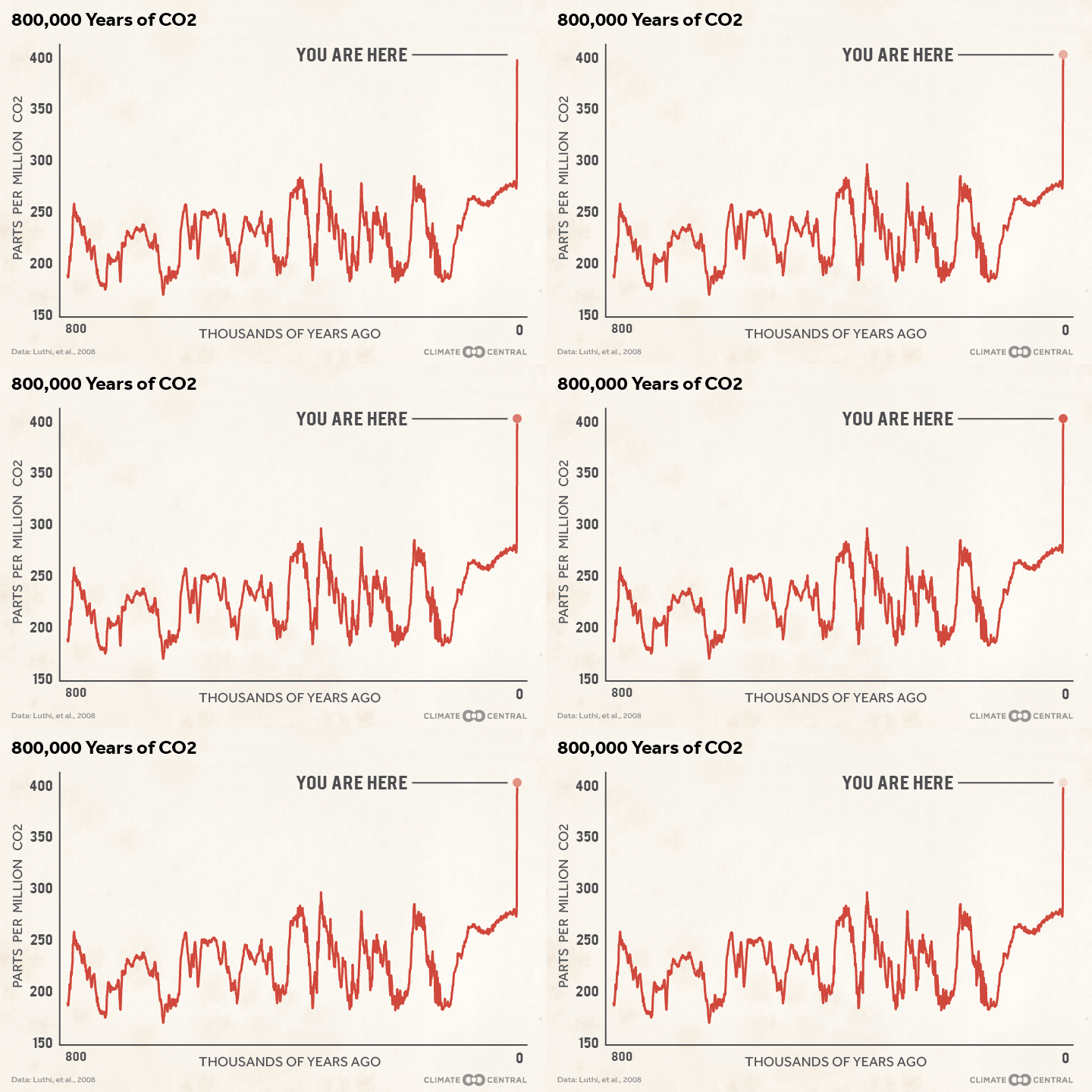
Climate Central reported in November: This week is a big one for our world. Atmospheric carbon dioxide (CO2) levels climbed above the 400 parts per million (ppm) at the Mauna Loa Observatory and it’s distinctly possible they won’t be back below that level again in our lifetimes.

Humans have burned enough fossil fuels to drive atmospheric CO2 to levels that world hasn’t seen in at least 400,000 years. That’s driven up temperatures, melted ice and caused oceans to acidify. Some extreme weather events around the world have become more likely and stronger because of it, and some will likely only get worse as the planet continues to warm.

Because CO2 sits in the atmosphere long after it’s burned, that means we’ve likely lived our last week in a sub-400 ppm world. It also means that the reshaping of our planet will continue for decades and centuries to come, even if climate talks in Paris in two weeks are successful. [Continue reading…]

Facebooktwittermail

ISIS wants to destroy cultural pluralism

Maha Yahya writes: ISIS wants to make the world in its own image. How the international community reacts to its horrific attacks will determine whether it will succeed.

ISIS has claimed more than 400 innocent lives in less than a month with attacks beyond Iraq and Syria in Paris and Tunis, a twin suicide bombing in Beirut, and the downing of a Russian jet in Egypt. Many saw in those attacks a civilizational struggle between the values of a liberal western world and a parochial intolerant Islam. Across Europe, calls are increasing for stringent measures restricting fundamental freedoms and eroding personal privacy as more than half US governors declared that their states will not accept Syrian refugees.

Through such responses policymakers are inadvertently dancing to the tune of ISIS that also views the world as divided in two; in their terms the “camp of Islam” and the “camp of the crusader coalition” that also includes Muslims who do not believe in the mission of ISIS. Its bloody attacks are one step in its efforts at eliminating the grey zone between these camps. This grey zone is the cosmopolitanism of Beirut and Paris; the places where the deliberate and accidental encounters between cultures, ethnicities and religions find themselves in music and writing, in scientific discoveries and in architectural feats.

ISIS did not begin its elimination of this grey zone in Paris or Beirut. It began with a pogrom in Iraq in June 2014, attacking more than two and a half million people of diverse religions and ethnicities that coexisted for centuries. Christians were expelled, the Turkomans and Shiites slaughtered and Yezidi women and children enslaved. [Continue reading…]

Facebooktwittermail

San Bernardino gunwoman pledged allegiance to ISIS, officials say

The New York Times reports: The woman who helped carry out the shooting in San Bernardino, Calif., on Wednesday had pledged allegiance to the Islamic State in a Facebook posting, according to federal law enforcement officials.

There’s no evidence the group directed the woman, Tashfeen Malik, and her husband Syed Rizwan Farook, to launch the attacks, which killed 14 and wounded 21, said the officials, who spoke on the condition of anonymity because the investigation is continuing.

“At this point we believe they were more self-radicalized and inspired by the group than actually told to do the shooting,” one of the officials said.

The posting had been removed from the social media site and it’s not clear when federal authorities obtained it.

In recent months, the F.B.I. has been particularly concerned about individuals inspired by the Islamic State staging attacks in the United States, law enforcement officials say. Even before the shootings and bombings in Paris last month, the agency had under heavy surveillance at least three dozen individuals who the authorities were concerned might commit violence in the group’s name. [Continue reading…]

Facebooktwittermail

Don’t make San Bernardino a victory for ISIS

Haider Ali Hussein Mullick writes: I am an American Muslim. I have spent my adult life teaching and advising senior military leaders in the fight against terror. On Wednesday night, as I watched representatives of the American Muslim community in San Bernardino, Calif., denounce the shooters who had just killed 14 people in their city, I recognized in their bearing and words their feelings of humiliation, horror and loyalty to the United States — alongside a great fear that a new round of Islamophobia will now follow.

I know from my own experience that more Islamophobia would be the worst outcome for American efforts to defeat the Islamic State.

As a naval officer I’ve taken an oath to defend the American Constitution against all enemies, foreign and domestic. I’ve trained members of the Navy SEAL teams, and my mentors include the former head of the National Rifle Association, the supreme allied commander of NATO, and the commanding general of the war in Afghanistan.

I have been deeply troubled by the anti-Muslim vitriol in our country since Islamist fanatics wreaked havoc in Paris. Fearmongers have already called for registering Muslims and closing mosques. The F.B.I. has warned Muslims about possible attacks from white supremacist militias.

If we don’t want to play into the hands of Islamic State propaganda that America is at war with Islam, we must stand up against Islamophobia. We should separate the few extremists from the vast majority of law-abiding patriotic American Muslims by working with the moderates, not against them.

The Islamic State has little to no support in most Muslim-majority countries, according to a Pew Research Center poll after the Paris attacks. Instead, with more than 60 countries aligned against it, the Islamic State is banking on Western societies to alienate their Muslim populations to increase recruitment. [Continue reading…]

Facebooktwittermail

If Assad is not forced out, ISIS never will be

Kyle Orton writes: it is now of primary importance that the British Government and the U.S.-led anti-Isis coalition as a whole make Assad’s ouster a central feature of their stated political objectives. The defeat of Isis requires the enlistment of Sunni Arab forces, and that can only happen if they are confident that Isis will not be replaced by radical sectarian forces of the Assad regime or Iran, which is in control of the Assad regime and which has deployed tens of thousands of Shi’a jihadists into Syria.

Limiting Iran’s power more broadly in Syria is crucial to defeating Isis. Iran and Isis are symbiotic, feeding off one-another by committing atrocities against the other’s political constituency against which they can claim to be the only protectors. The appearance of the coalition siding with Assad/Iran by only bombing Sunni radicals, while doing nothing as Iran moves tens of thousands of European- and U.S.-designated Shi’ite terrorists into Syria, is deeply damaging, helping Isis to present itself as the guardian of the Sunnis.

Sunni Arab forces are needed to defeat Isis because it is in Sunni Arab areas that Isis has its caliphate. Much propaganda has been spread by Assad, Iran, and Russia that there are no moderate Syrian rebels left, but this is simply untrue. The entire rebellion is at war with Isis and there are about 75,000 moderate rebels whom the coalition could work with, plus a further 25,000 not-so-moderate rebels who are also fighting Isis. (Al-Qaeda and pro-al-Qaeda forces amount to 15,000 at the most.) While the Pentagon’s train-and-equip program failed, as it was bound to do since it was only directed against Isis, and gets a lot of media attention, this ignores the more than 40,000 moderate rebels who have been vetted by the CIA and supplied with lethal weaponry, virtually none of which has gone astray. If the moderate rebels forces had something to fight for — namely the promise of self-rule, protected from Isis and Iran — and were given the appropriate resources they could be mobilized to defeat these two Western enemies. The Sunni Arab tribes also remain astonishingly unengaged, though when the West defeated Isis’s predecessor in Iraq it was exactly by aligning with these tribes to help them provide local security.

Finally, it is necessary not to over-rely on Kurdish forces. The Kurds have proven very adept at protecting Kurdish-majority zones from Isis, but many commentators have extended this fact to declare that the Kurds are our only reliable ally in Syria. Leaving aside the political authoritarianism and ethnic engineering of the PYD, the party in control of the Syrian Kurdish armed units, the PYD has been able to clear Isis from less than one province in a year with the backing of Coalition airstrikes. In early 2014, the rebellion, without any air support, expelled Isis from positions in seven provinces, two of which Isis remains wholly absent from and two of which Isis is still largely absent from. Organically rooted, local forces are needed to sustainably hold territory from which Isis is removed. If Kurds stayed in occupation of Arab territory it would produce a backlash similar to Iran’s militias that would redound to Isis’s benefit, as Sunni Arabs fear sectarian domination more than Isis. [Continue reading…]

The New York Times reports: Secretary of State John Kerry said Thursday he believes that if an agreement can be reached to ease President Bashar al-Assad of Syria from power, a coalition of Americans, Russians and Syrian forces could wipe out the Islamic State “in a matter of literally months.”

Mr. Kerry’s comments, in a speech to the Organization for Security and Cooperation in Europe in Belgrade, Serbia, on Thursday morning, were the first in which he publicly offered an estimate of how quickly a well-organized effort might be able to defeat the radical Sunni group. He also said that “without the ability to find some ground forces that are prepared to take on Daesh,” using an Arabic acronym for the group, “this will not be won completely from the air, and we know that.” But he was not specific about where those ground troops would come from. His aides later said they would have to be indigenous. [Continue reading…]

Facebooktwittermail

Don’t bomb Syria and don’t listen to Syrians?

As I understand it, the foundational premise of any antiwar movement is that the only way of protecting people who are harmed by wars is to end those wars. In other words, although the named issue is war, the object of concern is the victims of war.

At least I thought that was the issue, but these days if often looks like the victims of war are getting marginalized in the name of standing up for a wider cause: global justice. Indeed, when it comes to the UK’s Stop the War Movement, they profess such a deep interest in righting the world, that they often treat Syrians as an irritant who might undermine the group’s larger objectives. Moreover, when those crying, “Don’t bomb Syria” also welcome in their ranks some who are also calling for support for Bashar al-Assad, it becomes clear that the issue at hand is not actually where the bombs are falling but who is dropping them. Stop the War held no demonstrations outside the Russian Embassy in London when Vladamir Putin launched his bombing campaign on Syria.

Jeremy Cliffe writes: “Do we have Syrians?” interjects a woman. A brief silence. The gathering in Manchester’s Central Library is pondering who might take the microphone at its upcoming protest against plans to bomb Islamic State in Syria. On the list so far: Labour Party MPs, MEPs, councillors, the Green Party, the Campaign for Nuclear Disarmament, musicians, poets, trade unionists and “definitely a student of some sort”. Phone messages have been left, e-mails fired off and brains racked for names of old-time peaceniks. Only now has the idea of asking a Syrian arisen.

“There’s a big Syrian group,” murmurs one. “But they’re not anti,” continues another, disgusted: “They were lobbying for Britain to bomb Assad.” Those present sigh as one. On to the logistics of the event. It is decided that stewards should guard the mic, poised to fend off any “pro-war Syrians or imperialists”. After all, notes the chairman: “We know what we’re talking about here.” Would that BBC Manchester possessed such discernment. The station is interviewing pro-war Kurds tomorrow, to the group’s distain: “They dig ’em up.” “Amazing how they find them!”

Such is the eye-swivelling world of Stop the War, the organisation that, though not the same as the anti-war movement (dominated by decent, mild-mannered types), is its main organising force and has a record of sidelining the very peoples in whose interest it professes to act. Rethink Rebuild, the Syrian society in Manchester, requested a speaking slot at its Don’t Bomb Syria meeting there in October, but was ignored. It claims: “The Syrian voice was marginalised throughout the event.” Other Stop the War gatherings have followed that pattern. At one in Westminster Syrians criticising the unrepresentative panel were jeered at and the police called; in Birmingham a Syrian invited to speak was disinvited and branded a supporter of imperialism for backing a no-fly zone. This knack for alienating its notional beneficiaries goes all the way back to Stop the War’s foundation in 2001 by (among others) the Socialist Workers Party, an authoritarian far-left outfit. At one of its first conferences Iraqi and Iranian delegates quit when their motion condemning “Islamic terrorism” was defeated.

That is the thing with Stop the War. It is not anti-war so much as anti-West; a permanent howl of relativist anguish at NATO and its members. For example, the group could hardly be more indulgent of Vladimir Putin’s wars. It defended the invasion of Georgia as a reaction to “the ambition of the USA to exercise global hegemony”, called many of the Maidan protesters in Kiev neo-Nazis and excused Russian aggression in eastern Ukraine and the Crimea. Tellingly, at its “anti-war” demonstration in London on December 1st a poster emblazoned with Syrian flags and the slogan “Support For Bashar Al-Assad” was brandished above the crowd. [Continue reading…]

Facebooktwittermail

ISIS: The munitions trail

Financial Times reports: As a known arms dealer for rebels fighting Isis in his east Syrian home town, Abu Ali was sure his days were numbered when, a year ago, two jihadi commanders stepped out of their pickup truck and walked towards him.

He was baffled when they handed him a printed paper. “It read, ‘This person is permitted to buy and sell all types of weaponry inside the Islamic State,’” recalls Abu Ali. “It was even stamped ‘Mosul Centre’.”
Rather than being detained or expelled as they had feared when the jihadi group swept through eastern Syria last year, many black-market traders such as Abu Ali were courted by Isis. They were absorbed into a complex system of supply and demand that keeps the world’s richest jihadi group stocked with munitions across a self-proclaimed “caliphate” spanning half of Syria and a third of Iraq.

“They buy like mad. They buy every day: morning, afternoon and night,” says Abu Ali, who, like others who have operated inside Isis territories, asked not to be identified by his real name.

Isis seized weapons worth hundreds of millions dollars when it captured Iraq’s second city, Mosul, in the summer of 2014. Since then, in every battle that it has won, it has acquired more material. Its arsenal includes US-made Abrams tanks, M16 rifles, MK-19 40mm grenade launchers (seized from the Iraqi army) and Russian M-46 130mm field guns (taken from Syrian forces).

But dealers say despite this, there is one thing Isis still needs: ammunition. Most in demand are rounds for Kalashnikov assault rifles, medium-calibre machine guns and 14.5mm and 12.5mm anti-aircraft guns. Isis also buys rocket-propelled grenades and sniper bullets, but in smaller quantities. [Continue reading…]

Facebooktwittermail

Israeli expert: Trump’s call to kill terrorists’ families immoral, ineffective

CNN reports: A leading Israeli counter-terrorism expert says Donald Trump’s call to “take out” the families of terrorists would run afoul of international law and degrade the moral standing of the U.S.

“Any deliberate attacks aimed against civilians is a war crime, regardless if they are family members of terrorists or presidents or presidential candidates,” said Boaz Ganor, a former consultant to Israeli Prime Minister Benjamin Netanyahu.

“Adopting this policy is immoral and against the common liberal democratic values,” added Ganor, the founder and executive director of the International Institute for Counter-Terrorism in Israel. “Deliberate attacks against the terrorist families is blurring the moral differences between the terrorist organizations and the state which is fighting terrorism. This by itself might benefit the terrorists which are trying to claim that they are fighting a moral war against relentless and immoral entity.”

On Wednesday, Trump responded to a question on Fox News about minimizing civilian casualties in the fight against ISIS by saying the U.S. should hit the kin of enemy fighters.

“You have to take out their families, when you get these terrorists, you have to take out their families,” Trump said. “When they say they don’t care about their lives, you have to take out their families.” [Continue reading…]

It’s a shame Ganor wasn’t pressed to provide clarification on Israel’s long-standing policy of destroying the family homes of suspected terrorists. It’s immoral to kill family members but it’s ok to send in bulldozers to flatten their homes? Even Trump might find that confusing.

Facebooktwittermail

Naomi Klein’s ‘Leap Manifesto’: We can’t rely on big business for a climate fix

By Peter Burdon

Discussions at the Paris climate talks take place within incredibly narrow parameters. In fact, it would not be too great an exaggeration to say that the summit’s main purpose is to send the private sector a message about which way it should steer its future investments.

The financial press tends to be the most explicit on this point. The Financial Times, for instance, described the purpose of the Paris summit like this:

Investors will need to be persuaded that governments are going to make it easier for them to make money from a new electric bus system or a wind farm rather than a highway or a coal power plant.

I am under no illusion about the scale of business investment required to help developing countries move to low-carbon energy sources.

But by narrowing the conversation to neoliberal, market-based solutions, we risk ignoring other opportunities for social and environmental change. This is particularly true under the current state of emergency in France, which has silenced alternative or opposing voices.

These concerns are shared by the Canadian author and activist Naomi Klein, who this week (alongside her compatriots, the film-maker Avi Lewis and author Maude Barlow) came to Paris to present her Leap Manifesto – featuring strategies for a just transition away from fossil fuels.

Continue reading

Facebooktwittermail

ISIS emerged out of the dashed hopes of the Arab Spring

Adam Hanieh writes: In the wake of the November 13 attacks in Paris, much of the Left has linked the rise of the Islamic State of Iraq and Syria (ISIS) to the deepening imperialist violence in the Middle East.

War and imperialism, on one side, and the growing reach of jihadist terrorism, on the other, are said to be locked together in a mutually reinforcing embrace of violence and destruction. “Imperialist cruelty and Islamist cruelty feed each other,” the French Nouveau Parti Anticapitaliste (NPA) argued shortly after the Paris attacks. In order to break this nihilistic death grip, we need to oppose foreign intervention, put an end to imperialist violence, and halt the ongoing plunder of wealth from countries in the Middle East, Africa, and elsewhere.

The basic logic of this argument is undoubtedly sound. But in terms of explanatory value, this kind of analysis does not go far enough. It suffers from too much generality and abstractness — telling us little about the specificity of this particular moment, or the nature of ISIS as a movement. By attributing a kind of automaticity or natural mirror between ISIS and imperialism, we can miss the all-important context and history that has shaped the remarkably rapid rise of the organization.

Why does the response to Western aggression and the calamitous situations in Iraq, Syria, and elsewhere across the region take this particular ideological and political form? What explains the support that ISIS finds on the ground in both the Arab world and Europe? In short: why now? And why like this?

The real genesis of the Islamic State’s rise needs to be seen in the trajectory of the Arab uprisings that erupted throughout 2011 and 2012. These uprisings represented enormous hope, a hope that must continue to be defended. They were met with repression and reversal, unable to move forward in any fundamental sense. It was into this breach that Islamist groups stepped, their rise closely calibrated to the pushback against the revolts and the popular democratic aspirations that they embodied.

There was no inevitability to this. Rather, the difficulties the uprisings faced created a vacuum that was necessarily filled by something else. [Continue reading…]

Facebooktwittermail

U.S.-backed and YPG-led alliance faces challenges as a force in Syria

The Associated Press reports: Drawing on thousands of combatants from Syria’s mix of religious and ethnic groups, a U.S.-backed alliance called the Syrian Democratic Forces has emerged as the most effective fighting force against the Islamic State group.

But the dominant role of Kurdish fighters in the alliance is a concern for majority Sunni Arab factions and their regional backers, raising questions about the group’s future role in a broader political context in Syria.

In its founding statement, the Syrian Democratic Forces said its aim beyond destroying IS was to build a democratic, pluralistic Syria “where all Syrian citizens of all sects enjoy freedom, justice and dignity.”

“Officially they represent a whole range of ethnicities and ostensibly the vision could be deemed moderate, but the coalition can only gain limited traction, as the YPG is justifiably perceived as the dominant actor to which the allied rebel groups in particular are junior partners,” said Aymen Tamimi, an expert on rebel and Islamic extremist groups and a fellow at the Middle East Forum think tank.

One of the alliance’s biggest challenges is reclaiming mostly Arab areas with a fighting force whose most effective combatants are Kurds.

“They added Arab groups to the alliance to dilute the Kurdish element, but everyone knows it’s the Wihdat,” said Abu Khaled, a rebel fighter loosely affiliated with the Free Syrian Army, using the Arabic abbreviation for the YPG.

“Their (YPG) record is not clean, and that is the biggest problem facing this alliance,” he said from Turkey, where he goes back and forth to Syria.

His comments reflected the wide distrust the YPG faces among mainstream rebels in Syria. [Continue reading…]

Facebooktwittermail

Syria’s Kurds at the center of America’s anti-jihadi strategy

Aron Lund writes: The self-proclaimed Islamic State is under pressure in Syria today. In the Aleppo area, its defenses have been pierced by a Syrian government offensive backed by the Russian Air Force. Although most of the Russian airstrikes have hit other Sunni rebel groups (regardless of what the pro-Kremlin propaganda claims), some attacks target the Islamic State as well. In the deserts east of Homs, Syrian President Bashar al-Assad’s Russian-backed government is trying to reverse recent losses to the jihadi group. Should his army manage to recapture Palmyra, which was lost in May, it would be a severe blow to the Islamic State.

But until now, the most significant recent victories against the Islamic State have taken place further east and have come at the hands of an American-backed, Kurdish-majority alliance known as the Syrian Democratic Forces, or SDF.

Created as recently as October, the SDF is a political umbrella designed to provide legal and political cover for American military support to the Kurdistan Workers’ Party, better known as PKK. A Kurdish leftist group locked in battle with the Turkish government, it was designated a “ foreign terrorist organization” by the U.S. government in 1997 and graduated to become a Specially Designated Global Terrorist Organization in 2001, largely due to Turkish pressure.

The PKK, operating in Syria through a front group known as the People’s Defense Units, or YPG (with an all-female version called the YPJ), has emerged as the country’s most potent anti-jihadi force. Having crushed the Islamic State in Kobane in February, Tal Abyad in June, Hasakah City in July, and now in al-Houl on the Iraqi border, the Kurds and their local allies are gearing up for further offensives on jihadi strongholds near Raqqa and south of Hasakah. The White House desperately wants to support them, seeing few other ways to pressure the Islamic State in Syria.

So, in order to avoid any legal or political blowback, U.S. officials now insist that they are not at all working with the-organization-that-must-not-be-named, but rather with the SDF, where the YPG is only one member among many. And the United States has avoided adding the YPG to any blacklists, even though any American official could (but won’t) tell you that it’s a PKK front. [Continue reading…]

Facebooktwittermail

Yes, the rebels can defeat ISIS — and the UK’s increased involvement in Syria will help

Hassan Hassan writes: The US has thus far focused on working with particular forces in limited areas to battle Isis, while persistently striking the group’s bases and economic routes inside its heartlands. The tagetting of bridges and oil facilities and trucks is paralysing the economy in Isis-controlled areas. This sometimes pushed people to join the only employer in town to generate income for their families. Others have emptied their household of young members by sending them overseas as refugees.

Meanwhile, Isis embeds in residential areas to evade the airstrikes while still making money through taxation, extortion and other means that enabled it to take most of the areas now under control before it laid its hands on the oil infrastructure. It is also quietly expanding in less strategic but vulnerable areas such as the areas between Palmyra, the city of Homs and southern Syria, to avoid intensive bombardment or heavy military deployment.

Britain should not exacerbate the situation by merely deploying jets to fly more sorties onto Isis areas. Instead, most of the time and effort should be used to encourage and prop up local forces to fight ISIS. That requires a strategy that is independent from the one currently led by Washington. The focus for the UK should be to work mostly in the background through existing and new channels to advise, network, train and provide non-military services to armed fighting groups in different parts of the country.

For example, the UK has until recently sponsored an ambitious and unique programme to appoint moderate imams in an area controlled by various rebel forces, instead of extremist clerics affiliated to jihadi organisations. Part of the moderate clerics’ focus was to educate worshippers about the danger of takfir — or pronouncing fellow Muslims as infidels or apostates. According to a field commander of the faction overseeing the programme, the “culture of takfir” is a major impediment to getting fighters to combat groups such as Isis, especially if the faction is backed by western countries. [Continue reading…]

Facebooktwittermail

UK parliament votes to bomb ISIS in Syria – so, what will that mean internationally?

By Scott Lucas, University of Birmingham

The British parliament has approved a government plan to join the international alliance bombing Islamic State targets in Syria. After more than 10 hours debating, the motion in favour of action passed with 397 votes for and 223 votes against the government.

Ahead of the vote, British newspaper columns had been filled with discussion of a new “war”, while those opposed to the airstrikes drew parallels with the catastrophe of the intervention in Iraq in 2003.

Both of these are exaggerations. Britain’s bombing will not be significant and it certainly will not be part of a coherent strategy against the Islamic State, let alone a reasonable approach to Syria’s 56-month conflict.

This is no more than a political sideshow, a diversion from the core issue – namely the continuing civil war between president Bashar al-Assad and his opponents.

Continue reading

Facebooktwittermail