Author Archives: News Sources

It’s time to price in the hidden costs of fossil fuels

Nicholas Stern writes: The world is starting to realise that fossil fuels are not cheap. It is increasingly clear that oil, coal and gas have huge hidden costs that are omitted from prices, and they are therefore heavily subsidised.

The latest evidence about how expensive fossil fuels really are has been provided this week by the International Monetary Fund (IMF), an organisation that monitors the progress of the world’s economy. It estimates that oil, coal and gas will receive US$5.3tn in subsidies this year around the world. That is the equivalent of 6.3% of global GDP. The IMF correctly argues that the damages and costs caused by fossil fuels, through impacts such as air pollution, congestion, traffic accidents and climate change, should be treated as subsidies if they are not included in the prices paid for oil, coal and gas.

The increase from previous estimates is due to a number of factors, particularly a deepening understanding of the immense costs of air pollution. The unpriced costs of fossil fuels are in addition to, and much greater than, the direct financial support for fossil fuels through, for instance, tax breaks for oil and gas exploration and subsidies for consumers. The IMF points out that coal receives the biggest subsidies worldwide, and has the largest negative impact on human health through the pollution that it causes. [Continue reading…]


Facebooktwittermail

Stakes getting dangerously high for Saudi Arabia and its young prince

Bruce Riedel writes: As the war in Yemen resumes after a short humanitarian truce, the stakes are getting higher for Saudi Arabia’s princes.

The Royal Saudi Air Force and its allies resumed their bombing campaign this week after a five-day cease-fire to allow humanitarian supplies into Yemen. Saudi Arabia’s 29-year-old Defense Minister Prince Mohammed bin Salman has staked his future and his country’s on achieving some kind of victory in the kingdom’s war in Yemen. A truce that leaves Sanaa under the control of what the Saudis claim is an Iranian protégé regime is clearly not a decisive victory for the royals.

Instead — after weeks of air attacks on the Zaydi Shiite Houthi rebels and their allies — the prince’s war looks like a stalemate. The immense damage done to Yemen’s weak infrastructure has created considerable bad blood between Yemenis and their rich Gulf neighbors that will poison relations for years. Yemenis always resented their rich brothers, and now many will want revenge. Iran is scoring a victory on its Gulf rival without any cost to Tehran and with only limited Iranian assistance to the Zaydis. [Continue reading…]

Facebooktwittermail

Wanted in Saudi Arabia: Executioners

The New York Times reports: Job seekers in Saudi Arabia who have a strong constitution and endorse strict Islamic law might consider new opportunities carrying out public beheadings and amputating the hands of convicted thieves.

The eight positions, as advertised on the website of the Ministry of Civil Service, require no specific skills or educational background for “carrying out the death sentence according to Islamic Shariah after it is ordered by a legal ruling.” But given the grisly nature of the job, a scarcity of qualified swordsmen in some regions of the country and a rise in the frequency of executions, candidates might face a heavy workload.

Saudi Arabia’s justice system punishes drug dealing, arms smuggling, and murder and other violent crimes with death, usually by beheading in a public square.

Although the law also mandates that thieves in some cases have their hands cut off, that punishment is rarely carried out because judges consider it distasteful, according to Saudi lawyers.

On Sunday, Saudi Arabia beheaded a man for a drug offense, making him the 85th person to be executed this year, according to a count by Human Rights Watch based on Saudi government statements. That is almost as many people as the country executed in all of last year, when 88 people were beheaded. Thirty-eight of this year’s executions, including the one on Sunday, were for drug-related crimes with no allegations of violence, according to Adam Coogle, a researcher with Human Rights Watch.

In the United States, 35 prisoners were executed in 2014. [Continue reading…]

Facebooktwittermail

Israeli scheme to ban Palestinians from buses tantamount to apartheid

The Guardian reports: Israel’s prime minister, Binyamin Netanyahu, has cancelled a pilot scheme banning Palestinian workers from Israeli buses in the occupied territories – denounced as tantamount to apartheid – only hours after it was announced.

The plan had been approved by Netanyahu’s defence minister, Moshe Yaalon, but was cancelled amid fierce criticism from Israeli opposition figures, human rights groups and a former minister in Netanyahu’s own party, who said it was a “stain on the face Israel” that would damage its international image.

The move had been enthusiastically welcomed by settler groups and pro-settlement MPs who had long been lobbying for the ban.

The three month pilot scheme – which had been due to come into force on Wednesday – would have imposed strict new controls on thousands of Palestinians with permits to work in Israel, insisting they travel home through certain designated checkpoints and banning them from using Israeli run buses in the occupied West Bank.

The timing of the scheme’s launch – during visits by world football head Sepp Blatter and the EU’s foreign policy chief, Federica Mogherini – had seemed bizarre. Blatter is seeking to defuse moves to have a vote on Israel’s suspension from Fifa for alleged discrimination against Palestinians. [Continue reading…]

Facebooktwittermail

The GOP’s core is dying off by the day

Politico reports: It turns out that one of the Grand Old Party’s biggest — and least discussed — challenges going into 2016 is lying in plain sight, written right into the party’s own nickname. The Republican Party voter is old — and getting older, and as the adage goes, there are two certainties in life: Death and taxes. Right now, both are enemies of the GOP and they might want to worry more about the former than the latter.

There’s been much written about how millennials are becoming a reliable voting bloc for Democrats, but there’s been much less attention paid to one of the biggest get-out-the-vote challenges for the Republican Party heading into the next presidential election: Hundreds of thousands of their traditional core supporters won’t be able to turn out to vote at all.

The party’s core is dying off by the day.

Since the average Republican is significantly older than the average Democrat, far more Republicans than Democrats have died since the 2012 elections. To make matters worse, the GOP is attracting fewer first-time voters. Unless the party is able to make inroads with new voters, or discover a fountain of youth, the GOP’s slow demographic slide will continue election to election. Actuarial tables make that part clear, but just how much of a problem for the GOP is this? [Continue reading…]

Facebooktwittermail

Snowden sees some victories, from a distance

Scott Shane reports: For an international fugitive hiding out in Russia from American espionage charges, Edward J. Snowden gets around.

May has been another month of virtual globe-hopping for Mr. Snowden, the former National Security Agency contractor, with video appearances so far at Princeton and in a “distinguished speakers” series at Stanford and at conferences in Norway and Australia. Before the month is out, he is scheduled to speak by video to audiences in Italy, and also in Ecuador, where there will be a screening of “Citizenfour,” the Oscar-winning documentary about him.

But there have been far more consequential victories for Mr. Snowden’s cause two years after he flew from Hawaii to Hong Kong carrying laptops loaded with N.S.A. secrets.

Two weeks ago, a federal appeals court ruled that the first N.S.A. program he disclosed, which collects the phone call records of millions of Americans, is illegal. Last week, the House of Representatives voted overwhelmingly to transform the program by keeping the bulk phone records out of government hands, a change President Obama has endorsed and the Senate is now debating. And Apple and Google have angered the F.B.I. by stepping up encryption, including on smartphones, to scramble communications and protect customers from the kind of government surveillance Mr. Snowden exposed. [Continue reading…]

Facebooktwittermail

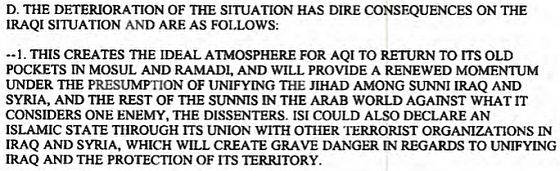
Defense Intelligence Agency report in 2012 warned about rise of ISIS in Iraq

Fox News reports: Seventeen months before President Obama dismissed the Islamic State as a “JV team,” a Defense Intelligence Agency report predicted the rise of the terror group and likely establishment of a caliphate if its momentum was not reversed.

While the report was circulated to the CIA, State Department and senior military leaders, among others, it’s not known whether Obama was ever briefed on the document.

The DIA report, which was reviewed by Fox News, was obtained through a federal lawsuit by conservative watchdog Judicial Watch. Documents from the lawsuit also reveal a host of new details about events leading up to the 2012 Benghazi terror attack — and how the movement of weapons from Libya to Syria fueled the violence there. [Continue reading…]

Facebooktwittermail

Experts: U.S. claims Ramadi a mere setback are ‘delusional’

McClatchy reports: The Obama administration Monday called the fall of the capital of Iraq’s Anbar province to the Islamic State a temporary setback that Iraqi forces would reverse with U.S. support. Experts dismissed that assessment as ludicrous.

“Delusional, really, is the better word,” Ali Khedery, a former U.S. official who served as an adviser to five U.S. ambassadors to Iraq and three heads of U.S. Central Command, said of the administration’s statement. “It’s unbelievable, frankly. I now know what it’s like to have lived through Vietnam, I guess.”

Experts called the loss a stunning blow to the Iraqi government and U.S. strategy.

It wasn’t clear why the administration clung to an upbeat message three days after the Islamic State overran most of Ramadi and a day after Iraq’s best special forces unit fled the city with other troops, local police and tribal fighters. The message was delivered in nearly identical verbiage by White House, State Department and Pentagon spokesmen and was reinforced by a statement from Army Gen. Martin Dempsey, the chairman of the Joint Chiefs of Staff. [Continue reading…]

Facebooktwittermail

Giving ISIS the battle they want in Iraq

Imran Khan writes: It was the worst defeat for Iraq’s elite security forces since the f‎all of Mosul just under year ago.

The images coming from Ramadi, the capital of Anbar province, looked more like a force in defeat rather than a tactical withdrawal.

They fled in the face of a campaign by the Islamic State of Iraq and the Levant (ISIL) group, which used firepower, car bombs and brute force for over a year to wear the Iraqi security forces down.

For ISIL it was a big victory.

Reports from Anbar suggest ISIL forces are now massing and gearing up for the next battle. A battle that they have wanted for a long time.

On Monday the Iraqi government announced that it had deployed at least ,3000 ‎Shia militia members to Habbineyeh airbase in Anbar in preparation for an assault on ISIL fighters.

The Iranians have stepped up support for the militias and the US-led coalition has increased air strikes in the last 72 hours on ISIL targets in Ramadi.

A very loose coalition of Iraqi Shia forces, Iranian support and America and the West. It is the war that ISIL have always wanted.

Across ISIL messages boards and social media accounts, ISIL sympathisers have drawn parallels between this conflict and ‎the Battle of Badr fought in 624 CE between the earliest followers of the Prophet Muhammad and the Quraish, the largest tribe in what is now Saudi Arabia. [Continue reading…]

Facebooktwittermail

To recapture Ramadi from Islamic State, Iraq must use this formula

Hayder al-Khoei writes: The fall of Ramadi, the capital of Iraq’s largest province, is a major defeat for the Iraqi security forces. It follows a period in which a number of strategic advances have been made by Iraqi forces elsewhere in the north and east of the war-torn country. Dreams of an offensive to defeat Islamic State in Mosul this year will now be crushed. Iraq will instead focus its resources and attention on liberating Ramadi, which lies just 60 miles to the west of Baghdad.

The complex realities on the ground will also lead to difficult choices being made on all sides of the conflict. Iraqi Prime Minister Haidar al-Abadi’s approval to send in the Shi’ite-dominated Hashid Shaabi paramilitary forces to the Sunni-dominated Anbar region will worry many, but it comes at the request of local Sunnis who are desperate to defend their areas against Islamic State. The Anbar governor, provincial council and local tribes have publically asked Baghdad to send in these paramilitary forces to support Iraq’s security forces and Sunni tribesmen.

Unlike in Tikrit, several Sunni tribes in Ramadi have already been resisting Islamic State for years now. As 3,000 Shi’ite fighters have deployed to the west of Ramadi following Abadi’s green light, 4,000 Sunni tribesmen have now been deployed in the west to prevent further Islamic State advances in Anbar. Sunni-Shi’ite military cooperation — aside from the official security forces that are themselves mixed — will be a crucial element in this campaign. Sunni tribal fighters are also officially part of the Hashid Shaabi in Anbar, so this paramilitary force is no longer exclusively Shi’ite. [Continue reading…]

Facebooktwittermail

ISIS solidifies foothold in Libya to expand reach

The Wall Street Journal reports: Islamic State leaders in Syria have sent money, trainers and fighters to Libya in increasing numbers, raising new concerns for the U.S. that the militant group is gaining traction in its attempts to broaden its reach and expand its influence.

In recent months, U.S. military officials said, Islamic State has solidified its foothold in Libya as it searches for ways to capitalize on rising popularity among extremist groups around the world.

“ISIL now has an operational presence in Libya, and they have aspirations to make Libya their African hub,” said one U.S. military official, using an acronym for the group. “Libya is part of their terror map now.”

Islamic State’s growth as a powerful anti-Western force has militant groups throughout the world trying to latch onto its notoriety. But until recently, affiliates have operated with a great degree of independence and there was little evidence they were taking orders from the group’s core leadership in Syria and Iraq, American officials said.

The core group benefited by pointing to the mushrooming number of affiliates to show its self-styled caliphate was expanding. But the gains in North Africa mark the first expansion of the group’s reach outside the Middle East beyond rebranding efforts by militants trying to secure direct support from the Syrian-based extremists, U.S. officials said. [Continue reading…]

Facebooktwittermail

ISIS is not as exceptional as it appears

Reyko Huang writes: The attention heaped on the Islamic State in Western media and public debate has centered primarily on two issues: its religion and its violence. On both fronts, the group has left observers aghast with its extremism. Those analysts focusing on the religion try to make sense of the group’s distinctive brand of Islamic ideology as well as the “psychopaths” who choose to become its followers. Those fixated on the group’s violence posit that its seemingly unlimited capacity to brutalize and terrorize has few parallels among violent organizations, so much so that “even al-Qaeda,” as is repeatedly pointed out, has disavowed the group.

Nevertheless, as Marc Lynch recently argued in the Monkey Cage, putting the Islamic State in a broader comparative perspective shows that the group is hardly unique among armed non-state organizations. This in turn points to ways scholars and observers might most productively study and write about the group.

Much of the media coverage and popular discussion of the Islamic State has focused on the group’s atrocious acts of violence. In their orchestrated murders and in the savvyness with which they broadcast them to the world’s horrified viewers, they are perhaps unmatched in the present age. And yet, to portray the Islamic State as uniquely brutal or unrivaled in its savagery is to forget our unfortunate history – even recent history – that is filled with episodes of extreme violence against civilians committed in the name of some political goal. One would be hard pressed to argue that the Islamic State’s actions are more unconscionable than those of the Khmer Rouge who created the killing fields of Cambodia, or Renamo of Mozambique whose fighters specialized in the kidnapping, rape and mutilation of women, men and children, or the systematic use of sexual violence as a weapon in the Bosnian war; or that the group’s staged beheadings are any more appalling than the thousands of “forced disappearances” conducted behind the scenes in the Salvadoran conflict. The only difference between cases such as these and the Islamic State when it comes to violence is that the latter operates in the age of social media and uses it to the fullest for shock-and-awe effects. [Continue reading…]

Facebooktwittermail

Who serves the best cappuccinos in the ISIS caliphate?

Channel 4 News reports: Abu Rumaysah al Britani, a man from Walthamstow in London who skipped bail to join the Islamic State group, has released a guide to the caliphate that ignores war-crimes and genocide, instead selling the Islamic State with the language of the west, of Costa coffee, of Cadbury’s chocolate, of holiday resort levels of comfort and climate.

The ‘Brief Guide to the Islamic State’ talks the about cosmopolitanism and ethnic diversity of the region that runs counter to the group’s medieval interpretation of Islam and the Islamic State militants’ destruction of ancient historical sites and images of mass killings it releases almost daily.

“If you were worried about leaving behind your local Costa coffee, then you will be happy to know that the Caliphate services some of the best lattes and cappuccinos around”, the guide reads. “The Caliphate offers an exquisite Mediterranean climate that has all the makings of a plush holiday resort.” [Continue reading…]

Facebooktwittermail

Give up on Netanyahu, go to the United Nations

Henry Siegman writes: The greetings President Obama extended last week to Israel’s new government may have sounded conciliatory, but Mr. Obama no longer entertains any illusions about Israel’s leaders.

In the wake of last month’s election, the longtime peace activists and diplomats who have devoted much of their professional lives to achieving a two-state solution to the Israeli-Palestinian conflict are more depressed and demoralized than ever before.

Well before Mr. Netanyahu declared during the recent election campaign that Palestinians would remain under Israeli military occupation as long as he is Israel’s prime minister, Mr. Obama understood that the Israeli government’s enthusiasm for continued peace talks with the Palestinians served no purpose other than to provide cover for Israel’s continued expansion of Jewish settlements and to preclude the emergence of anything resembling a Palestinian state in the West Bank.

Faced with this grim reality, some observers naïvely rooted for the center-left Zionist Union during the campaign. But the notion that a government led by Isaac Herzog and Tzipi Livni might have produced a two-state accord with the Palestinians was also a delusion. An agreement based on the 1967 lines never appeared in the Zionist Union’s platform or crossed Mr. Herzog’s lips.

Indeed, it was clear to anyone familiar with the history of the Israeli-Palestinian conflict that what little hope remained for a two-state solution would depend on the emergence of an Israeli government entirely under the control of Israel’s far right. Only a far-right government that so deeply offends American democratic sensibilities — as this one surely will — could provide the political opening necessary for a change in America’s Middle East policy. [Continue reading…]

Facebooktwittermail

How the CIA has been pulling the strings of U.S. foreign policy since 9/11

Yochi Dreazen and Seán D. Naylor report: Since its creation in 1947, the CIA has steadily evolved from an agency devoted to its mission of spying on foreign governments to one whose current priority is tracking and killing individual militants in an increasing number of countries. It has been well documented that the agency’s growing scope and depth of influence in the counterterrorism fight reflects its growing skill at hunting America’s enemies from Pakistan to Yemen. What is more surprising, however, is the CIA’s adept navigation of public scandals and its outmaneuvering of the DNI and opponents from the White House, Congress, the Defense Department, and the rest of the intelligence community. Through such machinations, the spy agency has managed to weaken or eliminate crucial counterweights to its own power.

To be sure, an empowered and largely autonomous CIA has global repercussions. Much of what the world associates with U.S. foreign policy since the 9/11 attacks—from drone strikes in the Middle East to the network of secret prisons around the world and the torture that occurred within their walls—originated at Langley. And given the agency’s dominance, the CIA seems bound to retain its outsize role in how the United States acts and is perceived abroad. With the agency at the forefront of another looming U.S. war in the Middle East, its primacy will again be put to the test.

Today, the CIA is the tip of the spear of the administration’s growing effort to beat back the Islamic State, which controls broad stretches of Iraq and Syria. CIA officers in small bases along the Turkish and Jordanian borders have helped to find, vet, and train members of the so-called moderate Syrian opposition so they can fight to dislodge the Islamic State and, ultimately, Syrian President Bashar al-Assad’s regime in Damascus. In addition, the agency is responsible for helping to funnel weapons and other supplies to rebels. Meanwhile, the Pentagon, which dwarfs the CIA in size, resources, and congressional backing, is dispatching Special Forces personnel to the region to carry out basically the same training mission. But if the two pillars of the national security establishment were to collide over Iraq and Syria, it would be a mistake to assume that the CIA would lose out. For better—and sometimes for worse—the CIA has been winning just these types of fights since the war on terror began 14 long years ago. [Continue reading…]

Facebooktwittermail

How Somalia’s Al Shabaab turned against its own foreign fighters

Jeremy Scahill reports: U.S. counterterrorism agencies have long been preoccupied with the threat posed by the recruiting successes of the Somali terrorist group al Shabaab in Western countries. The group has managed to lure hundreds of foreign fighters — including some 40 Americans — to Somalia through online propaganda videos and word-of-mouth in disaffected immigrant communities.

In recent years, however, al Shabaab has turned on the foreign fighters in its own ranks, waging a brutal campaign to purge the perceived spies from its midst. An intimate account of the Shabaab civil war was provided to The Intercept in a series of interviews conducted with a current member of al Shabaab and a source who has maintained close contacts with the group.

Al Shabaab has assassinated several foreign fighters on the CIA’s kill/capture list over the past few years and currently runs a network of secret prisons that hold, on charges of spying, U.S., British and other Western citizens who came to Somalia to join Shabaab, The Intercept has found. Shabaab operatives torture detainees using techniques such as waterboarding, beatings, and food and sleep deprivation, and conduct public executions of suspected spies, including by crucifixion. [Continue reading…]

Facebooktwittermail

The Rohingya crisis is not an isolated tragedy – it’s the shape of things to come

Tahmima Anam writes: In 1971 Ravi Shankar and George Harrison organised a concert in New York City’s Madison Square Gardens to fund relief efforts for war-torn Bangladesh. The album featured the image of a starving child on the cover, which became a symbol of an impoverished country emerging out of the rubble of war. Forty-four years later, another image is now associated with Bangladesh: that of the abandoned refugees who float on the Andaman Sea with no hope of rescue.

We’ve all seen the photographs of these refugees. We’ve seen them hanging their emaciated limbs off the sides of their boats. We’ve seen the scars on their backs,earned in fights over scarce food and water. We’ve read their harrowing stories of their being abandoned at sea, rejected by one government after another.

It is estimated that up to 8,000 refugees are marooned in the sea between Bangladesh and Malaysia. Most of them come from Rakhine state, in Burma, where as members of the Rohingya community they are denied the basic rights of citizenship. The rest are economic migrants from Bangladesh. [Continue reading…]

Facebooktwittermail

Climate change may put power grid at risk in the West

Climate Central: The ravages of climate change could severely hurt the ability of utilities in the 11 Western states to generate power unless they “climate proof” their power grid using renewables and energy efficiency, something they are not prepared for, according to a new study.

For nearly half of the West’s existing power plants, climate change could reduce their ability to produce electricity by up to 3 percent during an average summer and possibly up to nearly 9 percent during a decade-long drought, according to the study published Monday in the journal Nature Climate Change by researchers at Arizona State University. Coal-fired power plants in Wyoming, Utah, Arizona and Colorado are especially vulnerable, the study says.

Facebooktwittermail