Author Archives: News Sources

Why Israel doesn’t want a ceasefire with Hamas

Larry Derfner writes: If Israel agrees to end the war on terms that grant major, transformative relief to Gaza, that largely lift the blockade on the Strip and allow Gazans substantial freedom of movement – which is what Ban and even Kerry are talking about – then Hamas wins the war.

And this Israeli government will not allow that, not only because of false national pride, but also because if Hamas wins freedom for Gaza, it will take over the West Bank, directly or indirectly. The Palestinian Authority will collapse – to be replaced by Hamas or the Israeli military, either scenario being a nightmare for Israel – or the Palestinian Authority will refuse to go on playing Israel’s cop and begin demanding freedom for the West Bank, too.

As Noam Sheizaf wrote, Israel could agree to a ceasefire that ended the chokehold on Gaza if it was ready to end the occupation of the Palestinian territories altogether, in the West Bank as well. But it’s not. And so the only ceasefire the Netanyahu government will agree to is one that gains Gaza nothing or, at most, finds Israel throwing it a bone, thereby teaching Hamas and the rest of the Palestinians that firing rockets at Israel – even under extreme Israeli provocation – gets them nothing but a lot more pain.


Facebooktwittermail

U.S. diplomats and Marines close embassy and flee Libya fighting

The Daily Beast reports: Under the watchful eye of a military drone and three F-16 warplanes flying protective cover, 158 U.S. diplomats and 80 U.S. Marines evacuated the American embassy in Tripoli, Libya, on Saturday. Although there was no specific threat targeting the U.S. personnel, fighting between rival factions in the Libyan capital is raging amid fears the North African country is headed irreversibly toward anarchy. U.S. warships were positioned off the coast and more contingents of Marines were flown to the immediate vicinity, ready to deploy if needed to protect the evacuation convoy.

The Tripoli airport has been shut down by combat between two of the country’s most powerful militias, and most of the airplanes there have been destroyed or damaged so the evacuation had to be carried out overland: a five-hour drive to neighboring Tunisia. Under orders from Washington, the convoy pulled out of Tripoli at dawn and made it to safety by mid-day. It is unclear when or if the embassy will reopen.

Libya has been flirting with civil war for months as local gangs, ideological militias, Islamists and hopelessly dysfunctional state institutions have vied topsy-turvy for control. But this week Libya’s capital was rocked by some of the worst violence since the 2011 uprising that led to the NATO-backed ouster of strongman Muammar Gaddafi’s ouster, and with no sizeable national security force of its own, the government of Prime Minister Abdullah al-Thani has been unable to halt the descent into chaos. The U.S. isn’t alone in pulling out. Amid the rising violence, the United Nations has evacuated staff and Turkey announced Friday it was shuttering its embassy. The UK urged British citizens to leave Libya. [Continue reading…]

Facebooktwittermail

U.S. help for Syrian rebels — too little, too late

The Washington Post reports: A U.S.-backed effort to arm the moderate Syrian opposition is finally ramping up along the Turkey-Syria border, but it may come too late to save the rebels from defeats on two fronts, by President Bashar al-Assad’s government and by the extremists seeking to carve out an Islamic state.

Spurred by concerns that the al-Qaeda-inspired radicals will continue their relentless march across Iraq and Syria, the United States and its allies have begun accelerating the supply of arms and ammunition to a small number of vetted rebel groups in northern Syria, according to diplomats and rebels who have been receiving the deliveries.

Yet even as the fresh support arrives, challenges are mounting for the embattled moderates, who have been pushed out of eastern Syria by extremists, are being encircled in Aleppo by the government and are seeing their ranks eroded by defeats, desertions and infighting.

The outlook for the revolt against Assad’s rule is now bleaker than at any time in the past three years, rebel commanders say, diminishing the chances that the opposition will be able to present any meaningful challenge to the regime or even to serve as a counterweight to Islamist radicals, as U.S. policymakers are hoping. [Continue reading…]

Facebooktwittermail

‘Only stones remain’: Gaza lies in ruins

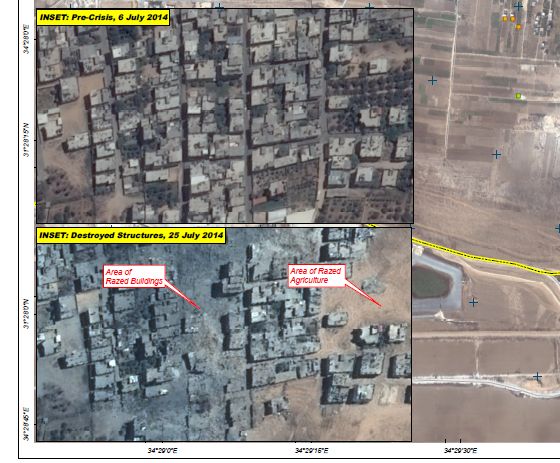
Mohammed Omer reports: Umm Ahmed Abu Sahwish holds stones in her hands. They are now all that’s left of her demolished home. “My home is gone and only stones remain,” the 65-year-old says.

Hundreds of homes here have been destroyed, and unexploded Israeli missiles litter the ground at the entrance to the town, at Gaza’s northern tip near the border with Israel. The local hospital, emergency rescue equipment, and infrastructure have also incurred heavy damage from Israeli shelling.

Another woman, from a family of 20 people, cries as she tries to dig through the rubble of her house. “Lifetimes of personal and household belongings are gone, with one Israeli missile. Where can we go? We have no food, water, bedding or extra clothes,” she says.

Driving the length of this tiny stretch of land – 1.8 million Palestinians live on Gaza’s 360sq km – scenes of devastation are everywhere. The trip from the north to the south of Gaza was only possible during a 12-hour humanitarian ceasefire, agreed to by Israel and Hamas on July 26.

On Sunday, Israel resumed its military operation in Gaza, as the prime minister’s office declared: “If residents are inadvertently hit, it is Hamas which is responsible given that it has – again – violated the humanitarian truce that Israel acceded to.” [Continue reading…]

Facebooktwittermail

Destroy Hamas? Something worse would follow: Pentagon intel chief

Reuters reports: A top Pentagon intelligence official warned on Saturday that the destruction of Hamas would only lead to something more dangerous taking its place, as he offered a grim portrait of a period of enduring regional conflict.

The remarks by Lieutenant General Michael Flynn, the outgoing head of the Defense Intelligence Agency, came as Israeli ministers signaled that a comprehensive deal to end the 20-day-old conflict in the Gaza Strip appeared remote.

At least 1,050 Gazans – mostly civilians – have been killed, and 42 Israeli soldiers and three civilians in Israel have died.

Flynn disparaged Hamas for exhausting finite resources and know-how to build tunnels that have helped them inflict record casualties on Israelis. Still, he suggested that destroying Hamas was not the answer.

“If Hamas were destroyed and gone, we would probably end up with something much worse. The region would end up with something much worse,” Flynn said at the Aspen Security Forum in Colorado.

“A worse threat that would come into the sort of ecosystem there … something like ISIS,” he added, referring to the Islamic State, which last month declared an “Islamic caliphate” in territory it controls in Iraq and Syria. [Continue reading…]

Facebooktwittermail

Rabid Jewish nationalism now governs Israel

Lisa Goldman writes: The vast majority of Israeli Jews support the military operation, called Protective Edge, but leftist Jews and the Arab minority organized anti-war protests, primarily in liberal Tel Aviv and then in Haifa, a mixed Arab-Jewish city.

There’s nothing new in seeing a minority of Israelis protest a popular war. It is not unprecedented for that minority to be met by counter-protestors who wrap themselves in the flag and call out insults like “traitor.” But this time something new and worrying happened: Peaceful, unarmed demonstrators in Israel’s two most liberal cities were physically attacked by ultra-nationalists wielding stones and bottles. In Haifa, nationalist thugs assaulted the Arab deputy mayor, slamming the middle-aged man down on the pavement. In Tel Aviv, they chased anti-war protestors into a cafe and smashed a chair over the head of one of them, even as municipal sirens wailed to announce an incoming rocket from Gaza. The police were ineffective in stopping the violence. Later, it emerged that the ultra-nationalist attackers had organized via a Facebook group managed by a well-known rap artist – a tattooed, muscular fellow who goes by the name The Shadow.

Something has broken down in Israeli society. Friends who always said they would never leave because they were too deeply rooted in the place, its language and their families are deeply worried and even despairing over the radical rightward shift of the mainstream political discourse. Several have said they were looking for opportunities abroad because they couldn’t see themselves raising their children in a country where dissent was slowly but surely being suppressed even as the national discourse hardened rightward.

Israel has always been a flawed democracy with many festering internal divisions. Its policies toward the Arab minority reflect the unresolved tension of a conflicted identity: Should Israel aspire to be a liberal democracy or a democracy for Jews? But in the five years since Benjamin Netanyahu was elected prime minister and formed a governing coalition composed of far-right, racist and anti-democratic parties, something very fundamental has changed in Israeli society. It feels as though the majority is willing to suspend essential elements of democracy in favor of Jewish nationalism. There doesn’t seem to be a place for dissent anymore.

Facebooktwittermail

In London 45,000 protest against Israel’s war on Gaza

The Independent reports: Tens of thousands of people amassed outside the Israeli embassy in London today to protest against Israel’s incursion into Gaza which has killed over 1000 Palestinians, including at least 192 children.

Chanting messages of solidarity to the Palestinian people, a constant flow of supporters filed through High Street Kensington underground station from early in the day.

45,000 people joined the demonstration, which later followed a route to Parliament, according to figures released by the Metropolitan Police.

The latest in a series of protests, last Saturday around 20,000 marched from outside Downing Street to the Israeli embassy.

Facebooktwittermail

Syria has its bloodiest week with 1,700 killed

The Huffington Post reports: As Israeli missiles lay waste to Gaza, Hamas rockets fly and innocents die in civilian planes downed in eastern Ukraine, Syria has slipped even further under the radar.

But with international attention focused elsewhere, Syria has just recorded it’s bloodiest week since the country descended into violence three years ago.

More than 1,700 people have been killed in just seven days, with fighters for the Islamic State in Iraq and the Levant (ISIS) accused of killing hundreds of government troops in a battle for a gas field, with hundreds of civilians killed as fighting intensified across the nation. The three-year-long civil war in Syria has now killed over 170,000 and displaced nearly nine million .

In the latest round of fighting, the London-based Syrian Observatory for Human Rights said that 270 government soldiers and gas field employees were killed in the clashes on July 19, many of them shot through the head execution-style. [Continue reading…]

Facebooktwittermail

Islamic State uses high grade captured weapons to fight Assad troops in Syria

The Telegraph reports: The extremist group Islamic State has launched a series of attacks across Syria, using military equipment seized from Iraq in its biggest concerted challenge yet to Assad regime forces.

Fighters from Islamic State have attacked two major military bases in the north-east of the country and well as regime-held areas near Aleppo.

They seized most of one base before coming under retaliatory aerial bombardment, seizing senior regime officers and in at least one case decapitating him, placing his easily recognisable head on a pole, according to pictures posted to social media.

The attacks mark a significant shift in the Syrian civil war. While the regime and Islamic State have fought in the past, both have until now preferred to focus their energies on the third major force in the civil war, the so-called “moderate rebels” comprising the Free Syrian Army and a variety of Islamist groups.

The attacks also suggest the group has for now abandoned plans to move further into Iraq or attack the capital Baghdad.

The change of tactics by Islamic State follows the gradual weakening of the western-backed rebels, who are squeezed between the jihadists and the regime. They declared war on the Islamic State in January, hoping that tackling the extremists would encourage more military backing from the West and its allies.

That backing never came, and with thousands of opposition fighters dying in the battles between competing rebel forces, the regime has advanced across key battlegrounds in the centre and north of the country, including Aleppo.

Meanwhile, in a series of lightning raids and defections, Islamic State managed to drive out competitors from most of the eastern province of Deir al-Zour, and seized major oilfields from the regime. [Continue reading…]

Facebooktwittermail

A nation in peril — Iraq’s struggle to hold together

Reuters reports: Iraq’s latest – and gravest – crisis erupted when mostly Sunni fighters swept through the north last month. Now the jihadist black flag flies over of most of the country’s Sunni Arab territory.

Kurdish forces, exploiting the chance to take another step towards independence, seized the city of Kirkuk and nearby oilfields, leaving the Shi’ite-led government controlling only the capital region and the mainly Shi’ite south.

The government is trying to reverse this de facto, three-way split of the country, but its reliance on Shi’ite militia and volunteers rather than the ineffectual national army has deepened sectarian mistrust without pushing the rebels back.

Across Baghdad a Sunni living in the Shi’ite area of Maalef, cut off from the rest of the city by a checkpoint where non-residents are turned back, said life there had become unbearable for those who do not belong to the majority Shi’ite community.

“The Sunnis all want separation now,” said the 37-year-old electrician, who asked not to be named for his security. “Facts on the ground tell you this will be the final result. On both sides now you have extremists who don’t want to get along”.

Kurdish politician Hoshiyar Zebari, who still staunchly advocates Iraqi unity, described the new geography. “The country is divided literally into three states: the Kurdish state; the black state (under Sunni insurgents) and Baghdad,” he said.[Continue reading…]

Facebooktwittermail

Father recounts witnessing his family killed by Israeli missile strike

Ayman Mohyeldin reports: Hassan Al Hallaq did what any sensible parent would do: When the latest bout of violence erupted here, he moved his family — heavily pregnant wife, Samar, and two young sons — away from their apartment on the outskirts of town and into the middle of Gaza City.

Away from the border, away from the tunnels, the rockets and the front line, Al Hallaq thought his wife and sons Kenan, 6, and four-year-old Saji would be safe.

The IT manager at a Palestinian bank had lived with his family through two previous wars and knew his neighborhood in East Gaza would be targeted by the Israelis because it is close to the border.

Facebooktwittermail

Israel is not my birthright

Shira Lipkin: I’m writing this in my new baby niece’s room. I am here in Florida visiting my family because of this niece, this tiny pudgy innocent baby. We are Jewish, and it’s time for my niece to receive her Hebrew name in a sweet little ceremony at our longtime synagogue.

Last night I sat at the synagogue next to my 19-year-old daughter. I felt a swell of joy as the services began; I’d been away too long. I’d loved services as a child and teenager.

And then we hit the first mention of Israel as the Promised Land, and I burst into tears.

On the way to services, I’d caught up on Twitter a bit. I’d read about the Israeli missiles still falling on Palestine. I’d read about the outright murder of Palestinian children.

And I sat there and listened to the rabbi call Israel our Promised Land, and it broke something in me.

I am an American Jew of a certain age (40), and what that means is that I was raised to believe that Israel was ours by divine right.

It sounds ridiculous when you say it aloud. Especially because, like many of my generation of Jews, I’m not particularly religious. Many Jews my age slid into paganism, a sort of ambivalent agnosticism, or outright atheism; we are cultural Jews rather than religious Jews. And yet when I first spoke about the conflict between Israel and Palestine some years ago, I found that falling out of my mouth – that God promised us Israel. It’s ours because God said so.

My daughter, trying to comfort me after the services, said, “Maybe it is the Promised Land, just not right now.”

My daughter is an atheist. And the narrative got her, too.

The history we are taught in our Sunday school is that we were there first, and that therefore the Palestinians are occupying our land. How long ago were we there, though? And who, exactly, is we? I find myself using that we – “We need to stop bombing Palestine,” “we need to give land back,” but I am not Israeli. I have never been to Israel. This is how deep it runs, this idea of possession. [Continue reading…]

Facebooktwittermail

Israel is destroying itself by clinging to victimhood

David Grossman writes: Look at us: The strongest nation in the region, a regional superpower that enjoys the support of the United States on an almost inconceivable scale, along with the sympathy and commitment of Germany, England and France – and still, deep inside, it sees itself as a helpless victim. And still it behaves like a victim – of its anxieties, its real and imagined fears, its tragic history, of the mistakes of its neighbors and enemies.

Facebooktwittermail

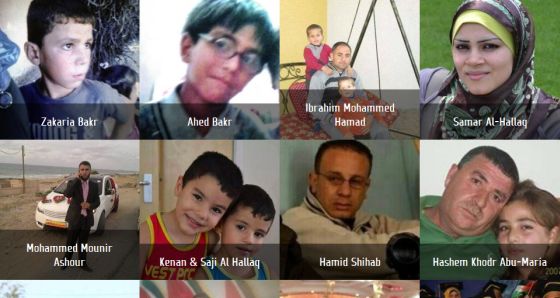
Beyond Numbers: Remembering the victims of Israeli operation ‘Protective Edge’ on Gaza

The Beyond Numbers platform aims to remember all innocent victims of the Israeli Operation “Protective Edge” on Gaza, launched on July 8, 2014. Each picture portrays a victim and his/her story, rather than a number to add to the death count.

The platform is regularly updated by Palestinians living in the conflict zone through the website’s proprietary crowdsourcing interface. The hope is to inspire the world to take action and call for the end of the violence.

beyondthenumber

Facebooktwittermail