J.J. Goldberg writes: One of the most common arguments in favor of the two-state solution to the Israeli-Palestinian conflict is the so-called demographic threat or demographic time-bomb. Proponents worry that if Israel continues to control the Palestinian territories, with or without formal annexation, the different birthrates of Jews and Arabs will eventually result in Jews being a minority in the territory under Israeli control. At that point Israel will no longer be a Jewish state — or, alternatively, will be a Jewish state with a non-Jewish majority that is disenfranchised because of its ethnic identity. There’s a word for that. I won’t say it, but I’ll note that it’s Afrikaans in origin.
How far off such a situation might be is a topic of considerable debate. Some say the threshold will be crossed within a decade or less. Others suggest a longer timeline is possible. A few on the right believe there’s no threat at all, either because Jewish and Arab fertility rates are converging or because Palestinian population figures are inflated. By and large, though, demography appears to be a very mainstream worry.
Well, worry no more. It turns out we’re there already. Comparing the annual Rosh Hashanah population report from Israel’s Central Bureau of Statistics, released September 2, with the midyear (July 1) population figures for the West Bank and Gaza in the CIA World Factbook, it turns out that Jews are now (as of Rosh Hashanah) outnumbered by Arabs under Israeli sovereignty by a grand total of 50,827. So the question is no longer whether or when the Jewish state will feature a minority ruling a majority. The question now is what to do about it. [Continue reading…]
Author Archives: News Sources
Secret recordings reveal Mubarak’s frank views on the U.S., Israel and the Brotherhood
The New York Times reports: Hosni Mubarak looked like a stalwart American ally but worried for years that Washington was trying to oust him as president of Egypt, he confided to a doctor recently in surreptitiously recorded conversations that came to light here last week.
“How did the revolution start?” Mr. Mubarak mused about his ouster, in early 2011. “The Americans worked on it since 2005, and I had a feeling then.”
The conversations were recorded over a period of months this year and were authenticated over the weekend when the doctor, an ear, nose and throat specialist, was summoned to testify about them. They offer a rare, unadulterated taste of the former president’s attitudes about a host of subjects — Washington, Israel, his Arab neighbors, Jews, the Muslim Brotherhood, Egypt’s new military leaders and most of all himself.
For all the aid the United States gave Egypt during his 30 years in power, his comments suggest that Washington gained little sway over Mr. Mubarak. And he expressed nothing but pride in his rule despite the steady decline of Egypt’s economy and influence.
The Islamists who won power after his removal “blame ‘the former regime’ for everything,” Mr. Mubarak is heard complaining in one recording. Speaking of the Egyptian population, he said, “They lived — they were 43 million when I received them and 90 million when I handed them over.”
The recordings were released last week through the Web site of the newspaper Youm el-Saba, and quickly captivated Egyptians with details like Mr. Mubarak’s boasts of his heroism as a pilot in the 1973 war against Israel, and his shock at the high prices of groceries. “An egg is one pound?” he said in shock, joking, “So let’s eat potato sandwiches!”
Mr. Mubarak apparently did not foresee the ouster in July of his successor, Mohamed Morsi of the Muslim Brotherhood. In a recording made in the spring, he was asked whether he thinks the military will act to stop the turmoil between Mr. Morsi’s opponents and his supporters; he responded, “What would they do?” He is heard guessing wrongly about Gen. Abdul-Fattah el-Sisi, the head of the military, saying he thought General Sisi supported Mr. Morsi and his Islamist allies: “The defense minister, I think, is to their liking.”
He realized his mistake after General Sisi seized power. In a later recording, someone said the general had turned out not to be a Muslim Brotherhood supporter after all. Mr. Mubarak laughed wryly: “No, no, he turned out to be devious.” [Continue reading…]
Bruce Schneier: NSA spying is making us less safe
Bruce Schneier, a cryptographer and author on security topics, is now helping The Guardian sift through documents leaked by Edward Snowden. He talked to MIT Technology Review about what he is learning.
MIT Technology Review: Taken together, what do all of the Snowden documents leaked thus far reveal that we didn’t know already?
Bruce Schneier: Those of us in the security community who watch the NSA had made assumptions along the lines of what Snowden revealed. But there was scant evidence and no proof. What these leaks reveal is how robust NSA surveillance is, how pervasive it is, and to what degree the NSA has commandeered the entire Internet and turned it into a surveillance platform.
We are seeing the NSA collecting data from all of the cloud providers we use: Google and Facebook and Apple and Yahoo, etc. We see the NSA in partnerships with all the major telcos in the U.S., and many others around the world, to collect data on the backbone. We see the NSA deliberately subverting cryptography, through secret agreements with vendors, to make security systems less effective. The scope and scale are enormous.
The only analogy I can give is that it’s like death. We all know how the story ends. But seeing the actual details, and seeing the actual programs, is very different than knowing it theoretically.
The NSA mission is national security. How is the snooping really affecting the average person?
The NSA’s actions are making us all less safe. They’re not just spying on the bad guys, they’re deliberately weakening Internet security for everyone—including the good guys. It’s sheer folly to believe that only the NSA can exploit the vulnerabilities they create. Additionally, by eavesdropping on all Americans, they’re building the technical infrastructure for a police state.
We’re not there yet, but already we’ve learned that both the DEA and the IRS use NSA surveillance data in prosecutions and then lie about it in court. Power without accountability or oversight is dangerous to society at a very fundamental level. [Continue reading…]
How the NSA is damaging the American economy
Network World reports: The spectacle of National Security Agency contractor Edward Snowden exposing the covert spying nature of US federal officials has sent ripple waves through the technology industry — especially in the outsourcing arena.
Experts predict the NSA fiasco could result in the loss of business for some hosting vendors, but it’s hard to say exactly what the impact has been or will be.
The head of a European cloud computing provider said recently though that he’s seen a “measurable impact” from companies looking to use its services to escape what they fear could be the prying eyes of the US NSA.
“It has not been a profound surge, but there is definitely a measureable impact,” says Robert Jenkins, co-founder and CTO of Cloud Sigma, which is headquartered in Switzerland and has data centers across Europe and the United States. “We’ve definitely seen cases where people are turning to us because of this.”
Forrester analyst and cloud tracker James Staten predicted this could happen in a blog post in the summer. Information Technology & Innovation Foundation (ITIF) estimated in a report that the US cloud computing market could stand to lose up to $35 billion by 2016 because of vendors bypassing US providers and looking to overseas competitors. Staten says that’s the low end of an estimate though. [Continue reading…]
Video: Gilbert Achcar on the revolutionary processes in the Arab uprisings
Climate change: IPCC issues stark warning over global warming
The Guardian reports: Scientists will this week issue their starkest warning yet about the mounting dangers of global warming. In a report to be handed to political leaders in Stockholm on Monday, they will say that the burning of fossil fuels and deforestation have now led to a warming of the entire globe, including land surfaces, oceans and the atmosphere.
Extreme weather events, including heatwaves and storms, have increased in many regions while ice sheets are dwindling at an alarming rate. In addition, sea levels are rising while the oceans are being acidified – a development that could see the planet’s coral reefs disappearing before the end of the century.
Writing in the Observer ahead of the report’s release, the economist and climate change expert Lord Stern calls on governments to end their dithering about fossil fuels and start working to create a global low-carbon economy to curtail global warming. Governments, he states, must decide what “kind of world we want to present to our children and grandchildren”.
The fifth assessment report on the physical science of climate change by the Intergovernmental Panel on Climate Change (IPCC) warns that humanity is on course over the next few decades to raise global temperatures by more than 2C compared with pre-industrial levels. Such a rise could trigger the release of plumes of the greenhouse gas methane from the thawing Arctic tundra, while the polar ice caps, which reflect solar radiation back into space, could disappear.
Although the report does not say so, Earth would probably then be facing a runaway greenhouse effect.
The scientists’ warning – the most comprehensive and convincing yet produced by climate scientists – comes at a time when growing numbers of people are doubting the reality of global warming. Last week, the UK Energy Research Centre (UKERC) published a survey showing that the proportion of British people who do not think the world’s climate is changing has almost quadrupled since 2005.
Asked if they thought Earth’s climate was changing, 5% of respondents said “no” in 2005, a figure that rose to 11% last year and reached 19% this year. [Continue reading…]
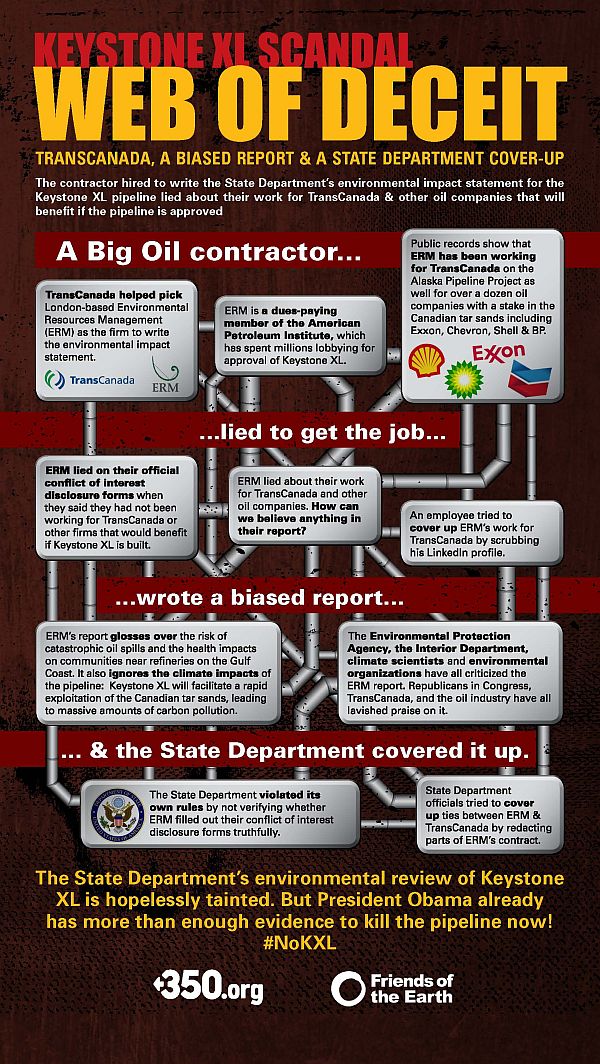
Keystone XL scandal web of deceit
NPR interview with Trita Parsi on the chance of an historic thaw in U.S.-Iran relations
Iran’s elite military warns of dangers of dealing with U.S.
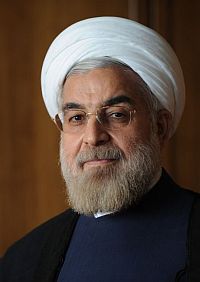
Reuters reports: Iran’s elite Revolutionary Guard has warned of the dangers of dealing with U.S. officials, ahead of expected diplomatic contacts, underlining the internal challenges President Hassan Rouhani could face to improve ties with the West.
Rouhani is expected to pursue a charm offensive in the coming week while in New York for the U.N. General Assembly in order to set the right tone for further nuclear talks with world powers which he hopes will bring relief from sanctions, according to diplomats and analysts.
Hours before leaving for New York on Sunday, the new Iranian president said that Tehran was ready for negotiations with Western powers provided they set no pre-conditions. He also said the world needed to accept Iran’s right to enrich uranium.
The Islamic Revolutionary Guard Corps (IRGC) military force was established to safeguard Iran’s revolution in 1979 and has since influenced political, social and economic affairs.
“Historical experiences make it necessary for the diplomatic apparatus of our country to carefully and sceptically monitor the behaviour of White House officials so that the righteous demands of our nation are recognised and respected by those who favour interaction,” an IRGC statement said.
It added the IRGC would support initiatives that were in line with national interests and strategies set forth by Iran’s theocratic leader and highest authority, Ayatollah Ali Khamenei.
The United States and its allies have imposed tough economic sanctions on Iran over suspicions Tehran intends to develop a nuclear capability. Iran says the programme is purely peaceful.
The IRGC statement, published by Iran’s Tasnim news agency on Saturday and marking the 33rd anniversary of the start of the Iran-Iraq war, came days after Khamenei and Rouhani told the security hardliners to stay out of politics, in effect instructing them not to scupper the new centrist government’s attempt to resolve the nuclear dispute.
How France’s burqa ban is promoting deadly intolerance
Nabila Ramdani writes: Join me in a criminal court in suburban Paris on almost any weekday and I’ll show you exactly where national debates about female face coverings end up.
Ever since France introduced its “burqa ban” in 2011, there has been a constant stream of wretched cases involving the handful of Muslims who choose to wear such garments. Not only are perfectly upstanding women being fined for their choice of dress, principally the full-body niqab, which leaves a slit for the eyes, but an increasing number of defendants are being tried for attacking them.
One case involves two self-styled “patriotic vigilantes” who targeted a pregnant 21-year-old in the commuter town of Argenteuil, north-west of Paris, in June. The new law persuaded the men to shout racist insults before putting the woman in hospital, where she lost her baby. Another three reported cases on the same council estate over the course of just one month this summer saw full-veil wearers assaulted as their attackers shouted: “Dirty Arab, dirty Muslim.”
Those calling for a veil ban in Britain have clearly ignored such depressingly routine cases. They do not realise how the legislation introduced by President Nicolas Sarkozy’s government has not only stigmatised Muslim women, but somehow legitimised physical attacks on them. The ban in France is a hateful assault on basic freedoms, one that has been seized on by an unlikely alliance of rightwing politicians and feminists. [Continue reading…]
In secret, Fisa court contradicted U.S. supreme court on constitutional rights
Yochai Benkler writes: On Tuesday, the Foreign Intelligence Surveillance Court (FISC) declassified an opinion in which it explained why the government’s collection of records of all Americans’ phone calls is constitutional, and that if there is a problem with the program, it is a matter of political judgment, not constitutional law. So, should Americans just keep calm and carry on phoning? Not really.
Instead, we should worry about a court that, lacking a real adversarial process to inform it, failed while taking its best shot at explaining its position to the public to address the most basic, widely-known counter-argument to its position. The opinion does not even mention last year’s unanimous US supreme court decision on the fourth amendment and GPS tracking, a decision in which all three opinions include strong language that may render the NSA’s phone records collection program unconstitutional. No court that had been briefed by both sides would have ignored the grave constitutional issues raised by the three opinions of Justices Scalia, Sotomayor, and Alito in United States v Jones. And no opinion that fails to consider these should calm anyone down.
The newly-released FISC opinion, the first to opine on the legality of the phone metadata collection program since the Snowden leaks brought the program to national attention, is based on two straightforward points.
First, in 1979, the supreme court held in Smith v Maryland that using “pen registers” that record what number called what other number, when, and for how long, did not violate the fourth amendment. The court in Smith reasoned that individuals have no expectation of privacy in information they knowingly hand over to the phone company. The FISC reasoned that even though the NSA metadata program collected more information than the program the supreme court upheld 35 years ago, the details did not make a constitutional difference. Individuals have no fourth amendment rights in their phone call metadata.
The second component of the FISC argument was that “grouping together a large number of individuals”, no single one of whom has “a fourth amendment interest”, “cannot result in a fourth amendment interest springing into existence ex nihilo”. Adding up many zeros doesn’t create a positive value; bulk collection of unprotected materials over a sustained period of years raises no special constitutional considerations.
Standing on its own, this logic may seem persuasive. But only until you think about how last year’s Jones decision by the supreme court destabilizes this logic. [Continue reading…]
Close the NSA’s back doors
An editorial in the New York Times says: In 2006, a federal agency, the National Institute of Standards and Technology, helped build an international encryption system to help countries and industries fend off computer hacking and theft. Unbeknown to the many users of the system, a different government arm, the National Security Agency, secretly inserted a “back door” into the system that allowed federal spies to crack open any data that was encoded using its technology.
Documents leaked by Edward Snowden, the former N.S.A. contractor, make clear that the agency has never met an encryption system that it has not tried to penetrate. And it frequently tries to take the easy way out. Because modern cryptography can be so hard to break, even using the brute force of the agency’s powerful supercomputers, the agency prefers to collaborate with big software companies and cipher authors, getting hidden access built right into their systems.
The New York Times, The Guardian and ProPublica recently reported that the agency now has access to the codes that protect commerce and banking systems, trade secrets and medical records, and everyone’s e-mail and Internet chat messages, including virtual private networks. In some cases, the agency pressured companies to give it access; as The Guardian reported earlier this year, Microsoft provided access to Hotmail, Outlook.com, SkyDrive and Skype. According to some of the Snowden documents given to Der Spiegel, the N.S.A. also has access to the encryption protecting data on iPhones, Android and BlackBerry phones.
These back doors and special access routes are a terrible idea, another example of the intelligence community’s overreach. Companies and individuals are increasingly putting their most confidential data on cloud storage services, and need to rely on assurances their data will be secure. Knowing that encryption has been deliberately weakened will undermine confidence in these systems and interfere with commerce.
The back doors also strip away the expectations of privacy that individuals, businesses and governments have in ordinary communications. If back doors are built into systems by the N.S.A., who is to say that other countries’ spy agencies — or hackers, pirates and terrorists — won’t discover and exploit them?
The government can get a warrant and break into the communications or data of any individual or company suspected of breaking the law. But crippling everyone’s ability to use encryption is going too far, just as the N.S.A. has exceeded its boundaries in collecting everyone’s phone records rather than limiting its focus to actual suspects.
Representative Rush Holt, Democrat of New Jersey, has introduced a bill that would, among other provisions, bar the government from requiring software makers to insert built-in ways to bypass encryption. It deserves full Congressional support. In the meantime, several Internet companies, including Google and Facebook, are building encryption systems that will be much more difficult for the N.S.A. to penetrate, forced to assure their customers that they are not a secret partner with the dark side of their own government.
Obama would be crazy not to seize this chance to engage with Iran
Fred Kaplan writes: President Obama would be crazy not to dive deep into diplomacy with Iran, right now. Forget the standard throat-clearing bromides and water-testing toe-dips that mark the resumption of relations with suspect characters. When the world’s leaders meet at the U.N. General Assembly next week, Obama should not only shake hands with Iranian President Hassan Rouhani but also meet with him privately, hand him a list of a dozen issues to discuss (uranium enrichment, sanctions, regional stability, etc.), and even be prepared to announce, if possible, a time and place for negotiations to begin and a roster of the delegates to be invited.
If Rouhani is who he claims to be—an Iranian moderate who has the authority to strike a bargain on nuclear programs and economic sanctions (at least until hardliners lose patience with him)—then this is an opportunity no Western leader can pass up.
If it’s all a ruse, or if the mullahs overrule whatever deal emerges, there’s no harm in trying. In fact, if things go bad and Western leaders feel compelled to respond with tighter sanctions or military action, they could do so with greater legitimacy after having given the high road a chance.
In any case, it does little good to sit around and debate the potential truth of Rouhani’s proclamations or the nature of Iranian politics, about which any outsider’s knowledge is limited. Rouhani has put his statements on the table. No Iranian president, in the entire revolutionary period, has said anything remotely this appealing. He has appointed, in Mohammad Javad Zarif, a foreign minister whose known views are consistent with these statements. Iran’s economy is in such a tailspin that the regime — including the mullahs who are ultimately in charge — may be willing to trade some things of value for an end to the U.S.-imposed sanctions. [Continue reading…]
Syria’s refugees: the catastrophe
Hugh Eakin and Alisa Roth write: In early June 2011, some three months into the uprising against the regime of Syrian leader Bashar al-Assad, Syrian government forces began preparing for a large-scale assault on Jisr al-Shughour, a rebellious border town sixty-five miles southwest of Aleppo. The events that led to this operation are a matter of some dispute. Residents of the town said that Assad’s security forces shot and killed an unarmed man during a protest after Friday prayers. At his funeral the next day, thousands of mourners marched to a post office where security forces were gathered.
According to eyewitnesses, government snipers on top of the building began shooting at the crowd, while more troops arrived to back them up. But numerous accounts also describe soldiers defecting and joining with the mourners, a number of whom had brought guns, to attack the regime forces; Syrian state media later claimed that 120 soldiers had been massacred by “armed gangs.”
What is certain is that an exceptionally violent confrontation took place. As the regime sent reinforcements to retake control, most of the town’s 44,000 inhabitants and many from the surrounding area fled. “They were burning houses and fields and killing animals. They started shooting. And killed two families,” a woman who called herself Lajia told us when, reporting for a public radio story, we met her in a tiny Turkish village two weeks later. With her six children, then aged six to seventeen, she had escaped from her farm near Jisr al-Shughour across the border to Turkey, where she was staying with relatives. “Villages were increasingly empty from around forty kilometers away,” a United Nations official reported after a fact-finding mission later that month. “Jisr al-Shughour itself was almost deserted.” Like Lajia and her family, much of the population had crossed into Turkey’s Hatay province—the first refugees in a conflict that has since produced more than two million of them.
In more than one way, what happened in Jisr al-Shughour is unusually revealing about the course of Syria’s civil war: it was the first well-documented case of protesters arming themselves and fighting back against Syrian troops. It was also one of the first occasions that large numbers of Syrians were forced to flee to a neighboring country. At the time, the Turkish government had not yet endorsed the Syrian opposition; it had spent the previous decade building economic and political ties with the Assad regime and still hoped for a negotiated solution to the uprising. But Turkey is a Sunni country whose current leadership has Islamist sympathies. Jisr al-Shughour was a Sunni town with a history of Islamist activism and violent repression by Syria’s ruling Baath regime, which is dominated by the Alawite sect. The refugees who left for Turkey soon became the first links in a crucial supply chain for the rebel cause. In July 2011, a few weeks after we met Lajia and other Syrians in the border region of Hatay province, a group of military defectors among them announced the founding of the Free Syrian Army (FSA), dedicated to the armed overthrow of Assad. [Continue reading…]
How to destroy Syria’s chemical arsenal
BBC News reports: Syria has been given until the middle of 2014 to destroy its chemical weapons stockpile.
But in a country torn apart by civil war, the disposal process is likely to be fraught with difficulties. So how will it work?
Different techniques are used for destroying chemical munitions and chemical agents, but most methods involve either:
- Incineration at very high temperatures to destroy the toxicity of the chemicals, or
- Neutralisation of the chemicals by the addition of water and a product like caustic soda.
Destroying chemical weapons, armed with explosives, carries extra risks. One solution is the use of mobile destruction units, which can be moved into place relatively quickly and therefore avoid the dangers of transporting live weapons through a warzone.
Some of these mobile units destroy chemical agents by surrounding them with explosives and placing them in an armour-plated chamber, known as a “bang box”. The explosion destroys the munition and the chemical agent.
The US military has developed a mobile unit, called the Explosive Destruction System (EDS), which uses chemicals to neutralise the toxic agent. It has been used to destroy more than 1,700 items in the US since 2001 and can handle up to six weapons at a time. [Continue reading…]
Syria meets first test of accord on chemical weapons
The New York Times reports: A senior Obama administration official said Friday that the United States was encouraged by the initial inventory that the Syrian government had submitted of its chemical weapons arsenal.
“We were pleasantly surprised by the completeness of their declaration,” said the official, who declined to be identified because he was not authorized to speak publicly on the matter.
“It was better than expected,” he added.
The Organization for the Prohibition of Chemical Weapons, the watchdog group known as the O.P.C.W. that oversees the international agreement banning poison gas, said on Friday that Syria had provided “an initial declaration” of its chemical weapons program.
The submission met the first deadline for Syrian compliance that was set down by the framework agreement that the United States and Russia concluded in Geneva last weekend.
American, British, Chinese, French and Russian diplomats are debating the terms of a United Nations Security Council resolution that would enforce the agreement. Secretary of State John Kerry said on Thursday that it was essential for the Council to adopt the resolution next week.
“It started coming in yesterday,” Michael Luhan, a spokesman for the O.P.C.W., said of the Syrian declaration. Mr. Luhan, who spoke in a telephone interview from The Hague, said that the organization’s technical experts were studying the declaration but would not give additional details.
The declaration’s completeness is an early test of President Bashar al-Assad’s commitment to relinquish Syria’s chemical weapons arsenal.
The United States and Russia agreed in Geneva that Syria has about 1,000 tons of precursor chemicals and chemical agents, including sulfur mustard and sarin gas.
The fact that Russia, which has been one of the principal supporters of the Assad government, reached a consensus with the United States on the size of the arsenal after receiving an intelligence briefing by American experts suggested that the Syrian government would eventually declare a similar figure. [Continue reading…]
Why suicide rate among veterans may be more than 22 a day
CNN reports: Every day, 22 veterans take their own lives. That’s a suicide every 65 minutes. As shocking as the number is, it may actually be higher.
The figure, released by the Department of Veterans Affairs in February, is based on the agency’s own data and numbers reported by 21 states from 1999 through 2011. Those states represent about 40% of the U.S. population. The other states, including the two largest (California and Texas) and the fifth-largest (Illinois), did not make data available.
Who wasn’t counted?
People like Levi Derby, who hanged himself in his grandfather’s garage in Illinois on April 5, 2007. He was haunted, says his mother, Judy Caspar, by an Afghan child’s death. He had handed the girl a bottle of water, and when she came forward to take it, she stepped on a land mine.
When Derby returned home, he locked himself in a motel room for days. Caspar saw a vacant stare in her son’s eyes. A while later, Derby was called up for a tour of Iraq. He didn’t want to kill again. He went AWOL and finally agreed to a dishonorable discharge.
Derby was not in the VA system, and Illinois did not send in data on veteran suicides to the VA.
Experts have no doubt that people are being missed in the national counting of veteran suicides. Luana Ritch, the veterans and military families coordinator in Nevada, helped publish an extensive report on that state’s veteran suicides. [Continue reading…]
Why Iran seeks constructive engagement
Hassan Rouhani, the president of Iran, writes in the Washington Post: Three months ago, my platform of “prudence and hope” gained a broad, popular mandate. Iranians embraced my approach to domestic and international affairs because they saw it as long overdue. I’m committed to fulfilling my promises to my people, including my pledge to engage in constructive interaction with the world.
The world has changed. International politics is no longer a zero-sum game but a multi-dimensional arena where cooperation and competition often occur simultaneously. Gone is the age of blood feuds. World leaders are expected to lead in turning threats into opportunities.
The international community faces many challenges in this new world — terrorism, extremism, foreign military interference, drug trafficking, cybercrime and cultural encroachment — all within a framework that has emphasized hard power and the use of brute force.
We must pay attention to the complexities of the issues at hand to solve them. Enter my definition of constructive engagement. In a world where global politics is no longer a zero-sum game, it is — or should be — counterintuitive to pursue one’s interests without considering the interests of others. A constructive approach to diplomacy doesn’t mean relinquishing one’s rights. It means engaging with one’s counterparts, on the basis of equal footing and mutual respect, to address shared concerns and achieve shared objectives. In other words, win-win outcomes are not just favorable but also achievable. A zero-sum, Cold War mentality leads to everyone’s loss.
Sadly, unilateralism often continues to overshadow constructive approaches. Security is pursued at the expense of the insecurity of others, with disastrous consequences. More than a decade and two wars after 9/11, al-Qaeda and other militant extremists continue to wreak havoc. Syria, a jewel of civilization, has become the scene of heartbreaking violence, including chemical weapons attacks, which we strongly condemn. In Iraq, 10 years after the American-led invasion, dozens still lose their lives to violence every day. Afghanistan endures similar, endemic bloodshed.
The unilateral approach, which glorifies brute force and breeds violence, is clearly incapable of solving issues we all face, such as terrorism and extremism. I say all because nobody is immune to extremist-fueled violence, even though it might rage thousands of miles away. Americans woke up to this reality 12 years ago.
My approach to foreign policy seeks to resolve these issues by addressing their underlying causes. We must work together to end the unhealthy rivalries and interferences that fuel violence and drive us apart. We must also pay attention to the issue of identity as a key driver of tension in, and beyond, the Middle East.
At their core, the vicious battles in Iraq, Afghanistan and Syria are over the nature of those countries’ identities and their consequent roles in our region and the world. The centrality of identity extends to the case of our peaceful nuclear energy program. To us, mastering the atomic fuel cycle and generating nuclear power is as much about diversifying our energy resources as it is about who Iranians are as a nation, our demand for dignity and respect and our consequent place in the world. Without comprehending the role of identity, many issues we all face will remain unresolved.
I am committed to confronting our common challenges via a two-pronged approach.
First, we must join hands to constructively work toward national dialogue, whether in Syria or Bahrain. We must create an atmosphere where peoples of the region can decide their own fates. As part of this, I announce my government’s readiness to help facilitate dialogue between the Syrian government and the opposition.
Second, we must address the broader, overarching injustices and rivalries that fuel violence and tensions. A key aspect of my commitment to constructive interaction entails a sincere effort to engage with neighbors and other nations to identify and secure win-win solutions.
We and our international counterparts have spent a lot of time — perhaps too much time — discussing what we don’t want rather than what we do want. This is not unique to Iran’s international relations. In a climate where much of foreign policy is a direct function of domestic politics, focusing on what one doesn’t want is an easy way out of difficult conundrums for many world leaders. Expressing what one does want requires more courage.
After 10 years of back-and-forth, what all sides don’t want in relation to our nuclear file is clear. The same dynamic is evident in the rival approaches to Syria.
This approach can be useful for efforts to prevent cold conflicts from turning hot. But to move beyond impasses, whether in relation to Syria, my country’s nuclear program or its relations with the United States, we need to aim higher. Rather than focusing on how to prevent things from getting worse, we need to think — and talk — about how to make things better. To do that, we all need to muster the courage to start conveying what we want — clearly, concisely and sincerely — and to back it up with the political will to take necessary action. This is the essence of my approach to constructive interaction.
As I depart for New York for the opening of the U.N. General Assembly, I urge my counterparts to seize the opportunity presented by Iran’s recent election. I urge them to make the most of the mandate for prudent engagement that my people have given me and to respond genuinely to my government’s efforts to engage in constructive dialogue. Most of all, I urge them to look beyond the pines and be brave enough to tell me what they see — if not for their national interests, then for the sake of their legacies, and our children and future generations.

[Note: I am typically fastidious about including links that appear in the original publication of any article since the choice of links is just as much a matter of authorship as is the choice of words. In this case, however, I have left out the links which all point to other articles in the Washington Post. It’s possible that Rouhani particularly likes the Post’s coverage of the issues, or that he recognizes the need of the struggling paper to capitalize on the traffic his op-ed will be bringing in today. More likely, though, is that the inclusion of these links can be attributed to a bit of opportunistic “initiative” on the part of an online editor.]