Author Archives: News Sources

Assange hails Obama spy scheme reform

Al Jazeera reports: WikiLeaks founder Julian Assange has called President Barack Obama’s announcement of plans to limit sweeping US government surveillance programmes a “victory of sorts” for fugitive former spy agency contractor Edward Snowden.

“Today, the President of the United States validated Edward Snowden’s role as a whistleblower by announcing plans to reform America’s global surveillance program,” Assange said in a statement on Saturday referring to Obama’s announcement a day earlier.

“Today was a victory of sorts for Edward Snowden and his many supporters,” Assange said in the statement, which was posted on the WikiLeaks website.

Facebooktwittermail

In Cairo camps, protesters dig in and live on

The New York Times reports: Reaching the heavily sandbagged entrance to the sprawling protest camp in the northeast of this city requires navigating past makeshift brick walls and stepping around circles of stone marking the places where “martyrs” shot by the government fell dead.

Once there, visitors must submit to ID checks and pat-downs by bearded men with orange vests, hard hats and clubs. Signs on a towering new tent read “Children against the coup.”

And then, stretching into the distance is the camp, where tens of thousands of people have built what amounts to a well-equipped community in what was once a traffic-clogged intersection. There are tents with electricity, televisions and Internet access, some of them two stories tall. There are a hospital, communal kitchens, latrines and showers.

This and a smaller camp across town are the front lines in Egypt’s dangerous political stalemate between a military-installed government and the Muslim Brotherhood and its Islamist allies who support the ousted president, Mohamed Morsi. The new government accuses them of gathering weapons and says they must leave or it will evict them by force.

But breaking up the camps will be difficult because of the crowds they have amassed, the infrastructure they have built, and the religious fervor the protesters bring to the fight. The military and the police have already killed dozens of people, and human rights groups have reported cases in which Mr. Morsi’s supporters have detained and tortured opponents. But instead of scaring the protesters into going home, the crackdowns have reinforced their conviction to stay. [Continue reading…]

Facebooktwittermail

Marx’s lesson for the Muslim Brothers

Sheri Berman writes: Karl Marx wrote that history repeats itself, first as tragedy, then as farce. He had in mind the Revolution of 1848, when a democratic uprising against the French monarchy collapsed into a Bonapartist dictatorship just as the French Revolution had six decades earlier.

In 1848, workers joined with liberals in a democratic revolt to overthrow the French monarchy. However, almost as soon as the old order collapsed, the opposition fell apart, as liberals grew increasingly alarmed by what they saw as “radical” working class demands. Conservatives were able to co-opt fearful liberals and reinstall new forms of dictatorship.

Those same patterns are playing out in Egypt today — with liberals and authoritarians playing themselves, and Islamists playing the role of socialists. Once again, an inexperienced and impatient mass movement has overreached after gaining power. Once again, liberals have been frightened by the changes their former partners want to enact and have come crawling back to the old regime for protection. And as in 1848, authoritarians have been happy to take back the reins of power. [Continue reading…]

Facebooktwittermail

New vision of al Qaida rises from U.S. embassy closings

McClatchy reports: The rise in prominence of Nasir al Wuhayshi, the Yemeni head of al Qaida in the Arabian Peninsula, underscores the transformation of al Qaida from a relatively small group led by one charismatic man into a diffuse global organization with many branches that pursue local objectives but follow a single ideology, according to counterterrorism analysts and officials.

The change has undermined the Obama administration’s boast that U.S. drone strikes in Pakistan have “decimated” what’s been called core al Qaida, according to veteran al Qaida watchers. Instead, the organization, no longer dependent on the leadership of a single personality, is growing, with authority now spread among leaders not just in Yemen but also in Iraq, Somalia, Syria and Egypt’s Sinai. The branches that operate in those regions aren’t affiliates, the experts say, they’re al Qaida.

The experts are still uncertain how the various leaders of al Qaida interact with one another, and there are signs that Ayman al Zawahiri, the Egyptian doctor who was named to lead al Qaida after U.S. special forces shot and killed Osama bin Laden in May 2011, still holds special influence.

But experts say it’s no longer accurate to talk about a core al Qaida that’s in charge of groups operating in the Arabian Peninsula, North Africa, Iraq and Syria.

“The great fiction al Qaida perpetrated on the West is that a centralized, hierarchical group controlled things from a cave in Afghanistan. That might’ve been true five years ago, but it’s certainly not true now,” said Christopher Swift, an adjunct professor of national security studies at Georgetown University who advises U.S. officials on counterterrorism strategy. [Continue reading…]

Facebooktwittermail

Yemenis call U.S. drone strikes an overreaction to al Qaida threat

McClatchy reports: The United States’ launching of eight drone strikes in Yemen in the span of 13 days has ignited widespread outrage in the country.

The anger over the strikes, which came as an al Qaida-related threat shuttered U.S. embassies and consulates in Yemen and 15 other countries, has overwhelmed attention to the threat itself, which many here view skeptically anyway.

“In the end, I think the American reaction has been far more than has been reasonable,” said Abdulghani al Iryani, a Sanaa-based political analyst. “It comes off almost as a show of strength. But, ultimately, it may end up backfiring, as al Qaida is getting more attention now than they would have even if they carried out an attack.” [Continue reading…]

Facebooktwittermail

The biggest secret is that intelligence is dumb

Adam Curtis writes: The recent revelations by the whistleblower Edward Snowden were fascinating. But they – and all the reactions to them – had one enormous assumption at their heart.

That the spies know what they are doing.

It is a belief that has been central to much of the journalism about spying and spies over the past fifty years. That the anonymous figures in the intelligence world have a dark omniscience. That they know what’s going on in ways that we don’t.

It doesn’t matter whether you hate the spies and believe they are corroding democracy, or if you think they are the noble guardians of the state. In both cases the assumption is that the secret agents know more than we do.

But the strange fact is that often when you look into the history of spies what you discover is something very different.

It is not the story of men and women who have a better and deeper understanding of the world than we do. In fact in many cases it is the story of weirdos who have created a completely mad version of the world that they then impose on the rest of us.

I want to tell some stories about MI5 – and the very strange people who worked there. They are often funny, sometimes rather sad – but always very odd.

The stories also show how elites in Britain have used the aura of secret knowledge as a way of maintaining their power. But as their power waned the “secrets” became weirder and weirder.

They were helped in this by another group who also felt their power was waning – journalists. And together the journalists and spies concocted a strange, dark world of treachery and deceit which bore very little relationship to what was really going on. And still doesn’t. [Continue reading…]

Facebooktwittermail

Obama’s weak agenda on spying reform

The New York Times Editorial Board: President Obama, who seems to think the American people simply need some reassurance that their privacy rights are intact, proposed a series of measures on Friday that only tinker around the edges of the nation’s abusive surveillance programs.

He said he wants “greater oversight, greater transparency, and constraints” on the mass collection of every American’s phone records by the National Security Agency. He didn’t specify what those constraints and oversight measures would be, only that he would work with Congress to develop them. But, in the meantime, the collection of records will continue as it has for years, gathering far more information than is necessary to fight terrorism.

He said he wants an adversary to challenge the government’s positions at the secret Foreign Intelligence Surveillance Court, a long-needed reform that would allow the court’s federal judges to hear more than one point of view in approving targets and security policy. But if those arguments remain closed to the public — and the president did not suggest otherwise — then it will be impossible to evaluate whether the change has had any effect. At a minimum, he could have urged the court to release unclassified summaries of its opinions when possible.

Finally, he announced that the N.S.A. would hire a civil liberties and privacy officer and create a Web site about its mission, and that a task force would review the nation’s surveillance technologies. These measures, however, are unlikely to have a real effect on intelligence gathering.

Fundamentally, Mr. Obama does not seem to understand that the nation needs to hear more than soothing words about the government’s spying enterprise. He suggested that if ordinary people trusted the government not to abuse their privacy, they wouldn’t mind the vast collection of phone and e-mail data.

Bizarrely, he compared the need for transparency to showing his wife that he had done the dishes, rather than just telling her he had done so. Out-of-control surveillance is a bit more serious than kitchen chores. It is the existence of these programs that is the problem, not whether they are modestly transparent. As long as the N.S.A. believes it has the right to collect records of every phone call — and the administration released a white paper Friday that explained, unconvincingly, why it is perfectly legal — then none of the promises to stay within the law will mean a thing.

If all Mr. Obama is inclined to do is tweak these programs, then Congress will have to step in to curb these abuses, a path many lawmakers of both parties are already pursuing. There are bills pending that would stop the bulk collection of communications data, restricting it to those under suspicion of terrorism. Other measures would require the surveillance court to make public far more of its work. If the president is truly concerned about public anxiety, he can vocally support legislation to make meaningful changes, rather than urging people to trust him that the dishes are clean.

Facebooktwittermail

How the government killed a secure e-mail company

Michael Phillips writes: In mid-July, Tanya Lokshina, the deputy director for Human Rights Watch’s Moscow office, wrote on her Facebook wall that she had received an e-mail from edsnowden@lavabit.com. It requested that she attend a press conference at Moscow’s Sheremetyevo International Airport to discuss the N.S.A. leaker’s “situation.” This was the wider public’s introduction to Lavabit, an e-mail service prized for its security. Lavabit promised, for instance, that messages stored on the service using asymmetric encryption, which encrypts incoming e-mails before they’re saved on Lavabit’s servers, could not even be read by Lavabit itself.

Yesterday, Lavabit went dark. In a cryptic statement posted on the Web site, the service’s owner and operator, Ladar Levison, wrote, “I cannot share my experiences over the last six weeks, even though I have twice made the appropriate requests.” Those experiences led him to shut down the service rather than, as he put it, “become complicit in crimes against the American people.” Lavabit users reacted with consumer vitriol on the company’s Facebook page (“What about our emails?”), but the tide quickly turned toward government critique. By the end of the night, a similar service, Silent Circle, also shut down its encrypted e-mail product, calling the Lavabit affair the “writing [on] the wall.”

Which secret surveillance scheme is involved in the Lavabit case? The company may have received a national-security letter, which is a demand issued by a federal agency (typically the F.B.I.) that the recipient turn over data about other individuals. These letters often forbid recipients from discussing it with anyone. Another possibility is that the Foreign Intelligence Surveillance Court may have issued a warrant ordering Lavabit to participate in ongoing e-mail surveillance. We can’t be completely sure: as Judge Reggie Walton, the presiding judge of the FISA court, explained to Senator Patrick Leahy in a letter dated July 29th, FISA proceedings, decisions, and legal rationales are typically secret. America’s surveillance programs are secret, as are the court proceedings that enable them and the legal rationales that justify them; informed dissents, like those by Levison or Senator Ron Wyden, must be kept secret. The reasons for all this secrecy are also secret. That some of the secrets are out has not deterred the Obama Administration from prosecuting leakers under the Espionage Act for disclosure of classified information. Call it meta-secrecy. [Continue reading…]

Facebooktwittermail

Police state: In America journalism itself has been criminalised

Lindsey Bever writes: Committing an act of journalism could soon become an imprisonable offence.

New York Times reporter James Risen has been ordered to testify in the criminal trial of former Central Intelligence Agency official Jeffrey Sterling, who has been indicted under the Espionage Act of 1917 – for leaking classified information to Risen for publication in his book, State of War. Last month, the US court of appeals for the fourth circuit in Richmond, Virginia, ruled that Risen could not claim a reporter’s privilege under the first amendment to win exemption from being compelled to testify.

In effect, the court has ruled that the journalist must reveal his source. That sets a dangerous precedent now applicable in Maryland and Virginia, home to the NSA and CIA – the very states in which national security journalism matters most. If a reporter cannot guarantee confidentiality to an important source willing to provide information that may be of vital public interest, the job of journalism itself has been criminalised. If a reporter like Risen refuses to co-operate and name names, he himself may face time behind bars.

Indeed, like a dedicated few before him, Risen has vowed to go to prison rather than break his vow of confidentiality in the courtroom. Although there will almost certainly be an appeal, the court’s ruling is a potentially devastating blow to investigative journalism. Given its significance, it is shocking how little publicity the Risen/Sterling case has yet received from major media outlets with a direct interest in its outcome. [Continue reading…]

Facebooktwittermail

New York Times calls on Congress to outlaw mass surveillance of Americans

The New York Times Editorial Board: It was bad enough in 2008 when Congress allowed the agency to spy without a warrant on e-mails and text messages between Americans and foreign targets of an investigation. That already strained the Fourth Amendment’s protections against illegal searches, but lawmakers decided it was justified as part of a terror investigation.

It turns out, as Charlie Savage revealed in The Times on Thursday, that the N.S.A. went far beyond those boundaries. Instead, it copies virtually all overseas messages that Americans send or receive, then scans them to see if they contain any references to people or subjects the agency thinks might have a link to terrorists.

That could very well include innocent communications between family members expressing fears of a terror attack. Or messages between an editor and a reporter who is covering international security issues. Or the privileged conversation between a lawyer and a client who is being investigated.

Data collection on this scale goes far beyond what Congress authorized, and it clearly shreds a common-sense understanding of the Fourth Amendment. It’s as if the government were telling its citizens not to even talk about security issues in private messages or else they will come to the attention of the nation’s spies. “By injecting the N.S.A. into virtually every crossborder interaction, the U.S. government will forever alter what has always been an open exchange of ideas,” said Jameel Jaffer, the deputy legal director of the American Civil Liberties Union.

Obama administration officials justified this unwarranted expansion of surveillance powers with the usual hairsplitting arguments over semantics. It’s not “bulk collection” of messages if the messages aren’t stored, they said (even if every message is analyzed by supercomputers as it is sent). It’s legitimate to search through conversations “about” a target, even if the target isn’t part of the conversation. Naturally, the Foreign Intelligence Surveillance Court approved these half-baked assertions with a secret opinion.

The disclosure of this practice makes it more urgent than ever that Congress clamp down on what is unquestionably the bulk collection of American communications and restrict it to clear targets of an investigation. Despite President Obama’s claim this week that “there is no spying on Americans,” the evidence shows that such spying is greater than the public ever knew.

Facebooktwittermail

Police state: After Lavabit, Silent Circle also shuts down its encrypted email service

IDG News Service reports: Silent Circle also shuttered its encrypted email service a few hours after Lavabit shut down citing an ongoing legal battle.

“We see the writing the wall, and we have decided that it is best for us to shut down Silent Mail now,” Silent Circle wrote in a blog post on Friday in reference to the closure by Lavabit.

The company, with U.S. headquarters in Maryland, said it had not received subpoenas, warrants, security letters, or anything else from any government, and “this is why we are acting now.”

The closure of Lavabit and Silent Circle reflect concern among email providers about government orders for customer data under the U.S. Foreign Intelligence Surveillance Act. Most of these come in the form of “gag orders” that prohibit the service providers from discussing in public the orders for disclosure of customer data. [Continue reading…]

Facebooktwittermail

What it means to be an NSA ‘target’: New information shows why we need immediate FISA Amendments Act reform

Electronic Frontier Foundation: An important New York Times investigation from today [Thursday] reporting that the NSA “is searching the contents of vast amounts of Americans’ e-mail and text communications into and out of the country,” coupled with leaked documents published by the Guardian, seriously calls into question the accuracy of crucial statements made by government officials about NSA surveillance.

The government has previously tried to reassure the public about its use of FISA Amendments Act Section 702 surveillance practices, emphasizing that, under Section 702, the government may not “intentionally target any U.S. citizen, any other U.S. person, or anyone located within the United States.” Indeed, the chair of the Senate Intelligence Committee Senator Feinstein, in a letter to constituents who wrote to her expressing concern about the NSA’s spying program, said this: “[T]he government cannot listen to an American’s telephone calls or read their emails without a court warrant issued upon a showing of probable cause.”

We’ve written before about the word games the government plays in describing its surveillance practices: “acquire,” “collect,” and “content” are all old government favorites. The New York Times report proves Feinstein statement is false, and it’s clear it’s time to add “target” to the list of word games as well.

First, at least this much is clear: a “target” under the FAA must be (a) a non-US person and (b) not physically located within the United States. A “person,” for purposes of the FAA, includes individuals as well as “any group, entity, association, corporation, or foreign power.” Under the FAA, the government can thus “target” a single individual (e.g., Vladimir Putin), a small group of people (e.g., Pussy Riot), or a formal corporation or entity (e.g., Gazprom).

So, when the NSA decides to “target” someone (or something), it turns its specific surveillance vacuum at them. The NSA then believes it can intercept and analyze all electronic communications of the target (telephone conversations, email conversations, chat, web browsing, etc) so long as the “target” is overseas and remains overseas. As others have noted, this includes conversations the “target” has with Americans, which would then be “incidentally” collected. Keep in mind this does not require a warrant or even the approval of a court, which is only one way Senator Feinstein’s reassurance was demonstrably false. But there’s still more. [Continue reading…]

Facebooktwittermail

Thousands of Native American children removed from their homes by the state of South Dakota

Jason Coppola reports: On June 4, 2013, a draft complaint was delivered to United Nations Office of the High Commissioner for Human Rights officials Giorgia Passarelli and Rekia Soumana in New York City regarding the removal of thousands of Native American children from their families and tribes in South Dakota.

It has been carried out in a manner which, says the Great Sioux Nation, could be defined as genocide. This charge is based on section 2 (e) of the UN genocide convention of 1948 and the Federal Genocide Implementation Act of 1987. It states:

“(a) Basic Offense – Whoever, whether in time of peace or in time of war and with the specific intent to destroy, in whole or in substantial part, a national, ethnic, racial, or religious group as such –

(1) kills members of that group;

(2) causes serious bodily injury to members of that group;

(3) causes the permanent impairment of the mental faculties of members of the group through drugs, torture, or similar techniques;

(4) subjects the group to conditions of life that are intended to cause the physical destruction of the group in whole or in part;

(5) imposes measures intended to prevent births within the group; or

(6) transfers by force children of the group to another group;

shall be punished…”

The draft complaint was hand-delivered by Daniel P. Sheehan, Chief Counsel to the Lakota People’s Law Project, in response to the more than 700 Native American children removed from their homes and placed in foster care each year in South Dakota. Of those children, about 87 percent are placed with non-native families or group homes, far from their Indian communities, culture, and ceremonies.

This, the Sioux charge, is in violation of the Indian Child Welfare Act (ICWA) passed by Congress in 1978 which was intended to protect Indian nations, families, and culture by allowing children to remain with their extended families, a central theme in their indigenous belief system, even if in foster care.

The taking of Indian children has a long and disgraceful history in the Americas.

According to a report prepared for congress by Indian Child Welfare Act directors from South Dakota’s nine American Indian tribes, with assistance from the Lakota People’s Law Project, “For the Lakota, Nakota, and Dakota (Sioux) people of South Dakota, the absorption into state care began with the 1868 Fort Laramie Treaty”.

The Fort Laramie Treaty guaranteed the Sioux Nation “the absolute and undisturbed use and occupation” of their ancestral lands spanning five US States including South Dakota. The treaties have been broken by the US Government ever since the discovery of gold in the Black Hills. [Continue reading…]

Facebooktwittermail

U.S. staff flee from another diplomatic mission

The New York Times claims that a threat against the U.S. consulate in Lahore was unrelated to the threat that resulted in U.S. embassies being closed across the Middle East, Africa, and Asia, but I suspect that the word “related” needs to be parsed carefully. In other words, even if the threat in Pakistan was not part of the same plot, it may well be related in the sense that a growing number of militants are seizing on the opportunity to find out how easy it is to make the State Department panic.

The United States ordered staff members pulled from its consulate in Lahore, Pakistan, on Friday, citing terrorist threats, and also advised Americans against traveling to Pakistan as violence continued to rattle the country for another day.

“The Department of State ordered this drawdown due to specific threats concerning the U.S. Consulate in Lahore,” the warning said. Except for a small number of emergency personnel, the diplomats in Lahore were moved to Islamabad, the Pakistani capital, a senior Obama administration official said.

At this point, it does not appear that the threat against the consulate is related to a broader terrorism alert that prompted the State Department to close 19 diplomatic missions in the Middle East, Africa and Asia, the official said.

Facebooktwittermail

The politics of AIPAC’s anti-Iran-diplomacy letters

Marsha B Cohen writes: Mitch McConnell did it, Harry Reid didn’t. Elizabeth Warren did it, Bernie Sanders didn’t. Al Franken did it, Tom Coburn didn’t.

I’m referring to the signing of the latest letter, crafted by the American Israel Public Affairs Committee (AIPAC) and proffered by Senators Bob Menendez (D-NJ) and Lindsey Graham (R-SC), urging President Barak Obama to turn a cold shoulder to newly elected Iranian president Hassan Rouhani while pursuing a more confrontational and aggressive Iran policy. The Arms Control Association’s Greg Thielmann has already penned an important discussion of why this measure complicates efforts to reach a peaceful solution with Iran, which I highly recommend.

It is worth recalling that another Iranian president-elect, Mohammad Khatami — a reformist whose surprise election shocked the Iranian political establishment — was also greeted by sanctions pushed through Congress. On August 19, 1997, weeks after Khatami took office, President Bill Clinton confirmed that virtually all trade and investment activities by US persons with Iran were prohibited. Those sanctions not only boosted Iranian hardliners who oppose a detente with the US, they also helped ensure that Khatami and his supporters would be unsuccessful in making many of the economic improvements and political changes needed to improve the lives of the Iranian people. His crippled victory was followed by the election of hardliner Mahmoud Ahmadinejad in 2005. Since then, dozens of letters, resolutions and sanctions bills have emanated from Congress, which of late seems incapable of accomplishing anything else. [Continue reading…]

Facebooktwittermail

Police state: Snowden’s email provider, Lavabit, shuts down to resist U.S. government invasion

Amy Davidson writes: Not every suspension-of-service notice for an e-mail company comes with a link to a legal-defense fund. Ladar Levison, the owner and operator of Lavabit, whose clients, reportedly, have included Edward Snowden, made it sound today as though he could use the help. “I have been forced to make a difficult decision: to become complicit in crimes against the American people or walk away from nearly ten years of hard work by shutting down Lavabit,” Levison wrote in a note posted on his site.

I wish that I could legally share with you the events that led to my decision. I cannot. I feel you deserve to know what’s going on—the first amendment is supposed to guarantee me the freedom to speak out in situations like this. Unfortunately, Congress has passed laws that say otherwise. As things currently stand, I cannot share my experiences over the last six weeks, even though I have twice made the appropriate requests.

As Kevin Poulsen and others have pointed out, our collective experience has prepared us to guess what is going on here: Levison got either a national-security letter “or a full blown search or eavesdropping warrant.” In the weeks since the Guardian and Washington Post first began publishing stories with Snowden’s documents, the picture of the National Security Agency’s domestic-surveillance practices that’s come together is different from the one most everyone held before we’d ever heard Snowden’s name. And it has left the Administration’s explanations of what it does and doesn’t do looking pretty spotty, and at times just false.

Rebecca Greenfield adds: Because of the type of encryption Lavabit uses, peer-to-peer, even if the government intercepted Snowden’s emails sent using Lavabit, it wouldn’t be able to read them without his encryption key. If the NSA was only after those old emails, shutting down Lavabit wouldn’t do them much good anyway. But if the government demanded that Lavabit install a method for monitoring its users communications, as in an ongoing data collection program like PRISM, shutting down would be a drastic-but-effective way to avoid participation. So far, only one company is known to have challenegd a FISA order of that kind: Yahoo, and it lost.

If Lavabit doesn’t exist, then the NSA can’t monitor it. Of course, that just means Snowden will have to find another ultra-secure email provider. Maybe he should consider a company with zero American ties, per Levison’s urging:

This experience has taught me one very important lesson: without congressional action or a strong judicial precedent, I would strongly recommend against anyone trusting their private data to a company with physical ties to the United States.

Facebooktwittermail

Al Qaeda shows how easy it is to make America cower

The New York Times reports: The gloating among jihadists and their sympathizers began last week, right after the United States shut down almost two dozen diplomatic posts across the Middle East in response to a terrorist threat.

“God is great! America is in a condition of terror and fear from Al Qaeda,” wrote one jihadist in an online forum. Another one rejoiced: “The mobilization and security precautions are costing them billions of dollars. We hope to hear more of such psychological warfare, even if there are no actual jihadi operations on the ground.”

The jihadists are not the only ones who see the new terrorist alert in a caustic light.

The Obama administration’s decision to evacuate so many diplomats on such short notice — however justified by the seriousness of the threat — has upset some of its foreign partners, who say the gesture contributes to a sense of panic and perceived weakness that plays into the hands of the United States’ enemies, and impedes their efforts to engage with people in their countries.

Some American officials have also said they believe the administration overreacted, in large part because of the political fallout from the attack last year on the diplomatic mission in Benghazi, Libya, that killed the American ambassador, J. Christopher Stevens. Since that attack, security procedures have been tightened at American diplomatic outposts across the Middle East. Those embassies are already so heavily fortified against attacks that many diplomats lament it is more and more difficult for them to do their jobs.

“I think since Benghazi the administration has been in a defensive crouch, and they are playing it as safe as they can,” said Will McCants, a former State Department counterterrorism official who is now an analyst at the Center for Naval Analyses in Alexandria, Va. [Continue reading…]

As there is indeed every reason to assume that this is all post-Benghazi caution, it’s more than ironic that this follows the death of a diplomat who was renowned for his courage in engaging with the population where he was stationed. After all, what’s the point of having embassies if they end up just becoming fortified hiding places for Americans who dare not venture out?

No doubt, the epicenter of cowardice is Washington itself which doesn’t so much fear for the lives of its diplomats as much as it fears for the political fallout from any attack on a U.S. embassy.

Facebooktwittermail

The new McCarthyism: Unhappy with U.S. foreign policy? Obama administration thinks you might be a threat to America

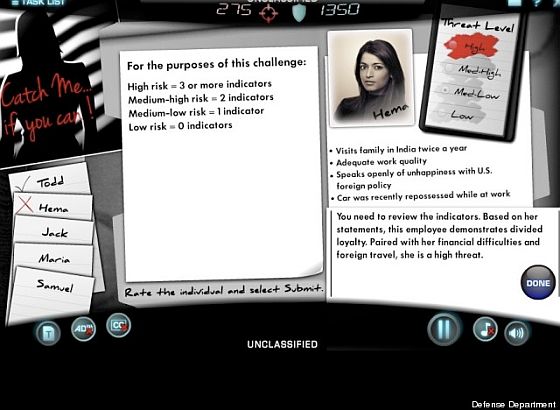
A Defense Information Systems Agency (DISA) slide profiles an 'insider threat.'

The Huffington Post reports: Watch out for “Hema.”

A security training test created by a Defense Department agency warns federal workers that they should consider the hypothetical Indian-American woman a “high threat” because she frequently visits family abroad, has money troubles and “speaks openly of unhappiness with U.S. foreign policy.”

That slide, from the Defense Information Systems Agency (DISA), is a startling demonstration of the Obama administration’s obsession with leakers and other “insider threats.” One goal of its broader “Insider Threat” program is to stop the next Bradley Manning or Edward Snowden from spilling classified or sensitive information.

But critics have charged that the Insider Threat program, as McClatchy first reported, treats leakers acting in the public interest as traitors — and may not even accomplish its goal of preventing classified leaks.

DISA’s test, dubbed the “CyberAwareness Challenge,” was produced in October 2012, a month before the Obama administration finalized its Insider Threat policy. The slide about Hema is included in a section of the training about “insider threats,” which are defined by an accompanying guide as “threats from people who have access to the organization’s information systems and may cause loss of physical inventory, data, and other security risks.” [Continue reading…]

Facebooktwittermail