Author Archives: News Sources

Leak inquiries show how wide a net U.S. govt. cast

The New York Times reports: Even before the F.B.I. conducted 550 interviews of officials and seized the phone records of Associated Press reporters in a leak investigation connected to a 2012 article about a Yemen bomb plot, agents had sought the same reporters’ sources for two other articles about terrorism.

In a separate case last year, F.B.I. agents asked the White House, the Defense Department and intelligence agencies for phone and e-mail logs showing exchanges with a New York Times reporter writing about computer attacks on Iran. Agents grilled officials about their contacts with him, two people familiar with the investigation said.

And agents tracing the leak of a highly classified C.I.A. report on North Korea to a Fox News reporter pulled electronic archives showing which officials had gained access to the report and had contact with the reporter on the day of the leak.

The emerging details of these and other cases show just how wide a net the Obama administration has cast in its investigations into disclosures of government secrets, querying hundreds of officials across the federal government and even some of their foreign counterparts.

The result has been an unprecedented six prosecutions and many more inquiries using aggressive legal and technical tactics. A vast majority of those questioned were cleared of any leaking.

On Thursday, President Obama ordered a review of Justice Department procedures for leak investigations, saying he was concerned that such inquiries chilled journalists’ ability to hold the government accountable. But he made no apology for the scrutiny of the many officials whose records were searched or who had been questioned by the F.B.I.

“He makes the case that we have 18-year-olds out fighting wars and acting like adults, and we have senior administration officials quoted in stories acting like children,” said Tommy Vietor, a former National Security Council spokesman. Mr. Obama and top administration officials say some leaks put Americans at risk, disrupted intelligence operations and strained alliances.

Some officials are now declining to take calls from certain reporters, concerned that any contact may lead to investigation. Some complain of being taken from their offices to endure uncomfortable questioning. And the government officials typically must pay for lawyers themselves, unlike reporters for large news organizations whose companies provide legal representation. [Continue reading…]


Facebooktwittermail

Hezbollah’s intervention in Syria: Nasrallah promises Assad victory as violence spills into Lebanon

The Los Angeles Times reports: The leader of the militant group Hezbollah on Saturday aligned his powerful movement squarely behind the government of Syrian President Bashar Assad and vowed victory against Syrian rebels, whom he assailed as proxy warriors for the West and Israel.

The televised comments by Hassan Nasrallah were the most definitive to date rallying Hezbollah to the defense of Assad’s government, which has been trying to put down a revolt by rebels supported by the United States and its allies.

The comments came as Syrian government forces, assisted by Hezbollah militiamen, intensified their assault on the strategic Syrian town of Qusair, near the Lebanese border. Both sides reported fierce fighting in Qusair six days after Syrian forces and their Hezbollah allies launched an attack on the longtime rebel stronghold.

“Syria is the backbone of the resistance, and the resistance cannot stand with folded hands while its backbone is being broken,” Nasrallah said in a televised speech, referring to Hezbollah’s signature “resistance” to the state of Israel.

“The battle is ours,” Nasrallah added, “and I promise you victory.”

The Independent reports: Two rockets hit a Beirut neighbourhood earlier today raising fears that the bloody civil war in Syria is increasingly seeping across the border into Lebanon.

AFP reports: Twenty-two Hizbullah members were killed in fighting alongside Syrian government forces against rebels for control of the town of Qusayr, a source close to the Lebanese group said on Sunday.

“There were 22 killed on Saturday. Nine bodies were repatriated the same day and the rest on Sunday,” the source said, declining to be named.

The Syrian army announced that on Saturday its forces had infiltrated Dabaa military airport, a rebel post north of Qusayr, a week into a Hizbullah-backed offensive to recapture the strategic central town near the Lebanese border.

Martin Chulov reports: The workmen had been busy in the room where Hezbollah honours its dead. In one corner of the martyrs’ cemetery in south Beirut, four women shrouded in black sat cross-legged near a new grave, reading from the Qu’ran. Metres away, the yellow flag of the militant group covered a freshly covered hole in a white marble floor. The scent of burning incense wafted across the room.

Another grave, its concrete seal barely dry, had been partly completed nearby. There were seven fresh holes in all; and the grave digger was never far away. More bodies were due on Friday. At this rate, the tiny room – a shrine to Hezbollah’s cause as much as to the men who died fighting for it – would soon be full.

The flurry of activity in the martyrs’ cemetery marks the busiest period for the militant movement since the 2006 war with Israel, in which an estimated 400 of its members died. All the new graves here have been dug in the past 10 days. Many others have been sealed with the familiar yellow and green standard in villages across Lebanon where the rumblings of a very different war have now boiled over into sacrifice and loss.

The newly arrived dead have ushered in a new reality for Hezbollah, one that has taken more than two years of uprising and war in neighbouring Syria to publicly acknowledge: all the fallen have died fighting Arabs in Syria, not Jews in Israel. Such a shift in orientation, for so long denied by the group’s leadership, is now being worn as a badge of honour by the families of the dead.

Many of the next of kin interviewed by the Guardian said that their sons and brothers had been defending Lebanon from foreign plotters – in this case Salafists from the east rather than Zionists from the south. “The threat to us comes from all directions,” said one grieving relative in the Beirut suburb of Chiyah on Friday. “But behind it all is the hidden hand of Israel.”

Oy veh! It’s one thing to be an anti-Zionist, but when people start seeing “the hidden hand of Israel” lurking everywhere, they start to sound more like devotees of The Protocols of the Elders of Zion.

At this time, instead of obsessing about mischief emanating from the Jewish state, it might be more appropriate to be asking what “resistance” means if its backbone has been provided by Bashar al-Assad.

Facebooktwittermail

Does Israel have a terminal disease?

One of the strange things about a terminal disease is that people often receive a diagnosis that amounts to a death sentence at a time when — as far as they can tell — they are in perfect health. To be told that death is lurking just over the horizon might lead one person to reflect on the meaning of mortality, while another presses forward and lives like there is no tomorrow.

In a strongly secular and death-denying culture, the latter response is less likely to be seen as an expression of denial and more as a life-affirming form of optimism.

You just discovered you have cancer and now you’re about to do a triathlon. Good for you!

Ethan Bronner writes: Israel today offers a set of paradoxes: Jewish Israelis seem in some ways happier and more united than in the past, as if choosing not to solve their most difficult challenge has opened up a space for shalom bayit — peace at home. Yes, all those internal tensions still exist, but the shared belief that there is no solution to their biggest problem has forged an odd kind of solidarity.

Indeed, Israel has never been richer, safer, more culturally productive or more dynamic. Terrorism is on the wane. Yet the occupation grinds on next door with little attention to its consequences. Moreover, as the power balance has shifted from the European elite, Israel has never felt more Middle Eastern in its popular culture, music and public displays of religion. Yet it is increasingly cut off from its region, which despises it perhaps more than ever. Finally, while the secular bourgeoisie, represented by Yair Lapid’s Yesh Atid Party, has forged an unexpected alliance with West Bank settlers, represented by Naftali Bennett’s Habayit Hayehudi Party, aimed at reducing the political power of the ultra-Orthodox, alarm over the failure to address the Palestinian problem has grown in a surprising place — among some of the former princes of the Zionist right wing.

At a Jerusalem cafe one noon, Dan Meridor, the former Likud minister and son of right-wing Zionist aristocracy, could not stop talking about the Palestinians.

“It is a sword of Damocles hanging over our heads,” he said. “We are living on illusions. We must do everything we can on the ground to increase the separation between us and the Palestinians so that the idea of one state will go away. But we are doing nothing.”

Mr. Meridor, nursing an American coffee at the cafe near the house his parents bought many decades ago in the upscale Rehavia neighborhood, sounded like two other public figures from famous right-wing families — Ehud Olmert, the former prime minister, and Tzipi Livni, the justice minister and chief peace negotiator. Both have made a series of emotional speeches begging Israelis to take the Palestinian issue seriously. They are getting little traction.

The Israeli left is still there, of course, but in increasingly insignificant knots. Two Israeli friends in Jaffa, from which tens of thousands of Palestinians left or were driven out in 1948, have beautifully renovated a house, even preserving a pre-state lemon tree in the courtyard. They are friendly with the Arabs who live nearby. Their children refused military service in protest over the West Bank occupation. And on the outside of their house they have put up a plaque noting that until 1948 the structure was the home of the Khader family, a tiny homage to a destroyed world.

But the family is rare. Mr. Lapid, the rising star of Israeli politics, is a former television host who agrees that something must be done about the Palestinians. But in an interview he offers no specifics other than hoping Mr. Kerry will pressure them to return to the negotiating table under conditions they have long rejected. Mr. Lapid, who spoke in the outdoor section of his neighborhood cafe in north Tel Aviv on a fragrant spring afternoon, was relaxed and buff in his long-sleeved black T-shirt and black jeans. Well-off Tel Avivians at nearby tables argued into their iPhones. Mr. Lapid said Israel should not change its settlement policy to lure the Palestinians to negotiations, nor should any part of Jerusalem become the capital of the Palestinian state he says he longs for. He has not reached out to any Palestinian politicians nor spoken publicly on the issue. As finance minister, he is focused on closing the government’s deficit.

Mr. Lapid may be a political novice but he knows the public mood. A former senior aide to Prime Minister Benjamin Netanyahu agreed, over a Jerusalem lunch of toasted bagels and salad, that most Israelis considered the peace process irrelevant because they believed that the Palestinians had no interest in a deal, especially in the current Middle Eastern context of rising Islamism. “Debating the peace process to most Israelis is the equivalent of debating the color of the shirt you will wear when landing on Mars,” he said.

Facebooktwittermail

Hannah Arendt: The woman who saw banality in evil

The New York Times reports: Fifty years ago, a small book called “Eichmann in Jerusalem: A Report on the Banality of Evil,” by a New School philosophy professor named Hannah Arendt set off a storm like few books before or since. Among Upper West Side intellectuals it sparked, as the critic Irving Howe put it, “a civil war,” siring vicious debates and souring lifelong friendships. It also sold more than 100,000 copies and reshaped the way people have thought about the Holocaust, genocide and the puzzle of evil ever since.

“The Controversy” — as people simply called the growing dispute — is largely forgotten now, and the intense rancor it inspired might seem improbable. But a new movie about the episode, “Hannah Arendt,” which opens Wednesday at Film Forum, revives the debates and the era.

Its director, Margarethe von Trotta, a veteran of the New German Cinema, was skeptical when a friend suggested she make this film 10 years ago. “My first reaction was, how can I make a film about a philosopher, someone who sits and thinks?” she recalled in a phone interview from her home in Paris.

She and her American screenwriter, Pamela Katz, wrote a treatment that covered Arendt’s whole life, but it was too long and diffuse. They decided to focus instead on the Eichmann affair. “It’s better for filmmakers to have a confrontation, not just abstraction,” Ms. von Trotta said.

In May 1960, Adolf Eichmann — the last surviving Nazi higher-up, who had fled to Argentina at the end of the war — was kidnapped by Mossad agents, flown to Jerusalem and tried for crimes against humanity.

Arendt, a Jewish-German refugee and author of a celebrated tome, “The Origins of Totalitarianism,” offered to cover the trial for The New Yorker. (Her book originally ran as a five-part article.)

She made two particularly provocative points. The first was that Eichmann, a senior SS officer, was not the malicious organizer of the Nazi death camps, as Israeli prosecutors charged, but rather a mediocre bureaucrat, “a leaf in the whirlwind of time,” as Arendt put it; “not a monster” but “a clown.” Hence the enduring phrase from her book’s subtitle: “the banality of evil.”

Arendt’s second point was that the “Jewish Councils” in Germany and Poland were complicit in the mass murder of their own people. They helped the Nazis round up the victims, confiscate their property and send them off on trains to their doom. Without these Jewish leaders, Arendt wrote, “there would have been chaos and plenty of misery, but the total number of victims would hardly have been between four-and-a-half and six million people.” She added, “To a Jew, this role of the Jewish leaders” was “undoubtedly the darkest chapter of this whole dark story.” [Continue reading…]

Facebooktwittermail

Guantanamo Bay prison guard converts to Islam because of the living faith of Muslim detainees

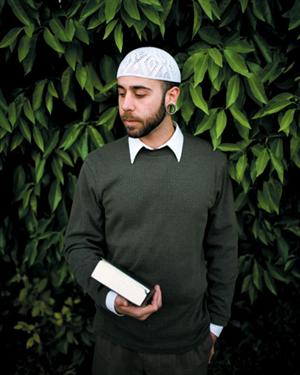
The Huntsville Times reports: Terry Holdbrooks Jr., 29, wears the beard of a bald Amish guy, the tattoos of a punk kid, and the twitchy alertness of a military policeman. Take him to a restaurant, and he’ll choose the chair with its back against the wall. Take his photo, and he’ll prefer to look away from the camera.

Part of that wariness Holdbrooks learned while guarding detainees from 2003 to 2004 at Guantanamo Bay, the U.S. holding tank for military prisoners on the southeastern point of Cuba.

And part of that wariness he developed after he converted to Islam while stationed at Guantanamo after months of midnight conversations with the Muslim detainees – a conversion that prompted several of his fellow soldiers to try several times to talk some “sense” into him so he wouldn’t “go over to the enemy,” as they put it.

Holdbrooks told the story of his conversion and of his observations of the controversial detention center to an audience of about 80 people at the Huntsville Islamic Center in Huntsville Saturday night, May 25, 2013. The camp, he said, tramples on every human right the U.S. has said it is against. The current hunger strike by 102 of the 166 prisoners has crossed 100 days. Many of those men were cleared to go home five or six years ago, Holdbrooks said. Their home countries tell their lawyers the U.S. won’t release them, and the U.S. tells them their home countries won’t receive them.

“They’ve lost hope. They’ve decided it’s better to die,” Holdbrooks said. “One of them is down to 70 pounds.”

Holdbrooks is traveling with Khalil Meek, a co-founder and executive director of the Texas-based Muslim Legal Fund of America. They are raising money for that non-profit civil rights organization, which helps pay for legal help for Muslims who are American citizens and who have been accused of vague crimes or placed on no-fly lists and other restrictions under the increasingly broad “anti-terrorism” provisions.

Even more than raising money for legal defense, Holdbrooks said, he wants to stir Americans to action. Holdbrooks’ self-published account of his experience at Guantanamo, “Traitor?,” was published this month. It’s available for sale online at www.GtmoBook.com.

“I tell this story and I wrote the book so idiot-simple that anyone could read and understand that the existence of Guantanamo is something to be ashamed of,” Holdbrooks said. [Continue reading…]

Facebooktwittermail

EDL raises risk of terrorism, say most Britons

British Future: Most people believe that far right groups like the English Defence League stir up hatred and violence in Britain in a way which increases the risk of future terrorist incidents. A rising proportion of Britons say they would never join the EDL – a view held by 84% of people who have heard of the group – according to new polling released this weekend.

After the brutal murder of a soldier in Woolwich by Islamist extremists, new polling published this weekend shows a clear public rejection of effort by one extreme fringe to capitalise on the activities of another, instead capturing growing opposition to the far right. Most of the public want the media to be more wary of giving either extremist group a media platform to spread hateful views.

61 per cent agree that ‘organisations like the English Defence League are stirring up hatred and violence between groups and making the risk of attacks of this kind more likely’ according to a new Survation poll, published in the Mail on Sunday. Only 14 per cent disagree.

Meanwhile, The Independent reports: Evidence emerged last night that one of the suspects involved in the killing of the British soldier Lee Rigby was well known to anti-terror police and the security services for at least three years before the brutal Woolwich attack. Michael Adebolajo was arrested in Kenya under suspicion of being at the centre of an al-Qa’ida-inspired plot in 2010, The Independent on Sunday can reveal.

He was one of seven men arrested by Kenyan police after landing on an island off the Kenyan coast in November 2010. Local press reports of the arrests referred to Mr Adebolajo as a “Nigerian with a British passport” who was “suspected of masterminding the racket”. Police claimed the men were travelling to Somalia to join the ranks of the al-Shabaab terrorist group. His family claimed he was held in detention and tortured before being deported back to Britain without charge.

After the incident, members of his family said he was “pestered” by MI5 agents pressuring him to become an informant for them and infiltrate radical Islamic extremist groups. Relatives said other family members were also harassed and questioned by the UK authorities. In an exclusive interview with The IoS, Mr Adebolajo’s brother-in law claimed constant demands to get him to spy on Muslim clerics might have pushed him over the edge.

Facebooktwittermail

No kissing please, we’re Islamists

AFP/Al-Akhbar: Islamists attacked a group of kissing couples who locked lips in a Turkish metro station to protest a morality campaign by the authorities in Ankara, the local press reported on Sunday.

One person was stabbed when about 20 Islamists chanting and some carrying knives attacked the demonstrators on Saturday, the Milliyet and Hurriyet newspapers reported.

About 200 people staged the kissing protest after officials in the Ankara municipality, which is run by Turkey’s ruling Islamist-rooted Justice and Development Party (AKP), admonished a young couple for kissing in the street.

Facebooktwittermail

U.S. shift poses risk to Pakistan

Declan Walsh writes: From multibillion-dollar military aid to stealthy and secretive drone strikes, Pakistan, perhaps even more than Afghanistan, has been the central focus of America’s 12-year war on Islamist militancy.

Now, as President Obama’s landmark policy speech on Thursday made clear, all of that is changing. Drone strikes are dwindling, the war in Afghanistan is drawing to a close and the battle against Al Qaeda is receding.

Pakistani leaders who have long demanded an American exit from their region may get their wish, but a broader disengagement is also likely to diminish the financing, prestige and political importance Pakistan held as a crucial player in global counterterrorism efforts, and could upset its internal stability.

The diminution of the drone campaign may ease a major point of friction between Pakistan and the West, but the tribal belt in northwestern Pakistan, where about 360 drone strikes have landed in the past decade, remains a hotbed of Islamist militancy, largely outside government control. Although many senior leaders of Al Qaeda sheltering there have been felled by C.I.A. missiles, they have been largely replaced by committed Pakistani jihadists with ties that span the border with Afghanistan.

With American combat troops leaving Afghanistan in 2014, and the drone campaign already winding down in Pakistan, analysts fear that unless the Pakistani Army can assert itself conclusively, the tribal region could be plunged into deeper chaos. [Continue reading…]

Facebooktwittermail

The path to climate catastrophe

Martin Weitzman: Recently the concentration of atmospheric carbon dioxide (CO2) reached an unprecedented level of 400 parts per million. What is the significance of this “milestone”? Does it portend catastrophic climate change? The short answer is no. The long answer is a more complicated and more nuanced maybe.

The modern era of carefully measuring and recording atmospheric CO2 began with the work of famed scientist Charles Keeling. In 1958, Keeling began to accurately monitor daily CO2 levels atop Mauna Loa, the highest mountain in Hawaii. Keeling chose this location because it was so remote from manmade sources that it would accurately track average “well mixed” CO2 levels throughout the world. Thanks to Keeling’s pioneering work we now have a continuous ongoing record of CO2 levels since 1958.

In 1958, Keeling recorded an atmospheric CO2 level of 315 ppm. Every year since then the Mauna Loa station has recorded ever-higher levels of CO2 than the year before. Atmospheric CO2 concentrations have grown relentlessly over the years until they just recently blew past the well-publicized milestone of 400 ppm.

The 400 ppm milestone is basically just a round number. To see why it might (or might not) be viewed as something unusual, or even threatening, we need to examine a longer record of CO2 levels over time.

There is a remarkable record of CO2 concentrations preserved in tiny bubbles in Antarctic ice cores going back 800,000 years. These measurements are less accurate than modern Keeling-style instrumental readings, but they are plenty accurate enough to see the big picture clearly. All throughout the past 800,000 years, which encompasses several ice ages and interglacial warming periods, CO2 levels fluctuated in a relatively narrow band between about 180 ppm (during the colder ice ages) to 280 ppm (during the warmer interglacial periods). For about the last 10,000 years we have been living in a warm interglacial period, with CO2 concentrations at about 280 ppm. Then, beginning with the industrial revolution about 1750, CO2 concentrations gradually moved up to Keeling’s accurately measured 1958 level of 315 ppm. Since then, as we have seen, CO2 concentrations have grown rapidly to the current 2013 level of 400 ppm.

So, the current CO2 concentration of 400 ppm is some 40 percent higher than anything that has been attained in the last 800,000 years. The glacial-interglacial cycles began some two and a half million years ago. Scientists estimate that a CO2 concentration of 400 ppm has not been attained for at least 3 million years. This rapid a change in CO2 concentrations has probably not occurred for tens of millions of years.

The point here is that we are undertaking a colossal planet-wide experiment of injecting CO2 into the atmosphere that goes extraordinarily further and faster than anything within the range of natural CO2 fluctuations for tens of millions of years. The result is a great deal of uncertainty about the possible outcomes of this experiment. The higher the concentrations of CO2, the further outside the range of normal fluctuations is the planet, and the more unsure are we about the consequences. [Continue reading…]

Facebooktwittermail

Why Americans are to blame for the Pentagon’s outrageous sex scandals

Micah Zenko and Amelia Mae Wolf write: Ongoing rampant sexual assault within America’s armed forces is a tragedy. The 2012 Workplace and Gender Relations Survey of Active Duty Members (WGRA) found that an estimated 26,000 active-duty servicemembers were sexually assaulted last year, and recent allegations of sexual assault by officers assigned to prevent that very crime have lent the situation a sinister irony. The U.S. military is clearly facing, in the words of Chairman of the Joint Chiefs of Staff Gen. Martin Dempsey, “a crisis.”

Last week, Gen. Mark Welsh, the Air Force chief of staff, declared that confronting the problem was his “No. 1 priority.” Army Chief of Staff Gen. Ray Odierno went further, saying: “The Army is failing in its efforts to combat sexual assault and sexual harassment.” He said that fighting the crime is now “our primary mission.” Repeating the claims of his two predecessors, Defense Secretary Chuck Hagel vowed to solve the chronic problem of sexual assault and stated that “every option is on the table.”

The estimated incidents of “unwanted sexual contact” within the military have increased since the previous survey in 2010 despite internal reforms. When reviewing the Pentagon and service websites dedicated to preventing sexual assault, it is difficult to comprehend the vast number of new directives, memoranda, instructions, policies, and awareness-raising campaigns that have been introduced over the past three years — none of which seems to be having an effect. Nancy Parrish, president of Protect Our Defenders, referred to these efforts as “half-hearted, half-measured reform Band-Aids.”

Unfortunately, however admirable the recent condemnations of sexual assault in the military, they’re unlikely to have much impact, because sexual assault in the military is not a military problem. It is an American problem. Scholars, retired officers, and others have longed warned of the creeping militarization of American society. However, as the Pentagon yet again renews its sexual assault prevention efforts, it must not discount the socialization of the American military. [Continue reading…]

Facebooktwittermail

Five most horrifying things about Monsanto — why you should join the global movement and protest on Saturday

AlterNet: Fed up with the fact that she has to spend “a small fortune” in order to feed her family things she says “aren’t poisonous,” Tami Canal of Utah has organized a global movement against the giant chemical and seed corporation Monsanto. Monsanto is the conglomerate mastermind behind many of the pesticides and genetically engineered seeds that pervade farm fields around the world. Monsanto produces the world’s top-selling herbicide; 40 percent of US crops contain its genes; it spends millions lobbying the government each year; and several of its factories are now toxic Superfund sites.

Canal, who has a 17-month-old baby and a six-year-old girl, cites concerns over public health, adverse affects on the environment, and political corruption as her motivation to organize against the biotech giant. And her concern has resonated. Protesters around the world have responded to Canal’s call to action, and will amplify their dissatisfaction with the corporation in a “March Against Monsanto” on May 25.

“Not only are they threatening our children and ourselves as well, but also the environment,” Canal says. “The declining bee population has been linked to the pesticides that they use, and that’s just the start. I’ve been reading studies recently that butterflies are starting to disappear, and birds. It’s only a matter of time, it’s pretty much a domino effect.”

What started as one mother’s call to action on a Facebook page has become a movement with more than 400 demonstrations scheduled in 50 countries and 250 cities around the globe. The events are organized online via an open Google Document, where people can find the protest nearest them. The March Against Monsanto Facebook page has received more than 105,000 “likes.” It has reached more than 10,000,000 people in the last week according to its website, which averages over 40,000 visitors per day. [Continue reading…]

Facebooktwittermail

How to stop the FBI from reading your email

MarketWatch: Emails are not private. A message may have one sender and one recipient but it can, with little effort, be read by a third party. In fact, despite the Fourth Amendment’s protections against unlawful searches, federal agencies do not necessarily need a warrant to read emails older than six months.

Concerns over such government snooping were raised by the American Civil Liberties Union, which last week noted a “troubling picture” of email surveillance practices by the Federal Bureau of Investigation and the Department of Justice. The agencies may be taking advantage of a component of the Electronic Communications Privacy Act, which requires warrants only for emails that have been stored on a third-party server for less than 180 days.

Documents reviewed by the ACLU showed that the FBI may be reading emails and other electronic messages without a warrant, and that different U.S. attorney’s offices may be applying “conflicting standards,” the group says. “It is time for Congress to step in and standardize the requirements and require warrants across the board,” says Nathan Wessler, a staff attorney with the ACLU. The report follows a similar review of IRS documents. [Continue reading…]

Facebooktwittermail

The war for the Arab world

Marc Lynch writes: A video of a rebel commander eating the lung of an enemy fighter and the horrific scenes of children massacred by forces loyal to President Bashar al-Assad are only a few of Syria’s ever-growing catalog of atrocities. This stuff of nightmares has raised fears that Syria’s civil war is spreading Sunni-Shiite sectarian conflict across the Middle East — fears galvanized by the escalating body count in Iraq, the dismal standoff in Bahrain, and the seemingly uncontainable tensions in Lebanon.

Many now see this sectarianism as the new master narrative rewriting regional politics, with Syria the frontline of a sectarian cold war permeating every corner of public life. The Sunni-Shiite divide, argues Brookings Institution fellow Geneive Abdo in a report released last month, “is well on its way to displacing the broader conflict between Muslims and the West … and likely to supplant the Palestinian occupation as the central mobilizing factor for Arab political life.”

Perhaps. But think about how little deep Arab sympathy for the Palestinian cause has actually produced effective or unified Arab official action in its support. Will Sunni solidarity be any more effective?

The sectarian master narrative obscures rather than reveals the most important lines of conflict in the emerging Middle East. [Continue reading…]

Facebooktwittermail

Syria opposition seeks to unify as momentum for talks builds

Reuters reports: Syria’s fractious opposition scrambled to agree a new leadership on Friday in a bid to present a coherent front at peace talks which the United States and Russia are convening to seek an end to more than two years of civil war.

A major assault by President Bashar al-Assad’s forces on a rebel held town over the past week is shaping into a pivotal battle. It has drawn in fighters from Assad’s Lebanese allies Hezbollah, justifying fears that a war that has killed 80,000 people would cross borders at the heart of the Middle East.

Washington and Moscow have been compelled to revive diplomacy by developments in recent months, which include new reports of atrocities, accusations chemical weapons were used and the rise of al Qaeda-linked fighters among rebels.

Facebooktwittermail

New documents reveal how a 1980s nuclear war scare became a full-blown crisis

Wired: During 10 days in November 1983, the United States and the Soviet Union nearly started a nuclear war. Newly declassified documents from the CIA, NSA, KGB, and senior officials in both countries reveal just how close we came to mutually assured destruction — over a military exercise.

That exercise, Able Archer 83, simulated the transition by NATO from a conventional war to a nuclear war, culminating in the simulated release of warheads against the Soviet Union. NATO changed its readiness condition during Able Archer to DEFCON 1, the highest level. The Soviets interpreted the simulation as a ruse to conceal a first strike and readied their nukes. At this period in history, and especially during the exercise, a single false alarm or miscalculation could have brought Armageddon.

According to a diplomatic memo obtained through a Freedom of Information Act request by National Security Archives researcher Nate Jones, Soviet General Secretary Yuri Adroprov warned U.S. ambassador Averell Harriman six months before the crisis that both countries “may be moving toward a red line” in which a miscalculation could spark a nuclear war. Harriman later wrote that he believed Andropov was concerned “over the state of U.S.-Soviet relations and his desire to see them at least ‘normalized,’ if not improved.”

The early 1980s was a “crisis period, a pre-wartime period,” said Gen. Varfolomei Korobushin, the former deputy chief of staff of the Soviet nuclear Strategic Rocket Forces, according to an interview conducted by the Pentagon in the early 1990s and obtained by Jones. The Kremlin’s Central Committee slept in shifts. There were fears the deployment of Pershing II ballistic missiles to Europe (also in November 1983) could tip the balance. If a conventional war erupted, Soviet planners worried their troops would come close to capturing the nuclear-tipped missiles, prompting the United States to fire them. [Continue reading…]

Facebooktwittermail

Israel is moving deeper into Syria’s turmoil

The New York Times reports: For more than two years, Israeli leaders have insisted they had no intention of intervening in the civil war raging in neighboring Syria, but they vowed to stop sophisticated weapons from being transferred to Hezbollah, the Lebanese militia group, and to respond to intentional fire into their territory.

Now, having followed through with a pair of airstrikes on weapons shipments this month and, on Tuesday, the destruction of a Syrian Army position, Israelis are asking what their options are, as if they feel it has become impossible to avoid deeper involvement.

Already, the language has grown more heated on both sides, with Syrian officials declaring they are prepared for a major confrontation with Israel — and Israel’s military chief warning of dire consequences.

“Clearly, a policy that functions successfully for more than two years for Israel, that policy is not working because Syria, Iran, Hezbollah and Russia have all upped the ante,” said Itamar Rabinovich, Israel’s former chief negotiator with Syria, mentioning that Russia continues to send advanced weaponry despite American and Israeli protests. “They created new rules of the game that Israel needs to figure out. It’s a policy in formation; the answers are not definitive.”

Several senior government officials, as well as half a dozen experts on Syria and the Israeli military, said on Wednesday that there was no new policy in Jerusalem, but there was a growing awareness that continuation of the current policy was likely to yield different results.

The next time Israel strikes a weapons convoy, they say, President Bashar al-Assad of Syria is much more likely to retaliate, given the recent statements from Damascus. That could lead to further Israeli reaction, and a spiraling escalation. [Continue reading…]

Facebooktwittermail