Author Archives: News Sources

Obama: the president of perpetual war

Micah Zenko writes: During his second inaugural address, President Obama offered two aspirational statements that struck many observers as incongruous with administration policies: “A decade of war is now ending” and “We, the people, still believe that enduring security and lasting peace do not require perpetual war.” We should question these observations, not least because of the string of U.S. government plans and activities that increasingly blur the conventional definition of war.

My own list of war-like activities since Obama’s inaugural would include: four drone strikes that killed 16 people (all in Yemen); the acknowledgement by Secretary of Defense Leon Panetta regarding drones, "We’ve done that in Pakistan. We’re doing it in Yemen and elsewhere. I think the reality is its going to be a continuing tool of national defense in the future"; the announcement that the U.S. military would provide intelligence, transportation, and refueling support for the French intervention in Mali; the signing of a U.S.-Niger status of forces agreement that will likely include a drone base for surveillance missions, although U.S. officials "have not ruled out conducting
missile strikes
at some point"; the forthcoming expansion (perhaps quintupling) of U.S. Cyber Command, including "combat mission forces" for offensive cyberattacks; the executive branch’s secret legal review determining that Obama "has the broad power to order a pre-emptive strike if the United States detects credible evidence of a major digital attack looming from abroad"; the Marine commandant’s announcement of a new "crisis response unit" that would be "rapidly employable" to "address crises"; and the revelation that the United States is negotiating to purchase the Sheraton Hotel in Sanaa, the capital of Yemen, to house the growing number of embassy staff, troops, and contractors who implement U.S. security force assistance and counterterrorism operations in that country. (For other examples, see the interesting End of War Timeline that Jack Goldsmith and Lawfare created.)

Using lethal force against other countries — and developing and sustaining the capabilities to do so in perpetuity — are the distinguishing features of a country at war. As Vice Chairman of the Joint Chiefs of Staff Adm. James Winnefeld, Jr. remarked in November, "We remain a nation at war." In January, Gen. Martin Dempsey, chairman of the Joint Chiefs, told Ted Koppel that even after 2014, "Our war in Afghanistan will be complete, but no one has ever suggested that that will end the war." Last week, Secretary Panetta reminded policymakers and the press, as he often does: "We are in a war. We’re in a war on terrorism and we’ve been in that war since 9/11." Finally, during his grueling confirmation hearing to become the next secretary of defense, Chuck Hagel stated: "We’re at war in Afghanistan. We’re at war around the world….The fact is we’ve been at war for 12 years."

Most analysts and journalists have focused on President Obama’s expanded scope, intensity, and institutionalization of targeted killings against suspected terrorists and militants. However, perhaps the enduring legacy of the Obama administration will be its sustained, rigorous effort to shape and define-down the idea of war. [Continue reading…]


Facebooktwittermail

Obama’s drone leaks: new imminence, old tactics

Noura Erakat writes: The Senate Armed Services Committee did not mention drones a single time during Senator Chuck Hagel’s confirmation hearings last week. That oversight, however, says a lot more about the politics surrounding the hearings than it does about the enduring salience of drone technology to U.S. national security policy. The Department of Justice’s “white paper” obtained by NBC on Monday affirms that.

The paper, drafted for some members of Congress and a less detailed analysis than the official, still unreleased, legal memo, provides the most robust legal analysis of the Obama administration’s targeted killing policy to date. Although it makes no mention of any particular target, the white paper is clearly responsive toAnwar Al-Awlaki, the U.S.-born Muslim cleric killed by a U.S. drone strike in Yemen in September 2011. The 16-paged document explores the lawfulness of killing of a U.S. citizen who is a senior operational leader of Al-Qaeda or an Associated force on foreign soil in an area outside of active hostilities, who poses an imminent threat, and whose capture is not feasible.

The memo is woefully insufficient as a legal analysis. Even its title, “Lawfulness of a Lethal Operation Directed Against a U.S. Citizen Who is a Senior Operational Leader of Al-Qa’ida or an Associated Force,” makes assumptions that merit thorough examination. Who, for example, qualifies as a Senior Operational Leader? Al-Awlaki never commanded any attacks but was a propagandist who arguably inspired them. Is an associated force a group that shares Al Qaeda’s ideology or must it be a part of a central command structure? Al-Awlaki’s Yemen-based non-state group, Al Qaeda Arabian Peninsula (AQAP) was developed independently in the south of Yemen and has national goals distinct from the aims of the transnational Al Qaeda network. [Continue reading…]

Facebooktwittermail

A speech on BDS that Dershowitz and other opponents of academic freedom tried to suppress

Judith Butler, speaking at Brooklyn College, New York City, on Thursday night: Usually one starts by saying that one is glad to be here, but I cannot say that it has been a pleasure anticipating this event. What a Megillah! I am, of course, glad that the event was not cancelled, and I understand that it took a great deal of courage and a steadfast embrace of principle for this event to happen at all. I would like personally to thank all those who took this opportunity to reaffirm the fundamental principles of academic freedom, including the following organizations: the Modern Language Association, the National Lawyers Guild, the New York ACLU, the American Association of University Professors, the Professional Staff Congress (the union for faculty and staff in the CUNY system), the New York Times editorial team, the offices of Mayor Michael Bloomberg, Governor Andrew Cuomo and Brooklyn College President Karen Gould whose principled stand on academic freedom has been exemplary.

The principle of academic freedom is designed to make sure that powers outside the university, including government and corporations, are not able to control the curriculum or intervene in extra-mural speech. It not only bars such interventions, but it also protects those platforms in which we might be able to reflect together on the most difficult problems. You can judge for yourself whether or not my reasons for lending my support to this movement are good ones. That is, after all, what academic debate is about. It is also what democratic debate is about, which suggests that open debate about difficult topics functions as a meeting point between democracy and the academy. Instead of asking right away whether we are for or against this movement, perhaps we can pause just long enough to find out what exactly this is, the Boycott, Divestment and Sanctions movement, and why it is so difficult to speak about this.

I am not asking anyone to join a movement this evening. I am not even a leader of this movement or part of any of its governing committee, even though the New York Times tried to anoint me the other day—I appreciated their subsequent retraction, and I apologize to my Palestinian colleagues for their error. The movement, in fact, has been organized and led by Palestinians seeking rights of political self-determination, including Omar Barghouti, who was invited first by the Students for Justice in Palestine, after which I was invited to join him. At the time I thought it would be very much like other events I have attended, a conversation with a few dozen student activists in the basement of a student center. So, as you can see, I am surprised and ill-prepared for what has happened. [Continue reading…]

Facebooktwittermail

Islam is not the real issue we are facing in Africa

Eliza Griswold writes: Stretching from west to east across Africa – from the Atlantic Ocean to the Red Sea – the Sahel today is a militant’s dream. Despite the French military’s recent routing of al-Qaida in the Islamic Maghreb and its allies in northern Mali, the threat of safe haven for the west’s enemies is not going to end there any time soon.

Although, for the moment, the militia have melted from sight, the latest battles in Algeria and Mali are harbingers of a larger catastrophe: the Sahel, the vast grassland north of the equator, has become the latest battleground in the west’s war against Islamist militants.

France’s plans to withdraw its 4,000 troops from Mali in late March are premature. From the air, US surveillance drones and French fighter planes will not be enough to keep peace in the Sahel – which includes Mauritania, southern Algeria, northern Mali, Chad and Sudan, as well as Somalia, where a 2006 Ethiopian invasion, tacitly backed by the US, looked at first like an utter defeat for the Islamists. Six months later, the militants returned to wage exactly the kind of war Ethiopia and the US had feared.

So how does the west avoid repeating the pattern? By understanding the root causes of the troubles that plague the Sahel. [Continue reading…]

Facebooktwittermail

Syrian capital sees heaviest clashes in weeks, frightened residents hide in their homes

The Associated Press reports: Syrian rebels and regime forces fought their most intense clashes in weeks inside the heavily guarded capital of Damascus on Wednesday, activists said, with the sounds of shell blasts echoing through the downtown area and keeping many children home from school while residents hid in their houses.

The opposition fighters blasted army checkpoints with rifles and anti-aircraft guns while government forces shelled the eastern and southern suburbs, trying to repel a new insurgent effort to push the civil war into the heart of the capital, the anti-regime activists said.

Although bordered by rebellious suburbs that have seen fierce fighting, widespread clashes have remained mostly on the capital’s edges, saving it from the destruction that has ravaged other major cities such as Aleppo and Homs.

The military of President Bashar has focused on securing the capital, and the dozens of rebels groups that have established footholds in Damascus suburbs have failed to form a united front, each fighting for its own area with little or no coordination with others. [Continue reading…]

Reuters adds: Syrian government jets bombarded the Damascus ring road on Thursday in a bid to halt a rebel advance which threatens President Bashar al-Assad’s hold on the capital, insurgent commanders and opposition activists said.

Warplanes fired rockets at southern parts of the route where rebels have spent the past 36 hours overrunning army positions and road blocks encircling the heart of the city, the site of key state security and intelligence installations.

Facebooktwittermail

Kuwait, ‘the back office of logistical support’ for Syria’s rebels

The National reports: Ten days before sitting down for a leisurely evening tea recently on the outskirts of Kuwait City, Jamaan Al Harbash was in Aleppo talking with rebels fighting to oust Syrian President Bashar Al Assad from power.

It was the third trip to the war zones of Syria by the former Kuwaiti MP, who no longer escapes the Syrian regime’s notice. Following a journey to the front in October, Syria’s state news agency condemned him for “attempts to spread sedition among the united Syrian people”.

The regime’s censure has not deterred Mr Harbash, who scrolls through his iPhone to show recent pictures of shattered neighbourhoods and a hospital he said was rebuilt with the help of Kuwaiti funds. Amid the scenes of war is a photo of Mr Al Harbash standing with a half dozen fighters of the rebel Free Syrian Army (FSA).

“The reason I went to Syria was to observe whether the aid we are sending is reaching the general population,” he said.

To many observers, Kuwait’s decision to host a United Nations meeting last week to raise humanitarian aid for Syrians – and its pledge of US$300 million to the effort – were the most overt steps that the country has yet taken to get involved in the crisis.

Until then, Kuwait had appeared largely absent from regional diplomacy on the crisis, while Qatar has funded and hosted the political opposition to Mr Al Assad and Saudi Arabia has reportedly sent arms to anti-regime fighters.

Yet interviews with aid organisations and officials suggest Kuwait has played a no less pivotal role than its Gulf Arab neighbours during the 22-month uprising. This country of 2.6 million people has emerged as a central fund-raising hub for direct financial support to insurgents fighting the Assad regime and for humanitarian aid to rebel-controlled areas, which are said to encompass slightly more than half of the country. [Continue reading…]

Facebooktwittermail

The devil in the (still undisclosed) detail: Department of Justice ‘white paper’ on use of lethal force against U.S. citizens made public

Amnesty International [PDF]:

“These [drone] strikes are legal, they are ethical and they are wise.”
White House Press Secretary, press briefing, 5 February 2013

A newly released document outlining the legal framework relating to an aspect of the US administration’s “targeted killing” programme is silent on human rights and does nothing to alleviate Amnesty International’s concern that the programme as a whole allows for the use of lethal force that violates the right to life under international law.

The US Department of Justice “white paper”, which “sets forth a legal framework for considering the circumstances in which the US government could use lethal force in a foreign country outside the area of active hostilities against a US citizen who is a senior operational leader of al-Qa’ida or an associated force of al-Qa’ida”, was first made public by NBC News. The document adds little new substance to what various administration officials have already said publicly on this issue. It again ignores the USA’s international human rights obligations, and expands the notion of
“imminent attack” to which the USA might respond with lethal force. It provides no case detail, and considers the lethal force question mainly under US constitutional and statutory law.

The fact that the document makes no express reference to international human rights law is unsurprising – this has become the norm for officials outlining policy and practice under the USA’s notion of a global armed conflict with al-Qa’ida. The silence on human rights is no less regrettable by its predictability.

The Justice Department paper, “an unclassified document prepared for some members of Congress”, apparently summarizing a longer legal memorandum that remains classified and undisclosed, addresses specifically the legality of the “targeted” killing in a “foreign country” of US citizens by the USA. It should not be forgotten that the vast majority of those killed by US forces in such operations in recent years, principally in drone attacks, have been foreign nationals. While the white paper concludes that “the US citizenship of a leader of al-Qa’ida or its associated forces…does not give that person constitutional immunity from attack”, it is not clear whether the case of a US citizen assessed as the possible target for lethal force would receive a greater degree of scrutiny and caution from decision-makers than an identically placed foreign national. As outlined below, there is certainly greater domestic political pressure on the administration to make clear its full legal opinions on the “targeted killing” of US nationals. Amnesty International reminds the US government not to allow the domestic focus on US nationals to distract from a fundamental concept of universal human rights, namely that the right to life, to liberty, and to fair trial of every human being is to be respected without discrimination on the basis of their nationality.

While the White House has responded to the release of the white paper by stressing that it is an unclassified document that contains a set of “general principles” already in the public domain, Amnesty International calls on the US administration to adopt an approach of far greater transparency than it has to date in relation to its use of lethal force in policy and practice. Such an approach should be one that facilitates independent assessment of the lawfulness of particular attacks, accountability for any attacks that are unlawful, and full reparations for victims of violations and their families. [Continue reading – PDF]

Facebooktwittermail

Letter from Mali: life is beginning to return to normal

Luke Harding writes: Last year Suleiman Kané hid his radio under several crates of fish. He also buried his satellite dish at the bottom of his fishing boat. The Islamists had swept into Gao, and were advancing rapidly across northern Mali. And so Kané stopped listening to music – an offence under sharia law – and avoided the rebels as far as possible.

A year later he and his large family are waiting to go home. The satellite dish is back in its old position, hooked up to a solar panel on the roof. Next to it is a bike, some firewood and a folding chair. His 15-metre-long floating home is moored at Mopti, Mali’s biggest river port. Kané’s two wives, five grownup sons and innumerable grandchildren – two with hacking coughs – are camped on the bank.

It is at Mopti that the shimmering Niger, west Africa’s great river, converges with its tributary, the Bani. West is the languid town of Ségou; north, and a three-day journey by boat, Timbuktu. On the turquoise water, fishermen in wooden pirogues are casting nets. Eagles whirl in the haze. Closer to town, people are washing clothes, mopeds and a shiny blue Mercedes.

French and Malian forces took Timbuktu 10 days ago, turfing out the jihadists who had run the Saharan town since last March. Paris also freed Gao and Kidal. Kané welcomes the return of the French, Mali’s old colonial masters. “I was born in 1939 and I remember the colonial period,” he says. “The French did a good job back then. They were fair.” He adds: “So far as I’m concerned they can stay.”

Everyone here has tales of rebel rule. Isate Kané (no relation to Suleiman) says one of her relatives was killed in Gao by a stray bullet. Kané says she was forced to wear a veil, but didn’t mind too much, since she kept her hands warm under it on chilly mornings. Far worse, she explains, was the predatory sexual behaviour of the jihadists. Most were lighter-skinned Tuareg or Arabs, with one or two black Malians. “One woman crossed the riverbank to bring her fish to market. This was in Gao. Two rebels chased her,” she says. “They wanted to rape her. She ran back to the bank so they shot her with a sniper rifle. She was pregnant.” The rebels took other women as sex-slaves, she says, sometimes killing them. She adds: “Whenever we saw them, we hid.”

Kané and her relatives – about 55 people, crammed on to one slow-moving barge – are waiting to travel north. The women are preparing lunch: a paste made from baobab tree fruit, millet and fish. “We eat fish and sell fish to buy rice,” she says. Nile perch – the Niger’s most delicious variety, known as capitaine – costs 1,500 CFA a kilo (£2); carp is 300 CFA. The Dogon, a tribe of animists, trade fish for baobab fruit, she says.

The river’s inhabitants tend to do the same things their parents have done, with jobs passed down along family lines. The fishermen are Bozo; the boys herding cattle across the waters Fulani; the rice planters Songhai. The Tuareg – blamed by many Malians for the country’s post-independence woes and a series of bitter rebellions against the capital Bamako – are nomads. How can Mali achieve peace? “By killing all the Tuareg,” Kané replies. [Continue reading…]

Facebooktwittermail

Tunisia is no longer a revolutionary poster-child

Rachel Shabi writes: Amid the shock and grief at a terrible murder, there is an angry accusation. When forthright opposition leader Chokri Belaid was gunned down in broad daylight outside his home in Tunis, furious protesters marched on the offices around the country of the ruling Ennahda party. Belaid’s brother, Abdel Majid, accused the Islamist party – which dominates the three-way coalition government – of the murder. Ennahda has denounced the assassination. Chillingly, Belaid, a secularist and vocal critic of Ennahda, warned of the rise of political violence when he appeared on Tunisian TV the night before he was killed.

Jalila Hedhli-Peugnet, president of the NGO Think Ahead for Tunisia, reflected the prevailing sentiment on Wednesday when she told France 24 that Belaid “was not assassinated under the dictatorship of Ben Ali, now he is assassinated under the democracy of Ennahda”. If the government didn’t kill him, she said, it also didn’t protect him from such a tragedy.

Tension has been building, then, within a revolution that is too often billed a success story. Tunisia has not suffered the level of turmoil and violence of Egypt, or the agonising death and displacement of Syria, and so it appears to be handling the transition from dictatorship to democracy well. Other post-uprising countries look to Tunisia as both inspiration and weathervane. But Tunisians themselves bemoan their role as revolutionary poster-child as it can lead to the outside world ignoring or dismissing the very real problems there.

One such problem is the escalating political violence in Tunisia in the past year. A report just released by Human Rights Watch cites attacks on activists, journalists, intellectual and political figures – all the incidents apparently “motivated by a religious agenda”. [Continue reading…]

Facebooktwittermail

The new colonialists

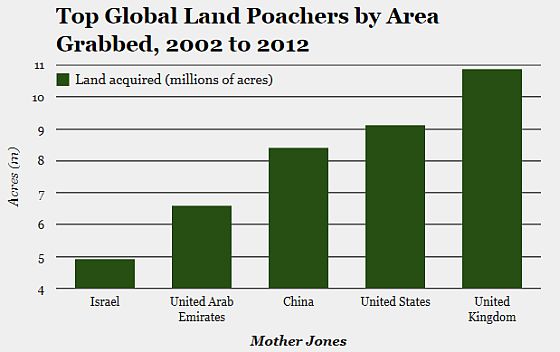
Mother Jones reports: In 2010, a former Wall Street trader flew into war-torn Sudan to negotiate a deal with a thuggish general. He had his eye on a 1 million acre tract of fertile land fed by a tributary of the Nile in the southern section of the country, a region that later claimed its independence as South Sudan. The investor, who planned to profit by developing and exporting agricultural commodities, boasted about how the region’s instability was a principal variable in his financial model: “This is Africa,” he told reporter McKenzie Funk, who shadowed him for a riveting piece in Rolling Stone (PDF). “The whole place is like one big mafia. I’m like a mafia head.”

Over the last decade (and especially during the last four years) wealthy nations have increasingly brokered deals for huge swathes of agricultural land at bargain prices in developing countries, installed industrial-scale farms, and exported the resulting bounty for profit. According to the anti-hunger group Oxfam International, more than 60 percent of these “land grabs” occur in regions with serious hunger problems. Two-thirds of the investors plan to ship all the commodities they produce out of the country to the global market. And droughts, spikes in food and oil prices, and a growing global population have only made the quest for arable land more urgent, and the investments that much more alluring.

In what a recent study in the Proceedings of the National Academy of Sciences (PNAS) characterizes as a “new form of colonialism,” investors from the US, UK, and China are gobbling up foreign farmland at “alarming rates” and often with little consultation and compensation of poor small-scale farmers and local populations. [Continue reading…]

Facebooktwittermail

When it views the Middle East, Washington is living in the past

Rami G Khouri writes: We will find out in coming months whether the second term of the Obama administration will herald any significant changes in United States policies in the Middle East. Four main issues should be monitored for any signs of change: the Palestine-Israel and wider Arab-Israeli conflicts; tensions with Iran; the Arab uprisings, revolutions, and constitutional transformations; and socio-economic conditions across the region.

Each of these issues is important in itself. However, viewed from Washington they often get conflated and confused, so American government responses to the various Arab uprisings, for example, often are shaped by officials’ concerns about Iran and Israel.

On a short visit to Washington this week where I had discussions with specialists on the Middle East, my sense is that little has changed in the U.S. capital in the past two years. While the ordinary men and women of the Arab world have launched the most dramatic and consequential change ever in the political configuration of their region, officials and experts in Washington appear to be living in the past, intellectually and politically immobilized, pursuing more or less the same policies of the past several decades. [Continue reading…]

Facebooktwittermail

From Tehran, Hagel and Rumsfeld, Obama and Bush don’t look much different

Alireza Nader writes: The Iranian regime is hardly cheering Hagel on, despite what some of his critics say. Yes, Hagel sounds cautious about a U.S. bombing campaign against Iran’s nuclear facilities, but such a campaign isn’t what keeps the Iranian supreme leader, Ayatollah Ali Khamenei, up at night. An American strike would spur the Iranian public to rally around the flag and buck up a wobbling, wheezing theocracy — and an Israeli strike would do so in spades.

The Iranian leadership’s real worry is not American planes but Iranian protesters. Their deepest anxieties revolve around a Persian version of Tahrir Square, a replay of the 2009 Green uprising that wasn’t ended by the regime’s violent repression. Strange as it may sound, the Islamic Republic is a lot more frightened of the imprisoned Iranian human rights activist Nasrin Sotoudeh than it is of Israeli Prime Minister Benjamin Netanyahu.

As such, Hagel’s nomination was greeted in Tehran with a shrug, not a sigh of relief. The Islamic Republic hardly thinks that with Hagel nominated, it’s off the nuclear hook. Iran’s leaders see U.S. “hostility” as institutionalized and systematized, not produced by partisan politics or individual appointments. As Hossein Salami, a top-ranking Revolutionary Guards officer, said of Hagel, “We view the United States as a political and ideological system driven by its strategic interests rather than by individual politicians.”

That was true even in the transition from George W. Bush to Barack Obama. The Islamic Republic greeted Obama’s election in 2008 with mixed emotions. On the one hand, the Iranian regime worried that Obama’s barrier-breaking achievement and inspiring life story might appeal to the average Iranian in a way unmatched by any previous U.S. president.

On the other, the Iranian regime continued to believe that its lifelong rivalry with the United States is the result of flatly irreconcilable differences: what it sees as Washington’s unshakable opposition to the Iranian revolution, unqualified and limitless support for Israel, and insistence on competing with Iran for influence over the Middle East.

If Obama’s election didn’t change Tehran’s view of U.S. policy, it’s hard to see how Hagel’s nomination could. After all, America’s war-weariness is no secret, and it’s hardly limited to Vietnam veterans such as Hagel. Iranian decision-makers can read The New York Times and watch CNN like anyone else, and they understand the reluctance, both among America’s people and elites, to go to war against Iran over its nuclear program.

Facebooktwittermail

Egyptian Salafi preacher supports rape of women protesters

Al Arabiya reports: An Egyptian Salafi preacher said raping and sexually harassing women protesters in Cairo’s Tahrir Square is justified, calling them “crusaders” who “have no shame, no fear and not even feminism.”

In an online video posted Wednesday, Ahmad Mahmoud Abdullah, known as “Abu Islam” and owner of the private television channel of “al-Ummah,” said these women are no red line.

“They tell you women are a red line. They tell you that naked women — who are going to Tahrir Square because they want to be raped — are a red line! And they ask Mursi and the Brotherhood to leave power!,” he said.

Abu Islam added that these women activists are going to Tahrir Square not to protest but to be sexually abused because they had wanted to be raped.

“They have no shame, no fear and not even feminism. Practice your feminism, sheikha! It is a legitimate right for you to be a woman,” he said.

“And by the way, 90 percent of them are crusaders and the remaining 10 percent are widows who have no one to control them. You see women talking like monsters,” he added.

Facebooktwittermail