Shadi Hamid writes: More than a year ago, a real debate began over whether to intervene militarily in Syria. Here in The Atlantic, Steven Cook of the Council on Foreign Relations was one of the first to propose taking military action – or at least thinking seriously about it. When Cook wrote his article (which, in its prescience, is well worth re-reading today), around 5,000 Syrians had been killed. Today, the number is more than 10 times that, and is now over 60,000 according to some estimates. I remember, early on, wondering whether 15,000 would be a “trigger.”
But, apparently, there is no “trigger.” Military intervention in Syria cannot not happen without American support and there is nothing to suggest the United States has any interest in intervening, no matter the number of dead. The Obama administration has cited the use of chemical weapons as a “red line,” but even that red line has managed to shift back and forth several times.
Opponents of intervention have, understandably, tended to focus on the risky – and potentially prohibitively difficult – nature of military action. Yet, the very fact that some “red lines” do exist suggests that the U.S. would be willing to intervene at some point, in spite of those difficulties. The question, then, isn’t so much the difficulty of the operation as much as what is an appropriate red line.
If Bashar al-Assad proceeded to destroy an entire city, killing 100,000 people in the matter of weeks, presumably many of those opposing intervention would decide to support it. But why then and not now? Why exactly is 60,000 people not enough? Sure, the use of chemical weapons should be a red line for national security reasons, but why should strictly national security considerations be a red line, when the killing of tens of thousands isn’t? It is this latter point which sends precisely the wrong message to Arab audiences and the broader international community. Nothing fundamental has changed in U.S. policy since the Arab Spring, even though many of us said, and hoped, that new realities required a new way of doing business. As I wrote nearly a year ago,
What made Libya a “pure” intervention was that we acted not because our vital interests were threatened but in spite of the fact that they were not. For me, this was yet one more reason to laud it.
The memory of the Iraq War obviously looms large. The war, itself, was one of the greatest strategic blunders in the recent history of American foreign policy. But its legacy is proving just as damaging, leading to a series of mistakes that we are likely to regret in due time. [Continue reading…]
Author Archives: News Sources
Tunisia: Murder most foul
Al Jazeera reports: Tunisians of all political stripes are in shock after the killing of Shokri Belaid, leader of the Democratic Patriots party.
Of all the political turmoil the country has experienced since the 2010-11 uprising, the slaying of the leftist politician – a well-known opposition figure and vocal critic of the ruling coalition – marks a new low.
The resulting crisis has led to the collapse of the government, and could potentially doom the election that was set to take place later this year.
Many say the killing is unsurprising, and that the Islamist-led government bears a heavy responsibility for tolerating and fuelling a deep partisan divide and a culture of political violence.
A star of the Popular Front, a leftist political alliance of which his party is a member, Belaid had many supporters among those who accused the current government of failing to deliver on social justice and economic development.
He was a figurehead of the protests in Siliana last November, when tensions over unemployment and stalling economic progress erupted. Ali Laarayedh, Tunisia’s interior minister, accused Belaid of inciting the protesters against the police. Belaid in turn said the interior ministry was guilty of tyranny.
Belaid, a lawyer and activist, had also been at the forefront of the early lawyer’s protests in December 2010, which grew to become the uprising that toppled the Tunisian government in January 2011. The Ennahdha movement and most of the country’s opposition parties did not give the uprising their explicit backing until the last days.
Wednesday’s shooting is the second suspected killing of an opposition politician since the uprising, and one of many violent attacks. [Continue reading…]
Deconstructing the claims that Qatar is supporting al Qaeda in Mali
RUSI Analysis: Claims that Qatar is supporting a range of Al-Qa’ida-affiliated groups in the Sahel are not new. In June 2012 the French satirical magazine Canard Enchaine quoted French Military intelligence sources asserting that Qatar was financially supporting various groups such as Al-Qa’ida in the Islamic Maghreb (AQIM) and its splinter group the Movement for Unity and Jihad in West Africa (MUJAO). The reports are vague but usually refer to financial support from Qatar, while some refer to Qatari planes landing at Gao disgorging arms and even Qatari Special Forces entering the fray.
None of these accusations ring true given the general thrust of Qatari foreign policy. Ironically, however, it is Qatar’s recent actions particularly in Libya that make these accusations seemingly plausible.
Qatar is one of two states (the other being Saudi Arabia) who officially espouse the austere doctrines of Muhammad Ibn Abdul Al-Wahhab, and last year named its state mosque after him. But Qatar is a box full of contradictions. Alcohol is easily available as is pork. Women can drive (nor has this been an issue) and Qatar has the most visible, outspoken and influential female consort in the history of the Arab world. Western education systems are at the heart of the state and there is not even an official mosque in the entire propose-built, multi-billion dollar ‘Education City’ campus housing six American Universities as well as University College London.
Externally Qatar’s policies can appear confused. Support of America by virtue of the two huge US bases in Qatar and significant (usually unwelcome) outreach to Israel in recent years is contrasted with seemingly amicable relations with Iran and support for Hamas and Hizbullah. More recently a record of enormous investment in London and Paris has been contrasted to escalating support of the Muslim Brotherhood across the Middle East and seemingly murky support of groups in the Sahel. Moreover, Qatar has been outspoken in its sub-state support of various groups in Mali’s regional neighbourhood in the last eighteen months.
A loose narrative has built suggesting that an ever increasingly confident Qatar is now beginning to support a range of ever more extreme Islamists across the region.
Examining exactly what Qatar is doing in Mali is difficult. Qatar never enlightens anyone of its foreign policy strategies or tactics and nor are there sufficient reliable sources of information in and around Mali.
The best one can say is that in addition to a lengthy history of interaction in the region, the Qatar Red Crescent Society increased its capabilities in Mali in 2012 evaluating the state of the plight and the their potential response. This occasionally involved entering Mali from Niger to get to the critical city of Gao. According to an AFP article this in and of itself involved seeking safe passage from the MUJAO, an Al-Qa’ida offshoot.
The very fact that the two organisations came to this safe passage agreement may well be a root cause of much of the subsequent supposition, with many assuming the transit agreement to be a signal of deeper connections. Yet this is what the Red Cross/Crescent does; it sticks to its central tenet of neutrality in a conflict and deals with the realities on the ground by making tactical deals to obtain access when it can. [Continue reading…]
Obama will allow lawmakers to see secret memo on drone strikes on American
The New York Times reports: The White House on Wednesday directed the Justice Department to release to the two Congressional Intelligence Committees classified documents discussing the legal justification for killing, by drone strikes and other means, American citizens abroad who are considered terrorists.
The White House announcement appears to refer to a long, detailed 2010 memo from the Justice Department’s Office of Legal Counsel justifying the killing of Anwar al-Awlaki, an American-born cleric who had joined Al Qaeda in Yemen. He was killed in a C.I.A. drone strike in September 2011. Members of Congress have long demanded access to the legal memorandum.
The decision to release the legal memo to the Intelligence Committees came under pressure, two days after a bipartisan group of 11 senators joined a growing chorus asking for more information about the legal justification for targeted killings, especially of Americans.
The announcement also came on the eve of the confirmation hearing scheduled for Thursday afternoon for John O. Brennan, President Obama’s choice to be director of the C.I.A., who has been the chief architect of the drone program as Mr. Obama’s counterterrorism adviser.
Critics accused Mr. Obama of hypocrisy for keeping the legal opinions on targeted killing secret, noting that in 2009 he had ordered the public release of the classified memos governing C.I.A. interrogations under President George W. Bush. Administration officials replied that the so-called enhanced interrogations had been stopped, while drone strikes continue.
Until Wednesday, the administration had refused to even officially acknowledge the existence of the documents, which have been reported about in the press. This week, NBC News obtained an unclassified, shorter “white paper” that detailed some of the legal analysis about killing a citizen and was apparently derived from the classified Awlaki memorandum. The paper said the United States could target a citizen if he was a senior operational leader of Al Qaeda involved in plots against the country and if his capture was not feasible.
Administration officials said Mr. Obama had decided to take the action, which they described as extraordinary, out of a desire to involve Congress in the development of the legal framework for targeting specific people to be killed in the war against Al Qaeda. Aides noted that Mr. Obama had made a pledge to do that during an appearance on “The Daily Show” last year.
“Today, as part of the president’s ongoing commitment to consult with Congress on national security matters, the president directed the Department of Justice to provide the Congressional Intelligence Committees access to classified Office of Legal Counsel advice related to the subject of the Department of Justice white paper,” said an administration official who requested anonymity to discuss the handling of classified material.
The official said members of the Intelligence Committees would now get “access” to the documents.
Christopher Anders, senior legislative counsel for the American Civil Liberties Union, called the president’s move “a small step in the right direction.” But he noted that the legal memo or memos were not being shared with either of the Armed Services Committees, which have jurisdiction over Pentagon strikes, or the Judiciary Committees, which oversee the Justice Department.
The public should be permitted to see at least a redacted version of the relevant memos, Mr. Anders said. “Everyone has a right to know when the government believes it can kill Americans and others,” he said. [Continue reading…]
How drones are fueling hatred of America
The New York Times reports: Late last August, a 40-year-old cleric named Salem Ahmed bin Ali Jaber stood up to deliver a speech denouncing Al Qaeda in a village mosque in far eastern Yemen.
It was a brave gesture by a father of seven who commanded great respect in the community, and it did not go unnoticed. Two days later, three members of Al Qaeda came to the mosque in the tiny village of Khashamir after 9 p.m., saying they merely wanted to talk. Mr. Jaber agreed to meet them, bringing his cousin Waleed Abdullah, a police officer, for protection.
As the five men stood arguing by a cluster of palm trees, a volley of remotely operated American missiles shot down from the night sky and incinerated them all, along with a camel that was tied up nearby.
The killing of Mr. Jaber, just the kind of leader most crucial to American efforts to eradicate Al Qaeda, was a reminder of the inherent hazards of the quasi-secret campaign of targeted killings that the United States is waging against suspected militants not just in Yemen but also in Pakistan and Somalia. Individual strikes by the Predator and Reaper drones are almost never discussed publicly by Obama administration officials. But the clandestine war will receive a rare moment of public scrutiny on Thursday, when its chief architect, John O. Brennan, the White House counterterrorism adviser, faces a Senate confirmation hearing as President Obama’s nominee for C.I.A. director.
From his basement office in the White House, Mr. Brennan has served as the principal coordinator of a “kill list” of Qaeda operatives marked for death, overseeing drone strikes by the military and the C.I.A., and advising Mr. Obama on which strikes he should approve.
“He’s probably had more power and influence than anyone in a comparable position in the last 20 years,” said Daniel Benjamin, who recently stepped down as the State Department’s top counterterrorism official and now teaches at Dartmouth. “He’s had enormous sway over the intelligence community. He’s had a profound impact on how the military does counterterrorism.”
Mr. Brennan, a former C.I.A. station chief in Riyadh, Saudi Arabia, has taken a particular interest in Yemen, sounding early alarms within the administration about the threat developing there, working closely with neighboring Saudi Arabia to gain approval for a secret C.I.A. drone base there that is used for American strikes, and making the impoverished desert nation a test case for American counterterrorism strategy.
In recent years, both C.I.A. and Pentagon counterterrorism officials have pressed for greater freedom to attack suspected militants, and colleagues say Mr. Brennan has often been a restraining voice. The strikes have killed a number of operatives of Al Qaeda in the Arabian Peninsula, the terrorist network’s affiliate in Yemen, including Said Ali al-Shihri, a deputy leader of the group, and the American-born cleric Anwar al-Awlaki.
But they have also claimed civilians like Mr. Jaber and have raised troubling questions that apply to Pakistan and Somalia as well: Could the targeted killing campaign be creating more militants in Yemen than it is killing? And is it in America’s long-term interest to be waging war against a self-renewing insurgency inside a country about which Washington has at best a hazy understanding?
Several former top military and intelligence officials — including Stanley A. McChrystal, the retired general who led the Joint Special Operations Command, which has responsibility for the military’s drone strikes, and Michael V. Hayden, the former C.I.A. director — have raised concerns that the drone wars in Pakistan and Yemen are increasingly targeting low-level militants who do not pose a direct threat to the United States.
In an interview with Reuters, General McChrystal said that drones could be a useful tool but were “hated on a visceral level” in some of the places where they were used and contributed to a “perception of American arrogance.” [Continue reading…]
Tunisian government dissolved after opposition leader’s killing sparks fury
Reuters reports: Tunisia’s ruling Islamists dissolved the government on Wednesday and promised rapid elections in a bid to calm the biggest street protests since the revolution two years ago, sparked by the killing of an opposition leader.
The prime minister’s announcement that an interim cabinet of technocrats would replace his Islamist-led coalition came at the end of a day which had begun with the gunning down of Chokri Belaid, a left-wing lawyer with a modest political following but who spoke for many who fear religious radicals are stifling freedoms won in the first of the Arab Spring uprisings.
During the day, protesters battled police in the streets of the capital and other cities, including Sidi Bouzid, the birthplace of the Jasmine Revolution that toppled Zine al-Abidine Ben Ali in January 2011.
In Tunis, the crowd set fire to the headquarters of Ennahda, the moderate Islamist party which won the most seats in an legislative election 16 months ago.
Prime Minister Hamdi Jebali of Ennahda spoke on television in the evening to declare that weeks of talks among the various political parties on reshaping the government had failed and that he would replace his entire cabinet with non-partisan technocrats until elections could be held as soon as possible. [Continue reading…]
Former top U.S. military official warns Iran attack would require occupation lasting decades
Think Progress: Former Vice-Chairman of the Joint Chiefs of Staff James Cartwright today said that military strikes on Iran would not completely end its nuclear program.
Appearing at a conference of the Center for Strategic and International Studies titled “Dealing with a Nuclear Iran,” Cartwright laid out what he saw as the difficulties inherent in launching a military strike on Iran’s nuclear program. Topping the former General’s list: the inability of any attack to wipe out the intellectual capital developed by Iran during its research.
An attack on Iran then would be one of delay, according to Cartwright, rather than denying Iran the ability to conduct further uranium enrichment. “You will not kill all of the intellectual capital,” Cartwright said, indicating that would take “tens of years” of occupation if that was the goal of a military strike. “If we want somebody to ‘uninvent’ [knowledge], that’s pretty unrealistic,” Cartwright said. [Continue reading…]
Cassino boss Sheldon Adelson pours riches into pro-Israel groups
Center for Public Integrity: Republican mega-donor Sheldon Adelson isn’t just interested in political giving.
Since 2007, the casino mogul has given into the hundreds of millions of dollars to pro-Israel causes through a Massachusetts-based foundation he and his wife operate, according to a Center for Public Integrity review of Internal Revenue Service filings.
The top recipient of tax-exempt gifts by the Adelson Family Foundation is by far a foundation called Birthright Israel. It has received $123 million from Adelson since 2007, IRS filings indicate.
Birthright offers free 10-day trips to Israel to Jews between age 18 and 26. The goal of the trips, according to Birthright, is to “send tens of thousands of young Jewish adults from all over the world to Israel as a gift” and is made possible through a “unique partnership” between the government of Israel and private philanthropists.
Foremost among those philanthropists is Adelson, whose support accounts for fully 40 percent of the money raised by the Birthright Foundation since 2007.
In 2008, Adelson’s $27.5 million gift to Birthright constituted 57 percent of all money raised by the organization. His patronage accounted for 19 percent of the group’s revenue in 2011, the most recent year IRS records are available. [Continue reading…]
Bloomberg stands up for academic freedom — but ‘violently’ opposes (non-violent) BDS
New York City mayor Michael Bloomberg says he’s ‘violently’ opposed to Boycott, Divestment and Sanctions (BDS) against Israel, while suggesting that people like Alan Dershowitz have as much respect for freedom as do the North Koreans. On balance, I’d say that’s a net plus.
That Bloomberg is opposed to BDS is hardly surprising, and that he claims to be ‘violently’ opposed is both hyperbolic and perhaps tinged with a conscious hint of irony. That he would liken Dershowitz and co. to the worst kind of authoritarians sounds to me like admirable fighting words.
Dana Rubinstein reports: “If you want to go to a university where the government decides what kind of subjects are fit for discussion, I suggest you apply to a school in North Korea,” said Mayor Michael Bloomberg this morning, siding with Brooklyn College in a debate over its decision to host an event featuring speakers from a pro-Palestinian group called Boycott, Divestment and Sanctions.
Brooklyn College’s descision to host a forum tomorrow featuring B.D.S. speakers has sparked protests from some members of the City Council and state legislature. Some, including Councilman Lew Fidler, have even threatened to withhold financial support from the college if it moves forward with the event.
Another, Assemblyman Alan Maisel, said, “We’re talking about the potential for a second Holocaust here.”
Today, Bloomberg called those arguments a threat to academic freedom, and from the standpoint of a supporter of Israel, counterproductive, too.
“I couldn’t disagree more violently with B.D.S., as they call it, Boycott, Divestment and Sanctions,” he said. “As you know I’m big supporter of Israel, as big a one as I think you can find in this city. But I also could not agree more strongly with an academic department’s right to sponsor a forum on any topic that they choose.”
Obama continues to cloak his killing program in secrecy
The New York Times reports: Early in his first term, President Obama rejected the vehement protests of the Central Intelligence Agency and ordered the public disclosure of secret Justice Department legal opinions on interrogation and torture that had been written in the administration of George W. Bush.
In the case of his own Justice Department’s legal opinions on assassination and the “targeted killing” of terrorism suspects, however, Mr. Obama has taken a different approach. Though he entered office promising the most transparent administration in history, he has adamantly refused to make those opinions public — notably one that justified the 2011 drone strike in Yemen that killed an American, Anwar al-Awlaki. His administration has withheld them even from the Senate and House intelligence committees and has fought in court to keep them secret, making any public debate on the issue difficult.
But with the disclosure on Monday of a Justice Department document offering a detailed legal analysis of the targeted killing of Americans, the barricades of secrecy have been breached. Just as leaks of interrogation memos in 2004 under President Bush ignited a fierce public debate over torture, the report on the so-called white paper by NBC News instantly touched off a renewed, and better informed, public discussion about whether and when a president can order the execution of a citizen based on secret intelligence and without any trial.
The Justice Department prepared the white paper, an unclassified, 16-page document, to brief Congressional oversight committees in lieu of providing lawmakers with the far longer, classified memorandum that justified the killing of Mr. Awlaki, a New Mexico-born Sunni Muslim cleric who joined Al Qaeda’s branch in Yemen and died in an American drone strike there in September 2011. But the paper dovetails with the legal arguments in that still-secret document, as described to The New York Times in October 2011 by people who have read it.
In short, the Justice Department argued that it was lawful for the government to kill an American citizen if “an informed, high-level official” decided that the target was a ranking figure in Al Qaeda who posed “an imminent threat of violent attack against the United States” and if his capture was not feasible. While the administration’s basic legal conclusions had already been aired — including in speeches by Attorney General Eric H. Holder Jr. and other officials — the white paper provided a far more detailed legal justification.
Some human rights groups dismissed it in language reminiscent of their critiques of the Bush administration’s legal opinions on torture, taking particular aim at its flexible definition of what might constitute an “imminent” threat and the lack of any outside check on its claimed authority.
The American Civil Liberties Union called the paper “chilling.” A spokeswoman for Amnesty International said there was increasing evidence that American practices were “unlawful, violating the fundamental human right not to be arbitrarily deprived of one’s life.” [Continue reading…]
Video: Probing Obama’s drone wars
Senator Hagel, Senator Graham, and the Israel lobby
Henry Siegman writes: Of the many controversial statements made by Senator Chuck Hagel over the years, none seemed to enrage Senator Lindsey Graham more than his remark that the Israel lobby intimidates U.S. Congressmen into advocating “stupid” policies. He challenged Hagel to name one such senator and to identify one such stupid policy.
The challenge created an unusual opportunity for Hagel, for there could be no better and conclusive evidence of the Israel Lobby’s power of intimidation of U.S. senators on the subject of Israel than these hearings themselves, and most particularly Senator Graham’s own behavior.
Unfortunately, Hagel could not take advantage of that opportunity. Had he done so, his nomination by President Obama to head the Department of Defense would undoubtedly have been dead in the water, for his former Democratic colleagues are no less guilty of yielding to that intimidation than Hagel’s former Republican colleagues.
But the truth of Hagel’s charge must be affirmed, particularly by those who are more concerned about Israel’s ability to survive as a Jewish and democratic state than about jeopardizing contributions to their own electoral campaigns. The truth that needs to be affirmed speaks not only to the existential dangers created by the current Israeli government’s illegal and often immoral behavior in the Occupied Territories but to the violation of the shared values that supposedly form the foundation of the unprecedentedly close ties between Israel and the United States.
It is not enemies of Israel but some of its most loyal and patriotic citizens, six former heads of Israel’s Shin Bet, the internal national security agency on which Israel’s security and existence depend, who blasted the policies of the government headed by Prime Minister Netanyahu as threatening Israel’s very survival because of its colonial ambitions in the West Bank and its lack of interest in reaching a peace accord with the Palestinians. Senator Kirsten Gillibrand lectured Senator Hagel that America’s ties with Israel are “fundamental” and not to be questioned, even if according to Israel’s president, Shimon Peres, its right wing government’s policies have put the country on a path to apartheid, a judgment with which two former Israeli prime ministers, Ehud Olmert and Ehud Barak, concur.
The heads of the IDF reportedly refused to implement a demand by Prime Minister Netanyahu to prepare for an assault on Iran’s nuclear facilities, believing it would have catastrophic consequences for Israel. Whether they are right or wrong–given their unanimity, the high likelihood is that they were right–no one can question the patriotism of these generals and security chiefs or their motives. Successive Israeli governments trusted them and relied on their judgments in safeguarding Israel’s existence. But such words of caution, when expressed by an American Congressman, are considered heretical, because the Israel lobby says so. [Continue reading…]
U.S. climate push requires intense grassroots support around ‘cap-and-dividend’ bill
Mike Tidwell writes: In the past three weeks there’s been much debate in U.S. environmental circles over a provocative new paper [PDF] from Harvard University political scientist Theda Skocpol. In it, Skocpol gives the most compelling analysis yet of why the 2009 cap-and-trade bill to fight global warming went down in flames. In sum, Skocpol argues that intense and radical opposition from Tea Party Republicans proved much stronger than the environmentalists’ insider-game, partner-with-business, harness-polls-instead-of-the-grassroots approach.
My added value in commenting here is that I experienced the run-up to — and aftermath of — the failed Waxman-Markey bill from the field. I’ve been a grassroots climate organizer for 10 years, having founded the organization I still direct: the Chesapeake Climate Action Network. CCAN straddles much of the political landscape of America, organizing in the conservative “South” (Virginia) and the liberal “Northeast” (Maryland), while staying very involved in national climate initiatives in Washington, D.C., the geographic center of our region.
I saw from the church-basement view the rise of Tea Party opposition to Waxman-Markey and the insufficient grassroots organizing response from the major green groups. What efforts were made (Sierra Club stands out as well as the short-lived but respectable field effort of the group 1Sky) fell mostly on deaf ears since average people couldn’t comprehend the complexity of the cap-and-trade bill and could see no immediate and direct benefit in their lives.
Climate Progress blogger Joe Romm has joined many environmental heads in assigning cap-and-trade’s failure in large part to Obama’s lack of leadership for the bill. Plus the economy had tanked. These two factors are important, I agree, but they don’t get to the real heart of the problem.
Skocpol, on the other hand, from my field-based perspective, nails both the key problems and the solutions we need for moving forward. She is absolutely correct to call for a completely different legislative approach for the next big push on climate in Washington. She is correct in arguing that round two should be based on the policy of “cap-and-dividend” instead of cap-and-trade. David Roberts at Grist and others have applauded Skocpol’s criticism of the cap-and-trade campaign. But they are skeptical of her view that the best alternative is a policy that caps carbon emissions through permit auctions and then rebates the money directly to all U.S. citizens with a monthly check — cap-and-dividend. [Continue reading…]
Idolizing the Internet
Evgeny Morozove writes: There are two ways to be wrong about the Internet. One is to embrace cyber-utopianism and treat the Internet as inherently democratizing. Just leave it alone, the argument goes, and the Internet will destroy dictatorships, undermine religious fundamentalism, and make up for failures of institutions.
Another, more insidious way is to succumb to Internet-centrism. Internet-centrists happily concede that digital tools do not always work as intended and are often used by enemies of democracy. What the Internet doesis only of secondary importance to them; they are most interested in what the Internet means. Its hidden meanings have already been deciphered: decentralization beats centralization, networks are superior to hierarchies, crowds outperform experts. To fully absorb the lessons of the Internet, urge the Internet-centrists, we need to reshape our political and social institutions in its image.
They arrive at this reform agenda in a rather circuitous way. First, they assume that the Internet has a logic that is currently at work re-shaping a bevy of digital platforms and industries. Here is how Clay Shirky — the thinker who has done the most to popularize the McLuhanesque idea that the Internet has a coherent logic — explains why we are so worried about privacy and Facebook: “Facebook is . . . our current target for our worries about privacy in exactly the same way that the music industry obsessed about Napster [and] the newspaper industry obsessed about Craigslist, which is to say: the logic of Facebook, the logic that Facebook is exposing, is, in many ways, the logic that is implicit in the Internet itself; Facebook just happens to be its current corporate avatar.”
Once the elusive logic of the Internet has been located, it is not uncommon to see Internet-centrists move to deflate its actual novelty. Thus, Yochai Benkler, a Harvard legal scholar and an exquisite purveyor of Internet-centrism, can marvel at the worlds of Wikipedia, open-source software, and file-sharing — which he, too, takes to represent the logic of the Internet — and then proceed to weave them into a larger narrative about human nature. For Benkler, the Internet proves that humans are collaborative, well-meaning creatures, and that our political institutions, shaped in accordance with a much darker Hobbesian view of human nature, have never been adequate for facilitating meaningful social interaction.
Benkler does not view the Internet as a tool so much as an idea that proves (and disproves) philosophical theories about how the world works. The Internet, for him, reveals only what has been true — that humans love to collaborate — all along. Not surprisingly, the Internet occupies just a few chapters of Benkler’s most recent book; the rest is him deploying the latest research in evolutionary biology, neuroscience, and experimental economics to find the spirit of the Internet in the worlds of Toyota and lobster fishermen, of Spanish farmers and Obama’s 2008 campaign.
This attempt to rediscover reality in terms and categories of a supposedly coherent Internet culture is the crucial idea behind Internet-centrism. In defining what is knowable, on what terms, and to what purposes, Internet-centrism produces a novel epistemology of its own. Analytically, it is similar to anthropocentrism — only it worships a different deity. Most adherents of Internet-centrism have traditionally kept quiet about their quasi-religion. But with the publication of Steven Johnson’s Future Perfect, they finally have a briskly written manifesto that distills all the major tenets of their worldview — and adds quite a few blinkers of its own. [Continue reading…]
The fight for survival in Damascus
Susanne Koelbl reports: Fear protected the Assad regime, but now fear seems to have switched sides, even in the capital. It now haunts army officers when they take the bus home from work, as it does ministerial employees, businesspeople, the rich and those suspected of being loyal to the regime. They are being kidnapped by armed men and locked into basements, sometimes for weeks. The kidnappers often claim that they are rebels with the Free Syrian Army. Some of the victims are burned with lit cigarettes or are left out in the snow, dressed only in their underwear, after ransom money has been paid. It isn’t always clear whether the perpetrators are fighting for a free Syria or are just ordinary criminals.
There is a neighborhood in the western part of Damascus called Mezze 86, inhabited almost exclusively by Alawites. Mezze 86 is the home of modest regime profiteers, the home of hangers-on. Residents work for the economics ministry, the police or the army.
As civil servants, they earn between 10,000 and 30,000 Syrian pounds a month, or €100 to €300 ($135 to $400). Most built their small concrete houses 20 years ago, and posters of Bashar Assad hang on every corner. Assad, an ophthalmologist by profession who received only very superficial military training, apparently tried to look frightening when he was photographed for the posters, wearing dark sunglasses and a general’s uniform, and with a grim expression on his face.
The first car bomb exploded in Mezze 86 in early October. On Nov. 5, a large explosion ripped away an entire row of shops, killing at least 11 people and wounding dozens more.
Hassan Khudir’s little house isn’t far from the site of the bombing. A civil servant in the transportation ministry, he is wearing a corduroy jacket and tie, even at home in his small living room. But as an Alawite, he senses that his orderly old life is over. Khudir, his wife and their four children must fear the revenge of the rebels. “We will all die if there is no reconciliation,” he says.
But the rebels in Damascus are also in mortal danger, like the three young female students in the back room of a Damascus café. They are wearing white hijabs to cover their hair and neck, and they are unwilling to remove their long coats. They are traditional Muslim women, they say. They arrive with two young men.
All five work for Enab Baladi, an underground newspaper and website from the rebel stronghold Daraya, only 4 kilometers (2.5 miles) from Mezze 86. “Enab Baladi” means “grapes of my country,” a name that is meant to invoke the sweet grapes that once grew in the gardens of Daraya.
The authors of Enab Baladi have documented the destruction that has been visited on Daraya since the army identified the suburb as a terrorist stronghold in the summer. They write, photograph and shoot videos, documenting fighter jets as their drop their deadly loads over Daraya, tanks rumbling through the district and shooting indiscriminately into buildings, and how the army went from house to house on Aug. 25, 2012, dragging supporters of the rebellion and lining them up against walls. Hundreds were shot to death on that day, say the founders of Enab Baladi.
The women have brought along a shaky video as an example. The footage shows the wreckage of a house, as a voice says anxiously, “Allahu akbar, Allahu akbar.” The cameraman pushes in the door of the bombed house and steps over upturned tables and cabinets. The body of a man in his mid-40s is lying on his back on the floor, his legs pulled up at an angle. “Allahu akbar,” the cameraman says with a sob. He hurries into the bathroom, where there is another victim on the floor. The camera crew finds a total of three bodies in the house. “Allahu akbar,” they all say, sobbing.
Almost 1,400 years ago, the Prophet Mohammed is said to have used the phrase “Allahu akbar” — God is great” — to boost the morale of his soldiers. Muslim fighters use it to this day, including groups affiliated with Al-Qaida, like the Al-Nusra Front.
Enab Baladi is the voice of the survivors of Daraya. The buildings that once housed their schools, post offices and hospitals are in ruins today. But are the rebels of Daraya in fact extremists, as the general claims?
“At first we carried flowers and demonstrated for reforms,” one of the women says in response. “The government invited us to round-table talks. After that they knew who our leaders were and arrested them. We are conservative, but we don’t want a caliphate. We yearn for democracy and humanity.”
Do your allies abduct people? “Yes. We have to exchange them for our relatives and friends who are still in prison.”
Do extremists fight on your side? “How can we be choosy here? We are victims and we are dying. We are grasping at every straw.”
What should a free Syria look like if it is achieved with the help of Islamists like the Al-Nusra group? “If the regime falls, we will fight against Al-Nusra. This here is only the beginning of a long process.”
The articles on Enab Baladi are surprisingly levelheaded, even when, as happened on this day, one of the newspaper’s co-founders was killed in his car when he was hit by shrapnel. But 23 months of war have also poisoned members of the opposition. The struggle against an army that is destroying its own country, and the bitterness over the fact that the Western world has not come to their aid, has shifted internal boundaries, even among the best. “Yes, that’s what has become of us,” one of the two men, a computer science student, says with shame in his voice. [Continue reading…]

Bulgaria links Hezbollah to bombing of Israelis
The Associated Press reports: Hezbollah bombed a bus filled with Israeli tourists in Bulgaria last year, investigators said Tuesday, describing a sophisticated bombing carried out by a terrorist cell that included Canadian and Australian citizens.
Bulgarian Interior Minister Tsvetan Tsvetanov, in the first major announcement in the investigation into the July 18 bombing that killed five Israelis and their Bulgarian driver, said one of the suspects entered the country with a Canadian passport, and another with one from Australia.
“We have well-grounded reasons to suggest that the two were members of the militant wing of Hezbollah,” Tsvetanov said after a meeting of Bulgaria’s National Security Council. “We expect the government of Lebanon to assist in the further investigation.”
Hezbollah, a Shiite militant group and political party that emerged in response to Israel’s 1982 invasion of Lebanon, has been linked to attacks and kidnappings on Israeli and Jewish interests around the world. The group has denied involvement in the Bulgaria bombing.
The bomb exploded as the bus took a group of Israeli tourists from the airport to their hotel in the Black Sea resort of Burgas. The blast also killed the suspected bomber, a tall and lanky pale-skinned man wearing a baseball cap and dressed like a tourist.
In an interview with The Associated Press, Europol Director Rob Wainwright said the bomb was detonated remotely using a circuit board that a Europol expert has analyzed. Although it was initially believed to be a suicide bombing, Wainwright said investigators believe the bomber never intended to die.
Two counterfeit U.S. driver’s licenses that were found near the bombing scene were traced back to Lebanon, where they were made, Wainwright said.
He said forensic evidence, intelligence sources and patterns in past attacks all point to Hezbollah’s involvement in the blast.
“The Bulgarian authorities are making quite a strong assumption that this is the work of Hezbollah,” Wainwright said. “From what I’ve seen of the case — from the very strong, obvious links to Lebanon, from the modus operandi of the terrorist attack and from other intelligence that we see — I think that is a reasonable assumption.” [Continue reading…]
‘Bread, freedom, social justice’ — an urgent and still unanswered demand in Egypt
Elijah Zarwan writes: In Cairo last week, on a crowded public bus near Tahrir Square, passengers were trapped, pressed tightly together and choking on tear gas, as the vehicle struggled to maneuver around a standoff between hapless police conscripts and a crowd of young men making a stand along the bank of the Nile. The commuters were furious. “Who are these people?” some spat as the bus inched past stunted teenagers throwing rocks and making obscene gestures.
That question has been asked again and again over the last two years as nearly identical scenes have played out with numbing regularity. Most Cairenes, President Mohamed Morsi, his cohorts in the Muslim Brotherhood, and the generals who ruled the country before them have agreed on a quick verdict: that “these people” are hired thugs, pawns either of shadowy remnants of the old regime or of unnamed foreign governments. As Morsi charged last week, they are “the counterrevolution incarnate.”
Some among the rock-wielding crowd might indeed be paid agents. Sometimes groups of them arrive in the city center in the back of mini pickup trucks. Some young protestors appear to take direction from older men with mustaches and bad leather jackets. Sometimes their faces bear knife scars, broken noses, and other telltale signs of lives spent in Cairo’s underworld. Often their eyes are glazed, and their speech is erratic from the use of cheap pills. That — and the fact that the Mubarak regime cultivated an auxiliary militia of drug addicts and criminals in poor neighborhoods for use when it was more convenient for civilian forces to carry out oppression — suggests that some of the chaos might, in fact, be organized.
But it would be a mistake to dismiss the protesters as paid thugs, or to blame the unrest on revolutionary anniversary pangs, Muslim Brotherhood misrule, or a court’s verdict — although those are all elements of it. True, it is difficult to systematically track the demographics of a stampede, but what most of those rushing to escape birdshot and tear gas canisters have in common is that they are male, urban, young, and unemployed; they have very little to lose, and even less confidence in a political class that does not represent them. For them, the mantra of the uprising that began two Januarys ago — “Bread, freedom, social justice” — remains an urgent and unanswered demand. [Continue reading…]
Those who stifle freedom in the name of Israel’s security also threaten democracy

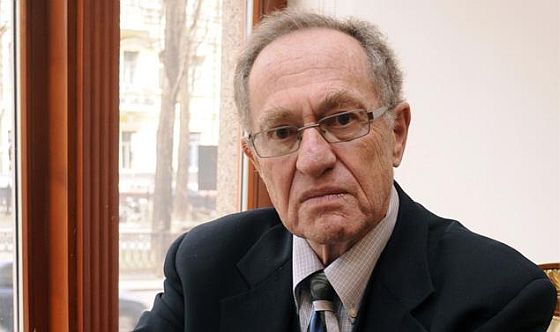
Harvard law professor and opponent of academic freedom, Alan Dershowitz.
An editorial in the New York Times says: One dispiriting lesson from Chuck Hagel’s nomination for defense secretary is the extent to which the political space for discussing Israel forthrightly is shrinking. Republicans focused on Israel more than anything during his confirmation hearing, but they weren’t seeking to understand his views. All they cared about was bullying him into a rigid position on Israel policy. Enforcing that kind of orthodoxy is not in either America’s or Israel’s interest.
Brooklyn College is facing a similar trial for scheduling an event on Thursday night with two speakers who support an international boycott to force Israel to end its occupation of the Palestinian territories. While this page has criticized Israeli settlements, we do not advocate a boycott. We do, however, strongly defend the decision by the college’s president, Karen Gould, to proceed with the event, despite withering criticism by opponents and threats by at least 10 City Council members to cut financing for the college. Such intimidation chills debate and makes a mockery of the ideals of academic freedom.
Mr. Hagel, a former Republican senator, has repeatedly declared support for Israel and cited 12 years of pro-Israel votes in the Senate. But that didn’t matter to his opponents, who attacked him as insufficiently pro-Israel and refused to accept any deviation on any vote. Mr. Hagel was even forced to defend past expressions of concern for Palestinian victims of the Israeli-Palestinian conflict.
In the Brooklyn College case, critics have used heated language to denigrate the speakers, Omar Barghouti and Judith Butler, a philosopher at the University of California, Berkeley, leaders of a movement called B.D.S., for Boycott, Divestment and Sanctions, that espouses “nonviolent punitive measures” to pressure Israel. Alan Dershowitz, a Brooklyn College graduate and Harvard law professor, has complained that the event is unbalanced and should not be co-sponsored by the college’s political science department. On Monday, Ms. Gould said other events offering alternative views are planned.
The sad truth is that there is more honest discussion about American-Israeli policy in Israel than in this country. Too often in the United States, supporting Israel has come to mean meeting narrow ideological litmus tests. J Street, a liberal pro-Israel group that was formed as a counterpoint to conservative groups like the American Israel Public Affairs Committee, has argued for vibrant debate and said “criticism of Israeli policy does not threaten the health of the state of Israel.” In fact, it is essential.
Belen Fernandez writes: It comes as little surprise that Harvard Law School professor Alan Dershowitz, Brooklyn College alumnus and raving apologist for Israeli crimes, has appointed himself commanding general in the assault on the college’s Political Science department for co-sponsoring a February 7 panel discussion on the Boycott, Divestment and Sanctions (BDS) movement.
As the BDS website notes, the non-violent movement was launched by sectors of Palestinian civil society as a means of pressuring Israel “until it complies with international law and Palestinian rights”. BDS co-founder Omar Barghouti and philosopher Judith Butler are scheduled presenters.
Among the opening salvoes of Dershowitz’s war was a January 30 Huffington Post article entitled “Brooklyn College Political Science Department’s Israel Problem“, in which his familiarity with the subject matter was underscored by his use of an incorrect acronym for the BDS movement – DBS – no less than 12 times. The error has since been rectified; the article’s more profound defects have not.
In the introductory paragraph, Dershowitz rails against “[t]he international campaign to delegitimate Israel by subjecting the Jewish state – and the Jewish State alone – to divestment, boycotts and sanctions”. No attention is paid to the possibility that Israel’s singling out in this case is perhaps a result of the fact that most other states in this world are not presently engaged in anachronistic colonial exploits, ethnic cleansing and apartheid. [Continue reading…]