Author Archives: News Sources

Does Ahmadinejad pose an existential threat to the Islamic Republic?

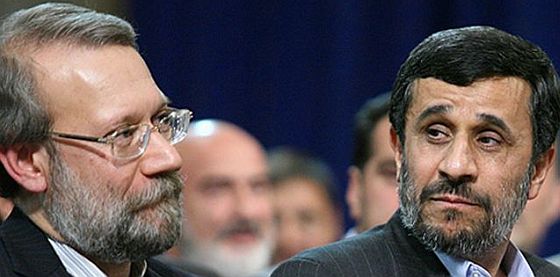
Mohammad Ayatollahi Tabaar writes: Four months before the next presidential election, Iran’s conservative establishment is facing a security threat: Mahmoud Ahmadinejad. Four years ago, a controversial election that reinstated President Ahmadinejad brought millions of Iranians into a face-to-face confrontation with Supreme Leader Ayatollah Ali Khamenei. Now, it is Ahmadinejad who is coming face-to-face with the very man who lifted him out of obscurity and granted him worldwide fame and unparalleled support against all pillars of the Islamic Republic.

During an unprecedented debate at the parliament, which ended in mayhem and the dismissal of the labor minister, Ahmadinejad played a video that implicated the powerful Larijani brothers, two of whom head the judiciary and legislative bodies, of corruption and nepotism. Sunday’s impeachment put Ahmadinejad’s remaining presidency in danger since many of his allies in the cabinet have had similar fates. At this fiery session that was being broadcast live on state radio, he threatened and eventually played the video to prove a backroom deal that involved the Larijani family. In response, the speaker of the parliament accused Ahmadinejad of mafia type activities and did not allow him to continue. Ahmadinejad angrily left the parliament and moments later 192 out of 272 members of parliament voted in favor of the impeachment.

With the next election just around the corner, the supreme leader fears that these public exchanges may once again dangerously polarize the polity and the country. During a meeting to resolve the tensions between the president and the speaker of the parliament just a few weeks ago, Khamenei frustratingly asked them not to publicize their differences. In October 2012, he even warned: “From today until the election day, whoever uses people’s emotions to create conflicts, has definitely betrayed the country.” In a country where political campaigns have turned into massive social movements, normal elections are seen by the government as unusual security threats. Khamenei recalls the 1997 and 2005 presidential elections that gave rise to the Reform and Green Movements, respectively. Looking at the increasing intensity of the past upheavals, he has good reason to worry that the next election could lead to turmoil and obliterate his office. [Continue reading…]


Facebooktwittermail

British PM invites Taliban to talks over Afghanistan’s future

The Guardian reports: David Cameron issued a direct appeal to the Taliban to enter peaceful talks on the future of Afghanistan after hosting talks at Chequers with the Afghan president, Hamid Karzai, and Pakistan’s president, Asif Ali Zardari.

The prime minister said the two leaders had agreed “an unprecedented level of co-operation”.

He said they had agreed to sign up to a strategic partnership between their two countries in the autumn.

At the same time, they also agreed to the opening of an office in the Qatari capital, Doha, for negotiations between the Taliban and the Afghan high peace council.

Cameron said the agreement should send a clear message to the Taliban. “Now is the time for everyone to participate in a peaceful, political process in Afghanistan,” he said.

He added: “This should lead to a future where all Afghans can participate peacefully in that country’s political process.”

Karzai said that they had had a “very frank and open discussion” and echoed Cameron’s appeal to the Taliban to join peace talks. [Continue reading…]

Facebooktwittermail

Israel, Palestine and the mapping of power

Tristram Hunt writes: ‘It’s almost comical. The idea of maps is to represent reality; here it represents fantasy.” So Professor Bruce Wexler of Yale University comments on how the vast majority of maps in Palestinian and Israeli schoolbooks omit the existence of the other entity. As a result, children on either side of the Green Line are growing up with “an internal representation of their homeland, in which one does not include the other”.

But since when have maps been about objective representation of space? They are about the expression and fulfilment of power. From the age of Ptolemy, all those lofty claims to comprehensiveness have usually succumbed to the promotion of political agendas. As the cartography scholar Jerry Brotton rightly remarks: “A map always manages the reality it tries to show.”

Nowhere more so than with the British empire. For in Israel/Palestine, just as in Kashmir and Sudan, postcolonial nations are still wrestling with imperialism’s mixed legacy and its arbitrary lines in the sand. As the colonial unravelling continues, and as rising powers seek to exert their own dominion, the historic confusions of British map-making are fostering all manner of geopolitical tensions.

From the outset, cartography and colonialism went hand in hand. The assertion of political control over supposed terra incognita was most effectively realised by drawing up plans and plots. Maps allowed for the expropriation of existing land rights (since indigenous communities often lacked accurate measuring instruments) and an explanation of a colony’s significance.

Take Bryan Edwards’s mid-18th century Map of the Island of Barbadoes, with its delineation of the Caribbean landscape into Anglican parishes and sugar plantations. What mattered was Barbados’s role in the imperial project, rather than any realistic representation of its geography or population.

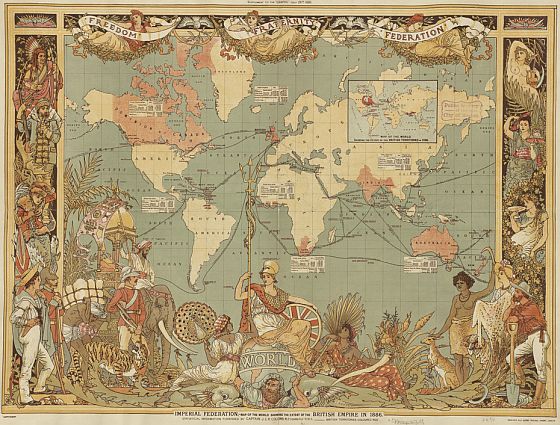
Or perhaps the most famous propagation of British colonial power, John Colomb’s 1886 map, Imperial Federation. It placed Britain centre stage, coloured our colonies a distinctive red, inflated the land mass of Canada, left swaths of unconquered terrain simply blank, and at its base posited a serene Britannia surrounded by icons of her Indian, Australian, and African colonies. [Continue reading…]

Facebooktwittermail

CIA rendition: more than a quarter of countries ‘offered covert support’

The Guardian reports: The full extent of the CIA’s extraordinary rendition programme has been laid bare with the publication of a report showing there is evidence that more than a quarter of the world’s governments covertly offered support.

A 213-page report compiled by the Open Society Justice Initiative (OSJI), a New York-based human rights organisation, says that at least 54 countries co-operated with the global kidnap, detention and torture operation that was mounted after 9/11, many of them in Europe.

So widespread and extensive was the participation of governments across the world that it is now clear the CIA could not have operated its programme without their support, according to the OSJI.

“There is no doubt that high-ranking Bush administration officials bear responsibility for authorising human rights violations associated with secret detention and extraordinary rendition, and the impunity that they have enjoyed to date remains a matter of significant concern,” the report says.

“But responsibility for these violations does not end with the United States. Secret detention and extraordinary rendition operations, designed to be conducted outside the United States under cover of secrecy, could not have been implemented without the active participation of foreign governments. These governments too must be held accountable.” [Continue reading…]

Facebooktwittermail

Egypt at risk of complete breakdown of law and order

The Associated Press reports: An Egyptian opposition party on Monday claimed police tortured one of its members to death, electrocuting him and beating him repeatedly on the head — the latest case alleging police brutality in a crackdown on anti-government protesters.

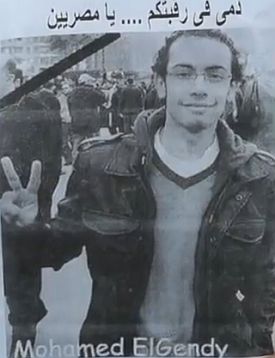
Mohammed el-Gindy, a 28-year-old activist, died of his wounds early Monday at a Cairo hospital after he was “tortured to death,” the Egyptian Popular Current party said in a statement.

The Interior Ministry had no immediate comment.

El-Gindy went missing for several days after protesting on Jan. 27 in Cairo’s Tahrir Square. The protesters are opposed to Egypt’s Islamist President Mohammed Morsi’s policies and are pressing him to amend the constitution, which was drafted by a panel dominated by Islamists and approved in a public referendum last year.

Party spokeswoman Mona Amer said she saw el-Gindy’s body and that it carried marks of torture. She said he was electrocuted, had broken ribs and a “cord appeared to have been wrapped around his neck.” A medical report cited brain hemorrhage as cause of death.

Amnesty International: Almost every girl and woman – regardless of age, social status or choice of attire – who has walked the streets or taken public transport in Cairo, has experienced some form of verbal or physical sexual harassment.

This isn’t new. For years, Egyptian women’s rights activists and others have called on the authorities to recognize the seriousness of the problem.

There needs to be a fundamental shift in institutionalized attitudes that discriminate against women.

The Egyptian authorities must introduce legal reforms, prosecute perpetrators and address root causes, because the plight of women who have experienced sexual violence has been ignored.

Blame is placed on the victims for being dressed “indecently,” or for daring to be present in “male” public spaces.

The horrific testimonies emerging following protests commemorating the second anniversary of the “25 January Revolution” have brought to light how violent mob sexual attacks against women have happened, but have rarely been brought to public attention.

International Crisis Group: It is difficult to know which is most dangerous: the serious uptick in street violence; President Morsi’s and the Muslim Brotherhood’s serial inability to reach out to the rest of the political class inclusively; or the opposition clinging to the hope of some extraneous event (demonstrations, foreign pressure, judicial rulings or military intervention) allowing it to gain power while bypassing arduous compromise and politics. They are tied of course: the president’s cavalier treatment of the constitution-writing process and the judiciary and the opposition’s lethargic approach to politics and rejection of Islamist legitimacy alike have eroded the authority of state institutions. This encourages in turn unrest and contributes to the economic slide. Together, these heighten risks of a complete breakdown of law and order. For two years, political factions repeatedly have failed to reach consensus on basic rules of the game, producing a transition persistently threatening to veer off the road. It is past time for the president and opposition to reach an accommodation to restore and preserve the state’s integrity.

Since President Mubarak’s ouster, the level of violence has ebbed and flowed, yet each new wave brings the country closer to tipping point. Already, some police officers, beleaguered by attacks on their headquarters, are considering removing their uniforms and going home; there is talk of brewing discontent among Central Security Forces, the riot control police; and criminal gangs along with looters profit from the chaos. There are new shocking images of police brutality. Many young Egyptians increasingly appear disillusioned with electoral politics, and some are drawn to anarchical violence.

The situation is made worse by deteriorating economic conditions. As foreign currency reserves decline, the government finds it ever more difficult to prop up the Egypt’s pound or maintain fuel and food subsidies. One should not be surprised to see larger segments of the population joining in socio-economic riots. By current trends, Egypt could find itself in a vicious cycle of economic under-performance and political instability, the one fuelling the other.

Facebooktwittermail

‘The god of Algiers’

Bruce Riedel writes: While [Algeria’s President Abdelaziz] Bouteflika is the public face of the government, real power still resides with the generals. They avoid the public limelight and are known in Algiers as “le pouvoir,” the power behind the scenes. In the shadowy world of “le pouvoir,” the most powerful man is probably the head of the secret police or mukhabarat. The head of Algerian intelligence, the DRS, Mohammad Mediene, has a long track record of eradicating terrorist groups using extreme methods. KGB-trained and rarely photographed, the 73-year-old Mediene has run Algerian intelligence since 1990 and is known for his professionalism and determination. He is also known by his nickname, ‘the god of Algiers,’ because his power is so pervasive and unaccountable. Born in 1939, he served in the French colonial army before defecting to the nationalist revolt when it began in the 1950s. Mediene is now the longest serving head of intelligence in the world. And probably the most ruthless.

His deputy, Bashir Tartag, commanded the actual assault on the terrorists in the desert facility. His nickname is “le bombardier” and he is also known for his support for the so called eradicationist school of counter-terrorism. But the DRS is also known for its tactic of infiltrating terrorist groups, creating “false flag” terrorists and trying to control them. Rumors have associated the DRS in the past with the Malian warlord Iyad Ag Ghali, head of Ansar al Dine AQIM’s ally in Mali, and even with Mukhtar Belmukhtar, the al-Qaeda terrorist who engineered the attack on the natural gas plant. The Algerians hope is that they can influence these groups to stay away from Algerian targets. The tactic originates with KGB and was developed by the DRS in the 1990s. It had success in dividing the jihadists then. This year is failed disastrously in Mali when the terrorists took events into their hands. [Continue reading…]

Facebooktwittermail

New old Libya

Robert Draper writes: The bronze likeness of Muammar Qaddafi’s nemesis was lying on his back in a wooden crate shrouded in the darkness of a museum warehouse. His name was Septimius Severus. Like Qaddafi, he was from what is now Libya, and for 18 years bridging the second and third centuries A.D. he ruled the Roman Empire. His birthplace, Leptis Magna—a commercial city 80 miles east of what the Phoenicians once called Oea, or present-day Tripoli—became, in every meaningful way, a second Rome. More than 1,700 years after the emperor’s death, Libya’s Italian colonizers honored him by erecting a statue of the imposing, bearded leader with a torch aloft in his right hand. They installed the statue in Tripoli’s main square (now Martyrs’ Square) in 1933—where it remained for a half century, until another Libyan ruler took umbrage.

“The statue became the mouthpiece of the opposition, because he was the only thing Qaddafi couldn’t punish,” says Hafed Walda, a native Libyan and professor of archaeology at King’s College London. “Every day people would ask, ‘What did Septimius Severus say today?’ He became a figure of annoyance to the regime. So Qaddafi banished him to a rubbish heap. The people of Leptis Magna rescued him and brought him back home.” And that is where I found him, reposing in a wooden box amid gardening tools and discarded window frames, awaiting whatever destination the new Libya might have in store for him.

Qaddafi correctly viewed the statue as a threat. For Septimius Severus stood as a wistful reminder of what Libya had once been: a Mediterranean region of immense cultural and economic wealth, anything but isolated from the world beyond the sea. Spreading over 1,100 miles of coastline, bracketed by highlands that recede into semiarid wadis and finally into the copper vacuum of the desert, Libya had long been a corridor for commerce and art and irrepressible social aspiration. The tri-city region of Tripolitania—Leptis Magna, Sabratah, and Oea—had once provided wheat and olives to the Romans.

Yet Qaddafi squandered the country’s advantages: its location just south of Italy and Greece, which made it one of Africa’s gateways to Europe; its manageable population (fewer than seven million inhabiting a landmass six times the size of Italy); its vast oil reserves. He quashed innovation and free expression. To schoolchildren, who memorized Qaddafi’s tangled philosophy as inscribed in his Green Book, the story of their country consisted of two chapters: the dark days under the West’s imperialist bootheel, and then the glory days of the Brother Leader.

Today the dictator and his warped vision for Libya are dead, and the nation is undergoing the spasmlike throes of reinvention. As Walda says, “The journey of discovery has just begun. In many ways this moment is more dangerous than wartime.” Temporary prisons are overstuffed with thousands of Qaddafi loyalists awaiting their fate as laws and court procedures are reformed. Militias control whole swaths of the country. Guns are less visible than they were during the war, but that only means the hundreds of thousands who possess them have learned to keep them out of sight. Highways in rural areas remain thoroughly unpoliced (not counting the checkpoints manned by former rebels, or thuwwar). Immigrants pour into Libya from its western and southern borders. Key Qaddafi associates, as well as his wife and some of his children, remain at large. Several new ministers are already on the take. [Continue reading…]

Facebooktwittermail

Obama: “I want to do something on climate, but I don’t know what.”

Our present course leads towards certain catastrophe.

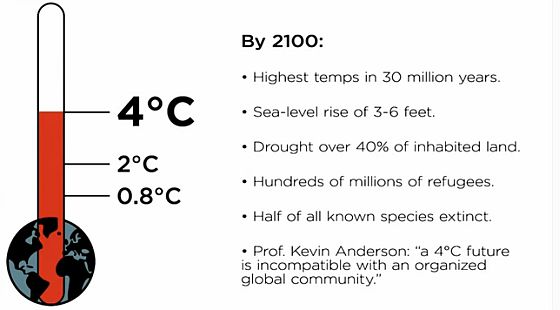
Jeff Goodell writes: Among all the tests President Obama faced in his first term, his biggest failure was climate change. After promising in 2008 that his presidency would be “the moment when the rise of the oceans began to slow and our planet began to heal,” President Obama went silent on the most crucial issue of our time. He failed to talk openly with Americans about the risks of continuing to pump greenhouse gases into the atmosphere, failed to put political muscle behind legislation to cap carbon pollution, failed to meaningfully engage in international climate negotiations, failed to use the power of his office to end the fake “debate” about the reality of global warming and failed to prepare Americans – and the world – for life on a rapidly­ warming planet. It was as if the biggest challenge humanity has ever faced became a political inconvenience for the president once he was elected.

Now Obama gets another shot at it. “The politics of global warming are changing fast,” says Kevin Knobloch, the president of the Union of Concerned Scientists. Thanks to a year of extreme weather and Hurricane Sandy, a large majority of Americans – nearly 90 percent – favor action on global warming, even if there are economic costs. The U.S. economy is on the road to recovery and no longer offers an excuse for inaction. Big Coal, traditionally the loudest voice against climate action, has been weakened by a glut of cheap natural gas and the economic viability of solar and wind power. China has new political leadership that appears open to discussing a global agreement to cut carbon. And Obama himself has nothing left to lose. “The president has a big opportunity here,” says former Vice President Al Gore. “This is a moment when he can expand the ideas of what’s possible.”

Obama’s record on climate issues is not all bad. In his first term, Gore points out, the president made significant strides in promoting clean energy. “He accomplished more than any president before him,” says Gore. Obama’s biggest move was to dramatically boost fuel standards for cars and trucks, which will cut climate-warming pollution by 6 billion metric tons in the course of the program. Thanks in part to billions of dollars in federal stimulus, wind energy doubled in the last four years, while solar installations increased sixfold. By the end of the decade, in fact, America is on track to cut its carbon pollution by as much as 17 percent, meeting the long-term goal Obama pledged at the Copenhagen climate talks in 2009.

The trouble is, Obama’s accomplishments are small-bore when weighed against the immense scale of the climate crisis. 2012 was the hottest year on record in the continental U.S. The polar ice caps are melting faster than scientists predicted; wildfires torched the American West; extreme drought parched 60 percent of the country’s farms, jacking up food prices. Then came Hurricane Sandy, which devastated New York and New Jersey. “Climate change has gone from something that happens in a computer model to something that people can see in their own backyards,” says Frances Beinecke, president of the Natural Resources Defense Council. “It is a global crisis playing out before our very eyes. And it’s not happening in slow motion.”

Obama isn’t blind to the threat. “He understands this is the central problem his administration has to deal with in the second term,” says John Po­desta, who headed up Obama’s transition team in 2008. “He knows the judgment of history is riding on this.” At a press conference shortly after his re­election, Obama admitted that “we hadn’t done as much as we need to” to address climate change, and promised a “wide-ranging conversation with scientists, engineers and elected officials” to make sure that global warming is “not a problem we’re passing on to future generations that’s going to be very expensive and very painful to deal with.”

But if the president is planning any bold action during his second term to combat global warming, there’s little evidence of it. “I want to do something on climate,” he told a friend and former White House staffer after the election, “but I don’t know what.” Before his 2008 inauguration, Obama solicited ideas for combating climate change from top environmentalists and energy executives. This time around, there have been no such meetings, and the president has not telegraphed any ideas on climate change to Congress. “If he has a larger strategy on this, I haven’t seen it,” says the chief of staff to a leading Democratic senator. One Democratic donor and climate activist who visited the White House in December was told point-blank by Heather Zichal, the White House adviser on energy and climate, that the president has no plans to propose any climate legislation to Congress, knowing that House Republicans would shoot it down.

“I think the president understands the climate crisis intellectually, but he has not had the ‘holy shit’ moment you arrive at when you think about this deeply enough,” says a leading climate advocate who has had private conversations with Obama about global warming. Instead of talking about the risks of climate change during the campaign, Obama touted an “all of the above” energy plan that was a soft-porn version of “drill, baby, drill.” Under Obama, in fact, oil and gas production have soared: Last year, U.S. oil production grew by 766,000 barrels a day, the largest jump ever, and domestic oil production is at its highest level in 15 years. [Continue reading…]

Facebooktwittermail

What happens when drones return to America?

Mockup of a mosquito drone that could be used for gathering DNA samples from unwitting targets.

Lev Grossman writes: Drones don’t care who they work for. They’ll spy for anyone, and as they get cheaper and more powerful and easier to use, access to military-grade surveillance technology will get easier too. Voracious as they are for information, drones could take a serious chunk out of Americans’ already dwindling stock of personal privacy. It’s certainly not legal to fly a drone up 10 stories to peer through the curtains into somebody’s bedroom, but it’s just as certain that somebody’s going to do it, if they haven’t already. Last February an animal-rights group in South Carolina launched a drone to watch a group of hunters on a pigeon shoot on private property. The hunters promptly shot it down. It might be America’s first case of human-on-drone violence, but it won’t be the last.

Whatever happens on the civilian front, the ongoing dronification of the U.S. military is barreling ahead. The Predator has already been superseded by the larger, faster, more powerful Reaper, which is in turn looking nervously over its shoulder at the even larger, jet-powered Avenger, currently in the testing phase.

The U.S.’s skunkworks are disgorging drones in a bizarre profusion — like Darwin’s finches, they’re evolving furiously to fill more and more operational niches and creating new ones as they go. Already soldiers carry hand-launchable Raven surveillance drones and kamikaze Switchblade drones for targeting snipers. The K-MAX unmanned helicopter ferries cargo around Afghanistan for the Marines. The Navy’s SeaFox, a single-use underwater drone, is hunting for Iranian mines in the Persian Gulf. The Army is testing a Long Endurance Multi-Intelligence Vehicle, essentially a 300-ft.-long unmanned blimp designed to squat over a battlefield at high altitude for weeks at a time. (Its manufacturer, Northrop Grumman, promises “more than 21 days of unblinking stare.”) DARPA has fielded a tiny drone that mimics the flight of a hummingbird, and it’s mulling a network of deepwater drones that would dwell on the seafloor but — like Godzilla — rise to the surface in times of need.

Drones are learning to think for themselves. Those University of Pennsylvania drones are already semiautonomous: you can toss a hoop in the air and they’ll plot a trajectory and fly right through it. (Whether or not you count Google’s self-driving cars as people-carrying, highway-borne drones seems like a question of semantics.) They’re also gaining endurance. In June, Boeing tested a liquid-hydrogen-powered drone called the Phantom Eye that’s designed to cruise at 65,000 ft. for four days at a time. Boeing’s Solar Eagle, which has a 400-ft. wingspan, is scheduled for testing in 2014. Its flights will last for five years.

This technology will inevitably flow from the military sphere into the civilian, and it’s very hard to say what the consequences will be, except that they’ll be unexpected. Drones will carry pizzas across towns and drugs across borders. They’ll spot criminals on the run and naked celebrities in their homes. They’ll get cheaper to buy and easier to use. What will the country look like when anybody with $50 and an iPhone can run a surveillance drone? Last fall the law schools at Stanford and NYU issued a report, “Life Under Drones,” which was based on 130 interviews with Pakistanis. It makes for unsettling reading. “Drones are always on my mind,” said a man from Islamabad. “It makes it difficult to sleep. They are like a mosquito. Even when you don’t see them, you can hear them. You know they are there.”

Facebooktwittermail

JSoc: Obama’s secret assassins

Naomi Wolf writes: The film Secret Wars [sic — the actual title is Dirty Wars], which premiered at Sundance, can be viewed, as Amy Goodman sees it, as an important narrative of excesses in the global “war on terror”. It is also a record of something scary for those of us at home – and uncovers the biggest story, I would say, in our nation’s contemporary history.

Though they wisely refrain from drawing inferences, Scahill and Rowley have uncovered the facts of a new unaccountable power in America and the world that has the potential to shape domestic and international events in an unprecedented way. The film tracks the Joint Special Operations Command (JSoc), a network of highly-trained, completely unaccountable US assassins, armed with ever-expanding “kill lists”. It was JSoc that ran the operation behind the Navy Seal team six that killed bin Laden.

Scahill and Rowley track this new model of US warfare that strikes at civilians and insurgents alike – in 70 countries. They interview former JSoc assassins, who are shell-shocked at how the “kill lists” they are given keep expanding, even as they eliminate more and more people.

Our conventional forces are subject to international laws of war: they are accountable for crimes in courts martial; and they run according to a clear chain of command. As much as the US military may fall short of these standards at times, it is a model of lawfulness compared with JSoc, which has far greater scope to undertake the commission of extra-legal operations – and unimaginable crimes. [Continue reading…]

Facebooktwittermail

Barak says reported Syria strike shows Israel is serious

Reuters reports: Defense Minister Ehud Barak said on Sunday an attack on a Syrian arms complex showed Israel was serious about preventing the flow of heavy weapons into Lebanon, appearing to acknowledge for the first time that Israel carried out the strike.

Israel has maintained official silence over Wednesday’s raid, which Syria said targeted a military research center north-west of Damascus.

“I cannot add anything to what you have read in the newspapers about what happened in Syria several days ago,” Barak told a security conference in Munich on Sunday.

“But I keep telling frankly that we said, and that is another proof that when we say something we mean it. We say that we don’t think it should be allowable to bring advanced weapons systems into Lebanon.”

Diplomats, Syrian rebels and security sources said Israeli jets bombed a convoy near the Lebanese border on Wednesday, apparently hitting weapons destined for the Lebanese militant group Hezbollah, which fought a 34-day war with Israel in 2006.

Syria denied the assertions, saying the target was the Jamraya complex on the northwestern fringes of Damascus and 8 miles from the border.

Facebooktwittermail

As self-immolations near 100, Tibetans question the effect

The New York Times reports: A crowd of Tibetans came here to India’s capital last week, bearing flags and political banners and a bittersweet mixture of hope and despair. A grim countdown was under way: The number of Tibetans who have set themselves on fire to protest Chinese rule in Tibet had reached 99, one short of an anguished milestone.

Yet as that milestone hung over the estimated 5,000 Tibetans who gathered in a small stadium, so did an uncertainty about whether the rest of the world was paying attention at all. In speeches, Tibetan leaders described the self-immolations as the desperate acts of a people left with no other way to draw global attention to Chinese policies in Tibet.

“What is forcing these self-immolations?” Lobsang Sangay, prime minister of the Tibetan government in exile, asked in an interview. “There is no freedom of speech. There is no form of political protest allowed in Tibet.”

Billed as the Tibetan People’s Solidarity Campaign, the four-day gathering featured protests, marches, Buddhist prayer sessions and political speeches in an attempt to push Tibet back onto a crowded international agenda. If the Arab Spring has inspired hope among some Tibetans that political change is always possible, it has also offered a sobering reminder that no two situations are the same, nor will the international community respond in the same fashion.

“The world is paying attention, but not enough,” Mr. Sangay added. “There was a self-immolation in Tunisia which was labeled the catalyst for the Arab Spring. We’ve been committed to nonviolence for many decades. And how come we have been given less support than what we witnessed in the Arab world?” [Continue reading…]

Facebooktwittermail

France’s next move: With Mali’s Islamists on the run, time to talk to the Tuaregs

Bruce Crumley writes: Though long hostile to allied Islamist groups across the Sahel region, Tuareg nationalists have struggled for decades for more freedom and autonomy. Boosted by an influx of weapons from the looted arsenals of slain Libyan dictator Muammar Gaddafi, they accepted the help of Islamist militias when wresting control of half of Mali last year—only to then see the radicals unilaterally impose their own brand of brutal Sharia rule over stretches of the breakaway region. But with those extremists now scattered and in retreat, calls are now arising for the central government and Tuareg leaders to link up against the common jihadi foe.

“We understand the resistance in Bamako to dealing with Tuareg forces that participated in the recent southern offensive, but the long-term stability of Mali relies on the central government and the Tuaregs negotiating and coming to certain agreements,” says a French government official who declines to be quoted by name. “The Tuaregs made a terrible decision in banding with the Islamists, and Malian anger over the consequences is understandable. But our view is all Tuareg leaders who renounce violence and accept the territorial integrity of Mali should be considered legitimate interlocutors in the political rebuilding process.”

That thinking may take some time to sell—particularly among southern Malians resentful of the Tuaregs separatist insurgency that enabled the Islamists’ rise in the power gap that followed a March 2012 military coup in Bamako. Now, there are already accusations of summary executions and rights violations by Malian forces during France’s anti-Islamist counter-offensive. Following the liberation of northern cities like Gao and Timbuktu, meanwhile, reports circulated that armed forces and locals had begun attacking other residents suspected of having supported or prospered under Islamist rule. As a result, once French forces freed the Tuareg-held town of Kidal Wednesday, military officials called in support of 1,400 Chadian troops—not Malian soldiers—to police the areato avert any vengeance killing.

That precautionary move is doubly significant in Kidal, given the complex Tuareg situation there. The Islamist group Ansar Dine had claimed to control Kidal—though there were no signs of any Islamist fighters when the French arrived there. The previous week, meantime, an influential Ansar Dine leader, Alghabass Ag Intalla, announced he’d bolted the al Qaeda-allied group to found the Islamic Movement for Azawad (IMA)—a nationalist Tuareg force renouncing “extremism and terrorism.” Shortly after, the secular Tuareg National Movement for the Liberation of Azawad (MNLA) offered to assist French troops continue the battle against jihadi militias.

Both the IMA and MNLA also say they’re ready to partake in talks towards a north-south political settlement capable of restoring peace and stability to Mali. Traoré and other central Malian leaders say they may accept negotiating with the MNLA, but have ruled out any cooperation with the IMA and any other Tuareg with past or present ties to extremists. That’s a position Paris is hoping to shift.

AFP reports: France said it carried out major air strikes Sunday near Kidal, the last bastion of armed extremists chased from Mali’s desert north in a lightning French-led offensive, after a whirlwind visit by President Francois Hollande.

An army spokesman said 30 warplanes had bombed training and logistics centres run by Islamist extremists overnight in the Tessalit area north of Kidal, where French troops took the airport Wednesday and have been working to secure the town itself.

Residents said French and Chadian soldiers had patrolled the town for the first time Saturday as the rest of the country feted Hollande on his tour, a victory lap that came three weeks into a so far successful intervention to oust the Islamists who occupied northern Mali for 10 months.

Facebooktwittermail

Jazz warrior defending Mali’s values

The New York Times reports: Cheick Tidiane Seck played a concert in Bamako last Saturday, the capital of his native Mali, just before he returned to his home in Paris.

A war was raging in the north of the country, as Malian and French troops bore down on the fabled desert city of Timbuktu that had been held by Tuareg rebels and their Islamist allies since spring. The jihadist fighters, as they retreated, set fire to a library containing thousands of priceless manuscripts dating from as far back as the 13th century, according to reports that emerged later.

But in the concert hall that night, Mr. Seck, on the piano, made music with other well-known stars of Mali’s jazz scene, playing to an audience of people from all over the country. “There were Tuaregs in the hall, and out in the streets,” Mr. Seck recalled, “and nobody threatened them.”

Sitting at a corner table in the basement of a cafe below his Paris apartment, Mr. Seck was unmistakable: A young Malian waiter stopped by to pay his respects to the 59-year-old music legend. A large man, Mr. Seck looked larger still in a flowing brown robe, upon which he had purposely hung a colorful beaded purse. “It’s Tuareg,” he said.

If Mr. Seck has a message today — a rare moment when the world can locate Mali on a map — it is that his country’s culture must endure, as it has for thousands of years.

But until France intervened last month to stop Islamist forces from moving south to Bamako, Mr. Seck was not so sure Mali itself would survive.

“I was afraid for my country,” he said. “Once I knew that they had conquered all the cities in the north, a chill went down my spine. It was an unspeakable wound.”

In his view, the Islamists’ acts of violence — against people, but also against the ancient culture of Timbuktu — were crimes against humanity. A 15th-century Malian proverb proclaims: “Salt comes from the north, gold from the south, but the word of God and the treasures of wisdom are only to be found in Timbuktu.”

According to some reports, much of the precious collection of manuscripts assembled in the Ahmed Baba Institute was saved by archivists and local residents before Timbuktu was seized by Islamist rebels last April; the documents remain hidden for fear that the jihadists will return.

But the wanton destruction of the graves of Timbuktu’s Sufi saints, considered idolatrous by orthodox Salafists, is undisputed, like the banning of music, the enforced veiling of women, the floggings and the amputations.

“A people has the right not to be ruled by violence,” Mr. Seck said. “They were going to impose Shariah across the whole country. They were going to destroy what was left of the harmony in the country.”

Now, he believes that danger has receded thanks to a decision by President François Hollande of France to intervene on Jan. 11. “The French knew that they had to do that in order to block this Islamic fundamentalism,” Mr. Seck said. “It must be stopped; they must be stopped.”

“So I say, ‘Bravo, Hollande,”’ he said. “I say, ‘A big bravo,’ and I am not the only one to say that. You can see French and Malian flags flying together all over Bamako.”

Now comes the hard part, as a fragile country tries to pull itself back together. Mr. Seck said he remained optimistic. [Continue reading…]

Facebooktwittermail

Inside Gao where Arab jihadis took bloody sharia retribution on Mali’s black Africans

Lindsey Hilsum reports: The jihadis carried out amputations in the sandy square where the residents of Gao used to watch basketball. The men who ruled Gao for nine months, until French and Malian troops drove them out last weekend, replaced the words “Place de l’Indépendence” in the green, red and yellow of the national flag with simple white on black: Place de la Sharia.

A thief would lose his right hand. Those accused of burglary would lose both right hand and left foot. On 21 December last year, people were assembled, as they had been several times before, and told to watch.

“No one was allowed to speak,” said Issa Alzouma. “Then they cut off my hand with a knife.”

Alzouma had been accused of stealing a motorbike, which he denies. At 39, he made a living digging gravel for construction companies. It was enough to support his wife and three children. Now he roams Gao in tattered clothes, the stump of his right arm wrapped in a grubby bandage, a flimsy black plastic bag dangling from his remaining wrist. Inside he keeps a few antibiotics and replacement bandages given by a Red Cross doctor who treated him at Gao hospital a week after his amputation.

“The doctor had to cut in and remove flesh because it was infected,” he said. “Under the bandage you can see my bones. It hurts and I feel as if my bones are coming out.”

Alzouma has no idea how he and his family will survive. “My wife just cries and cries,” he said. His friend Algalas Yatara, who was also accused of stealing a motorbike, carries a sheaf of papers in Arabic in his remaining hand. He thinks it is the judgment but is not quite sure, as neither man can read Arabic.

At least 12 men had hands or feet cut off after MUJAO (Movement for Jihad and Unity), and its allies in AQIM (al-Qaida in the Islamic Maghreb), took control of Gao last April. The exact number is not known because some were amputated in the military base where no non-jihadi was allowed. The mayor’s office, a few yards from the punishment ground, was turned into a sharia court. Outside, the sand has turned black where the enforcers of hesbah, or justice, ground down cigarettes and whipped those found smoking. Inside, the floor is littered with documents, including a ring-binder with details of the women flogged for not wearing the veil. Family members were made to put a thumbprint to show they acknowledged the punishment and would supervise the accused in future.

Suspects were confined to a small room where they were tied up and beaten, before being brought before Islamic judges, known as marabous, who sat every Monday and Thursday.

Ali Altini and Mohammed Aklini were due to be executed for homosexuality the Friday before last. French air strikes saved their lives, as the jihadis who would have carried out the sentence were killed or fled. The two men, who deny they are gay, were arrested on 12 December, bound, beaten, then interrogated. ” They asked me where the brothels are,” said Altini. “I answered that I didn’t know. Then they asked me to show them where people made pornographic movies. I answered again that I didn’t know.”

According to Altini, his six interrogators were Pakistanis, who communicated through a local translator. Altini and Aklini were arraigned before three marabous, one of whom they believed to be a Tunisian. [Continue reading…]

Facebooktwittermail

The world is facing viral mutations of the human psyche

Wole Soyinka writes: My mind, frankly, was on anything but peace as I entered the United Nations conference hall to participate in a Culture of Peace and Non-Violence event. On that same day – 21 September 2012 – yet another UN resolution had been released on the crisis in Mali. I felt overwhelmed by the ponderousness of the UN machine. That the UN, in association with African political leaders, recognised the danger posed by fundamentalist aggression to the Sahel and west Africa was not in doubt. The sense of urgency, however, lagged so far behind my own that it was a marvel I did not invade the conference hall with a banner, screaming: TAKE BACK MALI – YESTERDAY!

The security council had already set out a “roadmap” for a west African force of intervention in the Sahel – it required the secretary general to report back on “progress” a few months later. This, it struck me, was an instruction not to the secretary general, but to the fundamentalist invaders to report to the world on the progress they would have made in destroying the ancient libraries of Timbuktu; amputating the arms of a few more Malians; and stoning to death deviationists from their “moral code”.

It was an invitation to Ansar Dine’s allies Boko Haram to nudge a few more terminators into Nigeria; demolish a few more educational, cultural and religious institutions; eliminate what was left of the UN presence after its bomb attack on the UN HQ in Abuja; and continue its project of unleashing death and destruction in southern Nigeria.

Before the conference, I had button-holed senior Nigerian officials at every opportunity. None needed any persuasion about the danger to west Africa if the fundamentalist menace were not contained, rapidly. President Jonathan himself, I was assured, was sensitive to the ramifications of Mali’s northern takeover. So were a number of African heads of state. What was lacking was the practical preparedness for action. To any student of the fundamentalist temperament, this imperative of urgent response should be second nature. Africa’s political leadership should be in a state of permanent consciousness – and responsiveness. We are not novices, after all, to the ruthless nature of fundamentalist insurgency, its territorial desperation and, above all, its contempt for humanity. [Continue reading…]

Facebooktwittermail