Author Archives: News Sources

Palestinian ghettos were always the plan

Amira Hass writes: When Habayit Hayehudi party leader and rising political star Naftali Bennett calls for annexing Area C, the part of the West Bank under full Israeli security and civil control, he is following the logic of every single Israeli government: maximize the territory, minimize the Arabs.

Some may even interpret this as elections propaganda in favor of Habayit Hayehudi and endorse it warmly.

Bennett can propose annexation because every governing coalition since the Six-Day War – whether it was led by the Likud or Labor (or its precursor, Alignment) party, and whether its partners were Mafdal, Shas or Meretz – laid the spiritual and policy groundwork for him.

According to Bennett, about 60 percent of the West Bank – a.k.a. Area C – is annexable. What’s important about Area C is not whether 50,000 Palestinians live there, as democratic, benevolent Bennett claims, while suggesting to naturalize them and grant them Israeli citizenship, or whether the number is around 150,000 (as my colleague Chaim Levinson reminded us earlier this week).

Don’t worry. Even if there are 300,000 Palestinians living in Area C and all of them agree to become citizens, the Israeli bureaucracy will find ways to embitter their lives (the way it does the lives of the Bedouin in the Negev), revoke their citizenship (the way it does the residency status of Palestinians in East Jerusalem) and leave them without the little share of their land they still have (the way it did to the Palestinian citizens of Israel within the 1948 borders). This is why Bennett can allow himself to be munificent.

The true story behind area C is that there aren’t 400,000 Palestinians living there today; the villages have not expanded in accordance with their natural population growth; the number of residents has not grown; the herders can no longer graze their flocks freely; many of the inhabitants lack access to water, electricity, school and medical clinics; Israel has not been taken to the International Criminal Court in the Hague for destroying the cisterns; there are no paved roads in and between villages.

Many of the people have been living in tents and caves for 30 to 40 years – against their will and contrary to their hopes – and the Palestinian towns cannot expand properly and remove old industrial zones a reasonable distance from residential neighborhoods.

As I have said a million times and will say another million times: Area C is a tremendous success of Israeli policy and its implementers, the army and the Civil Administration. It is part of a farsighted, well-executed, perfectly thought-out policy that has succeeded precisely in that there aren’t 400,000 Palestinians living in the area. Bennett is probably decent/honest enough to acknowledge the debt he owes to the previous generations of Israeli politicians and military officials who warmed the country up for his annexation plan, ensuring its acceptance would be as effortless as a knife cutting butter in the sun.

In an interview on Israeli television in 2008, Uzi Arad, who went on to become Benjamin Netanyahu’s national security adviser, said:

[A]t the end of the day, I don’t think the majority of Israelis want to see themselves responsible for the Palestinians. We do not want to control the Palestinian population. It’s unnecessary. What we do want is to care for our borders, for the Jewish settlements and for areas which are unpopulated and to have our security interests served well. But also to take under our responsibility these populations which, believe me, are not the most productive on earth, would become a burden. We want to relieve ourselves of the burden of the Palestinian populations – not territories. It is territory we want to preserve, but populations we want to rid ourselves of.


Facebooktwittermail

Beyond al Qaeda

Howard W French writes: Pundits who bang on about the events in Mali on television today speculate glibly about the possible linkup of militant Islamic movements in places like Mauritania, Mali, Algeria, and northern Nigeria, potentially constituting a vast sea of Muslim radicalism and hostility to the West. They would do better to understand that such currents are inherent to the politics and culture of this region and are in no way a recent import. Rejection of borders and of the European drawn states is as old as the borders themselves, and Islam has always played a central role in this, as intellectual base, religious justification and rallying catalyst. These currents have been given added force and coherence by the age-old movement of peoples and ideas via pastoralism, overland pilgrimage to Mecca and the existence of large, sprawling and aggrieved transnational ethnic groups — like the Tuareg, Hausa, and Fulani, to name three — whose interests were never considered by the imperial mapmakers.

Most of those who write on today’s crisis seem to ignore that the Tuareg, who are a key to events in Mali, have been sporadically fighting for decades against the country of that name we see on the map. During a visit I made to Timbuktu in the 1990s, Tuareg rebels fired mortars into the town that landed within meters of my hotel with no prior warning, scrambling tourists and creating a state of emergency.

As for other rebel groups in the region, their general pattern has been to raise tensions like this, forcing the government, in effect, to sue for peace by offering money, talks about greater autonomy, or other concessions. What was new this time had less to do with the presence in the equation of an al Qaeda spinoff than with the fact that there has been no government worthy of the name in the capital, Bamako, since a military coup overthrew the elected president last March.

Before we start breaking out hammers in search of nails, this crisis should serve as a powerful reminder of the necessity of much stronger preventive diplomacy in Africa in general, a thread that runs through major crises in Rwanda, the Congo and most recently Côte d’Ivoire. When I spent time in Mali in the summer of 2011, Western diplomats seemed scantily informed and almost blasé about the situation there; this at a time when the political cognoscenti was already warning of an advanced state of rot that involved mounting corruption, drug trafficking, and high-level dawdling over rising Islamic militancy.

However, even the best diplomacy, which we clearly haven’t had in Africa, won’t change the fact that the Sahel is in for a period of extended unrest and uncertainty. Its vastness contains some of the most sparsely inhabited real estate anywhere, peppered here and there by far-flung population centers with little economic viability or connection to the outside world. Places like these are easy to attack and hard to hold, and the militants’ game of blackmail for greater resources is extremely tempting.

Whatever the political or religious labels of the militants, however, the biggest driver of turmoil in this region in the future will be population. The peoples of the arid Sahel have some of the highest birth rates in the world, and there is little prospect that they will be able to accommodate the quadrupling or more of their populations, as projected by the U.N., before century’s end. Under such scenarios, Mali will go from 16 million or so today to 75 million people. Even poorer Niger, next door, will surge from today’s similar population base to 125 million.

Explosions like these will make a mockery of the political map of Africa that is familiar today, as major ethnic clusters outstrip the claims of the present-day states to govern them. Al Qaeda in the Islamic Maghreb surely must be dealt with now, but over time it will be the least of our worries.

Facebooktwittermail

Was al Qaeda given a safe haven in northern Mali?

In an extract from his forthcoming book, Andy Morgan writes about ties that are claimed to have been secretly formed between the Malian government and Al Qaida in recent years. “There are facts about Al Qaida in the Islamic Maghreb (AQIM) that are reassuringly hard and verifiable. The organisation exists. It’s run by Algerian Arabs. It’s made a home from home in the north east of Mali… It earns millions and millions of euros from kidnapping westerners.”

With a couple of rare if significant exceptions, AQIM have never actually kidnapped their victims on Malian soil. They’ve only brought them back to Mali for safe-keeping. And with the equally rare exception of a major clash north of Timbuktu in July 2009, in which 28 soldiers were killed, the Malian army have never actually lead a full frontal assault on Al Qaida.

These two facts alone have lead many conspiracy theorists and almost the entire Touareg intelligentsia at home and abroad, to conclude that Al Qaida were invited on to Malian soil by the Malian government in order to the discredit the Touareg nationalist movement and mask the illegal trafficking going on in the north, from which a number of middle-ranking and senior Malian officials were drawing hefty amounts of black cash. In the atmosphere of anti-Islamist paranoia that seized the world following the 9/11 attacks, it was expedient for any government to twist the international image of a recalcitrant separatist movement and pass it off as an Islamist terror one instead. The strategy masked the true nature of the separatist struggle, confused international opinion and secured almost immediate benefits in the form of better diplomatic and security ties with the USA and Europe, more military aid, both in money and in kind. That’s what happened in Mali in the years following 2003.

The problem with the theory of collusion between AQIM and the Malian government is that no firm evidence has ever been produced to back it up. No one has actually photographed or recorded a Malian army officer or secret service agent chatting with an Al Qaida emir, or taking possession of a fat brown envelope full of narco-cash in some distant corner of the northern deserts. Of course, that’s the nature of this shadowy world. Nothing is ever written down. Dirty deals are done behind closed doors, or on an impossibly remote sand dune right in the middle of nowhere. The north of Mali has been closed to outsiders, especially journalists, for years. AQIM money is carefully laundered through various banks and legitimate businesses in Mali, Niger, Mauritania and further afield. Or it’s used to buy huge herds that chomp happily on the pastures of the north, away from the prying eyes of the world. There are no witnesses on record because there has never been any proper investigation. And even if there had been, who would risk their skin to expose skullduggery at such high levels. Fully uncovering the matrix of villainy that has been choking Tinariwen’s homeland since the beginning of the millennium presents a journalistic challenge that would make Watergate look like an episode of Miss Marple.

At the moment, all it can ever boil down to is one enormous hunch, a devil’s choice between a damning and a marginally less damning scenario. At best, finding AQIM on their territory, the Malian government just left them there to fester, knowing full well that their presence would putrefy the social fabric of the northern deserts. They did this because they didn’t want to risk Malian lives by taking fight to the terrorists, and / or because there were Northern Arabs in the Malian army and secret services who had strong family and cultural ties to AQIM and encouraged its presence on Malian soil because it provided an effective screen behind which they could continue with their high-stakes smuggling. Furthermore, AQIM’s presence in the north east would sully the Touareg independence cause with the taint of Islamic terrorism, an especially apt consideration following the Touareg rebellion of May 23rd 2006. At worst, all of the above is true, except that instead of waking up one morning and finding them there, the Malians actually invited AQIM to come and establish their iniquitous presence on this once open and welcoming land. That Malian policy towards AQIM should have been quite so cynical might come as quite a surprise to many. Diplomats at the US Embassy in Bamako were certainly quit taken aback when, in October 2006, a key official in the Malian Ministry of Territorial Administration told them that hostilities between the GSPC and the latest in a long line of Touareg rebel movements, the ADC, worked to the government of Mali’s advantage. Following clashes between the Touareg rebels and the GSPC, the terrorists had vowed to wipe out the ADC leadership. “The enemy of my enemy is my friend,” stated the Malian politician. Exactly how friendly, he refused to say.

Facebooktwittermail

Palestinian activists bemoan their lost Arab Spring

Asmaa al-Ghoul writes: “Is it easier to get a visa to Belgium or Sweden? How do I apply for asylum? Should I tear up my passport or hide it? Will the iris scan be conducted in the first country in which I arrive or the country in which I will seek asylum?” These questions, among others, are what busy the mind of 23-year-old Mahmoud Yahya these days.

Only a year ago Mahmoud was optimistic for change, and two years ago in 2011, Mahmoud took to the streets to effect that change. He says he felt like a giant then, capable of anything.

Mahmoud told Al-Monitor, “With every passing year, my despair increases. When I recall what I was like a year ago, I remember the hope I had that our hate-filled political and social reality could change. But when I look at how I was at the beginning of 2011, I cannot believe how convinced I was that I was Superman, and the same goes for how I saw all the other young people. The Arab revolutions had truly changed us.”

He added, “For the first time we felt like we had some agency. We went out to the streets on Dec. 5, 2010, and we confronted Central Security of the deposed government without blinking an eye. We broke through our collective fear and took to the streets protesting the closure of the Sharek Youth Forum. We took to the streets again in 2011 during the Egyptian and Syrian revolutions and were imprisoned and beaten, which also happened to our counterparts in the West Bank. Finally we had our own revolution on Mar. 15, 2011. Our defining chant was, “The people want to end the division!” They beat us, slandered us, broke our limbs, smeared our reputation and blackmailed us, which culminated in the killing of our Italian comrade Vittorio by unknown assailants. From that moment on, sadness and frustration would silence us forever.”

Mahmoud gazed at the ceiling, eyes welling up, “We believe in our strength, but we were romantic. When I saw all of the March 15 activists emigrating and traveling away from Gaza, I knew that we had failed to bring about our Palestinian Spring, so I decided to travel as well.” [Continue reading…]

Facebooktwittermail

The death of Fatah and the future of Palestine

Dalia Hatuqa writes: After nearly a half-century of existence, Fatah has left many loyalists and critics alike pondering its accomplishments. On New Year’s Eve, the Palestinian political party — which has led the Palestine Liberation Organization (PLO) for decades and currently holds the presidency of the Palestianian Authority (PA) — celebrated its 48th anniversary. In Ramallah, a few thousand mostly young men marched across the West Bank city to the Muqata’, the headquarters of the PA president and Fatah leader, Mahmoud Abbas. The streets were lined with the party’s younger supporters, some elderly veterans clad in military fatigues and several high-ranking members of the group’s leadership who are based in the West Bank.

As the marchers converged upon the headquarters — once a ravaged icon of the second Intifada, today it stands a revamped modern military compound — many started to trickle away. Addressing the enthusiastic group that remained, Abbas, looking every day of his 77 years, spoke of Palestinian leaders of years past. He started with Yasser Arafat, a Palestinian figure unrivaled in his persona, then moved on to Abu Jihad and Abu Eyad — both icons of Palestinian resistance — and Sheikh Ahmed Yassin, Hamas’s late spiritual leader, whose group Fatah has been at loggerheads with since it wrested control of the Gaza Strip in 2007.

Abbas recited the litany of names as if lamenting his party’s failure to deliver a unifying leader since Arafat to guide Palestinians through exceptionally troubling times: a moribund peace process, dire economic circumstances brought about by dwindling international aid, mushrooming Israeli settlements, and a political and geographical rift with the Gaza Strip.

Besides the marching band and the rally, few people in town seemed aware, let alone interested, in the festivities. Discussion of the economy and the E1 Israeli settlement plan dominated TV and radio station talk shows and café conversations. On the domestic political front, Fatah hasn’t been faring as well as should be expected on its home turf. During last October’s municipal elections, only 54 percent of eligible voters turned out to cast their ballots. Despite a Hamas boycott, Fatah was unable to present a unified front and many of its members broke with the party line by running on independent platforms. [Continue reading…]

Facebooktwittermail

Tribalism and the Syrian crisis

Tareq al-Abd writes: Prominent tribal figures have become omnipresent in Syrian opposition meetings, at a time when the regime is also hosting meeting after meeting for these same leaders. All of this is transpiring amid fears that societal unity will once again become fragmented, opening the door to tribal clashes in the worst possible scenario that could face Syria.

Tribal influence has returned to the forefront of the country’s political scene. Although their presence on the ground fluctuates between weak in some areas to effective in others, the impression is that Syrian society still longs for the old days of tribal friction and polarization, despite the fact that cohesion between some of them has played a positive role in avoiding disputes. As a result, there is a new drive to monitor the country’s tribal communities, their influence and relationship with the regime, be they for or against the current government.

The Syrian tribes are spread throughout all the regions of the country, from the extreme northeast in the plains of al-Jazira and the Euphrates river valley, all the way to the Badiya desert, Homs, Hama and the Damascus countryside, as well as the southern regions of Hauran and Jabal al-Druze. All these tribes are interconnected and have relationships with neighboring countries, especially Iraq and Jordan, with some tribes even claiming ties in Saudi Arabia. Furthermore, many inhabitants of Mount Lebanon still retain a strong connection to their places of origin in southern Syria and maintain good relations with their relatives there, while others have Turkish ancestry, such as the Abazaid clan in Daraa. [Continue reading…]

Facebooktwittermail

Laying bare the facts about Netanyahu and the settlements

Lara Friedman writes: On December 31, 2012, Time Magazine published an article entitled, “The West Bank’s 2012: The Year of the Israeli Settlement.” Earlier this week, the Israeli Peace Now movement released a new report that makes a case for a different title: 2009-2013: the Years of the Israeli Settlements. The new report (which I co-authored) details the Netanyahu government’s record on settlements over the course of its past 4 years in office. The results are incontrovertible: by every objective measure, the Netanyahu government has demonstrated that it is determined to use settlements to destroy the very possibility of the two-state solution.

Peace Now documents how, under the Netanyahu government, constructed started on 6867 new units in settlements. More than one-third of these starts were in settlements located east of the planned route of Israel’s separation barrier—areas that it cannot plausibly be argued will remain under Israeli control after a Israeli-Palestinian peace agreement. In the years preceding the Netanyahu government, only 20 percent of new construction was in settlements in these areas. Much of this new construction was triggered by the Netanyahu government, which tacitly encouraged settlers to begin new construction in the period leading up the 10-month settlement “moratorium” and then insisted that such construction must be allowed to continue during the moratorium.

Peace Now also documents the record number of tenders for new construction in settlements issued under the Netanyahu government, following the expiration of the settlement “moratorium.” We’re talking about tenders for 5302 new units in settlements in the West Bank and East Jerusalem—a number that erases the impact of the moratorium. [Continue reading…]

Facebooktwittermail

Syrian rebels accuse jihadist groups of trying to hijack revolution

Martin Chulov reports: Over the past six weeks a once co-operative arrangement between Aleppo’s regular Free Syrian Army units and al-Nusra has become one of barely disguised distrust.

A week of interviews with rebel groups in north Syria has revealed a schism developing between the jihadists and residents, which some rebel leaders predict will eventually spark a confrontation between the jihadists and the conservative communities that agreed to host them.

Some already talk of an Iraq-style “awakening” – a time in late-2006 as when communities in the Sunni heartland cities of Fallujah and Ramadi turned on al-Qaida groups in their midst that had tried to impose sharia law and enforce their will through the gun barrel.

“We’ll fight them on day two after Assad falls,” a commander said. “Until then we will no longer work with them.”

In recent weeks Liwa al-Tawhid and other militias who form part of the Free Syrian Army have started their own operations, without inviting al-Nusra along.

A raid on an infantry school north of Aleppo was one such occasion; so are attacks against Batallion 80 on the outskirts of the city’s international airport and a military base to the east, known as Querres.

“They are not happy with us,” the rebel leader said. “But they had been hoarding all their weapons anyway.”

Another significant issue for rebel leaders is what to do with state assets that have fallen into the hands of the opposition.

“They see stealing things that used to belong to the government, like copper factories, or any factory, as no problem,” said the rebel commander. “They are selling it to the Turks and using the money for themselves. This is wrong. This is money for the people.”

On Monday al-Nusra units went to a state-owned water factory on the Euphrates river. They invited regular rebel units to go with them as they picked through parts inside the factory for selling to whoever wanted them.

One unit did join the jihadists. Others refused.

“These are Syrian assets for Syrian people,” said a rebel commander who did not want to be named. “They see this as an open pasture for them to do as they please. Our job is to protect the state for life after Assad, not to destroy it.”

Money is flowing to al-Nusra. Members acknowledge that they receive cash from benefactors in the Sunni Arab world. But their coffers are also being filled with a garage sale of state assets, largely conducted by al-Nusra leaders.

A rebel unit pulled up on a main road in eastern Aleppo just up the road from the al-Nusra base. Pigeons circled over the city’s ancient citadel, which soared from a hilltop in the near distance.

Another rebel approached, this time to complain that young girls in his village had been pledged as brides to anyone who joined al-Nusra. “This is part of the employment benefits,” he said.

For now, community leaders seem to be able to say no to al-Nusra suitors who come calling, but fear these rights might be whittled away if the group consolidates its influence. [Continue reading…]

Facebooktwittermail

Israel: Rise of the annexers

Larry Derfner writes: The top story in the Israeli media right now is Barack Obama’s blunt warning, transmitted through American journalist Jeffrey Goldberg, to the Israeli political class. “Israel doesn’t know what its own best interests are,” the U.S. president has said repeatedly, warning that Prime Minister Benjamin Netanyahu’s unyielding stance toward the Palestinians was leading the country toward suicidal isolation.

With an election less than a week away, it’s safe to say that Israelis disagree. The most ubiquitous campaign banners on billboards and highways are Netanyahu’s “A strong prime minister means a strong Israel” and rising star Naftali Bennett’s “No to a Palestinian state, yes to The Jewish Home,” which is the name of Bennett’s extreme right-wing party.

This Israeli campaign has thrown into stark relief the growing rift between how the world and how Israelis view the Israeli-Palestinian conflict. To the world, Israel faces a clear choice — either go on ruling the Palestinians or meet their demand for independence. Israelis used to agree that this was indeed the dilemma — in years past, it’s what elections were fought over. Not anymore, though.

In the Israeli election campaign that culminates on Jan. 22, the idea of uprooting West Bank settlements, ending the 45-year military occupation, and making way for a Palestinian state has been pushed off center stage. It’s now the preserve of marginal candidates in the multiparty electoral system, artist and intellectual types, and the octogenarian figurehead president, Shimon Peres. A new idea has risen to take its place: More than ever, popular voices are calling for Israel to annex the bulk of the West Bank, which is the primary territory of a would-be Palestinian state. [Continue reading…]

Facebooktwittermail

Algerian hostage siege: ‘It could only have ended with a massive assault’

The Guardian reports: As the Algerian hostage siege continues and the death toll after an army assault remains uncertain, the military’s swift intervention with force appeared to be in keeping with its tough approach to insurgent operations in the wake of Algeria’s brutal civil war.

The military-dominated regime in Algiers – which remains in place despite the Arab spring that toppled leaderships elsewhere in north Africa – is the biggest defence powerhouse in the region, with a well-equipped and extensive army.

Algeria had 10 years of bloody internal conflict in the 1990s which saw up to 200,000 deaths, and the Algiers generals maintain their tradition of a no-negotiation, take-no-prisoners approach to insurgent assaults. The unprecedented gas field hostage-taking struck at the heart of Algeria’s economic power – its hydrocarbon sites – which meant high stakes for the regime.

Faced with the return of major terrorist operations on its home turf, Algiers seemed likely to want to send a stark message to its own population, that dramatic hostage-taking would be met with a dramatic response.

The Algerian communications minister, Mohamed Said Belaid, said during the siege: “This is an attack of multinational terrorists against the Algerian people and the Algerian state. The objective is clear: to destabilise Algeria.” He said that faced with hostage-takers who wanted “to destroy the national economy” and the state, “there would be no negotiations, or blackmail” and that Algeria would be “relentless in the fight against terrorists”.

It remains unclear which Algerian units led Thursday’s first military assault on the gas field where foreign and Algerian hostages were being held by Islamist groups and where scores are feared dead following the army’s operation. There was no confirmation whether the assault was led by ground troops, special forces or specialised counter-terrorism units who harked back to the days of Algeria’s now disbanded so-called Ninja units in the 1990s, which fought Islamists and were trained by the Soviet-era Russian military.

I knew it would end in a bloodbath,” Charles Pellegrini, former head of the anti-terrorist cell at the Elysée, told Le Parisien. “Trained in Russia in the Soviet era, the senior ranks of the Algerian army never negotiate with terrorists and always deal with these types of situations Russian-style.” [Continue reading…]

Ian Black writes: The slaughter in the Sahara has been a terrible shock for the foreign countries whose unfortunate nationals were involved. But no-one should have been surprised that the Algerian government adopted such an aggressive, take-no-prisoners approach to the deadly drama at In Amenas. As one macabre joke put it: “What’s worse then being kidnapped by al-Qaida? Answer: being rescued by the Algerian army.”

Algeria’s modern history is steeped in blood. In nationalist historiography the long struggle for independence against the French colonial power came at the price of a “million martyrs.” Even if that figure is exaggerated it added to the aura of mythical sacrifice led by the FLN. The Kiplingesque title of the best history of the liberation war in English – “A Savage War of Peace” (by Alistair Horne) – captured that brilliantly.

Thirty years after winning its independence from France Algeria was plunged into another terrible conflict. That began in 1991 when the army stepped in to cancel the second round of parliamentary elections which an Islamist party was poised to win. Victory for the FIS, went the famous warning at the time – and which was accepted by western governments – would have meant “one man, one vote – once.” The awful result was years of carnage that saw another 100,000 dead. Brutal massacres by terrorists were matched by brutal massacres by the Algerian security forces, sometimes disguised as the terrorists they were fighting. [Continue reading…]

Facebooktwittermail

What went wrong in Mali before the world started paying attention

Last August, Bruce Whitehouse wrote: The cracks in Mali’s democracy were present before the latest Tuareg rebellion [which began in January 2012]. The 1992 constitution, the free press and regular elections obscured long-standing anti-democratic practices. Western governments, glad to see the formal trappings of democracy anywhere in the region, tolerated these abuses. [Amadou Toumani] Touré’s presidency had begun under a cloud. Although international observers noted irregularities during the 2002 election, they declared it free and fair. Many in Mali and elsewhere believe Touré won only because the scales were tipped in his favour: the constitutional court annulled half a million votes, roughly a quarter of the ballots cast in the first round. Konaré, the incumbent, had chosen Touré as his successor and had acted to ensure his victory. Touré has been accused of orchestrating an ‘electoral hold-up’ for his 2007 re-election. Turnout for Mali’s elections throughout the decade was the lowest in West Africa. Recently Laurent Bigot, a French foreign ministry official, succinctly described Mali as a ‘sham democracy’.

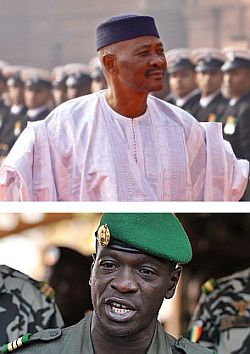
Former President Amadou Toumani Touré (top) and Captain Amadou Sanogo, the leader of the March 2012 coup.

Touré wasn’t a member of any political party, but most of Mali’s established parties joined a coalition in support of his policies. He was able to push sweeping legislation through the National Assembly with little or no debate. In 2009, after the Assembly passed a progressive bill to reform Mali’s 1962 laws governing women’s rights and families by 117 votes to 5, Islamic groups stirred up vociferous opposition, and parliamentarians had to distance themselves from a bill few of them had actually read. The law was never enacted. Touré’s ‘rule by consensus’ became a euphemism for the suppression of political debate and a trend towards absolutism. Checks and balances existed only on paper. Journalists were afraid to challenge the president’s agenda, especially after five of their colleagues were arrested in 2007 for writing about a teacher in Bamako who got his students to comment on a short story about a girl made pregnant thanks to the ‘carnal escapades’ of an African head of state. In Mali’s restive northern regions, ‘rule by consensus’ invited more problems. When a group of Tuareg rebels – seen in the south as gangsters involved in the region’s drug smuggling – rose up in 2006, Touré negotiated a controversial peace accord and withdrew the army from much of the north.

‘A fish rots from the head,’ Malians say. To keep the aid money flowing, Touré maintained a veneer of progress. His government at first boosted the number of children enrolled at school, which pleased donors, but never invested adequately in the country’s dilapidated education system. Only 12 per cent of students passed the high school leaving exams this year, the lowest rate ever recorded. Touré purchased a temporary peace in the north but never made good on promises to reduce the acute poverty there. He accepted millions of dollars of US military aid, which was supposed to be used to drive out al-Qaida in the Islamic Maghreb, but he never actually went after the group’s encampments. The military itself was racked by nepotism, and officers often skimmed off their soldiers’ ammunition and pay.

In 2010, the Global Fund to Fight Aids, Tuberculosis and Malaria suspended aid to Mali after it found that officials had pocketed millions of dollars of its grants. This fraud was noteworthy only because some of its perpetrators were held to account: Touré’s health minister is awaiting trial for embezzlement. The perception that corruption went unchecked at the highest levels of the state cost the president much of his legitimacy at home. At best, Malians felt he had turned a blind eye to the problem; at worst, they accused him and his wife of being directly involved.

As Touré’s second term approached its end, Malians had also lost faith in the rule of law. On the outskirts of Bamako, residents saw their property seized by members of the president’s inner circle, and were powerless to seek redress through the courts. Few Malians felt protected by the police, who were busy extorting bribes from motorists. Judges sold favourable verdicts to the highest bidders. There was the revival of a practice known as Article 320, first seen in the lawless days after Moussa Traoré’s fall: accused thieves were doused with petrol and set alight. (The name comes from the price of a litre of petrol and a box of matches, which in 1991 totalled 320 local francs.) At least seven such vigilante killings were reported in Bamako in the first two months of this year, and it seems likely that many more have taken place since.

The putschists capitalised on the popular disappointment with bogus democracy and weak government, using it to justify their actions. Hours after taking over, [Captain Amadou] Sanogo spoke of his men’s desire for reform: ‘not of the army, of the state’. The junta duly called itself the National Committee for Recovering Democracy and Restoring the State. Sanogo described Mali’s democratic edifice under Touré as a sagging wall that he and his men would knock down and rebuild. The coup had not derailed Mali’s democracy, he claimed, but had been necessary to save it. ‘When at a high level of state responsibility,’ he said in a televised interview in May, ‘you allow yourself to look a citizen in the eyes and lie to him, when you allow yourself to rig elections, to buy elections … is that what you call democracy?’

Whether Sanogo intended to save Mali’s democracy or confiscate it is an open question. But he and his men could never have hoped to overthrow Touré, and win support among Malians, had the country’s core institutions – the police, the courts and the electoral process – been sound. The soldiers who stormed the presidential palace on 21 March knew that Touré no longer had any legitimacy for the Malian people. So did Touré himself: hence his swift and silent departure. He resurfaced weeks later to sign a letter of resignation before the television cameras, then flew into exile in Senegal. [Continue reading…]

Facebooktwittermail

Mali music ban by Islamists ‘crushing culture to impose rule’

Robin Denselow writes: Nowhere does music have a greater social and political importance than in the vast desert state of Mali. It is shocking, therefore, that it has been banned across much of the two-thirds of Mali currently controlled by Islamic rebel groups.

As “Manny” Ansar, the director of the country’s celebrated Festival in the Desert, which has now been forced out of the country, explained: “Music is important as a daily event. It’s not just a business, for it’s through our music that we know history and our own identity. Our elders gave us lessons through music. It’s through music that we declare love and get married – and we criticise and make comments on the people around us.”

Malian musicians have become household names in the west. The list is remarkable, from the late Ali Farka Touré to the soulful Salif Keita, from Toumani Diabaté, the world’s finest exponent of the kora, to the bravely experimental Rokia Traoré. Then there’s the rousing desert blues of Tinariwen, who have performed alongside the Rolling Stones.

There is the passionate social commentary of Oumou Sangaré, and the rousing, commercially successful African pop fusion of Amadou & Mariam.

These musicians, with varied, distinctive styles, have educated western audiences about Africa and their country’s ancient civilisation, and the way in which traditional families of musicians, the griots, had acted as advisers to the rulers and guardians of the country’s history, and kept alive an oral tradition for generation after generation.

And yet the Islamic rebel groups are trying to wipe out this ancient culture – and in the process have forced Malian musicians to examine the role they should now play.

Ansar said he was “ashamed at what has happened has happened – and it was provoked by people who call themselves Muslims, like me”.

When I met him at a censorship conference in Oslo, he said the militias were stopping the music “to impose their authority, so there’s nothing to threaten them”. He added: “That’s why they are attacking the traditional chiefs and musicians. And they’re using concepts of Islam that are 14 centuries old and have never been applied. I find it strange that these ideas are being imposed now. It’s as if they took a computer and wiped the hard drive, and then imposed their ideas instead.”

The situation is particularly painful for musicians from the north of Mali, for bands such as Tinariwen from the nomadic Touareg or Kel Tamashek people, whose international popularity has been helped for the last 12 years by the Festival in the Desert. [Continue reading…]

Facebooktwittermail

Syria: Is it too late?

Frederic C. Hof writes: Syria is dying. Bashar al-Assad has made it clear that the price of his removal is the death of the nation. A growing extremist minority in the armed opposition has made it clear that a Syria of citizenship and civil society is, in its view, an abomination to be killed. And those in the middle long begging for Western security assistance are increasingly bemoaning that it is already too late. Between the cold, cynical sectarianism of Assad and the white-hot sectarian hatred of those extremists among his opponents Syria already is all but gone, a body politic as numbingly cold and colorless as the harsh wintry hell bringing misery and hopelessness to untold numbers of displaced Syrians.

It might in fact be too late to save Syria from the diabolical ministrations of Assad and his enabling Salafist enemies. Indeed, the single-minded, self-centered destructiveness of foes who once cooperated in the killing of Iraqis and who now collaborate in the murder of Syria may be sufficiently powerful to block any effort at national salvation regardless of its source. By facilitating Assad’s poison pill sectarian strategy Iran, Hezbollah, and Russia have facilitated the implantation of al-Qaeda (in the form of the Nusra Front) in Syria. By funneling arms and money to those calling for death to Alawites and the establishment of a Syrian emirate, donors in certain Gulf countries, Turkey, and elsewhere have advanced Assad’s survival strategy with a toxic blend of tactical skill and strategic stupidity. As in “Murder on the Orient Express,” many hands have plunged the knife into a victim perhaps too far gone to be saved.

Yet even if one accepted, analytically, the “it’s too late to save Syria” thesis, and the argument that saving Syria was never something the United States and its allies could do, can this be the basis of prudent policy? If Syria, as now appears likely, becomes a death star of failed statehood, will the effects of its ravaged carcass on the surrounding neighborhood be so benign as to present no challenges to US statecraft far more perilous than those presented by Syria now? Will the great sucking sounds of Lebanon, Jordan, Turkey and perhaps Iraq being pulled into the black hole of what was once Syria become the next normal; chapter two in the “it’s too late” saga? Will Americans at that point look back with regret at our reluctance to try to shape and influence when we may at least have had a chance to do so? [Continue reading…]

Facebooktwittermail

If you think we’re done with neoliberalism, think again

George Monbiot writes: How they must bleed for us. In 2012, the world’s 100 richest people became $241 billion richer. They are now worth $1.9 trillion: just a little less than the entire output of the United Kingdom.

This is not the result of chance. The rise in the fortunes of the super-rich is the direct result of policies. Here are a few: the reduction of tax rates and tax enforcement; governments’ refusal to recoup a decent share of revenues from minerals and land; the privatisation of public assets and the creation of a toll-booth economy; wage liberalisation and the destruction of collective bargaining.

The policies that made the global monarchs so rich are the policies squeezing everyone else. This is not what the theory predicted. Friedrich Hayek, Milton Friedman and their disciples – in a thousand business schools, the IMF, the World Bank, the OECD and just about every modern government – have argued that the less governments tax the rich, defend workers and redistribute wealth, the more prosperous everyone will be. Any attempt to reduce inequality would damage the efficiency of the market, impeding the rising tide that lifts all boats. The apostles have conducted a 30-year global experiment, and the results are now in. Total failure. [Continue reading…]

Facebooktwittermail

Is Washington’s chief drone warrior ready to wind up the CIA’s drone war?

Mark Perry writes: Lost amidst all the fuss over whether Obama nominee Chuck Hagel is – or isn’t – acceptable to the Israeli lobby (or whatever), is the crucial, but strangely low-profile, debate over the president’s nomination of controversial counterterrorism chief John Brennan to head up the CIA.

The 25-year agency veteran, who first tied himself to Obama when the then-Illinois Senator was launching his long-shot campaign for the Oval Office, makes Hagel look positively liberal. This early support for an Illinois back bencher paid off for Brennan, for when Obama took office he immediately turned to the CIA veteran for his expertise on the war on terrorism.

While Brennan’s official title during Obama’s first term was US Deputy National Security Advisor for Homeland Security and Counterterrorism, he was known to critics and supporters alike as “Mr Drone” – the official behind the administration’s more than 350 separate drone strikes in Pakistan, Yemen and Somalia that have killed more than 3400 people, including an estimated 891 civilians.

“No politically appointed official in US history has played such a prominent role in killing so many people outside of a war zone as John Brennan,” Foreign Policy‘s Micah Zenka writes, adding that Brennan is the “most lethal bureaucrat” in Washington.

That may well be, but while Brennan hasn’t exactly been given “a pass” by either Democrats or Republicans (and has been dubbed the administration’s “assassination czar” by American progresssives), his most predictable critics have been less than outspoken in opposing his nomination.

One of the reasons may well be that Brennan believes the CIA should be “demilitarised” (which has gained him the support of the agency’s powerful senior analysts), and its drone war turned over to the Pentagon – which is where it belongs.

Although doing so probably won’t end the programme (should it actually happen), senior military officers are known to be sceptical of its utility, and intelligence veterans support Brennan’s position on transforming the post-Patraeus CIA back into what it was intended to be – an agency that gathers intelligence instead of running push-button wars. [Continue reading…]

Facebooktwittermail

Mr Marlboro: the jihadist back from the ‘dead’ to launch Algerian gas field raid

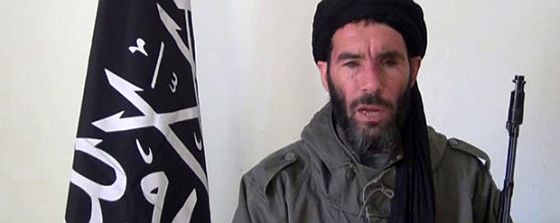
Mokhtar Belmokhtar

Peter Beumont writes: For a man whose death in combat in the Malian city of Gao was announced last June, Mokhtar Belmokhtar – the Islamist militant allegedly behind the raid on the Ansema gas field in Algeria – has been surprisingly busy.

Since that raid – which saw the deaths of several foreign oil workers, including a Briton, and the kidnapping of 41 more – Belmokhtar has been described in journalistic shorthand as “al-Qaida”.

On Thursday, as it was reported that some 25 of those captives had escaped, the real motives behind Belmokhtar’s raid – and his relationships with other Islamist groups in the Sahel – began to emerge as far more complex than first reported.

The standard version of Belmokhtar’s career as an Islamist leader is easy to summarise. The man dubbed the Uncatchable, as well as Mr Marlboro for his involvement in cigarette smuggling, was born in Ghardaia, Algeria, in 1972, starting his jihadist activities early.

By his own account – given in an interview at a time he was trying to shore up his leadership credentials – Belmokhtar, also known as Khalid Abu al-Abbas, travelled aged 19 to Afghanistan, where he claimed he gained training and combat experience before returning to his homeland in 1992.

This launched him into a two-decade career of Islamic militancy, first as a member of Algeria’s Islamic Armed Group (GIA) in the country’s civil war, then as a joint founder of the Salafist Group for Preaching and Combat (GSPC), which started extending its attacks against security forces into countries of the arid Sahel, which forms the southern fringe of the Sahara.

That group evolved into al-Qaida in the Islamic Maghreb (AQIM), a group as much interested in the financial benefits of kidnapping and smuggling as building an Islamic caliphate.

Despite the claims that Belmokhtar’s latest actions were carried out on behalf of AQIM in response to the French military action in Mali, his real agenda is likely to be more complicated and opaque. [Continue reading…]

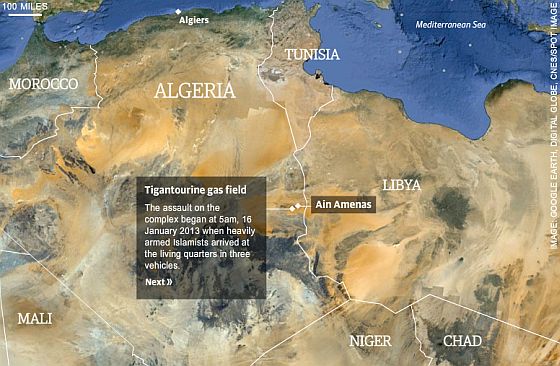
Click on the image below to view an interactive map of the Ain Amenas gas field attack:

Facebooktwittermail