Medical Xpress: A team of French researchers has discovered that the human brain is capable of distinguishing between different types of syllables as early as three months prior to full term birth. As they describe in their paper published in the Proceedings of the National Academy of Sciences, the team found via brain scans that babies born up to three months premature are capable of some language processing. Many studies have been conducted on full term babies to try to understand the degree of mental capabilities at birth. Results from such studies have shown that babies are able to distinguish their mother’s voice from others, for example, and can even recognize the elements of short stories. Still puzzling however, is whether some of what newborns are able to demonstrate is innate, or learned immediately after birth. To learn more, the researchers enlisted the assistance of several parents of premature babies and their offspring. Babies born as early as 28 weeks (full term is 37 weeks) had their brains scanned using bedside functional optical imaging, while sounds (soft voices) were played for them. Three months prior to full term, the team notes, neurons in the brain are still migrating to what will be their final destination locations and initial connections between the upper brain regions are still forming—also neural linkages between the ears and brain are still being created. All of this indicates a brain that is still very much in flux and in the process of becoming the phenomenally complicated mass that humans are known for, which would seem to suggest that very limited if any communication skills would have developed.
The researchers found, however, that even at a time when the brain hasn’t fully developed, the premature infants were able to tell the difference between female versus male voices, and to distinguish between the syllables “ba” and “ga”. They noted also that the same parts of the brain were used by the infants to process sounds as adults. This, the researchers conclude, shows that linguistic connections in the brain develop before birth and because of that do not need to be acquired afterwards, suggesting that at least some abilities are innate.
Author Archives: Attention to the Unseen
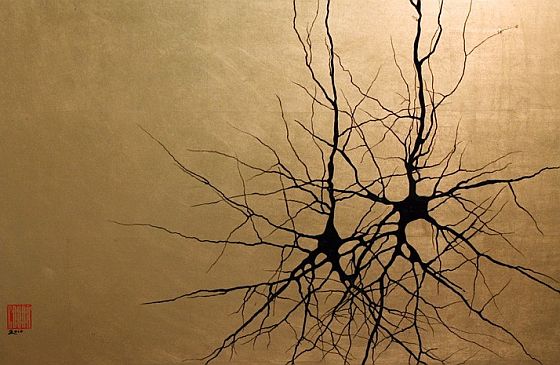
The beauty of neurons
Wired: When Greg Dunn finished his Ph.D. in neuroscience at Penn in 2011, he bought himself a sensory deprivation tank as a graduation present. The gift marked a major life transition, from the world of science to a life of meditation and art.
Now a full-time artist living in Philadelphia, Dunn says he was inspired in his grad-student days by the spare beauty of neurons treated with certain stains. The Golgi stain, for example, will turn one or two neurons black against a golden background. “It has this Zen quality to it that really appealed to me,” Dunn said.
What he saw under the microscope reminded him of the uncluttered elegance of bamboo scroll paintings and other forms of Asian art, and he began to paint neurons in a similar style.
See more of these paintings at Greg Dunn Design.
Music: Dhafer Youssef — ‘Diaphanes’
Music: Dhafer Youssef — ‘Aya 1984’
The language of Jesus, close to vanishing

The Christian village of Maaloula, in the hills outside Damascus, Syria, the last remaining community where Aramaic is maintained as an everyday language.
Aramaic, once the common language of the entire Middle East, is one or two generations away from extinction. Ariel Sabar writes: It was a sunny morning in May, and I was in a car with a linguist and a tax preparer trolling the suburbs of Chicago for native speakers of Aramaic, the 3,000-year-old language of Jesus.
The linguist, Geoffrey Khan of the University of Cambridge, was nominally in town to give a speech at Northwestern University, in Evanston. But he had another agenda: Chicago’s northern suburbs are home to tens of thousands of Assyrians, Aramaic-speaking Christians driven from their Middle Eastern homelands by persecution and war. The Windy City is a heady place for one of the world’s foremost scholars of modern Aramaic, a man bent on documenting all of its dialects before the language — once the tongue of empires — follows its last speakers to the grave.
The tax preparer, Elias Bet-shmuel, a thickset man with a shiny pate, was a local Assyrian who had offered to be our sherpa. When he burst into the lobby of Khan’s hotel that morning, he announced the stops on our two-day trek in the confidential tone of a smuggler inventorying the contents of a shipment.
“I got Shaqlanaye, I have Bebednaye.” He was listing immigrant families by the names of the northern Iraqi villages whose dialects they spoke. Several of the families, it turned out, were Bet-shmuel’s clients.
As Bet-shmuel threaded his Infiniti sedan toward the nearby town of Niles, Illinois, Khan, a rangy 55-year-old, said he was on safari for speakers of “pure” dialects: Aramaic as preserved in villages, before speakers left for big, polyglot cities or, worse, new countries. This usually meant elderly folk who had lived the better part of their lives in mountain enclaves in Iraq, Syria, Iran or Turkey. “The less education the better,” Khan said. “When people come together in towns, even in Chicago, the dialects get mixed. When people get married, the husband’s and wife’s dialects converge.”
We turned onto a grid of neighborhood streets, and Bet-shmuel announced the day’s first stop: a 70-year-old widow from Bebede who had come to Chicago just a decade earlier. “She is a housewife with an elementary education. No English.”
Khan beamed. “I fall in love with these old ladies,” he said.
Aramaic, a Semitic language related to Hebrew and Arabic, was the common tongue of the entire Middle East when the Middle East was the crossroads of the world. People used it for commerce and government across territory stretching from Egypt and the Holy Land to India and China. Parts of the Bible and the Jewish Talmud were written in it; the original “writing on the wall,” presaging the fall of the Babylonians, was composed in it. As Jesus died on the cross, he cried in Aramaic, “Elahi, Elahi, lema shabaqtani?” (“My God, my God, why have you forsaken me?”)
But Aramaic is down now to its last generation or two of speakers, most of them scattered over the past century from homelands where their language once flourished. In their new lands, few children and even fewer grandchildren learn it. (My father, a Jew born in Kurdish Iraq, is a native speaker and scholar of Aramaic; I grew up in Los Angeles and know just a few words.) This generational rupture marks a language’s last days. For field linguists like Khan, recording native speakers — “informants,” in the lingo — is both an act of cultural preservation and an investigation into how ancient languages shift and splinter over time.
In a highly connected global age, languages are in die-off. Fifty to 90 percent of the roughly 7,000 languages spoken today are expected to go silent by century’s end. We live under an oligarchy of English and Mandarin and Spanish, in which 94 percent of the world’s population speaks 6 percent of its languages. Yet among threatened languages, Aramaic stands out. Arguably no other still-spoken language has fallen farther. [Continue reading…]
Music: Dhafer Youssef — ‘Sura’
Self-knowledge is required for human survival
E.O. Wilson writes: Evolutionary biologists have searched for the grandmaster of advanced social evolution, the combination of forces and environmental circumstances that bestowed greater longevity and more successful reproduction on the possession of high social intelligence. At present there are two competing theories of the principal force. The first is kin selection: individuals favor collateral kin (relatives other than offspring) making it easier for altruism to evolve among members of the same group. Altruism in turn engenders complex social organization, and, in the one case that involves big mammals, human-level intelligence.
The second, more recently argued theory (full disclosure: I am one of the modern version’s authors), the grandmaster is multilevel selection. This formulation recognizes two levels at which natural selection operates: individual selection based on competition and cooperation among members of the same group, and group selection, which arises from competition and cooperation between groups. Multilevel selection is gaining in favor among evolutionary biologists because of a recent mathematical proof that kin selection can arise only under special conditions that demonstrably do not exist, and the better fit of multilevel selection to all of the two dozen known animal cases of eusocial evolution.
The roles of both individual and group selection are indelibly stamped (to borrow a phrase from Charles Darwin) upon our social behavior. As expected, we are intensely interested in the minutiae of behavior of those around us. Gossip is a prevailing subject of conversation, everywhere from hunter-gatherer campsites to royal courts. The mind is a kaleidoscopically shifting map of others, each of whom is drawn emotionally in shades of trust, love, hatred, suspicion, admiration, envy and sociability. We are compulsively driven to create and belong to groups, variously nested, overlapping or separate, and large or small. Almost all groups compete with those of similar kind in some manner or other. We tend to think of our own as superior, and we find our identity within them.
The existence of competition and conflict, the latter often violent, has been a hallmark of societies as far back as archaeological evidence is able to offer. These and other traits we call human nature are so deeply resident in our emotions and habits of thought as to seem just part of some greater nature, like the air we all breathe, and the molecular machinery that drives all of life. But they are not. Instead, they are among the idiosyncratic hereditary traits that define our species.
The major features of the biological origins of our species are coming into focus, and with this clarification the potential of a more fruitful contact between science and the humanities. The convergence between these two great branches of learning will matter hugely when enough people have thought it through. On the science side, genetics, the brain sciences, evolutionary biology, and paleontology will be seen in a different light. Students will be taught prehistory as well as conventional history, the whole presented as the living world’s greatest epic.
We will also, I believe, take a more serious look at our place in nature. Exalted we are indeed, risen to be the mind of the biosphere without a doubt, our spirits capable of awe and ever more breathtaking leaps of imagination. But we are still part of earth’s fauna and flora. We are bound to it by emotion, physiology, and not least, deep history. It is dangerous to think of this planet as a way station to a better world, or continue to convert it into a literal, human-engineered spaceship. Contrary to general opinion, demons and gods do not vie for our allegiance. We are self-made, independent, alone and fragile. Self-understanding is what counts for long-term survival, both for individuals and for the species.
Music: Habib Koité — Kanawa
Music: Debashish Bhattacharya & Bob Brozman — ‘Bana Mali’
Music: Toumani Diabaté — ‘Cantelowes’
Painting the way to the Moon
Wild River Review: Ed Belbruno doesn’t sit still easily. On a sunny, winter afternoon, he perches at the edge of his sofa talking about his latest book, Fly Me to the Moon (Princeton University Press), and about chaos. Specifically chaos theory. In his book, Belbruno tells the story of how he used chaos theory to get the world’s first spaceship (a Japanese spaceship named Hiten, which means “A Buddhist Angel that Dances in Heaven”) to the moon without using fuel. To illustrate a point, his hands move through the air, creating a sunlit swirl of fine dust particles.
Belbruno’s own paintings adorn the walls of his living room, one of which gave him the solution for Hiten. In the corner, tubes of oil paint lie on a drafting table next to an easel exhibiting his latest work, gorgeous splashes of color representing microwaves.
“Chaos is a way to describe the motion of an object where the motion appears to be very unpredictable,” he says. “Some things are not chaotic and some things are.”
“For example,” he continues. “If you look at a leaf falling to the ground on a windy day, it doesn’t fall like a piece of lead rocketing to the ground. It floats. And if the wind catches that leaf, it will dart around from place to place, and the resulting path is not something you know ahead of time. So from moment to moment, you cannot say where the leaf will go. Therefore, chaos has a sense of unpredictability to it. You could say, ’Well does it mean that I can’t really know where something is going?’ In a sense you can’t, because you have to know every little detail of the atmosphere of the earth, about how the wind varies from point to point, and we don’t. The same holds true for space and the orbit of the planets.”
Belbruno knows that out of seeming chaos, a path can be found between two points. [Continue reading…]
Music: Bugge Wesseltoft — ‘Dreaming’
Music: Maria Kalaniemi — ‘Tähdet Taivahalla’
Music: Toumani Diabaté — ‘Elyne Road’
Music: Maria Kalaniemi — ‘Namas’
Love of musical harmony is not nature but nurture
University of Melbourne: Our love of music and appreciation of musical harmony is learnt and not based on natural ability – a new study by University of Melbourne researchers has found.
Associate Professor Neil McLachlan from the Melbourne School of Psychological Sciences said previous theories about how we appreciate music were based on the physical properties of sound, the ear itself and an innate ability to hear harmony.
“Our study shows that musical harmony can be learnt and it is a matter of training the brain to hear the sounds,” Associate Professor McLachlan said.
“So if you thought that the music of some exotic culture (or Jazz) sounded like the wailing of cats, it’s simply because you haven’t learnt to listen by their rules.”
The researchers used 66 volunteers with a range of musical training and tested their ability to hear combinations of notes to determine if they found the combinations familiar or pleasing.
“What we found was that people needed to be familiar with sounds created by combinations of notes before they could hear the individual notes. If they couldn’t find the notes they found the sound dissonant or unpleasant,” he said.
“This finding overturns centuries of theories that physical properties of the ear determine what we find appealing.”
Coauthor on the study Associate Professor Sarah Wilson also from the Melbourne School of Psychological Sciences said the study found that trained musicians were much more sensitive to dissonance than non-musicians.
“When they couldn’t find the note, the musicians reported that the sounds were unpleasant, whereas non-musicians were much less sensitive,” Assoc. Prof Wilson said.
“This highlights the importance of training the brain to like particular variations of combinations of sounds like those found in jazz or rock.”
Depending on their training, a strange chord or a gong sound was accurately pitched and pleasant to some musicians, but impossible to pitch and very unpleasant to others.