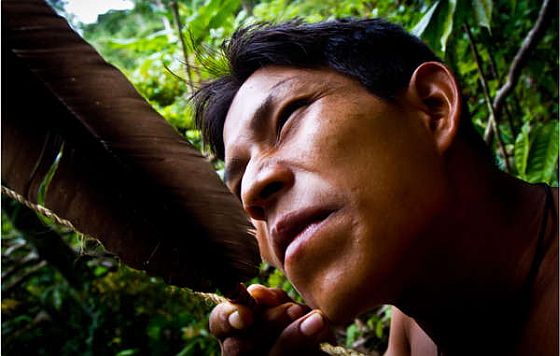
Survival International: Amazon Indians from Peru and Brazil have joined together to stop a Canadian oil company destroying their land and threatening the lives of uncontacted tribes.
Hundreds of Matsés Indians gathered on the border of Peru and Brazil last Saturday and called on their governments to stop the exploration, warning that the work will devastate their forest home.
The oil giant Pacific Rubiales is headquartered in Canada and has already started oil exploration in ‘Block 135’ in Peru, which lies directly over an area proposed as an uncontacted tribes reserve.
In a rare interview with Survival, a Matsés woman said, ‘Oil will destroy the place where our rivers are born. What will happen to the fish? What will the animals drink?’
The Matsés number around 2,200 and live along the Peru-Brazil border. Together with the closely-related Matis tribe, they were known as the ‘Jaguar people’ for their facial decorations and tattoos, which resembled the jaguar’s whiskers and teeth.
The Matsés were first contacted in the 1960s, and have since suffered from diseases introduced by outsiders. Uncontacted tribes are also at extreme risk from contact with outsiders through the introduction of diseases to which they have little or no immunity. [Continue reading…]

William Blake, Elmira Correctional Facility, New York State: “You deserve an eternity in hell,” Onondaga County Supreme Court judge Kevin Mulroy told me from his bench as I stood before him for sentencing on July 10, 1987. Apparently he had the idea that God was not the only one justified to make such judgment calls.
Judge Mulroy wanted to “pump six buck’s worth of electricity into [my] body,” he also said, though I suggest that it wouldn’t have taken six cent’s worth to get me good and dead. He must have wanted to reduce me and The Chair to a pile of ashes. My “friend” Governor Mario Cuomo wouldn’t allow him to do that, though, the judge went on, bemoaning New York State’s lack of a death statute due to the then-Governor’s repeated vetoes of death penalty bills that had been approved by the state legislature. Governor Cuomo’s publicly expressed dudgeon over being called a friend of mine by Judge Mulroy was understandable, given the crimes that I had just been convicted of committing. I didn’t care much for him either, truth be told. He built too many new prisons in my opinion, and cut academic and vocational programs in the prisons already standing.William Blake
I know that Judge Mulroy was not nearly alone in wanting to see me executed for the crime I committed when I shot two Onondaga County sheriff’s deputies inside the Town of Dewitt courtroom during a failed escape attempt, killing one and critically wounding the other. There were many people in the Syracuse area who shared his sentiments, to be sure. I read the hateful letters to the editor printed in the local newspapers; I could even feel the anger of the people when I’d go to court, so palpable was it. Even by the standards of my own belief system, such as it was back then, I deserved to die for what I had done. I took the life of a man without just cause, committing an act so monumentally wrong that I could not have argued that it was unfair had I been required to pay with my own life.
What nobody knew or suspected back then, not even I, on that very day I would begin suffering a punishment that I am convinced beyond all doubt is far worse than any death sentence could possibly have been. On July 10, 2012, I finished my 25th consecutive year in solitary confinement, where at the time of this writing I remain. Though it is true that I’ve never died and so don’t know exactly what the experience would entail, for the life of me I cannot fathom how dying any death could be harder or more terrible than living through all that I have been forced to endure for the last quarter-century. [Continue reading…]

The Economic and Social Research Council: Researchers in the UK have taken an important step towards understanding how the human brain ‘decodes’ letters on a page to read a word. The work, funded by the Economic and Social Research Council (ESRC), will help psychologists unravel the subtle thinking mechanisms involved in reading, and could provide solutions for helping people who find it difficult to read, for example in conditions such as dyslexia.
In order to read successfully, readers need not only to identify the letters in words, but also to accurately code the positions of those letters, so that they can distinguish words like CAT and ACT. At the same time, however, it’s clear that raeders can dael wtih wodrs in wihch not all teh leettrs aer in thier corerct psotiions.
“How the brain can make sense of some jumbled sequences of letters but not others is a key question that psychologists need to answer to understand the code that the brain uses when reading,” says Professor Colin Davis of Royal Holloway, University of London, who led the research.
For many years researchers have used a standard psychological test to try to work out which sequences of letters in a word are important cues that the brain uses, where jumbled words are flashed momentarily on a screen to see if they help the brain to recognise the properly spelt word.
But, this technique had limitations that made it impossible to probe more extreme rearrangements of sequences of letters. Professor Davis’s team used computer simulations to work out that a simple modification to the test would allow it to question these more complex changes to words. This increases the test’s sensitivity significantly and makes it far more valuable for comparing different coding theories.
“For example, if we take the word VACATION and change it to AVACITNO, previously the test would not tell us if the brain recognises it as VACATION because other words such as AVOCADO or AVIATION might start popping into the person’s head,” says Professor Davis. “With our modification we can show that indeed the brain does relate AVACITNO to VACATION, and this starts to give us much more of an insight into the nature of the code that the brain is using – something that was not possible with the existing test.”
The modified test should allow researchers not only to crack the code that the brain uses to make sense of strings of letters, but also to examine differences between individuals – how a ‘good’ reader decodes letter sequences compared with someone who finds reading difficult.
“These kinds of methods can be very sensitive to individual differences in reading ability and we are starting to get a better idea of some of the issues that underpin people’s difficulty in reading,” says Professor Davis. Ultimately, this could lead to new approaches to helping people to overcome reading problems.
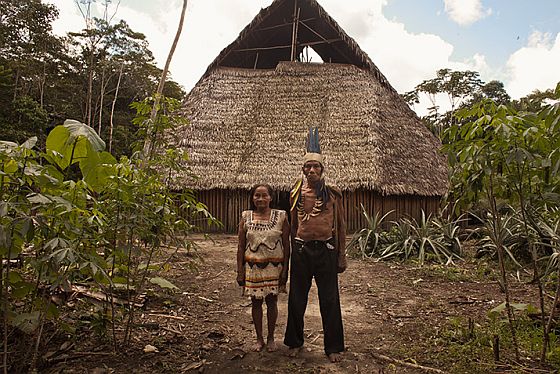
Jitoma Safiama, 70 -- seen here with his wife Rosita Garcia, a Muynane, in front of their maloca -- is a shaman and chief of a small subtribe of Uitotos, descendants of those who were chased by the rubber barons from their original lands around 1925.
Joshua Hammer writes: On a cloudless afternoon in the foothills of the Andes, Eliana Martínez took off for the Amazon jungle in a single-engine Cessna 172K from an airstrip near Colombia’s capital, Bogotá. Squeezed with her in the tiny four-seat compartment were Roberto Franco, a Colombian expert on Amazon Indians; Cristóbal von Rothkirch, a Colombian photographer; and a veteran pilot. Martínez and Franco carried a large topographical map of Río Puré National Park, 2.47 million acres of dense jungle intersected by muddy rivers and creeks and inhabited by jaguars and wild peccaries — and, they believed, several isolated groups of Indians. “We didn’t have a lot of expectation that we’d find anything,” Martínez, 44, told me, as thunder rumbled from the jungle. A deluge began to pound the tin roof of the headquarters of Amacayacu National Park, beside the Amazon River, where she now serves as administrator. “It was like searching for the needle in the haystack.”
Martínez and Franco had embarked that day on a rescue mission. For decades, adventurers and hunters had provided tantalizing reports that an “uncontacted tribe” was hidden in the rainforest between the Caquetá and Putumayo rivers in the heart of Colombia’s Amazon. Colombia had set up Río Puré National Park in 2002 partly as a means of safeguarding these Indians, but because their exact whereabouts were unknown, the protection that the government could offer was strictly theoretical. Gold miners, loggers, settlers, narcotics traffickers and Marxist guerrillas had been invading the territory with impunity, putting anyone dwelling in the jungle at risk. Now, after two years’ preparation, Martínez and Franco were venturing into the skies to confirm the tribe’s existence — and pinpoint its exact location. “You can’t protect their territory if you don’t know where they are,” said Martínez, an intense woman with fine lines around her eyes and long black hair pulled into a ponytail.
Descending from the Andes, the team reached the park’s western perimeter after four hours and flew low over primary rainforest. They ticked off a series of GPS points marking likely Indian habitation zones. Most of them were located at the headwaters for tributaries of the Caquetá and the Putumayo, flowing to the north and south, respectively, of the park. “It was just green, green, green. You didn’t see any clearing,” she recalled. They had covered 13 points without success, when, near a creek called the Río Bernardo, Franco shouted a single word: “Maloca!”
Martínez leaned over Franco.
“Donde? Donde?” — Where? Where? she yelled excitedly.
Directly below, Franco pointed out a traditional longhouse, constructed of palm leaves and open at one end, standing in a clearing deep in the jungle. Surrounding the house were plots of plantains and peach palms, a thin-trunked tree that produces a nutritious fruit. The vast wilderness seemed to press in on this island of human habitation, emphasizing its solitude. The pilot dipped the Cessna to just several hundred feet above the maloca in the hope of spotting its occupants. But nobody was visible. “We made two circles around, and then took off so as not to disturb them,” says Martínez. “We came back to earth very content.”
Back in Bogotá, the team employed advanced digital technology to enhance photos of the maloca. It was then that they got incontrovertible evidence of what they had been looking for. Standing near the maloca, looking up at the plane, was an Indian woman wearing a breechcloth, her face and upper body smeared with paint.
Franco and Martínez believe that the maloca they spotted, along with four more they discovered the next day, belong to two indigenous groups, the Yuri and the Passé — perhaps the last isolated tribes in the Colombian Amazon. Often described, misleadingly, as “uncontacted Indians,” these groups, in fact, retreated from major rivers and ventured deeper into the jungle at the height of the South American rubber boom a century ago. They were on the run from massacres, enslavement and infections against which their bodies had no defenses. For the past century, they have lived with an awareness — and fear — of the outside world, anthropologists say, and have made the choice to avoid contact. Vestiges of the Stone Age in the 21st century, these people serve as a living reminder of the resilience — and fragility — of ancient cultures in the face of a developmental onslaught. [Continue reading…]

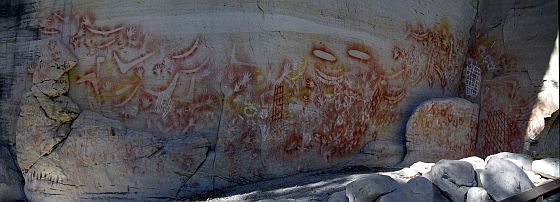
Global Mail reports: Tucked away in the sandstone ridges of the rugged tropics near Australia’s north-eastern tip, the ochre “bullymen” with their big penises and staring eyes still cling to the rock.
These are secret paintings, made by Aboriginal men who were driven from their lowlands by colonials hungry for gold, and who were then harassed in the hills by the Native Mounted Police, both black troopers and their white officers.
The locals painted the police, or “bullymen”, onto the rock, in the belief that these works would conquer the enemy through sorcery, as Tommy George, a descendant of the “black trackers” now in his 80s (and the last surviving speaker of Agu Alaya, or Taipan Snake language) has explained to archaeologist Noelene Cole.
The Aboriginal fugitives believed that the paintings were a weapon that gave them power over the armed lawmen, George explained.
“It was so deeply embedded in culture that they could use the rock paintings to kill people – that’s how powerful the art was.
“The paintings were there to kill the police.
“It shows the power of that visual culture. They thought it was as strong as guns,” Cole said.
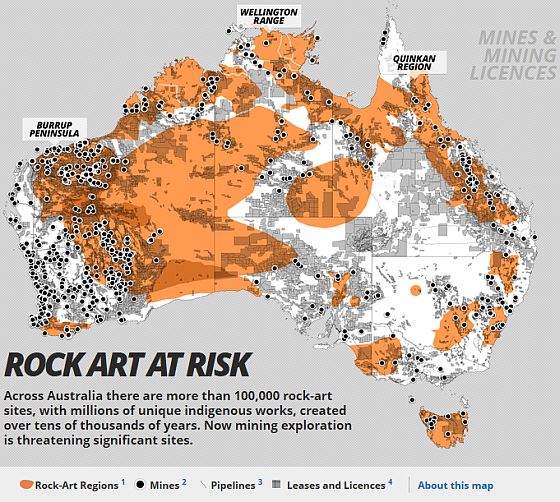
But now these poignant paintings, along with hundreds of other Aboriginal works in this remote Queensland gallery, which United Nations Educational, Scientific and Cultural Organisation (UNESCO) has recognised as one of the great rock-art precincts of the globe, are under a new threat from another power source: mining.
Prospectors have targeted the land beneath and around the art because it is rich in exploitable resources. These paintings are emblematic of the perils befalling rock art throughout Australia, where the resources sector has been booming for more than a decade, fuelled by China’s insatiable energy needs.
This is a recurring Australian story, as mining, industry and urbanisation surge across a landscape which harbours millions of images at more than 100,000 rock-art sites. State and territory heritage laws have proved weak in protecting the works, under governments keen to cash in on the mining bonanza. [Continue reading…]

Jalees Rehman writes: When we observe an interaction between two other human beings (Person A and Person B), we sometimes draw conclusions about the personality traits or character of these two individuals. For example, if we see that Person A is being rude to Person B, we may be less likely to trust Person A, even though we are merely “third-party” evaluators. i.e. not directly involved in the interaction. Multiple studies with humans have already documented such third-party social evaluation, which can even occur among children. A study published in 2010 showed that 3-year old children were less likely to help adults who had previously acted in a harmful manner in front of the kids, i.e. torn up a picture drawn by another adult in a staged experiment.
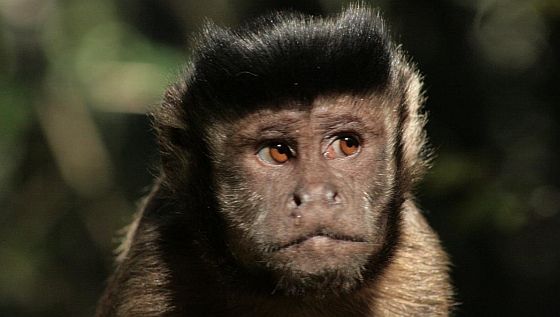
Do animals who observe humans also conduct such third-party social evaluations of humans? The recent study “Third-party social evaluation of humans by monkeys” published in Nature Communications by James Anderson and colleagues staged interactions with human actors in front of tufted capuchin monkeys (Cebus apella). The researchers found that the monkeys indeed evaluate humans after witnessing third-party interactions involving either helpful interventions or a failure to help fellow humans.
In front of each monkey, two actors performed either “helper” sessions or “non-helper” sessions. In the “helper” sessions, Actor A tried to get a toy out of a container and requested help from Actor B, who complied and helped out Actor A. In the “non-helper” sessions, Actor B refused to help. After the sessions, both actors offered a piece of food to the monkey. In the helper sessions, monkeys readily accepted food from both actors. On the other hand, monkeys in the non-helper sessions accepted food more frequently from actor A (the requester of help) than Actor B (the non-helper). [Continue reading…]

Evgeny Morozov: “When your heart stops beating, you’ll keep tweeting” is the reassuring slogan greeting visitors at the Web site for LivesOn, a soon-to-launch service that promises to tweet on your behalf even after you die. By analyzing your earlier tweets, the service would learn “about your likes, tastes, syntax” and add a personal touch to all those automatically composed scribblings from the world beyond.
LivesOn may yet prove to be a parody, or it may fizzle for any number of reasons, but as an idea it highlights the dominant ideology of Silicon Valley today: what could be disrupted should be disrupted — even death.
Barriers and constraints — anything that imposes artificial limits on the human condition — are being destroyed with particular gusto. Superhuman, another mysterious start-up that could enliven any comedy show, promises to offer, as its co-founder recently put it, an unspecified service that “helps people be superhuman.” Well, at least they had the decency not to call it The Übermensch.
Recent debates about Twitter revolutions or the Internet’s impact on cognition have mostly glossed over the fact that Silicon Valley’s technophilic gurus and futurists have embarked on a quest to develop the ultimate patch to the nasty bugs of humanity. If they have their way, no individual foibles would go unpunished — ideally, technology would even make such foibles obsolete.
Even boredom seems to be in its last throes: designers in Japan have found a way to make our train trips perpetually fun-filled. With the help of an iPhone, a projector, a GPS module and Microsoft’s Kinect motion sensor, their contrivance allows riders to add new objects to what they see “outside,” thus enlivening the bleak landscape in their train windows. This could be a big hit in North Korea — and not just on trains.
Or, if you tend to forget things, Silicon Valley wants to give you an app to remember everything. If you occasionally prevaricate in order to meet your clashing obligations as a parent, friend or colleague, another app might spot inconsistencies in your behavior and inform your interlocutors if you are telling the truth. If you experience discomfort because you encounter people and things that you do not like, another app or gadget might spare you the pain by rendering them invisible.
Sunny, smooth, clean: with Silicon Valley at the helm, our life will become one long California highway. [Continue reading…]
University of Chicago: As a bird sings, some neurons in its brain prepare to make the next sounds while others are synchronized with the current notes—a coordination of physical actions and brain activity that is needed to produce complex movements, new research at the University of Chicago shows.
In an article in the current issue of Nature, neuroscientist Daniel Margoliash and colleagues show, for the first time, how the brain is organized to govern skilled performance—a finding that may lead to new ways of understanding human speech production.
The new study shows that birds’ physical movements actually are made up of a multitude of smaller actions. “It is amazing that such small units of movements are encoded, and so precisely, at the level of the forebrain,” said Margoliash, a professor of organismal biology and anatomy and psychology at UChicago.
“This work provides new insight into how the physics of controlling vocal signals are represented in the brain to control vocalizations,” said Howard Nusbaum, a professor of psychology at UChicago and an expert on speech.
By decoding the neural representation of communication, Nusbaum explained, the research may shed light on speech problems such as stuttering or aphasia (a disorder following a stroke). And it offers an unusual window into how the brain and body carry out other kinds of complex movement, from throwing a ball to doing a backflip.
“A big question in muscle control is how the motor system organizes the dynamics of movement,” said Margoliash. Movements like reaching or grasping are difficult to study because they entail many variables, such as the angles of the shoulder, elbow, wrist and fingers; the forces of many muscles; and how these change over time,” he said.