Category Archives: Analysis

Kenya’s security forces say they’re targeting terrorists, but it’s young people who keep dying

Nanjala Nyabola writes: One day in 2014, university students Felix Nyangena and Dennis Magomere, 21 and 22 years old respectively, were walking from the Globe Cinema roundabout in Nairobi’s central business district to the nearby offices of the Higher Education Loans Board, a government agency that oversees financial disbursements to students. The Globe Cinema roundabout is one of the Kenyan capital’s busiest bus terminals, and during the day it can be among the most densely populated parts of the city. There, in the gentle light of the still-rising sun, Nyangena and Magomere were gunned down by two plainclothes police officers attached to the city’s anti-mugging unit. Nyangena did not die immediately. So the officer stood over his body and fired twice more, killing the young man in broad daylight. The officer then calmly wiped his fingerprints off the gun, planted it on the young man’s body, and made a call — presumably to report a robbery.

We know all of this because unlike many other extrajudicial killings by police and security officials in Kenya, Nyangena and Magomere’s murder was captured on video. The crisp, high-quality footage of the crime, taken on a witness’s mobile phone, is the centerpiece of a recent documentary by noted Kenyan journalist Mohammed Ali on the epidemic of extrajudicial killings and forced disappearances by security services. And perhaps as a result of both the video and the documentary, Kenya’s public prosecutor has announced that for the first time in recent memory, his office will charge a police officer for the unlawful killing of a civilian.

Unfortunately, the only unusual thing about this horrific story is the judicial outcome. Through a conspiracy of public apathy and sinister cover-ups, Kenyan security forces have essentially acquired carte blanche to kill and disappear citizens, particularly young ones, on the pretext of fighting crime and terrorism. The scourge of killings and disappearances has accelerated in recent years as the Somali militant group al-Shabab has trained its sights on Kenya, but abuse and impunity long have been the calling cards of the Kenyan security services. And while the discriminatory religious contours of the “War on Terror” would suggest that the problem is confined to northeastern and coastal Kenya, regions that are predominantly Muslim and have a high proportion of ethnic Somalis, the truth is that Kenyan authorities routinely commit violent crimes against young people all over the country. [Continue reading…]

Facebooktwittermail

How the world has changed since Paris climate pact

Earth

Climate Central reports: The relatively good news overall is new data showing that annual rates of emissions of the world’s main greenhouse gas may be stabilizing, though not yet falling. One of the goals of the Paris Agreement is to pursue “rapid reductions” to yearly pollution output following a plateau.

Preliminary International Energy Agency figures published Wednesday showed 35 billion tons of carbon dioxide pollution was released in 2015 — about the same amount that was released in 2014, which was similar to the amount from 2013.

“In the more than 40 years in which the IEA has been providing information on CO2 emissions, there have been only four periods in which emissions stood still or fell compared to the previous year,” the agency said. “Three of those – the early 1980s, 1992 and 2009 – were associated with global economic weakness. But the recent stall in emissions comes amid economic expansion.”

The bad news since December has been record-smashing global temperatures. Not only was 2015 the hottest on record, boosted by greenhouse gas pollution and warm phases in ocean cycles, but the first month of 2016 was the warmest January on record. A month after that, February was the most unusually warm month in 135 years of NASA records. [Continue reading…]

Facebooktwittermail

Computer’s Go victory reminds us that we need to question our reliance on AI

By Nello Cristianini, University of Bristol

The victory of a computer over one of the world’s strongest players of the game Go has been hailed by many as a landmark event in artificial intelligence. But why? After all, computers have beaten us at games before, most notably in 1997 when the computer Deep Blue triumphed over chess grandmaster Gary Kasparov.

We can get a hint of why the Go victory is important, however, by looking at the difference between the companies behind these game-playing computers. Deep Blue was the product of IBM, which was back then largely a hardware company. But the software – AlphaGo – that beat Go player Lee Sedol was created by DeepMind, a branch of Google based in the UK specialising in machine learning.

AlphaGo’s success wasn’t because of so-called “Moore’s law”, which states that computer processor speed doubles roughly every two years. Computers haven’t yet become powerful enough to calculate all the possible moves in Go – which is much harder to do than in chess. Instead, DeepMind’s work was based on carefully deploying new machine-learning methods and integrating them within more standard game-playing algorithms. Using vast amounts of data, AlphaGo has learnt how to focus its resources where they are most needed, and how to do a better job with those resources.

Continue reading

Facebooktwittermail

Russian airstrikes in Syria killed 2,000 civilians in six months

msf-hospital

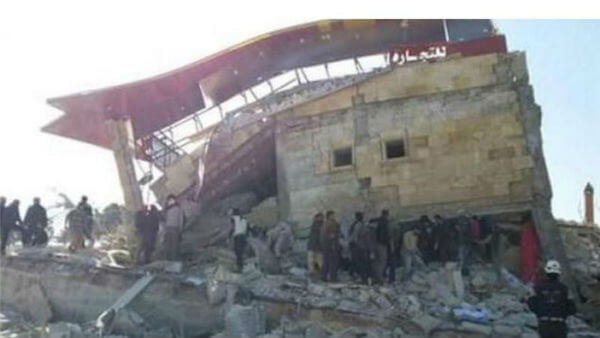
The Guardian reports: Russian airstrikes in Syria have killed about 2,000 civilians in six months of attacks on markets, hospitals, schools and homes, rights groups and observers say, warning that plans for a military drawdown may not mean an end to the deaths.

Moscow has insisted it carried out only surgical strikes on “terrorists”, but victims and fighters say bombers strayed well behind frontlines in areas far from strongholds of Islamic State or al-Qaida fighters.

Jets appear to have intentionally bombed civilian areas, in a campaign to spread fear and clear areas where government ground troops were planning to advance. Coalition airstrikes led by the US have also killed civilians, but have stricter rules of engagement. [Continue reading…]

Facebooktwittermail

Interpreting the Russian withdrawal from Syria

Aron Lund writes: The Russian intervention has achieved quite a lot. It has undercut the Syrian opposition, stabilized Assad’s government, and produced a peace process on more favorable terms for Assad than was previously possible. Perhaps Putin was always planning for an intervention of limited duration and kept Assad informed about this. With a truce in place, now is a good time to start scaling it down.

Meanwhile, other forms of support to the Syrian government are likely to continue and, if the peace process collapses, Putin could easily reverse his decision. Remember, the Hmeymim and Tartus bases will remain operational, which leaves Russia with all the infrastructure it needs to resume airstrikes on short notice.

Putin may be bluffing. The Russian government is not above a bit of wartime subterfuge and Putin saying something is not the same as Moscow actually doing it. The Kremlin has very consistently lied about its troop presence in eastern Ukraine and about what insurgent factions are being targeted in Syria. It is possible that the Russian president is simply telling his enemies what they want to hear, in order to mollify critics in the White House and gain time, without any intention of stopping the attacks.

The announcement on Monday was vaguely phrased. At no point did Putin say that he would end military operations in Syria. Parse his words and you will notice that he only commits to “begin withdrawing the main part of our military group,” while leaving some troops to guard the Russian bases, monitor the ceasefire, and engage in “creating conditions for the peace process.”

Putin may be banking on the failure of the peace talks. He knows he will be able to find plenty of excuses to delay, alter, or reverse his decision later. Even if a significant number of aircraft and pilots were to be pulled back to Russia, they can return to Hmeymim in a matter of days. [Continue reading…]

Facebooktwittermail

Russia’s exit from Syria highlights Assad’s limitations

Hassan Hassan writes: Five years after the uprising in Syria began, a renewed chance to steer the conflict in a less violent trajectory presents itself. Tensions have mounted between moderate rebels and Jabhat al-Nusra in northern Syria, and residents demonstrated in support of the rebels against the al-Qaeda affiliate; the Free Syrian Army has recently launched an offensive against the Islamic State in southern Syria; and Russia has announced that it will start withdrawing its main forces from the country. In the wake of positive sentiments following a semi-successful cessation of hostilities deal, the United States should capitalize on the current environment to de-escalate the conflict and shift its focus toward extremists. The Russian air campaign that began in September, while substantially improving the government’s ability to launch offensives and repulse attacks, has serious limitations and has not been the overwhelming victory that the regime would like to portray. In this context, the U.S. now has a compelling opportunity to act as counterbalance.

In a speech on July 26, 2015, Syrian President Bashar al-Assad made three uncharacteristic remarks that underscored the toll that four years of armed conflict had had on the Syrian Arab Army (SAA) and foreshadowed the dramatic entry of the Russian military into the theater some two months later. The first confession was that the SAA was suffering from “fatigue,” “demoralization,” and a “shortage in manpower.” Secondly, he spoke of the necessity for the army to cede control of certain areas, even if that territory appears significant to the regime’s support base. “In some cases, we have to abandon certain areas to move forces to an area we want to hold.” Finally, Assad highlighted the central role of foreign Shi’a militias in the war. He thanked Hezbollah and other foreign militias fighting on the side of the regime. He said that Hezbollah had the experience and skills needed to battle opposition fighters, and proclaimed, “A homeland is not for those who live in it or hold its passport, but those who defend it and protect it.” [Continue reading…]

Facebooktwittermail

How Iran views the Russian withdrawal from Syria

Arash Karami reports: Iranian officials and analysts are speculating about why Russian President Vladimir Putin suddenly decided to begin withdrawing troops from Syria. Some wonder whether Russia won concessions from the United States and the Syrian opposition, but most seem to think that Russia’s action is a positive sign, or at the least nothing to worry about.

Ali Akbar Velayati, foreign policy adviser to Iranian Supreme Leader Ayatollah Ali Khamenei, spoke to Iranian reporters March 15 after holding a press conference with Syrian Deputy Foreign Minister Faisal Mekdad in Iran. According to the media, Velayati said that during his meeting with Mekdad, they discussed “defending the territorial integrity” of Syria and its April 13 parliamentary elections. When asked if Iranian troops would replace the Russian forces leaving Syria, Velayati said that Russia’s action “will not change the overall cooperation between Iran, Russia, Syria and allied forces such as Hezbollah.”

Velayati noted that Russia still has an air base in Syria and, if necessary, would again up its effort against terrorists. Velayati added that at the moment, the Syrian government has the upper hand given recent gains by its allies, the cease-fires and the Geneva negotiations. In addition to its air base, Russia will also reportedly keep its maritime base in Syria operable, and nearly 1,000 military personnel will remain in the country. [Continue reading…]

Facebooktwittermail

Russia’s mafia state

Masha Gessen writes: The term “mafia state” was pioneered by Bálint Magyar, a sociologist in Hungary, Russia’s closest ally in Europe. Magyar and his colleagues have elaborated on the concept in the last decade, as Hungarian leader Viktor Orbán has amassed power, eliminated political and economic rivals, and turned the institutions of his state into instruments of personal power. So important is this concept to Hungarian intellectuals’ understanding of what has happened to their society that an edited collection of twenty sociological articles on the topic sold 15,000 copies there — an almost unheard-of figure for an academic volume anywhere, especially in a country of 9.8 million people. The concept is little-known outside of Hungary, though Magyar believes it describes the regimes in three other post-Communist states: Azerbaijan, Kazakhstan, and Russia. (Magyar’s own book, Post-Communist Mafia State: The Case of Hungary, has just been translated into English.)

Here is what a mafia state is not, according to Magyar, whom I interviewed in Budapest last year. It is not a kleptocracy or “crony capitalism,” because both of these terms suggest voluntary association among participants and appear to imbue all of them with agency. But in Russia, for example, the men who used to be known as the oligarchs have long since forfeited all political power and much personal autonomy in exchange for a share of the spoils. It is not “neoliberal” or “illiberal” because it is neither a development of liberalism nor a deviation from it — it has little to do with liberalism at all. Sure, it has so-called elections as well as courts and laws, but these have become entirely instrumentalized: they serve to help regulate relationships within the clan and to apportion favors, mostly because these were the tools most immediately available when the mafia came to power. It is not an oligarchy, because political power has been monopolized, as has corruption. It is not a dictatorship, because, unlike a dictatorship, the mafia state has some legitimacy — precisely the sham democratic rituals that lead some to call them “hybrid regimes.”

Much of the analysis of post-Soviet regimes focuses on what they lack: fair and open elections, for example, or free media. That, says Magyar, is like trying to describe an elephant by what it is not: “The elephant has no wings — OK. It cannot swim in water — OK. But that doesn’t tell us what an elephant is! ”To understand what a mafia state is, we need to imagine a state run by, and resembling, organized crime. At its center is a family, and at the center of the family is a patriarch. “He doesn’t govern,” says Magyar. “He disposes — of positions, wealth, statuses, persons.” In Putin’s Russia, the “family” includes, among others, long-time secret-police colleagues Igor Sechin and Sergei Ivanov, but also ostensible liberals from Putin’s St. Petersburg days, like prime minister Dmitry Medvedev and former finance minister Aleksei Kudrin. A somewhat more recent addition to the family is defense minister Sergei Shoigu, who had served as emergencies minister under Yeltsin. The patriarch and his family have only two goals: accumulating wealth and concentrating power. Violence and ideology — the pillars of a totalitarian state — become, in the hands of a mafia state, mere instruments. The distinction is particularly meaningful because all the states the model describes are post-Communist. Where the state used to own the entire economy, now it seeks simply to control the most lucrative businesses and skim off the top of the rest—and eliminate those who refuse to pay.

Mafia states murder people, just like the Mafia does—but they murder only the people who are immune to coercion and blackmail: journalists, for example, or defiantly independent actors like the opposition politician Boris Nemtsov, shot dead a year ago in Moscow. “But these murders, and even imprisonments, are on a much smaller scale than in traditional dictatorship because they are not necessary,” says Magyar. Most of the time, coercion will do the job — and mafia states, unlike some others, are pragmatic and do not murder for the sake of it. [Continue reading…]

Facebooktwittermail

The Madison Valleywood Project: A media-tech alliance formed to fight ISIS

Kaveh Waddell writes: On January 8, White House Chief of Staff Denis McDonough, Attorney General Loretta Lynch, the directors of the FBI and the NSA, the director of national intelligence, and other officials traveled to San Jose, California, to meet in secret with tech-company executives. The officials asked for the executives’ advice for how to launch counter-messaging campaigns on social media, according to reports. And a few weeks later, Secretary of State John Kerry made his way to Universal Studios, where he met with a dozen Hollywood studio executives to discuss how film and storytelling could be used to counter extremist narratives, reports said.

The culmination of the government’s efforts came just last month, when officials packed a room to capacity for a closed-door meeting at the Justice Department in Washington, D.C. There, the three elements of the government’s push came together both in person and in name: The agenda that was distributed to participants bore the title “Madison Valleywood Project,” in honor of the three main industries in attendance.

The meeting, which was scheduled to take three hours, was a chance to connect attendees whose worlds don’t usually intersect. After Carlin gave opening remarks, a New York-based branding consultant presented an overview of ISIS media strategies and recruiting tactics. Then, participants broke into eight-person teams and had an hour to storyboard a messaging plan.

The government played host and incubator, but left the creative work to the guests, who also included documentary filmmakers, political consultants, NGO representatives, and even a video-game developer. “We tried to cast a wide net,” said the administration official with knowledge of the meeting. “A lot of effort went into ensuring that each table had a person from each community.” Each table also included someone from the government.

Sitting next to Carlin, Jeffrey connected with another of his tablemates, a D.C.-based political consultant who staffed Obama’s 2008 and 2012 campaigns. The two began to talk about one of the main hurdles that the anti-extremist project faces: how to fund it.

They’re considering setting up a 501(c)(3) non-profit or a foundation, which would allow American companies to donate toward the cause. It’s important the money come from the private sector and individuals, Jeffrey said. “It can’t look like anything political or part of the U.S. government.”

One reason the government wants to stay out of the equation is to preserve the credibility of whatever the participants produce. For a would-be terrorist, the U.S. government probably isn’t the most trusted source for information. Officials are bringing people together, and giving them advice and information, but they appear to want the final product to be free of the baggage of being connected to the feds. [Continue reading…]

That’s right: ISIS recruits aren’t big fans of Uncle Sam, but they use social media, seem impressed by Hollywood blockbuster-style violence, and are responsive to slick advertising.

The logic of bringing together Hollywood, Madison Avenue, and Silicon Valley to fight ISIS, makes sense, kind of — except it really doesn’t.

The masters of form in this arena seem about as clueless as anyone else when it comes to content. There’s a consensus, apparently, that they need to come up with a “positive message.”

ISIS is appealing to people who want to bring about a radical change in the world and participate in the fulfillment of what they regard as a utopian vision. A plausible alternative would need to go some distance in appealing to such grandiose ambitions.

Whatever this as-yet unfunded project ends of producing, seems likely to be as half-baked as its conception.

If they are really intent on countering the propaganda coming from ISIS, then at the outset they surely need to be as focused and serious about their own undertaking as is ISIS’s own propaganda machine.

There’s no point coming up with a brand if you don’t have a product.

Facebooktwittermail

ISIS lost 22% of territory in Iraq and Syria over last 14 months

BBC News reports: A new analysis suggests so-called Islamic State (IS) militants have lost 22% of the territory they held in Syria and Iraq over the past 14 months.

The data was compiled by research company IHS.

It also estimates that IS has lost 40% of its revenue – much of it from oil – after losing control of much of the Turkish-Syrian border.

Security sources have told BBC Newsnight that the flow of UK jihadists going to fight in Syria is also down. [Continue reading…]

Facebooktwittermail

Surge in renewable energy stalls world greenhouse gas emissions

denmark-wind-power

The Guardian reports: Falling coal use in China and the US and a worldwide shift towards renewable energy have kept greenhouse gas emissions level for a second year running, one of the world’s leading energy analysts has said.

Preliminary data from the International Energy Agency (IEA) showed that carbon dioxide emissions from the energy sector have levelled off at 32.1bn tonnes even as the global economy grew over 3% .

Electricity generated by renewable sources played a critical role, having accounted for around 90% of new electricity generation in 2015. Wind power produced more than half of all new electricity generation, said the IEA. [Continue reading…]

Facebooktwittermail

We still don’t really know the health hazards of a nuclear accident

By Claire Corkhill, University of Sheffield

Five years after the nuclear disaster in Fukushima and 30 years after the Chernobyl accident, scientists are still disagreeing about the impact on human health – such as how many people have got cancer as a result and how dangerous the exclusion zones currently are.

In Fukushima, residents are forbidden to permanently return to their homes within the exclusion zone. And in Ukraine the city of Pripyat, 4km from Chernobyl, still remains largely deserted. While some experts have recently said that the areas surrounding these accidents are not as dangerous as previously thought, others are concerned about the high levels of radiation remaining in plants and animals, particularly seafood.

It is true that large doses of radiation can be fatal. Marie Curie, who carried radium in her pockets, eventually died of cancer. But small doses of radiation are all around us, every day. They are measured in millisieverts (mSv). The average person in the UK receives a dose of 2.7 mSv per year (or 7.8 mSv per year if you happen to live on top of granite in Cornwall, which emits radon gas).

A transatlantic flight will give you a dose of 0.08 mSv from cosmic radiation. Even eating a humble banana will expose you to 0.001 mSv of radiation, from the tiny amount of radioactive potassium inside. But it is only really when you are exposed to annual radiation doses of more than 1,000 mSv that things start to get a bit hairy.

Continue reading

Facebooktwittermail

400,000-year-old fossils from Spain provide earliest genetic evidence of Neandertals

Phys.org reports: Previous analyses of the hominins from Sima de los Huesos in 2013 showed that their maternally inherited mitochondrial DNA was distantly related to Denisovans, extinct relatives of Neandertals in Asia. This was unexpected since their skeletal remains carry Neandertal-derived features. Researchers of the Max Planck Institute for Evolutionary Anthropology in Leipzig, Germany, have since worked on sequencing nuclear DNA from fossils from the cave, a challenging task as the extremely old DNA is degraded to very short fragments. The results now show that the Sima de los Huesos hominins were indeed early Neandertals. Neandertals may have acquired different mitochondrial genomes later, perhaps as the result of gene flow from Africa.

Until now it has been unclear how the 28 400,000-year-old individuals found at the Sima de los Huesos (“pit of bones”) site in Northern Spain were related to Neandertals and Denisovans who lived until about 40,000 years ago. A previous report based on analyses of mitochondrial DNA from one of the specimens suggested a distant relationship to Denisovans, which is in contrast to other archaeological evidence, including morphological features that the Sima de los Huesos hominins shared with Neandertals.

“Sima de los Huesos is currently the only non-permafrost site that allow us to study DNA sequences from the Middle Pleistocene, the time period preceding 125,000 years ago”, says Matthias Meyer of the Max Planck Institute for Evolutionary Anthropology, lead author of an article that was published in Nature today. “The recovery of a small part of the nuclear genome from the Sima de los Huesos hominins is not just the result of our continuous efforts in pushing for more sensitive sample isolation and genome sequencing technologies”, Meyer adds. “This work would have been much more difficult without the special care that was taken during excavation.” [Continue reading…]

Facebooktwittermail

Your brain’s music circuit has been discovered

neurons

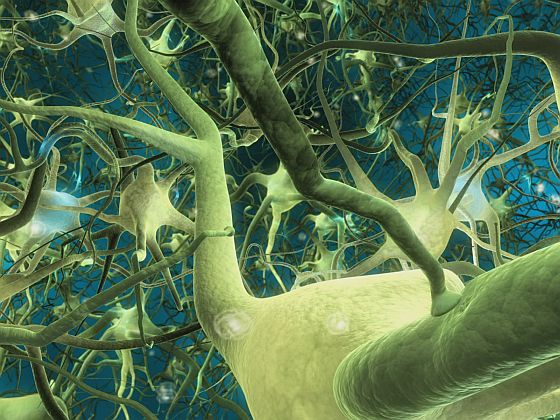
Daniel A Gross writes: Before Josh McDermott was a neuroscientist, he was a club DJ in Boston and Minneapolis. He saw first-hand how music could unite people in sound, rhythm, and emotion. “One of the reasons it was so fun to DJ is that, by playing different pieces of music, you can transform the vibe in a roomful of people,” he says.

With his club days behind him, McDermott now ventures into the effects of sound and music in his lab at the Massachusetts Institute of Technology, where he is an assistant professor in the Department of Brain and Cognitive Sciences. In 2015, he and a post-doctoral colleague, Sam Norman-Haignere, and Nancy Kanwisher, a professor of cognitive neuroscience at MIT, made news by locating a neural pathway activated by music and music alone. McDermott and his colleagues played a total of 165 commonly heard natural sounds to ten subjects willing to be rolled into an fMRI machine to listen to the piped-in sounds. The sounds included a man speaking, a songbird, a car horn, a flushing toilet, and a dog barking. None sparked the same population of neurons as music.

Their discovery that certain neurons have “music selectivity” stirs questions about the role of music in human life. Why do our brains contain music-selective neurons? Could some evolutionary purpose have led to neurons devoted to music? McDermott says the study can’t answer such questions. But he is excited by the fact that it shows music has a unique biological effect. “We presume those neurons are doing something in relation to the analysis of music that allows you to extract structure, following melodies or rhythms, or maybe extract emotion,” he says. [Continue reading…]

Facebooktwittermail

Russian Syria withdrawal: Vladimir Putin is the consummate political gambler

By Scott Lucas, University of Birmingham

Russian president, Vladimir Putin, is not an easy politician to read. He is willing to say one thing while his diplomats and military do another – as the long-running conflict in Ukraine has demonstrated. His statements are at the pinnacle of a Russian state propaganda machine shrouding any “truth” in layers of often deceptive assertions.

And, as the announcement on March 14 of a “withdrawal of most of [Russia’s] military group” from Syria demonstrated, he can spring a surprise on both his allies and his foes.

So, does this represent mission accomplished for Putin – as he maintained on Monday (“the tasks … are generally fulfilled”), or is this a sign of Russian weakness, with the costs of military intervention compounded by a shaky economy, the challenge of sanctions on Moscow, and a sharp fall in oil revenues?

Or is Putin just being deceptive, with his air force ready to resume bombing and his advisers ready to support pro-Assad ground offensives – especially if political talks to resolve Syria’s five-year conflict fail in Geneva?

Continue reading

Facebooktwittermail

What does Russia’s partial withdrawal from Syria signify?

Foreign Policy reports: Joshua Landis, director of the Center for Middle East Studies at the University of Oklahoma, said that until the past week, he had been in touch with officials close to the Assad regime in Damascus who expressed “a constant drumbeat of confidence that they’re going to take back every inch of Syrian soil, and Russia is their partner.” But those communications abruptly fell off earlier this month. “No one was answering the phones in Damascus. That leads me to believe they were thrown for a loop.”

Landis said that Putin’s planned withdrawal from Syria means he’s not going to back Assad “all the way.” But he said the move was also likely aimed at Washington, which has frustrated Moscow by refusing to work with Putin to fight the Islamic State. “This is a shot across America’s bow as well,” Landis said, “with Russia saying, ‘We’ll leave, and you’ll be stuck holding the bag in Syria.’”

The withdrawal announcement, reported by Russian state media, appears to have caught the White House off guard. A senior administration official said Monday that they had seen reports of the Russian move and that “we expect to learn more about this in the coming hours.” A spokesman for the Defense Department declined to comment. [Continue reading…]

BBC News reports: Russia will continue air strikes in Syria despite the withdrawal of most of its forces, a senior official has said.

Deputy Defence Minister Nikolay Pankov said it was too early to speak of defeating terrorism, after a campaign that has bolstered Syria’s government.

Russian defence ministry video showed the first group of aircraft taking off from Hmeimim air base in Syria on Tuesday morning and in flight.

Hours later, Russian TV showed planes arriving in the southern Russian city of Voronezh, where they were greeted on the tarmac by priests and crowds waving balloons.

Su-24 tactical bombers, Su-25 attack fighters, Su-34 strike fighters and helicopters were returning home, the TV said. [Continue reading…]

The Associated Press reports: The head of the defense committee in Russia’s upper house of parliament has estimated that about 1,000 Russian military personnel will remain in Syria at Russia’s two bases.

The head of the parliamentary defense committee, Viktor Ozerov, said Tuesday that he estimated about 1,000 Russian military personnel would remain in Syria at the two bases. That’s according to the Interfax news agency.

Ozerov says Russia would need a minimum of two battalions, a total of 800 troops, to protect the two bases. He says it will continue to conduct air reconnaissance, requiring some of the plane crews to remain, and the military specialists advising the Syrian army also would stay.

The estimate follows President Vladimir Putin’s announcement Monday that some of the Russian aircraft and troops would be withdrawn. Russia has not revealed how many soldiers it has deployed to Syria, where it maintains a naval facility as well as an air base, but U.S. estimates of the number of Russian military personnel varies from 3,000 to 6,000.

Britain’s foreign minister says he is skeptical about Russia’s announced military withdrawal from Syria.

Foreign Secretary Philip Hammond told lawmakers in the House of Commons that Russia had made past pledges to pull its troops out of Ukraine, “which later turned out to be merely routine rotation of forces.”

He says that “because Russia is completely un-transparent about its motives and its plans, we can only speculate.”

Hammond says a genuine de-escalation by Russia “would be welcome,” and urges Moscow to use its influence on President Bashar Assad’s government to seriously engage with the opposition.

Hammond said that “Russia has unique influence to help make these negotiations succeed and we sincerely hope that they will use it.” [Continue reading…]

Laura Rozen spoke to Paul Saunders, a Russia expert at the Center for the National Interest, who said: “It is striking, and many in … and out of the region will take note of the fact that President Putin said that withdrawal is going to take place because the Russian forces have achieved their objective,” Saunders told Al-Monitor March 14. “Because when they went in, it was framed very much in terms of strikes on [IS]. That mission is not really completed.”

“What has actually been accomplished is this rather tentative temporary cessation of hostilities leading to some kind of successful peace process between Assad and the forces of the opposition,” Saunders said.

Putin “is trying to send a message to both sides,” Saunders said. “Certainly for the Assad regime side, it makes very clear to them that they better actually negotiate seriously.”

But the announced partial withdrawal “does not mean Russia is just walking away,” Saunders added. “The pace of the withdrawal … also provides leverage. It can be slowed, it can be accelerated. Moscow has the continuing leverage that it needs.” [Continue reading…]

The New York Times reports: The announcement on Monday surprised people on all sides of the conflict. State Department officials, Syrian antigovernment activists, Mr. Assad’s supporters and Syrian opposition negotiators all reacted with disbelief, not sure whether to lament, celebrate or laugh.

In Idlib Province, held by a combination of insurgents that range from the Nusra Front to American-backed rebels, people fired guns in the air.

“People are distributing sweets and calling ‘God is great’ from the mosques,” said a fighter who gave his name as Ahmed. “There’s optimism, but we don’t know what’s hidden.”

Farther south, in Homs, an antigovernment activist, Firas — who, like Ahmed, asked that only his first name be used for safety reasons — was worried. “The Russians were sponsoring the cease-fire,” he said. “Now the regime will bomb again and the Russians will leave us for the Iranians, a disaster.”

Even in Geneva, the opposition spokesman, Salem al-Muslet, reflected that ambivalence, resenting Russia’s support for Mr. Assad but seeing Mr. Putin as the only figure who could force Mr. Assad to negotiate in earnest.

“Nobody knows what is in Putin’s mind, but the point is, he has no right to be in our country in the first place,” he said at first. “Just go.” Later, he added, “If it’s true, this is a good sign and a good start to a political solution.” [Continue reading…]

Facebooktwittermail

Obama’s policy of inaction in Syria rests on an anachronistic view of U.S. interests

Steven Heydemann writes: Did Syria’s sectarian make-up doom it to follow Iraq down the path of sectarian polarization, extremism and territorial fragmentation? Did demographics and history determine Syria’s fate? Only if we accept that these conditions are the causes of violence — a product of the “ancient hatreds” and not its effects. In the Syrian case, however, the evidence points in the opposite direction: polarization, extremism and fragmentation are the effects of escalating violence, not its causes. Participants in the uprising, as well as forthcoming research by Princeton political scientist Kevin Mazur, highlight the regime’s instrumental use of violence to exacerbate sectarian tensions. Recent survey data reflect the impact of sectarian polarization in Syria after years of conflict, but also the extent to which Syrians continue to express tolerance and a desire for cross-sectarian compromises in the name of peace.

Despite deep flaws in the assumptions underlying the administration’s policy, advocates of engagement inevitably run up against the ultimate defense of inaction: Syria just isn’t worth it. Supporters of the administration’s approach regularly fall back on the claim that the Syrian conflict is simply not central to U.S. strategic interests. Politically, they note, Syria has always been an adversary to the United States. Economically, its ties to the United States are trivial. However wrenching the conflict might be, the United States has little at stake in its outcome.

The only basis on which such a claim can stand, however, is to adopt an anachronistic, rigid conception of state interest — a conception the administration knows is inadequate in an era of hyper-globalization and increasingly porous state borders. Does the United States have an interest in preventing atrocities and supporting international mechanisms, such as Responsibility to Protect? Is it a matter of interest to the United States whether Iran consolidates its position as regional hegemon in the Arab east? Should the stability of Syria’s neighbors matter to the United States? Is the stability of the European Union in America’s interest? Does the United States have an interest in preserving a liberal international order that constrains authoritarian regimes such as Russia and Iran, including by raising the costs of aggression, whether in Syria or the Ukraine? As freedom of movement within the E.U. erodes, a global network of authoritarian regimes emerges to weaken liberal norms and institutions globally, and while the Arab state order unravels, it is increasingly clear that what is at stake for the United States in Syria was never simply about U.S.-Syrian relations. It is sadly ironic that the president’s commitment to inaction has undermined his vision of an international system in which military restraint and a smaller U.S. footprint would produce a more stable and peaceful international order. [Continue reading…]

Facebooktwittermail

Putin’s profitable intervention in Syria

Michael Weiss writes: The Syria war was as much a mediated weapons and hardware expo as it was a client rescue mission.

In October, Russian warships debuted the new Kalibr cruise missile, firing it across 900 miles of sea and land, across Iranian and Iraqi airspace (some of the missiles crash-landed in Iran, according to the Pentagon). But the display became a marquee event for Kremlin-run television, here acting as a multimedia brochure for Rosoboronexport, the Russian state arms dealer, which last year sold $15 billion in weapons to foreign purchasers.

The 45 or so fixed-wing aircraft deployed to Bassel al-Assad International Airport in Latakia, now a permanent Russian garrison and airbase on the Mediterranean, ranged from souped-up Soviet models to state-of-the-art killing machines. The Russian Air Force’s most modern ground attack jet, the Su-34, was showcased as a source of enormous national pride, with the state-owned outlet Sputnik reveling pornographically in the warplane’s ability to hunt “terrorists.” (The Su-34 was also documented cluster bombing populated areas, such as Hraytan, Aleppo.) Just before the New Year, Sergei Smirnov, the director of the Chkalov aviation factory, gave an interview with Vedomosti in which he said that Algeria, which has sought the purchase of the Su-32 export variant from Russia for the last eight years, recently made an official application to purchase the bombers from Rosoboronexport. Other potential buyers, according to “military expert” Igor Korotchenko, again hyping the Su-34 in Sputnik, are Vietnam, Iraq, Kazakhstan, Turkmenistan, Uzbekistan, Uganda, Nigeria, and Ethiopia.

Another sophisticated toy is the T-90 battle tank, examples of which have been spotted all over the Syrian battle space, at first guarding the Latakia airbase and now being driven by the Syrian army and Iranian-built Shia militias, such as Iraq’s Asaib Ahl al-Haq, or League of the Righteous, which in 2007 killed five U.S. soldiers in Karbala. In late December, Algeria announced that it planned to buy its third tranche of T-90s. Iran now also wants them. [Continue reading…]

Facebooktwittermail