Amal Ahmad writes: The Palestinian people began the New Year facing a bleak political situation, with a weak and compromised leadership, a geographically and administratively fragmented people, and a civil society increasingly marked by individualism and loss of political anchor. The state-building project that promised so much in the 1980s and 1990s is fast losing adherents – a recent poll revealed that nearly two-thirds of Palestinians no longer believe it is practical even though 137 countries now recognize Palestine. Yet little has emerged by way of an alternative political goal that enjoys popular support.
This commentary argues that the current political weakness of the Palestinian people derives in large part from the absence of strategic thinking, despite some organized efforts in this regard including for example by the Palestine Strategy Group and by Masarat. Yet it is vital that Palestinians strategize with or without the political factions within and outside the Palestine Liberation Organization (PLO): Without a clear and agreed strategy, some of the tools and tactics being adopted risk draining energies and proving ineffective or producing unwanted results. [Continue reading…]
Category Archives: Analysis
The archaic All Writs Act the government is using to try and unlock a terrorist’s iPhone
The Washington Post reports: The U.S. government and Apple are locked in a legal battle over unlocking an iPhone used by one of the San Bernardino shooters. But a new court order is throwing a law that dates to the days of the founding fathers into a high-tech debate over digital security.
On Tuesday, a U.S. magistrate judge in California ordered Apple to provide “reasonable technical assistance” to the government as it tries to bypass security features built into its products based on an interpretation of the “All Writs Act.”
The original form of that statute dates to the Judiciary Act of 1789, centuries before the iPhone was a twinkle in Steve Jobs’s eye. In its current form, the law gives federal courts the power to “issue all writs necessary or appropriate in aid of their respective jurisdictions and agreeable to the usages and principles of law.”
Basically, it’s “a very short, cryptic statute” that gives the courts “all sorts of incidental powers” to require things not specifically covered by other laws, according to Stephen Vladeck, a law professor at American University.
In the past, the act has been used to compel non-parties — like service providers of tech companies — to help in criminal investigations, Vladeck said. But that help has typically been limited to straightforward requests, like activating or turning off particular features and using systems that are already in place, he said.
The new order is different: It tells Apple to help the government by creating an entirely new software to help investigators bypasses security features. “That requires Apple to go much further than any company has ever been required to go in one of these cases,” said Vladeck. [Continue reading…]
Last October, Jennifer Granick and Riana Pfefferkorn wrote: Under the government’s interpretation of the All Writs Act, anyone who makes software could be dragooned into assisting the government in investigating users of the software. If the court adopts this view, it would give investigators immense power. The quotidian aspects of our lives increasingly involve software (from our cars to our TVs to our health to our home appliances), and most of that software is arguably licensed, not bought. Conscripting software makers to collect information on us would afford the government access to the most intimate information about us, on the strength of some words in some license agreements that people never read. (And no wonder: The iPhone’s EULA came to over 300 pages when the government filed it as an exhibit to its brief.)
The government’s brief does not acknowledge the sweeping implications of its arguments. It tries to portray its requested unlocking order as narrow and modest, because it “would not require Apple to make any changes to its software or hardware, … [or] to introduce any new ability to access data on its phones. It would simply require Apple to use its existing capability to bypass the passcode on a passcode-locked iOS 7 phone[.]” But that undersells the implications of the legal argument the government is making: that anything a company already can do, it could be compelled to do under the All Writs Act in order to assist law enforcement. [Continue reading…]
How a New York judge inspired Apple’s encryption fight
Reuters reports: Last October, prosecutors from the Justice Department asked a federal magistrate judge in Brooklyn to issue an order directing Apple to help the Drug Enforcement Administration bust security on an iPhone 5 seized from the home of Jun Feng, a suspected meth dealer.
The government had previously obtained many such orders against Apple and other companies under the All Writs Act, a 1789 statute that grants federal courts broad power to issue “necessary or appropriate” writs.
The act has been a powerful tool for prosecutors since 1977, when the U.S. Supreme Court ruled in U.S. v. New York Telephone that the All Writs Act extends, under certain conditions, to private companies in a position to assist “the proper administration of justice.”
Apple has a long history of compliance with All Writs Act orders. The company helped New York investigators extract data from a suspected child sex abuser’s iPhone in 2008; rushed a data extraction in 2013 from the phone of an alleged child pornographer in Washington; and in 2015 provided federal agents in Florida with data the company extracted from a drug suspect’s phone.
According to a Justice Department brief filed last fall, Apple never objected to All Writs Act orders in those cases – nor, for that matter, to any All Writs Act order directing the company to help federal investigators break into iPhones.
Apple’s policy of acquiescence abruptly changed in the Jun Feng case last year. And for all of the attention now focused on Apple’s announced opposition to a newly issued All Writs Act order directing the company to help Justice Department investigators break the passcode on an iPhone belonging to San Bernardino shooter Syed Farook, the Feng case is quite likely to produce a ruling before the Farook case.
The impending showdown over Farook’s phone is an irresistibly stark depiction of the competing interests of individual privacy and national security. But keep your eye on precedent from Feng. [Continue reading…]
FBI’s push to ‘fix a typo’ would really expand its surveillance authority
Robyn Greene writes: At last week’s Senate Intelligence Committee hearing on Worldwide Threats, FBI Director James Comey reiterated his call for a major expansion of the FBI’s surveillance authorities, but disingenuously downplayed it as fixing a “typo” in the law. In fact, Comey’s proposed fix, which he calls one of the FBI’s top legislative priorities, would be a major expansion of surveillance authority, and a major hit to Americans’ privacy and civil liberties. It would grant the FBI access to a range of revealing and personal details about Americans’ online communications — what are called Electronic Communications Transactional Records (ECTR), in legalese — without court approval.
Through Comey’s “ECTR fix,” the FBI would have the unilateral authority to obtain information from phone and Internet companies about your online communications such as logs of emails you send and receive, cell site data (including your location information), and lists of websites you visit. The FBI wants to get this information using National Security Letters (NSLs), which are demands for information issued directly by local FBI offices without any court approval or supervision.
Under current law, the FBI can only use NSLs to get information pertaining to a customer’s “name, address, length of service, and local and long distance toll billing records of a person or entity.” By contrast, if the FBI wants to compel a company to hand over the much more revealing private information that is included in ECTRs, they currently can’t use NSLs — instead, they have to get a court order after convincing a judge that they have a factual basis for demanding those records. Therefore, the FBI’s proposal that Congress add ECTRs to the NSL statute is far from a typo fix, and would instead be a major expansion of FBI’s authority to conduct surveillance with virtually no oversight and no accountability. [Continue reading…]
Apple’s stance highlights a more confrontational tech industry
Farhad Manjoo writes: The battle between Apple and law enforcement officials over unlocking a terrorist’s smartphone is the culmination of a slow turning of the tables between the technology industry and the United States government.
After revelations by the former National Security Agency contractor Edward J. Snowden in 2013 that the government both cozied up to certain tech companies and hacked into others to gain access to private data on an enormous scale, tech giants began to recognize the United States government as a hostile actor.
But if the confrontation has crystallized in this latest battle, it may already be heading toward a predictable conclusion: In the long run, the tech companies are destined to emerge victorious.
It may not seem that way at the moment. On the one side, you have the United States government’s mighty legal and security apparatus fighting for data of the most sympathetic sort: the secrets buried in a dead mass murderer’s phone. The action stems from a federal court order issued on Tuesday requiring Apple to help the F.B.I. unlock an iPhone used by one of the two attackers who killed 14 people in San Bernardino, Calif., in December.
In the other corner is the world’s most valuable company, whose chief executive, Timothy D. Cook, has said he will appeal the court’s order. Apple argues that it is fighting to preserve a principle that most of us who are addicted to our smartphones can defend: Weaken a single iPhone so that its contents can be viewed by the American government and you risk weakening all iPhones for any government intruder, anywhere.
There will probably be months of legal tussling, and it is not at all clear which side will prevail in court, nor in the battle for public opinion and legislative favor.
Yet underlying all of this is a simple dynamic: Apple, Google, Facebook and other companies hold most of the cards in this confrontation. They have our data, and their businesses depend on the global public’s collective belief that they will do everything they can to protect that data. [Continue reading…]
The war of Western failures: Hopes for Syria fall with Aleppo
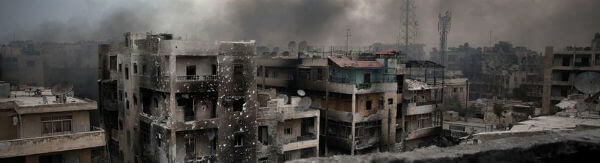
Der Spiegel reports: Aleppo has been a horrific place for some time now and few thought that it could get much worse. But things can always get worse — that’s the lesson currently being learned by those who have stayed behind in an effort to outlast this brutal conflict. People who have become used to dead bodies in the streets, hunger and living a life that can end at any moment.
“For the last two weeks, we’ve been living a nightmare that is worse than everything that has come before,” says Hamza, a young doctor in an Aleppo hospital. At the beginning, in 2011, he was treating light wounds, stemming from tear gas or beatings from police batons. When the regime began dropping barrel bombs in 2012, the injuries got worse. But now, with the beginning of the Russian airstrikes, the doctors are facing an emergency. Every two or three hours, warplanes attack the city, aiming at everything that hasn’t yet been destroyed, including apartment buildings, schools and clinics. Often, they use cluster bombs, which have been banned internationally.
They used to get around 10 serious injuries per day, but that number has now risen to 50, says Hamza, adding that most of their time is spent sorting body parts so they can turn them over to family members for burial. Russian missiles, he says, tear everyone apart who is within 35 meters of the impact.
“On one day, we had 22 dead civilians. The day before that, it was 20 injured children. A seven-year-old died and an eight-year-old lost his left leg.” The Russians attacked in the morning, he says, as the children were on their way to school. “We are going to need years of therapy in order to be able to cope with all this.”
There are seven doctors still working in the hospital. “Since the Russians began bombing the city, even more doctors have fled,” Hamza says. There are only about 30 medical professionals left in all of Aleppo, he adds. His hospital too is under fire and Hamza’s voice can be heard trembling over the phone. The regime, he says, has targeted the hospital five times in the past several years, but always missed. “The Russian bombardment, though, is very accurate.” One recent bomb, he says, just barely missed them. [Continue reading…]
A Syria policy that dare not speak its name

Michael Ignatieff writes: Once President Barack Obama had let Bashar al-Assad cross his “red line” and use chemical weapons in 2013, America was left with a policy in Syria that dare not speak its name.
The policy is not what the US wants but, in light of the ceasefire plan agreed last week in Munich between Moscow and Washington, it appears to have become what it reluctantly accepts: to allow Mr Assad and Russian president Vladimir Putin to win by focusing attacks on anti-regime rebels in strongholds such as Aleppo — and then, after a decent interval, to join with them to crush the militants of Isis.
The consequences of this policy are becoming clearer by the day: free Aleppo is dying under continuing Russian bombardment and a civilian uprising that began in 2011 is collapsing for want of help. Mr Assad is re-establishing his tyranny and is certain to take vengeance on surviving insurgents.
This is where risk avoidance has led a conscientious, prudent American president — to a diabolical transaction in which he and his allies regretfully sacrifice the lives of innocent civilians in the name of the mistaken belief that the west’s only overriding strategic interest in Syria is the defeat of Isis.
If this is the actual policy of the US the consequences should be spelt out. Russia and Iran will consolidate control of a rump state in the Middle East but the millions of Syrians who have fled the fighting will never return home and the region will never know peace. [Continue reading…]
Spring could bring a fresh surge of refugees — but Europe isn’t ready for them

The Washington Post reports: After an unparalleled tide of asylum seekers washed onto European shores last summer and fall, the continent’s leaders vowed to use the relative calm of winter to bring order to a process marked by chaos.
But with only weeks to go before more favorable spring currents are expected to trigger a fresh surge of arrivals, the continent is no better prepared. And in critical respects, the situation is even worse.
Ideas that were touted as answers to the crisis last year have failed or remain stuck in limbo. Continental unity lies in tatters, with countries striking out to forge their own solutions — often involving a razor-wire fence. And even the nations that have been the most welcoming toward refugees say they are desperately close to their breaking point or already well past it.
The result, analysts say, is a continent fundamentally unequipped to handle the predictable resurgence of a crisis that is greater than any Europe has faced in its post-Cold War history. [Continue reading…]
Assad preparing to handover Syria’s energy sector to Russia
The New Arab reports: The regime of Bashar al-Assad is reportedly seeking to rehabilitate and operate oil fields and power plants in areas controlled currently by the rebels and the Islamic State group respectively — areas that the regime forces began recapturing in northern and Western Syria backed by Russian airstrikes.
Measures are already in place by the Syrian regime to hand over the Syrian energy sector to Russian companies, led by a law on partnership between the private sector and foreign companies issued in early 2016.
Last month as well, Russian press reports said Bashar al-Assad, during a recent visit to Moscow, signed an agreement consisting of ten clauses purportedly giving Russia the right to freely operate in Syria, which cannot be revoked except by written agreement.
In the same vein, a recent report published by Russia’s RIA agency said Syria’s ambassador to Moscow, Riad Haddad, had met with the chairman of Russian gas company Gazprom Alexei Miller, and discussed giving Russian energy firms oil and gas concessions in Syria and other forms of cooperation. [Continue reading…]
Why ISIS hates the Sufis and blows up their shrines
The soul that denies true love as its motto
Were better unborn; its existence is dishonour.
So be drunk with love, for love is all there is.
Unless you deal with love, the way to God is closed.These words were among the hundreds of poems written by Rumi, the 13th-century Sufi apostle of love. Such was Rumi’s status in previous centuries that his epic Masnavi was called ‘the Quran in Persian’. For those who have read his verse, it’s hard to understand how anyone could despise the beauty of Sufi Islam. Considering that the Sufis always presented themselves as the loyal heirs of the Prophet Mohammad, it’s even harder to understand why Muslims should despise them. And yet over the past century, wave after wave of Muslim reform and renewal movements have rejected almost every aspect of Sufi Islam. The Islamic State of Iraq and Syria (ISIS) – whose franchises have sentenced Sufis to death in Syria and bulldozed their shrines in Libya – is only the latest of these anti-Sufis.
Why?
Here are a few reasons. [Continue reading…]
Start preparing for the collapse of the Saudi kingdom
Sarah Chayes and Alex de Waal write: For half a century, the Kingdom of Saudi Arabia has been the linchpin of U.S. Mideast policy. A guaranteed supply of oil has bought a guaranteed supply of security. Ignoring autocratic practices and the export of Wahhabi extremism, Washington stubbornly dubs its ally “moderate.” So tight is the trust that U.S. special operators dip into Saudi petrodollars as a counterterrorism slush fund without a second thought. In a sea of chaos, goes the refrain, the kingdom is one state that’s stable.
But is it?
In fact, Saudi Arabia is no state at all. There are two ways to describe it: as a political enterprise with a clever but ultimately unsustainable business model, or so corrupt as to resemble in its functioning a vertically and horizontally integrated criminal organization. Either way, it can’t last. It’s past time U.S. decision-makers began planning for the collapse of the Saudi kingdom.
In recent conversations with military and other government personnel, we were startled at how startled they seemed at this prospect. Here’s the analysis they should be working through.
Understood one way, the Saudi king is CEO of a family business that converts oil into payoffs that buy political loyalty. They take two forms: cash handouts or commercial concessions for the increasingly numerous scions of the royal clan, and a modicum of public goods and employment opportunities for commoners. The coercive “stick” is supplied by brutal internal security services lavishly equipped with American equipment. [Continue reading…]
Apple encryption case risks influencing Russia and China, privacy experts say
The Guardian reports: Authoritarian governments including Russia and China will demand greater access to mobile data should Apple lose a watershed encryption case brought by the FBI, leading technology analysts, privacy experts and legislators have warned.
Apple’s decision to resist a court order to unlock a password-protected iPhone belonging to one of the San Bernardino killers has created a worldwide privacy shockwave, with campaigners around the world expecting the struggle to carry major implications for the future of mobile and internet security. They warned that Barack Obama’s criticism of a similar Chinese measure last year now risked ringing hollow.
Senator Ron Wyden of Oregon, a leading legislator on privacy and tech issues, warned the FBI to step back from the brink or risk setting a precedent for authoritarian countries.
“This move by the FBI could snowball around the world. Why in the world would our government want to give repressive regimes in Russia and China a blueprint for forcing American companies to create a backdoor?” Wyden told the Guardian.
“Companies should comply with warrants to the extent they are able to do so, but no company should be forced to deliberately weaken its products. In the long run, the real losers will be Americans’ online safety and security.” [Continue reading…]
The more Donald Trump defies his party, the more his supporters cheer
The New York Times reports: Mark Jebens, a veteran of 22 years in the Marine Corps, found no fault with Donald J. Trump’s scathing criticism that President George W. Bush “lied” about weapons of mass destruction while leading the United States into war in Iraq.
“At the end of the day, a lot of good Marines and sailors and airmen died over something that wasn’t there,” said Mr. Jebens, who served three combat tours in Iraq. “So you’ve got to ask tough critical questions. In the military we called it a debrief or a hot wash.”
Mr. Trump’s hot wash of Mr. Bush in a debate on Saturday, including a suggestion that he did not heed intelligence warnings before the Sept. 11, 2001, terrorist attacks, convinced many Republicans that Mr. Trump had finally gone too far, tarring a former president who is popular in military-friendly South Carolina, and uttering charges that Rush Limbaugh, for one, called “liberal Democrat lingo.”
But numerous military veterans interviewed at Trump rallies in South Carolina this week, including Mr. Jebens, said they had no problem with Mr. Trump’s comments, even if they did not entirely agree with him. [Continue reading…]
$60 trillion of world debt in one visualization
The world’s failure to stop the massacre in Syria is based on a string of lies
Amir Tibon writes: In my conversations with the refugees [at a camp in Serbia] last month, I asked them about some of these lies as if they were well-established truths. Not because I believe them — but rather, because so many people, all over the world, hear and read these lies every day that it’s impossible to ignore them.
It felt dumb, for instance, to ask a family — father, mother, three children aged 12 to 3 — who had just escaped from the burning city of Aleppo, what they thought about “Russia’s bombing campaign against ISIS.” Of course, there is no such thing. Russia isn’t focusing its effort on bombing ISIS, but rather on trying to kill the people I was talking to, who are Syrian civilians. Yet conducting the interview without treating this big lie as if it is simply an alternate explanation of events would be considered “biased reporting.” So, I ask the question and get looks of disbelief, and worse.
Nadia, the mother of this family, told me that “the Russians are the worst thing that happened to us. We survived everything before them, but when they came in to help Bashar, we said — enough. They bomb schools, hospitals, refugee camps, buses carrying people to the border.” What specifically did their involvement mean, I asked her. Her reply: “I would ask myself every morning — how are the Russians going to try to kill my children today?”
Her husband, Yasser, a merchant who owned two stores in the city, disagrees with this analysis — he thinks Shiite militias supported by Iran are an even greater danger than Putin’s air force. “We ran away from the city because we know that after the Russians will finish it, the Iranians will come in. The Iranians are sending people to kill us for Assad.”
These militias, which are entering Syria from neighboring Iraq, have quite a reputation when it comes to killing. “They are just like ISIS, only difference is they are Shi’a and they talk Farsi,” says Yasser. “Tell me — why isn’t anyone bombing them? Why is the entire world only talking about ISIS? The Iranians in Syria burn people alive, burn children and women. Where is the world?” The couple then apologized, explaining they had much more to say, but their youngest daughter started crying, and anyway, they had to leave for the bus. They have six more days on the road ahead of them before reaching Germany.
The biggest lie of them all is that Bashar al-Assad, even more than Vladimir Putin, wants to defeat ISIS. The civil war in Syria, we are told more and more as of late, is actually a choice between Assad and ISIS. Framing the conflict in such terms makes it legitimate and acceptable to cooperate with Assad, a man who is responsible for the deaths of over a quarter of a million people. I tried to ask each and every Syrian I talked to one simple and “neutral” question that has to do with this falsehood. The question was — “Who are you running away from?” The vast majority of people didn’t choose Assad or ISIS — they said they are running away from both.
“The world needs to understand that Assad and ISIS are not enemies — they are partners in destroying our lives,” explained Muhammad, 24, from Aleppo, who stayed in the bombarded city for the last five years because he wanted to complete his university studies before getting out. “It’s like a coin that has two bad sides to it. Doesn’t matter which way you flip it, you’ll end up dead. As long as there is Assad, there will be ISIS. His violence against the Sunni people in Syria is what created ISIS in the first place.”
One man in his 50s, who presented himself in perfect English as a university professor from Aleppo, added: “I’m running away from Da’esh (the Arabic name for ISIS), but there are many different kinds of Da’esh operating in Syria today. There is Da’esh-Da’esh, the people who cut off heads and burn prisoners in cages. There is also Da’esh-Assad, which is actually much worse, and Da’esh-Iran, the Iranian militias who rape and murder women in front of their children’s eyes. They have much more money and capabilities, and they don’t film themselves while doing their atrocities. They are smart enough to hide it from the world. In addition to all these, there is also Da’esh-Putin. I’m coming from Aleppo; I’ve seen the results of his bombings. It’s a massacre. People are killed like cockroaches under a shoe. And then there is Da’esh-the West, which I think is the worst! I mean the civilized world, doing nothing to stop all of this.” [Continue reading…]

Will Merkel pay for doing the right thing?

Roger Cohen writes: A former German chancellor, Gerhard Schröder, recently called Angela Merkel’s decision to open the door to an unlimited number of refugees a “mistake” and offered this verdict: Merkel had a “heart, but no plan.”
This view of the German leader, who is beloved but now begrudged, is gaining ground as refugees from a ravaged Syria and elsewhere pour in. Local authorities are strained to the limit. Billions of euros have been spent with no end in sight. Many people came in whose identities are unknown; they have to register if they want handouts, but some have not and there are security concerns. Cologne has become a byword for concern over how a large influx of Muslim men will affect the place and security of women in German society.
Three important state elections loom next month. It seems inevitable the far-right Alternative for Germany Party will surge. Merkel will be blamed. Her support has already tumbled. One poll this month showed 46 percent of Germans support her, compared with 75 percent in April last year — and that’s with a strong economy. She could be vulnerable if her Christian Democratic Party turns on her. Europe without Merkel will sink.
So why did this customarily prudent chancellor do it? Because she is a German, and to be German is to carry a special responsibility for those terrorized in their homeland and forced into flight. Because she once lived in a country, East Germany, that shot people who tried to cross its border. Because a united Europe ushered Germany from its darkest hour to prosperity, and she is not about to let the European Union pitch into mayhem on her watch — as it would with more than a million ragged refugees adrift. And, yes, because she has a heart.
Merkel did the right thing. The question now is how she handles the consequences. [Continue reading…]
To be a refugee is much harder for a woman than for a man
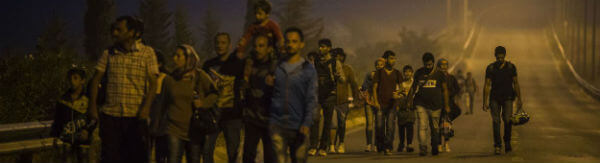
Renate van der Zee reports from the transit camp of Vinojug on the Macedonian-Greek border: In the camp’s supposedly “child-friendly” space, 25-year-old Nameen, from Homs, is nursing her tiny baby daughter. She went into labour as she was travelling through Turkey. “Fortunately they could get me to the hospital in time. The delivery went well,” she says with a faint trace of a smile.
Nameen stayed in the hospital for two days, rested for another 10 days in Turkey, and then crossed the Mediterranean in a dinghy with her baby in her arms.
“All I could think of was my girl, I was so scared she would drown or get ill. It was so cold. I am still worried for her safety, day and night.”
The other women in Vinojug agree: to be a refugee is much harder for a woman than for a man.
Amnesty International and the UN refugee agency, UNHCR, recently presented reports on the vulnerable position of women refugees and the dangers they face.
Europe is failing to provide basic protection for them, the Amnesty report stated.
This problem is now all the more critical because the percentage of women among the refugees who travel through Europe has risen dramatically. Exact data is not available, but according to UNHCR, last summer, a quarter of the refugees were women and children – now it is 55 percent. [Continue reading…]
Russian airstrikes targeted hospitals: ‘The planes returned several times,’ says eyewitness

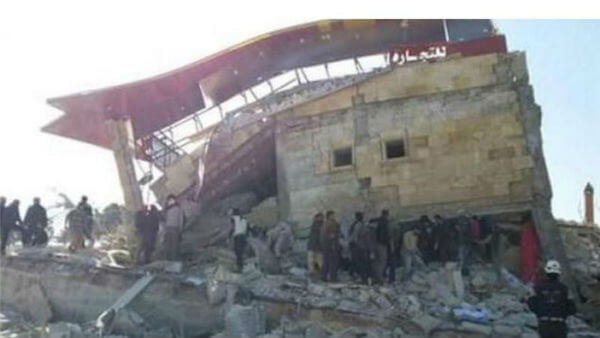
Syria Direct reports: Reported Russian airstrikes knocked three hospitals in northern Syria out of service on Monday, depriving more than 5,000 patients a month of care ahead of the deadline for a “cessation of hostilities” deal worked out between major powers at last week’s annual Munich Security.
The ceasefire, notably, excludes the Islamic State in addition to Jabhat a-Nusra, one of the lead factions in the Victory Army that controls nearly all of Idlib province.
Two hospitals, one belonging to Doctors Without Borders (MSF), were bombed in Idlib province on Monday. A third, a women and children’s hospital in the city of Azaz near the Turkish border, was also hit.
The National Hospital, also in Maarat al-Nuaman, was bombed shortly after the strikes on the MSF facility, Amjed al-Idlibi, a first responder with the Civil Defense who worked to extract the dead and wounded, told Syria Direct Tuesday.
“Both hospitals were hit directly…the planes returned several times to conduct air raids, with roughly 10 minutes between each raid,” said al-Idlibi. He said that the planes were Russian. [Continue reading…]
Meanwhile, Russia’s TASS reports: The Kremlin has dismissed as unacceptable the allegations the Russian air group in Syria has destroyed a hospital in Syria.
“We are strongly against such claims, the more so, since each time those who come up with such charges prove unable to somehow confirm their groundless accusations,” Russian presidential spokesman Dmitry Peskov has said.
Asked for a comment regarding reports a hospital in Syria’s Idlib province had been bombed, as well as claims the Russian air group was responsible, Peskov invited everybody to rely “on the root source first and foremost.” “In this particular case the representatives of Syrian authorities are the root source,” he said.
Peskov recalled that Syria’s ambassador to Russia, Riyadh Haddad, said on Tuesday the hospital in Idlib province was destroyed by the Americans, and not the Russian air group. [Continue reading…]
Note the reasoning of the propagandists: The allegations that the airstrikes on hospitals were carried out by Russia are firstly dismissed as “groundless accusations” and secondly dismissed by repeating a groundless accusation made by Syria’s ambassador to Russia — that these were U.S. airstrikes.
Unfortunately, there exists an uncritical audience all too willing to swallow this kind of shameless lying and tortured reasoning.