Category Archives: Analysis

The white nationalist roots of Donald Trump’s Warsaw speech

Jamelle Bouie writes: “The fundamental question of our time is whether the West has the will to survive,” said the president, before posing a series of questions: “Do we have the confidence in our values to defend them at any cost? Do we have enough respect for our citizens to protect our borders? Do we have the desire and the courage to preserve our civilization in the face of those who would subvert and destroy it?”

In the context of terrorism specifically, a deadly threat but not an existential one, this is overheated. But it’s clear Trump has something else in mind: immigration. He’s analogizing Muslim migration to a superpower-directed struggle for ideological conquest. It’s why he mentions “borders,” why he speaks of threats from “the South”—the origin point of Hispanic immigrants to the United States and Muslim refugees to Europe—and why he warns of internal danger.

This isn’t a casual turn. In these lines, you hear the influence of [Steve] Bannon and [Stephen] Miller. The repeated references to Western civilization, defined in cultural and religious terms, recall Bannon’s 2014 presentation to a Vatican conference, in which he praised the “forefathers” of the West for keeping “Islam out of the world.” Likewise, the prosaic warning that unnamed “forces” will sap the West of its will to defend itself recalls Bannon’s frequent references to the Camp of the Saints, an obscure French novel from 1973 that depicts a weak and tolerant Europe unable to defend itself from a flotilla of impoverished Indians depicted as grotesque savages and led by a man who eats human feces.

For as much as parts of Trump’s speech fit comfortably in a larger tradition of presidential rhetoric, these passages are clear allusions to ideas and ideologies with wide currency on the white nationalist right.

Defenders of the Warsaw speech call this reading “hysterical,” denying any ties between Trump’s rhetoric in Poland and white nationalism. But to deny this interpretation of the speech, one has to ignore the substance of Trump’s campaign, the beliefs of his key advisers, and the context of Poland itself and its anti-immigrant, ultranationalist leadership. One has to ignore the ties between Bannon, Miller, and actual white nationalists, and disregard the active circulation of those ideas within the administration. And one has to pretend that there isn’t a larger intellectual heritage that stretches back to the early 20th century, the peak of American nativism, when white supremacist thinkers like Madison Grant and Lothrop Stoddard penned works with language that wouldn’t feel out of place in Trump’s address. [Continue reading…]


Facebooktwittermail

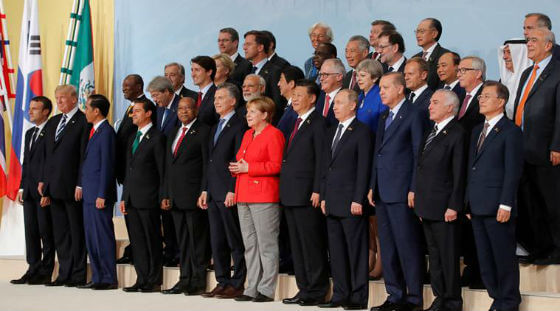
Once dominant, the United States finds itself isolated at G-20

Trump was shunted to the far left and placed under Emmanuel Macron’s close supervision.

The New York Times reports: For years the United States was the dominant force and set the agenda at the annual gathering of the leaders of the world’s largest economies.

But on Friday, when President Trump met with 19 other leaders at the Group of 20 conference, he found the United States isolated on everything from trade to climate change, and faced with the prospect of the group’s issuing a statement on Saturday that lays bare how the United States stands alone.

Chancellor Angela Merkel of Germany, the host of the meeting, opened it by acknowledging the differences between the United States and the rest of the countries. While “compromise can only be found if we accommodate each other’s views,” she said, “we can also say, we differ.”

Ms. Merkel also pointed out that most of the countries supported the Paris accord on climate change, while Mr. Trump has abandoned it. “It will be very interesting to see how we formulate the communiqué tomorrow and make clear that, of course, there are different opinions in this area because the United States of America regrettably” wants to withdraw from the pact, she said.

Mr. Trump seemed to relish his isolation. For him, the critical moment of Friday was his long meeting with the Russian president, Vladimir V. Putin, which seemed to mark the reset in relations that Mr. Trump has been desiring for some time. It also provided Mr. Putin the respect and importance he has long demanded as a global partner to Washington.

Where previous American leaders saw their power as a benevolent force, and were intent on spreading prosperity through open markets and multilateral cooperation, Mr. Trump has portrayed himself as a nationalist, a unilateralist and a protectionist, eager to save American jobs.

What recent events have underscored, though — and especially at the G-20 — is that no nation is today large or powerful enough to impose rules on everyone else. In advancing his views, Mr. Trump has alienated allies and made the United States seem like its own private island. [Continue reading…]

Facebooktwittermail

The remaking of Donald Trump

Joshua Green writes: Well into its run, The Apprentice was viewed by corporate America as the epitome of the forward-thinking, multicultural programming that all advertisers were increasingly seeking, especially after the election in 2008 of a biracial president. Just as Barack Obama symbolized the country’s uplifting racial progress, advertisers were “also tapping into that same yearning, particularly among younger Americans, to put racial divisions behind us and move forward in a more unified way,” Danny Allen, a top executive at the multi­cultural-focused ad agency Sensis, declared in 2009. As unlikely as it sounds from the vantage point of today, Trump and The Apprentice, up through the end of the decade, were considered by advertisers and audiences alike to be a triumph of American multiculturalism.

As a celebrity and a pop-culture icon, Trump was riding higher than ever. But privately he was obsessing over politics. Nobody knew it yet, but soon enough they would—because Trump was about to do something that any ordinary Republican with an eye on the White House would consider reckless to the point of insanity: He was about to torch his relationship with minority voters.
Trump had achieved by 2010 what Republican politicians had struggled, without success, to accomplish for the better part of 50 years. He had made himself genuinely popular with a broad segment of blacks and Hispanics. This audience didn’t think of him as a politician, of course. Not yet. But as a starting point in a bid for higher office, Trump was already out on the far horizon of where the Republican Party one day hoped to be.

Truth be told, the party was moving in entirely the wrong direction. Ever since 1964, when Barry Goldwater championed “states’ rights”—understood to signify his opposition to the civil rights movement—minority voters had turned their backs on the Republican Party. Richard Nixon’s “Southern strategy”—stoking white racism for electoral gain—had only cemented this state of affairs. In the 11 presidential elections that followed Goldwater’s thumping loss, no Republican had won more than 15 percent of the black vote. And in the most recent election, in 2008, exit polls showed that John McCain had pulled a meager 4 percent of them. Republicans fared slightly better among the fast-growing population of Hispanic voters, with George W. Bush hitting a high point of 44 percent in 2004. But here, too, the GOP was backsliding: McCain had carried just 31 percent of Hispanics. Republican strategists looking toward the future were already growing nervous because the changing demography of the U.S. made perfectly clear that minorities would steadily increase as a share of the eligible electorate. Republicans needed to win more of them.

Trump was the furthest thing from a racial innocent. In 1989, after five black and Hispanic male teenagers from Harlem were accused of raping a white female jogger in Central Park, he had felt it necessary to spend $85,000 running full-page ads in the New York daily newspapers calling for the return of the death penalty. “Muggers and murderers,” he wrote, “should be forced to suffer and, when they kill, they should be executed for their crimes.” (Even after DNA evidence exonerated the Central Park Five, Trump refused to apologize and held fast to his insistence that they were guilty.) And yet, however improbable, he had managed to win the good favor of millions of minority voters.

What was it, then, that impelled Trump to suddenly start questioning Barack Obama’s citizenship and implying that he wouldn’t produce a birth certificate because he hadn’t really been born in the U.S.? And not just air his suspicion that Obama was born in Kenya but conduct a full-scale media blitzkrieg that took him from Fox News to ABC’s The View to drive home this fantastical narrative?

Trump himself would never say. But knowing now that his presidential ambitions were serious—and not simply a ratings stunt, as we assumed at the time—it seems clear that he was considering challenging Obama in 2012 and had an inkling of the power he could marshal by highlighting the president’s otherness to appeal to anti-Obama voters. The birther charge had been circulating for some time in the darker corners of the internet, on right-wing conspiracy sites, and in email chains. As someone possessing perhaps the best raw political instincts of any Republican in his generation, Trump had intuited, correctly, that a racist attack targeting a black president was the surest way to ingratiate himself with grass-roots Republican voters. [Continue reading…]

Facebooktwittermail

Most Americans disagree with Trump admin’s enforcing travel ban against grandparents

Ryan Goodman writes: One of the hotly contested questions in the Travel Ban litigation is the definition of “close family relationships.” The Supreme Court told the administration that it cannot enforce the ban against any foreign national who has a “close familial relationship” with a person in the United States. The plaintiffs including the state of Hawaii have argued that the Supreme Court’s order should be understood to protect grandparents. The Justice Department told the federal court in Hawaii that the plaintiffs’ views of close family relationships “lack any universal or cohesive support.” That is the question the Hawaii federal court refused to decide on Thursday, and tried to kick the issue up to the Supreme Court. So, what to make of the competing views of family structure and where grandparents fit in?

A poll out this week suggests most Americans fundamentally disagree with the administration’s position. The Politico/Morning Consult survey asked the following question and got these results:

“Do you believe each of the following should qualify as a close family relationship for visa applicants from six predominately Muslim countries wishing to enter the United States? Grandparent”

Yes, this should qualify: 67%
No, this should not qualify: 20%

That is not only a huge margin in general. It also holds true across different groups of people who were asked the question. More specifically, the margin held strong such that at least 60% of Americans agreed that grandparents should qualify as a “close family relationship” for the purpose of receiving visas from the six predominately Muslim countries regardless of the respondent’s party identification, religion, gender, age, income, education, or region of the country. Even among people who voted for Donald Trump for president, 61% agreed that grandparents should qualify and 29% thought they should not. [Continue reading…]

Facebooktwittermail

Israel’s forthcoming security dilemma

Nadav Pollak writes: In recent weeks Israel and Hizballah continued a time-honored tradition that tends to flare up in the hot months of summer: exchanging harsh words and threats regarding what each side will do to the other in the next war. These are not empty threats. Each side has the ability to inflict tremendous damage on the other. But even though both sides are ready for a war, neither Israel nor Hizballah wants one now. The main purpose of their heated rhetoric is the maintenance of deterrence and alertness. However, a recent development might raise the temperature even more.

In a speech at the Herzliya Conference on June 22, Israel’s head of military intelligence, Maj. Gen. Herzi Halevi, basically confirmed prior reports in Arab media that the Iranian Revolutionary Guard Corps (IRGC) is working to establish an independent weapons industry in Lebanon focused on advanced missiles. This worrying development reportedly had become the focus of the Israel Defense Forces (IDF) and the Israeli cabinet in recent weeks, with some wondering if there will be a point at which Israel will need to execute a preemptive strike in Lebanon that might spark a war.

In recent years Israel attacked numerous arms shipments on their way to Hizballah. These advanced arms shipments reportedly included anti-ship missiles, surface-to-air missiles, and surface-to-surface ballistic missiles. Some of these missiles are accurate and can hit strategic sites in Israel, such as military bases and important civilian infrastructure. The Israeli prime minister and minister of defense time and time again said such capabilities in the hands of Hizballah would be a red line and insisted that Israel will act to prevent the flow of advanced weapons to the militant group. According to some estimates, Israel was able to destroy 60 percent of these advanced arms shipments. This might be cause for celebration, but it seems that these airstrikes changed something in Iran’s thinking.

Israeli media reported this week that the IRGC is pushing for a Hizballah-controlled advanced weapons industrial base because this would make Israel’s interdiction operations obsolete. Tehran likely hopes that Israel will avoid attacking Hizballah in Lebanon, fearing that such a direct attack might lead to war. As such, the closer the production line is to the customer, the better.

Iran’s calculus has some merit. It appears that Israel and Hizballah have an unspoken understanding: As long as Israel does not attack Hizballah on Lebanese soil and its attacks do not result in Hizballah casualties, the organization usually chooses not to retaliate. [Continue reading…]

Facebooktwittermail

Trump’s plan to team up with Putin in Syria — and leave Assad in power

The Daily Beast reports: For once, Rex Tillerson is not freelancing.

Late Wednesday, ahead of the first-ever meeting between Donald Trump and Vladimir Putin, the secretary of state suggested that the U.S. is willing to explore “joint mechanisms” with Russia to stabilize the vicious Syrian civil war.

After a dizzying series of policy shifts on Syria, administration and congressional sources tell The Daily Beast that Team Trump is introducing the beginnings of a new strategy for Syria—one that, in the short term at least:

• leaves dictator Bashar al-Assad in power;

• acquiesces to the idea of “safe zones” proposed by Russia and its allies;

• leans on cooperation from Moscow, including the use of Russian troops to patrol parts of the country.

It’s the sort of plan that observers have long suspected would ultimately emerge as Trump’s approach—despite his pledge that Assad has “no role” in governing the Syrian people. Top Trump aides from Jared Kushner to former national security adviser Michael Flynn have pushed for closer coordination with Russia on Syria for months. [Continue reading…]

Facebooktwittermail

Trump’s warning about ‘Western civilization’ evokes holy war

Walter Shapiro writes: A surprising omission in Donald Trump’s Warsaw foreign policy address was the president’s failure to hail the 17th century Polish king, John III Sobieski. As Steve Bannon and his fellow hard-right history buffs in the White House must know, it was Sobieski who defeated the Turks in 1683 at the gates of Vienna – and saved Central Europe from a Muslim invasion.

The Trump-Bannon worldview depicts Europe and America reeling from a second Muslim invasion. That is what Trump meant as he thundered, “The fundamental question of our time is whether the West has the will to survive … Do we have the desire and the courage to preserve our civilization in the face of those who would subvert and destroy it?”

The Trump advance team is probably high-fiving each other over their collective brilliance in choosing Warsaw as the venue for the president’s apocalyptic message to Europe. The combination of a welcoming right-wing government that shares Trump’s disdain for a free press and the emotional weight of Polish history seemed irresistible. [Continue reading…]

Facebooktwittermail

Yanis Varoufakis: A New Deal for the 21st century

Yanis Varoufakis writes: The recent elections in France and Britain have confirmed the political establishment’s simultaneous vulnerability and vigor in the face of a nationalist insurgency. This contradiction is the motif of the moment — personified by the new French president, Emmanuel Macron, whose résumé made him a darling of the elites but who rode a wave of anti-establishment enthusiasm to power.

A similar paradox is visible in Britain in the surprising electoral success of the Labour Party leader, Jeremy Corbyn, in depriving Theresa May’s Conservatives of an outright governing majority — not least because the resulting hung Parliament seemingly gives the establishment some hope of a change in approach from Mrs. May’s initial recalcitrant stance toward the European Union on the Brexit negotiations that have just begun.

Outsiders are having a field day almost everywhere in the West — not necessarily in a manner that weakens the insiders, but neither also in a way that helps consolidate the insiders’ position. The result is a situation in which the political establishment’s once unassailable authority has died, but before any credible replacement has been born. The cloud of uncertainty and volatility that envelops us today is the product of this gap. [Continue reading…]

Facebooktwittermail

The racial and religious paranoia of Trump’s Warsaw speech

Peter Beinart writes: In his speech in Poland on Thursday, Donald Trump referred 10 times to “the West” and five times to “our civilization.” His white nationalist supporters will understand exactly what he means. It’s important that other Americans do, too.

The West is not a geographic term. Poland is further east than Morocco. France is further east than Haiti. Australia is further east than Egypt. Yet Poland, France, and Australia are all considered part of “The West.” Morocco, Haiti, and Egypt are not.

The West is not an ideological or economic term either. India is the world’s largest democracy. Japan is among its most economically advanced nations. No one considers them part of the West.

The West is a racial and religious term. To be considered Western, a country must be largely Christian (preferably Protestant or Catholic) and largely white. Where there is ambiguity about a country’s “Westernness,” it’s because there is ambiguity about, or tension between, these two characteristics. Is Latin America Western? Maybe. Most of its people are Christian, but by U.S. standards, they’re not clearly white. Are Albania and Bosnia Western? Maybe. By American standards, their people are white. But they are also mostly Muslim.

Steve Bannon, who along with Stephen Miller has shaped much of Trump’s civilizational thinking, has been explicit about this. In a 2014 speech, he celebrated “the long history of the Judeo-Christian West struggle against Islam” and “our forefathers” who “bequeathed to use the great institution that is the church of the West.” [Continue reading…]

Facebooktwittermail

North Korea’s newly tested ICBM can likely reach targets throughout most of the continental United States

Jeffrey Lewis writes: it is important to understand that 7,000 km is the range that North Korea demonstrated. It is minimum. Those of us who study proliferation are now in the process of modeling the missile to determine its maximum range. And I don’t like what I see.

The new missile appears to share a lot of common characteristics with the new missile, called the Hwasong-12, tested on May 14. My colleagues at the Middlebury Institute, along with friends at the Union of Concerned Scientists, have been modeling this missile very carefully. We measured its length and width, located the weld lines that showed where the propellant tanks are located, estimated its weight by analyzing the crane that lifted it into place, and determined the power of its engine by tracking the missile’s acceleration down to the tenth of a second.

We concluded that this missile is larger than most experts initially thought. Moreover, it has a much better engine and more efficient airframe than anything North Korea has ever built.

The Hwasong-12 was large. The Hwasong-14 is larger still. It appears to be wider than the Hwasong-12, and has a second stage—a missile on top of a missile—that extends its range. Although it is too early to offer a definitive judgment about the full capability of the Hwasong-14, a two-stage missile of this size and sophistication should be able to deliver a nuclear weapon-size payload much farther than just Alaska, to targets throughout most of the continental United States.

It is possible that North Korea’s Hwasong-14 underperformed. But it is more likely that North Korea simply did not test the missile to its full range, wanting to bring it down into the sea. That is fairly straightforward for rockets that use liquid fuel, where it is possible to simply stop the engine to reduce the range.

China, for instance, conducted several reduced range tests of its DF-5 ICBM before conducting a full-range test in 1980. Another test fell short because the second stage engine turned off a few seconds too soon. Whatever happened, the capabilities demonstrated this week are probably not the full capability of the missile.

The bottom line is that there is no reason at this point to conclude that the Hwasong-14 has a range of “only” 7,000 km or that it is just Alaska that is within range. The technologies on display in the Hwasong-12 and Hwasong-14 suggest that the latter is much more capable. And there is no reason to think that North Korea cannot build an ICBM that can reach anywhere in the United States.

That isn’t a reason to panic. But it is a reason to face squarely the reality that North Korea is a nuclear-weapons state that can target the United States. [Continue reading…]


Facebooktwittermail

How Trump could tweet his way into nuclear war with North Korea

Laura Rosenberger writes: North Korea’s apparent test of an intercontinental ballistic missile puts it closer to having the ability to hit the United States with a nuclear warhead. This is an extraordinarily dangerous development.

I worked on North Korea policy in both the George W. Bush and Obama administrations, at the State Department and on the National Security Council, so I know firsthand just how difficult the challenges posed by North Korea are to deal with. I know how constrained the policy options are, and I’m familiar with the many difficult choices involved in selecting from a menu of bad options. And I know the incredibly complicated coordination — both within our own government, and with our allies and partners — that is necessary to implement a strategy to handle it.

But President Trump’s reaction to North Korea’s missile test was to immediately reach for his phone and sound off with chest-thumping statements on Twitter. This is a very reckless reaction, and one that risks miscalculation by adversary and ally alike.


North Korea will parse every word of Trump’s Twitter statements to try to understand what they mean. That’s because North Korea uses its own propaganda mouthpieces in an intricate way to signal its intentions to both internal and external audiences. As a government official working on North Korea, I spent hours working with analysts poring over North Korean statements to understand Pyongyang’s thinking — whether and how it differs from past statements — and cutting through the bluster to identify the core point it was communicating. Its words are carefully chosen, and it uses different formulas to send different signals.

We know from watching Pyongyang’s reactions to previous U.S. statements that it read our words in a similar way. North Korean officials will look for clear signals of intention in Trump’s tweets. The problem is, it’s not clear that Trump has any idea what his intentions are. He is sending signals that foreign officials will attach meanings to — meanings he may not have intended and might not even realize he’s sending. [Continue reading…]

Facebooktwittermail

Four things to know about North and South Korea

File 20170705 21675 xudwrd
People watch news of missile test on a public TV screen in North Korea.
AP Photo/Jon Chol Jin

By Ji-Young Lee, American University School of International Service

Editor’s note: North Korea tested what it claims was an intercontinental ballistic missile at 9:40 a.m. Pyongyang time on July 3. Some analysts say this is evidence that Alaska is now within striking distance of nuclear weapons held by strongman Kim Jong Un.

In response, the U.S. conducted joint military exercises with South Korea, and President Donald Trump accused China of supporting the North Korean government through trade.

Professor Ji-Young Lee of American University answers four questions to help put this conflict into context.


Why is there a North and a South Korea?

Before there was a South and North Korea, the peninsula was ruled as a dynasty known as Chosŏn, which existed for more than five centuries, until 1910. This period, during which an independent Korea had diplomatic relations with China and Japan, ended with imperial Japan’s annexation of the peninsula. Japan’s colonial rule lasted 35 years.

When Japan surrendered to the Allies in 1945, the Korean peninsula was split into two zones of occupation – the U.S.-controlled South Korea and the Soviet-controlled North Korea. Amid the growing Cold War tensions between Moscow and Washington, in 1948, two separate governments were established in Pyongyang and Seoul. Kim Il-Sung, leader of North Korea, was a former guerrilla who fought under Chinese and Russian command. Syngman Rhee, a Princeton University-educated staunch anti-communist, became the first leader of South Korea.

Continue reading

Facebooktwittermail

Graham Allison’s trap

Michael Vlahos writes: How do you turn a metaphor into an axiom? Try: “Strategist appropriation.” When writing on politics and war, this means lardering your first few graphs with maxims from so-called “masters of war,” preferably Sun Tzu or Clausewitz. Their unassailable wisdom gives your argument the burnish of authority.

Graham Allison, an academic with plenty of his own Harvard authority, goes a step further. He suggests that the great historian (and not so great general), Thucydides, like Clausewitz and Sun Tzu, offers not just quotable truths but also a fundamental law about how wars often happen: The Thucydides Trap.

Allison argues that when rising powers threaten the position of established powers, the inevitable competition can lead to conflict and, eventually, war. Twenty-five hundred years ago, top dog Sparta became fearful and envious of Athens’ rising wealth and arrogant pride. Two towering city-states became trapped in a thirty-year war whose consequences were tragic. Thucydides tells their story.

Allison insists history bears Thucydides out: Head-butting between rising and established powers leads to war 75 percent of the time. Terrible wars happen because powers get ensnared into tragedy. Today, he warns, China and the United States are caught in yet another such historic trap.

But we need to see that Thucydides was not writing history. In fact, he sought to transform the experience of his life into a story of such heroic pathos that it would stand high on the ridgeline, right alongside the Greco-Roman Ur-gospel and ultimate “fall of the city” tragedy—the Iliad. Having failed as an Athenian general, Thucydides, as the Bard himself, wrote an epic that, like the immortal Iliad, would live for the ages:

“In fine, I have written my work, not as an essay which is to win the applause of the moment, but as a possession for all time.”

He pretty much succeeded. Thucydides’ history of the Peloponnesian War is incontestably great writing and superb storytellling. But rather than history, it might better be termed, “non-fictive literature.” It sings like grand opera. It is staged as high tragedy. Only a story “bigger than life” could be a “possession for all time,” because it had to speak across time, to all mankind.

If this were Hollywood, the movie would begin with the splash title: “Based on a true story.”

Allison forces this story of Athens’ pride and Sparta’s envy into his law about how great-power wars happen. Yet this is a sleight-of-hand. Allison presents the Trap as though it were Thucydides’ creation, rather than Allison’s appropriation of Thucydides. [Continue reading…]

Facebooktwittermail

Why there is no realistic option of a ‘surgical strike’ on North Korea

The New York Times reports: The standoff over North Korea’s nuclear program has long been shaped by the view that the United States has no viable military option to destroy it. Any attempt to do so, many say, would provoke a brutal counterattack against South Korea too bloody and damaging to risk.

That remains a major constraint on the Trump administration’s response even as North Korea’s leader, Kim Jong-un, approaches his goal of a nuclear arsenal capable of striking the United States. On Tuesday, the North appeared to cross a new threshold, testing a weapon that it described as an intercontinental ballistic missile and that analysts said could potentially hit Alaska.

Over the years, as it does for potential crises around the world, the Pentagon has drafted and refined multiple war plans, including an enormous retaliatory invasion and limited pre-emptive attacks, and it holds annual military exercises with South Korean forces based on them.

But the military options are more grim than ever.

Even the most limited strike risks staggering casualties, because North Korea could retaliate with the thousands of artillery pieces it has positioned along its border with the South. Though the arsenal is of limited range and could be destroyed in days, the United States defense secretary, Jim Mattis, recently warned that if North Korea used it, it “would be probably the worst kind of fighting in most people’s lifetimes.”

Beyond that, there is no historical precedent for a military attack aimed at destroying a country’s nuclear arsenal.

The last time the United States is known to have seriously considered attacking the North was in 1994, more than a decade before its first nuclear test. The defense secretary at the time, William J. Perry, asked the Pentagon to prepare plans for a “surgical strike” on a nuclear reactor, but he backed off after concluding it would set off warfare that could leave hundreds of thousands dead.

The stakes are even higher now. American officials believe North Korea has built as many as a dozen nuclear bombs — perhaps many more — and can mount them on missiles capable of hitting much of Japan and South Korea. [Continue reading…]

Facebooktwittermail

I’m a climate scientist. And I’m not letting trickle-down ignorance win

Ben Santer writes: I’ve been a mountaineer for most of my life. Mountains are in my blood. In my early 20s, while climbing in France, I fell in a crevasse on the Milieu Glacier, at the start of the normal route on the Aiguille d’Argentière. Remarkably, I was unhurt. From the grip of the banded ice, I saw a thin slit of blue sky 120 feet above me. The math was simple: Climb 120 feet. If I reached that slit of blue sky, I would live. If I didn’t, I’d freeze to death in the cold and dark.

Now, over 40 years later, it feels like I’m back in a different kind of darkness — the darkness of the Trump administration’s scientific ignorance. This is just as real as the darkness of the Milieu Glacier’s interior, and just as life-threatening. This time, I’m not alone. The consequences of this ignorance affect every person on the planet.

Imagine, if you will, that you spend your entire professional life trying to do one thing to the best of your ability. In my case, that one thing is to study the nature and causes of climate change. You put in a long apprenticeship. You spend years learning about the climate system, computer models of climate and climate observations. You start filling a tool kit with the statistical and mathematical methods you’ll need for analyzing complex data sets. You are taught how electrical engineers detect signals embedded in noisy data. You apply those engineering insights to the detection of a human-caused warming signal buried in the natural “noise” of Earth’s climate. Eventually, you learn that human activities are warming Earth’s surface, and you publish this finding in peer-reviewed literature. [Continue reading…]

Facebooktwittermail

If we stopped emitting greenhouse gases right now, would we stop climate change?

File 20170703 17450 gkktjh
Best-case scenario, how much are we locked into?
Kletr/Shutterstock.com

By Richard B. Rood, University of Michigan

Earth’s climate is changing rapidly. We know this from billions of observations, documented in thousands of journal papers and texts and summarized every few years by the United Nations’ Intergovernmental Panel on Climate Change. The primary cause of that change is the release of carbon dioxide from burning coal, oil and natural gas.

One of the goals of the international Paris Agreement on climate change is to limit the increase of the global surface average air temperature to 2 degrees Celsius, compared to preindustrial times. There is a further commitment to strive to limit the increase to 1.5℃.

Earth has already, essentially, reached the 1℃ threshold. Despite the avoidance of millions of tons of carbon dioxide emissions through use of renewable energy, increased efficiency and conservation efforts, the rate of increase of carbon dioxide in the atmosphere remains high.

International plans on how to deal with climate change are painstakingly difficult to cobble together and take decades to work out. Most climate scientists and negotiators were dismayed by President Trump’s announcement that the U.S. will withdraw from the Paris Agreement.

But setting aside the politics, how much warming are we already locked into? If we stop emitting greenhouse gases right now, why would the temperature continue to rise?

Continue reading

Facebooktwittermail

Why almost every state is partially or fully rebuffing Trump’s voter fraud commission

The Washington Post reports: In a rare display of bipartisanship, officials in nearly every state have said they will partially or fully refuse to comply with President Trump’s voting commission, which has encountered criticism and opposition after issuing a sweeping request for voter data nationwide.

Even as some of the resistance centers on Trump and members of his commission, the broader responses from the states indicate a strong and widespread belief that local officials should be managing elections and that the White House’s request for volumes of information went too far.

“What it says is some Republicans actually still believe in federalism and that our constitution still governs the way states hold their elections,” said Rick Wilson, a longtime GOP strategist and frequent Trump critic, who called the resistance by Republican state-level officials “commendable.” He also pointed to the commission’s origins in Trump’s repeated — and unsubstantiated — claims that voter fraud is widespread and cost him the popular vote last year. [Continue reading…]

Facebooktwittermail

Trump’s lack of a North Korea strategy is drawing China and Russia closer

Isaac Stone Fish writes: In a dramatic change, the most shocking response to North Korea’s 3 July missile test – which some analysts think demonstrates Pyongyang’s ability to strike Alaska or Hawaii with a ballistic missile – came not from Donald Trump, but from Beijing and Moscow.

Trump’s Twitter response to the launch contained his typical combination of bluster, insult and prodding. “Does this guy have anything better to do with his life,” Trump said on 3 July, probably referring to the North Korean leader Kim Jong Un, adding, “perhaps China will put a heavy move on North Korea and end this nonsense once and for all!”

By a happy coincidence for the two countries, the launch occurred during Xi Jinping’s visit to Moscow. Hours before the launch, the Chinese Communist party secretary told Russian media that Sino-Russian strategic ties “are at the best point in history”, and the launch offered the two sides an occasion to demonstrate their closeness.

In a joint statement, China and Russia’s foreign ministries warned the situation on the Korean peninsula was so tense “it could lead to an armed conflict”. And it chastised the “relevant parties” – Trump, as well as Kim – to “refrain from provocative actions and warlike remarks”.

The striking thing about their statement is not only the language – mild when compared with Trump’s tweets, but surprisingly strident from China’s normally staid foreign ministry – but that Moscow and Beijing took the unusual step of issuing one together. [Continue reading…]

Facebooktwittermail