Category Archives: Analysis

Trump travel ban ‘simplistic and wrongheaded’, says former CIA chief

The Guardian reports: The former CIA director John Brennan has described Donald Trump’s travel ban on visitors from Muslim countries as “simplistic and misguided”, predicting it would be counterproductive if implemented.

Brennan, who was director of central intelligence from March 2013 until the last day of the Obama administration on 20 January this year, was highly critical of a range of Trump policies and actions in an interview with the BBC Newsnight programme aired on Monday night.

He said the administration’s use of the phrase “radical Islamic terrorism” served to legitimise terrorists in their own eyes, and warned that the president’s disparagement of US intelligence agencies would hurt morale and recruitment. [Continue reading…]


Facebooktwittermail

Trump associates didn’t have to be under surveillance to be unmasked

The current Trump/White House narrative designed to distract and deflect attention away from the massive array of ties Trump and his associates have with Russia, is to cast themselves as victims of politicized intelligence who were illegitimately spied on and thence illegitimately “unmasked.”

One of the key deceptions at the heart of this narrative is the notion that Trump and/or his associates were parties to the intercepted conversations from which their names were subsequently unmasked.

As Business Insider notes:

[F]ormer NSA Director Michael Hayden, who also served as the principal deputy director of national intelligence and the director of the CIA, cautioned against “automatically assuming that the US person was party to the conversation” that may have prompted an unmasking.

“My life experience suggests that the overwhelming proportion of these cases of incidental collection is not information to or from an American, but information about an American,” Hayden said. “In this case, it is very likely in most instances two foreigners talking about the Trump transition.”

Facebooktwittermail

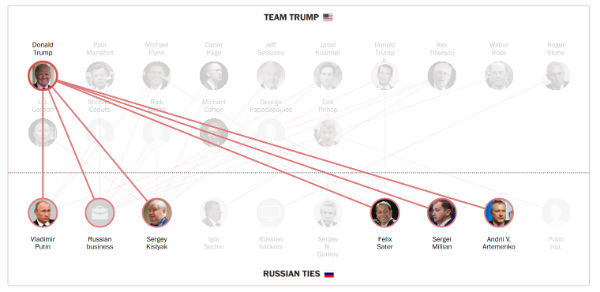
Here’s what we know so far about Team Trump’s ties to Russian interests

The Washington Post reports: Congress and U.S. intelligence agencies are scrutinizing connections between Russia and the Trump campaign as they investigate evidence that Russia interfered in the 2016 election. Here are members of Team Trump who are known to have Russian connections and the story lines that have made those ties relevant. [Click here to view extensive graphical analysis]

Facebooktwittermail

Trump has become Fox News’ No 1 assignment editor

Lloyd Grove writes: The jury is still out on whether Team Trump colluded with Russian operatives during last year’s presidential campaign—the subject of an extensive FBI investigation.

But the evidence is overwhelming that the Trump White House is colluding every day with the Fox News Channel, with Donald Trump himself acting as the right-leaning cable network’s cheerleader-in-chief and No.1 assignment editor.

The latest example is Fox News’s relentless promotion–abetted by the president’s Twitter feed and Monday’s installment of Fox & Friends—of a story that Los Angeles correspondent Adam Housely first told on Friday’s edition of Outnumbered, a noon weekday program in which four women on a couch and “one lucky guy” seated in the middle flirt and banter about the news of the day.

Appearing remotely from L.A., Housely reported that unnamed U.S. intelligence agencies, acting on orders from an unnamed Obama intelligence official, had improperly “unmasked” the identities of Team Trump members and associates who were caught up last year in surveillance operations; Housely also claimed that top Obama administration officials used the information for political gain.

The assertion, so far uncorroborated by other news outlets with the exception of Bloomberg’s Eli Lake, offered aid and comfort to Trump, who has been under intense media and congressional scrutiny for his alleged Russian connections ever since he tweeted on March 4 that President Obama—a “Bad (or sick) guy”—had ordered the “wiretapping” of Trump Tower. [Continue reading…]

Lake’s piece is noteworthy for this:

In February Cohen-Watnick discovered Rice’s multiple requests to unmask U.S. persons in intelligence reports that related to Trump transition activities. He brought this to the attention of the White House General Counsel’s office, who reviewed more of Rice’s requests and instructed him to end his own research into the unmasking policy [my emphasis].

The following month, Trump’s new national security adviser H.R. McMaster removed Cohen-Watnick from his position as NSC senior intelligence director only to get overruled by Trump. And then we learned about Cohen-Watnick’s family ties to the Russian government.

Michael Flynn’s request for immunity probably has much less to do with his desire to tell his story than his fear that his protege will be granted immunity first at which point the White House implodes as Trump aides rush for the exits.

Facebooktwittermail

A bomb hits Russia’s St. Petersburg metro. Conspiracy theories follow

The Daily Beast reports: An explosion killed at least 9 people and injured about 50 adults and children in the metro of Saint Petersburg, Russia, on Monday, according to Russian news agencies.

The crowded metro train hit by the attack was traveling between Sennaya and Tekhnologichesky Institut stations at about 3:00 p.m. Witnesses in one of the cars described a “deafening blast, sharp smell, and smoke.” Surviving victims were bleeding, many with hair burned off their heads and bodies. On seeing the smoke, “passengers in other wagons panicked, two women fainted,” according to a local student named Polina speaking to the Paperpaper internet outlet.

Senator Victor Ozerov, responsible for security at the Russian Federal Assembly said that “there are all the signs of a terrorist attack.” Izvestia reported that according to a special unit veteran investigating the attack, the bombing was carried out by a jihadist suicide-bomber.

The first images of the tragedy featured terrified, bloodied passengers, bloodied floors, blasted windows and doors in the bombed metro carriage.

In reaction, Russian authorities closed down the metro, which caused transport issues and traffic jams in Saint Petersburg. Taxi drivers gave people free lifts.

The attack coincided with a Kremlin-organized annual “Truth and Justice” event in St. Petersburg attended by President Vladimir Putin and 500 journalists from all over Russia. [Continue reading…]

Facebooktwittermail

The government Gorsuch wants to undo

Emily Bazelon and Eric Posner write: At recent Senate hearings to fill the Supreme Court’s open seat, Judge Neil Gorsuch came across as a thoroughly bland and nonthreatening nominee. The idea was to give as little ammunition as possible to opponents when his nomination comes up this week for a vote, one that Senate Democrats may try to upend with a filibuster.

But the reality is that Judge Gorsuch embraces a judicial philosophy that would do nothing less than undermine the structure of modern government — including the rules that keep our water clean, regulate the financial markets and protect workers and consumers. In strongly opposing the administrative state, Judge Gorsuch is in the company of incendiary figures like the White House adviser Steve Bannon, who has called for its “deconstruction.” The Republican-dominated House, too, has passed a bill designed to severely curtail the power of federal agencies.

Businesses have always complained that government regulations increase their costs, and no doubt some regulations are ill-conceived. But a small group of conservative intellectuals have gone much further to argue that the rules that safeguard our welfare and the orderly functioning of the market have been fashioned in a way that’s not constitutionally legitimate. This once-fringe cause of the right asserts, as Judge Gorsuch put it in a speech last year, that the administrative state “poses a grave threat to our values of personal liberty.”

The 80 years of law that are at stake began with the New Deal. President Franklin D. Roosevelt believed that the Great Depression was caused in part by ruinous competition among companies. In 1933, Congress passed the National Industrial Recovery Act, which allowed the president to approve “fair competition” standards for different trades and industries. The next year, Roosevelt approved a code for the poultry industry, which, among other things, set a minimum wage and maximum hours for workers, and hygiene requirements for slaughterhouses. Such basic workplace protections and constraints on the free market are now taken for granted. [Continue reading…]

Facebooktwittermail

Arab Winter

Borzou Daragahi reports: To the Egyptian state, Khaled al-Balshy is public enemy number one. In the three years since a military coup toppled the country’s elected government, he has been charged with trying to overthrow the government of President Abdel-Fattah al-Sisi, rioting, damaging public property, harboring fugitives from the law, blocking public roads, illegally protesting in the streets, and insulting the police. He has been described in the pro-government press as a communist, a paid foreign agent, an anarchist, and a member of the outlawed Islamist Muslim Brotherhood.

Balshy is a journalist, and until recently served as deputy head of the country’s press syndicate. A bookish, disheveled 45-year-old, in rectangular eyeglasses, Balshy is the editor of an independent news website called al-Bedayaiah, which means “beginning.” His wife, Nafisa el-Sabbagh, is also a journalist. The pair divide their time time between newsrooms, the press syndicate headquarters, and caring for their two kids, 16-year-old son Ali, and 9-year-old daughter Bassil. When Balshy’s not at home, at work, or out talking politics with friends, he spends a lot of time at various courthouses, both for his own pending cases and to keep tabs and offer support for the scores of other journalists run being run through the grinding, degrading machinery of Egypt’s judiciary.

He laughed at the charges against him. He said he’s never done anything violent in his life. In fact, during demonstrations last year against the Sisi government’s attempted transfer of two Red Sea islands to Saudi Arabia, he was regarded as the voice of reason. “I was the one who advised people to go home, and I tried to communicate with the security officials,” he said. “I wanted them to stop beating people.”

Eventually, Balshy grew used to living in what he describes as a “traditional dictatorship,” where the court appearances and public smears became humdrum. He even dared grow hopeful at signs of dissatisfaction, including widespread opposition to the Red Sea islands deal, as well as sporadic shows of spine by the judiciary and small spontaneous demonstrations against police brutality or the price of bread.

As the military-dominated government under Sisi widened its crackdown on media, civil society, and dissidents, democracy activists often turned to the international community for support. This frequently came in the form of subtle warnings by the US and others that continued military aid was contingent on the country’s democratic progress or simply statements standing up for those targeted in the crackdown — in some cases lending them just enough backing to be released from jail or allow their work to continue.

But then Donald Trump was elected president, and everything appeared to get worse. [Continue reading…]

Facebooktwittermail

Trump’s budget would hit rural towns especially hard — but they’re willing to trust him

The Washington Post reports: At the Boys and Girls Club in this rural city in southern Oklahoma, the director is unsure how he will stay open if President Trump’s proposed budget goes through, eliminating money for several staff positions.

Similar conversations are happening at the Oklahoma Shakespearean Festival’s after-school arts program, which relies on National Endowment for the Arts grants that Trump wants to eliminate. And at the county senior center, which already lost its state funding and could lose all or most of its federal funding, too. And at the Farm Service Center, which supports 1,200 local producers and is staffed with employees whose positions were targeted in the budget.

In this town of 16,000 — located near the Texas border in Oklahoma’s Bryan County, where Trump won 76 percent of the vote — excitement about Trump’s presidency has been dulled by confusion over an agenda that seems aimed at hurting their community more than helping it.

The president’s proposed budget would disproportionately harm the rural areas and small towns that were key to his unexpected win. Many red states like Oklahoma — where every single county went for Trump — are more reliant on the federal funds that Trump wants to cut than states that voted for Democratic nominee Hillary Clinton.

Durant has already undergone years of state budget cuts, as Oklahoma has been unable to balance its increasing costs with declines in the oil industry, tax cuts and generous corporate tax credits. That has made federal funds even more vital to the city, especially for programs that serve the poor and working class. [Continue reading…]

Facebooktwittermail

Americans spent an estimated $17 billion on ammunition while Obama was president

Philip Bump writes: The eight years during which Barack Obama served as president were a boom time for the gun industry. Obama’s consistent and futile efforts to introduce new regulations restricting gun sales were whipped into rhetoric about imminent crackdowns on gun ownership — rhetoric that predated Obama’s election, much less his policy efforts.

There’s been some indication that gun sales have receded in the wake of Donald Trump’s election. The go-to metric for gun sales — a figure that isn’t directly compiled by the government — is the number of federal background checks completed during a month. The biggest month for such checks tends to be December, as people buy firearms as Christmas gifts. In December 2015, the FBI conducted 3.3 million background checks. In December 2016, after Trump’s win? 2.8 million.

Over the first two months of the year, the number of checks completed totaled 4.3 million. In January and February 2016, the total was 5.2 million. That’s a 2017 decline of 17 percent — but it was also the third-highest January-February total on record. (The FBI started conducting background checks in 1998.) [Continue reading…]

Facebooktwittermail

Don’t get fooled again by bogus links, bots and pure bunk. Here’s how

Margaret Sullivan writes: Roger Daltrey of the Who sang it with a full-throated scream in 1971: “We don’t get fooled again!”

And yet, we still do. Oh, do we ever.

Remember this one from the presidential campaign? The “news story” that spread the lie that Pope Francis had endorsed Donald Trump for president? It was shared more than a million times. Or recall the faked report that the leader of the Islamic State was urging American Muslims to vote for Hillary Clinton.

With the proliferation of hoaxes, conspiracy theories, doctored photos and lies that look like news, it’s inevitable: We’re all chumps sometimes.

For those who are tired of it, along comes the first International Fact-Checking Day — which arrived, appropriately, on Sunday, just after April Fools’ Day.

Think of it as a global counterpunch on behalf of truth.

“It’s not about being killjoys, shaking a finger at everyone, so we’re trying to do it with a sense of fun,” said Alexios Mantzarlis, the 28-year-old director of the International Fact-Checking Network, based at the Poynter Institute in Florida. [Continue reading…]

Facebooktwittermail

Americans’ right to protest is in grave danger under Trump, United Nations warns

Amanda Erickson writes: The right to protest is fundamental to American democracy. The country was born, after all, out of decades of civil disobedience by people angry about taxation without representation. (In Washington, FWIW, we are still angry.)

But according to United Nations human rights investigators, this very basic principle is under attack. Over the past few months, on the heels of a fresh wave of organizing by liberals, at least 19 states have introduced measures that would criminalize peaceful protest. In places such as Minnesota, Michigan and Iowa, Republican lawmakers have proposed laws that would stiffen penalties for demonstrators who block traffic. In North Dakota, GOP leaders are pushing a bill that would allow motorists to run over and kill agitators, as long as the crash was accidental. In Indiana, conservatives want to instruct police to use “any means necessary” to remove activists from a roadway. Opponents worry this could lead to more brutal police response.

Colorado lawmakers are considering a big increase in penalties for environmental protesters. Activists who tamper with oil or gas equipment could be, under the measure, face felony charges and be punished with up to 18 months behind bars and a fine of up to $100,000. A bill pending in the Virginia state legislature would dramatically increase punishment for people who “unlawfully” assemble after “having been lawfully warned to disperse.” Those who do so could face a year in jail and a $2,500 fine.

In Missouri, some lawmakers want to make it illegal to wear a robe, mask or disguise (remarkably, a hoodie would count) to a protest. Lawmakers in North Carolina want to make it a crime to heckle lawmakers.

Taken together, the United Nations warns, these bills represent an “alarming and undemocratic” trend that could have a chilling effect on activism. [Continue reading…]

Facebooktwittermail

In Trump country, shock at Trump budget cuts, but still loyalty

Nicholas Kristof writes: I talked to many Trump voters about the impact if Trump’s budget cuts go through, and none regretted their votes in November. They all said that they might vote for Trump for re-election.

“I don’t think I re-evaluate Trump,” Moreno said, adding that he just wants the president to re-evaluate his budget proposal.

Judy Banks, a 70-year-old struggling to get by, said she voted for Trump because “he was talking about getting rid of those illegals.” But Banks now finds herself shocked that he also has his sights on funds for the Labor Department’s Senior Community Service Employment Program, which is her lifeline. It pays senior citizens a minimum wage to hold public service jobs.

“This program makes sense,” said Banks, who was placed by the program into a job as a receptionist for a senior nutrition program. Banks said she depends on the job to make ends meet, and for an excuse to get out of the house.

“If I lose this job,” she said, “I’ll sit home and die.”

Yet she said she might still vote for Trump in 2020. And that’s a refrain I heard over and over. Some of the loyalty seemed to be grounded in resentment at Democrats for mocking Trump voters as dumb bigots, some from a belief that budgets are complicated, and some from a sense that it’s too early to abandon their man. They did say that if jobs didn’t reappear, they would turn against him. [Continue reading…]

Facebooktwittermail

While Trump promotes coal, other countries are turning to cheap sun power

The Washington Post reports: On the solar farms of the Atacama Desert, the workers dress like astronauts. They wear bodysuits and wraparound sunglasses, with thick canvas headscarves to shield them from the radiation.

The sun is so intense and the air so dry that seemingly nothing survives. Across vast, rocky wastes blanched of color, there are no cactuses or other visible signs of life. It’s Mars, with better cellphone reception.

It is also the world’s best place to produce solar energy, with the most potent sun power on the planet.

So powerful, in fact, that something extraordinary happened last year when the Chilean government invited utility companies to bid on public contracts. Solar producers dominated the auction, offering to supply electricity at about half the cost of coal-fired plants.

It wasn’t because of a government subsidy for alternative energy. In Chile and a growing list of nations, the price of solar energy has fallen so much that it is increasingly beating out conventional sources of power. Industry experts and government regulators hail this moment as a turning point in the history of human electricity-making.

“This is the beginning of a trend that will only accelerate,” said Chilean Energy Minister Andrés Rebolledo. “We’re talking about an infinite fuel source.” [Continue reading…]

Facebooktwittermail

Every day a new Russian revelation. That’s not as bizarre as it sounds

Anne Applebaum writes: The former national security adviser wants to testify under immunity. The chairman of the House Intelligence Committee sneaks off to the White House for illicit briefings. Every day brings a new revelation in Washington, and every day reveals the story of someone else’s conversation with someone else from Russia.

But if this seems momentous or ludicrous, bizarre or improbable, it shouldn’t. Take a step back and look around the world: Russian interference in democratic elections is neither new nor unusual. On the contrary, it’s ubiquitous, it plays a role in just about every Western democracy, it often follows the same patterns as it did in the United States, and it often leads to the same disarray.

True, in some places it includes funding, of which there is no evidence in the United States. One of France’s presidential candidates, Marine Le Pen of the “far right” National Front, was in Moscow last week as her party is openly seeking Russian financial support. In 2014, her party received a 9 million euro loan from a Russian-Czech bank, and in 2016, it was revealed this week, she received an additional 3 million euros from another Russian bank; a political fund run by her father, the former party chairman, also received 2 million euros from a Russian-backed fund based in Cyprus. Le Pen’s agenda — anti-NATO, anti-European Union — is perfectly aligned with that of Moscow, which seeks to destroy the European and transatlantic institutions that curb Russian influence. That support hasn’t damaged her standing with her voters: At a major Le Pen rally in Lille, France, a few days ago, Putin’s name was cheered.

Sometimes, Russian interference is more covert, involving training and support for far-right and extremist groups. A Hungarian neo-Nazi who authorities say murdered a police officer late last year had illegal military-grade weapons and ties to Russian operatives. Scandinavian far-right groups also have links to strange Russian “nationalist” groups that sometimes lend them money or help them train.

But most of the time, Russian interference in foreign elections takes the same forms that it did in the United States. [Continue reading…]

Facebooktwittermail

‘Everything we built for 20 years, gone in a blink’ – life in the ruins of Aleppo

Ruth Maclean reports: A small group of boys play football, dodging tangled metal in the ruined Umayyad mosque of Aleppo’s old city. When they were last able to come here, before the war, the vast courtyard’s patterned floor was beautifully polished, and the pile of bricks in a corner was a millennium-old minaret.

Now, the boys pick at the sandbags piled in its huge, fire-blackened arches. For them, this ancient place-of-worship-turned-fortress is a playground in a hellscape.

“It seems bigger now, maybe because I didn’t see it for such a long time,” says Yamin Saeed, a sweet-faced 14-year-old in a fake Armani jumper. Before the war, he and his friends were like children anywhere – they went to school, they loved Tom and Jerry – but the battle for Aleppo aged them overnight.

“I saw a human head once,” says Mohammed Sheni, who is also 14. “We were walking and then there was a rocket and people died. I’m trying to forget it, but you can’t forget something like that.”

It is a windy day. The boys walk home, steering clear of the narrow back streets to avoid dangling steel and falling concrete.

Amid a countrywide uprising against Bashar al-Assad’s government, rebels took control of Aleppo’s eastern half in 2012. In the following years, it was held by a mishmash of different groups, often at war with each other as well as with forces loyal to Assad. [Continue reading…]

Facebooktwittermail

Trump’s words could jeopardize his environmental rollbacks, too

Bloomberg reports: President Donald Trump’s words may come back to haunt him in court as he moves to roll back regulations that fight climate change, just as they did when he tried to ban travel from six predominantly Muslim countries.

Environmentalists are scrutinizing Trump’s tweets and the phrasing of presidential orders, looking for evidence that an action is driven by politics or that a review of regulations is being carried out with a specific outcome in mind. That could be used in a lawsuit to argue that the process is a sham and violates federal law governing rulemaking.

“If there’s anything that suggests that it’s a politically motivated decision instead of a rationally based decision, that’s always something we put before the court,” said Abigail Dillen, vice president of litigation for climate and energy at Earthjustice. “Explosive statements” in a White House order “can and will be used against them,” she said. [Continue reading…]

Facebooktwittermail

Why Egypt’s ruler loves Donald Trump

The Economist reports: Donald Trump’s decision to give up his salary as president was not inspired by similar gestures made by previous American leaders, such as Herbert Hoover and John F. Kennedy. Rather, Mr Trump was “following in the footsteps” of Abdel-Fattah al-Sisi, the president of Egypt, claimed two Egyptian newspapers. Mr Sisi, after all, is Mr Trump’s “role model”, said an Egyptian television host. He was on top of Mr Trump’s guest-list for the inauguration, reported an Egyptian news website.

Such fake news is easily debunked. Mr Trump promised to forgo his salary before ever meeting Egypt’s strongman. Mr Sisi, who cut his own salary only by half, did not attend the inauguration. But the relationship between the two leaders, who will meet in the White House on April 3rd, has captivated Egypt’s scribes and talking heads. Many of them see Mr Trump’s affection for Mr Sisi as a matter of national pride worth celebrating—and exaggerating.

Take Mr Trump’s phone call to Mr Sisi in January, which the White House described in anodyne terms. Egyptian journalists, by contrast, were ecstatic. Newspapers cited officials who claimed that the call heralded a new era in relations. A TV host, Amr Adib, suggested that Mr Trump was in awe of Mr Sisi’s leadership. “How have you guys survived the past 40 months?” Mr Trump asked Mr Sisi, according to Mr Adib, referring to Egypt’s many problems. [Continue reading…]

Facebooktwittermail

Secretary of State Rex Tillerson spends his first weeks isolated from an anxious bureaucracy

The Washington Post reports: Secretary of State Rex Tillerson takes a private elevator to his palatial office on the seventh floor of the State Department building, where sightings of him are rare on the floors below.

On many days, he blocks out several hours on his schedule as “reading time,” when he is cloistered in his office poring over the memos he prefers ahead of in-person meetings.

Most of his interactions are with an insular circle of political aides who are new to the State Department. Many career diplomats say they still have not met him, and some have been instructed not to speak to him directly — or even make eye contact.

On his first three foreign trips, Tillerson skipped visits with State Department employees and their families, embassy stops that were standard morale-boosters under other secretaries of state. [Continue reading…]

Amberin Zaman writes: In meetings with Turkish President Recep Tayyip Erdogan, Prime Minister Binali Yildirim and Foreign Minister Mevlut Cavusoglu, Tillerson is believed to have confirmed the administration’s decision to press ahead with plans to capture Raqqa, the Islamic State’s last remaining stronghold in Syria, with the help of the Kurdish-dominated Syrian Democratic Forces (SDF). Tillerson’s meeting with Erdogan lasted over two hours.

“What we discussed today are options that are available to us. They are difficult options. Let me be very frank, it’s not easy, they are difficult choices that have to be made,” Tillerson told a joint news conference with Cavusoglu.

In a highly unusual move, Erdogan excluded the US Ambassador to Ankara John Bass from his meeting with Tillerson and Cavusoglu, officials familiar with the participants confirmed on condition that their names be withheld. Bass, a highly regarded career diplomat, is counted as one of Turkey’s few passionate advocates in Washington. Brett McGurk, the US special envoy to the anti-IS coalition widely perceived in Ankara as a friend of the SDF, was also excluded from the meeting. [Continue reading…]

Facebooktwittermail