Category Archives: Editorials

Send them parasols?

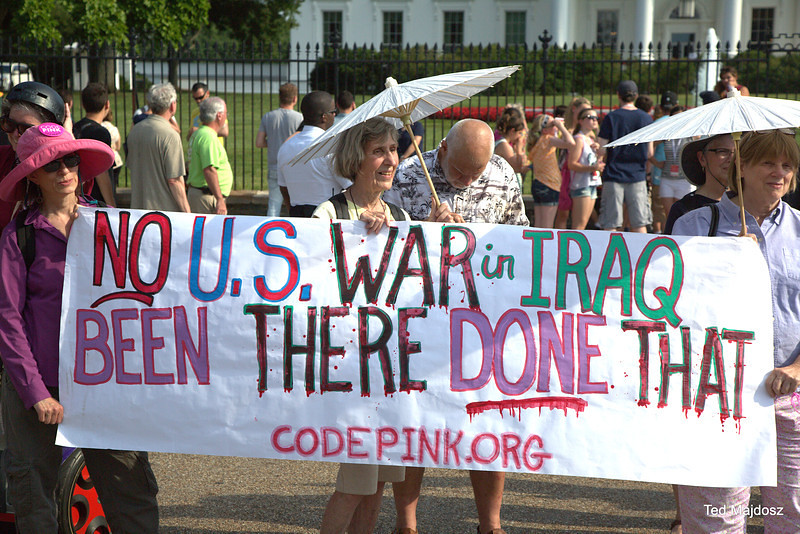
CODEPINK asks: “Why does our President want to take sides and get involved in a civil war? The US is not the target of ISIS, but if we become involved, we will be.”

A lot of Americans these days, some of whom regard themselves as impeccable humanitarians, have formed the conviction that when it comes to the Middle East (or pretty much anywhere else in the world), intervention by the United States — especially military intervention — can do nothing but harm.

President Obama’s concerns about the Iraqi humanitarian crisis and the safety of US personnel can be solved without dropping bombs. Helping the besieged civilians in Iraq should be an orchestrated international effort, not carried out just by the US — the country that unleashed the sectarian turmoil in the first place. (CODEPINK)

Tens of thousands of Iraqis fled from ISIS, taking refuge on a mountain top where they have no food, water, or shelter. How long could anyone survive in these conditions when daytime temperatures often exceed 100F?

By the time CODEPINK’s wished for international effort could be orchestrated, thousands of those in need of help would be dead.


Channel 4 News
spoke to a Yazidi refugee, Barakat al-Issa, who is trapped in the Sinjar mountains: “the situation is very tragic, more than 100 thousand people are trapped in the mountains here, in need of water and food.”

The Americans and Turkish have carried out air drops of aid, but the effort was not sufficient said Mr al-Issa: “They are saying that planes are dropping aid, but this aid is only getting to some 5 per cent of the people who are trapped here, because of the mountainous terrain.”

“People are waiting here for international forces to intervene, in the hope that this will become a safe haven for aid to be delivered.”

“Most of the people here are civilians and they hope a peacekeeping force will come from Iraq or Nato.”

He accused the Islamic State militants of kidnapping at least 500 Yazidi women, whose fate remains unknown, and said that dozens of families had been murdered in the south of the Sinjar mountains as they tried to flee. He also repeated allegations that militants had been seen executing women and children.

To advocate neutrality in this conflict seems indicative of either being willfully deluded about the nature of ISIS or the result of simply not paying attention to what has been happening in Syria and Iraq over the last two years.

ISIS, or the Islamic State as it now prefers to be known, is utterly uncompromising. These men have chosen to fight a war that they will either win or lose — don’t expect them to ever send a delegation of negotiators to Geneva or start talking about how they want to live peacefully side by side with anyone. Coexistence is not part of their vocabulary.

Anyone in CODEPINK who is averse to taking sides should watch the video below — or at least as much of it as they can stomach — to witness how these jihadists whose passion for killing has no limit choose to portray themselves.

Some of the latest military action in Iraq appears to already by paying off but the situation remains dire, as Rudaw reports:

Local officials said today that 10,000 Yezidis who were stranded on Mount Shingal for one week were rescued and settled in the town of Zakho.

Medical teams and aid organizations in Zakho have rushed in to assist the rescued families, said Rudaw reporter.

Ashti Kocher, Zakho’s security chief said that Kurdish armed forces have opened a safe corridor for the Yezidis at Mount Shingal.

“We have also cleared about 30 kilometers of the ISIL forces in order to open a road for those families,” said Kocher, who currently leads a Peshmerga unit at Sinune village near Shingal.

Kocher said that the rescued civilians were transported to the Kurdistan Region through Rojava (Syrian Kurdistan) which is under the control of Kurdish forces known as the Peoples Protection Units (YPG).

Barakat Issa, Rudaw reporter on Mount Shingal said that the number of Yezidis stranded on the mountain is higher than initially reported. He said that nearly 100,000 people are hiding on the mountain.

Issa said that in the past few days 60 children and elderly have [died] … of hunger and thirst while there is fear that Islamic militants controlling the town of Shingal and other villages have massacred hundreds of others.

Stephen Walt proposes a course of inaction for the U.S. in the Middle East on the grounds that U.S. intervention never has its desired effects, but he adds this caveat:

[T]his argument would not preclude limited U.S. action for purely humanitarian purposes — such as humanitarian airdrops for the beleaguered religious minorities now threatened with starvation in Iraq. That’s not “deep engagement”; that’s merely trying to help people threatened with imminent death. But I would not send U.S. forces — including drones or aircraft — out to win a battle that the Iraqi government or the Kurds cannot win for themselves.

So the anti-interventionist “humanitarian” perspective is this — if I understand it correctly: we should try to make sure the Yazidi do not starve to death on the mountaintop. If, however, they manage to come back down only later to be slaughtered by ISIS, that’s their problem.

Facebooktwittermail

No innocent civilians in #Gaza, says former head of #Israel’s National Security Council

Giora Eiland is a retired Major General from the Israel Defense Forces. As head of Ariel Sharon’s National Security Council, Eiland helped draft Israel’s disengagement plan for removing Israeli military forces and settlers from Gaza.

In an op-ed for Ynet today, “In Gaza, there is no such thing as ‘innocent civilians’,” Eiland provides a rationale for making no distinction between Palestinian fighters and Palestinian children — they all in his mind belong to an “enemy state.”

[W]e must avoid the artificial, wrong and dangerous distinction between the Hamas people, who are “the bad guys,” and Gaza’s residents, which are allegedly “the good guys.” We are dealing with an enemy state, not with a terror organization which is seemingly operating from within an innocent civilian population.

He hardly needed to articulate this view as though it constitutes a policy recommendation, since it appears to be perfectly in accordance with the way in which the Israeli government, its military commanders, and its individual soldiers, have conducted the latest war.

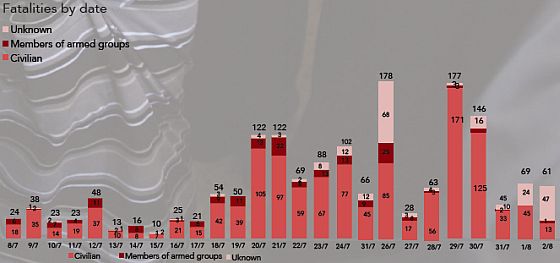
The casualty figures, as compiled by the UN, speak for themselves:

war-on-civilians

Facebooktwittermail

#Obama won’t end #Israel’s war on #Gaza

After an Israeli airstrike near a UN shelter which killed at least 10 people on Sunday, the State Department issued a statement saying: “The suspicion that militants are operating nearby [a UN shelter] does not justify strikes that put at risk the lives of so many innocent civilians.”

From day one in the current war, Israel has attempted to absolve itself for responsibility for civilian casualties by arguing that they are “human shields.” What the State Department finally made clear is that describing civilians as human shields does not make their lives expendable.

The State Department has understood this legal fact from day one but it waited almost a month before asserting this with any force. And even while the Obama administration caught the media’s attention in the last few days for voicing “harsh” criticism of the Israelis, it did so at the very same time as replenishing Israel’s supply of munitions.

The New York Times reports:

For all its outrage over civilian casualties, the United States steadfastly backs Israel’s right to defend itself and shares Israel’s view that Hamas is a terrorist organization. In a world of bitter enmities, the Israeli-American dispute is more akin to a family quarrel.

The White House seems determined to tamp down the latest eruption in tensions. “The nature of our relationship is strong and unchanged,” the press secretary, Josh Earnest, told reporters on Monday, pointing to comments by Mr. Netanyahu over the weekend, in which he said, “I think the United States has been terrific.”

The two statements are part of a recurring pattern for this administration: an angry outburst, followed by calmer words and the grudging recognition that little is going to change in the fundamental relationship between the United States and its closest ally in the Middle East.

Disputes between the United States and Israel are hardly new. President Ronald Reagan sold Awacs surveillance planes to Saudi Arabia over Israel’s fierce objections. George H.W. Bush held up loan guarantees because of Israeli settlement construction. Bill Clinton fumed after his first Oval Office encounter with a newly elected Israeli prime minister, Mr. Netanyahu.

But the chronic nature of this tension is unusual — and, according to current and former officials, rooted in ill will at the very top. “You have a backdrop of a very acrimonious relationship between the president and the prime minister of Israel,” said Robert M. Danin, a Middle East expert at the Council on Foreign Relations.

While tensions between Mr. Obama and Mr. Netanyahu only occasionally spill into the open, Mr. Kerry became the subject of very public and vitriolic — albeit anonymous — criticism from Israeli officials for his efforts two weeks ago to negotiate a cease-fire between Israel and Hamas. His proposal, the officials said, was tilted in favor of Hamas and did not do enough to protect Israel’s security.

Mr. Kerry, American officials responded, based his efforts on an Egyptian cease-fire proposal that had already been accepted by the Israelis. He submitted his ideas to the Israelis, anticipating that they would have concerns. Whatever the precise circumstances, Mr. Kerry found himself excoriated across the political spectrum in Israel.

At the White House, officials were incensed by what they saw as shabby treatment of Mr. Kerry, a loyal friend of Israel. In addition to the cease-fire and the peace talks, they noted, Mr. Kerry went to bat for Israel with the Federal Aviation Administration after it imposed a ban on commercial flights to Tel Aviv following a rocket attack near Ben-Gurion International Airport.

What does batting for Israel against the FAA mean? That at a moment when Israel seemed particularly vulnerable, the Secretary of State for the United States thought that it was his job to place the interests of Israel’s economy above those of his own citizens.

Now that a ceasefire has tentatively taken hold, the U.S. role in negotiations in Cairo, nominally promoting mediation yet predictably operating as Israel’s most loyal supporter, is to make sure that Israel’s interests take precedence above all others.

It is in Israel’s interests that it now contrive an expression of its humanitarian concerns — that after having flattened many parts of Gaza it will pay lip service to the need to consider the welfare of the population.

Yet there seems little doubt that even if the siege is “eased” is various ways, Israel’s war against Gaza will continue.

Facebooktwittermail

#HannibalDirective: #Israel confirms that it killed 130 #Palestinians in effort to ‘rescue’ (kill) one soldier

Haaretz reports: After Friday’s abduction of 2nd Lt. Hadar Goldin in the Gaza Strip, the Israel Defense Forces executed in full its “Hannibal procedure,” a protocol that calls for the massive use of force in an effort to rescue a captured soldier, even at risk to his life. As a result of the heavy fire in the Rafah area, dozens of innocent civilians were killed.

A senior General Staff officer said Sunday that “a great deal of fire was used in the area, and targets were attacked” in order to isolate it.

According to Palestinian reports, more than 130 Palestinians were killed in this onslaught, with some of the bodies located only in the days after it happened. Palestinians also accused the IDF of attacking vehicles en route to the Rafah hospital, including several ambulances.

IDF sources said that senior commanders in the field ordered the procedure implemented in full. The army knows that innocents were hurt as a result of the massive use of force after the soldier’s capture.

An IDF inquiry concluded that about 75 minutes after a cease-fire was to have taken effect on Friday morning, a Givati Brigade patrol came under heavy fire while moving toward a building where a tunnel shaft was located. Company commander Maj. Benaya Sarel and his communications officer, Staff Sgt. Liel Gidoni, were killed. The IDF now believes Goldin, a squad commander, was also killed in the incident.

Contrary to earlier reports, however, the inquiry concluded that the terrorist who came nearest the three soldiers wasn’t wearing a suicide belt, but simply continued firing his rifle until he was killed.

When other soldiers from the company arrived at the scene a few minutes later, they found three bodies, those of Sarel, Gidoni and a Hamas operative wearing an IDF uniform. They then realized that Goldin was missing. The company’s deputy commander, 1st Lt. Eitan, decided to take some of his men into the tunnel to search for Goldin, in violation of protocol.

A few hundred meters into the tunnel, the troops found some of Goldin’s personal effects, which later helped the IDF to establish that he had been killed. The tunnel itself had several branches, some of them blocked. One led into a mosque, which the soldiers searched, but it was empty. Another led to a Hamas outpost.

The IDF then sent additional forces to the area, including aircraft and observation equipment. According to an IDF source, virtually all the firepower in the south-central region of the Gaza Strip were sent to the Rafah sector, where the incident took place, on orders from Givati Brigade commander Col. Ofer Winter. This included a tank battalion and an infantry battalion, which helped search for additional tunnel shafts. These forces also laid down heavy fire “from all directions,” including tank shells, artillery bombardments and air strikes, in an effort to isolate the area where Goldin was thought to be, block all access routes to and from it and thereby ensure that nobody could either enter or leave without the soldiers noticing, the IDF source said. This was in line with the Hannibal procedure, which one senior officer said is meant to ensure that “every effort to locate the kidnapped [soldier] and the kidnappers” is made.

Anshel Pfeffer attempts to explain why Israel is willing to kill its own soldiers while attempting to “rescue” them:

Recent reports in the international media suggest that the directive is tantamount to ordering the captured soldier to be shot in order to prevent him being taken prisoner; rather, it is the suspension of safety procedures which normally prohibit firing in the general direction of an IDF soldier, specifically firing to stop an escaping vehicle.

The original order mentioned using light-arm fire, particularly selective sniper fire, to hit the captors or stop their vehicle – “even if that means hitting our soldiers. In any case, everything will be done to stop the vehicle and prevent it from escaping.”

That kind of makes sense — no effort spared in attempting to prevent a soldier being spirited away. But that’s not what just happened:

On Friday morning, when the IDF still believed that Lieutenant Hadar Goldin may have been taken alive by Hamas into an attack tunnel beneath Rafah in the southern Gaza Strip, the Hannibal Directive was activated to its most devastating extent yet – including massive artillery bombardments and air strikes on possible escape routes.

Massive bombardment to “save” a soldier falls into the same category of Orwellian doublespeak as the infamous need to destroy villages in order to save them (in Vietnam).

Nevertheless, Pfeffer goes on to say:

Perhaps the most deeply engrained reason that Israelis innately understand the needs for the Hannibal Directive is the military ethos of never leaving wounded men on the battlefield, which became the spirit following the War of Independence, when hideously mutilated bodies of Israeli soldiers were recovered.

So what happened on Friday? Goldin’s body was most likely hideously mutilated by an American-manufactured, Israeli-fired artillery shell and spared the risk of becoming hideously mutilated in some other way.

I’d like to hear Gilad Shalit‘s opinion on how well this rationale holds up.

Facebooktwittermail

The self-aggrandizing pathology of #Israeli identity

During Israel’s latest assault on Gaza, over 1,700 people have been killed. For the Western media, no single death has been deemed worthy of a headline. The dead are counted in numbers. The identities of Palestinians have been most specific when it comes to the numbers of children, yet still to most of the world these remain nameless and faceless young people.

But on Friday the war suddenly focused sharply on a single face and name captured in photos revealing the youthful smile of an Israeli soldier: Lieutenant Hadar Goldin.

In a brutal and cynical act, Hamas had kidnapped the young soldier and in so doing, torn up an agreement for a humanitarian ceasefire — at least, that was the story Prime Minister Netanyahu and President Obama broadcast with outrage and indignation.

Washington must not “ever second-guess me again” on how to deal with Hamas, Netanyahu later demanded while scolding the U.S. ambassador, Dan Shapiro.

It turns out that Goldin was not kidnapped but was killed in battle, according to the IDF. That determination is itself somewhat mysterious. The IDF initially said it was the conclusion reached by a “special committee.”

Just as mysterious is this: “It is understood the army came to its conclusion after examining DNA evidence, reports the BBC’s Bethany Bell in Jerusalem. No body has been found.” Note that: DNA but no body.

Just in case Goldin’s story sounds familiar but you’re not sure why, remember what triggered this war: the “kidnapping” of three Israeli settlers who were reported as missing even when they were already presumed dead.

In a column today, Nahum Barnea writes:

The press conference convened at the Kirya Base in Tel Aviv on Saturday night was meant to be a victory conference. We have been saved: The operation has ended. Hamas has been destroyed. Our forces have returned home safely.

A crowded lineup of State of Israel flags was placed behind Prime Minister Benjamin Netanyahu and Defense Minister Moshe Ya’alon. The flags conveyed a sense of festivity. The two officials’ faces conveyed a sense of Tisha B’Av.

Netanyahu delayed his appearance by 20 minutes because of the comments made by the family members of kidnapped officer Hadar Goldin. The family demanded defiantly that the IDF avoid leaving the Strip as long as their son was in Hamas’ hands, dead or alive.

Netanyahu and Ya’alon did not accept the demand, but were forced to rewrite their speeches. From an announcement about a unilateral withdrawal of IDF forces from the Strip, Netanyahu moved to vague, unbinding sentences, such as “all options are on the table.” When the Americans say that about Iran, we know there are neither options nor a table, that it’s all talk. I doubt Netanyahu has any options.

It seems highly improbable that Netanyahu was in any doubt that Goldin had been killed and his body will never be recovered, but the IDF announcement to that effect did not come until after the “victory” speech. The timing of that announcement would appear to have fit into a political schedule rather than being determined by a sequence of discovery. Netanyahu was thereby spared from facing questions about why he had decided that Goldin’s body could be left behind.

The grief of Goldin’s family and friends cannot be any less profound than that shared by the tens of thousands of Palestinians who have lost family members.

And yet, when Israel grieves its losses, it doesn’t simply convey how much it cares for its own; it underlines the extent to which it attaches so little value to the lives of others.

For many and maybe most Israelis, non-Israeli non-Jewish life apparently isn’t worth much. Nor can much worth or credence be attached to the words of those Israelis who profess their grief at the loss of innocent life when in the very same breath they justify their own brutality.

These justifications always assert that Israel only kills in accordance with the dictates of necessity. Israel uses violence when left with no other choice.

But to claim that when killing a man designated as a “terrorist” it is sometimes unavoidable to sacrifice the lives of those around him is a bald-faced lie. I repeat: it is a lie. And it is a lie that has been repeated again and again over the last month as whole families have again and again been slaughtered.

If the same “terrorist” happened to be surrounded not by his family but he was in a crowded part of Jerusalem surrounded by Jewish Israelis, the calculus would be completely reversed.

The necessity of saving the lives of the Israelis would suddenly trump the necessity of killing the “terrorist.”

(And note: we now live in a word where the term terrorist simply means: someone whose right to life has been revoked and who can therefore be killed without any legal process. Every terrorist is marked for summary execution.)

This is what exposes the lie — a lie used just as often by Americans as it is by Israelis — of so-called “collateral damage”: No government ever has the audacity to refer to its own citizens as collateral damage. This is a designation reserved for lives, always non-white, that are regarded as being worth less.

These are people who get eliminated supposedly because they are unlucky enough to be in the wrong place at the wrong time. But in reality they are viewed by their killers as having lives that simply aren’t worth protecting.

Anyone who believes that the life of a Jew has greater intrinsic value than that of anyone else, is, I would say, a racist.

Some may believe that among the tribes of humanity the Jewish people are something akin to endangered species — that there is a Jewish imperative for survival that non-Jews cannot understand. Of course, your not Jewish, you can’t understand, erects a wall that even the most agile gentile cannot spring over.

Even though the Jewish fear of annihilation is authentically grounded in the memory of the Holocaust and centuries of antisemitism, this fear appears in recent decades to have metastasized and grown into a rage for survival, justifying murder.

All forms of survivalism are pathological in their refusal to embrace the universal reality of death: the fact that no one’s life is so precious that it cannot be lost or so durable that it will never end.

The stridency with which Israel has come to assert its right to exist and its right to defend itself, fuels a self-righteous passion in which Israelis believe they have a right to kill Palestinians. Such a right can only be claimed by a people who hold themselves in too high regard.

Around the world there are many endangered peoples and endangered cultures — neither Jewish Israelis, Jews in general, nor Jewish culture face such a threat of extinction. What they face is a fear of annihilation that for many forms the core of their identity.

Anyone, Jewish or not, whose life becomes molded by their fear of death ends up strangling the very thing they hold too tight. We can only embrace life by also facing our own mortality.

Facebooktwittermail

#Hamas statement on the violation of the ceasefire and the missing #Israeli soldier

Since the mainstream media so widely reported that Hamas “violated” the internationally brokered ceasefire in Gaza on Friday, it’s worth hearing in full Hamas’s own explanation about what happened. The following press release comes from Hamas’s military wing, the Ezzedeen Al-Qassam Brigades and appeared in English on their website yesterday.

Statement Clarifying the Zionist Enemy’s Violation of the Humanitarian Ceasefire, the Claim of the Disappearance of One Soldier, and the Clashes East of Rafah

The Zionist Enemy violated the humanitarian ceasefire yesterday, Friday, 1 August 2014, by moving forces to the East of Rafah, the continued artillery shelling, and the deployment of snipers on many fronts in the Gaza Strip. In addition, Enemy Forces committed a terrible massacre against civilians in Rafah, killing dozens; and the killing of Palestinian civilians continues. The Zionist Enemy claims the disappearance of one soldier. In this regard, Ezzedeen Al-Qassam Brigades, after conducting an internal review in the relevant circumstances, affirms the following:

1- Zionist Enemy Forces used the talks about a humanitarian ceasefire to advance troops more than two kilometers inside the Gaze Strip to the east of Rafah. Our assessment is that one of our deployed ambushes clashed with the advancing troops. The clash started around 7:00 a.m., before the humanitarian ceasefire. Enemy artillery and air force directed its fire on civilians after 10:00 a.m. in a flagrant violation of the ceasefire, under the pretext of searching for a missing soldier.

2- We lost contact with the troops deployed in the ambush; and assess that these troops were probably killed by enemy bombardment, including the solider said to be missing, presuming that our troops took him prisoner during the clash.

3- Ezzedeen Al-Qassam Brigades has no information till this moment about the missing soldier, his place, or the circumstances of his disappearance.

4- We informed the mediators who participated in arranging the humanitarian ceasefire of our agreement to cease fire against Zionist cities and settlements; and that we cannot operationally cease fire against troops inside the Gaza Strip that conduct operations and move continuously. These Enemy Forces could easily come in contact with our deployed ambushes, which will lead to a clash.

One of several features of the latest turn of events that has received little to no attention in the media, is the fact that Israel claimed it had agreed to a ceasefire yet it also asserted its right to continue its military operations during the ceasefire. A ceasefire that is used to reposition troops, search for tunnels, or pursue other strategic objectives, is not a ceasefire; it is a subterfuge.

Facebooktwittermail

A plan to conquer #Gaza

It might seem reasonable to call Moshe Feiglin an Israeli right-wing extremist, but he’s also the Deputy Speaker of the Knesset and a member of the ruling Likud party. He exemplifies the fact that the mainstream in Israel has moved so far to the right, the extremity is not so far from the center.

Feiglin has a “solution” for Gaza and if it contains any measure of restraint it is that he says that it should only be hit by conventional weapons. His willingness to hold back on the use of nuclear weapons says less about wanting to spare Palestinian lives than the fact that in his plan he sees the Gaza Strip being fully occupied by Jews and becoming part of Israel.

In his plan, “the IDF will conquer the entire Gaza, using all the means necessary to minimize any harm to our soldiers, with no other considerations.”

The only consideration he offers to the population of Gaza is this: “One warning from the Prime Minister of Israel to the enemy population, in which he announces that Israel is about to attack military targets in their area and urges those who are not involved and do not wish to be harmed to leave immediately. Sinai is not far from Gaza and they can leave. This will be the limit of Israel’s humanitarian efforts.”

Sinai is part of Egypt. In his plan to ethnically cleanse Gaza, Feiglin does not make clear whether he envisages that Israel would claim unilateral control over the Egyptian border, providing Palestinians with an escape route.

Feiglin is notorious for his racism. He once said: “You can’t teach a monkey to speak and you can’t teach an Arab to be democratic. You’re dealing with a culture of thieves and robbers. The Arab destroys everything he touches.”

Feiglin’s ambition — apart from wanting to destroy Gaza — is to replace Netanyahu as leader of Likud. He has twice received 23% of the vote in contests for the party leadership.

Facebooktwittermail

#Israel: missing soldier was killed in combat – claims about #Hamas ceasefire breach and kidnapping fall apart

As Mondoweiss reported earlier, there is timestamped evidence that the battle in which Goldin was killed began before the ceasefire was due to start. If the IDF was launching an assault on Rafah at 7am on Friday morning, it’s hard to believe that they expected to implement a ceasefire one hour later.

Having initially claimed that Goldin had been kidnapped, the IDF has been surprisingly swift to conclude that he is dead. One would expect that such a conclusion would require some kind of physical evidence, yet the area in which he is believed to have died could hardly allow any kind of search. Moreover, the fact that this conclusion has been reached by a committee suggests that rather than being based on forensic evidence, this determination is more likely a logical inference. The inference being: the area of Rafah in which Goldin went missing was bombed so heavily by Israel that no human being could have survived and therefore he must be dead.

In other words, the Hannibal procedure was successful in preventing an Israeli soldier being abducted.

Israel has seized on yesterday’s events and decided to abandon efforts at reaching a ceasefire on the pretext that Hamas cannot be trusted to comply with any agreement. The basis for that accusation, however, now looks very sketchy.

What seems more plausible is that the failure of the ceasefire has either provided Israel with an opportunity or the ceasefire was indeed engineered to fail precisely because the Israeli government has no intention of negotiating an end to this war.

The Associated Press reports:

In a phone call with U.S. Ambassador to Israel Dan Shapiro, Netanyahu vented his anger, according to people familiar with the call.

Netanyahu told Shapiro the Obama administration was “not to ever second-guess me again” and that Washington should trust his judgment on how to deal with Hamas, according to the people. Netanyahu added that he now “expected” the U.S. and other countries to fully support Israel’s offensive in Gaza, according to those familiar with the call.

The New York Times reports:

Israel will continue its military campaign in the Gaza Strip as long as necessary to stop Hamas’s attacks on Israel, Prime Minister Benjamin Netanyahu said on Saturday evening, but he added that once the army’s operations to destroy tunnels into Israel were completed, Israel would decide how to redeploy its forces, suggesting a de-escalation of the ground war in Gaza.

“From the beginning, we promised to return the quiet to Israel’s citizens, and we will continue to act until that aim is achieved,” Mr. Netanyahu said in a nationally televised statement with his defense minister beside him. “We will take as much time as necessary, and will exert as much force as needed.”

Israel was not ending its operation unilaterally, he said, adding: “We will deploy in the places most convenient to us.”

Mr. Netanyahu praised the United States for supporting Israel and asked for international help to rebuild Gaza and secure its “demilitarization.”

The current war is really nothing more than a continuation of the struggle that has lasted throughout Israel’s history. Its goal is to subjugate the Palestinian people, an effort that compels resistance, and so the struggle continues.

Facebooktwittermail

#Israel prefers to kill its own soldiers rather than see them captured

The New York Times reports: A newly agreed cease-fire in the Gaza conflict collapsed hours after it came into effect on Friday with the Israeli military announcing that a soldier appeared to have been captured by Palestinian militants who emerged from a tunnel near Rafah in the southern Gaza Strip.

Gaza health officials said that 35 Palestinians were killed and more than 100 wounded as Israeli forces bombarded the area. Palestinian witnesses said by telephone that Israeli tank shells hit eastern Rafah as residents returned to inspect homes they had evacuated.

Lt. Col. Peter Lerner, a spokesman for the Israeli military, said that government forces were moving to destroy a tunnel, as the terms of the cease-fire allowed for, when several militants came out of the ground.

Colonel Lerner said the militants included at least one suicide attacker, that there was an exchange of fire on the ground and that initial indications were that a soldier was apparently dragged back into the tunnel. He was unable to offer details about the soldier’s condition or whether anyone was killed in the attack. He said the episode began at around 9.30 a.m., roughly 90 minutes after the 72-hour cease-fire came into effect.

“The cease-fire is over,” Colonel Lerner said, adding that the military was carrying out “extensive operations on the ground” to try to locate the missing soldier. He did not identify the soldier but said that his family had been notified.

Moussa Abu Marzouk, a senior official in the political wing of Hamas, the Islamic group that dominates Gaza, told the Turkish news media that Hamas had taken a soldier captive but claimed the event took place before the cease-fire began. [Continue reading…]


To “subvert capture of soldier” means to implement what the IDF calls the “Hannibal Procedure.”

In an interview in 1999, IDF Chief of Staff Shaul Mofaz explained: “an abducted soldier, in contrast to a soldier who has been killed, is a national problem.”


If the second lieutenant is still alive, Israel now has a national problem.

The IDF’s response appears to be to try and kill everyone in the vicinity of Goldin’s capture — even if that means killing the soldier himself.


Officially, the IDF says that a soldier cannot be intentionally killed, but Haaretz reported in 2011:

While the protocol permits risking the life of the abducted soldier, a kind of “Oral Law” that goes further has developed, which holds that a dead soldier is better than an abducted one. It is supported by many commanders, even at the brigade or division level, who call for using all available means to foil an abduction, including even firing a tank shell or carrying out an aerial strike against the vehicle carrying the abductors and the kidnapped soldier.

That the capture of a soldier creates a national problem is supposedly a reflection of the degree to which Israel sees each soldier’s life having inestimable value, but that would seem to conflict with the idea that a dead soldier is better than a captured one.

Given the extent to which Israel demonizes its enemies, there seems to be another factor at play. That is, while Israel asserts its “right” to imprison the whole population of Gaza, for Hamas to take a prisoner results in an intolerable disruption of the balance of power.

One way or another, Israel is then forced to negotiate with an adversary which it otherwise views with disgust and contempt.

Negotiation and war itself demands that the enemy be viewed with respect, yet it wounds Israel’s pride if it has to talk to terrorists.

Once again, Israel seems to be a victim of its own arrogance. It wants a ceasefire in which it can continue military operations — destroying tunnels. It wants a ceasefire in which its troops do not withdraw from Gaza.

In other words, Israel demands the right to make all the rules and throws deadly and explosive tantrums when it fails to get its way.

In The Art of War, Sun Tzu wrote:

There is no instance of a nation benefiting from prolonged warfare.

Israel has either been at war or on a war footing throughout its existence. Indeed, many Israelis seem to believe that their willingness to fight is the only thing that ensures the Jewish state’s survival. They regard this as their strength when on the contrary, it suggests a foundational weakness.

Facebooktwittermail

#Israel tells #Hamas: You can keep your rockets

In the tweet embedded below, the number of casualties is probably exaggerated, but the purpose of the photograph is obvious: to show that Hamas, just like Israel, has soldiers. Obviously they aren’t as well equipped as the IDF and they use different tactics, but in ways that the media generally prefers to ignore, there are many of the elements of conventional warfare taking place in Gaza — soldiers fighting soldiers.


This is also asymmetric warfare — an expression that has acquired some Orwellian undertones. The asymmetry is often treated as conferring advantages on the weaker side, for instance by saying that they merely have to survive to win.

There is, however, a much more traditional and unambiguous way of characterizing asymmetric warfare: David and Golliath.

Right and might are on opposite sides.

Many Israelis express frustration with the fact that so many people outside the conflict sympathize with the Palestinians and suggest that a lack of sympathy for Israel may be a symptom of antisemitism.

In reality, all it generally reflects is a pervasive humanitarian inclination: to side with and empathize with the underdog.

We each recognize our own vulnerability to malicious attacks and hope that there is such a thing as common humanity: that people can be willing to help each other on no other basis than we recognize fellow human beings.

To their consternation, Eli Lake and Josh Rogin report: Israeli Prime Minister Benjamin Netanyahu has said his military will not stop until it dismantles a labyrinth of tunnels often burrowed under private homes and even beneath Gaza’s mosques. But Netanyahu has not called for destroying the organization that built those tunnels: Hamas — and he won’t, multiple Israeli officials told The Daily Beast. Which raises the question: Why are Israeli forces in Gaza — at the cost of more than 1,300 lives and a rising tide of global condemnation — in the first place?

“You have to think through what comes next,” a senior Israeli official said this month when asked why Israel was not pursuing regime change against Hamas. “You don’t want to actually administer Gaza and you don’t want someone worse taking over.”

Another senior Israeli official said that Jerusalem’s military did not even seek to take out the entire stockpile of Hamas rockets. Instead, he said, this latest round of fighting was aimed at creating deterrence and destroying the tunnels. More recently, Israeli officials have said they also seek to demilitarize Hamas.

A third official added Israel would accept leaving Hamas for now with its current store of missiles, if the Egyptian government were to agree to more stringently monitor goods passing over its border with Gaza. Under this plan, Cairo would police how much concrete and iron comes into the country to keep Hamas from rebuilding the labyrinth of tunnels that pass under the Israeli and Egyptian borders, allowing them to smuggle in both more tunnel building material — and the rockets (or machine tools to make them) that have rained down on Israeli cities.

The fact that Gazans have become so proficient at tunneling is not the result of having teams of over-sized rodents. It is the result of the political policies of the Israeli and Egyptian governments. The flow of goods into and out of Gaza can be just as easily managed as it is in any other part of the world where there are border crossings. That’s the function of border crossings.

Israel did not put Gaza under siege for the sake of Israel’s national security. The siege was never designed to prevent the flow of weapons. The purpose of the siege is to punish and apply pressure on the whole population. It is a tool of psychological warfare.

Facebooktwittermail

Why did the IDF let Hamas dig so many tunnels into Israel?

For years, the Israeli Defense Forces have been aware of the construction of tunnels from Gaza into Israel, it has known where these are located and it has done nothing.

We hear a lot about Israel’s right to defend itself but what about its responsibilities when defending itself?

I refer not simply to the glaringly obvious responsibility of proportionality in the use of violence, but also the responsibility to take prudent steps to avoid conflict in the first place.

Specifically, since Israel asserts that tunnels from Gaza pose a strategic threat, why has it done so little in the past to prevent these tunnels from being constructed, made such feeble attempts to locate those that exist, and left in place tunnels it already identified?

Israelis frequently assert “we have no choice” when justifying the slaughter of hundreds of innocent people, yet those who are attached to victimhood invariably do this: use the cloak of necessity to cover up their own bad choices.

In reality, Israel rarely lacks the opportunity to make choices; what it lacks is sound judgement.

The latest chapter in Israel’s long narrative — casting itself once again as a victim of necessity — is the current campaign in Gaza whose ostensible purpose is to destroy the “infrastructure” of Hamas’s “terror tunnels.”

Prime Minister Benjamin Netanyahu says: “We will not complete the operation without neutralizing the tunnels, the sole purpose of which is the destruction of our civilians and the killing of our children,” reports the New York Times. “It cannot be that the citizens of the state of Israel will live under the deadly threats of missiles and infiltration through tunnels — death from above and death from below.”

The paper goes on to describe how Israelis are now held captive by their fear of the terror tunnels:

In cafes and playgrounds, on social-media sites and in the privacy of pillow talk, Israelis exchange nightmare scenarios that are the stuff of action movies: armed enemies popping up under a day care center or dining room, spraying a crowd with a machine gun fire or maybe some chemical, exploding a suicide belt or snatching captives and ducking back into the dirt.

“It takes us a little bit to our childhood fairy tales of demons,” said Eyal Brandeis, 50, a political scientist who lives on Kibbutz Sufa, a mile from where 13 militants emerged from a tunnel at dawn July 17. “It’s a very pastoral environment I live in, the quiet, the green grass, the trees. It’s not a pleasant thought that you sit one day on the patio drinking coffee with your wife and a bunch of terrorists will rise from the ground.”

Devils who emerge from the bowels of the earth — their sole intention being to kill or kidnap Israelis. There cannot be any doubt that the Israeli government, like any other, would do everything in its power to protect its citizens from such an awful threat.

Yet Israel bombs Gaza now because in the past it did so little to address this issue.

Either the magnitude of the threat has in recent days been wildly exaggerated, or the IDF is guilty of gross negligence.

(Just to be clear, while the current war on Gaza began in the name of halting rocket attacks, it is now squarely focused on tunnel destruction. This is the justification being used for flattening whole neighborhoods.)

The Israeli journalist Shlomi Eldar reported yesterday:

In an interview with Al-Monitor, Efraim Barel, a resident of Nirim village, said that the residents of villages the length of the border with Gaza not only heard and sensed the excavations underway beneath their homes, but even uncovered tunnels in their areas. According to Barel and others, the IDF did nothing about it.

“For years, the residents heard noises,” Barel said. “One Friday, I was lying on the couch and heard loud knocking, boom-boom-boom. I really felt it from under the sofa. My dog started to bark, to go crazy. The army came. They were by me under the house for three days. They asked questions, brought all kinds of instruments to hear noises, and that was the end of it. Later on, there was flooding in the area and then one of the tunnels was exposed. Evidently, that was the tunnel I had heard being dug under my house.”

That the subsoil of this area is well suited to tunneling has been known since Alexander the Great’s siege of Gaza in 332 BC. But unlike the protagonists of that era, Israel has access to technology capable of finding existing tunnels and detecting those under construction — although the narrative of necessity is still being promoted through reporting such as this in Haaretz on July 17:

The IDF has tried almost every possible technological solution in its attempt to find tunnels. They have used geologists, experts in the search for oil and gas, and U.S. Army personnel, but so far no guaranteed solution has been found.

A report in the same newspaper a week later undermines this claim.

Even after the Israeli soldier Gilad Shalit was captured in a Hamas raid in 2006 and taken back to Gaza through a tunnel, Israel failed to take responsibility for its own defense by preventing new tunnels being constructed and failed to locate and destroy existing tunnels. The means to accomplish both of those goals have long been available and would cost relatively little to implement.

Israel’s failure to shut down the tunnels may even suggest that this was not the result of negligence. On the contrary, by allowing the tunnels to remain in place, Israel’s political and military leadership may have made a conscious choice to retain a pretext for renewed attacks on Gaza — a pretext that could be deployed whenever it suited Israel’s purposes.

How could Israel have addressed this issue before now? Haaretz reports:

There are three main types of technology for locating tunnels; the most common is based on listening for digging. In 2009, scientists at the Technion technology institute’s Faculty of Civil and Environmental Engineering presented a method for identifying tunnels using a fiber-optic cable.

The Technion’s Assaf Klar and Raphael Linker say the system can even locate narrow tunnels more than 60 feet (18 meters) deep while keeping a lid on false alarms.

“Tunnel excavation is accompanied by the release of stresses that cause permanent — though very tiny — displacements and strains in the ground,” Klar says. “If you can measure these strains in the soil with sensitive equipment, you can find a tunnel’s location.” Tunnel excavation produces a very distinctive signal, he adds.

The research lays the groundwork for an underground fence based on existing technology called BOTDR — Brillouin optical time domain reflectometry. This makes it possible to measure fiber distortion along 30 kilometers using a single device and a standard fiber-optic cable — a cable that costs only a few shekels a meter.

The system is based on so-called wavelet decomposition of the BOTDR signal, a process that breaks down the signal into simpler shapes and filters out irrelevant noise. The signals that remain are then classified by a network that locates tunnels using the computer simulation of tens of thousands of profiles, including disturbances not related to tunneling; for example, raindrops.

“The ability of the BOTDR approach to supply a continuous profile of soil distortions along the fiber-optic line — and the ability of the neural network to identify the relevant profile — are the keys to the system’s success,” Linker says.

In recent days, geology experts have made their own claims; they say technologies indeed exist to locate the tunnels, it’s just that the IDF hasn’t adopted them. “It’s not a challenge and it’s not difficult; solutions are already at hand,” says Dov Frimerman, the former geologist at the Public Works Department.

Frimerman was one of the geologists behind the research into the sinkholes near the Dead Sea. He describes another method for locating underground spaces via radar, which he used to find sinkholes at the Dead Sea.

“If I drive a car or armored personnel carrier with underground radar attached, technically there’s no tunnel I can’t identify up to 10 meters deep,” he says. “You can go over the entire border at 5 kilometers an hour and within three hours mark every tunnel.”

The radar sends electromagnetic waves into the ground and creates a picture of the soil layers — “for example, if there’s a fault. That’s how we found the [hollow] spaces under the parking lot of what was the resort village at Ein Gedi,” Frimerman says.

This American-made radar is relatively simple to use. Frimerman notes that even Hamas’ tunnels more than 10 meters deep can be found by this method when the tunnels slope up into Israeli territory. Also, sealed- and concrete-walled tunnels can be identified this way.

A third method for locating tunnels more than 10 meters deep is microgravimetry, which measures very small variations in gravity.

“The level of precision of this test is in parts of a billion, so there’s no hole or space in the ground up to 100 to 150 meters that can’t be identified with it,” Frimerman says. The equipment was originally developed by NASA and was used to test gravity variations to determine the distribution of minerals in the ground.

The method for locating tunnels by listening for sounds underground is called geo-seismology. It’s based on the use of microphones as underground sensors.

“When you don’t know if there are tunnels you can dig two pits 10 centimeters in diameter and 10 meters deep. You place microphones there, which cost $80 to $100 each, and connect them to equipment that costs $2,500. It’s impossible to reach a distance 100 meters from the microphones without hearing movement in the headphones,” Frimerman says.

“If the tunnel is ready, you can hear whoever is walking in it; you can distinguish between the steps of a person and the steps of a fox, for example. It’s impossible to dig at a distance of 100 to 150 meters from the microphones without noticing the digging.”

For a relatively low price the IDF could spread microphones 100 meters apart and cover the entire Gaza border, Frimerman says. If the position where soldier Gilad Shalit was abducted in 2006 had two microphones near the fence 100 meters apart, no one could have walked through the tunnel without being heard, he adds.

“The technology exists; it’s not clear why they aren’t using it,” he says. “We proposed it 30 years ago.”

Frimerman’s claims are also backed up by one of Israel’s best known geologists, Col. (res.) Yossi Langotsky, the man behind Israel’s massive oil-and-gas discoveries off the coast. He also set up Military Intelligence’s special-operations division and is a two-time winner of the Israel Defense Prize.

The IDF characterizes its current operation as both proactive and defensive: “We’re not willing for [Hamas] to come and meet us in our backyard,” says IDF spokesman Peter Lerner. “We want to meet them in theirs.”

But Israel has been aware of tunnel construction since 2003 and contrary to the IDF spokesman’s claim seems to have been quite content to face Hamas in its backyard. Indeed, one might wonder whether aside from the political value tunnels offer to Israel in providing a ready-made pretext for attacking Gaza at any time, Israel’s unwillingness to prevent tunnel construction may say as much about a more visceral objection: why go to the expense of digging up your own land and installing a network of sensors, when instead you can bomb Gaza, teach Hamas a lesson and show the Palestinians you’re still the boss?

The “terror tunnels” pose less of a threat to Israel than they serve as yet another excuse to ruthlessly bludgeon the residents of Gaza.

Facebooktwittermail

The advantage the Palestinians have over the Israelis

Every chapter in the ongoing conflict between Israelis and Palestinians provides graphic examples of the extraordinary inequality between the adversaries.

Israel has F-16s, smart bombs, tanks, artillery, drones, Apache attack helicopters and the financial support of the U.S. government. The military force of the Palestinians poses less threat to Israelis than do daily traffic accidents.

By the metrics of war, whether it’s in terms of deaths, injuries, prisoners taken, territory occupied, or property destroyed, Israel is unequivocally and overwhelmingly the dominant power.

And yet in spite of this dominance the Palestinians have an advantage over the Israelis:

Palestinians are not afraid of Israelis.

Israel, on the other hand, is a country governed by fear — fear of Palestinians, fear of Arabs, fear of Muslims, fear of rejection, fear of isolation, fear of the world, fear of annihilation, and fear of peace.

In every conceivable way, Israel has accrued the material of power — militarily, economically, and politically through its alliance with the United States — but all these physical attributes of power cannot conceal its core weakness.

Meanwhile, the less faith Israel has in itself, the louder it shouts.

Paul Mason writes:

The call to prayer started when it was still dark. There’d only been three or four explosions audible overnight, so people came on to the streets quickly, the women into the courtyard, men and boys onto the vast carpet of the Al-Umari mosque.

There’s a mixture of looks on people’s faces, ranging from devout to simply stunned.

“They are trying to crush the nation,” the imam says, in his sermon. “They don’t understand we are a nation that can’t be crushed.”

They’re the kind of words you hear from people who’ve in fact been crushed, but here amid these ancient arches, and on this day, they’re more than rhetoric.

Because it’s quiet: yes the drones are in the sky, yes there’s the crack of tank fire just past the shattered apartment blocks of Shejaiyah, and the occasional rattle of small arms.

But something has, for now, cranked the intensity of the war down. Overnight, Barack Obama called on Israel to cease fire immediately. The Israeli PM, Binyamin Netanyahu rejected it out of hand. The reason why is understood by the smallest Palestinian child skipping in this medieval yard.

If Israel stops now, Hamas wins a massive moral victory. Netanyahu said as much, on US TV. A poll today says 89 per cent of Israelis want their army to carry on fighting until they “topple Hamas”. It’s a fantasy – and a sick one because, to make it happen, you would have to fill these streets with civilian corpses, and on a scale far in excess of the 1,062 deaths so far.

Ameera, aged 15, has lived through night after night of bombing. “I am not frightened,” she says. Why not? “Because I am Palestinian. Palestine will be free, and I say again Palestine will be free, and I am not afraid of any Israeli.” [Continue reading…]

Facebooktwittermail

At Iran’s urging, Hezbollah breaks with Assad to support Hamas

As Hamas fighters battle on their home turf against the armed forces of the most militarized state on the planet, most of observers in the region who employ the term “axis of resistance” should have little trouble acknowledging that Hamas is a genuine resistance movement — except that is for Bashar al-Assad.

A few days ago Assad mocked Hamas as “amateurs who wear the mask of resistance.”

Hezbollah, whose own claim to be a resistance movement has been undermined by its willingness to help prop up Assad, has nevertheless reaffirmed its support for Hamas.

Reuters reports:

Hezbollah leader Sayyed Hassan Nasrallah pledged full support on Friday to the Palestinian group Hamas in its conflict with Israel despite a deep rift between the two militant organisations over the civil war in Syria.

“We in Hezbollah will be unstinting in all forms of support, assistance and aid that we are able to provide,” Nasrallah said.

“We feel we are true partners with this resistance, a partnership of jihad, brotherhood, hope, pain, sacrifice and fate, because their victory is all our victory, and their defeat is all our defeat,” he said.

Nasrallah delivered his speech in public in Hezbollah’s stronghold of south Beirut, a rare event for the militant Shi’ite Lebanese leader who has lived in hiding, fearing for his security, after Hezbollah’s 2006 war with Israel.

That inconclusive 34-day conflict won Hezbollah sweeping support around the Arab world for standing up to Israel’s military superiority. But its more recent military action in neighbouring Syria has eroded that regional backing.

Shi’ite Hezbollah has sent thousands of fighters into Syria to fight alongside President Bashar al-Assad’s forces, helping turn the tide against overwhelmingly Sunni Muslim rebels.

But the Hamas leadership, once based in Damascus, refused to support Assad as he confronted with force peaceful protests which broke out in 2011 and descended into an insurgency and civil war. Since then 160,000 people have been killed.

Adnan Abu Amer reports for Al-Monitor:

Hezbollah Secretary-General Hassan Nasrallah called [Hamas leader Khaled] Meshaal on July 20. This was the first official contact between Hezbollah and Hamas since April, a Hamas official informed Al-Monitor.

Hezbollah’s official website reported that, during his phone call with Meshaal, “Nasrallah praised the steadfastness of the resistance fighters in Gaza,” stressing that he “stands next to the Palestinian resistance and supports its conditions to end the battle.”

Al-Monitor contacted a Palestinian official in Lebanon who mediated Hamas’ troubled relationship with Hezbollah, who said, “It is no secret that the relationship between the officials has not been great because of the crisis in Syria. But Iran contacting Meshaal through the head of the Shura Council Ali Larijani, Foreign Minister Javad Zarif and a senior Revolutionary Guard officer on July 7 encouraged Nasrallah to call Meshaal despite the Syrian boycott of Hamas. Therefore, Nasrallah contacting Meshaal has not had positive echoes in Damascus.”

Facebooktwittermail

A morality lesson on Israel and Hamas from an American four-star general

In spite of this nation’s numerous military misadventures and its corrupt military establishment, many Americans still have an uncritical admiration for this country’s generals — men whose stainless uniforms and steely faces seem to be an outward representation of their trustworthiness and moral stature.

Gen. James T. Conway USMC (Ret)

Gen. James T. Conway USMC (Ret)

Who better to speak in defense of Israel, than a good Christian soldier like retired General James T Conway, former commander of the United States Marine Corps?

Propaganda, which is nothing more than a form of political advertising, works by engaging its target audience emotionally while circumventing any kind of analytical process. It trades in ideas whose truth should seem so obvious that we will accept them without thought. And the easiest way of making an idea seem true is through endless repetition.

The Israeli government and those inside and outside Israel who operate in its service, have settled on two messages — on human shields and tunnels — through which they want to demonize Hamas and cover up war crimes committed by the Israeli Defense Forces.

In “The Moral Chasm Between Israel and Hamas,” an op-ed for the Wall Street Journal, this is how Conway regurgitates Israel’s message about human shields:

Israel’s military exists to protect its civilian population and seeks to avoid harming noncombatants, while its adversary cynically uses Palestinian civilians as human shields while deliberately targeting Israeli civilians.

Conway describes the Hamas tunnels, of which Israel is reported to have discovered about 30, as having been “designed for launching murder and kidnapping raids.”

Let’s first consider the claim that Hamas uses human shields, since this has become Israel’s favorite explanation for why the IDF has killed hundreds of Palestinian civilians.

The human shield, as a concept, is a mainstay of American movie and TV drama. We all know how it works.

The bad guys hold women and children at gunpoint and the good guys hold fire because they don’t want to kill the innocents.

It’s an expression of the moral depravity and cowardice of evil men who know how to exploit the good intentions of righteous men. (It’s also a narrative in which the heroes and villains are all men and the powerless women can do no more than hope they fall into the right arms.)

So how does this work in Gaza. The evil Hamas fighters hide behind the women and children and then the Israelis kill the women and children.

Wait a minute! That’s not how it’s supposed to work. What’s the point of holding a human shield if your adversary has little interest in protecting the life of that supposed “shield”?

This gets to the nub of the issue: the only kind of human shield worth holding is one whose life is valued by your adversary.

The Israelis understand this. That’s why, as has been well documented, they have been seen using Palestinians as human shields.

The closest Hamas can come to making forcible use of human shields is by taking prisoners. Which brings us to the tunnels.

The tunnel is the perfect abode of the bogeyman. It has iconic power in the representation of an invisible evil force — a force which emerges out of darkness and might spring up from anywhere. No wonder Israel’s propagandists believe they can use the “terrorist-tunnel threat” to their advantage.

There’s no question that militants in Gaza have constructed tunnels under the fortified perimeter which surrounds the open-air prison of the Gaza Strip. We can also surmise that these have not been constructed to provide “escape” routes to Israel.

What we can deduce is that far more time and effort has been invested in the construction of these tunnels than in their use. Moreover, if or when any of these tunnels gets put into service there is a high probability that the IDF will quickly thereafter discover the tunnel’s location and just as quickly destroy it.

The implication, therefore, is that these tunnels have been constructed as part of a defensive infrastructure to only be used at a time of necessity. That inference is further reinforced by the fact that extended periods of calm during which ceasefires have been in effect, have not been interrupted by the Palestinians going on the offensive and trying to capture Israeli soldiers in the vicinity of the fence.

* * *

I don’t actually know whether General Conway is a Christian soldier. He could believe in the non-dual philosophy of Advaita Vedanta. He could be a Sufi, or he might be an initiate of the Kabbalah.

What I do know is that when Conway left the Pentagon, like so many of his other colleagues, he passed through the revolving door that leads straight into the defense industry. There he became a director of Textron, a corporation one of whose subsidiaries, AAI, manufactures drones used by Israel.

I have little doubt that when sales reps for AAI tout the effectiveness of their products, they proudly point out how they have been “battlefield tested” by the IDF.

In other words, to be absolutely blunt, when General Conway takes to the pages of the Wall Street Journal to offer lessons on the morality of Israel’s current war on Gaza, I have little doubt that this is a war from which Conway is personally profiting — and therein, I would suggest, lies the real morality tale.

Facebooktwittermail

Israel’s economic interests come first, airline safety considerations second

The FAA has lifted its ban on U.S. airlines flying to Israel. It issued this statement last night:

The FAA has lifted its restrictions on U.S. airline flights into and out of Israel’s Ben Gurion Airport by cancelling a Notice to Airmen it renewed earlier today. The cancellation is effective at approximately 11:45 p.m. EDT.

Before making this decision, the FAA worked with its U.S. government counterparts to assess the security situation in Israel and carefully reviewed both significant new information and measures the Government of Israel is taking to mitigate potential risks to civil aviation.

The European Aviation Safety Agency (EASA) has followed the FAA’s lead — sort of.

EASA had previously recommended that airlines refrain from using Ben Gurion. Now they recommend that National Aviation Authorities should “base their decisions for flight operations to and from Tel Aviv Ben Gurion International Airport (LLBG) in Israel on thorough risk assessments, in particular using risk analysis made by operators.” They say that their revised recommendations are based on “information provided by the Civil Aviation Authority (CAA) of Israel and following coordination with the Federal Aviation Administration.”

Individual airlines may still choose to avoid Israel. In its most recent statement, Lufthansa said: “At the present time no adequate authoritative new information is available that would justify a resumption of flights.”

Hamas has pointed out that since the airport is being used by Israeli military aircraft, it remains a military target.

Israel’s military use of a civilian airport must also mean that by Israel’s definition of the term, passengers and staff at Ben Gurion are being used as “human shields.”

What kind of “new information” could the Israeli government have provided in order to reverse the FAA’s earlier decision? Was it this?

“We knew about that rocket,” said Israeli government spokesman Mark Regev. “We were tracking it for about three minutes, our Air Force. We could have taken it down, but because we saw that it wasn’t going to hit inside the airport, we let it through.”

When the rocket struck Yehud, just north of the airport, Col. Effi Mishov, the commander of the Dan district in the Home Front Command, said: “The Iron Dome is a great answer to the threat, but it is not 100 percent effective.”

Was Mishov lying when he suggested that the rocket had slipped past Iron Dome, or was Regev lying when he said “we let it through”?

Regev’s claim is wildly implausible. If the air force was tracking the path of this rocket with pinpoint accuracy, then they could see it was going to land in a residential neighborhood. Their mission isn’t just to protect the airport; it is to protect Israelis. Moreover, if they believed they could allow a rocket to come down so close to the airport without airlines and aviation authorities seeing this as a security threat, the Iron Dome operators must be delusional.

Mishov provided the only plausible explanation: the missile shield is not completely effective. No such shield exists in Israel or anywhere else.

Given that no evidence has been presented which could lead anyone to conclude that the safety risk at Ben Gurion airport is any less today than it was yesterday, it seems reasonable to infer that the FAA yielded to political pressure.

Meanwhile, Hamas spokesman Osama Hamden is hopefully correct in saying that the partial closure of Israel’s vital gateway to the world should give Israelis a better idea of what it means to live under siege.

Facebooktwittermail

Israel Air Force didn’t see any need to protect Tel Aviv suburb from rocket strike

Following yesterday’s rocket strike that resulted in most foreign airlines cancelling flights to Ben Gurion International Airport, the Israeli government says they let the rocket through without intercepting it because they could see it wasn’t going to hit the airport.

The Jerusalem Post reported:

Similarly to an incident last week, when a large chunk of shrapnel crashed through the roof a house in the Tel Aviv area, this strike was also in a run-down neighborhood of dilapidated houses.

It would appear that for low-income Israelis, their government doesn’t believe it’s worth the expense of firing Iron Dome missiles that may themselves be worth more than the houses likely to be destroyed. The government appears to have as little regard for the occupants of those houses.

“We knew about that rocket,” said Israeli government spokesman Mark Regev. “We were tracking it for about three minutes, our Air Force. We could have taken it down, but because we saw that it wasn’t going to hit inside the airport, we let it through.”

In an interview on CNN, former New York mayor Michael Bloomberg, who had just flown to Israel on El Al, said: “If you don’t feel safe here, I don’t know where you would feel safe.”

He also said: “If you have a standard [like the FAA is applying to Ben Gurion] you would close every airport in the United States. You’d close down every airline.”

Really?

Yehud, where the Hamas rocket struck yesterday, is on the north side of the airport. That means that during its descent, the rocket almost certainly passed within hundreds of feet of aircraft touching down, taking off, taxiing on the runway, or at their departure gates.

What Bloomberg is calling an “overreaction” by the FAA would by most people’s standards be a prudent and necessary response to what was in fact a very close call.

If what Mark Regev said is true — that the rocket was being tracked — then however effective Iron Dome might be when deployed, the judgement of its operators seems to be severely impaired.

Meanwhile, when Bloomberg claims that Israel is the safest country in the world, how does that square with the repeated claims that Israelis are living in an intolerable situation?

It would appear that what really worries Israel more than Hamas is a hit to the economy and a dip in tourism.

Everybody seems comfortable, everybody thinks they are well protected by a army and an air force that knows how to fight and is out there trying to protect them. And when they walk down the streets and they send their kids to school and they go to the parks, when they get to a concert, they feel safe.

Who cares about the rockets? Just don’t shut down the airport.

Facebooktwittermail

Hamas has shattered the Israeli illusion that the status quo is sustainable

Noam Sheizaf writes: I’ve exchanged emails with people in Gaza in the past few days. These are people who don’t care much for Hamas in their everyday lives, whether due to its fundamentalist ideology, political oppression or other aspects of its rule. But they do support Hamas in its war against Israel; for them, fighting the siege is their war of independence. Or at least one part of it.

The demand that the people of Gaza protest against Hamas, often heard in Israel today, is absurd. Even if we disregard the fact that Israelis themselves hate protests in times of war, they still expect the Palestinians to conduct a civil uprising under fire. The people of Gaza support Hamas in its war against Israel because they perceive it to be part of their war of independence. A Hamas warrior who swears by the Quran is no different from a Vietcong reciting The Internationale before leaving for battle. These kind of rituals leave a strong impression, but they are not the real story.

Israelis, both left and right, are wrong to assume that Hamas is a dictatorship fighting Israel against its people’s will. Hamas is indeed a dictatorship, and there are many Palestinians who would gladly see it fall, but not at this moment in time. Right now I have no doubt that most Palestinians support the attacks on IDF soldiers entering Gaza; they support kidnapping as means to release their prisoners (whom they see as prisoners of war) and the unpleasant fact is that most of them, I believe, support firing rockets at Israel.

“If we had planes and tanks to fight the IDF, we wouldn’t need to fire rockets,” is a sentence I have heard more than once. As an Israeli, it is unpleasant for me to hear, but one needs to at least try and understand what lies behind such a position. What is certain is that bombing Gaza will not change their minds. On the contrary.

“But if they didn’t fire rockets or launch terror attacks there would be no siege. So what do they want?” the Israeli public asks. After all, we already left Gaza. [Continue reading…]

When Israelis say “we left Gaza,” it’s as though the territory was granted independence and political autonomy. Of course withdrawal meant no such thing.

“The disengagement [from Gaza] is actually formaldehyde. It supplies the amount of formaldehyde that’s necessary so that there will not be a political process with the Palestinians,” said Dov Weisglass, adviser to former Israeli Prime Minister Ariel Sharon.

Indeed, by removing a few thousand vulnerable Jewish settlers and Israeli troops, one of the most tangible effects of this so-called withdrawal was to make Gaza easier to bomb.

As soon as Israel puts troops back on the ground in battle, the clock starts ticking. Sooner or later, the price — in terms of Israeli casualties — risks becoming unsustainable. The alternative — occasional air strikes — is as easy as mowing the lawn.

All that Hamas can do is try and make the cost of the latest operation as high as possible and by this measure, in the eye of some observers, Hamas can already declare victory.

Ariel Ilan Roth, Executive Director at Israel Institute, who has served in the Israeli navy, writes:

War is not an exercise in fairness, but in the attainment of strategic objectives.

And, on that score, Hamas has already won. It has shattered the necessary illusion for Israelis that a political stalemate with the Palestinians is cost-free for Israel. It has shown Israelis that, even if the Palestinians cannot kill them, they can extract a heavy psychological price. It has also raised the profile of the Palestinian cause and reinforced the perception that the Palestinians are weak victims standing against a powerful aggressor. Down the road, that feeling is sure to be translated into pressure on Israel, perhaps by politicians and certainly by social movements whose objective is to isolate Israel politically and damage it through economic boycotts.

As multiple airline now cancel flights to Israel because of safety concerns, they might not be joining the boycott movement (BDS), but the effect could to some degree be the same.

Facebooktwittermail

‘Israeli Defense Forces should be given the Nobel Peace Prize’

Granted, when Israel’s Ambassador to the United States, Ron Dermer, addressed the Christians United for Israel Summit in Washington on Tuesday, he would have been warmly received whatever he said. Indeed, had he gone on stage and simply let out one long mellifluous fart, he would surely have won extended applause from such an uncritical audience.

Nevertheless, when claiming that the Israeli army should be given the Nobel Peace Prize for its “unimaginable restraint” in Gaza, Dermer was not just speaking to his evangelical friends — he was addressing and insulting all Americans.

Sure, ever since Barack Obama was prematurely awarded the prize it has been a tarnished honor, but this refrain that Israel exercising restraint as it kills hundreds of civilians, including more than a hundred children, is an effort to make people doubt what they are through news reports and social media being shown many times a day.

The Israelis like Dermer, with unimaginable conceit, are saying: don’t believe your own eyes; listen to our message of peace because really, unless you’re an Israeli, you couldn’t possibly understand what’s happening in our neighborhood.

What this conceit amounts to is self-deification and a conviction in the god-like authority of ones own beliefs.

Facebooktwittermail