Category Archives: Editorials

We live in a complicated world

C.J. Chivers reports from an undisclosed location:

The Syrian rebels posed casually, standing over their prisoners with firearms pointed down at the shirtless and terrified men.

The prisoners, seven in all, were captured Syrian soldiers. Five were trussed, their backs marked with red welts. They kept their faces pressed to the dirt as the rebels’ commander recited a bitter revolutionary verse.

“For fifty years, they are companions to corruption,” he said. “We swear to the Lord of the Throne, that this is our oath: We will take revenge.”

The moment the poem ended, the commander, known as “the Uncle,” fired a bullet into the back of the first prisoner’s head. His gunmen followed suit, promptly killing all the men at their feet.

This scene, documented in a video smuggled out of Syria a few days ago by a former rebel who grew disgusted by the killings, offers a dark insight into how many rebels have adopted some of the same brutal and ruthless tactics as the regime they are trying to overthrow.

The New York Times reporter (one of their best — and I mean that) just got his hands on this video. Its content provides a graphic fresh image of the country in which the United States is about to become militarily entangled. The report is clearly intended as a warning: venture no closer.

What Chivers clearly didn’t realize when he filed his report (I’m assuming he’s in Turkey) was that the video he had just been handed was a year and a half old. Only after the story got published was the date of the video later corrected from April 2013 to the spring of 2012.

It’s not that there is the slightest reason to think that the situation in Syria has improved during the intervening period, yet I doubt that Chivers would have made the centerpiece of his presentation of “an increasingly criminal environment populated by gangs of highwaymen, kidnappers and killers,” a video made that long ago. It naturally begs the question: if you want to convey what Syria’s like in late 2013, why are you using a video from early 2012?

Moreover, in his choice of language — gangs of highwaymen, kidnappers and killers — why is Chivers now sounding like Bashar al-Assad who has always insisted that his battle is against criminals and terrorists?

Summary executions, wherever they take place, are always an ugly affair. Americans, however, are generally shielded from the brutal nature of such killing because the cases we most often hear about are not carried out at the order of a vindictive field commander, nor with bullets through the back of the head. Instead, all we hear is that an estimated number of suspected terrorists died in a covert drone strike that had presumably been authorized by the president. No blood, no bodies, no names.

The argument against Obama’s plan to strike Syria takes frequent twists and turns, but a theme that keeps on returning — they are all as bad as each other — appears like the ghost of 9/11.

What are Americans to make of the Middle East with its teeming masses of Muslims. Some Sunni, some Shia, and how to remember which is which, yet above all, each a potential terrorist. Surely the wisest course of action is to have nothing to do with the lot.

After 12 years we’re still talking about “bad guys” and our difficulty in knowing who they are — a difficulty that has led so many Americans to conclude: they’re all bad guys.

And then we’re told that even now the intelligence services, who are supposedly better informed than anyone else, are still struggling to connect the dots. Why? Because they haven’t finished working on their coloring books?

Maybe the problem has less to do with the nature of the Middle East, and more to do with the fact that Americans remain locked in a kindergarten mindset, seeing a world persistently rendered with no more complexity than a comic book. We imagine a comic book world, but we don’t actually live in one.

Facebooktwittermail

Obama rewrites history — disowns ‘red line’ on use of chemical weapons in Syria

August 20, 2012:

Chuck Todd: Mr. President, could you update us on your latest thinking of where you think things are in Syria, and in particular, whether you envision using U.S. military, if simply for nothing else, the safe keeping of the chemical weapons, and if you’re confident that the chemical weapons are safe?

President Obama: I have, at this point, not ordered military engagement in the situation. But the point that you made about chemical and biological weapons is critical. That’s an issue that doesn’t just concern Syria; it concerns our close allies in the region, including Israel. It concerns us. We cannot have a situation where chemical or biological weapons are falling into the hands of the wrong people.

We have been very clear to the Assad regime, but also to other players on the ground, that a red line for us is we start seeing a whole bunch of chemical weapons moving around or being utilized. That would change my calculus. That would change my equation.

September 4, 2013:

Yahoo News: Recasting his role in setting a “red line” on Syria, President Barack Obama insisted on Wednesday that Congress and the world will lose credibility if Bashar Assad’s alleged chemical weapons massacre goes unpunished.

“My credibility’s not on the line. The international community’s credibility is on the line, and America and Congress’ credibility is on the line,” Obama said during a visit to Stockholm, Sweden.

“I do have to ask people, well, if, in fact, you’re outraged by the slaughter of innocent people, what are you doing about it?” Obama asked. “The moral thing to do is not to stand by and do nothing.”

The president rejected any notion that he needs to use military force against Syria in order to preserve his personal standing in the world after calling a chemical weapons attack a “red line” in an Aug. 20, 2012, press conference.

“I didn’t set a red line. The world set a red line,” he insisted.

So is Obama now not merely U.S. president but also president of the world? When he says “my calculus” this doesn’t merely reflect his own thinking — it represents the will of humanity?

The people who fear world government are mostly nutcases, but when Obama talks like this he fuels their paranoia.

You — Barack Obama, the guy sitting in the White House — it was you who set that red line. You weren’t giving a legal interpretation of the Chemical Weapons Convention to which Syria isn’t even a signatory.

Moreover, it’s worth noting, as the Washington Post points out, Syria’s possession of chemical weapons stockpiles “results from a never-acknowledged gentleman’s agreement in the Middle East that as long as Israel had nuclear weapons, Syria’s pursuit of chemical weapons would not attract much public acknowledgement or criticism.”

Obama now says: “The moral thing to do is not to stand by and do nothing.” True. And given that, how does he account for the fact that for the last two years, as 100,000 Syrians have been killed, he has essentially stood by and done nothing?

As always though, this isn’t a choice between nothing and something, the “something” now seemingly reduced to a Goldilocks military strike — one that is not too hot, nor too cool.

In several directions there are diplomatic doors inching open — in Iran and Russia. Instead of pursuing those, Obama appears to insist on a course of action that might end becoming worse than nothing and there’s nothing moral about that.

Facebooktwittermail

The evidence on munitions linked to the August 21 chemical attacks

Eliot Higgins has become one of the most widely respected analysts studying weapons used in Syria. At Brown Moses Blog he writes:

Since the August 21st alleged chemical attack in Damascus, I’ve been working to gather as much evidence as possible relating to the attack, and sharing it on this blog. This post acts to summarise the evidence I’ve gathered so far, as well as examining some of the claims made about the attack. This is all up for healthy debate in the comments below, and it should be kept in mind that “evidence” does not equal “proof” when debating this information.

What munitions were used in the attack?

One thing to understand about the munitions used in chemical attacks is they are designed to disperse an agent, and as chemical agents are generally heat sensitive, huge explosions are the not the ideal mechanism to do that. In many cases a smaller dispersal charge is used, and this means you can expect to find significant remains of the munitions used after a chemical attack.

M14 140mm Artillery Rocket

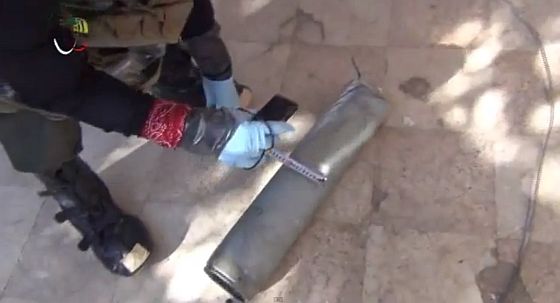
Since the attacks the remains of only two munitions have been recorded by activists in Damascus. The first, a M14 140mm artillery rocket fired from the BM-14 multiple rocket launcher (and variants), was filmed in Medmah al-Sham in Damascus, and footage recorded by the activists shows the UN inspectors taking measurements and samples from the munition. The remains shown in the video are barely damaged, with only the warhead and connector missing. This may be significant, as one potential warhead carries 2.2kg of sarin, but it should be clear there’s also a smoke warhead for this munition. As with both munitions linked to the alleged chemical attack, it seems only the UN report will clarify whether or not these were likely to be carrying any sort of chemical agent. Only one example of this artillery rocket was recorded and put online, it’s unknown if there’s further examples at the attack sites. More details on the M14 140mm and my identification of it can be found here.

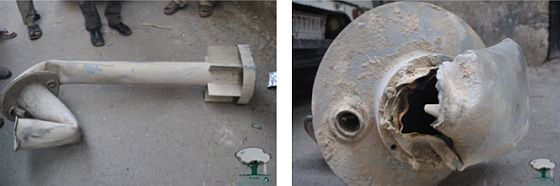
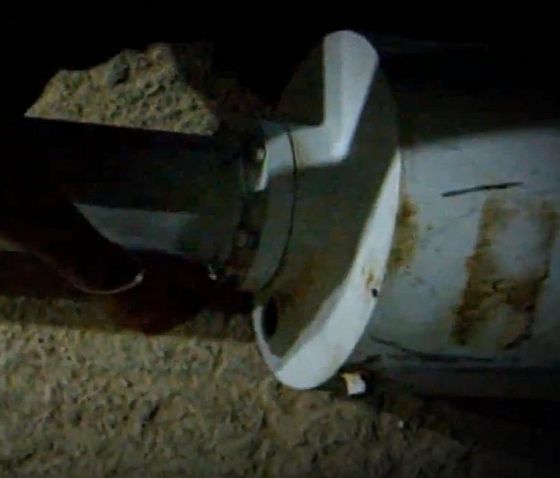
The second munition linked to the alleged chemical attack is pictured above. What’s extremely interesting about this munition is it appears to be something that’s unique to the conflict. I’ve spoken to a number of arms and chemical weapons specialists, and they do not recognise this as any specific type of munition. For the purposes of this blog post, and to save me having to write out “the unidentified munition linked to alleged chemical attacks” repeatedly, I will refer to this as the UMLACA (Unidentified Munition Linked to Alleged Chemical Attacks). [Continue reading…]

The canister shown in the image above, appears to be of similar dimension to the head of the missile shown in the video at the top of this post. Its construction quality does not suggest that this was fabricated in some jihadist’s workshop. Moreover, the launcher shown in the video appears to be an Iranian Falaq-2 model, according to N.R. Jenzen-Jones.

For those who are still in the false flag brigade and who insist that the attack must have been launched by an opposition element — sure, that’s possible.

It’s possible that rebels were able to steal or capture an Iranian launcher. It’s possible that they were also able to obtain missiles already armed with their chemical components from one of the regime’s stockpiles. It’s possible that having gathered together the weapons and the delivery system. It’s possible that each of these came with detailed instructions on how to use them. And it’s possible that these novices in the use of such weapons were quick studies and successfully fired them.

All of that is possible. But is it likely? And given the more obvious explanation — that these chemical weapons were being used by the forces that had been trained and then authorized to use them — why lean in favor of the remote possibility?

I suspect the reason is this — and it has nothing to do with the evidence. If you start with two convictions — that military intervention in Syria is a bad idea, and that the U.S. is hellbent on intervening — then you will be vigilant, watching for anything that could be used as a pretext for intervention. If such a pretext emerges, then the first line of resistance in preventing its use as a justification for intervention will be to say: it didn’t happen. The second line of resistance is to concede it happened but to assert that the Assad regime was not responsible.

The cause is just — attempting to oppose what appears to be an unjust war-making agenda — but its pursuit gets quickly divorced from any desire to be objective. The focus is on that which must be resisted, even if that means abandoning any real interest in what actually happened.

Facebooktwittermail

The constituency Congress worries about: Israelis anxious about Obama’s ‘retreat’ on Syria

When members of Congress return from vacation and debate President Obama’s measure calling for military strikes on Syria, some people think that the body elected to represent the will of the American people will pay more attention to popular opposition to the strikes than to pressure from the White House. Yet many members of Congress will be less attentive to either of those elements and be much more concerned about how this issue is playing in Israel. When members of Congress see headlines like this — “Israelis fear U.S. debate on Syria foreshadows weakness on Iran” — they will be left in no doubt about which way to cast their vote.

Moreover, when Obama enjoys resolute support from the Jerusalem Post and from President Shimon Peres, no one on Capitol Hill needs to think too deeply about what their ‘duty’ dictates.

Sure, there will be a lively debate. There will be outright opposition from a liberal/libertarian/Tea Party coalition and Congress probably won’t give the president a blank check, but at the end of the day, Obama will get what he’s asking for. (But I’ll be happy to be proved wrong.)

The Los Angeles Times reports: Israel braced for rockets and got a diplomatic bombshell instead.

The Obama administration’s surprise decision to delay a U.S. strike against Syria to allow for congressional debate left anxious Israelis relieved Sunday that any potential blow-back from Syria would be postponed for at least a week.

But there was hand-wringing inside government offices over how Obama’s hesitancy will be interpreted in the restive region and what it says about U.S. assurances to Israel that it will use military force to stop Iran from obtaining a nuclear bomb.

Many here viewed Obama’s last-minute equivocation as the latest evidence of a growing U.S. reluctance to engage aggressively in the Middle East, a worrisome prospect for a nation that relies heavily on its close American ties to intimidate enemies.

Even if the U.S. eventually punishes Syria for its alleged use of chemical weapons last month, Obama’s delay is expected to embolden those in Israel who argue for a unilateral military strike against Iran.

And the upcoming congressional debate over Syria will complicate Israel’s effort to keep a low profile on the issue and avoid taking sides in what could become a partisan clash in Washington.

Not surprisingly, Obama’s announcement dominated the headlines and airwaves Sunday in Israel, where citizens had been rushing to get government-issued gas masks in anticipation that Syria or Iran would make good on their threat to bomb Israel in the event of a U.S. strike against Damascus.

Some praised Obama for putting the matter to a more rigorous debate. Many predicted the U.S. ultimately would still strike Syria and that the impact could be stronger with a united American front.

But in a region that tends to value military strength over democratic ideals, others lambasted Obama’s decision and said it would be seen as a sign of weakness. [Continue reading…]

The editorial in the Jerusalem Post spells out what no American politician would be blunt enough to say: that Israel and America have no interest in seeing the war in Syria end. They are content to see the killing continue — just so long as mass casualties from chemical weapons can be avoided. The measure of “success” following U.S. strikes will be that the world can sink back into its indifference about Syria.

[T]he ongoing civil war in Syria is primarily a humanitarian crisis. While there is a desire by the civilized world to stop the bloodshed and reinstate political stability, the West has no real geopolitical interests in ending the Syrian conflict.

Aside from the innocent civilians caught in the crossfire, there are no “good guys” among the sides of the conflict. The despotic Assad regime, which has no qualms about using chemical weapons to kill its own citizens, is battling against forces aligned with al-Qaida – the archenemy of the US – and against the Muslim Brotherhood.

Facebooktwittermail

If Obama wants to deter future chemical attacks, then he should focus on deterrence instead of punishment

President Obama announced this afternoon that he has decided to launch an attack on Syria but will not move forward until Congress has had an opportunity to debate the issue and has voted to authorize the attack.

Earlier this week, Politico reported:

As President Barack Obama moves closer to calling for military action against Syria, a powerful ally that could help him win over skeptics is staying quiet.

The Israel lobby, including the high-profile American Israel Public Affairs Committee and other Jewish groups, isn’t pushing for intervention even as evidence emerged this week that the Assad regime used chemical weapons against its citizens.

The silence could be a problem for Obama, since the Jewish groups are connected across the political spectrum, wielding influence from the far right to liberal Democrats on issues critical to the Middle East — especially when it comes to the use of military force.

And while Obama has been willing to strike a foreign country without Congress’s approval — as he did in Libya — this time he not only faces a reluctant Congress, but a vocal chorus of Republican and Democratic lawmakers publicly advocating against entanglement.

Since AIPAC and the rest of the lobby have thus far remained silent, will they now start lobbying on behalf of the White House? Possibly, but it seems just as likely that they will not want to be held responsible for pushing Congress to make an unpopular decision.

As for what Congress will do, Obama is taking a gamble, but not as big a gamble as Britain’s prime minister David Cameron took when he got defeated in parliament. Chances are, Congress will bloviate on the issues, tip their hats in the direction of a president who was polite enough to ask their opinions and then, since they don’t really have any, they’ll mostly line up behind him support his decision and sing the praises of the men and women of America’s armed services.

Since Obama has introduced an element that up until now was not part of the debate — that this attack once authorized could come at any time at all — there is another course of action that the White House should consider and that might actually make more sense even to those who remain mesmerized by the supposed utility of America’s military strength: use it as an ongoing deterrent rather than an instrument of punishment. In other words, once Obama has been given the green light from Congress, U.S. battleships can then hold their positions off the coast of Syria indefinitely ready to strike without warning.

If the goal is simply to prevent further use of chemical weapons, the threat of an attack of indeterminate scope is likely to have much more impact on Assad’s calculations than the memory of an attack his forces managed to survive.

Obviously, there are more constructive courses of action that America and its allies should pursue that would not involve either the threat or use of military strikes, but since strikes themselves are the focus of the current debate, then it’s surely preferable to think about using that particular form of power in the most intelligent way possible.

Facebooktwittermail

Opposing military strikes without dishonoring those who died in the Damascus chemical attacks

This may be the one and only time I ever quote Infowars, but at least on this occasion it’s worth pointing out why in the following instance (and no doubt too many others), it’s a boneheaded operation.

During his State Department speech today [Friday], Secretary of State John Kerry grossly misrepresented the facts about the chemical attack at Ghouta near Damascus.

“The United States government now knows that at least 1,429 Syrians were killed in this attack, including at least 426 children,” Kerry said. “I’m not asking you to take my word for it. Read for yourself, everyone… the evidence from thousands of sources, evidence that is already publicly available,” he added.

According to the international aid group Doctors Without Borders, however, 355 people were killed, not the wildly exaggerated figure cited by Kerry.

To inflate 355 deaths to 1,429 would certainly be a wild exaggeration. But did Doctors Without Borders report that just 355 people were killed?

No.

This is what they said:

Three hospitals in Syria’s Damascus governorate that are supported by the international medical humanitarian organization Doctors Without Borders Médecins Sans Frontières (MSF) have reported to MSF that they received approximately 3,600 patients displaying neurotoxic symptoms in less than three hours on the morning of Wednesday, August 21, 2013. Of those patients, 355 reportedly died.

That’s 355 people who survived the attack, were taken to one of the three hospitals referred to, and then died.

A lethal dose of sarin can kill someone in one minute. The majority of the children who died in the attack most likely died before they could even crawl out of bed. The 3,600 people who reached a hospital were those who had suffered less exposure. Most of the dead probably didn’t get outside their homes.

When I say Infowars is a boneheaded operation, I’m giving them the benefit of the doubt. I’m assuming their analysis is stupid and not purposefully deceptive.

And as I’ve said repeatedly over the last week, there are many good reasons to oppose the imminent U.S. military strikes on Syria. But those who minimize the scale of the chemical attack, or based on minimal evidence insist that it must have been launched by the opposition, do two things:

1. They undermine their own credibility.
2. By arguing from what is increasingly exposed as a false position they thereby empower those they are arguing against.

If the Obama administration sounds more credible in its assessment of what happened on August 21, then more Americans will be inclined to accept the administration’s determination of an appropriate response to the attacks.

What the administration has utterly failed to do and has not even attempted, is to explain why anyone should expect or have any confidence that the strikes it has planned will actually have their intended effect — to deter any future chemical attacks.

Since President Obama has already made it clear that neither he, nor the Pentagon, nor most Americans have any appetite to enter a broader military intervention in Syria, the punitive strikes that seem likely to take place in the coming hours, may prompt the Assad regime to plan and carry out yet another chemical attack.

The follow-up attack may be smaller than the one on August 21. It may again occur with conflicting assertions about who is responsible and yet it will almost certainly accomplish its strategic objective: to confront the United States with an impossible choice — to either ignore the attack and thereby demonstrate that the first “punishment” was less than ineffective; or, to get drawn into a cycle of escalation that almost every American wants to avoid.

And just in case anyone thinks that’s a piece of wild conjecture I plucked out of thin air, in fact it comes from the former U.S. ambassador to Syria, Lebanon, and Iraq, Ryan C. Crocker.

Facebooktwittermail

Whatever Obama does, Assad wins

President Obama says he hasn’t made a decision on whether to launch a military strike on Syria. Having consulted with his national security team and with foreign allies, the one person he might wish he could secretly consult would be the Syrian president himself. After all, since the White House has made it abundantly clear that the widely announced coming attack (assuming it happens) will be limited in scope, it’s effect will largely be determined by Bashar al-Assad. This might be what Bashar would tell Barack:

I’ve looked at your options, and I’m going to be honest here, I feel for you. Not exactly an embarrassment of riches you’ve got to choose from, strategy-wise. I mean, my God, there are just so many variables to consider, so many possible paths to choose, each fraught with incredible peril, and each leading back to the very real, very likely possibility that no matter what you do it’s going to backfire in a big, big way. It’s a good old-fashioned mess, is what this is! And now, you have to make some sort of decision that you can live with.

So, where do I begin? Well, this is just the tip of the iceberg, but let’s start with the fact that my alliance with Russia and China means that nothing you decide to do will have the official support of the UN Security Council. So, right off the bat, I’ve already eliminated the possibility of a legally sound united coalition like in Libya or the First Gulf War. Boom. Gone. Off the table.

Now, let’s say you’re okay with that, and you decide to go ahead with, oh, I don’t know, a bombing campaign. Now, personally, I can see how that might seem like an attractive option for you. No boots on the ground, it sends a clear message, you could cripple some of my government’s infrastructure, and it’s a quick, clean, easy way to punish me and make you look strong in the face of my unimaginable tyranny. But let’s get real here. Any bombing campaign capable of being truly devastating to my regime would also end up killing a ton of innocent civilians, as such things always do, which I imagine is the kind of outcome you people would feel very guilty about. You know, seeing as you are so up in arms to begin with about innocent Syrians dying. Plus, you’d stoke a lot of anti-American hatred and quite possibly create a whole new generation of Syrian-born jihadists ready to punish the United States for its reckless warmongering and yadda yadda yadda.

Okay, what else? Well, you could play small-ball and hope that limited airstrikes to a few of my key military installations will send me the message to refrain from using chemical weapons again, but, c’mon, check me out: I’m ruthless, I’m desperate, and I’m going to do everything I can to stay in power. I’d use chemical weapons again in a heartbeat. You know that. And I know you know that. Hell, I want to help you guys out here, but you gotta be realistic. Trust me, I am incapable of being taught a lesson at this point. Got it? I am too far gone. Way too far gone.

Oh, and I know some of you think a no-fly zone will do the trick, but we both know you can’t stomach the estimated $1 billion a month that would cost, so wave bye-bye to that one, too.

Moving on.

I suppose you could always, you know, not respond with military force at all. But how can you do that? I pumped sarin gas into the lungs of my own people, for God’s sake! You can’t just let me get away with that, can you? I mean, I guess you easily could, and spare yourself all of this headache, but then you would probably lose any of your remaining moral high ground on the world stage and make everything from the Geneva Conventions to America’s reputation as a beacon for freedom and democracy around the world look like a complete sham.

And, hey, as long as we’re just throwing stuff out there, let’s consider a ground invasion for a moment. Now, even if you could reasonably fund a ground invasion, which I’m pretty sure you can’t, what exactly would such an invasion accomplish in the long term? I suppose it’s possible that you could come in and sweep me out the door and that would be the end of it. It’s possible. You know, like, in the sense that seeing a majestic white Bengal tiger in the wild is possible. Or, more likely, you could find yourself entrenched in a full-blown civil war that drags on for 15 years and sets off further turmoil in the rest of the region, leading to even more dead bodies for your country and mine, and even more virulent hatred of America. In fact, boy, maybe this is the one option that should be totally off the table.

Oh, and speaking of me being toppled from power, let’s say, just for fun, that tomorrow I were to somehow be dethroned. Who’s in charge? Half of these rebel groups refuse to work with one another and it’s getting harder to tell which ones are actually just Islamic extremists looking to fill a potential power vacuum. We’ve got Christians, Sunnis, and Shias all poised to fight one another for control should I fall. You want to be the ones sorting through that mess when you’re trying to build a new government? I didn’t think so.

As Marsha Cohen notes, some of the most astute political commentary these days comes in the form of satire, and no, the words above did not actually come from Bashar al-Assad — they came from the Onion.

At the same time, there are quite a few professional political commentators whose work might benefit a bit if they injected a bit of irony into their observations.

A few days ago a blog post at The Nation on “The Moral Obscenities in Syria” solemnly featured the favorite question of all conspiracy theorists: Cui bono? Who benefits?

It’s a reasonable question. But by this point, when it comes to the chemical attacks in Damascus, it’s an easy question to answer: Assad, of course.

Whether Assad planned the attack, authorized it, or even knew about it before it captured the headlines, is by now besides the point.

Whether by accident or by design, this has turned out to be one of the most grizzly master-strokes in the whole conflict.

If 100,000 deaths exposed Western indifference to the plight of Syrians, 1,400 additional deaths are now exposing the impotence of the most powerful nation on earth and the weakness of the man who tries to play the role of the most powerful man on earth. And that’s the problem with both these expressions of American hubris: they only hold up when left untested.

American power might be more sustainable if it had more subtlety and didn’t allow itself to always ultimately be reduced to a display of pyrotechnics. Yes, Americans have great skill in setting off explosions — in the art of shock and awe — but when was the last time one of these performances actually accomplished something useful?

President Obama might feel like he’s rounding out his experience of presidential power if he gives the order for a fusillade of cruise missile strikes on Syria some time in the next few days, but to what end?

Years hence, when Obama feels safe enough to give an honest explanation for why he acted, will it be any better than Bill Clinton’s explanation for his relationship with Monica Lewinsky? “I did something for the worst possible reason — just because I could,” he said. “I think that’s just about the most morally indefensible reason anybody could have for doing anything.”

With a preponderance of the evidence always pointing strongly in the direction of the Assad regime being responsible for the chemical attack, the most pressing question has never been, who did it? but rather, what is an appropriate response?

In 2006, after a Hezbollah ambush resulted in eight Israeli soldiers getting killed and two captured, Israeli Prime Minister Ehud Olmert launched a war in which he said that Hezbollah’s stronghold in Southern Lebanon would be bombed “back into the stone age”. But after a month of devastating air strikes, Hezbollah, far from having been crushed, had demonstrated its capacity to withstand the assault. Once the fighting ended, Secretary-General Hassan Nasrallah was able to declare that Hezbollah had achieved a “divine victory” and his popularity soared across the Arab world among both Shia and Sunnis.

Likewise, an American attack on Assad’s military infrastructure — an attack which will be small in comparison to Israel’s assault on Lebanon — is pretty much guaranteed to leave the Syrian leader stronger. He will have faced and withstood American might and his willingness to use chemical weapons may not even have been diminished.

Even if his use of chemical weapons in the future turns out to be more cautious, the August 21 attack will still serve as a reminder of his force’s capabilities. Just as the Deir Yassin massacre in Palestine in 1948 demonstrated, a relatively small massacre can have a huge effect in terrorizing a population.

Assad has arguably already demonstrated the value of his chemical weapons arsenal even if he never uses it again. And Obama’s message to Assad — his “punishment” for using prohibited weapons — is likely to telegraph to the Syrian people the opposite message: that there is no limit on the number of people the regime slaughters so long as their deaths are bloody — the kinds of deaths the world deems tolerable.

Facebooktwittermail

A military strike on Syria shouldn’t be triggered by proving that Assad used chemical weapons

At least there was one useful outcome from the war in Iraq: Western governments no longer have the luxury of being able to launch wars based on pretexts that escape careful scrutiny. We are no longer purely at the mercy of rumors from shadowy figures like “Curveball.” We are however still vulnerable to specious lines of reasoning.

Here’s how the current hoax is operating largely without impediment:

President Obama set a “red line” a year ago on Syria’s use of chemical weapons — except it wasn’t red and it wasn’t a line.

In August last year, Obama said:

We have been very clear to the [Assad] regime, but also to other players on the ground, that a red line for us is we start seeing a whole bunch of chemical weapons moving around or being utilized. That would change my calculus. That would change my equation.

Even if the phrase “being utilized” seemed unambiguous, it certainly wasn’t clear what “whole bunch” and “moving around” were supposed to mean.

Over the following year, following reports of chemical weapons indeed being assembled, moved around, and utilized, Obama’s red line seemed to morph and its implied meaning became that if Assad used chemical weapons and killed a whole bunch of Syrians then the line would have been crossed.

Yet even if an implied definition of the red line emerged, to call it red always suggested that on the other side of the line there was some tangible threat — yet there never was. Obama had said that if Assad crossed the line, this would change Obama’s “calculus” and “equation.” That could mean anything. It could for instance mean that such an action would change Obama’s opinion about Assad and his regime.

When the Bush-style phrase “red line” slipped from Obama’s lips, it seems he instantly recognized he’d made a mistake and so his effort at damage control was to give his red line an indecipherable definition. But it didn’t work. In political discourse, “red line,” is a much stronger meme than “change my calculus.”

So, even if Obama did not think he was committing himself to military action a year ago, that’s what he did.

The argument he had inadvertently constructed was simple and moronic: If Assad uses chemical weapons, America will become directly engaged in the war in Syria.

If the use of chemical weapons by Assad’s forces can be proved, then U.S. military action logically follows.

Almost everyone now, having become slaves to that logic, is insisting on seeing the proof that chemical weapons have been used, yet fewer challenge the logic itself.

Let’s suppose that over the next week or so, the Obama administration can put together a very compelling case based on detailed intelligence and forensic evidence that chemical weapons were used and that they were indeed used by Assad’s own forces. Obama by that point will have won three-quarters of the argument. The doubters will have been sidelined and the proponents of military action further empowered.

Yet military action to what end?

Assad misbehaved and now he’s getting punished and if the punishment is suitably measured he won’t misbehave again?

Sorry, but psychology that might be applicable in a kindergarten probably isn’t applicable to a regime that is fighting for its survival.

Assad didn’t reach into a cookie jar without permission. After which having been appropriately scolded he can’t necessarily be expected to behave properly.

The regime might already be fragmenting and the risk of further use of chemical weapons might not come from them falling into the hands of Jabhat al-Nusra — it may come from units inside the Syrian army who are already in control of these weapons and who start to operate as independent militias.

Obama’s real calculus now is the worst one upon which any decision to engage in military action can be based: how can I avoid looking weak? He wants to fire just enough cruise missiles so that he and the United States can avoid getting mocked and not so many that they provoke retaliation. To accomplish what?

The use of military action for no other purpose than as a show of strength is really a demonstration of the opposite — a fear of appearing weak.

If Obama really wants to engage in an action that could have tangible positive results — though it would require immense political courage — he should set aside his strike plans and target lists and pick up the phone to call Tehran.*

President Hassan Rouhani is fluent in English, has a doctorate in constitutional law, and Iran has more political leverage in Syria than any other country in the region. Iranians also have had the experience of being victims of chemical warfare. If anyone has the power to break the stalemate in Syria, it’s Iran. Indeed, a diplomatic opening between Washington and Tehran would probably act as a much more powerful incentive than any other for Bashar al-Assad to start exercising caution and stop killing so many of his people.

*This suggestion comes from Marsha B. Cohen of Lobe Log.

Facebooktwittermail

Breaking international law in order to defend it

Remember the popular uprising that began in Iraq in 2001? Remember the peaceful protests and the ruthlessness with which Saddam crushed his opponents? Remember the Free Iraq Army fighting against the Republican Guard and the many cities that were turned to ruble during the two years that preceded the U.S. intervention into what had by then become a civil war? Remember the chemical weapons attack in which hundreds died and the shocking videos that Colin Powell showed at the UN Security Council? Remember how there was atrocity after atrocity and George Bush’s only response was to say he was gravely concerned?

Remember all of that?

Me neither.

So let’s see Syria for what it is and not like broken record players insist that 2013 is a rerun of 2003.

After all, the search for parallels tends to be an exercise in magical thinking. We say this is like that, as though on the basis of a tenuous symmetry we will then be able to predict the future.

The most significant parallel between 2003 and 2013 is one that applies to virtually all armed conflicts: it’s very difficult to predict how they will end.

So, when President Obama and other U.S. officials begin their earnest sales campaign on the necessity and value of launching some kind of attack on Syria, the thing to view with greatest skepticism is any kind of prediction about the outcome of this intervention.

This operation will send a strong signal to President Assad that he cannot use chemical weapons with impunity.

The implication being that he will be deterred from using CW again. But will that be the outcome? We don’t know. Maybe he’ll use them more often but on a much more limited scale. Maybe there will become an even greater incentive for others to seize and use CW in the hope that the U.S. can be dragged even deeper into the conflict.

This operation will send a signal to tyrants around the world that the international community is willing to take any necessary action in the defense of international law.

The problem is, international law — as far as I’m aware — doesn’t include provisions for punitive military strikes without the authorization of the UNSC. All the U.S. will be demonstrating is that it retains its long-standing view of itself as the world’s policeman. That won’t defend international law — it will merely show that America’s imperialistic tendencies have yet to diminish.

But perhaps even more disturbing than any prediction, Obama may attempt to sell his chosen course of action on the basis of necessity — that even if no one has any idea where this might lead, the President of the United States found himself with no choice but to launch an attack.

We had no choice is always a lie and a cop out. It represents an effort on the part of decision-makers to conceal the manner in which they make their choices. And it represents a refusal to accept responsibility for the consequences of those choices.

Facebooktwittermail

Nothing says something more clearly than cruise missiles

Once again the “something must be done” brigade has taken charge. The cruise missiles being readied for strikes against targets unspecified in Syria will carry the message of “accountability.”

CBS News reports:

There was no debate at the Saturday meeting [of President Obama’s national security team] that a military response is necessary. Obama ordered up legal justifications for a military strike, should he order one, outside of the United Nations Security Council. That process is well underway, and particular emphasis is being placed on alleged violations of the Geneva Convention and the Chemical Weapons Convention.

And the chances that those legal justifications might not be found? Zero. (It’s worth noting that Syria, like Israel, is not a party to the Chemical Weapons Convention.)

An American intelligence official told Foreign Policy the other day that this was — and presumably remains — the U.S. position on Syria: “As long as they keep body count at a certain level, we won’t do anything.”

That “certain level” presumably meant a relative level. No doubt that level was never going to be specified but from what one can infer from the historical record it meant that if the daily death toll remained in the dozens to low hundreds and Syrians were being killed by conventional weapons, then whatever the absolute body count — be it 100,000 or 200,000 or even 1,000,000 — the United States would do nothing.

With the use of chemical weapons, it appears that Bashar al-Assad has crossed the threshold of an acceptable number of dead and method of killing and so the U.S. and its allies are ready to launch cruise missiles — armed of course with conventional warheads — to impose some form of accountability on the Syrian regime.

The killing can continue, but the further use of chemical weapons is forbidden. Syrians will soon be able to sleep somewhat more comfortably (so long as they don’t get killed by U.S. cruise missiles), reassured that they are less at risk of dying from asphyxiation but still at risk of getting blown up or buried under rubble as their homes are destroyed under artillery fire.

Obama et al can claim they sent a message without having thrust their respective countries directly into another war. Or to be more precise that the West will have only made a cameo appearance in the war in Syria. Widespread public opposition to military intervention will most likely be sufficiently placated by witnessing that direct intervention turned out to be brief.

Indeed, as the cruise missile message is currently being crafted, the focus is on punishment, not intervention.

As the Associated Press reports:

The international community appeared to be considering action that would punish Assad for deploying deadly gases, not sweeping measures aimed at ousting the Syrian leader or strengthening rebel forces. The focus of the internal debate underscores the scant international appetite for a large-scale deployment of forces in Syria and the limited number of other options that could significantly change the trajectory of the conflict.

“We continue to believe that there’s no military solution here that’s good for the people, and that the best path forward is a political solution,” State Department spokeswoman Marie Harf said. “This is about the violation of an international norm against the use of chemical weapons and how we should respond to that.”

Bashar al-Assad, having been forcibly instructed in the international norms that cannot be violated will presumably continue engaging in those actions that were normal before last week’s chemical attacks and have occurred without interruption every day since: 148 people killed today, 80 on Sunday, 114 on Saturday, 86 on Friday, 115 on Thursday — the kinds of death toll that Western governments and the populations they represent can comfortably ignore.

Facebooktwittermail

The dehumanizing effect of opposing war

Yes, you read that right: The dehumanizing effect of opposing war. Say what?

A vast amount has been written on the dehumanizing effects of war — essays, commentary, treatises and works of literature many of which deserve to be required reading in every school and college around the world.

Yet the dehumanizing effect of opposing war is a subject on which I haven’t I’ve read a single word.

But how could opposing war be dehumanizing? Isn’t opposition to war one of the most humanitarian of expressions?

Certainly it should be, yet here is where such opposition frequently deviates away from its humanitarian roots: opposition to war morphs into opposition to war makers.

Once the focus becomes the war makers — the governments, the corporate interests, the political lobbies, the opinion makers and so forth — then it becomes possible to view something like the chemical attacks in Damascus as some kind of manufactured event.

Having made that shift, it then becomes that much easier to become emotionally disengaged.

Here’s a small boy struggling for his life:

Do you wonder whether this has been ‘faked’? Are you afraid that the propagation of videos of this type is happening purely for the purposes of political manipulation? Do you think that this kind of suffering reveals something about the barbaric nature of the Middle East? Do you feel that Americans are being coerced into giving attention to an issue that should not involve Americans?

If you answered yes to any of those questions, you might want to consider whether you are suffering from the dehumanizing effect of opposing war.

The other day in response to an op-ed on the chemical attack in Damascus, someone wrote a comment on this site which included this:

I do not think any Western government has any moral standing to say anything about the killing of citizens given its own view on killing its own citizens. I’m appalled by the whole mess and the West’s economic and ideological entanglement and the simpering nonsense feed [sic] to the public by the elite media outlets. I just want to stick my head in the ground and not think or know anything about the snafu that is our Western vision, just now, of international affairs.

There is a disarming level of honesty and sense of frustration in anyone admitting that they would prefer to remain ignorant. But to object to the hypocrisy of Western governments does not require that we prevent ourselves from having a human reaction to the deaths of thousands of innocent people. Just because Barack Obama and David Cameron make sanctimonious statements about the use of chemical weapons being intolerable doesn’t mean that we should do the reverse.

If we do that — if we come to regard the slaughter of thousands as somehow inconsequential — it’s time to ask whether our opposition to war is truly that or whether it’s merely a desire that war not intrude on our lives, eat up our tax dollars, and fill our TV screens.

Has opposition to war been reduced to nothing more than a desire that it would go away?

(The videos in this post came from Joanna Paraszczuk’s latest post at EA WorldView.)

Facebooktwittermail

Further evidence The Independent may be colluding with GCHQ

A report in The Independent yesterday included this line in reference to a GCHQ project (the construction of a major surveillance center in the Middle East):

Information about the project was contained in 50,000 GCHQ documents that Mr Snowden downloaded during 2012.

Since Edward Snowden issued a statement making it clear that he was not a source for this report, the claim that he obtained 50,000 GCHQ documents (a claim that has not previously been reported) begs two questions:

1. Who is the source of this claim?
2. Is the claim factually correct?

Given that the report says nothing whatsoever about its sourcing, but does include, “The Government claims…,” we can at least conclude that The Independent‘s reporters were speaking to British government officials, most likely inside GCHQ itself.

So how would GCHQ “know” that Snowden downloaded 50,000 GCHQ documents? It’s possible that David Miranda was carrying the whole trove of leaked documents on the laptop that was confiscated from him by British police when he detained in Heathrow airport last weekend. But I’m inclined to doubt that these documents are now being carried around anywhere by anyone unless that is absolutely necessary.

Back in July, Bloomberg reported that NSA chief Keith Alexander “said the NSA has determined which files Snowden took and said they amounted to a lot of information, though he wouldn’t say how much.”

So, the NSA must have informed GCHQ. Right? Not so fast.

The Associated Press now reports:

The U.S. government’s efforts to determine which highly classified materials leaker Edward Snowden took from the National Security Agency have been frustrated by Snowden’s sophisticated efforts to cover his digital trail by deleting or bypassing electronic logs, government officials told The Associated Press. Such logs would have showed what information Snowden viewed or downloaded.

The government’s forensic investigation is wrestling with Snowden’s apparent ability to defeat safeguards established to monitor and deter people looking at information without proper permission, said the officials, who spoke on condition of anonymity because they weren’t authorized to discuss the sensitive developments publicly.

And those 50,000 documents? That’s probably GCHQ fishing for information, feeding a line to a journalist who doesn’t care too much whether it’s true, and then waiting to see whether Glenn Greenwald or Snowden bites the bait and divulges more information about what documents did or did not get leaked.

Facebooktwittermail

Independent of GCHQ?

When a newspaper report appears with four names in the byline, it’s either an indication that the depth of the reporting required a team, or perhaps the opposite — that the report was so suspect, no one person was willing to take responsibility.

Kim Sengupta’s lack of confidence in his own reporting in an “exclusive” for The Independent is evident in the fact that he felt it needed to be backed up with an op-ed. The op-ed itself, while filled judiciously with caveats, amounts to a resounding expression of confidence in the work of Britain’s intelligence services, its “highly professional” employees and their ability to protect the British people “against the ravages of terrorism.”

That GCHQ — Britain’s arm of the NSA which operates nominally under the authority of the British government — having built a massive surveillance center in the Middle East presents no moral dilemmas, according to Sengupta.

People would expect them to do so in a region enmeshed in so much turmoil, which had been the source, at times, of bombings in this country.

By “people”, Sengupta presumably means British people — not the people whose communications are being monitored. The fact that this center has been built with the consent of a host government that most likely is unelected — that presents no moral dilemmas? How about this one: that such a government will expect strong support from the UK and the U.S. if threatened by a homegrown democracy movement? Providing land for a massive GCHQ operation sounds like the kind of insurance policy that many an Arab autocrat would view as a sound investment.

Given that Sengupta positions himself as a fairly unambiguous cheerleader for GCHQ, why would he now being exposing some of its most sensitive operations? The answer, as far as I can tell, is that this is simply a case of: you scratch my back and I’ll scratch yours.

Intelligence sources provided The Independent with enough details for the paper to stitch together an exclusive and in return the paper launched an insidious multipronged attack on The Guardian, Glenn Greenwald, and Edward Snowden. The Guardian is presented as kowtowing to the demands of the British government, Greenwald as a potential threat to Britain’s national security, and Snowden as the purveyor of information that could put lives at risk — and all of this comes right at the time that Scotland Yard is conducting a “terrorism investigation into material found on the computer of David Miranda,” Greenwald’s partner.

At a time when journalism itself is under threat, it might not be surprising yet it is nevertheless depressing that there are so many journalists willing to sell out their own profession.

Facebooktwittermail

Dictators, massacres, and the media

Does Bashar al-Assad check his approval ratings? Probably not. But that’s no reason to believe that he or his government lack interest in their public image. Indeed, Assad probably pays as much attention to how he is perceived in New York and Washington, as he is in Homs or Alleppo, which is not to say he hopes to make any new American friends but rather that he has a keen interest in the extent to which he can rely on American indifference.

Having already probed the international political and media environment with some exploratory ‘minor’ use of chemical weapons and triggered no major international public or political outcry, the Syrians have likely been looking for the most propitious moment to escalate. As much as people refer to the use of chemical weapons as ‘unthinkable’ and ‘unconscionable,’ the regime quite likely sees this class of weapons as useful in several ways.

Firstly, they are very effective as instruments of terror. To avoid a cloud of dispersing poisonous gas is far more difficult than avoiding artillery fire. Since there’s really no way to take cover, the incentive to flee will be that much higher.

Secondly, if pockets of resistance can be cleared without destroying most of the physical infrastructure, then in a city such as Damascus it will be that much easier for the regime to fool itself into believing that it is avoiding destroying the city.

So, the primary obstacles to the use of chemical weapons are international law and public opinion. International law has little power if the United Nations Security Council does nothing to promote its enforcement, and in the case of Syria there is no consensus among the UNSC’s veto-wielding members.

That leaves the limited effect that public opinion can have on shaping the actions of individual governments.

If Assad wanted to run a test to see what kind of reaction the slaughter of hundreds more of his citizens might have in a world that already seems largely indifferent to the deaths of over 100,000 people, he couldn’t have been better served than he was by General Sisi’s operations in Cairo last week in which hundreds of Muslim Brotherhood protesters were gunned down.

The U.S. cancelled military maneuvers that were due to take place with their Egyptian counterparts next month. A few generals won’t be sharing cocktails together. As for the press reaction, predictably the casualties weren’t ‘Egyptians’ — they were ‘Islamists’ who, we are often led to believe, have a predilection for martyrdom.

For Assad, the signals from Cairo were all positive. Add to that America’s overriding preoccupation with the actions of the NSA and now the sentencing of Bradley Manning, and all of Assad’s advisers must have agreed that this week looked the perfect week to fire off some chemical weapons. A front-page story, but just a one-day story, was probably the assessment.

The New York Times turns out to be have been the only major U.S. newspaper that made this its lead story, yet cautious as ever it played down the casualty size and underlined the uncertainty about the causes of death: “Scores Killed in Syria, With Signs of Chemical War” and “Images of Death, but No Proof of Cause.”

The Washington Post went with “Syrian regime accused of chemical attack” — no mention of the number of casualties and the lead story was on the NSA. Likewise the Los Angeles Times kept numbers out of its headline: “Syrian rebels allege new gas attack.”

USA Today said: “Rebels say chemical attack kills hundreds” — again this ran beneath the lead on the NSA.

The Atlanta Journal-Constitution consigned the story to page two.

Assad’s media advisers must be reporting back to their president: Mission accomplished. As we expected, the U.S. government doesn’t care too much about what we do and the American people care even less. The really big news today is that a young American soldier changed his name.

More sarin is on the way.

Update: As Brian Whitaker noted, there is another element in the timing of this attack: it comes on the one-year anniversary of Obama laying down his ‘red line’ on the use or even movement of chemical weapons.

Facebooktwittermail

Jeffrey Toobin’s crazy logic

Three weeks ago, the mild-mannered New York Times reporter, James Risen, nailed Jeffrey — Snowden’s a criminal — Toobin, when Risen said:

“That’s the thing I don’t understand about the climate in Washington these days, is that people want to have debates on television and elsewhere, but then you want to throw the people who start the debates in jail.”

Having been left speechless, Toobin seems to have has spent the last three weeks struggling to come up with a come back.

This is what he came up with:

The assassinations of Martin Luther King, Jr., and Robert F. Kennedy led directly to the passage of a historic law, the Gun Control Act of 1968. Does that change your view of the assassinations? Should we be grateful for the deaths of these two men?

Of course not. That’s lunatic logic. But the same reasoning is now being applied to the actions of Edward Snowden. Yes, the thinking goes, Snowden may have violated the law, but the outcome has been so worthwhile.

Say what? James Earl Ray and Sirhan Sirhan were advocates of gun control? That’s the unintended lunatic logic in Toobin’s reasoning.

Somehow I doubt that Toobin’s capacity to reason is that impaired. His purpose, much more likely, is to make an emotive argument based not on reason, but insinuation. Having already committed himself to the position that Snowden is a criminal, Toobin now wants to up the ante by placing him on a par with infamous assassins.

For Toobin, Snowden’s unforgivable crime was that he stepped out of line. The man who Toobin views with utter contempt is a “thirty-year-old self-appointed arbiter of propriety [who] decided to break the law and disclose what he had sworn to protect. That judgment — in my view — was not Snowden’s to make.” In other words, Snowden’s job was to do as he was told and not have the temerity to question the judgement of his superiors. Snowden’s sole responsibility was to follow his orders, without question.

If Toobin actually believes that the issue at stake here is one of propriety, then he’s even more confused than he already appears.

A state that engages in mass surveillance on its own population, is not merely being intrusive. Those of us who object to the NSA gathering all our personal information are not objecting because we think the NSA is being rude. Information is power and the more information the government acquires, the more likely it becomes that the power which flows from this information will sooner or later be abused.

In a final desperate swipe, Toobin suggests that Snowden can hardly be imagined to have stayed in Hong Kong and now taken up temporary residence in Russia without either the Chinese government or the Russian government gathering the classified information in his possession. They surely snuck into his room and copied his hard drive while he was asleep.

However much Snowden might lack the kind of stature for which Toobin reserves his respect, the former NSA contractor is an expert on one issue about which Toobin knows nothing: cyber security. Snowden knew how to gather the intelligence and how to extract it. I have little doubt in his ability to now maintain its security.

And what Toobin is forgetting, through his fixation on trying to undo his own embarrassment, is that Russia and China do actually have other interests at stake. Hong Kong was only too pleased to be relieved of its Snowden problem by seeing his departure, and Russia’s reluctance to take on the burden was made only too obvious by its insistence that Snowden, while he remained in Moscow airports transit lounge, was not in Russia.

Maybe it’s time for Jeffrey Toobin to follow Snowden’s lead and go into hiding for a while.

Facebooktwittermail

The Guardian and the constraints of state censorship

When the editor of The Guardian, Alan Rusbridger, published an op-ed yesterday on the arrest of Glenn Greenwald’s partner David Miranda at Heathrow airport on Sunday, Rusbridger waited until paragraph nine before describing the heavy-handed response of the British government to the Snowden leaks.

That the paper would be under pressure from the highest levels of government to shut down the story and that GCHQ goons would oversee the destruction of hard drives in The Guardian’s basement, would surely have warranted detailed coverage at the time of these events, accompanied by at least one strongly-worded editorial. So why did the paper’s editor wait two months to say anything, and why did he partially bury the story by reporting on it in the middle of the outcry following Miranda’s detention?

The short answer is: I don’t know. But the likely explanation is that The Guardian did not believe it was at liberty to disclose the latest example of Britain’s operation as a police state.

Prior to the incidents Rusbridger recounted, the Ministry of Defence had already moved to silence the press on June 7 by issuing a DA-Notice.

This is Britain’s Orwellian system of “guided media self-regulation”. Secret notices are issued advising newspaper editors when they should keep their mouths shut through a “voluntary” system which, if not followed, places an editor at risk of prosecution. It’s a bit like the friendly advice a Mafia enforcer gives someone on how to avoid getting his kneecaps shattered.

In the age of the internet, censorship is clearly an anachronism, but the fact that information might be widely available outside the UK is not in the eyes of the Ministry of Defence a justification for the same information to be disseminated further by British publications. The DA-Notice System cryptically advises: “just because something is on a foreign website, it does not necessarily mean that it has immediately been widely seen.” Which seems to imply, for instance, that just because a story appears in the New York Times, that doesn’t justify The Guardian covering it too.

On June 7, Jeff Stein reported:

The June 7 “DA-Notice,” or Defence Advisory Notice, which was itself confidential, accepted that the U.S. National Security Agency was sharing information gleaned from the surveillance programs with its British counterparts, and said UK intelligence organizations were worried about revelations of their own roles in the programs.

“There have been a number of articles recently in connection with some of the ways in which the UK Intelligence Services obtain information from foreign sources,” said the notice issued by the Defence Advisory Committee, a joint body with media organizations.

“Although none of these recent articles has contravened any of the guidelines contained within the Defence Advisory Notice System, the intelligence services are concerned that further developments of this same theme may begin to jeopardize both national security and possibly UK personnel,” it said.

The notice itself was marked “Private and Confidential: Not for publication, broadcast or use on social media.”

It warned British media not to publish information on “specific covert operations, sources and methods of the security services, SIS and GCHQ [the NSA’s British counterpart], Defence Intelligence Units, Special Forces and those involved with them, the application of those methods, including the interception of communications and their targets; the same applies to those engaged on counter-terrorist operations.”

British news organizations are concerned about the tenor of the advance warning.

“They’re sending out a notice saying nothing’s been published that damages national security but we’re concerned the press might (and on the back of developments in the US, no less),” said a media source.

The worry is that British authorities may be preparing to pursue reporters through the courts if they publish details on UK participation in the massive US electronic surveillance programs, code-named “PRISM” and “BLARNEY,” according to a report in The Washington Post.

At Columbia Journalism Review, Ryan Chittum writes:

Prior restraint is the nuclear option in government relations with the press and unfortunately, the British don’t have a First Amendment. But Rusbridger, having gone through the fire with Wikileaks, was prepared for that. The paper’s journalism is mostly being done in New York and the Snowden documents are dispersed in other countries.

Combine Rusbridger’s revelations with news of the detention of Greenwald’s partner David Miranda by UK authorities and you have a DEFCON 2 journalism event.

Miranda was serving as a human passenger pigeon, shuttling encrypted files on USB drives between filmmaker Laura Poitras and Greenwald because, as the whole world now knows, the Internet is fully bugged by the US and UK governments. So the UK, using an anti-terrorism statute, arrested Miranda on arrival at Heathrow, interrogated him for 9 hours, threatened to arrest him, and took his stuff. The war on whistleblowers has now escalated to disrupting journalists’ communications.

In light of Rusbridger’s disclosures, it’s even clearer that the detention of Miranda is part of an attack on American journalists authorized at the highest levels of the British government, and it’s an attack that is at the very least implicitly backed by the Obama administration.

Facebooktwittermail

Obama backtracks on promise to create ‘independent’ panel of ‘outsiders’ to review surveillance programs

Remember, it was just five days ago that President Obama promised to form “a high level group of outside experts” — an “independent group” — whose job would be to review the intelligence communities surveillance programs.

An indication that Obama has yet again been willfully attempting to mislead the American people was immediately evident in the fact that neither his memorandum instigating the creation of this panel, nor DNI Clapper’s follow-up, made any reference whatsoever to the composition of this group — no reference to its independence or that its members would genuinely be outsiders.

Having received a barrage of criticism for giving serial-liar Clapper the job of leading this panel, the White House has now reversed itself. Yet when it comes to following through on the promise that the panel will be independent, either Obama will have to retract his initial memo, or — more likely — he will soon issue some weasel words on the reason a group of intelligence insiders are the best qualified people to sit on the review panel.

National security council spokeswoman Caitlin Hayden says:

“The members require security clearances and access to classified information so they need to be administratively connected to the government, and the DNI’s office is the right place to provide that. The review process and findings will be the group’s.”

The panel is being directed to deliver its report within 60 days of its establishment, no later than December 15. That’s 122 days away and at this point, no one has even been selected to sit on the panel.

It typically takes an applicant 87 days to receive a security clearance to work at the NSA. Even if the process for panel members is expedited, the NSA will vigorously object to corners being cut since panel members will be looking at the most sensitive information that the government possesses.

If Obama really wanted this to be an independent review, he wouldn’t have set a December 15 deadline. The time frame looks like an exercise in pure cynicism. Superficially it creates the appearance of a desire to deal with this issue swiftly — for it not to become mired in bureaucratic inertia. But since — due to the deadline — the panel members will most likely all already have security clearances before being selected, irrespective of whether they have been employed by the federal government, they will be insiders.

I guess by President Obama’s definition, former NSA chief Gen Michael Hayden would fit the description of an “outsider.”

Facebooktwittermail

White House backtracks on Clapper’s role in surveillance review

“I can confirm we are not backtracking on what the president announced,” said national security council spokeswoman Caitlin Hayden when explaining how the White House is backtracking on the role DNI Clapper will have in “establishing” a panel reviewing NSA surveillance.

It turns out that when President Obama wrote, “I am directing you to establish a Review Group on Intelligence and Communications Technologies,” he meant things like, find a room, make sure there are enough chairs, take lunch orders — that kind of thing. As a self-confessed liar, Clapper is not being given the role of leading the meetings or choosing the panel members — though no doubt he’ll be able to eavesdrop on the conversation.

Hayden:

“As we announced on Friday, the review group will be made up of independent, outside experts. The DNI’s role is one of facilitation, and the group is not under the direction of or led by the DNI.

Facebooktwittermail