Category Archives: Editorials

Obama’s vision of good governance: that which warrants no scrutiny

In recent days Barack Obama has made it clear how he views his job — and that of the whole United States government. It’s effectiveness hinges on public trust, which is to say, if government is doing its job, ordinary Americans can forget about it and get on with their lives, confident that those who have been entrusted to govern can do so even if we don’t know what they are doing. Transparency is necessary only in so far as it serves to dissipate mistrust.

The information leaked by Edward Snowden has had the effect of diminishing trust in government and so the solution to that problem is anything that will elevate trust. Obama however can’t even acknowledge that trust has been severely undermined — most notably by the habit that he and his top officials have of lying — and so he now talks about the need to “maintain the public trust.”

In Obama’s memorandum initiating a review of U.S. surveillance programs and in DNI Clapper’s follow-up, not a single word is mentioned on the issues of civil liberties and the right to privacy.

Obama might as well have said: “We’re going to do whatever it takes for you folks to stop worrying yourselves and let us carry on with our work, uninterrupted. After all, it’s summertime. Shouldn’t you be out enjoying the sun?”

Facebooktwittermail

War and the death of personal responsibility

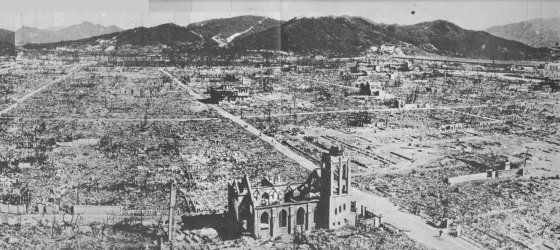
Hiroshima, August, 1945

The testimony of those who have fought in war is filled with accounts about gruesome acts that few individuals could ever have imagined engaging in or witnessing in any other circumstances. War opens up dark realms that don’t even enter the nightmares of those who have never been there. The more horrific the event, the more haunting the memory — or at least, so one might expect.

Sixty-eight years after the first atomic bomb was dropped on Hiroshima, Greg Mitchell looks back at the experiences of some of those who were involved.

Never before, nor subsequently, has there been an act of genocide in human history where so many people have been slaughtered in such a brief span of time.

At 8.15 am, local time, on August 6, 1945, Colonel Paul W. Tibbets unleashed the greatest force of human destruction ever devised, while piloting an aircraft to which the personal touch had been added: his mother’s name — the Enola Gay.

Forty years after the event, Mitchell spoke to Tibbets and they talked about his experience. But prior to that conversation, Mitchell visited Hiroshima.

While spending a month in Japan on a grant in 1984, I met a man named Akihiro Takahashi. He was one of the many child victims of the atomic attack, but unlike most of them, he survived (though with horrific burns and other injuries), and grew up to become a director of the memorial museum in Hiroshima.

Takahashi showed me personal letters to and from Tibbets, which had led to a remarkable meeting between the two elderly men in Washington, D.C. At that recent meeting, Takahashi expressed forgiveness, admitted Japan’s aggression and cruelty in the war, and then pressed Tibbets to acknowledge that the indiscriminate bombing of civilians was always wrong.

But the pilot (who had not met one of the Japanese survivors previously) was non-committal in his response, while volunteering that wars were a very bad idea in the nuclear age. Takahashi swore he saw a tear in the corner of one of Tibbets’ eyes.

So, on May 6, 1985, I called Tibbets at his office at Executive Jet Aviation in Columbus, Ohio, and in surprisingly short order, he got on the horn. He confirmed the meeting with Takahashi (he agreed to do that only out of “courtesy”) and most of the details, but scoffed at the notion of shedding any tears over the bombing. That was, in fact, “bullshit.”

“I’ve got a standard answer on that,” he informed me, referring to guilt. “I felt nothing about it. I’m sorry for Takahashi and the others who got burned up down there, but I felt sorry for those who died at Pearl Harbor, too…. People get mad when I say this but — it was as impersonal as could be. There wasn’t anything personal as far as I’m concerned, so I had no personal part in it.

“It wasn’t my decision to make morally, one way or another. I did what I was told — I didn’t invent the bomb, I just dropped the damn thing. It was a success, and that’s where I’ve left it. I can assure you that I sleep just as peacefully as anybody can sleep.” When August 6 rolled around each year “sometimes people have to tell me. To me it’s just another day.”

One of the other aircraft on the mission to bomb Hiroshima, at the time unnamed, was later named Necessary Evil — a response presumably to what had become the conventional wisdom: that as horrific as the use of nuclear weapons had been, their use had been necessary as the means to bring to an end the Second World War. The lives lost in Hiroshima and Nagasaki prevented even greater loss of life, had the war dragged on — so the argument goes.

But as Ward Wilson has persuasively argued, it was not the nuclear destruction of two of its cities that led Japan to surrender; it was instead the Soviet Union’s decision to invade.

The Soviet invasion invalidated the military’s decisive battle strategy, just as it invalidated the diplomatic strategy. At a single stroke, all of Japan’s options evaporated. The Soviet invasion was strategically decisive — it foreclosed both of Japan’s options — while the bombing of Hiroshima (which foreclosed neither) was not.

For many of those involved, war, seemingly driven by necessity, closes off the faculty of choice and where there is no sense of choice, there is little sense of responsibility.

Those who look back and question their own actions are implicitly considering the possibility that they could have acted otherwise.

Though it’s often said that truth is the first casualty of war, what keeps the war machine in perpetual motion is the conviction: we have no choice.

Facebooktwittermail

Snowden initiates review of U.S. surveillance operations — Obama takes credit

“I called for a thorough review of our surveillance operations before Mr. Snowden made these leaks,” President Obama claimed today in a press conference at the White House.

Oh really? Was this in a classified memo? Was it going to be a secret review whose findings would never be made public?

And if Obama was already working on this issue, how come it wasn’t until after the first leaks that for the very first time he sat down with the Privacy and Civil Liberties Oversight Board?

If this board now has an essential role in the review Obama has just proposed, there is no evidence whatsoever that he attached much significance to the board’s operations prior to the leaks. As Government Executive reported this week:

The little-known Privacy and Civil Liberties Oversight Board, created in 2007 on a 9/11 Commission recommendation, was limping along for years with no appointees or staff leadership. All that changed with this summer’s revelations of domestic surveillance of Americans’ telephone activity by the National Security Agency.

The board — an independent agency that consists of four part-time members and a full-time chair who advise the president and Congress on the balance between security and privacy — this month will finally welcome its first executive director, attorney Sharon Bradford Franklin. That’s after it took more than two years for President Obama to nominate and for the Senate to approve the board members — Chairman David Medine was just confirmed in May.

Board members were not briefed on the NSA’s surveillance operations until June 19, two weeks after the first leaks had been published by The Guardian.

Obama now claims that the new review could have proceeded in a more orderly fashion in the absence of the media attention that has been generated, thanks to the leaks.

As far as this president is concerned, that government which governs best is the one whose operations we know least about and care even less about.

(The following clip from Obama’s news conference is preceded by a 30-second commercial.)

Facebooktwittermail

NSA closes security loophole. Employees must now use pigeon post instead of email

David Sanger, the NSA’s representative at the New York Times, recently reported that in order to prevent the emergence of another Snowden, the agency is imposing a “two-man rule” on system administrators, or what one might call a peer-policing policy so that these guys don’t do anything naughty when left to their own devices. A logical implication of that policy would be that this duplication of roles would mean that the agency would need to hire more system administrators.

Reuters now reports:

The National Security Agency, hit by disclosures of classified data by former contractor Edward Snowden, said Thursday it intends to eliminate about 90 percent of its system administrators to reduce the number of people with access to secret information.

Keith Alexander, the director of the NSA, the U.S. spy agency charged with monitoring foreign electronic communications, told a cybersecurity conference in New York City that automating much of the work would improve security.

Automated? Seriously? If what system administrators do can be automated, why are there system administrators? Or are they like manual typesetters resisting the implementation of electronic typesetting? Or has the NSA always employed about ten times as many systems administrators as it needed?

Yes, my Onion-style headline is made up, but the real one — “NSA to cut system administrators by 90 percent to limit data access” — makes about as much sense. It’s like the Air Force saying it can now fire most of its maintenance workers because it’s started operating aircraft that can fix themselves.

Facebooktwittermail

Obama: ‘The odds of people dying in a terrorist attack obviously are still a lot lower than in a car accident, unfortunately.’ Unfortunately?

Did Obama mean ‘fortunately’ and misspeak when he said ‘unfortunately’?

No.

If he was really wanting to underline the fact that car accidents pose a vastly greater threat to Americans than does terrorism, then he would be acknowledging that this administration and its predecessor have got their priorities wrong — that is, if they truly believe it’s their job to keep Americans safe.

So, he wasn’t celebrating the fact that terrorism poses a minimal risk to the average American.

Neither, presumably, was he saying that it’s unfortunate that terrorists aren’t doing a better job at killing people.

All he could have been implying was while it’s unfortunate that lots of people get killed in car accidents, there’s not much the government can do to reduce that risk. The resources of the U.S. government (provided by U.S. taxpayers) are much better being dedicated to minimizing what is already statistically a virtually non-existent risk posed by the threat of terrorism.

In the pathology of Washington-speak which marches in lock-step with the interests of the Military-Technology Complex, this is what it means to keep things in perspective.

Facebooktwittermail

“Something big” — a big attack, a big leak, or major panic?


U.S. officials stunned

Al Qaeda chief Ayman al Zawahiri and Nasir al-Wuhayshi, the leader of al Qaeda in the Arabian Peninsula (AQAP), were discussing “something big,” sources say. It’s rare for veteran al Qaeda leaders to break operational security by openly discussing possible plots, and the interception stunned U.S. officials. (CBS News)

Al Qaeda is pushing our buttons

Anthony Shaffer, a former military intelligence officer who now works with the Center for Advanced Defense Studies, said this might just be “Al Qaeda pushing our buttons” to see how the U.S. responds.

“It’s a test in my judgment,” he told FoxNews.com. “I think this is a trial balloon by Al Qaeda to see how we would react.” (Fox News)

No smoking gun

“The threat picture is based on a broad range of reporting, there is no smoking gun in this threat picture,” a U.S. official told Reuters on condition of anonymity.

U.S. officials said there was still no information about a specific target or location of a potential attack, but the threat to Western interests had not diminished.

It’s safe in Baghdad

Rattled lawmakers in both parties applauded President Obama’s decision to shutter two dozen U.S. diplomatic posts across the Middle East and North Africa this weekend, calling the threat of a fresh terrorist attack credible, specific and the most alarming in years.

The State Department extended the closure of 19 embassies, consulates and smaller diplomatic posts through Saturday “out of an abundance of caution,” spokeswoman Jen Psaki said in a written statement Sunday. Several other posts, including embassies in Kabul and Baghdad, will reopen Monday. (Washington Post)

Americans flee from Yemen

After days of alarms and embassy lockdowns, the United States and Britain on Tuesday stepped up security precautions in Yemen, with Washington ordering “nonemergency” government personnel to leave and the Foreign Office in London saying it has withdrawn its diplomatic staff in the capital of Sana “due to increased security concerns.”

The United States also urged its citizens living in Yemen to depart immediately. Neither the American nor British authorities said how many employees were affected by the decision to withdraw personnel. (New York Times)

U.S. playing into the hands of Al Qaeda

A suspected U.S. drone strike in Yemen — the fourth reported in the last 10 days — killed four alleged Al Qaeda members Tuesday, as the U.S. and British governments evacuated their embassies because of intelligence suggesting a possible terrorist attack.

A drone-launched missile struck a vehicle in Marib province, east of the Yemeni capital, Sana, killing the four militants, according to the Yemen Post, a privately-owned English language newspaper. A second strike targeted a “militant hideout,” the paper said, citing local security officials.

But the attacks did not hit any of the 25 suspected terrorists named on a list released Monday by the Yemeni government, according to a Yemeni official who was not authorized to be quoted.

The Yemeni government is “deeply disappointed in the U.S. decision to evacuate embassy staff,” the official said. “It plays into the hands of Al Qaeda, and it’s going to hurt our economy.” (Los Angeles Times)

U.S. spreads panic in Yemen

Adam Baron, a freelance journalist in Sanaa [the capital of Yemen], described the mood in the city: “This morning a manned intelligence aircraft circled around Sanaa for roughly two to three hours. It caused a state of alarm and panic amongst residents because it’s something that just doesn’t really happen.”

“This is a threat that’s always present… But due to these intercepted communications, there’s this belief that something could be coming soon.” (BBC News)

So what can we deduce from all of this?

1. In spite of the massive U.S. intelligence apparatus, Ayman al Zawahiri is able to have his communications intercepted without giving away his location. In other words, al Qaeda is able to outwit the NSA. So much for the value of their capacity to track the communications of all U.S. citizens.

2. In the estimation of the State Department, in spite of the fact that Iraq just had its highest monthly death toll in five years, Baghdad is one of the safest cities in the Middle East. Who knew?

3. At a time when the Obama administration clearly has an interest in hyping terrorist threats and promoting the idea that leaks from Edward Snowden made America less safe, there are leaks currently coming out of the administration that indisputably have the highest level of classification and whose disclosure poses a real national security threat. Are we to suppose that there is another Snowden out there, but this time someone willing to take an even greater risk of being tried for treason? I doubt it very much.

Much, much, more likely, these are leaks that were authorized by President Obama himself, the leaker-in-chief who can declassify whatever he wants.

Coming from anywhere else it would be treason, but coming from the Oval Office, it’s business as usual.

Facebooktwittermail

Jeff Bezos buys the Washington Post

Given the political complexion of the Washington Post, one could argue that any change in ownership would be an improvement — unless of course it had been bought by Rupert Murdoch.

Jeff Bezos has the aura of a technology visionary, but once anyone is anointed a visionary of any kind at least half that status derives from the projections of blind believers.

At last year’s Kindle announcement, Bezos seemed like he was constantly on the brink of spontaneously combusting, as though the molecules of his body were vibrating at a slightly faster speed than most people’s. This is partly a matter of charisma, but it is mostly, it seems, a consequence of the intensity of his belief.

If you want to retain that vision of Bezos about to catch fire, make sure you don’t watch the video. In this case, seeing is not believing — at least for the inveterate skeptic writing this post. Maybe that’s because I’m not a faithful member of the church of technology.

Still, $250 million is a reasonably large wad of cash even if that’s only 1% of Bezos’ net worth, so I expect he’s thought a great deal about what he wants to do with the newspaper. Here’s some evidence that he may turn out to be agent of creative change in the news business. Jason Fried writes:

Jeff Bezos stopped by our office yesterday and spent about 90 minutes with us talking product strategy. Before he left, he spent about 45 minutes taking general Q&A from everyone at the office.

During one of his answers, he shared an enlightened observation about people who are “right a lot”.

He said people who were right a lot of the time were people who often changed their minds. He doesn’t think consistency of thought is a particularly positive trait. It’s perfectly healthy — encouraged, even — to have an idea tomorrow that contradicted your idea today.

He’s observed that the smartest people are constantly revising their understanding, reconsidering a problem they thought they’d already solved. They’re open to new points of view, new information, new ideas, contradictions, and challenges to their own way of thinking.

Bezos is identified as a libertarian and they do of course come in all political stripes. Still, if there was one element of libertarianism one would expect to see across the political spectrum, it is the defense of free speech. On that score, Amazon seems to have failed miserably when in 2010 they acquiesced to pressure from Congressional staffers:

Early this week, after hacker attacks on its site, Wikileaks moved its operation, including all those diplomatic cables, to the greener pastures of Amazon.com’s cloud servers. But today, it was down again and mid-afternoon we found out the reason: Amazon had axed Wikileaks from its servers.

The announcement came from Sen. Joe Lieberman (I-CT), the chairman of the Senate Homeland Security Committee. Lieberman said in a statement that Amazon’s “decision to cut off Wikileaks now is the right decision and should set the standard for other companies Wikileaks is using to distribute its illegally seized material.”

Committee staff had seen news reports yesterday that Wikileaks was being hosted on Amazon’s servers, a committee spokeswoman told TPM. The service, we should note, is self-serve; as with services like YouTube, the company does not screen or pre-approve the content posted on its servers.

Staffers then, according to the spokeswoman, Leslie Phillips, called Amazon to ask about it, and left questions with a press secretary including, “Are there plans to take the site down?”

Amazon called them back this morning to say they had kicked Wikileaks off, Phillips said. Amazon said the site had violated unspecified terms of use.

Facebooktwittermail

The occupation mustn’t be called a ‘wound’ but Netanyahu still welcomes American Band-Aids

Press TV reports: Iran’s president-elect, Hassan Rohani, says the occupation of Palestine is an “old wound” on the body of the Muslim world.

“After all, in our region, there’s been a wound for years on the body of the Muslim world under the shadow of the occupation of the holy land of Palestine and the beloved [city of] al-Quds,” Rohani stated at a rally in the Iranian capital, Tehran, held to mark International Quds Day.

The New York Times reports: At least three Iranian news agencies appeared to misquote him as saying: the “Zionist regime is a sore which must be removed.” Later in the day they posted corrections.

Mr. Rouhani, who has sought to portray himself as a moderate, did not use the most inflammatory anti-Israeli invective sometimes heard from other Iranian leaders, most notably Mr. Rouhani’s predecessor, Mahmoud Ahmadinejad, who has called Israel a cancerous tumor, a virus and an aberration that should be expunged from history.

Nevertheless, the initial news agency translation of Mr. Rouhani’s comments from the state television videotape infuriated Prime Minister Benjamin Netanyahu of Israel. He has previously described Mr. Rouhani as a “wolf in sheep’s clothing” whose surprising June 14 election victory was unlikely to change Iran’s policies, particularly regarding what Israel views as an Iranian determination to become a nuclear weapons power.

“Rouhani’s true face has been revealed earlier than expected,” Mr. Netanyahu said in a statement. “Even if they will now rush to deny his remarks, this is what the man thinks and this is the plan of the Iranian regime. These remarks by President Rouhani must rouse the world from the illusion that part of it has been caught up in since the Iranian elections.

“The president there has changed, but the goal of the regime has not: to achieve nuclear weapons in order to threaten Israel, the Middle East and the peace and security of the entire world. A country that threatens the destruction of the state of Israel must not be allowed to possess weapons of mass destruction.”

When told later that the original translation had been wrong, and that the videotape showed Mr. Rouhani had in fact not referred directly to Israel or said anything about removing the “sore,” Mr. Netanyahu’s office was unmoved and seemingly uninterested in nuance. “We stand by what we say,” said his spokesman, Mark Regev. “The remarks attributed to him we think, we are sure, that represents his true outlook.”

Tumors have to be removed, but wounds can heal.

Is healing an image that offends Netanyahu? Probably, because for as long as Israel has enemies it will feel justified in retaining its position as the Middle East’s sole nuclear power and also its Qualitative Military Edge as the region’s super-power.

Meanwhile, Secretary of State Kerry can keep on handing out Band-Aids — just so long as no one refers to what they are covering up as a “wound.”

Facebooktwittermail

News police at Wired jump into action

Wired magazine’s news editor Kevin Poulsen and senior writer David Kravets followed up on yesterday’s pressure cooker story and are admonishing everyone else who ran with it to now focus on the “real news.”

A visit by law enforcement to the Catalano family in Long Island, turns out not to have been triggered by NSA mass surveillance.

[T]he local police department that actually visited Catalano’s husband finally explained themselves, and it turns out the story is more about a dispute with the husband’s former employer than rampant secret police surveillance. Here’s the statement from the Suffolk County Police Department:

Suffolk County Criminal Intelligence Detectives received a tip from a Bay Shore based computer company regarding suspicious computer searches conducted by a recently released employee. The former employee’s computer searches took place on this employee’s workplace computer. On that computer, the employee searched the terms ‘pressure cooker bombs’ and ‘backpacks.’

After interviewing the company representatives, Suffolk County Police Detectives visited the subject’s home to ask about the suspicious internet searches. The incident was investigated by Suffolk County Police Department’s Criminal Intelligence Detectives and was determined to be non-criminal in nature.

Catalano did not respond to repeated inquiries via e-mail and Twitter for this story, and her husband did not respond to a message sent through LinkedIn. But Catalano’s Twitter timeline indicates that her husband lost his job in May.

At a time where we’re treated almost daily to new revelations about covert government surveillance, it’s easy to see why this story found traction. But bogus claims of secret data mining and “profiling” detract from the real news. So please let’s stop.

OK. So this turns out not to be a story about mass surveillance — at least not the kind in which the NSA engages. But maybe Wired should exercise a bit of caution before they start preaching to everyone about what constitutes the “real news.”

Firstly, by referring to “bogus claims of secret data mining and ‘profiling'” Wired is insinuating that Catalano’s story was fabricated. She now says: “We found out through the Suffolk Police Department that the [web] searches involved also things my husband looked up at his old job. We were not made aware of this at the time of questioning and were led to believe it was solely from searches from within our house.”

Wired says Catalano did not respond to repeated inquiries via e-mail and Twitter, but did they make any attempt to contact her husband’s former employer?

There is a story here and it sounds like it involves a different kind of mass surveillance. Instead of it directly involving the NSA, this is about Americans spying on each other, much like informants providing tips to the secret police in East Germany.

Did Catalano’s husband’s former employer actually suspect he might be a terrorist? More likely, they were trying to preempt an unfair dismissal lawsuit and thought they could dig some “dirt” out of his browser history. Armed with “suspicious” searches, they knew that if they were to pass these “tips” to law enforcement that there isn’t a single police department in America that will blow off a warning about terrorism — however flimsy that warning might be.

I’m just guessing how this played out. Wired on the other hand might have looked into this angle of the story before deciding that there was no story.

Some people might think that a society in which citizens never hesitate to alert the authorities about suspicious activity is a society in which everyone who is law-abiding can feel safe. This could be a kind of civic-mindedness in which we all look out for one another. But reasonable caution can slide into paranoia and the powers of the state allowed to expand as individuals are encouraged to distrust each other.

When a government insists on promoting fear, we should indeed be afraid — of the government.

Facebooktwittermail

The perils of shopping online in America today

Michele Catalano tells a story that is emblematic of the far reach of America’s national security state, the stupidity by which it is guided, and the incompetence with which it executes its operations.

In a country where we now know nothing is concealed from the NSA’s all-seeing, never-blinking eye, it’s easy to imagine that with hair-trigger sensitivity the counter-terrorism apparatus can now swing into action at an instant, stamping out any emerging threat.

Inspired by the Tsarnaev brothers, the next miscreant goes online in search of some instruments of death, but before he’s had time to weigh up merits of Fargo versus Presto pressure cookers, law enforcement pounces and nips another plot in the bud — just another day in the relentless effort to keep America safe. Or not.

The Catalano family in Long Island fit the profile. Anyone interested in buying a pressure cooker and a backpack could surely be up to no good and the police were not going to take any chances.

How were the police provided with information about this particular American family’s web-browsing habits? We can only wait to see whether Gen Alexander or any of his cohorts at the NSA are kind enough to volunteer an answer.

Since Catalano recounted her story on Medium earlier today, it’s been picked up by The Guardian and the Atlantic. Naturally, this is being viewed as evidence that in America today, even the most innocent behavior can come under the scrutiny of the state. But a detail that seems just as important is this: the supposedly suspicious behavior that led to this police investigation occurred weeks before the police showed up.

This detail more than anything else perfectly illustrates the way in which excessive state power works: not only is it excessively intrusive but it is equally incompetent. The larger organizations become, the more inefficient they become.

The raison d’être of the national security state is not its claimed desire to “keep Americans safe” — it is self-perpetuation and growth. Don’t picture Minority Report – picture Brazil

Michele Catalano writes: It was a confluence of magnificent proportions that led six agents from the joint terrorism task force to knock on my door Wednesday morning. Little did we know our seemingly innocent, if curious to a fault, Googling of certain things was creating a perfect storm of terrorism profiling. Because somewhere out there, someone was watching. Someone whose job it is to piece together the things people do on the internet raised the red flag when they saw our search history.

Most of it was innocent enough. I had researched pressure cookers. My husband was looking for a backpack. And maybe in another time those two things together would have seemed innocuous, but we are in “these times” now. And in these times, when things like the Boston bombing happen, you spend a lot of time on the internet reading about it and, if you are my exceedingly curious news junkie of a twenty-year-old son, you click a lot of links when you read the myriad of stories. You might just read a CNN piece about how bomb making instructions are readily available on the internet and you will in all probability, if you are that kid, click the link provided.

Which might not raise any red flags. Because who wasn’t reading those stories? Who wasn’t clicking those links? But my son’s reading habits combined with my search for a pressure cooker and my husband’s search for a backpack set off an alarm of sorts at the joint terrorism task force headquarters.

That’s how I imagine it played out, anyhow. Lots of bells and whistles and a crowd of task force workers huddled around a computer screen looking at our Google history.

This was weeks ago. I don’t know what took them so long to get here. Maybe they were waiting for some other devious Google search to show up but “what the hell do I do with quinoa” and “Is A-Rod suspended yet” didn’t fit into the equation so they just moved in based on those older searches. [Continue reading…]

President Obama would have us believe that the Boston bombing does not demonstrate the limitations of mass surveillance but on the contrary that the NSA demonstrated its value after the bombing by ruling out the existence of a wider plot.

Or, to put it another way and extend this overused metaphor once more: the NSA’s greatest talent is not its ability to find needles in haystacks but in finding hay in haystacks.

Facebooktwittermail

How secret is X-Keyscore?

Here’s a telling insight into the operation of American intelligence.

How does the NSA spot a foreigner? It’s easy. Those are the people who use “foreign” languages.

The name X-Keyscore hadn’t appeared in the mainstream English-language media until today, but for Brazilians this news is close to a month old.

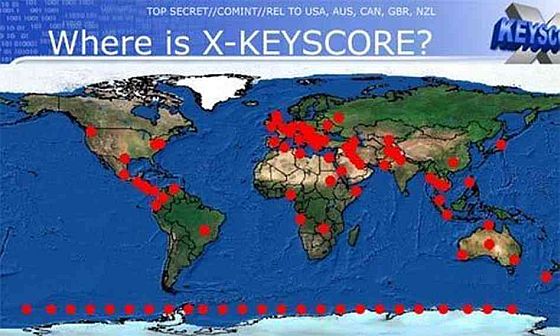
An article in Brazil’s O Globo newspaper published on July 9 co-authored by Glenn Greenwald included several of the X-Keyscore slides. A translation provided by Cryptome describing the slide (shown above) titled “Where is X-Keyscore?” says:

Map in 2008 shows Brazil among countries surveilled by the X-Keystore [sic] program, which details the presence of foreigners by the language used in emails and phone calls.

From this description it’s reasonable to deduce that the NSA — like many American bigots — figures it’s easy to identify foreigners, ’cos those are the folks that talk and write funny. And that probably explains why the NSA can boast no more than a 51 percent level of confidence in identifying their target’s “foreignness.”

The PowerPoint slides published today in The Guardian have been described as “training materials,” but I think Shane Harris’ description of this as a “marketing document” is closer the mark. In other words, this looks more like a presentation of a product’s claimed value as that would be promoted to a customer (such as the Department of Defense), rather than instructions on how to use the application.

A June 20 job posting by the major defense technology contractor SAIC for an “XKEYSCORE Systems Engineer” could indicate that SAIC itself created X-Keyscore and now provides its customers with support for its “fielded mission systems.”

Even if this application was created for the NSA, it appears to be accessible by multiple agencies and contractors.

CGI, a multinational information technology corporation which handles defense contracts for the U.S. Army, U.S. Navy and U.S. Marine Corps, has since July 19 been advertising a position for a Computer Network Operations (CNO) Analyst whose required skills include: “Familiarity using the following tools: Cadence, Surrey, TrafficThief, CNE Portal and X-Keyscore.” (If the name “TrafficThief” sounds familiar, that might be because it showed up on an earlier NSA slide: “PRISM Collection Dataflow.”)

Interestingly, such an analyst also requires: “Working knowledge of system and network exploitation, attack pathologies and intrusion techniques; denial of service attacks, man in the middle attacks, malicious code delivery techniques, fuzzing, automated network vulnerability and port scanning, botnets, password cracking, social engineering, network and system reconnaissance.”

This sounds like a position for an experienced hacker whose job is to defend the U.S. Army from other hackers. The analyst will: “Review threat data from various sources, including appropriate Intelligence databases, to establish the identity and modus operandi of hackers active in customer networks and posing potential threat to customer networks.” Accessing those appropriate intelligence databases presumably involves, among other things, the use of X-Keyscore.

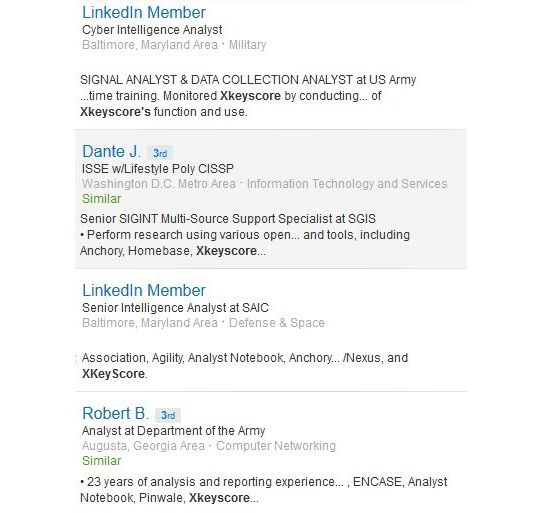
That this is a widely used application is also evident from LinkedIn where numerous intelligence analysts proudly include use of X-Keyscore in their background experience:

However secret the use of X-Keyscore might be, it’s certainly not so secret that anyone seems particularly nervous about mentioning its name.

Facebooktwittermail

Truth is not something to be determined by the state

In 1977, I was an undergraduate at Lancaster University in England coming towards the end of my first year studying politics. My perspective on America at that time had been shaped by events of the preceding decade: Vietnam; the assassinations of Martin Luther King Jr and Bobby Kennedy; Watergate and Nixon; the CIA’s illegal operations; and this amorphous but far-reaching entity called American Power.

Still, as much as America seemed to dominate the world, in my own experience — like that of most other non-Americans across the West — that domination came mostly in the relatively benign and sometimes enriching form of American culture — from Lucille Ball to Mission Impossible, and from Jack Kerouac to Miles Davis.

And then something unusual happened.

On April 6 the university was in recess for the Easter vacation but suddenly Lancaster and one student in particular became the focus of national news when Britain’s secret police raided the campus.

Steve Wright was a graduate student in the politics department engaged in research on “Social Control and Death Technologies.” Wright’s supervisor was Dr. Paul Smoker, one of the founding fathers of modern peace research, who was then Lancaster’s Director of the Programme of Peace and Conflict Research.

That Britain had a secret branch of the police force dedicated to tackling political subversion was not common knowledge, even though the Special Branch (also known as Specialist Operations 15 or SO15) had actually been created in 1883 to combat Irish nationalists.

As the force grew through the 20th century, the scope of what it deemed potential threats to public order and national security expanded to include the Campaign for Nuclear Disarmament, groups in the animal rights movement and later anti-globalisation demonstrators.

In 1977, there were indications that Britain’s intelligence services had also come to regard investigative journalism as a national security threat.

What would later emerge was that Wright’s arrest was part of an operation designed to protect not only Britain’s state secrets but also to protect American interests and specifically those of the National Security Agency.

At the time of the arrest, Sir Charles Carter, the Vice Chancellor (chief administrator) of the University issued a public statement in defense of academic freedom and the right for research to be undertaken without the interference of the security service. Carter noted:

Truth is not something to be determined by the state.

It would be more than a decade before the NSA’s operations in Britain were first reported in the press. This came in spite of the British government’s best efforts to suppress publication of Duncan Campbell’s investigation of Project P415, otherwise known as ECHELON — a system of global surveillance that the NSA had been building and operating before Edward Snowden was even born.

In a 2005 article for the journal Surveillance & Society, Wright (who is now Associate Director of the Praxis Centre, Leeds Metropolitan University) told the story behind the uncovering of ECHELON and an investigation in which all the key researchers got promptly arrested.

Decades after those events, this story is of particular relevance now, as the NSA presents its global mass surveillance operations as having been necessitated by 9/11. As Campbell reported in 1988, the NSA and its partners’ surveillance systems “rely on near total interception of international commercial and satellite communications”.

Not only does the NSA eavesdrop on everyone — it has been doing so for far longer than most Americans realize.

Steve Wright gave me permission to republish his 8,200 article which I have divided into four parts which I will post over the next four days, beginning with: The ECHELON trail — Part One: An illegal vision.

Facebooktwittermail

The paradigm shift: How Snowden succeeded in changing the mindset that got us into war

On January 31, 2008, in a Democratic primary presidential debate with Hillary Clinton, Barack Obama when speaking about the war in Iraq, made one of the most memorable and seemingly significant statements of the campaign:

I don’t want to just end the war, but I want to end the mindset that got us into war in the first place.

Many of those of us who found Obama’s promises of hope and change too vague and superficial to mean much, took his declaration on ending the mindset that got us into war as a bold repudiation of the Bush-Cheney era — an important signal that he understood the primary effect of U.S. national security policy, post 9/11, had been to generate a culture of fear inside America.

After taking office, not only did Obama fail to follow through on his commitment to change this mindset, but through the expansion of America’s drone war, widening the war on terrorism, sharply increasing the use of the Patriot Act in order to conduct mass surveillance inside America, and by starting an unprecedented war on whistle-blowers, this president has done more to expand state power and secrecy than any of his predecessors.

If George W. Bush was preoccupied with presenting the tough posture of a national security president, the change Obama has brought is to dispense with the posturing and instead focus on the expansion of the national security infrastructure.

The only significant challenge he has faced showed up unexpectedly in the form of a 29 year-old whistle-blower.

Thanks to Edward Snowden, for the first time since 9/11, Americans have refused to be silenced by government fear-mongers. They no longer accept the assertion that the need to “combat terrorism” is a national imperative that trumps all others.

As the czars of the national security establishment once again pull out the terrorism card in the hope that they can stifle debate and deflect tough questions, they are discovering for the first time in over a decade that their prized asset has suddenly lost much of its value.

While the media’s attention has often focused more on Snowden than the information he leaked, this focus is what has given the story such longevity — for better or worse, people have more interest in stories about people than they do in the analysis of policy. That NSA surveillance has become a focus of public concern, is not in spite of the extent to which this became a story about one individual, but on the contrary, because the issue could be embodied. (Obama apologists who profess an interest in civil liberties should take note.)

Ultimately this isn’t a story about Edward Snowden, yet it wouldn’t have become a story about issues that affect everyone without it first being a story about him.

Duncan Campbell is a veteran investigative journalist who began unearthing evidence of the NSA’s mass surveillance operations decades before most people had even heard the name, “National Security Agency,” let alone had any understanding of the scope of its operations. Campbell is unequivocal in describing Snowden as a hero who has done a public service in the interests of protecting civil liberties across the world.

The Associated Press reports: After 9/11, there were no shades of gray. There are plenty now.

The vigorous debate over the collection of millions of Americans’ phone records, underlined by a narrow House vote upholding the practice, buried any notion that it’s out of line, even unpatriotic, to challenge the national security efforts of the government.

Democrats and Republicans, conservatives and liberals, joined in common cause against the Obama administration’s aggressive surveillance, falling just short Wednesday night against a similarly jumbled and determined coalition of leaders and lawmakers who supported it.

It’s not every day you see Republican Speaker John Boehner and Democratic leader Nancy Pelosi facing off together against their own parties’ colleagues — with an assist from Rep. Michele Bachmann, no less — to help give President Barack Obama what he wanted. But that’s what it took to overcome efforts to restrict the National Security Agency’s surveillance program.

After the Sept. 11, 2001, terrorist attacks, President George W. Bush warned the world “either you are with us or you are with the terrorists,” period, and those few politicians who objected to anything the U.S. wanted to do for its national security looked like oddballs.

That remarkable political consensus cracked in the bog of the Iraq war, and argument returned, but the government has had little trouble holding on to its extraordinary counterterrorism tools.

What’s changed?

The passage of time, for one thing, and the absence of another attack on the scale of 9/11. Americans have also discovered, through Edward Snowden’s leaks, that surveillance doesn’t start at the water’s edge or stop with terrorist plotters in the homeland, but sweeps in the phone records of ordinary people indiscriminately.

Even in the frightening aftermath of 9/11, when large majorities told pollsters they were ready to trade in some personal protections for greater security, any effort to monitor phone calls or emails of average people was considered a step too far. In a Pew Research Center survey the week after the terrorist attacks, 70 percent said no to that.

Republican Sen. John McCain of Arizona says memories of those days have faded and the political climate has changed.

“The stuff we went through last year about detainees we never would have gone through in 2002,” he said Thursday. He was referring to the debate in Congress for two years straight over the indefinite detention of terrorist suspects, even U.S. citizens captured within the nation’s borders.

The closeness of the House surveillance vote “says there’s great and widespread concern about the extent of the NSA’s activities,” McCain said, “and that’s why we need hearings in Congress.” This, from a supporter of the NSA surveillance.

Facebooktwittermail

Liberal Zionists and the demographic dogma

Roger Cohen writes: Peace talks, it seems, are set to resume between Israelis and Palestinians after six visits to the region by Secretary of State John Kerry.

The heart sinks.

Israel and Palestine need a two-state peace. It would involve bitter compromises on both sides, but no more bitter than those accepted by Nelson Mandela in putting the future before the past, hope before grievance.

Without a two-state peace, Israel cannot remain a Jewish and democratic state because over time there will be more Arabs than Jews between the Jordan River and the Mediterranean Sea.

The growth of the Palestinian population — the capacity for Arabs to breed faster than Jews — seems to be treated like a law of physics and has long been termed by liberal Zionists as a “demographic threat.” Even if Cohen doesn’t use the phrase, he defines the concept. It’s all the more ironic that he should at the same time appeal to the example of Nelson Mandela — who embodies the spirit of reconciliation — when advocating a plan for peace based on separation.

Outside the context of Israel, anyone who dares to speak about a “demographic threat” will swiftly and justifiably be branded a racist. In the United States, no doubt there are members of the Tea Party caucus in Congress who view the growth of America’s Latino population as a demographic threat both to the Republican Party and to American identity, but everyone knows that they couldn’t get away with using this phrase in public discourse.

But when it comes to Israel, peace-desiring liberal Zionists like Roger Cohen, see absolutely no problem in supporting the idea that Israel’s existence as a Jewish state utterly depends on Jewish majority rule. (No one cares to specify exactly how large that majority must be, but there is seemingly no conflict between this assertion of majority rule and the claim that as a Jewish state, Israel can also be democratic.)

What if actual demographics turned out to match purported demographic threat?

In the Jerusalem Post, Paul Morland notes:

According to Neve Gordon, a geographer at Ben-Gurion University, and Yinon Cohen, an academic at Columbia, births to Jews living in the West Bank have grown five-fold in the past 20 years, while Jews moving to the West Bank have more than halved in number. Overwhelmingly today, the growth of the Jewish population in the settlements is organic and due to a high birth rate rather than to arrival from pre-1967 Israel. Gordon and Cohen’s work suggests that the fertility rate of the burgeoning ultra-Orthodox population in Judea and Samaria [the West Bank] is now no less than two-and-a-half times that of the local Arab population.

This information should be handled with care. It does not have a direct bearing on the hotly debated question of the total number of Arabs living in the West Bank and what the impact of their incorporation within Israel would be. Nor does it necessarily suggest that Jews will grow as a share of the population of Israel with or without the West Bank; issues of mortality as well as fertility will impact this, and so will movements of populations in and out of the area.

However, it is worth noting that, at least within Israel itself, Arab demographic momentum is flagging.

Morland doesn’t reach the following conclusion, but let’s suppose the so-called demographic threat has been over-estimated and that superior Jewish reproduction rates could guarantee that within a Greater Israel which absorbed the West Bank and its Palestinian population, Jews could indeed sustain a comfortable majority (at this point forget about attempting to define what comfortable might mean).

Where would this leave the liberal Zionists? Would the idea of an expanded Israel in which Palestinians were given the rights of citizenship start to sound more palatable if Jewish majority rule could nevertheless be ensured?

A few years ago I saw a promotional video for J Street in which an American rabbi was asked to describe what a Jewish state meant to her and she said quite simply that it is a state where Jews are “in charge.”

Being in charge; maintaining a majority — these seem to be nothing more than ways of describing domination.

And then there are the less liberal Zionists such Uzi Arad, Benjamin Netanyahu’s former national security adviser. He was much more blunt when he said: “We want to relieve ourselves of the burden of the Palestinian populations – not territories. It is territory we want to preserve, but populations we want to rid ourselves of.”

Cohen claims that peace talks now offer a way “back to the Zionist dream.”

Maybe like most, it’s a dream that’s hard to make sense of once one awakes.

Facebooktwittermail

David Sanger’s role in promoting anti-Snowden government propaganda

David Sanger

Even while the New York Times prides itself as a pillar of the American establishment, it generally tries to maintain at least a facade of independence from the U.S. government. It’s journalists generally enjoy higher levels and easier forms of access to administration officials than most other journalists and yet that access supposedly adds depth to their reporter rather than simply making them the dutiful mouthpieces of government.

But imagine this: Imagine if the Times’ chief Washington correspondent, David Sanger, was to begin a report like this:

I was talking to Ash Carter, deputy secretary of defense, an old friend of many, many years — I won’t say how many — and he tells me the NSA…

Well, before we even learned whatever gems of information Carter might have shared with his buddy, we’d have good reason to wonder whether Sanger was acting as a reporter or whether he might be doing his old friend a favor.

In “N.S.A. Imposes Rules to Protect Secret Data Stored on Its Networks,” Sanger reported on information he had gathered from Carter the day before at the Aspen Security Forum. But the New York Times reporter wasn’t there, notebook in hand, listening to briefings from Pentagon officials. It was Sanger acting as host who said:

It’s wonderful to be here with Ash Carter, deputy secretary of defense, an old friend of many, many years — I won’t say how many…

In his report, Sanger wrote:

Ashton B. Carter, the deputy secretary of defense, said the conditions that allowed Mr. Snowden to download and remove data without detection amounted to “a failure to defend our own networks.”

“It was not an outsider hacking in, but an insider,” he said.

This is another iteration of the meme that the administration has been disseminating: Edward Snowden is not a whistleblower; he’s a hacker.

The image that administration officials are trying to spread is of Snowden as essentially operating like a burglar — a low-level technician who pilfered classified information that he had no authority to access.

So far, there has been no reporting that substantiates this view. In fact, as an infrastructure analyst (not a systems administrator, as he is often described), it seems most likely that Snowden was fully authorized to examine all the documents that he later chose to leak.

Indeed, in his conversation with Sanger, Carter confirms that with Snowden “you had an individual who was given very substantial authority to access that information…”

Clearly, this is not a story about hacking, yet Sanger chose not to quote that part of his friend’s statement.

The main thrust of Sanger’s report — pushing the line that he had been spoon-fed by Carter and NSA chief Keith Alexander — is that Snowden’s leaks have made the work of the NSA more difficult. Subtext: if there’s another terrorist attack, blame Snowden.

And Sanger reports that the NSA has been forced to impose new rules such as the “two-man rule” derived from the safeguards on handling nuclear weapons. When it comes to nuclear weapons, Carter says, “You don’t let people all by themselves do anything.” So how’s that apply to the NSA? Is this a pitch to double the agency’s size?

Sanger’s explanation of the two-man rule is that it “requires two computer systems administrators to work simultaneously when they are inside systems that contain highly classified material.” It sounds like if the agency as a whole is not about to double it size, then they will at least need to hire lots of new systems administrators.

A search of the NSA’s current career openings does not actually show any positions available to systems administrators.

Here’s a transcript of the segment of the Sanger-Carter conversation that related to Snowden:

Sanger: After Wikileaks happened, and I was involved in some of the Times coverage on it so I recall this pretty distinctly, we were asking a lot of people the question: how could you download 250,000 documents from the State Department and no alarms going off? And my recollection is that your old boss Bob Gates asked that question both publicly and privately pretty vividly.

Then Mr Snowden comes along and it wasn’t 250,000 documents but it was certainly documents of a higher level of sensitivity than what was in Wikileaks. So, tell us first as you’ve looked at it, what you think happened — why that was able to happen — and secondly, since you mentioned before the importance of defending your own networks, how you’re changing your practices, or plan to change your practices going forward. And maybe make an assessment of how much damage, if any, was done.

Carter: Well, we are assessing the damage and I can just tell you right now, the damage is very substantial — and I won’t get into Snowden himself, because that’s a criminal investigation involved where I can’t talk about that.

But to the issue, it gets back to what I said: job one for us has to be defending our own networks. And this is a failure to defend our own networks. And it’s not an outsider hacking, it was an insider. And everybody who has networks knows that the insider threat is an enormous one.

This failure originated from two practices that we need to reverse. The first is that, in an effort for those in the intelligence community to be able to share information with one another, there was an enormous amount of information concentrated in one place. That’s a mistake.

We normally compartmentalize information for the very good reason so that one person can’t compromise a lot. Loading everything onto a server by people each cleared in their own compartment — but loading onto a server creates a security risk of decompartmentalization. That’s thing one —

Sanger:But that wasn’t a surprise to anybody, people said that as they were doing it…

Carter: — I don’t know who it was a surprise to — it wasn’t a surprise to me, but it’s something we can’t do because it creates a — too much information in one place.

The second thing is you had an individual who was given very substantial authority to access that information and move that information. That ought’n to be the case either.

So, we’re acting to reverse both of those things. It’s quite clear that those were the two root causes of this.

Now what do you have to do about that? You do have to compartmentalize more rigidly and you have to have a system which I would liken to our longstanding system for handling nuclear weapons.

You know we have no-loan zones. We have two-man rule. You go out Barksdale and walk around the apron and you’ll see a red line, and it says: you cross that red line and you can get shot, because there are areas where you are simply not to be because proximity to nuclear weapons is too sensitive and momentous a thing to be allowed for individuals, because there’s always some aberrant individual, where you’ve got to recognize that fact.

So when it comes to nuclear weapons we give special — we watch people’s behavior in a special way. You don’t let people all by themselves do anything. Nobody ever touches a nuclear weapon by him or herself. There are always two people rated in the same specialty. So everybody can see and understand exactly what is being done to that weapon. It’s been that way for decades.

Here we had the case where we had a single person at one installation in the intelligence community, could have access to and moreover move that much information.

Both of those pieces are a mistake and have to be corrected.

As for Carter’s observation about red lines and the people who transgress them getting shot, is this the Obama administration’s latest threat to whistleblowers — that they now risk being shot on sight?

Facebooktwittermail

David Brooks: Islamists ‘lack the mental equipment to govern’

David Brooks is the kind of mild-mannered conservative who was able to move from the Weekly Standard to the New York Times as easily as a hand sliding into a glove.

To describe the largest political class in the Middle East as lacking the equipment to govern, would, from anyone else’s mouth, sound like the crudest form of bigotry. Brooks makes it sound like incontrovertible truth.

Islamists might be determined enough to run effective opposition movements and committed enough to provide street-level social services. But they lack the mental equipment to govern. Once in office, they are always going to centralize power and undermine the democracy that elevated them.

Nathan Brown made that point about the Muslim Brotherhood recently in The New Republic: “The tight-knit organization built for resilience under authoritarianism made for an inward-looking, even paranoid movement when it tried to refashion itself as a governing party.”

Once elected, the Brotherhood subverted judicial review, cracked down on civil society, arrested opposition activists, perverted the constitution-writing process, concentrated power and made democratic deliberations impossible.

It’s no use lamenting Morsi’s bungling because incompetence is built into the intellectual DNA of radical Islam. We’ve seen that in Algeria, Iran, Palestine and Egypt: real-world, practical ineptitude that leads to the implosion of the governing apparatus.

I’m surprised Brooks included a link to Brown’s piece in TNR because anyone who goes there will see that the George Washington University professor doesn’t share Brooks’ contempt for Islamists. Brown writes:

In studying Islamist movements over the last decade, I generally found that the most rewarding time to speak to leaders was about a year or so after an election. During the heat of the political battle, they made decisions like most politicians do (on the fly, often overreacting to yesterday’s headlines) and spoke like most politicians do (providing glib spin than reflective analysis). But at calmer moments, they spoke less like politicians and more openly. And there was a reason why: The movements prided themselves (justifiably) on an ability to learn.

Egypt’s Muslim Brotherhood and its sister organizations represent the most successful non-governmental organizations in Arab history. No other movements have been able to sustain, reinvent, and replicate themselves over so much time and space. And there are two secrets to that success: a tight-knit organizational structure that rewards loyalty and the ability to adjust and adapt.

How high does the Republican Party score on its ability to adjust and adapt? On the basis of its current trajectory as America’s old white party, I’d say: not very well.

Let’s suppose that Egypt’s military swiftly organize new presidential elections and Mohamed ElBaradei becomes the face of secularist rule in Egypt. Will Brooks then give the secularist just one year to see if they possess the mental equipment to govern?

It looks like it won’t be long before the New York Times columnist reverts to the neoconservatives’ default position: Muslims aren’t ready for democracy.

Facebooktwittermail

How Obama is becoming an insider threat to democracy

It seems like we’re getting snowed in by Snowden — if you’ll forgive the pun.

On Thursday, McClatchy published an investigative report, “Obama’s crackdown views leaks as aiding enemies of U.S..”

By now, the term, “Insider Threat Program,” should be getting just as much attention in the mainstream media and the blogosphere as anything to do with Edward Snowden, and yet the story has largely been ignored.

While the NSA story is in large part a story about the potential dangers that can stem from mass surveillance, the Insider Threat Program describes the ways in which the day-to-day operations of government are changing now through a neo-McCarthyist attack on whistle-blowing.

The fact that this program is being instituted across all government agencies and not just those handling national security issues, reflects the degree to which we now live in a security state — one in which democratic processes have been made subservient to security and security has become the lens through which virtually everything gets viewed.

Changes that are most insidious and most difficult to reverse are those which shape culture. They don’t have to be encoded in laws and regulations.

While Obama came into office promising to change the culture of secrecy in Washington, his actions have had the opposite effect and the Insider Threat Program is another phase in a process through which government becomes more paranoiac, less innovative, more subject to group-think, and less representative of the interests of the people.

The most dangerous forms of change are often the least dramatic. They are incremental. What might become an intolerable trend, develops from small steps each of which might seem benign or reasonable at the time it occurs.

Obama in November approved “minimum standards” giving departments and agencies considerable leeway in developing their insider threat programs, leading to a potential hodgepodge of interpretations. He instructed them to not only root out leakers but people who might be prone to “violent acts against the government or the nation” and “potential espionage.”

The Pentagon established its own sweeping definition of an insider threat as an employee with a clearance who “wittingly or unwittingly” harms “national security interests” through “unauthorized disclosure, data modification, espionage, terrorism, or kinetic actions resulting in loss or degradation of resources or capabilities.”

“An argument can be made that the rape of military personnel represents an insider threat. Nobody has a model of what this insider threat stuff is supposed to look like,” said the senior Pentagon official, explaining that inside the Defense Department “there are a lot of chiefs with their own agendas but no leadership.”

The Department of Education, meanwhile, informs employees that co-workers going through “certain life experiences . . . might turn a trusted user into an insider threat.” Those experiences, the department says in a computer training manual, include “stress, divorce, financial problems” or “frustrations with co-workers or the organization.”

An online tutorial titled “Treason 101” teaches Department of Agriculture and National Oceanic and Atmospheric Administration employees to recognize the psychological profile of spies.

A Defense Security Service online pamphlet lists a wide range of “reportable” suspicious behaviors, including working outside of normal duty hours. While conceding that not every behavior “represents a spy in our midst,” the pamphlet adds that “every situation needs to be examined to determine whether our nation’s secrets are at risk.”

The Defense Department, traditionally a leading source of media leaks, is still setting up its program, but it has taken numerous steps. They include creating a unit that reviews news reports every day for leaks of classified defense information and implementing new training courses to teach employees how to recognize security risks, including “high-risk” and “disruptive” behaviors among co-workers, according to Defense Department documents reviewed by McClatchy.

“It’s about people’s profiles, their approach to work, how they interact with management. Are they cheery? Are they looking at Salon.com or The Onion during their lunch break? This is about ‘The Stepford Wives,’” said a second senior Pentagon official, referring to online publications and a 1975 movie about robotically docile housewives. The official said he wanted to remain anonymous to avoid being punished for criticizing the program.

Facebooktwittermail

Is America in a death spiral?

Global warming may have caused irreversible damage to the environment; cigarette smoking can cause irreversible damage to the lungs; lead poisoning can cause irreversible damage to a child’s brain; and Edward Snowden’s intelligence leaks have caused irreversible damage to America — at least that’s what NSA director General Keith Alexander claimed today.

Irreversible damage? The end is nigh? Talk about hyperbole!

Edward Snowden has apparently now leaped to the top of the league among threats to America. Did Bush or Cheney or anyone else declare after 9/11 that al Qaeda had caused irreversible damage to America? Not that I recall. And yet a disaffected NSA system administrator has now supposedly caused more harm to America than even Osama bin Laden accomplished.

Facebooktwittermail