Afua Hirsch writes: Britain has a problem with terrorism. Nothing focuses the mind more than the image of an apparently British man addressing the world in high definition as he brutally beheads a fellow Brit. But while the numbers of violent extremists are, by all accounts, relatively small, the issues underlying their reasons for turning towards terrorism are widespread.
I’ve been talking to young Muslims for a documentary on the root causes of extremism, and it’s clear there are a series of common complaints. Primarily, even though David Cameron may have said the killers of David Haines “are not Muslims, they are monsters”, young Muslims still have a profound and consistent sense of being demonised by society, and as creating a source of fear.
Further, many people still fail to distinguish between the different motivations for Brits travelling to the Middle East. It struck me how many young Muslims want to travel to Syria to help with the desperate humanitarian situation, or to join rebels trying to bring down President Assad – a goal that until recently was in line with Britain’s own foreign policy. However, the people I spoke to fully expected to be welcomed back to the UK by being arrested, slapped with a TPim and stripped of their passport.
For a passionate teenager, watching the suffering in Syria and believing that they are barred from contributing because of double standards driven by Islamophobia can create extreme feelings of alienation. And for those who are converted to extremism, there are usually other factors: contact with a seductive and effective hate preacher, indifference towards or a desire for violence, a sense of purposelessness – in some cases the same factors that attract young people to criminal gangs.
For a generation of non-Arabic speaking Muslims for whom the complexities of their faith can be lost in translation, recruiters from groups such as Islamic State (Isis) can play on this vulnerability. [Continue reading…]
Category Archives: ISIS
‘Lend me your ears’ (and pay up) — an ISIS ransom note
“After two disastrous and hugely unpopular wars in Afghanistan and Iraq, why is it that our governments appear so keen to get involved in yet another unwinnable conflict?”
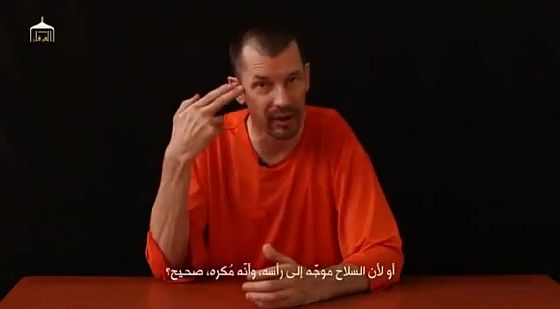
The question comes from a British journalist, John Cantlie, who has been a prisoner of ISIS for most of the last two years and who has now been compelled to become the organization’s spokesman.
In a newly released video he continues:
I’m going to show you the truth behind these systems and motivation of the Islamic State, and how the western media, the very organisation I used to work for can twist and manipulate that truth to the public back home.
There are two sides to every story – think you’re getting the whole picture? And I’ll show you the truth behind what happened when many European citizens were imprisoned and later released by the Islamic State and how the British and American governments thought they could do it differently to every other every other European country.
They negotiated with the Islamic state and got their people home while the British and Americans were left behind.
It’s very alarming to see where this is all headed and it looks like history repeating itself yet again. There is time to change this seemingly inevitable sequence of events, but only if you, the public act now. Join me for the next few programmes and I think you may be surprised by what you learn.
Stay tuned.
ISIS is frequently credited for its media sophistication, but its use of a prisoner to serve as a spokesman shows how impoverished the organization must be when from among its thousands of Western recruits apparently there aren’t any fit to represent and articulate the cause they are all fighting for. (Individuals like Moner Mohammad Abusalha from Florida might accurately represent the Western face of ISIS, but they also undermine the organization’s credibility.)
When we are told that several European governments successfully negotiated with ISIS and “got their people home,” no mention is made of ransoms being paid.
While ISIS’s latest message tries to leverage antiwar sentiment in the West, no one should mistake this as a wise warning whose purpose is to forestall another military misadventure.
Put most simply the message is: hold fire, pay up, or John Cantlie will meet the same fate as James Foley, Steven Sotloff, and David Haines.
Other commentators have argued that ISIS’s use of beheading videos has been designed to bait the West — to draw the U.S. and its allies into another unwinnable war — but the latest video seems to confirm what I have said repeatedly: ISIS wants to consolidate and expand its caliphate since its success in doing that serves as a much potent magnet for recruits than the prospect of being targeted in U.S. airstrikes.
In response to the start of U.S. military operations in Iraq, ISIS seems to have focused most of its efforts beyond America’s current reach by making gains in Syria.
Even though President Obama says he is ready to order airstrikes in Syria, there seems little reason to believe that these are imminent, and ISIS wants to use the intervening period to its full advantage.
The Cantlie video is the second ISIS releases this week.
“Fighting has just begun” declares the “trailer” for its Hollywood-style “Flame of War,” but as it did in its other video release this week, Alhayat Media Center is addressing the public, rather than Western governments, in an effort to increase war fears more than war fever.
Obama’s recipe for endless war in Syria
Shortly before President Obama unveiled his strategy for defeating ISIS (aka Daesh), NotGeorgeSabra wrote: Obama is expected to announce a grand strategy to defeat the Islamic State (ISIS, or Daesh) one year after he sold Syria’s rebels down the river and betrayed his own self-imposed “red line.”
This strategy will be billed as comprehensive, encompassing all elements of American imperialism’s tremendous national power — military, economic, diplomatic, political — but there are unresolved contradictions with the Syrian aspect of this grand strategy that, taken together, will add up to the kind of strategic and political incoherence that Daesh will surely exploit to survive and persist in their Syrian safe haven for years, a safe haven created by Obama’s do-nothing-but-stupid-shit policies.
The central problem with Washington’s policy from the standpoint of ending Daesh is the U.S. goal of a negotiated settlement between the revolution and the counter-revolution in Syria, one that removes Bashar al-Assad from the presidency but preserves the state he and his father built intact.
Why is this a problem? Judge a policy by its results — a ruinous, intractable war that has resulted in the biggest humanitarian catastrophe of the century, a weak and divided rebel movement starving for weapons and money, a militarily robust failed state in the making headed by a man who doesn’t hesitate to gas his own people, and Daesh, a fascist organization that wields state power in one-third of both Syria and Iraq whose thousands of veteran fighters have years of combat experience and Western passports!
How did America’s preference for a negotiated, peaceful settlement in Syria lead to endless war and bloodshed?
Simple: the U.S. (tandem with its regional allies) provided rebel forces with just enough weapons to keep fighting but not to win. [Continue reading…]
(H/t Scott Lucas)
If Obama wanted to, he could help free thousands of enslaved Yazidi women in a single day
Matthew Barber writes: The plight of thousands of Yazidi women, kidnapped by the Islamic State (IS) during its August 3 attack on Iraq’s Sinjar mountains and in the following weeks, has received some media attention, but most people are unaware of just how far-reaching this disastrous phenomenon is. Boko Haram kidnapped girls in the hundreds, prompting international outcry and an online campaign demanding that they be freed; IS has kidnapped Yazidi women and girls in the thousands in a sexually-motivated campaign that has rent apart countless families and wrought unimaginable levels of pain and destruction.
During the Syria conflict there have been numerous allegations of forced jihadi marriages that have been difficult to confirm, and widely denied by IS supporters online. Many of those stories were dropped, lacking credible evidence. As the past few years in Syria have demonstrated, rumors run rampant in contexts of conflict, and the initially difficult-to-confirm cases of kidnapped Yazidi women of this summer have been treated with appropriate caution.
Despite this initial caution, the sheer scale of the kidnapping of Yazidi women and the firsthand reports of escaped survivors—and those still in captivity via telephone—have made details of the phenomenon, and its sexual motivations, certain.
Having stayed in northern Iraq all summer, I can confirm the assertions of the journalists who have written about the problem. I have worked directly with those involved in rescue efforts and have personally interacted with families whose daughters have been kidnapped and are now calling their relatives from captivity.
I have no trace of doubt that many women have been carried off and imprisoned; the question that remains is about the numbers. Restrained estimates have posited numbers of kidnapped Yazidi women in the hundreds. However, the reality is likely to be in the thousands. [Continue reading…]
ISIS captures 21 Kurdish villages in northern Syria
Syrian Observatory for Human Rights reports: ISIS have taken over 21 villages inhabited by Kurdish civilians, in the western and eastern countrysides of Ein al-Arab “Kobane” after a massive attack using heavy artillery and tanks, confirmed reports of losses in both of YPG and ISIS sides, in addition to human losses in Kurdish civilians, the area is witnessing a migration of civilians into areas nearby, amid fears of committing massacres by ISIS in these areas in case it broke into it, the clashes continue between the two sides near these areas.
SOHR also reports: Reliable resources have confirmed to SOHR that 162 people have joined to IS military camps in the northern eastern and eastern countryside of Aleppo since September 10 and after the President Barack Obama’s speech where he has declared war on the Islamic States. Among those who have joined in the past seven days, 15 fighters from different Arab and foreign nationalities, including 4 Australian persons entered to Syria through Turkish territory and 147 ex- Syrian combatants of al Nusra Front and the Islamic battalions.
It is worth mentioning that reliable resources reported to SOHR that 6300 fighters joined to the training camps of the Islamic State in the two cities of Aleppo and Al Raqqa in the last July in 2014, where this is considered the widest process of recruiting fighters in the Islamic State’s ranks since the declaration of establishment in April/2013 in the city of Al Raqqa until it transferred to the Islamic State in the late of June/2014.
Anti-terror operation in Australia ‘thwarted’ beheading plot
ABC (AU) reports: Police say a large-scale anti-terrorism raid in Sydney this morning has foiled a plot to “commit violent acts” in Australia, including a plan to behead a member of the public.
More than 800 officers launched the raids as part of Operation Appleby in suburbs across Sydney’s west and north-west, with a further 70 police involved in raids on properties in Brisbane’s south.
Police said 15 people had been detained in Sydney as part of the operation between NSW officers, the Australian Federal Police and ASIO.
Court documents are expected to reveal that the raids, at 25 different properties, were aimed at a cell which planned to behead a member of the public in Sydney.
The documents are expected to say that the plan involved snatching a random member of the public in Sydney, draping them in an Islamic State group (IS) flag and beheading them on camera. [Continue reading…]
There is a ruthless logic in terrorism: it always aims to produce the maximum effect from the minimum amount of resources.
At a time when increased security measures have made international plots aimed at bombing or hijacking aircraft especially difficult, it is easy to see why beheading is becoming the preferred technique through which an organization such as ISIS can terrorize its enemies.
No need for any expertise or hard-to-acquire materials — all that is required is a knife, a camera, a YouTube account, and someone willing to murder a helpless victim.
Up until recently, we might have imagined that executioners of this kind would be hard to find, but unfortunately we are learning otherwise.
British Muslim leaders unite to call on ISIS to release Alan Henning
The Independent reports: Over one hundred Muslim leaders today make an unprecedented joint appeal to the kidnappers of Alan Henning to release the aid worker unharmed or commit the “worst condemnable sin” against Islam.
The joint statement to The Independent has been signed by dozens of Imams from across the UK as well as community leaders and other prominent Muslims. It has been passed on to Mr Henning’s family.
Among those signing the letter are representatives of all strands of Islam from Shia to Sunni to Salafi, Sufi, and Deobandi.
The Muslim Council of Britain an umbrella body with over 500 affiliated national, regional and local organisations including mosques, charities and schools is also a signatory. [Continue reading…]
Iraq’s Shia militias appear to be more powerful than the army
The New York Times reports: Militia justice is simple, the fighters explained.
“We break into an area and kill the ones who are threatening people,” said one 18-year-old fighter with Asaib Ahl al-Haq, a Shiite militia that operates as a vigilante force around Baghdad.
Another 18-year-old fighter agreed. “We receive orders and carry out attacks immediately,” he said, insisting that their militia commanders had been given authority by Iraqi security officials. That free hand has helped make Asaib Ahl al-Haq the largest and most formidable of the Iranian-backed Shiite militias that now dominate Baghdad.
Once a leading killer of American troops, the militia is spearheading the fight against the Sunni extremists of the Islamic State, also known by the acronyms ISIS and ISIL. That means Asaib Ahl al-Haq and the United States military are now fighting on the same side, though each insists they will not work together.
But the power and autonomy of Asaib Ahl al-Haq and other Shiite militias also pose a central challenge to the creation of a more just and less sectarian Iraqi government. President Obama has said that the new American military offensive depends on such an inclusive Iraqi government, to undercut the appeal of the Sunni extremists and avoid American entanglement in a sectarian war.
Even while many Iraqi Shiites view the militias as their protectors, many in the Sunni minority say they fear the groups as agents of Iran, empowered by the Baghdad government to kill with impunity.
After a decade of support from Iran and a new flood of recruits amid the Islamic State crisis, the Shiite militias are also now arguably more powerful than the Iraqi security forces, many here say, limiting the ability of any new government to rein them in.
“The militias have even bigger role now that they are said to be fighting ISIS” said Alla Maki, a Sunni lawmaker. “Who will control them? We have no real Iraqi Army.”[Continue reading…]
Syrian opposition blasts reports it signed a truce with ISIS
The Daily Beast reports: Critics of President Obama’s latest pledge to arm the moderate Syrian rebels are trumpeting a report of a supposed deal between the opposition forces and ISIS, but Syrian opposition leaders are fighting back with what they say is overwhelming evidence that no truce exists.
The September 12 Agence France-Presse report stating that that moderate and Islamic rebel brigades in the southern Damascus suburbs had signed a “non-aggression” pact to focus efforts on fighting the Assad regime are not only false but are easily disproved by evidence that ISIS and the moderate rebels are still fighting each other in that region, according to rebel commanders on the ground and activists supporting the Syrian opposition.
“The only report we have received on anything resembling a ceasefire was that ISIS and Sons of Golan, an FSA brigade outside Damascus, halted fighting for 24 hours to collect bodies before hostilities resumed. However, this report also confirms that there is substantial fighting between the two groups that is leading to fatalities,” said Mohammed Alaa Ghanem, director of government relations for the Syrian American Council, a Washington NGO that works with the Syrian opposition and the FSA. “It is fantastical to think that rebels outside Damascus would expend lives and resources to rout ISIS from the Damascus suburbs; besiege the group for over a month; wait until two days after Obama announces he will aid the rebels to fights ISIS; and then sign a deal with ISIS (the first ever) while the group was besieged in its last holdout.” [Continue reading…]
Iraqi official briefs Syria’s Assad on campaign against ISIS
Reuters reports: Iraq’s national security adviser briefed Syrian President Bashar al-Assad on efforts to counter Islamic State on Tuesday, Syrian state media reported, the first such meeting since the United States launched air strikes on the radical group in Iraq.
The United States and other Western governments have dismissed the idea of cooperating with Syria in the fight against Islamic State, which has seized large areas of Iraq and Syria. Western governments see Assad as part of the problem and say he must leave power.
But the Shi’ite-led government in Baghdad, together with Iran and the Lebanese group Hezbollah, have been important allies for Assad since the uprising against his rule erupted in 2011. Shi’ite Iraqi militias have fought on Assad’s side against the insurgency spearheaded by Sunni Islamists.
The meeting between Faleh al-Fayad, the Iraqi national security adviser, and Assad indicated that the Iraqi government aims to maintain those ties. It also points to the scope for possible indirect cooperation between Syria and the West in the fight against Islamic State via third parties such as Iraq. [Continue reading…]
War on ISIS will be long and difficult, top defense officials tell Senate
McClatchy reports: In their first public briefing since President Barack Obama laid out his new strategy for defeating the Islamic State in Iraq and Syria, the nation’s two top defense officials on Tuesday provided few details of their plans and no guarantees of success.
Instead, in response to questions from members of the Senate Armed Services Committee, Defense Secretary Chuck Hagel and Army Gen. Martin Dempsey, the chairman of the Joint Chiefs of Staff, laid out a litany of likely obstacles to the president’s plan that were daunting in their breadth.
There is no guarantee that Iraqi military forces can be reconstituted to become an effective force against the Islamic State, they said. There’s no certainty a U.S.-trained Syrian force will choose to fight the Islamic State ahead of the government of President Bashar Assad, they said.
Indeed, the chances of success are far less in Syria than in Iraq, Dempsey said, as Hagel nodded agreement. “Five thousand alone is not going to be able to turn the tide,” Hagel said, referring to the number of Syrian rebels likely to be trained under a proposed U.S. program.
Even the pledge that no American soldiers would engage in ground combat operations seemed tenuous. Dempsey said he could foresee circumstances where American advisers would join Iraqi troops, for example, if the Iraqis tried to recapture Mosul, in what he called “close combat advising.”
“If we reach the point where I believe our advisers should accompany Iraqi troops on attacks against specific targets, I will recommend that to the president,” Dempsey told the committee. [Continue reading…]
Turkey considers buffer zone along its Iraq, Syria border
Daily Sabah reports: Turkey’s military is studying the prospect of establishing a buffer zone along its border with Syria and Iraq amid the escalating threat posed by the Islamic State of Iraq and al-Sham (ISIS), President Recep Tayyip Erdoğan was quoted as saying yesterday. The government will evaluate the plans and decide whether such a move is necessary, Turkish television stations quoted Erdoğan as telling reporters on his plane as he returned from an official visit to Qatar.
A presidency official confirmed that Erdoğan had made such remarks but did not specify where along the border the zone might be established and gave no further details. “The general staff is carrying out inspections on whether a buffer zone could be viable, but there is nothing concrete yet,” an official said on the condition of anonymity. Turkey, a NATO member and Washington’s key ally in the region, has been reluctant to take part in combat operations against ISIS, or allow the U.S.-led coalition to use its airbases for strikes against the extremists because the group is holding 49 Turkish nationals hostage, including diplomats and children. [Continue reading…]
New reality for Israelis on Golan Heights: Islamists now control the other side
McClatchy reports: The green and white flag fluttering above a border checkpoint not far from the Ein Zivan kibbutz on a recent afternoon symbolized the new reality that has taken hold for Israelis who live on the Golan Heights: Islamist rebels now control areas of Syria on the very doorstep of Israeli-controlled land.
For now, the groups, which include al-Qaida’s Nusra Front, are focused on consolidating their positions and pushing toward the Syrian capital, Damascus. But there are worries in Israel that once the Islamist militants establish control, they will turn their guns toward the Israeli-held sector of the Golan.
“Right now it’s not on their agenda, but it’s inevitable,” said Eyal Zisser, an expert on Syria at Tel Aviv University.
Just how big a threat the rebels fighting to topple Syrian President Bashar Assad are to Israel remains an open topic. Israel has tried to remain aloof from the war in Syria, except to blast Syrian government convoys from the air that Israeli officials feared were transferring sophisticated weapons to Hezbollah, Israel’s Lebanese nemesis. Israel’s reaction even to the beheading by the Islamic State of American journalist Steven Sotloff, who held Israeli citizenship, was muted; officials explained they didn’t want to become embroiled in the conflict.
But with the capture Aug. 27 of the Syrian side of the Quneitra border crossing, Islamist rebels now occupy land adjacent to the Israeli section of the strategic plateau, changing the calculus of concern. Despite attempts by the Syrian army to reassert control, the rebels have captured more villages near the Israeli-held Golan, raising the prospect that the frontier area will become a stronghold of Islamist groups. [Continue reading…]
Kurds retake Christian villages from ISIS
AFP reports: Kurdish peshmerga forces on Tuesday recaptured several Christian villages in northern Iraq in clashes with Islamic State (IS) jihadists, an officer and a cleric said.
Tens of thousands of Iraqi Christians, most of them Chaldeans, fled their homes when IS militants launched a renewed drive in the north in early August.
Iraq’s largest Christian town, Qaraqosh, and dozens of other villages were all but emptied in what Christian leaders described as the worst disaster for the minority in centuries. [Continue reading…]
Pentagon: U.S. ground troops may join Iraqis in combat against ISIS
The Guardian reports: The Pentagon leadership suggested to a Senate panel on Tuesday that US ground troops may directly join Iraqi forces in combat against the Islamic State (Isis), despite US president Barack Obama’s repeated public assurances against US ground combat in the latest Middle Eastern war.
A day after US warplanes expanded the war south-west of Baghdad, Army General Martin Dempsey, the chairman of the Joint Chiefs of Staff, told the Senate armed services committee that he could see himself recommending the use of some US military forces now in Iraq to embed within Iraqi and Kurdish units to take territory away from Isis.
“If we reach the point where I believe our advisers should accompany Iraqi troops on attacks against specific [Isis] targets, I will recommend that to the president,” Dempsey said, preferring the term “close combat advising”.
It was the most thorough public acknowledgement yet from Pentagon leaders that the roughly 1,600 US troops Obama has deployed to Iraq since June may in fact be used in a ground combat role, something Obama has directly ruled out, most recently in a televised speech last week.
Dempsey, who has for years warned about the “unintended consequences” of Americanizing the Syrian civil war that gave rise to Isis, said he envisioned “close combat advising” for operations on the order of taking Mosul, Iraq’s second largest city, away from Isis. [Continue reading…]
Middle East Monitor adds: The head of Iraq’s Shia Sadrist movement Muqtada Al-Sadr yesterday threatened the United States’ troops if they decide to return to Iraq.
Al-Sadr said, in a statement posted on his official website: “The Black House [The White House] has decided to resume its attacks on Iraqi territory and perhaps the American decision comes after it had regretted its mockery of a withdrawal from Iraq to avoid the Iraqi fierce military and political and popular resistance.”
Al-Sadr continued: “I say, if you [United States] decide to return to Iraq, we will fight you with all our power and you will regret your decision.”
Al-Sadr called on the Iraqi government not to seek the occupier’s help even under the pretext of defeating the Islamic State, claiming the radical organization is nothing but an “American colonial invention”.
U.S. strikes in Syria won’t turn locals against ISIS
A columnist for Al-Monitor living in Aleppo writes: [T]he war against IS will be won and lost on the ground through hearts and minds, not through missiles and bombs. This is something I felt acutely while talking to the people of Al Bab, who almost unanimously sang the praises of the Islamic State’s administration and the services the group brought to the areas under its control after years of turmoil.
“My business had never been this good under the local rebels, some of whom were my relatives,” said Abu Riad. “They brought law and order; they went after the criminals and bandits and cleaned up the town. Under the rebels, it was chaos and lawlessness. Now I can be sure my merchandise is safe and I can transport it safely as no one dares steal here anymore,” he added. Even more extraordinary is that some of Aleppo’s industrialists and factory owners opted to move their machinery from the Sheikh Najjar industrial zone into IS territory in Al Bab, as they knew it would be safe from looting there.
Law and order aren’t the only advantages of being under IS rule. The group also provides many services, mostly free of charge. “They fixed roads and power lines; they gave out food to the needy. They have traffic police and free religious schools. The rebels never did that. All they did was steal and fight each other,” said Abu Raid. When I asked him about what hardships under the austere rule of IS, he said, “Yes, they have very strict laws, but they won’t harm or bother you unless you cross the red lines. For me, the only difficulty I had was not being able to smoke in public. The rest wasn’t too bad; we are a very conservative town, after all.” [Continue reading…]
‘People in Raqqa have to deal with two evils, ISIS or Assad’
The Guardian reports: The city where the western hostages slain by the Islamic State (Isis) terror group were held is nervously preparing for an onslaught. Each night since Barack Obama said he would bomb Isis targets in Syria, residents of the eastern city of Raqqa – those who support the group and those who abhor it – have sat in fear waiting for the air strikes to begin.
Many believe that the city’s civilians will pay the price of a campaign to root out Isis, which after controlling Raqqa for more than a year is now well embedded in its ramshackle neighbourhoods and entwined into much of its social fabric.
Isis has run Raqqa with impunity since it ousted the Syrian regime in mid-2013, fearing no foe and ruthlessly imposing its worldview on a population that has been unwilling to confront them.
There is widespread revulsion at Isis’s brutal ways. Most know of the beheadings of the hostages. The same sort of summary slaughter takes place most days in the city’s main square – routine killings without hearing or mercy. Many families say they have stopped taking their children to public parks.
It is Raqqa’s silent, seething anti-Isis rump on whom the US and its regional partners will depend to eventually rise up. But before that happens, the spectre of a deadly air assault is terrifying many.
“I believe most of the casualties will be civilian,” said Abu Mohammed, 33, a shopkeeper. “The majority will be from Raqqa and very few from Isis. Many of our young men in the city have joined Isis either because of fear or because of the wages they give, which is $400 (£246) per month. This is a very good salary for us here.”
Abu Mohammed said he had adapted to the group’s hardline rule and saw Isis as a better option than the regime of Bashar al-Assad. “We are afraid that after the US air strikes, the regime will take control of the city. Assad is a criminal and his regime is brutal. We had bad experience with the Free Syria Army [FSA], they are corrupt and now we are getting used to Isis’s Islamic rules. Day after day, they are getting better with people.”
Abu Maya Al-Raqawi, 40, a media worker from the city, said: “Some people are already fleeing the city as they know that civilians are going to be the real victims for these air strikes. Raqqa will be completely destroyed. We all know that Isis are spreading themselves among civilians and they occupy the FSA and old regime headquarters, which are in civilian areas. People in Raqqa have to deal with two evils, Isis or Assad. Which one is better? I don’t know the answer.” [Continue reading…]
Al Qaeda appealed to ISIS to release British aid worker Alan Henning following kidnap
The Independent reports: Al-Qaeda appealed to Isis to release the British hostage Alan Henning because it believed he was an innocent aid worker who was genuinely trying to help suffering Muslims, it can be revealed.
In evidence that the depravity exhibited by Isis is now repelling Muslims of all views and backgrounds, even the terrorist group behind the 11 September attacks on the US in 2001 decided that kidnapping the aid-convoy volunteer was a step too far.
Mr Henning, a taxi driver from Eccles, Salford, was so moved by the plight of Muslims in Syria that he decided to miss last Christmas with his wife and two children and travel 4,000 miles to deliver medical equipment to refugees holed up in the town of Al-Dana. A local commander – or emir – of Jabhat al-Nusra, the al-Qaeda affiliate in Syria, visited his then-allies in Isis four days after Mr Henning, 47, was captured. The emir confronted the kidnappers, arguing that their actions were “wrong under Islamic law” and “counter-productive”, according to a journalist who interviewed the man immediately after the encounter. [Continue reading…]