Category Archives: ISIS

Islamic State of Iraq and Syria

ISIS suspected of bombing Russian jet, but little evidence cited in support of this claim

The Daily Beast reports: Wittingly or unwittingly, British authorities have triggered a sudden blizzard of assertions that the Russian Airbus A321 that crashed in Egypt was brought down by a bomb on board. Until 10 Downing Street, apparently acting on their own initiative, decided to send their own aviation security experts to the airport at Egypt’s Sharm el-Sheikh to “assess” the level of security, British and American intelligence agencies were limiting the chance of a bomb being the cause to a “possibility.”

The Brits have provoked, within hours, a chorus of endorsements that terrorism was involved, but without any single piece of definitive evidence to prove it.

Stopping prudently just short of such evidential confidence, 10 Downing Street said “we cannot say categorically why the Russian jet crashed. But as more information has come to light we have become concerned that the plane may well have been brought down by an explosive device.”

Reports by CNN, NBC News, and the Associated Press originally cited a single, anonymous U.S. intelligence official who said that ISIS was involved.

Multiple U.S. officials told The Daily Beast that it was too soon to say definitively that a bomb aboard the airplane was responsible for the crash. But none of them would rule out that possibility, either, and acknowledged that a bomb is one scenario that intelligence agencies have been considering since the day of the crash.

“Intelligence officials are starting to lean that way,” a U.S. official told The Daily Beast of the bomb scenario.

Notably, the intelligence so far that tends to support the theory of a bomb has been technical in nature, including intercepted communications from within terrorist groups and indications from satellites of some intense heat signature at the time of the crash — possibly from an explosion. [Continue reading…]

The Independent reports: An “engine explosion” is thought to be the most likely cause of the Russian plane crash in Sinai on Saturday which killed 224 people, according to Egyptian and Russian media reports.

Investigators have been carrying out preliminary analyses of the Metrojet Airbus 321’s two “black box” flight recorders since Tuesday morning, though damage to the equipment has slowed their progress.

But while an initial assessment of the evidence on the cockpit voice recorder seemed to show noises “uncharacteristic of a standard flights” just before the plane disappeared off radar screens, a first look at the other recorder has thrown up an explosion of the engine as the main lead.

That’s according to a source close to the investigation, the Egyptian Al-Masry al-Youm newspaper reported. The source also said that the possibility of a catastrophic blast on the engine was first thrown up by an analysis of debris at the crash site. [Continue reading…]


Facebooktwittermail

U.S.-backed offensive against ISIS in northern Syria suffers devastating setback

McClatchy reports: The newest U.S.-backed offensive against the Islamic State in northern Syria suffered a devastating setback when the extremist group detonated an explosive-laden vehicle near a Kurdish-led column of armored vehicles, an Arab militia commander said Monday.

The Islamic State said the suicide bomber, with five tons of explosives, attacked a convoy of 70 vehicles Sunday, including tanks and armored personnel carriers, killed dozens of Arabs and members of the Kurdish People’s Protection Units, or YPG.

Such vehicles are a favorite tactic of the Islamic State in northeastern Syria, according to another commander in the region, Abu Issa, of the Liwa Thurwar Al-Raqqa, or Raqqa Revolutionaries. He said between mid-July and mid-October, the Islamic State had sent 45 such vehicle bombs against his force, which is based north of Raqqa, the Islamic State’s self-styled capital. Among those killed were five of the 20 men who had been trained by the U.S. in the use of TOW anti-tank missiles.

“They empty out a 10-ton armored personnel carrier. They remove the seats and everything. There’s one driver, and he comes really fast,” Abu Issa told McClatchy in an interview last month. He said a TOW missile can stop the vehicle, but he said the U.S. had not supplied his forces with those missiles.

Abu Issa’s is not the only group hoping for U.S. arms in order to take on the Islamic State. Even the Sanadid militia, which took part in the fighting near al Hawl, has yet to receive U.S. ammunition, Bandar told McClatchy on Monday.

“We got nothing yet from the Americans,” he said. [Continue reading…]

Facebooktwittermail

U.S.-backed ‘Syrian Democratic Forces’ created to fight ISIS, exist only as a name

The New York Times reports: A newly appointed spokesman for the alliance briefed reporters in Syria beneath a yellow banner bearing its name in Kurdish, Arabic and Assyrian. But the meeting took place inside a Kurdish militia facility because the alliance does not have its own bases yet, nor flags to put on its cars or a defined command structure, said the spokesman, Talal Sillu.

The combined force is to be commanded by a six-person military council, Mr. Sillu said. But he acknowledged that only one member had been selected so far — Mr. Sillu himself.

Last week, President Obama announced plans to deploy dozens of Special Operations troops to support the new alliance. And before that, American officials said 50 tons of ammunition had been airdropped for Arab fighters with the new group.

But already, things have not always gone as planned. Since the ammunition airdrop, American officials have privately acknowledged that the Arab units it was intended for did not have the logistical capability to move it. So, again, the Kurds were called to help.

An array of smaller groups have allied with the Kurds, including Arab and Turkmen rebels, Christian militias and Bedouin fighters loyal to a sheikh who considered the Libyan leader Col. Muammar el-Qaddafi a friend.

While these groups hate the Islamic State, most are small, and some have been repeatedly routed by the very jihadists the United States now hopes they will defeat.

While the Kurds have become used to securing territory, with uniformed forces and a clear chain of command, their Arab allies often leave teenagers with Kalashnikovs at checkpoints who stop and release cars at random, scaring drivers.

A commander of one Arab group lamented that while Kurdish commanders could simply order their fighters to move, he could only make suggestions and hope his men complied. [Continue reading…]

Facebooktwittermail

U.S. brings F-15C dogfighters to counter Russians over Syria

The Daily Beast reports: The U.S. Air Force is deploying to Turkey up to a dozen jet fighters specializing in air-to-air combat—apparently to help protect other U.S. and allied jets from Russia’s own warplanes flying over Syria.

Officially, the deployment of F-15C Eagle twin-engine fighters to Incirlik, Turkey—which the Pentagon announced late last week—is meant to “ensure the safety” of America’s NATO allies, Laura Seal, a Defense Department spokesperson, told The Daily Beast.

That could mean that the single-seat F-15s and the eight air-to-air missiles they routinely carry will help the Turkish air force patrol Turkey’s border with Syria, intercepting Syrian planes and helicopters that periodically stray into Turkish territory.

But more likely, the F-15s will be escorting attack planes and bombers as they strike ISIS militants in close proximity to Syrian regime forces and the Russian warplanes that, since early October, have bombed ISIS and U.S.-backed rebels fighting the Syrian troops.

Seal declined to discuss the deployment in detail, but hinted at its true purpose. “I didn’t say it wasn’t about Russia,” she said.

Russia’s air wing in western Syria is notable for including several Su-30 fighters that are primarily air-to-air fighters. The Su-30s’ arrival in Syria raised eyebrows, as Moscow insists its forces are only fighting ISIS, but ISIS has no aircraft of its own for the Su-30s to engage.

The F-15s the U.S. Air Force is sending to Turkey will be the first American warplanes in the region that are strictly aerial fighters. The other fighters, attack planes and bombers the Pentagon has deployed — including F-22s, F-16s, A-10s and B-1s—carry bombs and air-to-ground missiles and have focused on striking militants on the ground.

In stark contrast, the F-15s only carry air-to-air weaponry, and their pilots train exclusively for shooting down enemy warplanes. It’s worth noting that F-15Cs have never deployed to Afghanistan, nor did they participate in the U.S.-led occupation of Iraq. The war in Syria is different. [Continue reading…]

Facebooktwittermail

They freed a Syrian town from ISIS. Now they have to govern it.

The Washington Post reports: When Islamic State fighters fled this northern Syrian town in June, they took with them the electricity generators, the water pumps, the hospital equipment and pretty much everything else that had helped sustain the semblance that they ran a functioning state.

They left behind their graffiti, their instruments of torture, the block of wood on which they beheaded their victims, the cage in which they punished smokers — and a community riven with suspicion and distrust.

Today, Tal Abyad is a tense and troubled place. Its new Kurdish masters are seeking to assert their control over a mixed town that, at least until recently, had an Arab majority — some of whom were not entirely unhappy to be governed by the Islamic State.

“As long as you didn’t bother them, they didn’t bother you,” said Sarkis Kaorkian, 60, who is one of the town’s few Christians who remained behind and is now deeply relieved the Islamic State is gone. He claims he drank and smoked his way through the group’s 17-month rule by staying out of their way and paying on time the $100 tax, or jizya, leveled twice a year on Christian residents. [Continue reading…]

Facebooktwittermail

Details revealed in chilling plot to kill anti-ISIS activists in Turkey

NBC News reports: The double murder achieved its goal. It sent the message that, even here in the relative safety of Turkey, ISIS and its supporters can reach its critics.

The bodies of 22-year-old Ibrahim Abdel Qader and 20-year-old Fares Hammadi were found early Friday in an apartment in the Turkish town of Sanliurfa. Qader had been stabbed dozens of times and both men were, in the gruesome fashion that has become ISIS’s trademark, beheaded.

The deaths of the two young Syrians, both members of a citizen-journalist group called “Raqqa Is Being Slaughtered Silently,” sent shockwaves through the exile Syrian community here.

How did two young men, known targets of ISIS who took measures to protect themselves, end up dead?

NBC News has now learned the answer to that question: In an exclusive interview, Ibrahim’s brother, Ahmed, explained what happened. [Continue reading…]

Facebooktwittermail

U.S.-supported victory over ISIS in Iraqi town results in praise for Iran

The Wall Street Journal reports: A big victory over Islamic State here provided fresh ammunition for the many Iraqi Shiites who prefer Iran as a battlefield partner over the U.S., despite indications that Washington could soon intensify its battle against the extremist militants.

Shiite militias and politicians backed by Iran have claimed much of the credit for the Iraqi recapture a little over a week ago of the city and oil refinery of Beiji, about 130 miles north of Baghdad. Militia fighters danced and posed for pictures on tanks and armored cars near the bombed-out shell of the massive refinery there, Iraq’s largest.

But U.S. officers say the Iran-backed proxy militias known as Popular Mobilization Forces, or PMF, played only a supporting role. The bulk of the fighting was by Iraqi federal police and elite counterterrorism units trained by the U.S., the American officers said.

Still powerful Iraqi politicians and militia leaders have cited the yearlong operation to retake the city as evidence that Iraqis can combat Islamic State alone—or with help only of the Iran-backed militias. Some are now lobbying Prime Minister Haider al-Abadi to rely less on the U.S.-led coalition battling Islamic State and more on the PMF.

“Iraqi people in general, not only us, have started to feel that the Americans are not serious at all about the fight against Islamic State,” said Moeen Al- Kadhimi, a spokesman for the Iran-backed Badr Corps militia. “Every victory that the PMF does without the help of the Americans is a big embarrassment for the Americans.”

Following the declaration of victory at Beiji, the U.S.-led coalition, which has been conducting an air campaign against Islamic State in Iraq and Syria for more than a year, published a list of airstrikes it conducted around the city.

“It’s easy to say after the fact that ‘we did this,’ ” said Maj. Michael Filanowski, an officer for the Combined Joint Task Force, which organizes operations of the U.S.-led coalition. “But if you look at the sequence of events, it was Iraqi security forces that did the assault operations.”

He called the militias a “hold force,” meaning they secured the territory after it fell to the Iraqi forces. [Continue reading…]

Facebooktwittermail

A mass refugee crisis, and it may yet get worse

The New York Times reports: They arrived in an unceasing stream, 10,000 a day at the height, as many as a million migrants heading for Europe this year, pushing infants in strollers and elderly parents in wheelchairs, carrying children on their shoulders and life savings in their socks. They came in search of a new life, but in many ways they were the heralds of a new age.

There are more displaced people and refugees now than at any other time in recorded history — 60 million in all — and they are on the march in numbers not seen since World War II. They are coming not just from Syria, but from an array of countries and regions, including Afghanistan, Iraq, Gaza, even Haiti, as well as any of a dozen or so nations in sub-Saharan and North Africa. They are unofficial ambassadors of failed states, unending wars, intractable conflicts.

The most striking thing about the current migration crisis, however, is how much bigger it could still get.

What if Islamic State militants are not beaten back but continue to extend their brutal writ across Iraq and Syria? What if the Taliban continue to increase their territorial gains in Afghanistan, prompting even more people to flee? A quarter of Afghans told a Gallup Poll that they want to leave, and more than 100,000 are expected to try to flee to Europe this year. [Continue reading…]

Facebooktwittermail

ISIS assassinates prominent Syrian activists in Turkey

The Daily Beast reports: This month, ISIS perpetrated the worst terrorist attack in modern Turkey’s history. Today, it dispatched an assassin to murder two Syrian activists from the “capital” of the so-called caliphate, and wasted no time boasting of its cross-border reach.

Fares Hammadi and Ibrahim Abd al-Qader were both members of the grassroots anti-ISIS organization known as Raqqa is Being Slaughtered Silently (RBSS). Not long after the jihadist takeover of their hometown of Raqqa City in 2014, they fled to Urfa, southern Turkey, where they set up shop coordinating the group’s media from a putatively safe place. But ISIS found them somehow.

“In the morning, somebody, we don’t know who, exactly, but he was from ISIS—entered their apartment and shot them in the head,” Abu Ibrahim al-Raqqawi, one of the Raqqa-based members of RBSS, told The Daily Beast via Skype. “Then he beheaded them. There was a third friend who was coming to the apartment. He found their bodies. He was shocked.” [Continue reading…]

Facebooktwittermail

If Assad stays on, then Syria will never be saved

H A Hellyer writes: The regime in Damascus has powerful backers in Russia and Iran who are willing to intervene. Opponents of that regime have no such comparable sponsors. The help they receive is limited.

Now the search is on for a compromise solution to the crisis in Syria. But the motives have little to do with the civilian body count, which is now in excess of 200,000 since the start of the crisis. The impetus also has little to do with the destruction of much of Syria’s civilisational heritage either. Rather, the critical factors are the flow of refugees to Europe and the threat of ISIL spreading. Bearing these factors in mind, it’s entirely possible Mr Al Assad will get something of a free pass.

But the compromise solution is not the extension of Mr Al Assad’s rule in Damascus. A full solution in Syria would be the radical reform of the regime structure in the country – a full reform of the apparatus, so that not only would Mr Al Assad leave, but the Baathist edifice would change. That wouldn’t necessitate the destruction of the edifice in the same way as in Iraq, but it would mean more than the departure of Mr Al Assad. A compromise, therefore, that includes Mr Al Assad, is not a compromise in the slightest.

But judging from the moves that are currently being entertained in Europe and the US, it may be that any solution that sees the reduction of refugee flows, and increased activity against ISIL, will be deemed as acceptable. [Continue reading…]

Facebooktwittermail

U.S. signals Bashar al-Assad can take part in political transition in Syria

The Wall Street Journal reports: On Thursday, Thomas Shannon, President Barack Obama’s nominee to be undersecretary of state, said Mr. Kerry is seeking to ascertain whether Russia and Iran are prepared “to convince Mr. Assad that during a political transition process, he will have to go.”

During his confirmation hearing, Mr. Shannon said Mr. Kerry “thought it was time to bring everybody together and effectively call their bluff.”

The U.S. diplomacy is placing the Arab states and Turkey in a bind, as many of them have provided significant arms and funding to the largely Sunni rebel forces seeking to overthrow Mr. Assad.

Saudi Arabia, in particular, has publicly criticized Russia’s military intervention in Syria, arguing it could strengthen Mr. Assad and Shiite-dominated Iran, his closest Middle East ally.

Still, Saudi Arabia is finding it difficult to oppose the new round of diplomacy because of Russian President Vladimir Putin’s heavy military investment in Syria. Saudi officials have been holding their own direct talks with the Kremlin and have also pressed for a clear time line for when Mr. Assad would be forced to stand down, senior Arab officials said.

Mr. Obama’s position in the early days of Syria’s civil war was that Mr. Assad had to step down immediately as part of any resolution to the conflict, but that position shifted as the regime held together and the spread of Islamic State has become a higher priority.

The administration’s primary aim now is to get warring parties to abide by a cease-fire, so the U.S. can more effectively zero in on Islamic State and give new momentum to the stalled fight.

As a result, the administration’s view is Mr. Assad’s future can be dealt with later.

Current and former U.S. officials say the White House’s acceptance of Russian and Iranian demands on keeping Mr. Assad in power at least temporarily will make it hard — if not impossible — for the administration to get the different rebel factions fighting the regime to sign on to a cease-fire. [Continue reading…]

Facebooktwittermail

U.S. to send dozens of special forces to Syria as first boots on ground

Reuters reports: U.S. officials disclosed plans on Friday to station the first American boots on the ground in Syria in the war against Islamic State fighters, saying dozens of special forces troops would be sent as advisers to groups fighting against the jihadists.

The announcement of the small ground force came as diplomats from more than a dozen countries held talks over Syria, which for the first time in the more than four-year-old civil war were attended by President Bashar al-Assad’s ally Iran.

In a rare hint of diplomatic progress, Tehran signaled it would back a six-month political “transition” period in Syria followed by elections to decide Assad’s fate, although his foes rejected the proposal as a trick to keep the president in power.

The Vienna talks ended without a specific conclusion apart from an agreement to reconvene in some form next week, delegates said. In addition to Assad’s fate, key sticking points have long included the question of which rebel groups should be considered terrorists and who should be involved in the political process. [Continue reading…]

Facebooktwittermail

Taking stock of ISIS oil

Matthew M. Reed writes: The early estimate for ISIS oil revenues was $2-3 million a day. Media coverage ran with that number and so did U.S. officials for a time. However, the price/volume assumptions built into it were never clear. “It’s not an estimate that the U.S. intelligence community or the Pentagon is endorsing or has come up with,” a Pentagon spokesman said in September 2014.

The first official U.S. government estimate for ISIS oil revenue came in October last year. Then-Treasury Undersecretary David Cohen estimated that ISIS probably earned $1 million a day in June—before the anti-ISIS coalition intervened. That estimate held up until February 2015 when Cohen said ISIS revenues had fallen to just $2 million a week (or ~$300,000 a day). At that point, U.S. officials became convinced oil was not the top money maker for ISIS; instead the group relied more on taxation, tolls, ransom and theft. Official estimates came with big caveats but the U.S. government apparently believed it had cut down ISIS oil revenues by two-thirds.

That estimate lasted until July, when Treasury’s Assistant Secretary for Terrorist Financing Daniel Glaser concluded that oil ranked third among ISIS revenue streams, but it was still significant. “Earlier this year ISIL made about $40 million in one month, off of the sale of oil. So if you want to extrapolate that out, you get to about $500 million in the course of a year,” he said. $500 million a year works out to almost $1.4 million a day, which is almost a five-fold increase from the lowball claim made in February. (FT estimates revenue at $1.5 million a day as well.) [Continue reading…]

See also Part Two of this report.

Facebooktwittermail

ISIS on recruitment spree in Russia

The Associated Press reports: The Russian province of Dagestan, a flashpoint for Islamic violence in the North Caucasus, is feeding hundreds of fighters to the Islamic State in Syria — and now some are coming back home with experience gained from the battlefield.

The departures mean that the region itself has become markedly less violent recently with fewer bombings and shootings. And the returning fighters have either landed in jail or been kept under close police surveillance. But there are long-term concerns that the presence of radical Muslims trained in IS warfare could lead to greater instability and violence.

“We can’t allow them to use the experience they have just gained in Syria back home,” Russian President Vladimir Putin said recently.

Eduard Urazayev, a former minister in Dagestan’s provincial government, and now a political analyst, said that poverty and unemployment in the region made the IS recruiters’ job easier. “If the high level of corruption and unfavorable socio-economic situation remain,” Urazayev said, “it may further fuel protest sentiments and increase sympathy for the IS.” [Continue reading…]

Facebooktwittermail

Reports of the demise of the Free Syrian Army have been greatly exaggerated

Alex Rowell writes: The loose coalition of non-jihadist Syrian rebels often dubbed the Free Syrian Army (FSA) has not had an easy time of the past two years.

Between annihilating defeats at the hands of Al-Qaeda-linked rivals across key provinces in 2014 and longstanding fears of expanding Islamist influence and ideology even within comparatively moderate brigades, a perception has taken root among many observers — particularly in the West — that the FSA is neither a viable nor an especially desirable alternative to the Bashar al-Assad regime. In an August 2014 interview, US President Barack Obama dismissed the fighters as “former doctors, farmers, pharmacists and so forth,” whose chances of victory had “always been a fantasy.” An October 2014 poll found only 35% of Americans favored arming Syrian rebels to fight ISIS, with strong fears cited that the weapons would later be used against the US.

Yet, as the killing last week of a member of Jabhat al-Nusra, Al-Qaeda’s official Syrian subsidiary, by a non-jihadist brigade in Daraa underscored, the notion that the remaining FSA factions today are all happily subservient comrades of the Bin Ladenists is clearly simplistic. Indeed, the FSA’s Southern Front coalition, which controls important territory along Syria’s southern border, including crossings with Jordan (whence it receives military and financial aid from both Gulf and Western nations), officially repudiated Nusra in April 2015, saying “neither [Nusra] [n]or anything else with this ideology represents us […] We can’t go from the rule of Assad to [Al-Qaeda leader Ayman al-]Zawahiri and Nusra.”

Equally, a string of recent FSA accomplishments on the battlefield — most notably the well-publicized destruction of dozens of regime tanks by rebels wielding CIA-supplied anti-tank missiles, leading to territorial gains in Hama and Aleppo — suggests the doctors, farmers, and pharmacists are not as martially feckless as President Obama would have New York Times readers think.

In short, reports of the FSA’s death have been greatly exaggerated. Or, as Brookings Doha Center Visiting Fellow Charles Lister, who has recently completed a book on the Syrian insurgency, put it in a column last week, “Although it is often overlooked, Syria does have a powerful and socially entrenched moderate opposition on the ground.” [Continue reading…]

Facebooktwittermail

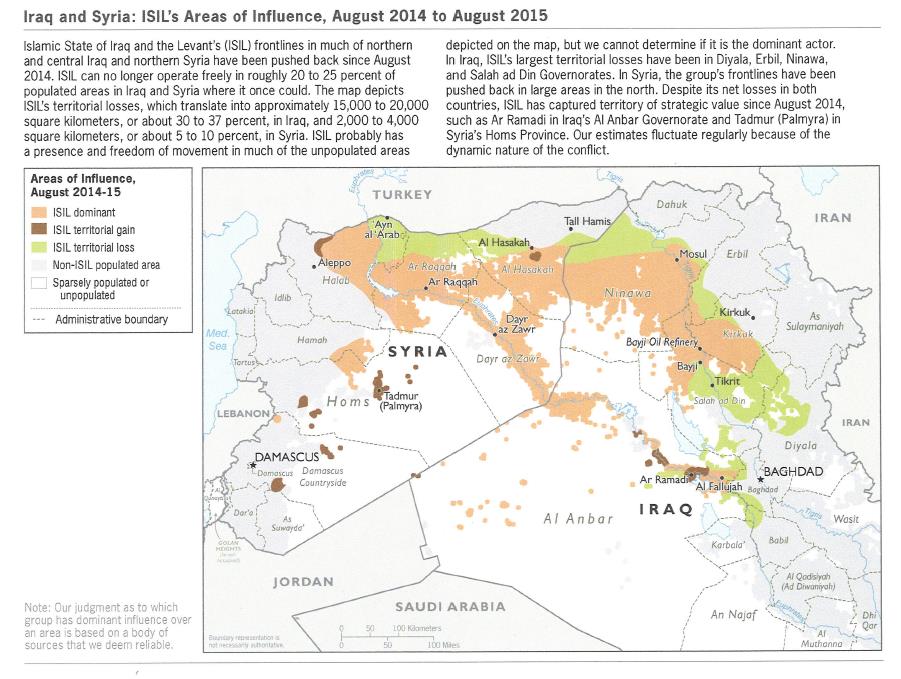
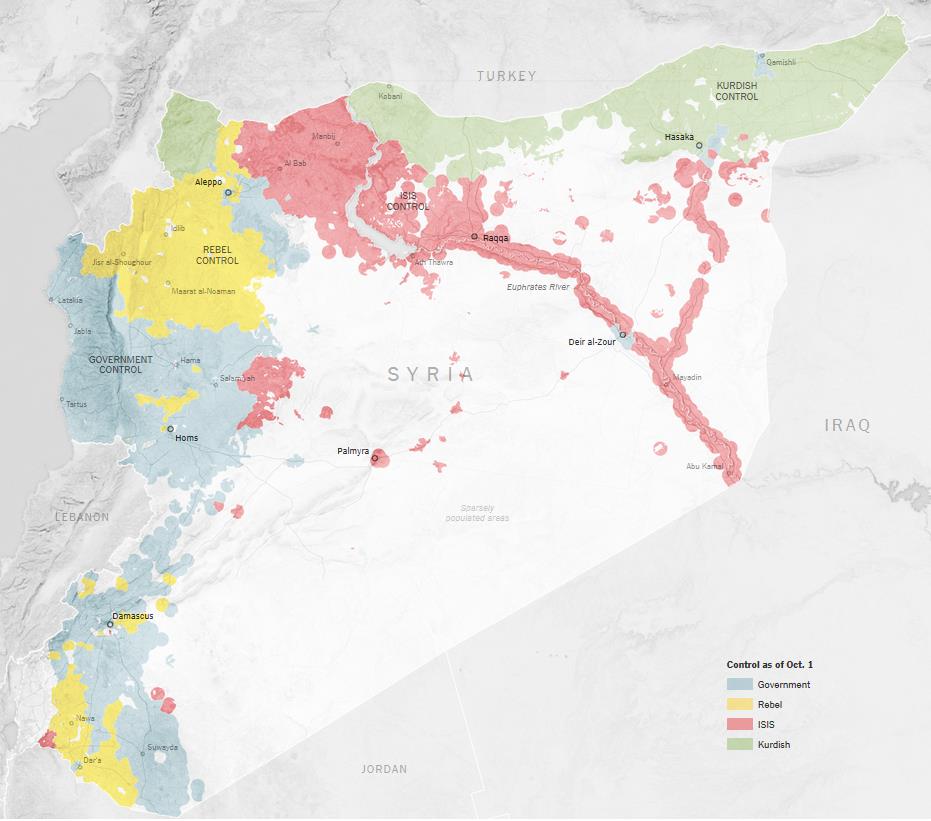
Map: ISIS areas of influence in Syria and Iraq

The following maps come from a recent Congressional Research Service report, “Armed Conflict in Syria: Overview and U.S. Response.”

Iraq and Syria: ISIS’s Areas of Influence, August 2014 to August 2015
img128
Source: Map and text produced by U.S. Department of Defense, September 2015.

Syria Conflict Map: Estimated Areas of Control as of October 1, 2015
Syria-areas-of-control
Source: Tim Wallace, New York Times. Area of control data source is Carter Center, October 1, 2015.
Notes: All areas approximate. Yellow area of “Rebel Control” includes areas under Jabhat al Nusra (Al Qaeda affiliate) control, and includes
areas controlled by a wide variety of anti-Asad forces. White color denotes sparsely populated or unpopulated areas.

Facebooktwittermail

After a U.S. shift, Iran has a seat at talks on war in Syria

The New York Times reports: Just a few weeks ago, Ayatollah Ali Khamenei said any new talks with the United States were forbidden. He described the United States as a persistent enemy of the Islamic revolution, and said that despite the nuclear agreement, it needed to be kept at a distance.

But participating in the multination Syria talks does not contradict Mr. Khamenei’s dictums, some Iranian analysts say.

“Our leader has banned the bilateral relations between Iran and America or any negotiation aimed at resuming relations,” said Hamidreza Taraghi, a political analyst in Tehran considered close to the ayatollah. “Case-by-case negotiations or finding solutions for regional problems on a multilateral basis is all right.”

So, while publicly siding with the hard-liners, the Supreme Leader may well be giving more negotiating room to President Hassan Rouhani, who has advocated more open engagements with the rest of the world. There has already been an unspoken cooperation between Iran and the United States in Iraq, where both are fighting the Islamic State.

“We should thank President Rouhani for his efforts in reaching out to the international community, and the nuclear deal,” said Farshad Ghorbanpour, a political analyst close to the government in Tehran. “Now we are seeing the rewards: We are playing an increasing active role in the international arena.”

That role is something that Iran has desperately sought: Diplomatic weight and respect that bolsters its claim that it, not Saudi Arabia, is the most influential power in the region. “It’s very important because it shows that, following the nuclear agreement, Iran is now ready to cooperate on crisis management in the Middle East,” Seyed Hossein Mousavian, a former Iranian diplomat and nuclear negotiator who now teaches at Princeton, said in a telephone interview. “I’m not surprised, because the leader had said that if the deal were done fairly, with face-saving for all parties, Iran would agree to next steps on other issues. This is a big step forward.”

Cliff Kupchan, an Iran specialist and chairman of the Eurasia Group, a Washington political consultancy, said that given Russia’s recent intervention in Syria to support Mr. Assad, it was clear he would remain in charge for a while, which meant Iran would be attending the Vienna talks from a position of strength.

Still, Mr. Kupchan said in an email, “as U.S.-Iran contacts spread to a broader array of issues, it will be harder and harder for Iranian conservatives to quarantine cooperation.” [Continue reading…]

Facebooktwittermail

The other refugee crisis

Joshua Meservey writes: In 2012, Syrians fleeing their country’s brutal civil war began arriving in significant numbers in Iraqi Kurdistan, a semi-autonomous enclave of ethnic Kurds in the north of the country. Two years later, ISIS vaulted out of northern Syria and swept across swathes of Iraq, scattering millions of Iraqis. Many of them, in addition to fleeing to Europe, made their way to the Kurdistan region and the protection of its military forces, the peshmerga, which have, for now at least, turned back ISIS’s attempts to overrun northern Iraq’s last sanctuary.

In contrast to many countries, the Kurdistan region has not hesitated to accept large flows of displaced people. Part of this is because nearly all of the Syrians who fled to Kurdistan are ethnic Kurds themselves. So too are members of several religious minorities sheltering in Kurdistan, such as the Kaka’i and the Yazidi, who faced annihilation last year at the hands of ISIS before escaping to Kurdistan.

However, the Kurds have also welcomed non-Kurds fleeing ISIS. Arab Sunni and Shiite Muslims, the latter considered heretics by ISIS, have found protection in the territory, as have the Turkmen, Shabaks, and Assyrian Christians, who have been virtually cleansed from their ancestral home in the Nineveh Plains region.

The cost of caring for so many dispossessed people is straining Kurdistan’s modest resources. Its estimated 2013 GDP was $25 billion, compared to Europe’s 2014 GDP that was more than $16 trillion. Its oil-dependent finances were already being squeezed due to plunging global oil prices, and there is the cost of fighting a war along a more than 600-mile front. The regional government also accuses the Iraqi government of withholding for more than a year its federal budget share, which Baghdad had already slashed in February 2014. The Kurdistan region, with a native population of only 5.4 million, now hosts more than a million refugees — many of whom require shelter, food, and medical care. [Continue reading…]

Facebooktwittermail