Category Archives: ISIS

Islamic State of Iraq and Syria

U.S. strategy in Iraq increasingly relies on Iran

The New York Times reports: At a time when President Obama is under political pressure from congressional Republicans over negotiations to rein in Tehran’s nuclear ambitions, a startling paradox has emerged: Mr. Obama is becoming increasingly dependent on Iranian fighters as he tries to contain the Islamic State militant group in Iraq and Syria without committing American ground troops.

In the four days since Iranian troops joined 30,000 Iraqi forces to try to wrest Saddam Hussein’s hometown of Tikrit back from Islamic State control, American officials have said the United States is not coordinating with Iran, one of its fiercest global foes, in the fight against a common enemy.

That may be technically true. But American war planners have been closely monitoring Iran’s parallel war against the Islamic State, also known as ISIS or ISIL, through a range of channels, including conversations on radio frequencies that each side knows the other is monitoring. And the two militaries frequently seek to avoid conflict in their activities by using Iraqi command centers as an intermediary.

As a result, many national security experts say, Iran’s involvement is helping the Iraqis hold the line against Islamic State advances until American military advisers are finished training Iraq’s underperforming armed forces.

“The only way in which the Obama administration can credibly stick with its strategy is by implicitly assuming that the Iranians will carry most of the weight and win the battles on the ground,” said Vali R. Nasr, a former special adviser to Mr. Obama who is now dean of the School of Advanced International Studies at Johns Hopkins University. “You can’t have your cake and eat it too — the U.S. strategy in Iraq has been successful so far largely because of Iran.” [Continue reading…]

Facebooktwittermail

Airstrikes starting to take toll on ISIS’s money flow

McClatchy reports: The Islamic State might be the best-funded radical Islamist group, perhaps in history, but the coalition air campaign that’s targeting its oil-refining operations and military assets has begun to damage its ability to earn.

And by denying the group additional territorial expansion, the airstrikes have limited the opportunities for it to profit from capturing new infrastructure and banks, according to a recent report by a money-laundering watchdog group, as well as U.S. officials and residents of Islamic State territory.

The Islamic State, a self-styled modern caliphate that controls much of northern and western Iraq and eastern Syria, turned itself into perhaps the richest and best-equipped military non-state actor last June after seizing tremendous amounts of money and equipment from the Iraqi government as it swept through Mosul and to the western and northern outskirts of Baghdad while the Iraqi army collapsed.

The Islamic State is thought to have at least 30,000 combatants and 5 million to 6 million people under its control, leaving a huge economy to be taxed and extorted.

Thousands of armored vehicles and thousands of tons of military equipment, much of it modern weaponry supplied to Iraq by the United States, were seized in the rout last June, along with cash reserves from government banks, mostly in local currency, of at least $500 million, according to the Financial Action Task Force, an international money-laundering body that examined the group’s complex financial operations in a report released in late February.

That windfall came as the group was already making millions of dollars a day pumping and refining oil and petroleum products from previously captured oil fields, mostly in eastern Syria, where the group has wrested control of at least 50,000 barrels per day of oil and refined petroleum output, according to the task force’s report, a number widely supported by reports from the area.

Although the task force notes recent efforts by Turkish and Kurdish officials to limit the Islamic State’s ability to export these products by smuggling, not all the exporting has been stopped. Even the group’s rudimentary oil-refining ability — a process commonly targeted by coalition airstrikes — while damaged, is probably sufficient to at least support the group’s huge military operation and provide some income stream. [Continue reading…]

Facebooktwittermail

Iraq’s attack against ISIS in Tikrit catches U.S. ‘by surprise’

Nancy A. Youssef reports: The Iraqi military launched a major campaign to take back a key city from the self-proclaimed Islamic State over the weekend — a move that caught the U.S. “by surprise,” in the words of one American government official.

The U.S.-led coalition forces that have conducted seven months of airstrikes on Iraq’s behalf did not participate in the attack, defense officials told The Daily Beast, and the American military has no plans to chip in.

Instead, embedded Iranian advisers and Iranian-backed Shiite militias are taking part in the offensive on the largely Sunni town, raising the prospect that the fight to beat back ISIS could become a sectarian war.

The news is the latest indication that not all is well with the American effort against the terror group. On Friday, U.S. defense officials told The Daily Beast that a planned offensive against the ISIS stronghold of Mosul had been indefinitely postponed. Over the weekend, an American-backed rebel group in Syria announced that it was dissolving, and joining an Islamist faction.

Then there was the unexpected battle for Tikrit. Over the weekend, a reported 30,000 troops and militiamen—mostly Shiites —stormed the Sunni dominated city of Tikrit, former Iraqi President Saddam Hussein’s hometown and the symbolic birthplace of his three decades of repressive practices against the majority Shiite population.

U.S. officials were largely left in the dark of the planning and timing of the operation, defense officials said. The Pentagon said Monday it was not conducting airstrikes in support of the Tikrit offensive because the Iraqi government did not ask for such help. [Continue reading…]

Facebooktwittermail

Iran backs Iraq military campaign to reclaim Tikrit from ISIS

The Wall Street Journal reports: Iran took a leading role in the Iraqi military’s largest offensive yet to reclaim territory from Islamic State, throwing drones, heavy weaponry and ground forces into the battle while the U.S. remained on the sidelines.

The operation that began Monday aims to retake Tikrit, best known as the hometown of Saddam Hussein, 80 miles north of the capital Baghdad. In addition to supplying drones, Iran’s powerful Revolutionary Guard force has fighters on the ground with Iraqi units, mostly operating artillery and rocket batteries, according to a U.S. military official. Iraqi Shiite militias closely allied with Iran are also heavily involved.

Iran’s semiofficial Fars news agency reported that Qasem Soleimani, head of the Revolutionary Guard’s overseas unit Quds Force, was on the ground near Tikrit advising commanders.

The offensive is a test of Iraqi security forces’ fitness for the much more daunting challenge of recapturing Mosul, Iraq’s second-largest city.

It has also thrown a new spotlight on Shiite Iran’s role in assisting Shiite-dominated Iraq to regain control of large parts of the country taken by the Sunni radical group Islamic State. Tehran has wielded increasing influence over Iraq’s military affairs after Iraqi security forces proved unable to contain the Islamic State onslaught that began in summer. [Continue reading…]

Time adds: [M]ilitary planners believe that Tikrit’s Sunnis have grown tired of ISIS’s harsh rule for 10 months. They hope that some of those Sunnis will now be willing to turn their guns against ISIS. Iraqi Prime Minister Haider al-Abadi has offered these Sunni tribes a pardon, and a last chance to come back into the fold with the national government.

“I call upon those who have been misled or committed a mistake to lay down arms and join their people and security forces in order to liberate their cities,” said Abadi at a press conference on Sunday in Samarra, 60 miles north of Baghdad.

During the American occupation of Iraq, these local Sunni tribes did rise-up against ISIS’s Al-Qaeda predecessor and fought in coordination with US-forces against other Sunni militiamen through the Sunni Awakening Movement.

“Sunni tribes of Tikrit could turn against ISIS,” says Hamed al-Mutlaq, a member of the Iraqi parliament and an influential Sunni politician. “They prefer the security forces to be in control. They would rather be with the Iraqi forces than ISIS.”

While tribal leaders may not want to see ISIS wielding all the influence in their territory, they’re even less likely to want to see Shiite militiamen controlling their streets.

“We know that there are Sunni tribal sheiks that don’t like [ISIS],” says Pollack. “But there are other Sunni sheiks who are more scared of the Shiite militias than they are of [ISIS].”

And they have reason to be. These Shiite militias that are marching alongside the Iraqi government forces have been accused of kidnappings, forced evictions and summary executions of Sunni civilians.

“The use of Shiite militias is a big problem,” says Mutlaq. “They have burned houses, terrorized and abducted people in Diyala, Samarra and Baghdad. They have a bad reputation.” [Continue reading…]

Facebooktwittermail

Women joining ISIS face punishment if they try to leave

Jihadica has published 32 fatwas issued by ISIS which “provide a unique glimpse into life and politics in the Islamic State. Not intended as propaganda like most of the material distributed by the group, they are an unusual source, and one that so far seems to have gone unnoticed.”

These are some of the rules that apply to women:

Q. Is it permissible for women to show their eyes and part of their face?

A. No. Women’s showing their eyes, or part of their face, causes temptation (fitna), especially when make-up is used. It is necessary for women to cover their eyes, even if only with something thin.

Q. Is it permissible for a woman to wear weapons on her cloak (abaya), such that part of her body, or the definition of her body, is made visible?

A. No, not if the weapon gives definition to the body, as with a bandolier or quiver worn over the back. If the weapon is something like a Kalashnikov, then yes. It is permissible in the way a small bag is permissible.

Q. Is it permissible, in the city or villages, for a female nurse to work in an office with a male doctor in the absence of a proper male guardian (mahram)?

A. No. It is forbidden for a woman to be alone with an unfamiliar man. If a guardian is unavailable, then she should have a group of women about her in order to ward off temptation. If a group of women is unavailable, then no.

Q. Is it permissible for women to see male doctors for women’s medical conditions, given that there are few female doctors specializing in women’s medical conditions?

A. Women should see female doctors for treatment, and exert effort in seeking them out. If a female doctor cannot be found, then it is permissible to see a male doctor, but on the condition that he not be alone with her, and that he only examine her in the place(s) necessary.

Q. What are the characteristics of women’s proper covering (hijab)? What are the characteristics of improper showing (tabarruj)?

A. Proper covering includes: (1) having the entire body and hands concealed, (2) being thick, not thin, (3) being unadorned, (4) being loose-fitting, not tight-fitting, (5) being unperfumed, (6) not resembling men’s clothing, and (7) not resembling infidel women’s clothing. Improper showing includes: (1) showing anything of the body before unfamiliar men, (2) showing any part of the clothing beneath the veil, (3) suggestive ambling in front of men, (4) leg slapping, which is highly arousing, (5) coy and flirtatious talking, and (6) mixing with men, touching their bodies, shaking their hands, and crowding together with them in cramped vehicles.

Q. Is it permissible for a woman to travel without a proper male guardian (mahram)?

A. No. She must have a guardian.

Q. Is it permissible for the wives of martyrs to leave with their children for the lands of unbelief?

A. No. It is prohibited for them, and for anyone else, to leave for and reside in the lands of unbelief. Whoso migrates from the Abode of Islam to the Abode of Unbelief has committed a great sin (ithm ‘azim), shirking the duty to emigrate to the Abode of Islam. If a woman insists on leaving for the Abode of Unbelief with the son of a mujahid, she should be punished (tu‘azzar) as a deterrent and preventive measure.

Facebooktwittermail

Lure of the Caliphate

Malise Ruthven writes: As Dounia Bouzar shows in Ils cherchent le paradis ils ont trouvé l’enfer (They looked for Paradise and found Hell), her poignant account of French “orphan parents” who lose their children to the jihadist cause, French middle-class teenagers and medical students from atheist families are far from being immune to seduction by these jihadists groups. Bouzar’s story focuses on Adèle, the fifteen-year-old daughter of a professional couple in Paris who joins Jabhat al-Nusra after an online conversion by her handler “Brother Mustafa.” In a farewell note to her mother she leaves behind, Adèle writes:

My own darling Mamaman (Mamaman à moi)
…Its because I love you that that I have gone.
When you read these lines I’ll be far away.
I will be in the Promised Land, the Sham, in safe hands.
Because its there that I have to die to go to Paradise.
… I have been chosen and I have been guided.
And I know what you do not know: we’re all going to die,
punished by the wrath of God.
It’s the end of the world, Mamaman.
There is too much misery, too much injustice…
And everyone will end up in hell.
Except for those who have fought with the last Imam in the Sham,
Except for us.

Adèle’s family does not know exactly how she first became drawn to Islam. But as with so many other young recruits from Europe, the Internet seems to have played a crucial part. On Adèle’s computer, they discover pictures of her in a black niqab, as well as a record of her online conversion and rapid indoctrination by Brother Mustapha, in a hidden Facebook account in which she calls herself Oum Hawwa (“Mother of Eve”).

Her conversion appears to have been influenced by the sudden death of Cathy, her much-loved aunt, from an aneurysm at the age of forty. In the Facebook dialogue, Mustapha consoles her about her loss and asks: “Have you reflected on what I explained?”

“Yes, thanks be to God, my spirit is clearer. God called aunt Cathy back to bring me closer to Him. He did this so I would see the Signs that the ignorant don’t hear.”

“This is how He tests us,” says Mustapha. “Everything is written—there is always an underlying meaning. Allah wanted you to learn. But He must send you a trigger so you can leave the ignorance in which you have been kept up till now. Your reasoning is merely human. Allah reasons as Master of the Universe.…”

As Adèle’s engagement strengthens, Mustapha becomes more strident, moving into grooming mode:

When I tell you to call me you must call me. I want you pious and submissive to Allah and to me. I can’t wait to see your two little eyes beneath the niqab.

The story ends tragically: in Syria, the girl is briefly married to Omar, a jihadi chosen by the Emir of her group. Then one day Adèle’s parents receive a text from Adèle’s cellphone: “Oum Hawwa died today. She was not chosen by God. She didn’t die a martyr: just a stray bullet. May you hope she doesn’t go to hell.”

In the hope of retrieving her daughter, Adèle’s mother, Sophie, receives help from Samy, a practicing French Muslim. He has just come back from Syria after failing to rescue his own fourteen-year-old younger brother, Hocine, who also joined al-Nusra. Samy explains the all-embracing ideology that drives the jihadists. After being kidnapped in Northern Syria, Samy had been brought before a leader of the French division of al-Nusra. “There were young French boys everywhere. An entire town of French recruits,” Samy recalls. He is told that the Syrian jihad and the restoration of the caliphate is a prelude to the final battle at the End of Time. He is warned not to listen to the Salafists (orthodox believers) who claim that waging jihad is subject to certain limitations. “God has chosen us! We have the Truth! You’re either with us or you’re a traitor,” he is told, in a phrase that echoes George W. Bush. “Only those who fight with the Mahdi” — the Muslim messiah, who will restore the caliphate — “will enter paradise.” [Continue reading…]

Facebooktwittermail

The U.S. has no counter-narrative to challenge ISIS propaganda

Simon Cottee writes: ISIS’s métier is shock and gore, whereas the [U.S. State Department’s Center for Strategic Counterterrorism Communications] CSCC’s, to put it unkindly, is more mock and bore, more Fred Flintstone than Freddy Krueger. Shock and gore, needless to say, is where the action is — and hence where the Internet traffic tends to go. “You’re never going to be able to match the power of their outrageousness,” Fernandez said, conceding this disadvantage.

ISIS has a vast network of “fanboys,” as its virtual supporters are widely and derisively known, who disseminate the group’s online propaganda. (ISIS ennobles them with the title “knights of the uploading.”) They are dedicated, self-sufficient, and even, Fernandez said, occasionally funny. And they are everywhere on Twitter, despite the social-media network’s efforts to ban them. Fernandez described the group’s embrace of social media as “a stroke of genius on their part.” The CSCC doesn’t have fanboys.

More crucially, ISIS has a narrative. This is often described by the group’s opponents as “superficial” or “bankrupt.” Only it isn’t. It is immensely rich. The International Centre for the Study of Radicalisation and Political Violence estimates that of the 20,000 or more foreign jihadists believed to have gone to fight in Syria and Iraq, around 100 are from the United States. These fighters may be naive or stupid, but they didn’t sacrifice everything for nothing. John Horgan, director of the Center for Terrorism and Security Studies at University of Massachusetts Lowell, told me that people who join groups like ISIS “are trying to find a path, to answer a call to something, to right some perceived wrong, to do something truly meaningful with their lives.”

The CSCC doesn’t have a narrative — not one, at any rate, remotely comparable in emotional affect and resonance to that of ISIS. No one is more sharply aware of this than Fernandez himself. “ISIS’s message,” he said, “is that Muslims are being killed and that they’re the solution. … There is an appeal to violence, obviously, but there is also an appeal to the best in people, to people’s aspirations, hopes and dreams, to their deepest yearnings for identity, faith, and self-actualization. We don’t have a counter-narrative that speaks to that. What we have is half a message: ‘Don’t do this.’ But we lack the ‘do this instead.’ That’s not very exciting. The positive narrative is always more powerful, especially if it involves dressing in black like a ninja, having a cool flag, being on television, and fighting for your people.” [Continue reading…]

It’s a bit misleading to keep on talking about the need for a counter-narrative when narratives are nothing more than marketing strategies.

ISIS’s marketing strategy is coupled with the realities it has created on the ground. It might be marketing hype to pronounce the territory under its control as a caliphate, but the fact is, it does control real territory as large as a medium-sized country. Without that territory, it would have next to nothing to market.

Countering ISIS requires much more than coming up with a better pitch — it has to be a pitch for something tangible and not just some vacuous promise of a better future. Such a narrative (if it can be found) can neither be crafted nor delivered by the U.S. government

Facebooktwittermail

SNL skit targets American militarism, Toyota — and ISIS?

When an American man reaches that juncture in life where he’s ready to buy a Toyota Camry, he can be confident he’s now living the American dream: a reliable car, a house in the suburbs and then the final act that will prove his boldness and manhood — he tearfully ships off his teenage daughter to join the U.S. Army.

I didn’t watch the Super Bowl, so I didn’t see this ad until today. My reaction to Toyota’s message: WTF?

It seems like the writers for Saturday Night Live also took exception to Toyota’s message and thought that it was worth a parody — a parody which a segment of SNL’s audience thought was in bad taste.

As much as some viewers are applauding SNL for being so bold as to take on ISIS, I think that what the show really did was use ISIS to give themselves some cover while taking an indirect punch at U.S. militarism and the Americanist dogma that military service is the closest thing to saintliness.

Meanwhile, I’m still waiting for Toyota to seize the marketing opportunity that has been staring them in the face for decades: to launch The Technical — a four-wheel drive pickup truck with a factory-installed gun-mount, and “fully loaded” with all the features that an organization like ISIS needs for desert warfare.

But joking aside, when the military history of the 21st century gets written, among the tools of warfare of preeminent importance, the Toyota pickup truck is probably going to rank higher than the drone. And it’s not just any Toyota truck; the truck of choice is the Hilux.

“The Toyota Hilux is everywhere,” says Andrew Exum, a former Army Ranger and now a fellow of the Center for a New American Security. “It’s the vehicular equivalent of the AK-47. It’s ubiquitous to insurgent warfare. And actually, recently, also counterinsurgent warfare. It kicks the hell out of the Humvee.”

Whether you’re an American dad, or you’re fighting for ISIS, there’s only #OneBoldChoice: Toyota.

Now if there’s any way Toyota could trick ISIS to trade in their Hiluxes for the Toyota Isis minivan — that’s right, Toyota makes an “Isis” — there’s no question the militant group could swiftly be defeated.

Facebooktwittermail

ISIS and the caliphate

Hassan Hassan writes: ISIL is not an apocalyptic cult as people tend to make it out to be. It employs Islamic eschatological ideas but only as part of its wider religious and political project. Messianic movements do not attract large followings in the way ISIL seems to.

The disproportionate focus on this part of its propaganda, which might be a result of familiarity with the concept in the West, risks misdiagnosis of the appeal of ISIL.

ISIL has a strategy for a clear religious and political project. Its focus on Dabiq [the location in Syria of an epic battle between Muslims and Christians, which prophecies predict] is nothing new. Abu Musab Al Zarqawi, ISIL’s founding father, spoke about the prophecy during his jihadi operation in Iraq. According to Yaroslav Trofimov, author of Siege of Mecca, Al Zarqawi took the idea from his Jordanian mentor Abu Mohammed Al Maqdisi.

In its videos, ISIL refers to its fighters as the “soldiers of the caliphate”, not the soldiers of Dabiq. It is the caliphate, or the Islamic state, that draws the attention of new recruits and invigorates them to fight for the group. It claims to represent the interest of Sunnis in Iraq, Syria and beyond. So it is this idea that must be the focus of attention for those fighting ISIL.

As politicians and commentators repeatedly warn about the danger of radicalization and the need for effective de-radicalization programs, this way of framing the threat posed by ISIS seems to me to involve an implausible proposition: that those who have a passionate desire to create a caliphate can be persuaded to abandon that desire.

Much as the issue of radicalization has in recent months focused on European Muslims who have been drawn into the ranks of ISIS, it shouldn’t be forgotten that the bulk of ISIS’s fighters did not abandon the comforts (or alienation) of Western societies. They came from Muslim countries that hold out no promise of becoming Islamic states and whose governments have little interest in representing the interests of the populations over whom they rule.

Millions of Muslims, without being extremists of any variety, see the Islamic world as having been carved up by Western colonialism, robbed of its sovereignty, and placed under the control of compliant and corrupt rulers. Broadly speaking, what’s on offer right now is a brutal ISIS caliphate vs. a fractious status quo. That seems like a lousy choice.

As Iraq, Syria, Egypt, and Libya demonstrated over the last half century, the project of pan-Arab secular nationalism was a spectacular failure.

On the other hand, the Arab monarchies have the durability of a chronic disease — their ability to survive has accomplished little more than cripple the region.

If ISIS and the other forms of Islamic extremism are seen for what they are — symptoms of a disease, rather than the disease itself — then the remedy cannot be found by merely looking for ways to suppress its symptoms.

What is called for is a better vision that can be embraced on a larger scale than what ISIS or anyone else is currently offering.

This isn’t about de-radicalization but instead, real radicalism which goes to the root and is built around a vision of what it wants to create rather than what it endeavors to destroy.

Facebooktwittermail

Europe’s jihadis in search of identity

Kenan Malik writes: What is striking about the stories of wannabe jihadis is their diversity. There is no “typical” recruit, no single path to jihadism.

Sahra Ali Mehenni is a schoolgirl from a middle-class family in the south of France. Her father, an industrial chemist, is a non-practising Muslim, her mother an atheist. “I never heard her talk about Syria, jihad,” said her mother. One day last March, to the shock of her family, she took not her usual train to school but a flight from Marseilles to Istanbul to join Isis. When she finally phoned home it was to say: “I’ve married Farid, a fighter from Tunisia.”

Kreshnik Berisha, a German born of Kosovan parents, played as a teenager for Makkabi Frankfurt, a Jewish football club and one of Germany’s top amateur teams. He went on to study engineering and in July 2013, boarded a bus to Istanbul and then to Syria. “I didn’t believe it,” said Alon Meyer, Makkabi Frankfurt’s coach. “This was a guy who used to play with Jewish players every week. He was comfortable there and he seemed happy.” Berisha later returned home to become the first German homegrown jihadi to face trial.

There are hundreds of stories such as these, from all over Europe. What they tell us is that, shocking though it may seem, there is nothing unusual in the story of the runaway Tower Hamlets schoolgirls. And that what Emwazi has in common with other European recruits is not so much his harassment as his college education.

The usual clichés about jihadis – that they are poor, uneducated, badly integrated – are rarely true. A survey of British jihadis by researchers at London’s Queen Mary College found no link to “social inequalities or poor education”; most were highly educated young people from comfortable families who spoke English at home. According to Le Monde, a quarter of French jihadis in Syria are from non-Muslim backgrounds.

What draws most wannabe jihadis to Syria is, to begin with, neither politics nor religion. It is a search for something a lot less definable: for identity, for meaning, for “belongingness”, for respect. Insofar as they are alienated, it is not because wannabe jihadis are poorly integrated, in the conventional way we think of integration. Theirs is a much more existential form of alienation.

There is, of course, nothing new in the youthful search for identity and meaning. What is different today is the social context in which this search takes place. We live in a more atomised society than in the past; an age in which many people feel peculiarly disengaged from mainstream social institutions and in which moral lines often seem blurred and identities distorted.

In the past, social disaffection may have led people to join movements for political change, from far-left groups to anti-racist campaigns. Today, such organisations often seem equally out of touch. What gives shape to contemporary disaffection is not progressive politics but the politics of identity.

Identity politics has, over the last three decades, encouraged people to define themselves in increasingly narrow ethnic or cultural terms. A generation ago, “radicalised” Muslims would probably have been far more secular in their outlook and their radicalism would have expressed itself through political organisations. Today, they see themselves as Muslim in an almost tribal sense, and give vent to their disaffection through a stark vision of Islam. [Continue reading…]

Facebooktwittermail

ISIS killer Mohammed Emwazi had link to 2005 London bomb plot

The Observer reports: Mohammed Emwazi, the Islamic State (Isis) extremist behind the beheading of western hostages, was able to flee Britain and the scrutiny of the security services, despite being a member of a terror cell that was known to have links to the failed 21/7 attacks on London in 2005, the Observer can reveal.

One leading member of Emwazi’s network had a telephone conversation on the day of the attacks with Hussein Osman, who was later jailed for life for placing an explosive at Shepherd’s Bush tube station.

The security services were also aware that associates of the 12-strong west London terror group had joined the four 21/7 bombers at a training camp in Cumbria a year before the attempt to bring carnage to London’s streets.

The revelations, contained in court documents seen by this newspaper, raise urgent questions over how Emwazi, who became known as “Jihadi John”, was able to evade surveillance, slip out of the country in 2013 using false papers and re-emerge in Syria a year later to become the world’s most wanted terrorist.

Not only was Emwazi a “person of interest” for MI5 as a member of a London jihadi cell set up in 2007 to recruit for al-Shabaab, an al-Qaida affiliate, but at least one member of his network had a connection with one of the most infamous crimes in British history.

The failed 21/7 attacks came a fortnight after four men blew themselves up on tubes and a bus, killing 52 people and injuring more than 700, the worst terrorist atrocity committed on British soil. [Continue reading…]

Facebooktwittermail

Mohammed Emwazi was not a fine young man driven to murder

Shashank Joshi writes: Cage is a British organisation that “campaigns against state policies” towards “communities impacted by the war on terror”. It had been in contact with Emwazi until 2012. They portray him as an “extremely gentle, kind” and “beautiful young man” – words that might lead one to question their judgment – radicalised under relentless and arbitrary pressure from the British government. In this version, Emwazi is a tragic victim crushed by the power of an overweening security state. The world sees a butcher; Cage sees a dupe. In case anyone was in danger of missing the point, Cage’s website broadcast a simpler message: “the state is the only terrorist”.

This narrative would be funny, were the charge not so serious. Cage’s account of Emwazi’s radicalisation is self-serving, disingenuous, and highly selective. They start the story in 2010, when Kuwait cancelled Emwazi’s visa – under British pressure, he alleges – and he was prevented from returning to the country of his birth. This is presented as unprovoked harassment, borne of MI5’s sadistic compulsion to target the Muslim community as a whole. There’s a reason that Cage have left out the backstory, which helps us understand why Emwazi was on the government’s radar in the first place.

In 2009, he had travelled to Tanzania to go on “safari”. He was refused entry, deported, and questioned by MI5, who reportedly accused him of seeking to join al-Qaeda’s Somali affiliate al-Shabab. This is entirely plausible. Why? Because British court papers identify Emwazi as a member of a network of Islamist extremists connected to Somalia.

This network had been in contact with a 7/7 bomber, and one key member, Bilal Berjawi, had also tried to go on a “safari” earlier that year – eventually ending up fighting in Somalia, later dying in a drone strike. It’s also worth noting that Emwazi, in his incarnation as Jihadi John, was “obsessed with Somalia” and forced hostages to watch al-Shabab videos.

So if you think that Emwazi was really going on safari, I have a bridge to sell you. And some free travel advice: if you desperately want to see lions and elephants, my suggestion is that you opt for a reputable travel agency rather than a well-established jihadist network. [Continue reading…]

Facebooktwittermail

Mohammed Emwazi triable in British courts for war crimes, say prosecutors

The Guardian reports: Prosecutors and detectives have been working on building a criminal case against Mohammed Emwazi, 26, for potential offences of war crimes and multiple counts of murder, the Guardian has learned.

The the Islamic State militant dubbed “Jihadi John” has featured in seven propaganda videos claiming responsibility for the beheadings of hostages from Britain, the US and other countries.

The Crown Prosecution Service on Friday confirmed it is working with detectives from Scotland Yard’s counter-terrorism command to prosecute Emwazi over the videos and other suspected crimes if he ever comes within Britain’s jurisdiction.

A former top prosecutor said Emwazi’s crimes would be triable in British courts if committed overseas in territory seized by Isis in Syria during the civil war there.

A CPS spokesperson said: “We are liaising with the MPS [Metropolitan Police Service] Counter Terrorism Command (SO15) on their assessment of the content of videos that have been posted online that appear to show the murder of hostages.”

Lord MacDonald QC, the former director of public prosecutions, said the fact the offences took place in Syria would not prohibit a prosecution in a British court: “Since Victorian times it has been a criminal offence for British citizens to commit murder anywhere.” [Continue reading…]

Facebooktwittermail

U.S. rethinks plan to retake Mosul

The Wall Street Journal reports: The U.S. military is considering a months-long campaign of airstrikes to squeeze Islamic State fighters in Mosul before inserting Iraqi ground forces to retake the city, officials said Friday.

The on-the-ground fight to retake Mosul isn’t likely to start until the fall at the earliest, after an intensified air campaign to target Islamic State leaders and cut off supply lines in and around the city, the officials said.

The emerging plan is at odds with a briefing by a U.S. military’s Central Command official in February in which he said the U.S. and Iraq were looking at starting a campaign to liberate Mosul, Iraq’s second-largest city, by April or May.

Afterward, Iraqi and American officials cast doubt on the likely readiness of Iraqi forces.

U.S. military officials now say they believe that Iraqi’s best military units are many months away from being in a position to successfully conduct such an operation. Those forces haven’t yet begun their training at the bases set up by American military officers in Iraq.

“When we feel that the Iraqi forces are ready to go and win decisively, we will go and advise the Iraqis to begin the operation,” a military official said. [Continue reading…]

Facebooktwittermail

ISIS may not be a global threat, but neither is it a problem with a ready solution

The New York Times reports: The reports are like something out of a distant era of ancient conquests: entire villages emptied, with hundreds taken prisoner, others kept as slaves; the destruction of irreplaceable works of art; a tax on religious minorities, payable in gold.

A rampage reminiscent of Tamerlane or Genghis Khan, perhaps, but in reality, according to reports by residents, activist groups and the assailants themselves, a description of the modus operandi of the Islamic State’s self-declared caliphate this week. The militants have prosecuted a relentless campaign in Iraq and Syria against what have historically been religiously and ethnically diverse areas with traces of civilizations dating to ancient Mesopotamia.

The latest to face the militants’ onslaught are the Assyrian Christians of northeastern Syria, one of the world’s oldest Christian communities, some speaking a modern version of Aramaic, the language of Jesus.

Assyrian leaders have counted 287 people taken captive, including 30 children and several dozen women, along with civilian men and fighters from Christian militias, said Dawoud Dawoud, an Assyrian political activist who had just toured the area, in the vicinity of the Syrian city of Qamishli. Thirty villages had been emptied, he said. [Continue reading…]

In the aftermath of the war in Iraq, some Americans, perceiving echoes of the government-fueled national hysteria that followed 9/11, now regard the attention being given to ISIS as disproportionate to the size of the threat.

A few days ago, one commentator described ISIS as: “A nasty nuisance, which has killed thousands in the Middle East, but a nuisance nonetheless.”

If one subscribes to the Steven Pinker view of the world, then how bad the current situation is, just comes down to numbers.

Fewer people have been killed by ISIS than by barrel bombs dropped by the Assad regime in Syria, or were killed during the U.S.-led invasion and occupation of Iraq.

The threat to humanity posed by climate change, far exceeds all other global threats, including what can arguably be called a minor threat from ISIS.

But if an issue is defined as not rising above the threshold of being a nuisance, solely based on numbers, then since between 1882 and 1968 only 3,446 blacks were lynched in America, should the racial violence occurring during that chapter in this country’s history be described as having been no more than a nasty nuisance?

The very fact that we view lynching as emblematic of a chapter in history, illustrates the fact that significance can never be reduced to numbers.

In France, the death toll from the Charlie Hebdo shootings was little more than the average number of fatalities that occur every day on France’s roads.

Since statistically, the French face little more risk from terrorism than they face from traffic accidents, does that mean the French government should devote the same amount of time and resources to addressing road safety as they do to tackling terrorism?

Again, this doesn’t just come down to numbers. For one thing, there’s no reason to view road safety as a problem that risks escalating. Neither is there reason to imagine that individuals or groups of people have a specific interest in making the roads more dangerous. Road safety is an issue that gains ongoing and appropriate attention from every relevant constituency from central government to local government, town planners to school teachers, and vehicle manufacturers to medics.

The fact that it is the type of issue that generally gets effectively addressed, is the very reason it is largely ignored in political and popular discourse.

Conversely, while it’s easy to say that ISIS presents a problem that needs “to be dealt with,” the very fact that it remains unclear what mechanisms might be effective in tackling this problem, is one of the main reasons ISIS continues to grab the headlines.

ISIS might not represent an unstoppable force and yet its campaign of violence has proved very difficult to contain.

Politicians glibly talk about the strategy for defeating ISIS, yet no one has made a convincing case that such a strategy has been found.

Some observers believe that each time another ISIS headline appears, the group has simply been served up the attention it craves, but to dismiss this as a group of attention-seekers is to gravely misjudge ISIS’s ambitions.

A year ago, before ISIS had become a household name but after it taken over Fallujah, President Obama wanted to downplay its significance in what became an infamous dismissal — he said they were just “a jayvee team.”

In those early months of 2014, ISIS used America’s inattention to its full advantage.

Whether showered with or starved of attention, ISIS pursues its goals because they have less concern about how they are perceived by Americans, or for that matter the rest of the world, than we might imagine.

The issue now is less about the quantity of attention ISIS garners that it is about the quality of that attention.

When viewed through the paradigm of the war on terrorism, it’s natural and appropriate to point to that neocon project’s manifold failures. We might also see this as the latest manifestation in a problem that cannot wholly be solved. In other words, that we need to learn how to live with what can be regarded as a manageable amount of terrorism.

But maybe we are being distracted by the category of terrorism itself.

In spite of the fact that ISIS has engaged in what are generally viewed as some of the most grotesque acts of terrorism ever carried out, it differs from all other terrorist groups in at least two fundamental ways:

  • It has spawned a mass movement, and
  • It has captured and now governs large tracts of territory.

While there was recent furious debate about whether ISIS should be called Islamic, there has been little discussion about its claim to have created a state.

That claim is treated as too preposterous as to merit consideration — the so-called Islamic State is surely destined to implode.

And yet that hasn’t happened and it isn’t about to happen. Neither is this a state that stands any chance of being recognized by any other, but nor does it seek such recognition. On the contrary, the recognition it seeks is from all those who reject the legitimacy of nation states — and this constituency is large and growing.

Facebooktwittermail

ISIS executioner, Mohammed Emwazi, was under watch by British intelligence

The New York Times reports: Mr. Emwazi was called “Jihadi John” by the foreign hostages he guarded, a number of whom he apparently beheaded in widely circulated videos. He was first identified on Thursday by The Washington Post website, and his name was confirmed by a senior British security official. The official said that the British government had identified Mr. Emwazi some time ago but had not disclosed his name for operational reasons. The identification was also confirmed in Washington by a senior United States military intelligence official.

Information is still vague about Mr. Emwazi, with Britain officially refusing to confirm that he is indeed “Jihadi John” because of what are described as continuing operations.

But Mr. Emwazi appears in 2011 court documents, obtained by the BBC, as a member of a network of extremists who funneled funds, equipment and recruits “from the United Kingdom to Somalia to undertake terrorism-related activity.”

Mr. Emwazi is alleged to be part of a group from West and North London, sometimes known as “the North London Boys,” with links to the Somalia-based terrorist group Al Shabab, organized by an individual who had returned to London in February 2007 and whose name was redacted in court documents.

Another person associated with that group was Bilal al-Berjawi, who was born in Lebanon but brought to West London as a baby. He fought in Somalia and rose through the ranks of Al Shabab and Al Qaeda in Africa before being killed in a drone strike in January 2012, according to Raffaello Pantucci, also a fellow at the Royal United Services Institute.

Mr. Berjawi traveled to Kenya in February 2009, telling his family he was heading for a safari; he and a friend were detained in Nairobi and shipped back to London, but made it to Somalia in October that year.

The neighborhood group “is a tight community and it’s very probable that they knew each other and were part of the same crew,” Mr. Pantucci said.

So it is likely that Mr. Emwazi’s own safari a few months later in May, from Britain to Germany to Tanzania, using the name of Muhammad ibn Muazzam, set off alarms with the British security services, and that he had started on the road to radicalism even before his encounter with MI5 in 2009. [Continue reading…]

Facebooktwittermail

The contradiction between the secular and fundamentalist roots of ISIS is more apparent than real

ISIS: Inside the Army of Terror, by Hassan Hassan and Michael Weiss — a Chatham House review: Despite its declaration of a new ‘caliphate’ based on jihadist principles, much of the senior leadership Islamic State is actually made up of Saddam-era Baath Party members.

A study of the origins and make-up of Islamic State characterizes the jihadist group as a ‘spectral hold-over’ of the old regime.
‘Most of its top decision-makers served either in Saddam Hussein’s military or security services. In a sense, ‘secular’ Baathism has returned to Iraq under the guise of Islamic fundamentalism.’

The authors, Syrian researcher Hassan Hassan, who hails from the town of Albu Kamal on the Iraqi border, and the American journalist Michael Weiss, write that this contradiction between secular and fundamentalist is more apparent than real.

Despite the secular origins of the Baath party, Saddam Hussein used it to preserve the dominance of Iraq’s Sunni Muslims – only 20 per cent of the population – and repress the majority Shia. In the declining years of his rule Saddam Hussein adopted an overtly religious path, in the hope of co-opting the Sunni Muslim leadership. In fact, Saddam lost control of his so-called Islamic Faith Campaign and many Baath Party members fell under the spell of the imams. [Continue reading…]

Facebooktwittermail

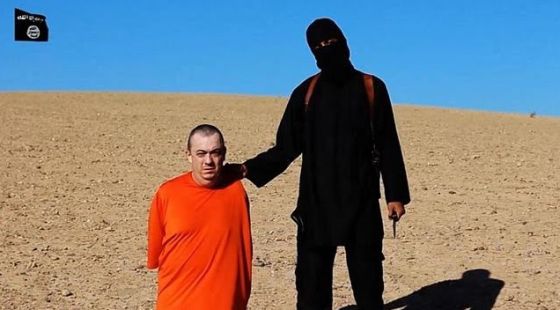
ISIS ‘Jihadi John’ named as Mohammed Emwazi, portrayed as victim of UK counter-terrorism policies

British aid worker, Alan Henning, and his executioner, alleged to be British jihadist, Mohammed Emwazi.

British aid worker, Alan Henning, and his executioner, alleged to be British jihadist, Mohammed Emwazi.

The Washington Post reports: The world knows him as “Jihadi John,” the masked man with a British accent who has beheaded several hostages held by the Islamic State and who taunts audiences in videos circulated widely online.

But his real name, according to friends and others familiar with his case, is Mohammed Emwazi, a Briton from a well-to-do family who grew up in West London and graduated from college with a degree in computer programming. He is believed to have traveled to Syria around 2012 and to have later joined the Islamic State, the group whose barbarity he has come to symbolize.

“I have no doubt that Mohammed is Jihadi John,” said one of Emwazi’s close friends who identified him in an interview with The Washington Post. “He was like a brother to me. . . . I am sure it is him.”

A representative of a British human rights group who had been in contact with Emwazi before he left for Syria also said he believed Emwazi was Jihadi John, a moniker given to him by some of the hostages he once held.

“There was an extremely strong resemblance,” Asim Qureshi, research director at the rights group, CAGE, said after watching one of the videos. “This is making me feel fairly certain that this is the same person.” [Continue reading…]

Qureshi, in a statement on the CAGE website, portrays Emwazi as a victim of British counter-terrorism policies:

This case should trigger thinking about British domestic and foreign policy. What risk assessments, if any, have been made about British counter-terrorism policy and the key part it plays in radicalising individuals? How have the security services been allowed to get away with abusing British citizens without redress? Why are the long-standing grievances over Western interventions in the Muslim world been ignored?

Propagandists have a habit of becoming the most devout believers in their own narrative, but I think it requires a particularly distorted mindset to portray Emwazi, given his alleged actions, as a victim.

In a press conference today, Qureshi described Emwazi as a “kind” and “gentle” young man.

In a video released today, Qureshi says: “The questions shouldn’t be about Jihadi John but they should be about what role our security services have played in alienating people in this society and turning them away from being able to find solutions to the problems they have.”

Moazzam Begg, CAGE’s director of outreach and a former detainee at Guantánamo, can also reasonably argue that he has been a victim of Britain’s counter-terrorism policy and what some see as its over-zealous security services.

Given Qureshi’s reasoning, are we to imagine that Begg or anyone else finding themselves in a similar position might be just as likely to follow in Emwazi’s footsteps and become another of ISIS’s executioners?

In fact, Begg has no illusions about ISIS: “You have no idea how dangerous these people are,” he wrote on Facebook in early 2014.

He also wrote:

“I saw muhajireen (foreigners), locked in cages, by Allah worse, than my Guantanamo cell.

“They beat people to make them confess…just like the Arab regimes, there is no difference.

“I have been to many places, Bosnia, Afghan… but never seen this kind of fitnah [turmoil] and such dangerous extremism and readiness for takfeer [excommunication].

“Syrians on the ground have started to hate foreigners because of them.

“ISIS have even detained and killed aid workers…brothers from UK who have taken convoys [have] been looted by ISIS, guns shoved in faces of brothers who have crossed Europe to bring aid.

“And what’s the basis of detaining the non-Muslim aid worker [Alan Henning] who came in as a guest of Muslims, under their protection? They’ve probably murdered him too, just like many Muslims they’ve done that to.”

The world is full of people who for multitudes of justifiable reasons regard themselves as victims, yet this doesn’t absolve them of responsibility for their own actions.

The Guardian adds: “Jihadi John” is one of a trio of Britons who held hostage Spanish, French, Danish, British and US nationals. The hostages were captured in northern Syria, some in Idlib province, others in Aleppo and a third group in and around Raqqa province, which has since become the main Syrian stronghold of Isis.

The jihadi cell that spawned Isis was initially strong in Idlib province, having taken root there in the summer of 2012. From there it spread to Aleppo, where hostages that had been captured at that point were held in one of two locations – under the eye hospital in the centre of the city or in a factory deep in an industrial zone on its northern outskirts.

By February last year, all the hostages, including Briton John Cantlie, who is one of two remaining western hostages, were moved to Raqqa.

It was in Raqqa that the hostages first became aware of the status that Emwazi had developed among Isis. One former hostage described him as “cold, sadistic and merciless”.

Facebooktwittermail
