Category Archives: Obama administration

“Osama bin Laden is my father”

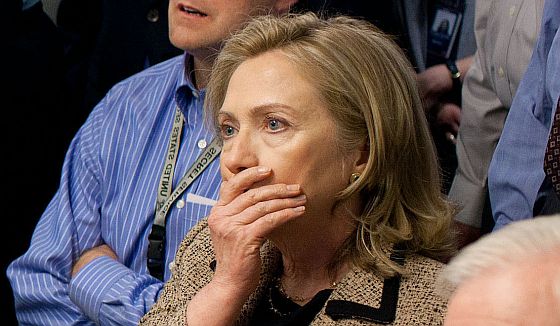
Hillary Clinton witnessing the operation to kill Osama bin Laden. Is this an expression of horror at the sight of seeing parents executed in front of their children?

The Guardian reports:

Osama bin Laden’s daughter cradled the head of her wounded mother in the room where the al-Qaida leader had just been killed.

“I am Saudi,” she told Pakistani security officials shortly after US special forces had flown away with the terrorist’s bloodied body. “Osama bin Laden is my father.”

The 12-year-old had herself been injured by a piece of flying debris in her foot or ankle during the night-time raid on Bin Laden’s compound in Abbottabad, northern Pakistan, but she was comforting her father’s fifth wife, Amal Ahmed al-Sadah, 29, who was shot in the calf by commandos as they closed in on Bin Laden.

The woman lay quietly, her head in the girl’s lap, though she seemed conscious, the officials told the Guardian. Across the room stood another woman, hands tied behind her back and mouth taped, aged around 30 and possibly Bin Laden’s doctor from Yemen.

Danny Schechter writes:

The tip on bin Laden’s whereabouts came in back in 2010. You have to assume the house was under surveillance. If they thought they “bagged him” they would be watching closely and choosing the right time to deep six the target (I actually wrote this lead paragraph sentence before reading this “Breaking News” from the Washington Post: “CIA had secret outpost in Abbottabad”).

“The CIA maintained a safe house in the Pakistani city of Abbottabad for a small team of spies who conducted extensive surveillance over a period of months on the compound where Osama bin Laden was killed by US special operations forces this week (US officials),” the newspaper reported.

Both Afghan agents and Pakistani intelligence now say they told the US about the house as early as 2009.

So, they knew he was there. That was a reason drones weren’t used.

The CIA wanted a more controlled high profile and dramatic intervention for public consumption, for what, in the end, was a marketing campaign – marketing the centrality of the agency’s role in a war whose main audience is not on the battlefield, but in the homeland.

They needed a heroic narrative to revive support for a war they have been losing, and a scalp to sell to a conflict-weary and disillusioned population. It is no surprise that the Seals labelled OBL “Geronimo”, reviving memories of fighting guerrilla-style Indian wars. Muslim renegades are apparently our new “savages”.

Tom Wright writes:

Consider the following scenario. A group of Irish republican terrorists carries out a bombing raid in London. People are killed and wounded. The group escapes, first to Ireland, then to the US, where they disappear into the sympathetic hinterland of a country where IRA leaders have in the past been welcomed at the White House. Britain cannot extradite them, because of the gross imbalance of the relevant treaty. So far, this seems plausible enough.

But now imagine that the British government, seeing the murderers escape justice, sends an aircraft carrier (always supposing we’ve still got any) to the Nova Scotia coast. From there, unannounced, two helicopters fly in under the radar to the Boston suburb where the terrorists are holed up. They carry out a daring raid, killing the (unarmed) leaders and making their escape. Westminster celebrates; Washington is furious.

What’s the difference between this and the recent events in Pakistan? Answer: American exceptionalism. America is subject to different rules to the rest of the world. By what right? Who says?

Consider another fictive scenario. Gangsters are preying on a small mid-western town. The sheriff and his deputies are spineless; law and order have failed. So the hero puts on a mask, acts “extra-legally”, performs the necessary redemptive violence and returns to ordinary life, earning the undying gratitude of the local townsfolk, sheriff included. This is the plot of a thousand movies, comic-book strips, and TV shows: Captain America, The Lone Ranger, and (upgraded to hi-tech) Superman. The masked hero saves the world.

Films and comics with this plot-line have been named as favourites by many presidents, as Robert Jewett and John Shelton Lawrence pointed out in The Myth of the American Superhero and Captain America and the Crusade Against Evil. The main reason President Obama has been cheered to the echo across the US, even by his bitter opponents, is not simply the fully comprehensible sense of closure a decade after the horrible, wicked actions of September 11 2001. Underneath that, he has just enacted one of America’s most powerful myths.


Facebooktwittermail

The cost of fear: How Osama bin Laden helped drive America towards bankruptcy

While most of America is celebrating the death of Osama bin Laden, it’s worth giving credit where credit is due: he didn’t just nurse a quixotic ambition — to attack the US economy — but he also figured out how it could be done and succeeded. Perhaps he was inspired by the AIDS virus and realized that, just like triggering a deadly auto-immune reaction, the only way to attack America was to trick the US government into conducting and expanding the attack itself.

In a clear-eyed analysis of the cost of the massive convulsion called a global war on terrorism, the National Journal makes one mistake — the headline: “The Cost of bin Laden: $3 Trillion Over 15 Years.”

The real cost of al Qaeda’s attacks on US embassies, the USS Cole, New York and Washington DC was a few billion dollars. Beyond that, the additional cost was the cost of America’s overreaction.

If bin Laden and his cohorts had carefully studied the synergy through which American fearfulness, the mass media, commercial interests and political opportunism so easily combine to fuel national hysteria, they would have realized that all they needed to do was engineer a sufficiently potent catalyst (9/11), following which virtually no further effort would be required. Indeed, al Qaeda’s method of “attack” has now evolved to the point where it can attack America simply with ideas about the possibility of an attack.

It has harnessed the counterpart of asymmetric warfare which is asymmetric fear — a state of trauma in which smaller and smaller threats provoke more and more extreme reactions.

If a day ever comes when an America president can boldly declare that al Qaeda has been defeated, have little doubt that the US taxpayer will still be required to incur the massive cost of protecting this country from al Qaeda redux — an organization that has no name and in fact does not exist but lurks in the unmappable territory of the future, just waiting to pounce.

The most expensive public enemy in American history died Sunday from two bullets.

As we mark Osama bin Laden’s death, what’s striking is how much he cost our nation—and how little we’ve gained from our fight against him. By conservative estimates, bin Laden cost the United States at least $3 trillion over the past 15 years, counting the disruptions he wrought on the domestic economy, the wars and heightened security triggered by the terrorist attacks he engineered, and the direct efforts to hunt him down.

What do we have to show for that tab? Two wars that continue to occupy 150,000 troops and tie up a quarter of our defense budget; a bloated homeland-security apparatus that has at times pushed the bounds of civil liberty; soaring oil prices partially attributable to the global war on bin Laden’s terrorist network; and a chunk of our mounting national debt, which threatens to hobble the economy unless lawmakers compromise on an unprecedented deficit-reduction deal.

All of that has not given us, at least not yet, anything close to the social or economic advancements produced by the battles against America’s costliest past enemies. Defeating the Confederate army brought the end of slavery and a wave of standardization—in railroad gauges and shoe sizes, for example—that paved the way for a truly national economy. Vanquishing Adolf Hitler ended the Great Depression and ushered in a period of booming prosperity and hegemony. Even the massive military escalation that marked the Cold War standoff against Joseph Stalin and his Russian successors produced landmark technological breakthroughs that revolutionized the economy.

Perhaps the biggest economic silver lining from our bin Laden spending, if there is one, is the accelerated development of unmanned aircraft. That’s our $3 trillion windfall, so far: Predator drones.

Facebooktwittermail

The execution of Osama bin Laden — updated

We know Osama bin Laden wasn’t armed when he was shot and killed. We know he wasn’t hiding behind a woman. What we’ve yet to find out are the exact orders that were given to whoever pulled the trigger, but so far mounting evidence suggests that in the early hours of Monday morning, US Navy SEALs conducted an execution under the direction of President Obama.

Update: In a White House press briefing today, Jay Carney provided clarification on the execution order, which is to say that bin Laden would have been taken captive if he had made it clear that he wanted to surrender.

The team had the authority to kill Osama bin Laden unless he offered to surrender, in which case the team was required to accept his surrender, if the team could do so safely.

Carney did not respond when a reporter asked whether any of the US servicemen in the operation spoke Arabic.

Meanwhile, testifying in Congress Attorney General Eric Holder said that even if bin Laden had attempted to surrender, US Navy SEALs would have been justified in killing him.

A senior Pakistani security official told ABC News, the bin Laden was killed in front of his 13-year old daughter. In photographs published by Reuters showing three of the men killed in the compound, no weapons could be seen.

* * *

Gary Younge writes:

While many nations suffered from al-Qaida’s terrorism and few in the world will mourn Bin Laden’s death, the United States is the only place where it sparked spontaneous outpourings of raucous jubilation.

The national unity that Barack Obama has sought to harness following the announcement is indeed eerily familiar. Albeit in joy rather than sorrow, it’s the same kind of unity that followed 9/11. It is also the same kind of unity that rallies around flags, dismisses dissent and disdains reflection. And however comforting it may have been at the time, the consequences of that kind of unity has been disastrous.

The reason Bin Laden’s death was a source of such elation is in part because almost every other American response to 9/11 is regarded as a partial or total failure. Two thirds of the people believe that the Iraq invasion was not worth it, and the country is evenly divided on the issue of whether the invasion Afghanistan is a good idea. The public mostly supports keeping Guantánamo open – but nonetheless concedes that doing so will fuel anti-American sentiment.

So the frustration of the last decade, during which the limits of America’s military superiority were tested and found wanting, had their outlet in the murder of a single man at the hands of a crack team of US Navy Seals.

Having effectively declared war on the world it is hardly a surprise that Bin Laden would come to this kind of end.

This was not so much the exercise of American power as the performance of it. Coming eight years to the day after George W Bush landed on the USS Abraham Lincoln to announce “Mission accomplished” in Iraq, news of Bin Laden’s death was yet another mediated milestone in this war on an abstract noun. Like the capture of Saddam Hussein, the murder of Bin Laden changes little. Al-Qaida was never a top-down organisation, and was in decline anyhow – and the principal reason for its waning fortunes is the uprisings in the Arab world, revolts that have mostly taken place against America’s client states.

But to suggest that “justice has been done”, as President Obama did on Sunday night, seems perverse. This was not justice, it was an extra-judicial execution. If you shoot a man twice in the head you do not find him guilty. You find him dead. This was revenge. And it was served very cold indeed.

Geofrrey Robertson writes:

America resembles the land of the munchkins, as it celebrates the death of the Wicked Witch of the East. The joy is understandable, but in some respects, unattractive. It endorses what looks increasingly like a cold-blooded assassination ordered by a president who, as a former law professor, knows the absurdity of his statement that “justice was done”. Amoral diplomats and triumphant politicians join in applauding Bin Laden’s summary execution because they claim real justice – arrest, trial and sentence would have been too difficult in the case of Bin Laden. But in the long-term interests of a better world, should it not at least have been attempted?

That future depends on a respect for international law. The circumstances of Bin Laden’s killing are as yet unclear and the initial objection that the operation was an illegitimate invasion of Pakistan’s sovereignty must be rejected. Necessity required the capture of this indicted and active international criminal and Pakistan’s abject failure (whether through incompetence or connivance) justified Obama’s order for an operation to apprehend him. However, the terms of that order, as yet undisclosed, are all important. Bill Clinton admitted recently to having secretly approved teh assassination of Bin Laden by the CIA after the US embassy bombings in the1990s, while President Bush publicly said after 9/11 that he wanted Bin Laden’s head on a plate. Did President Obama order his capture, or his execution?

Robert Lambert writes:

Al-Qaida strategists, propagandists, operatives and supporters will be relieved that Osama bin Laden, their iconic figurehead, died a martyr and was not captured alive and imprisoned to stand trial. To this extent the strategists determining US counterterrorism policy have shown a disregard for effective counterterrorism and instead fostered continuity with the war on terror which has boosted, rather than diminished, global support for al-Qaida since 9/11.

When Tony Blair and George Bush stood shoulder to shoulder in the aftermath of 9/11 it was clear to both leaders that military responses would replace criminal investigations as the preferred tools of counterterrorism. Sadly, in Iraq, Afghanistan and around the globe, the war on terror resulted in the deaths of far more civilians than suspected terrorists – whether high profile like Bin Laden or lesser and unknown known figures operating in the name of al-Qaida.

As a result, the war on terror lost moral authority and became a gift to al-Qaida propagandists. The fact that the most effective counterterrorism is always closely focused on the prosecution of terrorist conspirators appeared to be of no concern in the Pentagon or Whitehall.

According to al-Qaida propagandist Saif al-Adl, 9/11 was intended to provoke the US to “lash out militarily against the ummah” in the manner if not the scale of “the war on terror”.

“The Americans took the bait,” he continues, “and fell into our trap” – no doubt using hindsight to describe al-Qaida’s ability to predict the massive scale and range of the military responses to 9/11.

Patrick Cockburn writes:

Al Qaeda is the most successful terrorist organization in history. By destroying the World Trade Centre in New York on 9/11 it provoked the US into launching wars damaging to itself in Afghanistan and Iraq. Al Qaeda aimed to destroy the status quo in the Middle East and it succeeded beyond its wildest dreams.

Its success has not been all its own doing. Ayman al-Zawahiri, al-Qaeda’s number two and chief strategist, wrote at the time of 9/11 that the aim of the group was to lure the US into an over-reaction in which it would “wage battle against the Muslims.” Once the US was committed to a ground war, and no longer exercised its power primarily through local surrogates, the way would be open for Muslims to launch a jihad against America. By over-reacting, President Bush, aided by Tony Blair, responded to 9/11 very much as al-Qaeda would have wished.

In the decade since the attack on the Twin Towers “terrorist experts” and governments have frequently portrayed al-Qaeda as a tightly organized group located in north-west Pakistan. From some secret headquarters its tentacles reach out across the world, feeding recruits, expertise and money to different battlefronts.

Al-Qaeda has never operated like that. The closest it ever came to being a sort of Islamic Comintern was when it had several hundred militants based in the Tora Bora mountains of Afghanistan in 1996-2001. Even at that time, when it could operate more or less freely in the Afghan mountains, its numbers were so small that it would hire local tribesmen by the day to be filmed for al-Qaeda propaganda videos, showing its men marching and training.

Facebooktwittermail

Osama bin Laden and the Arab Spring

Premature death offers the surest path to immortality.
No, that isn’t a metaphysical statement; just a rather prosaic observation.

Che Guevara, Marilyn Monroe, James Dean, John F Kennedy, Malcolm X and now Osama bin Laden — all will forever be remembered through iconic images that capture their vitality, untarnished by age and infirmity.

The war on terrorism made pitifully little sense other than in symbolic terms, yet even in these terms the US has consistently been the loser.

9/11 was an offense to American pride — how could the greatest, most powerful nation on earth be brought to its knees by a small band of young men armed with box cutters?

Apparently, the only way to restore American pride and reinvigorate American power was to go on a rampage across the Middle East, kill hundreds of thousands of people and then, in what most Americans would gladly see as the final act, execute America’s archenemy. If we bankrupted ourselves along the way, it was all in the name of the most noble cause: the war between good and evil.

But evil can only be effectively externalized and symbolically vanquished if we simultaneously indulge in the willful suppression of awareness. The destruction of al Qaeda has only been a plausible objective for as long as we remain dreamily wedded to our own sense of innocence.

Elliot Abrams, a man still guided by his own dream images of the Middle East, writes:

The timing of Osama bin Laden’s death is perfect, coming during the Arab Spring. Al Qaeda’s message that violence, terrorism and extremism are the only answer for Arabs seeking dignity and hope is being rejected each day in Tunisia, Egypt, Libya, Syria, Yemen, Bahrain and throughout the Arab lands.

Al Qaeda and its view of the world are being pushed aside in favor of demands for new governments, free elections, freedom of speech and assembly and an end to corruption. Bin Laden’s death weakens Al Qaeda and Salafi movements further by taking away their most powerful symbol.

But on the contrary, what bin Laden’s death has achieved is to terminate the real life of a fugitive and leave behind nothing but the powerful symbol.

While in the eyes of Americans bin Laden came to symbolize violence, in the eyes of those who looked up to him as “Sheikh Osama” he symbolized a beacon of defiance in a region where for too long subservient populations had acquiesced to authoritarian rule by leaders who were themselves subservient to American interests.

As a political awakening now erupts across the region, a narrow violent Islamist movement has not so much been rejected as it has been superseded by a broad, youthful, partially non-violent, popular movement.

Even if the Middle East’s young revolutionaries have no organizational links or ideological sympathies with al Qaeda and its affiliates, the jihadists can nevertheless be viewed as a historical precursor to the Arab Spring in as much as they too rejected the political legitimacy of the region’s American-backed autocratic rulers.

To the extent that commentators portray the uprisings as ideologically non-violent, this seems to say more about the way Americans across the political spectrum have in the post 9/11 era been conditioned to view political violence, than it says about the nature of the Middle East’s ongoing revolutions. If one wants to praise the uprisings it is only politically correct to do so if one also praises their ostensible non-violent character.

Nowhere has this image of non-violence been held up more frequently than in the coverage of the Egyptian revolution, but as Egyptian journalist and blogger, Hossam el-Hamalawy, writes, this image is a fabrication.

One of the biggest myths invented by the media, tied to this whole Gene Sharp business: the Egyptian revolution was “peaceful.” I’m afraid it wasn’t. The revolution (like any other revolution) witnessed violence by the security forces that led to the killing of at least 846 protesters.

But the people did not sit silent and take this violence with smiles and flowers. We fought back. We fought back the police and Mubarak’s thugs with rocks, Molotov cocktails, sticks, swords and knives. The police stations which were stormed almost in every single neighborhood on the Friday of Anger–that was not the work of “criminals” as the regime and some middle class activists are trying to propagate. Protesters, ordinary citizens, did that.

Egyptians understand well what a police station is for. Every family has a member who got abused, tortured or humiliated by the local police force in his/her neighborhood. And I’m not even talking here about the State Security Police torture factories. I’m talking about the “ordinary police.”

Other symbols of power and corruption were attacked by the protesters and torched down during the uprising. Revolutionary violence is never random. Those buildings torched down or looted largely belonged to Mubarak’s National Democratic Party.

In a number of provinces like in N Sinai and Suez, arms were seized by protesters who used them back against the police to defend themselves. State Security Police office in Rafah and Arish, for example, were blown up using RPGs, hand grenades and automatic rifles, while gas pipelines heading to Jordan and Israel were attacked.

Am I condemning this violence? Totally not. Every single revolution in history witnessed its share of violence. The violence always starts on the hands of the state, not the people. The people are forced to pick up arms or whatever they can put their hands on to protect themselves.

Along with dispelling the myth of non-violence, maybe it’s time we stopped calling this an Arab Spring — or at least remember that spring brings tornadoes and storms and not just flowers and birdsong.

Facebooktwittermail

The death of Osama bin Laden

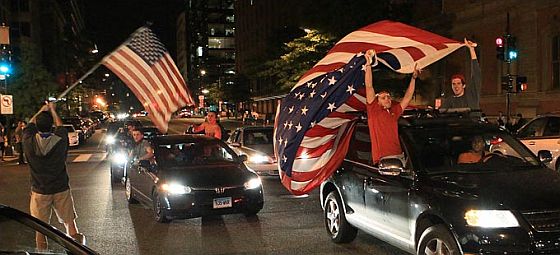
“As crowds gathered outside the White House, there was little question that Mr. Obama’s presidency had forever been changed.” That’s the caption the New York Times put under the photo below.

David Axelrod might have preferred this event to have occurred closer to the end of Obama’s reelection campaign, though accusations that the news was being timed to serve partisan political interests would have been even harder to refute than they are now.

“Osama bin Laden, the mastermind of the most devastating attack on American soil in modern times and the most hunted man in the world, was killed in a firefight with United States forces in Pakistan, President Obama announced on Sunday night,” is the lead in the New York Times main report.

US forces on a mission to kill or capture (not capture or kill) bin Laden, killed him “in a firefight” in Pakistan. At least that’s what the Times reports. Only further into the report does it reiterate what Obama actually said: “After a firefight, they killed Osama bin Laden and took custody of his body.”

The White House chooses its words carefully. If bin Laden was killed during the firefight then it’s reasonable to assume that this is exactly what Obama would have said. To say that the al Qaeda leader was killed after a firefight seems to suggest he was executed.

The exact manner in which the death occurred may explain why, at least thus far, no photographic evidence has been released. If bin Laden was indeed executed it was most likely for political reasons.

Bin Laden’s capture could surely have provided an intelligence bonanza of inestimable value. His subsequent trial would indeed have been a compelling demonstration of what it should mean to deliver justice. But it would also have opened a can of worms.

If bin Laden had been tried in front of a military tribunal then yet again this government would be undermining the strength of the criminal justice system. If on the other hand he was tried in a civilian court, it would be hard for the administration to justify its continued use of military tribunals for any terrorism-related cases.

During a trial, there would be no predicting what kind of strategically damaging information might have been revealed that could have affected US relations with Pakistan, Saudi Arabia or other Gulf nations.

And then there would be the headache of deciding where the trial could take place.

Just over a year ago, it was Attorney General Eric Holder who assured Congress that there was no risk of bin Laden ever being read his Miranda rights.

“The reality is that we will be reading Miranda rights to the corpse of Osama bin Laden. He will never appear in an American courtroom. That’s the reality. … He will be killed by us, or he will be killed by his own people so he’s not captured by us. We know that,” Holder said emphatically.

“Dead men don’t talk,” is a truth esteemed by those who value secrets, but the fact that bin Laden’s death leaves so many questions unanswered means that he will remain a potent force for those who want to promote conspiracy theories of every variety. The celebrations in this “victory” will likely be quite short-lived.

Lawrence Wright notes:

The fact that bin Laden was found in a compound in a wealthy retirement community populated in large part by former Pakistani military officers raises dire questions about the relationship of the Pakistani army and its intelligence community to radical Islamic terrorists. For the past decade, as America has poured billions into a country where about one in a hundred citizens pays income taxes, the Pakistani military/intelligence complex has gone into the looking-for-bin-Laden business. Now, they are out of business. If it is true that Pakistani intelligence was helpful in locating bin Laden, and kept that matter secret, then we can begin to sort out our fraught relationship with that troubled country on a more equitable, trusting basis. If that turns out not to be the case, then there will be a dreadful reckoning to come.

Al Qaeda and its followers will be attempting to make a powerful statement in the next several weeks to demonstrate that they are still relevant following this mighty loss. Al Qaeda affiliates may speed up operations that were in the pipeline. The recent bombing in Marrakesh and the arrests in Germany demonstrate that Al Qaeda continues to have enthusiastic, entrepreneurial operatives that are eager to make their own mark on history.

The fact that bin Laden had found refuge close to Islamabad may or may not reveal a role played by individuals in Pakistan’s intelligence and military establishment, but perhaps more importantly it should serve as a reminder of what was already known in 2001: that al Qaeda never was an organization tied to a particular place.

Al Jazeera‘s political analyst, Marwan Bishara, writes:

[F]or the Muslim world, bin Laden has already been made irrelevant by the Arab Spring that underlined the meaning of peoples power through peaceful means.

It is also worth recalling that bin Laden’s al-Qaeda and its affiliates have killed far more Arabs and Muslims than they did Westerners.

And it was only after they failed to garner real support in the Arab world that they ran back to Afghanistan and began to target the West.

After long hijacking Arab and Muslim causes through its bloody attacks on Western targets, al-Qaeda has been discredited since 9/11 and its organisational capacity diminished by Western counter terror measures.

Al-Qaeda’s bin Laden has provided the Bush administration with the excuse to launch its disastrous and costly wars in the greater Middle East.

As expected, Washington’s wars in Iraq, Afghanistan and Pakistan continued to provide al-Qaeda with fresh recruits and support in the Muslim world and perpetuate a cycle of violence that ripped through the region for the last decade.

However, it has been the more implicit and less costly US and Western intelligence services that succeeded to a large degree in curtailing al-Qaeda activities, limiting the movement of its leaders that eventually led to his killing.

So what will this mean for the US war in Afghanistan and Pakistan? Certainly Washington has less reason or justification to wage a war in Afghanistan now that bin Laden is no more.

It might also find more readiness among certain Taliban leaders in the absence of the thorniest issue of al-Qaeda, to make a deal that insures a power sharing arrangement in favour of the Taliban in return for curbing the use of Afghanistan by al-Qaeda to export “terrorism”.

Bin Laden will continue to be a distraction for the short term, and especially if some of al-Qaeda groups muster revenge attacks.

But in the long term, it is the historical transformations in the Arab and Muslim world that will eventually close the book on al-Qaeda.

Facebooktwittermail

Bin Laden’s body buried at sea

Brian Whitaker reports:

The dilemma of what to do with Osama bin Laden’s body appears to have been quickly resolved if reports that he has been buried at sea prove correct.

Burying him on land could have led to his grave becoming a centre of contention as well as raising questions about where he should be buried.

“Finding a country willing to accept the remains of the world’s most wanted terrorist would have been difficult,” a US official said, adding: “So the US decided to bury him at sea.”

Fears about Bin Laden’s burial place turning into a shrine for Islamists were probably unfounded, since the Wahhabi/Salafi tradition rejects such things. Even Saudi kings are buried in unmarked graves.

Senior US officials initially told news agencies that his body would be disposed of in accordance with Islamic tradition, which involves ritual washing, shrouding and burial within 24 hours.

Although the swift burial complies with Islamic custom and should therefore avoid causing any offence in Muslim countries, the apparent haste could lead to claims that the person killed was not really Bin Laden – though the US authorities have taken DNA samples and appear to have no doubts.

The 24-hour rule has not always been applied by the US in the past. For example, the bodies of Uday and Qusay Hussein – sons of the Iraqi dictator – were held for 11 days before being released for burial.

Burial at sea is rare in Islam, though several Muslim websites say it is permitted in certain circumstances.

One is on a long voyage where the body may decay before the ship reaches land. The other is if there is a risk of enemies digging up a land grave and exhuming or mutilating the body – a rule that could plausibly be applied in Bin Laden’s case.

For sea burial, according to alislam.org, the body should be lowered into the water “in a vessel of clay or with a weight tied to its feet”. The website adds: “As far as possible it should not be lowered at a point where it is eaten up immediately by the sea predators.”

Facebooktwittermail

A more militarized CIA for a more militarized America

Glenn Greenwald writes:

The first four Directors of the CIA (from 1947-1953) were military officers, but since then, there has been a tradition (generally though imperfectly observed) of keeping the agency under civilian rather than military leadership. That’s why George Bush’s 2006 nomination of Gen. Michael Hayden to the CIA provoked so many objections from Democrats (and even some Republicans).

The Hayden nomination triggered this comment from the current Democratic Chairwoman of the Senate Intelligence Committee, Dianne Feinstein: “You can’t have the military control most of the major aspects of intelligence. The CIA is a civilian agency and is meant to be a civilian agency.” The then-top Democratic member of the House Intelligence Committee, Jane Harman, said “she hears concerns from civilian CIA professionals about whether the Defense Department is taking over intelligence operations” and “shares those concerns.” On Meet the Press, Nancy Pelosi cited tensions between the DoD and the CIA and said: “I don’t see how you have a four-star general heading up the CIA.” Then-Sen. Joe Biden worried that the CIA, with a General in charge, will “just be gobbled up by the Defense Department.” Even the current GOP Chair of the House Intelligence Committee, Pete Hoekstra, voiced the same concern about Hayden: “We should not have a military person leading a civilian agency at this time.”

Of course, like so many Democratic objections to Bush policies, that was then and this is now. Yesterday, President Obama announced — to very little controversy — that he was nominating Gen. David Petraeus to become the next CIA Director. The Petraeus nomination raises all the same concerns as the Hayden nomination did, but even more so: Hayden, after all, had spent his career in military intelligence and Washington bureaucratic circles and thus was a more natural fit for the agency; by contrast, Petraues is a pure military officer and, most of all, a war fighting commander with little background in intelligence. But in the world of the Obama administration, Petraeus’ militarized, warrior orientation is considered an asset for running the CIA, not a liability.

That’s because the CIA, under Obama, is more militarized than ever, as devoted to operationally fighting wars as anything else, including analyzing and gathering intelligence. This morning’s Washington Post article on the Petraeus nomination — headlined: “Petraeus would helm an increasingly militarized CIA” — is unusual in presenting such a starkly forthright picture of how militarized the U.S. has become under the 2009 Nobel Peace Prize winner:

Facebooktwittermail

How Obama leads from behind

Ryan Lizza writes:

This spring, Obama officials often expressed impatience with questions about theory or about the elusive quest for an Obama doctrine. One senior Administration official reminded me what the former British Prime Minister Harold Macmillan said when asked what was likely to set the course of his government: “Events, dear boy, events.”

Obama has emphasized bureaucratic efficiency over ideology, and approached foreign policy as if it were case law, deciding his response to every threat or crisis on its own merits. “When you start applying blanket policies on the complexities of the current world situation, you’re going to get yourself into trouble,” he said in a recent interview with NBC News.

Obama’s reluctance to articulate a grand synthesis has alienated both realists and idealists. “On issues like whether to intervene in Libya there’s really not a compromise and consensus,” Slaughter said. “You can’t be a little bit realist and a little bit democratic when deciding whether or not to stop a massacre.”

Brzezinski, too, has become disillusioned with the President. “I greatly admire his insights and understanding. I don’t think he really has a policy that’s implementing those insights and understandings. The rhetoric is always terribly imperative and categorical: ‘You must do this,’ ‘He must do that,’ ‘This is unacceptable.’ ” Brzezinski added, “He doesn’t strategize. He sermonizes.”

The one consistent thread running through most of Obama’s decisions has been that America must act humbly in the world. Unlike his immediate predecessors, Obama came of age politically during the post-Cold War era, a time when America’s unmatched power created widespread resentment. Obama believes that highly visible American leadership can taint a foreign-policy goal just as easily as it can bolster it. In 2007, Obama said, “America must show—through deeds as well as words—that we stand with those who seek a better life. That child looking up at the helicopter must see America and feel hope.”

In 2009 and early 2010, Obama was sometimes criticized for not acting at all. He was cautious during Iran’s Green Revolution and deferential to his generals during the review of Afghanistan strategy. But his response to the Arab Spring has been bolder. He broke with Mubarak at a point when some of the older establishment advised against it. In Libya, he overruled Gates and his military advisers and pushed our allies to adopt a broad and risky intervention. It is too early to know the consequences of these decisions. Libya appears to be entering a protracted civil war; American policy toward Mubarak frightened—and irritated—Saudi Arabia, where instability could send oil prices soaring. The U.S. keeps getting stuck in the Middle East.

Nonetheless, Obama may be moving toward something resembling a doctrine. One of his advisers described the President’s actions in Libya as “leading from behind.” That’s not a slogan designed for signs at the 2012 Democratic Convention, but it does accurately describe the balance that Obama now seems to be finding. It’s a different definition of leadership than America is known for, and it comes from two unspoken beliefs: that the relative power of the U.S. is declining, as rivals like China rise, and that the U.S. is reviled in many parts of the world. Pursuing our interests and spreading our ideals thus requires stealth and modesty as well as military strength. “It’s so at odds with the John Wayne expectation for what America is in the world,” the adviser said. “But it’s necessary for shepherding us through this phase.”

Facebooktwittermail

The crisis of American tentativeness

Christopher Dickey and John Barry write:

From Washington’s vantage, every Friday is becoming Black Friday in the Middle East. Muslim prayers turn to protests that keep building toward full-scale uprisings faster than anyone had predicted, and with potentially cataclysmic consequences nobody dares imagine. This Friday, the shock came in Syria, where President Bashar al-Assad runs one of the Middle East’s most repressive regimes. Across the country, protesters have grown ever more emboldened in recent weeks, and on Friday they poured into the streets by the tens of thousands to face the deadly fusillades of Assad’s security forces. More than 70 died. What did the White House have to say? From Air Force One: “We call on all sides to cease and desist from the use of violence.”

Surely President Obama can do better than that. Or perhaps not. The drama—the tragedy—increasingly apparent at the White House is of a brilliant intellect who is nonetheless confounded by events, a strategist whose strategies are thwarted and who is left with almost no strategy at all, a persuasive politician and diplomat who gets others to crawl out on limbs, has them take big risks to break through to a new future, and then turns around and walks away from them when the political winds in the United States threaten to shift. It’s not enough to say the Cabinet is divided about what to do. Maybe the simplest and in many ways the most disturbing explanation for all the flailing is offered by veteran journalist and diplomat Leslie H. Gelb: “There is one man in this administration who debates himself.” President Obama.

These patterns of behavior and their consequences have been on horrifying display in the blood-drenched streets of Misrata, Libya, where the population has begged for more support from NATO and the United States. But they did not begin with Libya, or with the surprise uprising in Tunisia in January or the stunning fall of Egypt’s President Hosni Mubarak in February. They were evident from Year 1 of the Obama presidency in his excruciating deliberations over the Afghan surge, in the hand extended ineffectually to Iran, and the lines drawn in the sand, then rubbed out and moved back, and further back, in the dismal, failed efforts to build a Palestinian peace process. But in Libya the crisis of American tentativeness has grown worse almost by the day. Muammar Gaddafi holds on, despite Obama’s demand for him to leave, and the civilians that the Americans, their allies, and the United Nations vowed to protect are being slaughtered.

Facebooktwittermail

Obama’s secret prison network

The Associated Press reports:

“Black sites,” the secret network of jails that grew up after the Sept. 11 attacks, are gone. But suspected terrorists are still being held under hazy circumstances with uncertain rights in secret, military-run jails across Afghanistan, where they can be interrogated for weeks without charge, according to U.S. officials who revealed details of the top-secret network to The Associated Press.

The Pentagon has previously denied operating secret jails in Afghanistan, although human rights groups and former detainees have described the facilities. U.S. military and other government officials confirmed that the detention centers exist but described them as temporary holding pens whose primary purpose is to gather intelligence.

The Pentagon also has said that detainees only stay in temporary detention sites for 14 days, unless they are extended under extraordinary circumstances. But U.S. officials told the AP that detainees can be held at the temporary jails for up to nine weeks, depending on the value of information they produce. The officials spoke on condition of anonymity because the program is classified.

The most secretive of roughly 20 temporary sites is run by the military’s elite counterterrorism unit, the Joint Special Operations Command, at Bagram Air Base. It’s responsible for questioning high-value targets, the detainees suspected of top roles in the Taliban, al-Qaida or other militant groups.

The site’s location, a short drive from a well-known public detention center, has been alleged for more than a year.

The secrecy under which the U.S. runs that jail and about 20 others is noteworthy because of President Barack Obama’s criticism of the old network of secret CIA prisons where interrogators sometimes used the harshest available methods, including the simulated drowning known as waterboarding.

Facebooktwittermail

Whose flag still gets burned in Baghdad?

As US Secretary of Defense Robert Gates visited Baghdad yesterday, the New York Times reported:

Mr. Gates and American military commanders have made no secret of their view that some of the 47,000 American troops in Iraq should remain after 2011 as a stability force, particularly as tensions have flared between Arabs and Kurds in the north. But Mr. Gates said that the Iraqi government must first request that the American troops stay. That has not happened yet, much to the growing impatience of American commanders who say they need to know now in order to plan into 2012.

“We are willing to have a presence beyond that time,” Mr. Gates told the soldiers at Camp Liberty. “But we’ve got a lot of commitments around the world.” He added that “if folks are going to want us to have a presence, we’re going to need to get on with it pretty quickly in terms of our planning and our ability to figure out where we get the forces.”

He also said that although the Iraqis had shown interest in keeping some American troops in the country, “The politics are such, we’ll just have to wait and see.”

Mr. Gates was obliquely referring to the politics surrounding Mr. Maliki, who is hemmed in by a bloc of politicians loyal to the anti-American cleric Moktada al-Sadr. Mr. Sadr, whose support Mr. Maliki relied on to secure a second term as prime minister, is opposed to any delay in the American withdrawal. Any extension of the American troop presence would require the politically risky decision by Mr. Maliki to ask for it.

The top American commander in Iraq, Gen. Lloyd J. Austin III, made clear on Thursday that Iraq was not ready to defend itself, particularly from the skies. He said the Iraqis also needed help with intelligence gathering, logistics and the use of different weapons systems in coherent warfare. He said that there was a debate in the Iraqi government about whether the United States should stay or not, and that the wind of that debate was not blowing in one direction, “It’s blowing in every direction.”

Despite the uncertainties, Mr. Gates told the troops at Camp Liberty that “Iraq has been an extraordinary success story for the United States military.” In briefly reflective comments, he recalled for them the first of some dozen trips to Iraq as defense secretary, in December 2006, when violence was raging and he held a news conference at a nearby base while a firefight went on in the background.

Today, Mr. Gates said, countries in turmoil across the Middle East “would be happy if they could get to where Iraq is today — it isn’t perfect, but it’s new and it is a democracy and people do have rights.”

In conclusion, he recalled that when he took over as defense secretary, people said he would be evaluated by how Iraq turned out. “And I’ll let people judge for themselves,” he said.

Meanwhile, Al Jazeera‘s Jane Arraf tweets that demonstrators gathered in Baghdad’s Tahrir Square today, burning American flags and protesting against the continuation of the US occupation. The protesters also say even the US embassy — the biggest embassy in the world — is part of the occupation.

Facebooktwittermail

Obama’s unaccomplished mission in Libya

Just over a week ago, President Obama gave a speech on Libya and declared: “The United States of America has done what we said we would do.”

I authorized military action to stop the killing and enforce U.N. Security Council Resolution 1973.

We struck regime forces approaching Benghazi to save that city and the people within it. We hit Qaddafi’s troops in neighboring Ajdabiya, allowing the opposition to drive them out. We hit Qaddafi’s air defenses, which paved the way for a no-fly zone. We targeted tanks and military assets that had been choking off towns and cities, and we cut off much of their source of supply. And tonight, I can report that we have stopped Qaddafi’s deadly advance.

But not in Misurata. The people there must be wondering why the sense of urgency in the international effort to protect Benghazi seems to have withered during Gaddafi’s onslaught on the third largest city in Libya.

MSNBC reports:

Libyans in the besieged city of Misrata are suffering a host of horrors at the hands of forces loyal to Moammar Gadhafi, including beatings, rapes, summary executions and worsening food and medicine shortages, a spokesman for the opposition said Tuesday.

More than 1,000 people have been killed or are presumed dead since the conflict began in early February, and another 100 are listed as missing, said the spokesman, who spoke on condition that he not be identified.
“The security situation remains grave, especially in particular areas where Gadhafi’s forces are still present — whether in the form of heavy artillery tanks on the ground or in the form of groups of snipers positioned alongside some of the areas … very close to the city or in the suburbs,” he told msnbc.com via Skype from Libya’s third largest city.

Opposition fighters managed to repel an advance by Gadhafi forces from the east on Saturday, with the help of bombardments from coalition aircraft. But part of a food supply depot at the city’s port went up in flames. Though residents are grateful for the coalition’s help, they wanted to know why it did not act sooner.

“People are starting to question how come the response of the international coalition is not being … timely enough, but also well spread enough across the city boundaries and within the city center itself … to just eliminate this kind of threat to the city and its population,” the spokesman said.

Washington’s most urgent objective seems to have been to withdraw US combat aircraft as fast as possible — and to do so irrespective of whether their were forces ready to take their place.

The Guardian reports:

Nato is running short of attack aircraft for its bombing campaign against Muammar Gaddafi only days after taking command of the Libyan mission from a coalition led by the US, France and Britain.

David Cameron has pledged four more British Tornado jets on top of eight already being used for the air strikes. But pressure is growing for other European countries, especially France, to offer more after the Americans withdrew their attack aircraft from the campaign on Monday.

“We will need more strike capability,” a Nato official said.

Al Jazeera reports:

Abdul Fatah Younis, the head of the Libyan opposition’s armed forces, has accused NATO of acting too “slowly”, or not acting at all, to protect civilians in their fight against Muammar Gaddafi, the Libyan leader.

Younis’ comments came as the rebels were forced out of the oil town of Brega in the country’s east by a renewed offensive launched by Gaddafi’s forces. The rebels were forced to retreat to Ajdabiya, ending a stalemate over the last five days over who controlled Brega.

Speaking at a press conference in the opposition stronghold of Benghazi, Younis, who was formerly the country’s interior minister, said that NATO had “disappointed” the rebels, even though it is helping them.

“Unfortunately, and I am sorry to say this, NATO has disappointed us. My staff have been in contact with NATO officials to direct them to targets that should protect civilians, but until now, NATO has not given us what we need,” he said.

In particular, Younis was scathing in his criticism of the NATO response to events in Misurata, where residents have been under siege from pro-Gaddafi forces for the last 40 days. Younis said that Gaddafi had contaminated the drinking water, and that residents of the city did not have access to basic supplies.

“Civilians are dying daily because of lack of food or milk, even children are dying. Even by bombing. If NATO waits for another week, it will be a crime that NATO will have to carry. What is NATO doing? It is shelling some defined areas only,” he said.

@ChangeInLibya (via LibyaFeb27.com) provides this translation of Younis’ press conference:

Question: Why has NATO stopped striking Gaddafi forces on the ground and what is the explanation?

AbdulFatah Younis: Sadly, NATO has let us down. Myself and my officers call the NATO officers and give them the targets that if struck will protect the civilians. But respected people, the NATO coalition has not given us what we want. If NATO wanted to destroy the siege around Misratah, then it could have done so days ago. They use “killing civilians” as an excuse, “we do not want to perform air strikes for fear of killing civilians”. The area that Gaddafi forces are stationed in does not have any civilians. Plus, civilians are dying each day. Children, women and old aged that do not have any medicine, they have no milk. Children who do not have the most basic types of medicine. Children are dying each day, and they die each day from bombardment. Men and women. If NATO will wait for another week, then Misratah will be finished. No one will be alive. Its people will die and it will be a crime on the forehead of the international community till the end of time. What is NATO doing? The UN put NATO on our head like a crown and it’s not doing much. A strike here and a strike there. Let me tell you something….translate this first…

**English Translation**

AbdulFatah Younis: When a huge force of tanks, Grad missiles, rocket launchers and 155 (?) cannons appears and heads to Ajdabiya, Brega or Benghazi for example, we inform NATO instantly because we do not have the type of weaponry to block them. NATO’s reaction/respons is very slow. For our message to be delivered from one representative to another to another to the head of NATO to the Field Commander to the fighter jet pilot takes 8 hours. Is this Gaddafi force pushing forward going to wait for 8 hours until it is bombed from the air? Of course not! It will have entered the city and set it alight! NATO needs to either do its job properly with us, or I will ask the National Council of Libya to raise this concern to the UN Security Council. This matter is serious, people are dying each day and all that is mentioned is NATO is with us. Nato is with us, that’s it, where? Air strikes, yes, sometimes, but this slowness is allowing Gaddafi’s forces to kill people. After they enter a city, that’s it. You should strike him before he enters the city and I will give you the coordinates and the points of congregation and points to strikes. Even our planes, we have some planes, a few that we managed to fix after the pure Libyan revolution. We fixed some planes, we have one armed gunship, and some MIG 21s and MIG 23s. Even when we ask to bring out our planes they say no, don’t fly them. But these planes can come out quickly, after 3 minutes of a warning issued they can be in the air. This fixed plane can benefit me because its quick, on the spot, a hand’s reach away, available on the ground. They say to us no don’t use your planes. So you are not being merciful to us and neither are you allowing God’s mercy to come down to us. You were not merciful to us and neither did you allow us to use our planes. We find ourselves in the parting ways of comfort. I leave this message to you as journalists, upright and moral men and women so you can spread it to the world, so that NATO is not considered to be an “asset” helping us.

Facebooktwittermail

The Obama administration’s appalling decision to give Khalid Sheikh Mohammed a military trial

Dahlia Lithwick writes:

Today, by ordering a military trial at Guantanamo for 9/11 plotter Khalid Sheikh Mohammed and his co-defendants, Attorney General Eric Holder finally put the Obama administration’s stamp on the proposition that some criminals are “too dangerous to have fair trials.”

In reversing one of its last principled positions—that American courts are sufficiently nimble, fair, and transparent to try Mohammed and his confederates—the administration surrendered to the bullying, fear-mongering, and demagoguery of those seeking to create two separate kinds of American law. This isn’t just about the administration allowing itself to be bullied out of its commitment to the rule of law. It’s about the president and his Justice Department conceding that the system of justice in the United States will have multiple tiers—first-class law for some and junk law for others.

Every argument advanced to scuttle the Manhattan trial for KSM was false or feeble: Open trials are too dangerous; major trials are too expensive; too many secrets will be spilled; public trials will radicalize the enemy; the public doesn’t want it.

Of course, exactly the same unpersuasive claims could have been made about every major criminal trial in Western history, from the first World Trade Center prosecution to the Rosenberg trial to the Scopes Monkey trial to Nuremburg. Each of those trials could have been moved to some dark cave for everyone’s comfort and well-being. Each of those defendants could have been tried using some handy choose-your-own-ending legal system to ensure a conviction. But the principle that you don’t tailor justice to the accused won out, and, time after time, the world benefited.

Now the Obama administration—having loudly and proudly made every possible argument against a two-tier justice system—is capitulating to it.

But make no mistake about it: It won’t stop here. Putting the administration’s imprimatur on the idea that some defendants are more worthy of real justice than others legitimates the whole creeping, toxic American system of providing one class of legal protections for some but not others: special laws for children of immigrants, special laws for people who might look like immigrants, different jails for those who seem too dangerous, special laws for people worthy of wiretapping, and special laws for corporations. After today it will be easier than ever to use words and slogans to invent classes of people who are too scary to try in regular proceedings.

Say what you want about how Congress forced Obama’s hand today by making it all but impossible to try the 9/11 conspirators in regular Article II courts. The only lesson learned is that Obama’s hand can be forced. That there is no principle he can’t be bullied into abandoning. In the future, when seeking to pass laws that treat different people differently for purely political reasons, Congress need only fear-monger and fabricate to get the president to cave. Nobody claims that this was a legal decision. It was a political triumph or loss, depending on your viewpoint. The rule of law is an afterthought, either way.

Facebooktwittermail

Libya offers lessons for both Washington and al Qaeda

It’s hard to observe Washington without concluding that it fosters a political culture in which stupidity — or at least feigned stupidity — is a prerequisite of success. Pity the politician who might be so naive as to imagine that the appearance of intelligence would boost his or her political fortunes.

It has thus been painfully predictable that as murmurs of an al Qaeda presence on the front lines in Libya have gained wider currency, the only response would be fear and caution. Thus the New York Times reports:

Secretary of State Hillary Rodham Clinton, who pushed the president to intervene in Libya, was described by an administration official on Thursday as supremely cautious about arming the rebels “because of the unknowns” about who they were and whether they might have links to Al Qaeda.

Ring all the alarm bells — links to al Qaeda — God forbid the political penalty for venturing anywhere near there!

But here’s a radical idea: what if links to al Qaeda in Libya turned out to be a good thing?

A report in the Wall Street Journal says that Abdel Hakim al-Hasady, an influential Islamic preacher and high-school teacher who spent five years at a training camp in eastern Afghanistan, now oversees the recruitment, training and deployment of about 300 rebel fighters from the eastern Libyan town of Darna.

Islamist leaders and their contingent of followers represent a relatively small minority within the rebel cause. They have served the rebels’ secular leadership with little friction. Their discipline and fighting experience is badly needed by the rebels’ ragtag army.

Among his followers, Mr. Hasady has the reputation of a trained warrior who stood fearlessly at the front ranks of young protesters during the first days of the uprising.

And his discourse has become dramatically more pro-American, now that he stands in alliance with the West in a battle against Col. Gadhafi.

“Our view is starting to change of the U.S.,” said Mr. Hasady. “If we hated the Americans 100%, today it is less than 50%. They have started to redeem themselves for their past mistakes by helping us to preserve the blood of our children.”

Mr. Hasady also offered a reconsideration of his past approach. “No Islamist revolution has ever succeeded. Only when the whole population was included did we succeed, and that means a more inclusive ideology.”

Facebooktwittermail

Getting Libya’s rebels wrong

When Tunisians rose up calling for the end of Zine El Abidine Ben Ali’s rule, beyond the fact that the revolution caught the rest of the world by surprise, no one seemed in much doubt about what the Tunisian people wanted. And shortly after that when Egyptians rose up demanding that Hosni Mubarak must go, the sentiment of the people was not hard to decipher. But when it comes to Libya, many Western observers seem willing to accept the analysis provided by Saif al-Islam Gaddafi who in February warned that Libya is not Tunisia or Egypt and that those challenging his father’s rule would be inviting civil war.

On Wednesday, Libyan officials took Western journalists on a trek 70 miles south of Tripoli to witness the carnage wrought by NATO airstrikes. After 10 days of attacks, Siraj Najib Mohamed Suessi, an 18-month old baby, was described by a New York Times reporter as “the first specific and credible civilian death” from allied airstrikes.

Beyond the earshot of Gaddafi government officials, relatives of the child were clear about who they blamed for his death:

“No, no, no, this is not from NATO,” one relative said, speaking quietly and on condition of anonymity for fear of retaliation. The Western planes had struck an ammunition depot at a military base nearby, he said, and the explosion had sent a tank shell flying into the bedroom of the baby, a boy, in a civilian’s home. “What NATO is doing is good,” he said, referring to the Western military alliance that is enforcing a no-fly zone in Libya.

[A]s government minders directed journalists to the house and the grave, several residents approached foreign correspondents to tell them surreptitiously of their hatred of Colonel Qaddafi.

“He is not a man. He is Dracula,” one said. “For 42 years, it has been dark. Anyone who speaks, he kills. But everyone here wants Qaddafi to go.”

Denunciations of this type have been reported from all over Libya — even now some people in Tripoli are willing to cautiously speak out.

The objective of Libya’s rebel fighters is not hard to decipher — they aim to get rid of Gaddafi — unless, that is, you are skeptical about the intentions of the foreign powers.

Steve Coll says: “It is not clear what the rebels are fighting for, other than survival and the possible opportunity to take power in a country loaded with oil.”

David Bromwich sees the hand of the CIA at work and echoes of the Bay of Pigs.

While the Obama administration itself is raising the specter of al Qaeda:

President Obama’s top two national security officials signaled on Thursday that the United States was unlikely to arm the Libyan rebels, raising the possibility that the French alone among the Western allies would provide weapons and training for the poorly organized forces fighting Col. Muammar el-Qaddafi’s government.

Defense Secretary Robert M. Gates made his views known for the first time on Thursday in a marathon day of testimony to members of Congress. He said the United States should stick to offering communications, surveillance and other support, but suggested that the administration had no problem with other countries sending weapons to help the rebels, who in recent days have been retreating under attack from pro-Qaddafi forces.

Secretary of State Hillary Rodham Clinton, who pushed the president to intervene in Libya, was described by an administration official on Thursday as supremely cautious about arming the rebels “because of the unknowns” about who they were and whether they might have links to Al Qaeda.

Najla Abdurrahman, a Libyan-American writer and activist, expresses her frustration about the confused image of the Libyan pro-democracy movement that is frequently being presented in the media.

The recent remarks by Adm. James Stavridis, NATO’s supreme allied commander for Europe, alleging “flickers in the intelligence of potential al Qaeda, Hezbollah” among Libyan rebels are indicative of a disturbing trend in much of the discussion — and reporting — on Libya over the past several weeks. Ambiguous statements linking Libya and al Qaeda have repeatedly been made in the media without clarifying or providing appropriate context to such remarks. In many instances, these claims have been distorted or exaggerated; at times they have simply been false.

The admiral’s comments — and the subsequent headlines they’ve engendered — represent a new level of irresponsibility, constructing false connections, through use of highly obscure and equivocal language, between al Qaeda and Libyan pro-democracy forces backed by the Transitional National Council. The latter is itself led by a group of well-known and respected Libyan professionals and technocrats. Even more far-fetched is the admiral’s mention of a Hezbollah connection, or “flicker” as he put it.

Statements of this type are troubling because of their tendency to create alarmist ripple effects. Such perceptions, once created, are nearly impossible to reverse and may do serious damage to the pro-democracy cause in Libya. The fact that Stavridis qualified his comments by stating that the opposition’s leadership appeared to be “responsible men and women” will almost certainly be overshadowed by the mention of al Qaeda in the same breath. One must wonder, then, what precisely was the purpose of the admiral’s vague and perplexing remarks.

There is a pressing need for officials and commentators to clarify connections drawn between Libya and al Qaeda and to provide more accurate and responsible analysis. And it’s not just Stavridis’s reference to al Qaeda that is problematic; two similar claims making the media rounds also demand careful scrutiny. One involves an anti-Qaddafi organization called the Libyan Islamic Fighting Group (LIFG) that confronted and was crushed by the regime in the 1990s. The second involves disturbing reports of the recruitment of Libyan youth by al Qaeda in Iraq, some of whom left their homes to take part in suicide missions in that country. Neither is connected to the current uprising, but both are frequently mentioned when discussing it.

Facebooktwittermail

Holy moly — here comes another 9/11. Fears of blowback from Libya

Reuters reports that the CIA is now on the ground in Libya and the Obama administration is considering arming Gaddafi’s opponents.

This is some of the reaction from Firedoglake‘s David Dayen:

I can just go back to the American track record of arming insurgencies and it’s not very good. Robert Gates knows well from his experience in the CIA that when he armed or helped to arm the Afghan rebels to try to get the Soviets out, that didn’t end well for us.

I just don’t think we know enough about this opposition which is, I think, substantly [sic] different than the opposition that was in peaceful protest throughout the Arab world, to make that assessment that we are going to provide armaments and then possibly trainers to deal with the situation.

Let’s unpack this statement because there’s an awful lot embedded in it that reveals widely held assumptions among those who view Libya as a special case and believe what is going on there can be viewed as intrinsically different from the wider Arab democratic revolution.

Dayen refers to Gaddafi’s opponents as “insurgents” — a term generally applied to armed opponents of a legitimate government. But anyone who doubts that the Gaddafi government has lost its legitimacy needs to explain why so many of Libya’s ambassadors have defected — now even Moussa Koussa, Libya’s foreign minister, has fled to the UK.

I doubt that Dayen’s purpose is to legitimize Gaddafi, but this kind of language certainly delegitimizes those who are fighting to free Libya from Gaddafi’s control. Moreover, to refer to the US’s track record in supporting insurgencies is another way of casting aspersions at the Libyans by invoking memories of the counter-revolutionary anti-Sandinista Contras in Nicaragua or the Mujahadeen out of whose ranks al Qaeda later emerged.

Dayen then makes the ambiguous assertion that on the one hand we don’t know enough about the Libyan opposition, yet apparently we do know enough about them to know that they are intrinsically different from the revolutionaries in Egypt and Tunisia.

Are we supposed to distrust any uprising in which Facebook doesn’t play a prominent role?

Or is the fundamental reason for mistrusting the Libyan rebels because they fairly swiftly armed themselves after hundreds of unarmed demonstrators had been killed?

What would have placated the fears of those in the West who now view with suspicion Libya’s rag-tag army of rebel fighters? That several thousand more would have been killed before the peaceful protest movement transitioned into an armed uprising?

The fact is that peaceful protest movements can be crushed. The partial successes in Tunisia and Egypt says less about the indomitable force of people power, than it says about the extent to which the autocratic leaders in each of those countries were constrained in how far they could go in violently suppressing their own people while still retaining Western support. The West’s support for tyrants is utterly cynical but it does have limits and thus the awkward maneuvering we have repeatedly witnessed as Washington sustains its ties to old autocratic allies while simultaneously coaxing them to institute enough reforms that they might guarantee their survival.

In spite of his relatively brief political rehabilitation, Gaddafi knew from the moment the uprising burst forth, that he wasn’t going to get any protection from the West and thus he did not fear condemnation for his brutality. That’s why he has shown no restraint in his fight for survival. It would be ironic if he now found he was being offered a lifeline by those who oppose Western intervention in Libya.

Facebooktwittermail

CIA agents in Libya aid airstrikes and meet rebels

The New York Times reports:

The Central Intelligence Agency has inserted clandestine operatives into Libya to gather intelligence for military airstrikes and to contact and vet the beleaguered rebels battling Col. Muammar el-Qaddafi’s forces, according to American officials.

While President Obama has insisted that no American military ground troops participate in the Libyan campaign, small groups of C.I.A. operatives have been working in Libya for several weeks as part of a shadow force of Westerners that the Obama administration hopes can help bleed Colonel Qaddafi’s military, the officials said.

In addition to the C.I.A. presence, composed of an unknown number of Americans who had worked at the spy agency’s station in Tripoli and others who arrived more recently, current and former British officials said that dozens of British special forces and MI6 intelligence officers are working inside Libya. The British operatives have been directing airstrikes from British jets and gathering intelligence about the whereabouts of Libyan government tank columns, artillery pieces and missile installations, the officials said.

American officials hope that similar information gathered by American intelligence officers — including the location of Colonel Qaddafi’s munitions depots and the clusters of government troops inside towns — might help weaken Libya’s military enough to encourage defections within its ranks.

In addition, the American spies are meeting with rebels to try to fill in gaps in understanding who their leaders are and the allegiances of the groups opposed to Colonel Qaddafi, said United States government officials, speaking on the condition of anonymity because of the classified nature of the activities. American officials cautioned, though, that the Western operatives were not directing the actions of rebel forces.

A C.I.A. spokesman declined to comment.

The United States and its allies have been scrambling to gather detailed information on the location and abilities of Libyan infantry and armored forces that normally takes months of painstaking analysis.

“We didn’t have great data,” Gen. Carter F. Ham, who handed over control of the Libya mission to NATO on Wednesday, said in an e-mail last week. “Libya hasn’t been a country we focused on a lot over past few years.”

Several weeks ago, President Obama signed a secret finding authorizing the C.I.A. to provide arms and other support to Libyan rebels, American officials said Wednesday. But weapons have not yet been shipped into Libya, as Obama administration officials debate the effects of giving them to the rebel groups. The presidential finding was first reported by Reuters.

Facebooktwittermail

Does the US have a strategic interest in the success of the Arab democratic revolution?

One of the most pernicious effects of the Bush era was that the neocons succeeded in turning so many progressives into realists.

Before Bush, “the national interest” was correctly viewed as the abiding concern of insular conservatives. It meant that Americans should be concerned with the rest of the world only in as much as anything going on out there could impact American interests — above all this meant American economic interests.

Now we have liberals and progressives who seem to have somehow discovered their William F Buckley Jr within — their preeminent concern has become the national interest. It’s all well and good to go and intervene in Libya, but does this serve United States’ national interests?

If realism was meant to be the antidote to neoconservatism, it’s definitely been overrated.

A neoconservative looks into a mirror and thinks he’s looking at the future. A realist looks into the future and can only see the past.

The neocon’s preeminent thinker, Robert Kagan, gave Obama this rave review after his speech on Libya last night:

With his speech tonight, President Obama placed himself in a great tradition of American presidents who have understood America’s special role in the world. He thoroughly rejected the so-called realist approach, extolled American exceptionalism, spoke of universal values and insisted that American power should be used, when appropriate, on behalf of those values. I was particularly pleased to see him place Libya in the context of the Arab Spring. This is the part of the equation that the self-described realists have missed. While in isolation acting to defend the people of Libya against Moammar Gaddafi might not seem imperative, it is in the broader context of the revolutionary moment in the Middle East that U.S. actions take on greater significance. Tonight the president began to place the United States on the right side of the unfolding history in the region.

The president also deserves credit for showing, once again, how bold and effective U.S. leadership can pave the way for multilateral efforts. He has been right to insist that others take their fair share of the burden, but he has also made clear that American leadership was essential, even indispensable.

This was a Kennedy-esque speech.

Meanwhile, Fred Kaplan at Slate was equally enthusiastic — but for different reasons:

President Barack Obama’s speech on Libya Monday night was about as shrewd and sensible as any such address could have been.

Some of his critics hoped he would outline a grand strategy on the use of force for humanitarian principles. Some demanded that he go so far as to declare what actions he would or would not take, and why, in Syria, Bahrain, and other nations where authoritarian rulers fire bullets at their own people. Still others urged him to spell out when the air war will stop, how we’ll exit, who will help the Libyan people rebuild their country after Qaddafi goes, and what we’ll do if he doesn’t go.

These are all interesting matters, but they evade the two main questions, which Obama confronted straight on. First, under the circumstances, did the United States really have any choice but to intervene militarily? Second, for all the initial hesitations and continuing misunderstandings, would the actions urged by his critics (on the left and right) have led to better results? For that matter, have any presidents of the last couple of decades dealt with similar crises more wisely?

The answers to all those questions: No.

Curiously, Obama left out any mention of the rebel fighters. They could be forgiven for now wondering whether this is mostly because Washington is reluctant to place itself alongside images of young (and not so young) men wearing keffiyehs, carrying AK-47s and RPGs.

The closest Obama came to clearly delineating the relationship between the US intervention and the Libyan revolution was here:

… America has an important strategic interest in preventing Gaddafi from overrunning those who oppose him. A massacre would have driven thousands of additional refugees across Libya’s borders, putting enormous strains on the peaceful – yet fragile – transitions in Egypt and Tunisia. The democratic impulses that are dawning across the region would be eclipsed by the darkest form of dictatorship, as repressive leaders concluded that violence is the best strategy to cling to power. The writ of the UN Security Council would have been shown to be little more than empty words, crippling its future credibility to uphold global peace and security. So while I will never minimize the costs involved in military action, I am convinced that a failure to act in Libya would have carried a far greater price for America.

Now, just as there are those who have argued against intervention in Libya, there are others who have suggested that we broaden our military mission beyond the task of protecting the Libyan people, and do whatever it takes to bring down Gaddafi and usher in a new government.

Of course, there is no question that Libya – and the world – will be better off with Gaddafi out of power. I, along with many other world leaders, have embraced that goal, and will actively pursue it through non-military means. But broadening our military mission to include regime change would be a mistake.

The US and its allies have taken sides in Libya, but holding back from making regime change the coalition’s military goal shouldn’t be seen as merely a PR gambit designed to protect the mission’s chosen branding: “humanitarian intervention”.

The rebels now have a fighting chance of winning, but the revolution itself cannot be completely outsourced to foreign powers.

As for the idea that the US has a strategic interest in the success of the wider revolution, I’m not about to claim that having previously displayed such a lack of interest in the rights of ordinary people across the region, the US has now been reborn as the indispensable champion of democracy that the neocons claim. But the emerging democracies across the Arab world will be keenly aware of the role that the US has had in advancing or obstructing this historic trend.

An effort to get on the right side of history has less to do with demonstrating America’s moral character than diminishing the depth of its untrustworthiness in the eyes of those it has long abused.

Facebooktwittermail