Category Archives: Obama administration

Carter derides racist tone against Obama

Carter derides racist tone against Obama

Visit msnbc.com for Breaking News, World News, and News about the Economy

Editor’s Comment — The difference between racism in America now and its earlier incarnations is that we now live in a society largely cleansed of racial slurs. Bigotry hides behind a facade of civility. Whenever the facade slips, it can quickly be re-hoisted while those who point an accusatory finger will themselves be accused of prejudice.

What we have failed to recognize is that lack of candor is actually more corrosive than bigotry. Bigotry paraded in the open can be challenged, but bigotry well-tutored in all the lessons of political correctness gets free reign.

Facebooktwittermail

How to put pressure on Netanyahu

How to put pressure on Netanyahu

Faced with the Israeli prime minister’s delaying tactics, President Obama, who has displayed both determination and extreme caution on this issue, is well aware that he may not be able to reduce the financial aid or lay so much as a finger on the military assistance provided by the United States to Israel every year. A decision of this kind, were it to be made, would immediately be perceived as a serious attack on Israel’s security and would inevitably result in an American Israel Public Affairs Committee intervention in Congress. While the pro-Israel lobbyists may feel uncomfortable about the Jewish settlements and can hardly contest the principle of a Palestinian state, at the same time they seem prepared to stand up to the White House in order to secure continued U.S. material and financial aid to Israel.

The Obama administration, nevertheless, has a number of effective levers that it can use to make the Israeli government give way. First, it can refrain from the systematic use of its Security Council veto in favor of Israel, and thus intensify the Jewish state’s diplomatic isolation. It can then gradually reduce the level of military cooperation in crucial areas where Israel is very dependent on the United States, such as intelligence, space, communications, detection and nuclear power.

It can also insist publicly that Israel join the Non-Proliferation Treaty review conference next year, as suggested by the State Department in May. This could force Israel to acknowledge openly its nuclear arsenal and to formalize a deterrence doctrine that could be applied against its potential adversaries — steps that so far the Israelis have refused to take.

Lastly, it can reduce its loan guarantees to Israel along the lines of the measures taken by James Baker in 1991-1992 to make Yitzhak Shamir agree to the Oslo peace process.

There is of course another simple, effective and relatively painless way to put pressure on the Israeli government without going to such extremes: The Obama administration merely needs to make the Israeli government understand that the strategic interests of the two countries no longer necessarily converge. It should then leave the Israelis out of the negotiations with Iran, informing them neither of the status of discussions nor of their content.

In so doing, U.S. negotiators would convey directly to the Israeli authorities the message that not all the issues of concern to Israel necessarily dominate Washington’s agenda and should not jeopardize the outcome of negotiations as a whole. This is guaranteed to make Jerusalem edgy. [continued…]

Editor’s Comment — The question is: does Obama have the will to apply any of these types of pressure?

Facebooktwittermail

‘Nuclear-free zone impossible in anti-Israel Mideast’

‘Nuclear-free zone impossible in anti-Israel Mideast’

[Shaul Chorev, chairman of Israel’s Atomic Energy Commission, in an address to the International Atomic Energy Association in Vienna] stressed that in order for the Middle East to function as a nuclear-free zone, the Arab states in the region needed to alter that approach to Israel.

“Progress toward realizing this vision cannot be made without a fundamental change in regional circumstances, including a significant transformation in the attitude of states in the region toward Israel,” he said.

“The constant efforts by member states in the region to single out the State of Israel in blatantly anti-Israel resolutions in this General Conference is a clear reflection of such hostile attitude. [continued…]

Editor’s Comment — Chorev made the proforma declaration that Israel would not be the first to introduce nuclear weapons into the region yet by voicing Israel’s reluctance to make the Middle East a nuclear-free zone implicity and unambiguously confirmed that such a goal would require Israel’s disarmament.

Clinton lays out Iran requirements

When the United States sits down with Iran early next month for face-to-face talks, the Iranian nuclear program will be at the top of the American agenda, even though Iranian officials insist it is off the table, Secretary of State Hillary Rodham Clinton said Tuesday.

“Iran says it has a number of issues it wishes to discuss with us,” Mrs. Clinton told reporters. “But what we are concerned about is discussing with them the questions surrounding their nuclear program and ambitions.”

She said the meeting, to be held Oct. 1, would fulfill President Obama’s pledge to engage with Iran. But she insisted that the United States would not be drawn into a lengthy and fruitless diplomatic dance with Iran, as some analysts have warned. [continued…]

Facebooktwittermail

Is Bagram Obama’s new secret prison?

Is Bagram Obama’s new secret prison?

On Monday, one day after the New York Times and the Washington Post reported that the Obama administration was planning to introduce tribunals for the prisoners held in the U.S. prison at Bagram airbase, Afghanistan, the reason for the specifically timed leaks that led to the publication of the stories became clear.

The government was hoping that offering tribunals to evaluate the prisoners’ status would perform a useful PR function, making the administration appear to be granting important rights to the 600 or so prisoners held in Bagram, and distracting attention from the real reason for its purported generosity: a 76-page brief to the Court of Appeals for the District of Columbia [.pdf], submitted yesterday, in which the government attempted to claim that “Habeas rights under the United States Constitution do not extend to enemy aliens detained in the active war zone at Bagram Airfield in Afghanistan.”

The main reason for this brazen attempt to secure a PR victory before the appeal was filed is blindingly obvious to anyone who has been studying the Bagram litigation over the last five months. In April, Judge John D. Bates ruled that three foreign prisoners seized in other countries and “rendered” to Bagram, where they have been held for up to six years, had the right to challenge the basis of their detention in U.S. courts. [continued…]

Obama supports extending Patriot Act provisions

The Obama administration supports extending three key provisions of the Patriot Act that are due to expire at the end of the year, the Justice Department told Congress in a letter made public Tuesday.

Lawmakers and civil rights groups had been pressing the Democratic administration to say whether it wants to preserve the post-Sept. 11 law’s authority to access business records, as well as monitor so-called “lone wolf” terrorists and conduct roving wiretaps.

The provision on business records was long criticized by rights groups as giving the government access to citizens’ library records, and a coalition of liberal and conservative groups complained that the Patriot Act gives the government too much authority to snoop into Americans’ private lives. [continued…]

Facebooktwittermail

U.S. kills top Qaeda militant in southern Somalia

U.S. kills top Qaeda militant in southern Somalia

American commandos killed one of the most wanted Islamic militants in Africa in a daylight raid in southern Somalia on Monday, according to American and Somali officials, an indication of the Obama administration’s willingness to use combat troops strategically against Al Qaeda’s growing influence in the region.

Western intelligence agents have described the militant, Saleh Ali Saleh Nabhan, as the ringleader of a Qaeda cell in Kenya responsible for the bombing of an Israeli hotel on the Kenyan coast in 2002. Mr. Nabhan may have also played a role in the attacks on two American embassies in East Africa in 1998.

American military forces have been hunting him for years, and on Monday, around 1 p.m., villagers near the town of Baraawe said four military helicopters suddenly materialized over the horizon and shot at two trucks rumbling through the desert.

The trucks were carrying leaders of the Shabab, an Islamist extremist group fighting to overthrow Somalia’s weak but internationally recognized government. The Shabab work hand-in-hand with foreign terrorists, according to Western and Somali agents, and in the past few months, as the battle for control of Somalia has intensified, the group seems to be drawing increasingly close to Al Qaeda. [continued…]

Facebooktwittermail

Iran agrees to meeting on nuclear program

Iran agrees to meeting on nuclear program

The Obama administration, hoping to persuade Tehran to curtail its nuclear program and initiate a dialogue that focuses on other issues, will have its first formal meeting since it took office with Iran on Oct. 1.

The four other United Nations Security Council permanent members — China, Russia, France, and the U.K. — along with Germany will participate in the meeting, which was brokered Monday in a call between Javier Solana, the European Union’s foreign-policy chief, and Saeed Jalili, Iran’s main nuclear negotiator.

The event, whose location hasn’t been decided, won’t be a “formal negotiation,” a spokeswoman for Mr. Solana said. There will be no set agenda or specific goals. Instead, she said, it will serve as an opportunity to question Iran on a proposal it released last week calling for a discussion with the international community on a range of security and development issues. [continued…]

Facebooktwittermail

The point of no return

The point of no return

Let’s just ask ourselves what would have happened in Israel itself without what is known as the “settlement enterprise.” Where would another half a million women, children, and men live within the 1967 borders? How many new towns, neighborhoods, and communities would have to be built? What kind of infrastructure would have to be built? How many additional roads would we need to pave, instead of the ones paved in the West Bank, some of them for Israelis only? And what would have happened to the population density in central Israel and in western Jerusalem?

The evacuation of 8,000 Jewish settlers from the Gaza Strip and their absorption in Israel cost taxpayers NIS 10 billion. Those interested in turning back time and evacuating Israelis from the areas beyond the 1967 borders would have to invest NIS 600 billion [$160 billion] for that end. An unreal figure.

Without the Palestinians grasping the process, and without most of Israeli citizens giving it some thought, the areas beyond the 1967 borders have become the main absorption area for new Israeli citizens: New immigrants from the former Soviet Union, young Jerusalemites, haredim facing economic distress, etc. The “territories” served as Israel’s territorial backbone, and played this role with great success.

Israel’s Leftist camp believes that it has the upper hand, referring as ultimate proof to Likud Prime Minister Benjamin Netanyau’s declaration in favor of a Palestinian state, albeit with some conditions. Yet the Left is wrong: While it was engaged in the futile “diplomatic process,” the active Rightist camp, with the backing and assistance of all of Israel’s governments with the exception of one, engaged in developing Jewish settlements in the territories.

Half a million Jews beyond the Green Line constitute the point of no return. The talk about a “construction freeze” or “construction suspicion” at certain settlements are a joke and an insurance policy for the leaders – in Israel, in Palestine, and in the world – who know deep in their hearts that the decision had been made.

What we have here is two peoples that cannot be divided: A mixture of Jews and Palestinians that cannot be separated. It’s too late. [continued…]

Editor’s Comment — When Benjamin Netanyahu uttered the phrase, “Palestinian state”, it should have been taken as a signal that the two-state solution was well and truly dead.

Shimon Peres now says Salam Fayyad is a “Palestinian Ben-Gurion”. A Ben-Gurion or a Pétain?

The state Fayyad envisions may indeed provide the means for the effective pacification of the majority of Palestinians. And as a Haaretz commenter put it, the Palestinians may end up being able “to elect their own dog catchers, … issue Palestinian stamps and sing their own anthem and even have an Olympic ping-pong team.” What they will not gain is sovereignty.

As a Jewish 36-year-old mother of five told The National recently when asked whether her Palestinian neighbors had any right to their shared water supply:

“We should take care of the foreigners here, and give them running water and help them survive and live the proper way,” she says firmly, like a schoolmarm. “But we should do this only after they understand we are the rulers of this country. Until they deserve it, they can’t have the best conditions.”

Cap in hand, the Palestinians must ask their masters if they can be given a state — a little patchwork one without any real power.

Maybe they’d be better off simply asking for a vote.

EU sources: Terms set for renewal of Israel-PA talks

Negotiations between Israel and the Palestinians will resume next month on the basis of an understanding that the establishment of a Palestinian state will be officially announced in two years.

Palestinian and European Union sources told Haaretz that talks will initially focus on determining the permanent border between Israel and the West Bank.

Due to the Palestinians’ reservations over establishing a state with temporary borders, as was proposed during the second stage of the road map, this step will probably be defined as “early recognition” of Palestine. [continued…]

Borders first?

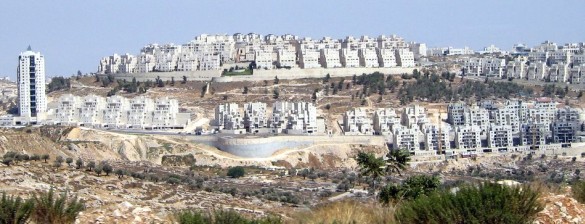
The most immediate issue raised by ‘borders first’ is whether it will deal with the Greater Jerusalem border. The issue here is not the Old City, the central focus of so much emotion and identity. It is the large central area of the West Bank, an area far beyond the old municipal boundaries of the city which extends deep into the central West Bank. Israel has developed huge settlements and a massive infrastructure which now almost surrounds East Jerusalem and which all but prevents any meaningful connection between the north and the south, and between the West Bank and East Jerusalem.

Will the negotiated border between the West Bank and Israel deal with the Jerusalem area? If the negotiated borders ratify the Israeli settlements and infrastructure as currently configured and proposed (including the controversial E-1 area), then the supposed Palestinian state would be essentially non-viable. It’s hard to imagine a government led by Netanyahu agreeing to remove existing settlements around the Greater Jerusalem area. But no Palestinian leader is likely to be able to sell a deal which ignores or ratifies the Greater Jerusalem settlement areas to his people, even if pressured to accept. If the negotiated borders ignore or defer the Jerusalem area – an idea I’ve heard in circulation – then the outcome would be meaningless and counter-productive. [continued…]

Dividing war spoils: Israel’s robbery of Palestinian property

While the news headlines were occupied with the freeze or suspension of Jewish settlements in the Occupied Palestinian Territories or with the competition for positions in the sixth Fateh conference in Bethlehem, Israel is putting into effect the most devastating operation since the ethnic cleansing of Palestine in al Nakba of 1948. This new operation aims to eliminate irrevocably Palestinian rights and historical roots in Palestine.

Ironically, Arab and Palestinian leaderships remain oblivious to these cataclysmic developments. In particular, the Palestinian leadership, whose main duty is to defend Palestinian rights, is bogged down with the assignment of internal political posts and fighting what it sees as its primary enemy, Hamas.

The Zionist leadership in Israel felt bold enough to transform the ideological slogan of ‘Jewish Israel’ into a reality on the ground. The Knesset, the Israel Parliament, passed a law on August 3rd, 2009, after its second and third readings, which allowed the sale of “Absentees” Palestinian refugees’ land to Jewish individuals and Jewish institutions exclusively anywhere in the world. Thus, the legal right of the original Palestinian owner to his land would be severed through creating a barrier between the owner and his property. The passing of the new law represents an audacious initiative by the current Israeli government that no previous Israeli government dared contemplate or venture into. [continued…]

Wobbly stools

There no question anymore that the only recipe for healing the Israeli-Palestinian wound is the termination of the occupation and the establishment of peace between the State of Israel and the new State of Palestine beside it. This demands meaningful and intense negotiations, within a fixed time span. That is impossible if at the same time settlements continue to expand. As the Palestinian lawyer Michael Tarasi aptly put it: ‘We are negotiating about the division of a pizza and in the meantime Israel is eating the pizza.’

That’s why Obama has presented the Israeli government with an unequivocal demand: an immediate stop to all building in the settlements, including East Jerusalem. A clear and logical demand. But while pressuring Netanyahu, he himself is exposed to heavy pressure at home over the health insurance system and the Afghan war…

The Americans recognise, of course, that our government is trying to deceive them. If they allow the building of just another 500 houses in the settlement blocks, and the completion of just another 2500 houses whose construction has already begun, and just a few more in East Jerusalem, in practice the building will go on unchecked.

The settlers know perfectly well that their whole enterprise has been based on deceit and trickery, house after house and neighbourhood after neighbourhood, and they are happy to allow Netanyahu to continue with this method. For the time being, they do not cry out, they are not worried, the more so as no large Israeli public movement has yet arisen in support of Obama’s peace efforts. [continued…]

Facebooktwittermail

Obama’s tough choice on Iran

Obama’s tough choice on Iran

The U.S. and its allies are not saying Iran is currently developing nuclear weapons; they’re warning that allowing Iran to assemble the full nuclear fuel cycle to which it is entitled as a signatory of the Non Proliferation Treaty — particularly uranium enrichment — gives it an infrastructure that could quickly be converted to produce bomb materiel. Stating Washington’s case at the International Atomic Energy Agency in Vienna this week, Ambassador Glyn Davies warned that Iran had already created enough low-enriched uranium that, if it kicked out nuclear inspectors and reconfigured its enrichment plant, could be re-enriched to provide materiel for a single bomb. “We have serious concerns that Iran is deliberately attempting, at a minimum, to preserve a nuclear option,” Davies said.

Moscow sees the problem in terms of strengthening the safeguards against Iran weaponizing nuclear materials, rather than trying to prevent it attaining “breakout” capacity by denying its right to enrich uranium.

President Mahmoud Ahmadinejad reiterated this week that Iran no intention of ending uranium enrichment, or of negotiating away its nuclear rights. That doesn’t necessarily preclude a diplomatic solution to the standoff, but it underscores the likelihood that the Western powers might have to compromise on their own demands in order to achieve one. In some previous rounds of negotiation, Iran has been more open to discussing strengthening of the IAEA monitoring regime and other safeguards against weaponization. Right now, however, it’s far from clear that Iran is in an accommodating mood, given its fierce and ongoing domestic power struggle. [continued…]

Secret Iranian missile memos

I have been given a series of what appear to be internal secret Iranian documents by sources I trust. If authentic, and I believe they are, they provide important insights into Iran’s missile development program and have important implications for North Korea’s as well. Unfortunately, to protect my sources and the Iranians who spirited these documents out to the West, I cannot be too explicit about their contents. The following examination of these memos contains both information from and my analysis of them. I have tried to explicitly point out what is my speculation.

The memos cover, in a somewhat sketchy way, a lot of ground. Perhaps the most important aspects are those that deal with how several countries collaborate in either developing missiles or selling missile technology to Iran. The memos use codes for the different collaborator countries but I think I know the meanings of the codes. If my understanding is correct, they indicate that representatives from North Korea and China have been present at all phases of production and flight testing. Iran has also gotten important help from Russia, though Russians do not appear to have been as ubiquitous as the Chinese and the North Koreans. The evidence from the memos indicates that this help is on the governmental level rather than “rogue” individuals. This includes Russian help though Russia has been particularly vocal in its denials of such assistance. Despite these denials, the evidence of foreign assistance, both images of engines and turbopumps that are obviously of Russian origin—either their actual production or at the very least their designs—and these internal Iranian memos, make the case overwhelmingly. [continued…]

Facebooktwittermail

A somber warning on Afghanistan

A somber warning on Afghanistan

Western powers now in Afghanistan run the risk of suffering the fate of the Soviet Union there if they cannot halt the growing insurgency and an Afghan perception that they are foreign invaders, according to Zbigniew Brzezinski, the former U.S. national security adviser to President Jimmy Carter.

In a speech opening a weekend gathering of military and foreign policy experts, Mr. Brzezinski, who was national security adviser when the Soviet Union invaded Afghanistan in late 1979, endorsed a British and German call, backed by France, for a new international conference on the country. He also set the tone for a weekend of somber assessments of the situation.

He noted that it took about 300 U.S. Special Forces — fighting with Northern Alliance troops — to overthrow Taliban rule after the Sept. 11 attacks in 2001.

Now, however, with about 100,000 U.S. and allied troops in Afghanistan, those forces are increasingly perceived as foreign invaders, much as the Soviet troops were from the start, Mr. Brzezinski said. [continued…]

In Kandahar, a Taliban on the rise

The slow and quiet fall of Kandahar, the country’s second-largest city, poses a complex new challenge for the NATO effort to stabilize Afghanistan. It is factoring prominently into discussions between Gen. Stanley A. McChrystal, the overall U.S. and NATO commander, and his advisers about how many more troops to seek from Washington.

“Kandahar is at the top of the list,” one senior U.S. military official in Afghanistan said. “We simply do not have enough resources to address the challenges there.”

Kandahar in many ways is a microcosm of the challenges the United States faces in stabilizing Afghanistan. The city is filled with ineffective government officials and police officers whom the governor calls looters and kidnappers. Unemployment is rampant. Municipal services are nonexistent. Reconstruction projects have not changed many lives. A lack of NATO forces allowed militants free rein. [continued…]

Are US taxpayers funding the Taliban?

The United States Agency for International Development has opened an investigation into allegations that its funds for road and bridge construction in Afghanistan are ending up in the hands of the Taliban, through a protection racket for contractors.

And House Foreign Affairs Committee member, Rep. Bill Delahunt (D-Mass.) vowed to hold hearings on the issue in the fall, saying: “The idea that American taxpayer dollars are ending up with the Taliban is a case for grave concern.”

U.S. officials confirmed that the preliminary investigation and the proposed hearings were sparked by a GlobalPost special report on the funding of the Taliban last month that uncovered a process that has been an open secret in Afghanistan for years among those in international aid organizations.

The report exposed that the Taliban takes a percentage of the billions of dollars in aid from U.S. and other international coalition members that goes to large organizations and their subcontractors for development projects, in exchange for protection in remote areas controlled by the insurgency. [continued…]

McChrystal: No major al-Qaida signs in Afghanistan

The top commander of U.S. and international forces in Afghanistan said Friday he sees no signs of a major al-Qaida presence in the country, but says the terror group still maintains close links to insurgents. [continued…]

Bin Laden calls Obama ‘powerless’ in Afghan war

Al-Qaida leader Osama bin Laden described President Barack Obama as “powerless” to stop the war in Afghanistan and threatened to step up guerrilla warfare there in a new audiotape released to mark the anniversary of the Sept. 11 attacks in the United States.

In the 11-minute tape, addressed to the American people, bin Laden said Obama is only following the warlike policies of his predecessor George W. Bush and Vice President Dick Cheney and he urged Americans to “liberate” themselves from the influence of “neo-conservatives and the Israeli lobby.”

The tape was posted on Islamic militant Web sites two days after the eighth anniversary of the 2001 suicide plane hijackings. The terror leader usually addresses Americans in a message timed around the date of the attacks, which sparked the U.S.-led war in Afghanistan the same year, and then in Iraq two years later.

Bin Laden said Americans had failed to understand that al-Qaida carried out the attacks in retaliation for U.S. support for Israel. If America reconsiders its alliance with the Jewish state, al-Qaida will respond on “sound and just bases.” [continued…]

Facebooktwittermail

Obama’s squandered summer

Obama’s squandered summer

… health care reform, while an overdue imperative, still is overshadowed in existential urgency by the legacies of the two devastating cataclysms of the Bush years, 9/11 and 9/15, both of whose anniversaries we now mark. The crucial matters left unresolved in the wake of New York’s two demolished capitalist icons, the World Trade Center and Lehman Brothers, are most likely to determine both this president’s and our country’s fate in the next few years. Both have been left to smolder in the silly summer of ’09.

As we approach the eighth anniversary of the war that 9/11 bequeathed us in Afghanistan, the endgame is still unknown and more troops are on their way. Though the rate of American casualties reached an all-time high last month, the war ranks at or near the bottom of polls tracking the issues important to the American public. Most of those who do have an opinion about the war oppose it (57 percent in the latest CNN poll released on Sept. 1) and oppose sending more combat troops (56 percent in the McClatchy-Ipsos survey, also released on Sept. 1). But the essential national debate about whether we really want to double down in Afghanistan — and make the heavy sacrifices that would be required — or look for a Plan B was punted by the White House this summer even as the situation drastically deteriorated.

No less unsettling is the first-anniversary snapshot of 9/15: a rebound for Wall Street but not for the 26-million-plus Americans who are unemployed, no longer looking for jobs, or forced to settle for part-time work. Some 40 million Americans are living in poverty. While these economic body counts keep rising, tough regulatory reform for reckless financial institutions, too-big-to-fail and otherwise, seems more remote by the day. Last Sunday, Jenny Anderson of The Times exposed an example of Wall Street’s unashamed recidivism that takes gallows humor to a new high — or would were it in The Onion, not The Times. Some of the same banks that gambled their (and our) way to ruin by concocting exotic mortgage-backed securities now hope to bundle individual Americans’ life insurance policies into a new high-risk financial product built on this sure-fire algorithm: “The earlier the policyholder dies, the bigger the return.”

When we look back on these months, we may come to realize that there were in fact “death panels” threatening Americans all along — but they were on the Afghanistan-Pakistan border and on Wall Street, not in the fine print of a health care bill on Capitol Hill. Obama’s deliberative brand of wait-and-then-pounce leadership let him squeak — barely — through the summer. The real crises already gathering won’t wait for him to stand back and calculate the precise moment to spring the next Do-or-Die Speech. [continued…]

Quick impressions of the D.C. 9/12 protest

Big crowd. Do not believe any description that says “thousands.” If there weren’t at least a healthy six figures there, I will permanently revoke my head-counting license.

Nineteen out of 20 signs were hand-made. My favorite was “Stop spending our tacos. I love tacos.” The most popular were variations on “Don’t tread on me,” “You lie,” complaints about Obama’s “socialism,” warnings about the 2010 elections, references to the deficit or big spending, critiques of Obamacare, and (especially) cracks about various czars (including not a few that equated czars with Soviet Communism). Godwin’s Corollary was satisfied on multiple occasions, including “Hitler gave great speeches, too,” “the Nazis did national health care first,” and someone comparing Obama’s 2009 with Hitler’s 1939 (alas, we didn’t get to ask him whether America was about to invade Poland). Michael Moynihan did have a nice chat about George Marshall with the fellow holding a sign saying “McCarthy was right.” There was an “Obama bin lyin,” “Feds = treason,” “Birth certificate,” and “Glen Beck for president.” Greatly outnumbering such things were references to the constitution, taking our country back, and so forth. [continued…]

Editor’s Comment — Claims that the tea-party turnout has been wildly exaggerated are, to my mind, a strange way of responding to a disturbing trend. Glenn Beck’s followers might be misinformed and delusional but they are not so marginal that they can be ignored. Let’s be blunt: he’s galvanized more support for his crazed movement than America’s antiwar movement brought together in opposition to the war in Iraq.

Should Obama respond and if so how?

Invite Glenn Beck, along with Dick Armey and Matt Kibbe from FreedomWorks, to The White House. Let these self-appointed leaders of the white people present their case to the president. I’d be surprised if they did not find some way of weaseling out of accepting the invitation, but if they did meet, I’d be fascinated to hear what they would actually have to say.

If a hundred thousand or more people (and yes, I think it would take that many to fill Pennsylvania Avenue), take the trouble of coming to Washington, they deserve to have their presence acknowledged and their grievances heard. After all, isn’t this a president who campaigned on his willingness to talk to his enemies? Frankly, I think Obama has everything to gain and nothing to lose by having such a meeting. His opponents on the other hand are much more comfortable shouting invective from a distance than they would be trying to muster some intelligence face-to-face with their nemesis.

Facebooktwittermail

Rethinking our Iran strategy

Rethinking our Iran strategy

Three decades of assumptions about Iran — including the premises behind Washington’s recent outreach to Tehran — have been transformed by its stunning uprising. It’s time for a policy rethink.

The Obama administration’s offer to engage was the right idea. But the theocracy’s brutal crackdown on the opposition since the June 12 presidential election, followed by the purge of senior politicians in show trials and an alarming increase in general executions, marks a turning point for Iran’s revolution. U.S. policy now needs a broader approach. Recent history offers relevant guidelines.

The three most important revolutions of the 20th century — for their political innovation and impact — happened in the Soviet Union, China and Iran. At the peak of revolutionary paranoia, the Soviet Union and China witnessed turmoil similar to what is happening today in Iran. Soon afterward, however, Moscow and Beijing altered course. Both began the move from defiant revolutionary regime to a normal state willing to work within the international order and mended relations with the United States. [continued…]

Facebooktwittermail

U.S. accepts offer from Tehran for broad talks

U.S. accepts offer from Tehran for broad talks

The United States has decided to ignore Iran’s refusal to discuss its nuclear program and instead accept a vague Iranian plan for talks on security issues as the opening gambit to draw Tehran into real negotiation.

The effort to “test” Iran’s intentions, announced on Friday, came after Russian Prime Minister Vladimir Putin said his country is skeptical of the need for new sanctions on Iran, giving the Americans little choice but to treat seriously Iran’s latest offer.

Iran this week ruled out talks on its program, instead offering a five-page plan that it said would lay the groundwork for peace and stability in the region. The document, first posted Thursday on the Web site of ProPublica news service, made no reference to international demands that Iran suspend its efforts to enrich uranium, but did mention ending proliferation in nuclear weapons as well as a broad offer of dialogue. [continued…]

Why Washington should welcome Iran’s broadening of the agenda

The Iranian proposal is best understood not from the prism of the West’s focus on the nuclear program, but from the vantage point of Iran’s long standing objective to be recognized as a regional power with a permanent seat at the table of regional decision making. Iran believes it suffers from severe role deficit — though it is one of the most powerful countries in the region, its neighbors view it by and large as a disruptive, anti-status quo power and have consequently refrained from giving it access to recognized and institutionalized avenues of influence.

After all, the reigning order in the Middle East is one defined and upheld by the United States, which for the past thirty years has sought Iran’s isolation and exclusion, not its inclusion and rehabilitation. Breaking out of this isolation and forcing Washington and the regional capitols to grant Iran the role it craves have been overarching strategic goals of Iranian foreign policy for several decades now.

Iran believes that the nuclear stand-off provides it with an opportunity to achieve this objective. By broadening the agenda for negotiations, Iran takes the opportunity to discuss with the great powers matters where the views of the Iranian government hardly have been taken into account in the past. The broader aim is to institutionalize the great power’s recognition of Iran’s role and seat at the table.

Perhaps more importantly, the Iranians refuse to permit the P5 plus 1 to single-handedly set the parameters of the talks. By presenting its own proposal, Iran is introducing its own parameters. The Iranians are in essence negotiating about the shape of the table before negotiating matters of substance. This is hardly surprising. During the EU-Iranian negotiations on the nuclear issue, Tehran was immensely frustrated by Europe’s dismissal of several Iranian proposals and its insistence on solely discussing its own set of ideas and demands. By now, Iran seems determined not to let that happen again. [continued…]

Facebooktwittermail

Iran urges disposal of all nuclear arms

Iran urges disposal of all nuclear arms

Iran is not prepared to discuss halting its uranium enrichment program in response to Western demands but is proposing instead a worldwide control system aimed at eliminating nuclear weapons, President Mahmoud Ahmadinejad’s top political aide said in an interview Thursday.

In a set of proposals handed to the permanent members of the U.N. Security Council and Germany on Wednesday, Iran also offered to cooperate on solving problems in Afghanistan and fighting terrorism and to collaborate on oil and gas projects, Mojtaba Samareh Hashemi said. A longtime confidant of the president’s, Samareh Hashemi is reportedly being considered for the key post of first vice president in Ahmadinejad’s new government.

As described by Samareh Hashemi, Iran’s offer is similar to a call by President Obama in April to eliminate the world’s nuclear weapons. Later this month, Obama is scheduled to chair a special session of the U.N. General Assembly’s annual meeting aimed at seeking consensus on preventing the spread of nuclear weapons, rather than targeting individual nations such as Iran and North Korea. Ahmadinejad is also scheduled to attend the U.N. meeting and has said he is ready to debate Obama publicly.

“It’s not really responsive to our greatest concern, which is obviously Iran’s nuclear program,” State Department spokesman P.J. Crowley said of Tehran’s package of proposals. “Iran reiterated its view that as far as it is concerned, its nuclear file is closed. . . . That is certainly not the case. There are many outstanding issues.” [continued…]

Editor’s Comment — As usual, Iran’s position is portrayed as being one of intransigence, yet at the core of the conflict here is a dispute over whether one side can claim the “right” to dictate the parameters of engagement. The US and its allies are in effect saying: we are the ones who get to set the agenda.

Is 2009 a real change from 2008? I’m still waiting to spot the difference.

The specific nuclear clause in Iran’s proposal is this:

Promoting the universality of NPT mobilizing global resolve and putting into action real and fundamental programmes toward complete disarmament and preventing development and proliferation of nuclear, chemical and microbial weapons.

How serious a proposal is this?

In a way it’s clearly simply a rhetorical challenge. It’s a way of calling Obama’s bluff. Was his Prague declaration more than a piece of campaign-style fluff? A way of offering Europeans a feel-good moment that would make his tour Kennedyesque? Or was he serious?

If nuclear disarmament is ever going to reach the negotiating table then the Middle East’s sole nuclear power is first going to have to come out of the closet. And this goes to the heart of the current impasse: Iran’s opponents insist that the nuclear file cannot include discussion about Israel’s nuclear weapons. Iran must curtail its nuclear aspirations (even though we don’t actually know what they are) while Israel is at liberty to conceal its nuclear actualities.

“They’re baaaaack….”

When I started blogging back in January, one of my early posts questioned the belief that Obama’s election had ended talk of military action against Iran. I thought this view was “almost certainly premature,” because I didn’t think a rapid diplomatic breakthrough was likely and I knew that advocates of a more forceful approach would soon come out of the woodwork and start pushing the new administration to get tough with Tehran.

Well, I hate to say I told you so, but … Right on cue, Wednesday’s Wall Street Journal had an op-ed from former Senators Dan Coats and Chuck Robb and retired Air Force general Chuck Wald, recommending that Obama “begin preparations for the use of military options” against Iran’s nuclear facilities. They argue that keeping the threat of force “on the table” is the only way to achieve a diplomatic solution, but they also make it clear that they favor bombing Iran if diplomacy fails. In their words, “making preparations now will enable the president, should all other measures fail to bring Tehran to the negotiating table, to use military force to retard Iran’s nuclear program.” [continued…]

Russia says sanctions against Iran are unlikely

Foreign Minister Sergey V. Lavrov on Thursday all but ruled out imposing new sanctions against Iran over its nuclear program, brushing aside growing Western concerns that Iran had made significant progress in recent months in a bid for nuclear weapons.

Mr. Lavrov said he believed that a new set of proposals that Iran gave to European nations on Wednesday offered a viable basis for negotiations to end the dispute. He said he did not believe that the United Nations Security Council would approve new sanctions against Iran, which could ban Iran from exporting oil or importing gasoline.

“Based on a brief review of the Iranian papers, my impression is there is something there to use,” Mr. Lavrov said at a gathering of experts on Russia. “The most important thing is Iran is ready for a comprehensive discussion of the situation, what positive role it can play in Iraq, Afghanistan and the region.” [continued…]

Facebooktwittermail

US Jewish leaders push Obama to act on Iran

US Jewish leaders push Obama to act on Iran

Several hundred Jewish leaders and activists are planning to arrive here Thursday to urge top Obama administration officials and US congressmen to take action on Iran.

They are pushing for Congress to quickly pass an Iran sanctions bill sponsored by US House Foreign Affairs Committee Chairman Howard Berman and otherwise take serious economic and diplomatic steps to pressure Iran to abandon its pursuit of nuclear capabilities that threaten Israel.

“Congress is back, legislation is on the agenda, and this is September, when at some level decisions are being made in connection with Iran,” Anti-Defamation League Washington Director Jess Hordes said of the planning of the event.

His organization will be joining the United Jewish Communities, the Jewish Council for Public Affairs, the Conference of Presidents of Major American Jewish Organizations, the National Conference of Soviet Jewry and several other groups as part of the effort. [continued…]

U.S. says Iran could expedite nuclear bomb

American intelligence agencies have concluded in recent months that Iran has created enough nuclear fuel to make a rapid, if risky, sprint for a nuclear weapon. But new intelligence reports delivered to the White House say that the country has deliberately stopped short of the critical last steps to make a bomb.

In the first public acknowledgment of the intelligence findings, the American ambassador to the International Atomic Energy Agency declared on Wednesday that Iran now had what he called a “possible breakout capacity” if it decided to enrich its stockpile of uranium, converting it to bomb-grade material.

The statement by the ambassador, Glyn Davies, was intended to put pressure on American allies to move toward far more severe sanctions against Iran this month, perhaps including a cutoff of gasoline to the country, if it failed to take up President Obama’s invitation for serious negotiations. But it could also complicate the administration’s efforts to persuade an increasingly impatient Israeli government to give diplomacy more time to work, and hold off from a military strike against Iran’s facilities. [continued…]

Iran dims hopes for diplomacy

ran rejected any compromise with the West over its nuclear program Wednesday, as blunt comments from the Obama administration over Tehran’s bomb-making capability suggested that the two sides were headed toward a renewed diplomatic crisis.

Iran offered Western officials a long-awaited package of proposals to restart negotiations over its nuclear program. But diplomats who viewed the offer Wednesday said the document of fewer than 10 pages essentially ignored questions over Iran’s production of nuclear fuel and instead focused broadly on other international issues.

It made no mention of Tehran’s willingness to suspend its uranium-enrichment activities or to enter into substantive talks about the future of its nuclear program, they said. [continued…]

Russia ‘delivers SAMs to Syria’

Russia has begun deliveries of Pantsir S1 air-defense missiles to Syria, some of which are expected to be passed on to Iran, Syria’s strategic ally that has largely bankrolled the deal, according to the Interfax-AVN military news agency.

Interfax quoted Yuriy Savenkov, deputy director general of the Instrument Design Bureau, or KBP, as saying that deliveries started several weeks ago. KBP produces the Pantsir and other high-precision weapons.

Meantime, Kommersant quoted Alexei Fedorov, head of Russia’s United Aircraft Corp., as confirming the existence of a 2007 contract with Syria for eight twin-engined MiG-31E interceptors.

This aircraft, NATO codename Foxhound, can fly at three times the speed of sound and engage several targets at a range of up to 110 miles simultaneously. [continued…]

Taking Iran seriously

Given Iran’s shortening nuclear timetable and diplomatic challenges for forging an international consensus on sanctions, we urge Mr. Obama simultaneously to begin preparations for the use of military options. Now is the time for the president to reinforce his commitment to “use all elements of American power to prevent Iran from developing a nuclear weapon,” as he stated in February. We believe only a credible U.S. military threat can make possible a peaceful solution.

By showing that he has not taken the military option off the table, Mr. Obama may also be able to convince Israel to forgo a unilateral military strike while forcing Tehran to recognize the costs of its nuclear defiance. Furthermore, making preparations now will enable the president, should all other measures fail to bring Tehran to the negotiating table, to use military force to retard Iran’s nuclear program. We do not downplay the risks of this option and recognize its complications, but we do believe it to be a feasible option of last resort. [continued…]

Facebooktwittermail

President procrastinator

President procrastinator

Brzezinski has argued that negotiations with Taliban elements, not an increased war effort and grand goals of military victory, may be the key to a more stable Afghanistan. He says: “I would have to be convinced that we were going to be driven out or defeated if we don’t increase forces – but if the increase in forces is designed to achieve some sort of a victory, then I think it is the wrong path … Is becoming more and more deeply engaged in a conflict which involves not just Afghanistan but Pakistan in the long range interests of the US?”

On Iran, Mr Brzezinski worries that the negotiations currently being considered by the US are unlikely to prosper because they are too focused on the Islamic Republic’s nuclear status, to the exclusion of Iran’s concerns.

“If we refuse to discuss other issues that the Iranians wish to discuss, we will encourage the Iranians to refuse to discuss the issues that we want to discuss,” he says. “It’s as simple and basic as that. And we cannot engage the Iranians in serious negotiations if we at the same time publicly discuss more severe sanctions, not to mention that other options [by which he means military force] are on the table.”

As for the administration’s efforts on Middle East peace, Mr Brzezinski’s frustration is all too clear. “So much time has been spent diddling around,” he says, arguing that an “evasive compromise” on settlements will do little to advance a final agreement. “I haven’t given up hope, but hope isn’t everlasting,” he says, mournfully. [continued…]

Facebooktwittermail

Should Obama go ‘all in’ on Afghanistan?

Should Obama go ‘all in’ on Afghanistan?

Obama does not act impulsively. Before betting his remaining chips on Afghanistan, he will no doubt deliberate carefully. He will consult. He will sift through all the evidence. Yet before hitting the “start over” button on Afghanistan, he would do well to consider the following: Sometimes the essence of leadership is not to render the right decision but to pose the right question.

As difficult as it is to do so at a time when war has become a seemingly perpetual condition, when it comes to Afghanistan, the really urgent need is to recast the debate. Official Washington obsesses over the question: How do we win? Yet perhaps a different question merits presidential consideration: What alternatives other than open-ended war might enable the United States to achieve its limited interests in Afghanistan?

At this pivotal moment in his presidency, if Obama is going to demonstrate his ability to lead, he will direct his subordinates to identify those alternatives. [continued…]

Editor’s Comment — For Obama to pose the right question he would need to have not already given the wrong answer. Having emphatically called this a “war of necessity” makes it incredibly difficult to climb out of the rhetorical hole he has dug himself into, for it there are alternatives there can be no necessity.

Facebooktwittermail

The path to peace is hard to find on Obama’s ‘roadmapolis’

The path to peace is hard to find on Obama’s ‘roadmapolis’

President Bush’s “road map” first emerged as the US began preparing to invade Iraq. Key Arab regimes had long made clear to Washington that the price of even tacit support for the war was American willingness to address a conflict that generated immense hostility towards the US on the Arab street. The “road map” read like a crack of the whip, outlining a timetable that promised a provisional Palestinian state by the end of 2003 and a resolution of all final status issues by the beginning of 2005. But the Bush administration gave the Israelis and Palestinians no reason to take it seriously; its purely symbolic purpose was plain to see.

The Bush administration made a second high-profile stab at the peace process in the form of the Annapolis Conference held in November 2007, which drew in not only the Israelis and Palestinians, but also a range of Arab states – in what it portrayed as a symbolic affirmation of the administration’s policy of building an alliance of Arab moderates with the US and Israel against the region’s radicals, namely Hamas, Hizbollah, Syria and Iran. Again, there was little reason for the Israelis or Palestinians to take the process seriously. Annapolis simply invited them to talk among themselves about what a peace agreement could look like. The conversation went nowhere, of course, but the fact that it was happening at all was the point for the Bush administration, whose new priority had become rallying Arab support against Iran and its allies.

So what does any of this have to with the US president Barack Obama’s own efforts to jump start the peace process? After all, Mr Obama made it a priority from the get-go of his presidency and can hardly be accused of going through the motions in order to mollify the Arabs to win their support on other issues. Or can he? [continued…]

Facebooktwittermail

The Afghanistan abyss

The Afghanistan abyss

President Obama has already dispatched an additional 21,000 American troops to Afghanistan and soon will decide whether to send thousands more. That would be a fateful decision for his presidency, and a group of former intelligence officials and other experts is now reluctantly going public to warn that more troops would be a historic mistake.

The group’s concern — dead right, in my view — is that sending more American troops into ethnic Pashtun areas in the Afghan south may only galvanize local people to back the Taliban in repelling the infidels.

“Our policy makers do not understand that the very presence of our forces in the Pashtun areas is the problem,” the group said in a statement to me. “The more troops we put in, the greater the opposition. We do not mitigate the opposition by increasing troop levels, but rather we increase the opposition and prove to the Pashtuns that the Taliban are correct.

“The basic ignorance by our leadership is going to cause the deaths of many fine American troops with no positive outcome,” the statement said. [continued…]

Can victory for President Karzai be taken as legitimate?

Western diplomats have been afraid of this predicament ever since the poll results began to come in, with an apparent lead for President Karzai accompanied by a torrent of allegations of fraud. Mr Karzai is now within a whisker of the 50 per cent that would allow him to him claim victory and prevent a run-off vote. But the huge number of serious allegations of fraud — in the thousands, but with at least 600 material to the outcome of the election — mean that it is hard to take his victory as legitimate.

That, certainly, is the view of Abdullah Abdullah, his main rival, and Abdullah supporters. They are threatening to challenge the result through legal appeals and through violence if necessary. The studied position of British and US officials for the past week — that it is for Afghans to decide whether or not the polls produce a credible and legitimate result — is about to shatter. If substantial numbers of Afghans decide that the vote was rigged, what do other governments do then? They have had no answer, hoping not to be in that position. They had better find one now. [continued…]

Fake Afghan poll sites favored Karzai, officials assert

Afghans loyal to President Hamid Karzai set up hundreds of fictitious polling sites where no one voted but where hundreds of thousands of ballots were still recorded toward the president’s re-election, according to senior Western and Afghan officials here.

The fake sites, as many as 800, existed only on paper, said a senior Western diplomat in Afghanistan, who spoke on the condition of anonymity because of the political delicacy of the vote. Local workers reported that hundreds, and in some cases thousands, of votes for Mr. Karzai in the election last month came from each of those places. That pattern was confirmed by another Western official based in Afghanistan.

“We think that about 15 percent of the polling sites never opened on Election Day,” the senior Western diplomat said. “But they still managed to report thousands of ballots for Karzai.”

Besides creating the fake sites, Mr. Karzai’s supporters also took over approximately 800 legitimate polling centers and used them to fraudulently report tens of thousands of additional ballots for Mr. Karzai, the officials said. [continued…]

Sole informant guided decision on Afghan strike

To the German commander, it seemed to be a fortuitous target: More than 100 Taliban insurgents were gathering around two hijacked fuel tankers that had become stuck in the mud near this small farming village.

The grainy live video transmitted from an American F-15E fighter jet circling overhead, which was projected on a screen in a German tactical operations center four miles north of here, showed numerous black dots around the trucks — each of them a thermal image of a human but without enough detail to confirm whether they were carrying weapons. An Afghan informant was on the phone with an intelligence officer at the center, however, insisting that everybody at the site was an insurgent, according to an account that German officers here provided to NATO officials.

Based largely on that informant’s assessment, the commander ordered a 500-pound, satellite-guided bomb to be dropped on each truck early Friday. The vehicles exploded in a fireball that lit up the night sky for miles, incinerating many of those standing nearby.

A NATO fact-finding team estimated Saturday that about 125 people were killed in the bombing, at least two dozen of whom — but perhaps many more — were not insurgents. To the team, which is trying to sort out this complicated incident, mindful that the fallout could further sap public support in Afghanistan for NATO’s security mission here, the target appeared to be far less clear-cut than it had to the Germans.

One survivor, convalescing from abdominal wounds at a hospital in the nearby city of Kunduz, said he went to the site because he thought he could get free fuel. Another patient, a 10-year-old boy with shrapnel in his left leg, said he went to gawk, against his father’s advice. In Kabul, the Afghan capital, relatives of two severely burned survivors being treated at an intensive-care unit said Taliban fighters forced dozens of villagers to assist in moving the bogged-down tankers.

“They came to everyone’s house asking for help,” said Mirajuddin, a shopkeeper who lost six of his cousins in the bombing — none of whom, he said, was an insurgent. “They started beating people and pointing guns. They said, ‘Bring your tractors and help us.’ What could we do?” [continued…]

Editor’s Comment — The striking gap in this account is the absence of testimony from the pilots who released the 500-pound bombs. It’s as though they were merely small cogs in a military machine within which they had little control. Yet we do learn one thing: one of the F-15 pilots recommended dropping 2000-pound bombs. Based on the thermal images he could see, there was little he could discern about the individuals gathered around the fuel trucks yet in his mind the best thing to do would be to kill the maximum number of people in the area.

As the story has been told, the fuel was being dispersed because the trucks couldn’t reach their intended destination. What seems more likely? That the insurgents hoped to later re-collect hundreds of gallons of kerosene stowed away in kitchen jugs, or that the stolen fuel was destined to be used cooking beans over hand-pumped kerosene burners?

“Who goes out at 2 in the morning for fuel? These were bad people, and this was a good operation,” a key local official told the Post.

In the clear mountain air of Afghanistan, the full-moon late last week would have provided surprisingly good light – certainly good enough to make the prospect of some free fuel appealing to more than just the bad people.

Europeans seek to shift security role to Afghan government

The leaders of France, Germany and Britain called Sunday night for an international conference to work out a plan to shift responsibility for security in Afghanistan to the Afghan government.

The call by the three governments, the largest contributors of troops to the war in Afghanistan after the United States, came as mounting military casualties and doubts about the mission there have fueled growing public opposition to the war in Europe.

In Washington, a State Department spokeswoman, Megan Mattson, said the department had no immediate comment on the proposed conference. [continued…]

Facebooktwittermail