Category Archives: Obama administration

Thoughts on Iran, mountains and winning without war

On mountains and metaphors

A few random thoughts and observations on the latest developments with Iran:

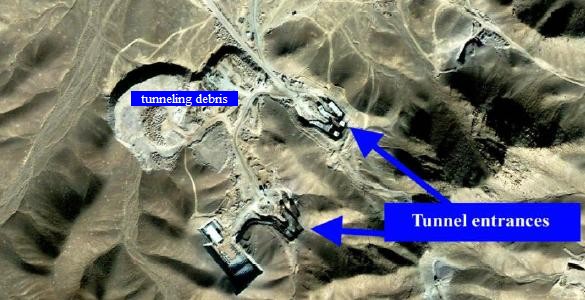
How big’s a mountain? It’s a clandestine nuclear facility under construction “inside a mountain“.

The only adjective that got left out was “deep,” yet knowing that detail might be the key to knowing exactly what “very heavily protected” means.

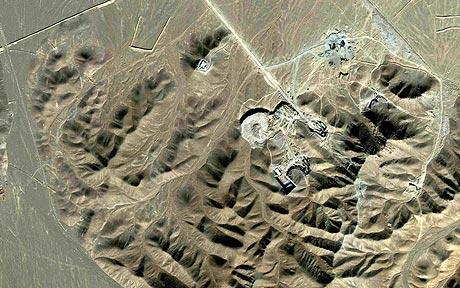
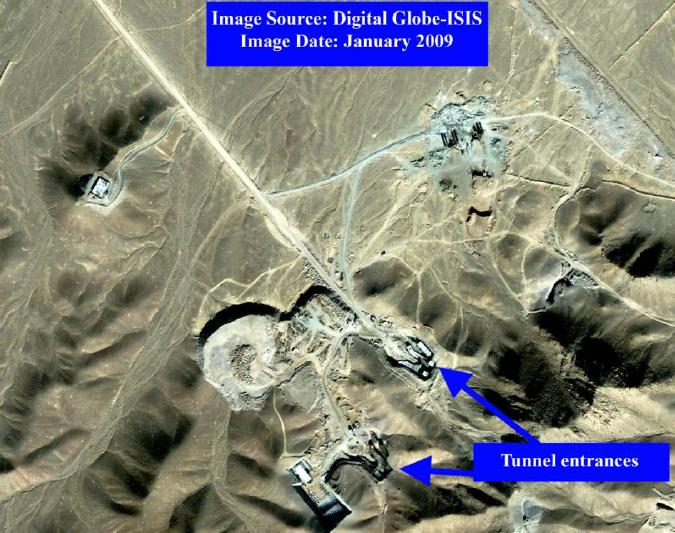
(This much we can already deduce about the extent of the tunneling: it has produced two very large adjoining flattened mounds of debris which are marked in the image above.)

Gary Sick seems to have been among the descriptively most precise in referring to “a small enrichment facility in an underground chamber on a Revolutionary Guards base.”

Inside an underground chamber it is; inside a mountain it is not — at least not unless one assumes a Lilliputian perspective and calls a 167ft tall hillock a mountain. That’s the difference in elevation between one of the tunnel entrances and the highest point along the ridge that the tunnel penetrates. (Use Google Earth to see specific elevations. For instance, the northern tunnel entrance is at 2,975ft. The adjacent ridge to the east is at 3,142ft.)


View Larger Map

Not so fast with the sanctions. When the president of a country sharing a 1,458km border with Iran says sanctions against Iran won’t work, there’s reason to think that he isn’t simply making a prediction; he might be making a promise.

Iraq’s President Jalal Talabani gave this warning on Saturday and no doubt it was warmly received in Tehran. China and Russia might be crucial when it comes to imposing sanctions. Iraq might turn out to be key when it comes to enforcing or being unable to enforce them.

Pity the IAEA. There it is — the world’s indispensable nuclear monitoring agency — but does anyone care to share their intelligence so that IAEA inspectors can do their work? Only when the powers that be deem it useful.

Bombs away. Maybe this isn’t the smoking gun Israel was waiting for. Evidence of a clandestine program may confirm some of Israel’s dire warnings, but how many other similarly well-concealed and hard-to-destroy facilities might there be? All that an Israeli attack might actually accomplish would be to legitimize Iran’s withdrawal from the NPT and a rush towards weaponization.

The meaning of a mountain. If “inside a mountain” might be a topographical stretch, it’s an image that serves multiple purposes:
1. It’s too good an image for any journalist to risk undermining with a skeptical question. (“And just how big is that mountain?”)
2. It tells the world that the Iranians are dastardly, sneaky fellows whose evil plans can only be hidden by something as big as a mountain.
3. It says the Americans are so smart that they can find anything, however well hidden.
4. It highlights the possibly insurmountable challenge Israel would face in launching an air strike against a target much harder to destroy than a reactor under construction in Syria, or a weapons convoy on the move in Sudan.
5. It says that Obama isn’t a daydream believer sending his representatives into a negotiating trap; he’s back in his superhero mode out to save the world.

What’s it all about? Once you get past the theatrics it comes down to the pursuit of national interests — it’s not (or at least should not be) about putting Iran in a box.

Every party has distinct national interests, but fruitful negotiations will hinge on identifying where these interests overlap — not simply the overlapping interests of the US and its allies, but also those that are shared by Iran.

Stepping off the war path requires that everyone, including the Iranians, can see a way of winning.

Facebooktwittermail

Locating Iran’s secret nuclear facility (updated, update II)

Update — Turns out ISIS already published a report [PDF] on this and suggest an alternative location NW of Qum in addition to the one described below. They also add dates to the imagery, the Google Earth images appearing below having been taken on March 25, 2005.

Locating Iran’s secret nuclear facility

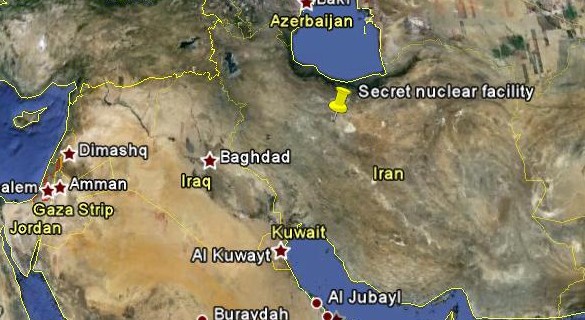
In numerous dispatches, Iran’s newly-reported and until a few days ago undeclared nuclear facility, is described as being built “inside a mountain“. In an Obama adminstration background briefing it was described as being located in “a very heavily protected, very heavily disguised facility”. Reports have also said that it is located north east of the city of Qum.

Understanding what “inside a mountain” and “very heavily protected” actually mean is important. It could mean that the facility is effectively invulnerable to any form of military strike.

Facilities buried more than 1000ft away from the earth’s surface are “essentially invulnerable to nuclear attack” says the Union of Concerned Scientists.

If it turns out the the Qum facility (and perhaps others) are in fact so heavily protected that they cannot be destroyed through a conventional or even an unconventional military strike, then the military threat that supposedly remains placed on that proverbial table would not really be a strike that could cripple of destroy Iran’s purported nuclear weapons program. It would simply mean that the threat of war remains on the table.

If that’s the case, then during the past couple of years (and remember, this facility has apparently been under observation since 2006), all the veiled and unveiled threats of an Israeli attack on Iran’s nuclear facilities have probably been made for purely political purposes.

So where is this newly announced facility and how heavily protected is it?

The Daily Telegraph has published this image from Reuters with the caption: “Satellite photo of what is believed to be a uranium-enrichment facility near Qom.”

I’m a novice at using Google Earth but I’ve got a good topographic eye, so with “inside a mountain, north east of Qum (alt spelling Qom)” as my starting point, I thought I’d take a look.

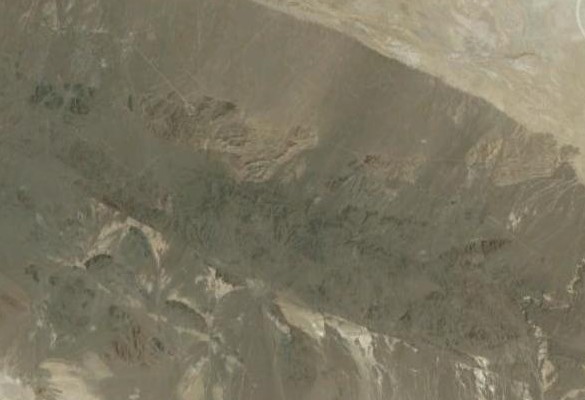
Here are some mountains north east of Qum:

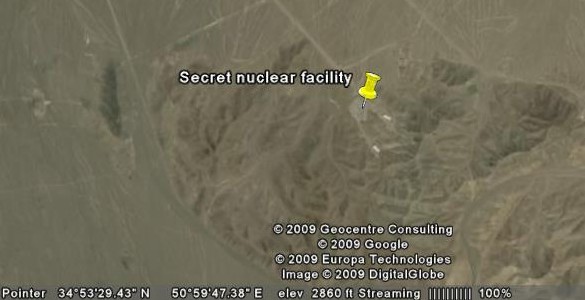
And what d’ya know? Here’s the location that appears in the Telegraph:

Of course, we don’t know for sure whether the Reuters-distributed image is actually a photograph of the facility in question, but let’s assume it is.

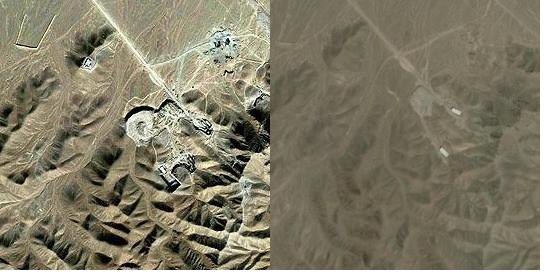
The Google Earth image is older and a comparison of the two reveals extensive earthworks that doubled in area during the (to me) unknown lapse between the two images. It looks like open-cast mining, suggesting that wherever in proximity to that these earthworks the facility might be buried, it probably isn’t under a 1000ft of granite.

The question remains (and it’s obviously one I can’t answer): is this facility invulnerable to a military attack?

(Update: The photos from ISIS identify two tunnel entrances to the east of the excavated area.

It seems quite possible that the tunnels do indeed extend deep enough into the mountains to provide strike invulnerability.)

If you want to examine the location more carefully, you can find it here on Google maps. And these are the coordinates: 34°53’8.74″N — 50°59’45.90″E

Second update: Upon further examination of the Google Earth information, I’m having second thoughts about the “buried in a mountain” description.

While the satellite image is suggestive of mountains, the range in elevation between the tunnel entrances and the highest surrounding ridges is little more than a hundred feet! These aren’t mountains: they are hillocks. Situated in a few undulations that protrude slightly from a vast salt basin area that is mostly at about 3,000ft in elevation, this “very heavily protected” facility might not in fact be quite as invulnerable as I suggested above.

Facebooktwittermail

Iran’s newly revealed nuclear facility

Paradox: Now is the time to deal

Iran has admitted that it has at least one (and there is no reason to believe that there are not more) secret enrichment facilities. More information will undoubtedly come out in the coming days but we can deal now with the most important issue: how to proceed from here. As President Obama has rightly said today, this is not the first time Iran has hidden nuclear facilities it should rightly declare to the IAEA.

Iran will undoubtedly claim that it has not introduced nuclear material into the centrifuges and therefore did not have the obligation to report it. In fact, when I was in Israel earlier this summer, everyone I spoke to was convinced that such a facility existed but that Iran had not introduced uranium into it. However, there is a lot that can be done to train personnel etc. with enriching other isotopes like xenon or silicon. And training personnel is the important aspect right now. When the history of these secret facilities is known, I suspect that we will discover that they were started during the enrichment “suspension” that ended in 2006. We will also discover, I firmly believe, that the Natanz facility has been used as a training center for workers for those covert facilities. That could explain why there has been a relatively slow start: they were constantly cycling new trainees through with the consequent inefficiencies new workers always introduce. [continued…]

The Iran nuclear revelation

… despite what I expect to see swarming the media in the next few days — wanna bet that John Bolton or John Bolton-equivalent oped is already in production over at the Washington Times Washington Post (sorry, it’s hard to tell the difference on foreign policy issues sometimes) — I actually think that this public revelation makes war less rather than more likely. The timing of the announcement, immediately following the consultations at the UN and the G-20 and just before the Geneva meetings, makes it seem extremely likely that the Obama administration has been waiting for just the right moment to play this card. Now they have. It strengthens the P5+1 bargaining position ahead of October 1, changes Iranian calculations, and lays the foundations for a more serious kind of engagement. So now let’s see how it changes the game. [continued…]

How to keep Iran in check without war

For the better part of two decades, there have been cries of alarm that the United States must “do something” or else Iran would have an operational nuclear weapon within a few years. If these warnings of a “ticking clock” had been heeded, there would have been ample reason for the United States or Israel to go to war with Iran at almost any time. In fact, there have been as many serious predictions that a war was imminent and unavoidable as there have been false predictions about the timing of an Iranian bomb. Seymour Hersh, writing in the New Yorker beginning in 2006, quoted many sources inside and outside the U.S. government who claimed that the Bush administration was preparing to attack Iran because of its nuclear policies. It now appears that Vice President Cheney, based on his own words in retirement, was in fact pressing for such an attack, but President Bush vetoed it.

In June 2008, former U.S. ambassador to the United Nations John Bolton predicted that Israel “will attack Iran” before January 2009 when the new U.S. president was sworn in, but apparently the Israeli leadership decided otherwise. Just a few weeks ago, retired Air Force general Chuck Wald on National Public Radio outlined a sustained bombing campaign against Iran that would last “weeks or months,” then added, “Now, does anybody in their right mind want to attack Iran? No, not a bit. But sometimes you’ve got to do things you don’t like to do.” From the tone of his voice, the prospect of an attack did not seem to dismay him, and he has gone on to write a series of op-eds pushing the military option.

These statements are admirably clear in recognizing that the end game in any concerted pressure campaign against Iran is war. Secretary of State Hillary Clinton threatened “crippling sanctions” to be imposed on Iran if it failed to cooperate with U.S. diplomatic efforts. That phrase was later echoed by Israeli prime minister Netanyahu during his visit to Germany, and it is expected to be a major focus of the U.S. Congress starting in September. Iran does not have sufficient refinery capacity to meet all its gasoline needs, and the Congress is expected to press for actions that would attempt to curtail or block such imports into Iran. A prohibition of Iranian petroleum imports—most likely restricted to the United States and perhaps some of its European allies since Russia, China and even many of Iran’s allies (think Venezuela) and immediate neighbors (think Iraq) are unwilling to cooperate—can only be truly enforced by a blockade, which is an act of war.

The perpetual plea for U.S. foreign policy to “do something” needs to be changed; we would be better served by adopting the physicians creed: “First, do no harm.” [continued…]

Iranian leader offers U.S. access to the country’s nuclear scientists

Iran is willing to have its nuclear experts meet with scientists from the United States and other world powers as a confidence-building measure aimed at resolving concerns about Tehran’s nuclear program, Iranian President Mahmoud Ahmadinejad said Wednesday.

At international talks next week on its nuclear ambitions, Iran also will seek to buy from the United States enriched uranium needed for medical purposes, Ahmadinejad told reporters and editors from The Washington Post and Newsweek. Agreement by the Americans, he suggested, would demonstrate that the Obama administration is serious about engagement, while rejection might give Iran an excuse to further enrich its stock of uranium.

“These nuclear materials we are seeking to purchase are for medicinal purposes. . . . It is a humanitarian issue,” Ahmadinejad said in the interview. “I think this is a very solid proposal which gives a good opportunity for a start” to build trust between the two countries and “engage in cooperation.” [continued…]

Russia’s president pledges to help U.S. nudge Iran on nuclear issue

Russian President Dmitry Medvedev offered closer cooperation with the United States in curbing Iran’s nuclear ambitions Wednesday, promising President Obama that Moscow would help the Islamic Republic make “a right decision” and hinting that sanctions might be necessary to achieve it.

U.S. officials said they regarded Medvedev’s comments, after meeting Obama on the sidelines of the United Nations General Assembly, as a major shift in Russia’s position just a week before six major powers are to meet with Iranian officials in Geneva.

Russia, which has extensive economic ties with Iran, has consistently opposed sanctions. And, as its relations with Washington deteriorated in recent years, it has tended to view the Islamic Republic as a useful counterweight. [continued…]

Russia can sway Iran’s nuclear ambitions

So far, US-led efforts to increase pressure on Iran have failed in large part because of Russia’s hostile stance in the UN security council. During Vladimir Putin’s presidency (2000-08), Russia repeatedly opposed more punitive measures against Iran. Fuelled by a combination of anti-Americanism and renewed geopolitical ambition, Moscow insisted that Tehran had a sovereign right to build nuclear power stations – with Russian technological support.

But now that the Obama administration is moving its anti-ballistic missile shield from land-based installations in eastern Europe to mobile vehicles closer to Iran, the Russian president, Dmitry Medvedev, declared on Wednesday at the UN in New York that “sanctions are seldom productive but they are sometimes inevitable”.

With the “reset” of US-Russian relations, the Kremlin has performed a spectacular “rethink” of its Iran policy. The “secret” Moscow visit by Binyamin Netanyahu on 7 September seemed to reassure the Russian leadership that Israel would not launch unilateral pre-emptive strikes against suspected Iranian nuclear installations – on the condition that Moscow promise not to equip Iran with the advanced S-300 system, an offensive missile capability that could deliver nuclear warheads. [continued…]

Green movement ‘understands world’s concerns’ over nuclear Iran

A spokesman for Iranian opposition leader Mir Hossein Mousavi is telling the “citizens of the world” and especially “the people and government of America” that the opposition shares international concerns about the possibility of a nuclear-armed Iran.

The statement by Mohsen Makhmalbaf — an Iranian film director — goes as far as to say that any agreement signed with President Mahmoud Ahmedinejad’s “coup-empowered illegitimate government” would not be honored by the opposition, known as the Green Movement. He added: “All such agreements will be subject to review in the future.” [continued…]

Facebooktwittermail

Obama pushes timetable for Mideast talks

Obama pushes timetable for Mideast talks

Mr. Obama and his aides have stressed the settlement-freeze issue as the key to developing support among the Arab states. Mr. Netanyahu hasn’t agreed to a complete freeze on building settlements, though he did agree earlier this year to a partial freeze.

The president and other senior U.S. officials focused Tuesday on the urgency of resuming talks. Mr. Obama met the Israeli and the Palestinian leaders on the sidelines of the annual U.N. General Assembly. “Simply put, it is past time to talk about starting negotiations,” Mr. Obama said before a trilateral meeting with Mr. Netanyahu and Palestinian Authority President Mahmoud Abbas at the Waldorf Astoria in New York. “Permanent status negotiations must begin and begin soon.”

Arab diplomats said Washington’s apparent softening on the settlement issue ran the risk of looking like a concession to Mr. Netanyahu. “This could seriously blow back against Abbas if there isn’t quick progress on talks,” said an Arab official closely involved in the peace process. [continued…]

Editor’s Comment — When Obama picked Rahm Emanuel as his chief of staff, there was some reason to hope that Emanuel was going to function as Obama’s enforcer. The president could remain Mr Congeniality while, when the situation required it, Emanuel would be sent out to break knee-caps.

There were hints of this when earlier this summer it was reported that Netanyahu had been told he couldn’t meet Mitchell until he’d finished his “homework” on freezing settlements.

In the end, it turned out that “pressure” from the Obama administration amounts to strong words with no visible force behind them. It comes in the form of sternness — no doubt quite effective when Obama insists to Malia and Natasha that it’s bedtime, but not very impressive when it’s directed at the likes of Benjamin Netanyahu.

Enough with the pressure — it’s time for some threats and then follow through. Obama needs to demonstrate through actions that he means what he says.

And while the Israelis would like to see linkage between the administration’s approach to the Middle East conflict and its engagement with Iran, here’s the contrast: pressure applied on a friend can often be more effective than pressure applied on an adversary. Israel has a lot to lose. It should not be allowed to take its close ties with the United States for granted.

Visit msnbc.com for Breaking News, World News, and News about the Economy

Editor’s Comment — As refreshing as Gavin Polone’s appeal is that the US stop treating Israel as an exception among all states, equally refreshing is Dylan Ratigan’s directness in posing his questions. (Hat tip to Mondoweiss.)

Facebooktwittermail

Obama is considering strategy shift in Afghan war

Obama is considering strategy shift in Afghan war

President Obama is exploring alternatives to a major troop increase in Afghanistan, including a plan advocated by Vice President Joseph R. Biden Jr. to scale back American forces and focus more on rooting out Al Qaeda there and in Pakistan, officials said Tuesday.

The options under review are part of what administration officials described as a wholesale reconsideration of a strategy the president announced with fanfare just six months ago. Two new intelligence reports are being conducted to evaluate Afghanistan and Pakistan, officials said.

The sweeping reassessment has been prompted by deteriorating conditions on the ground, the messy and still unsettled outcome of the Afghan elections and a dire report by Mr. Obama’s new commander, Gen. Stanley A. McChrystal. Aides said the president wanted to examine whether the strategy he unveiled in March was still the best approach and whether it could work with the extra combat forces General McChrystal wants. [continued…]

More U.S. troops to Afghanistan? Obama’s caught in a vise

With the military and Republicans publicly pressuring him to send more troops to Afghanistan soon and his own administration now deeply divided about how to proceed there, the eight-year war against al Qaida and the Taliban has become an increasingly urgent policy and political dilemma for President Barack Obama.

He can escalate an unpopular and open-ended war and risk a backlash from his liberal base or refuse his commanders and risk being blamed for a military loss that could tar him and his party as weak on national security.

Obama’s decision could be a defining moment of his presidency, and it will reveal much about how he leads. Friends and enemies around the world will be watching — and judging — whether he’s firmly in charge or whether he instinctively seeks some safe middle ground. [continued…]

It’s not about the troops

The push is on for President Barack Obama to send more troops to Afghanistan, perhaps as many as 40,000 more. Boxing in Obama was almost certainly the aim of whoever gave the Washington Post’s Bob Woodward a copy of the 66-page internal memo by Gen. Stanley McChrystal, commander of U.S. and NATO forces in Afghanistan.

Most of the news stories about the memo have emphasized its conclusion that, without more U.S. troops, the war will probably be lost to the Taliban. But the memo (reprinted in full on the Post’s Web site) says many other things, too. In fact, high up in his report, McChrystal emphasizes that focusing only on troop requirements “misses the point entirely.”

The point that this focus misses, the general writes, is that this is a war against insurgencies and therefore requires “a comprehensive counterinsurgency campaign,” in which the main objective is not so much to destroy the enemy but rather to protect the Afghan people—to provide them with security so that the Afghan government can deliver basic services. [continued…]

Facebooktwittermail

Israel’s never-ending war

Israel’s never-ending war

As Israel’s Prime Minister, Benjamin Netanyahu, and Palestinian Authority President Mahmoud Abbas, meet at the United Nations today, “both sides have made clear that they’ll essentially be humoring Obama, showing up because the President of the United States expects it of them and not to relaunch long-stalled ‘final status’ peace negotiations, as the administration had hoped,” writes Tony Karon at Time magazine.

The conventional wisdom among most seasoned observers of the conflict is that the status quo is untenable — that at some point both sides will have to arrive at a mutually acceptable way of implementing a two-state solution.

The process that might lead to that point is as murky as ever.

The possibility that receives less consideration is that Israelis, living in a country forged through war — a country that has never really known peace — having become resigned to the apparent necessity of remaining on a perpetual war footing, have now reached a point where war is more than tolerable: it is acceptable.

War is what created Israel, has allowed it to exist and will guarantee its perpetuation. Many Israelis may pay lip-service to the notion that peace is desirable, yet it is their willingness to engage in war that makes them feel safe.

For Ariel Siegelman, an Israeli soldier who fought in Gaza in a special forces unit of the IDF, the key lesson from the 2006 war in Lebanon was this: “We learned that we had been living in an imaginary world and that the most dangerous type of war is the one that you call peace. We learned that we are not in fact in a ‘peace process’ at all. We are at war.”

In the Washington Post just this week, Jackson Diehl pointed out that even as the UN’s damning report on the war on Gaza brought renewed critical attention to the most recent conflict, “Operation Cast Lead, as the three-week operation is known in Israel, is generally regarded by the country’s military and political elite as a success.” (Diehl, with apparent satisfaction, predicted: “As for the Goldstone report [PDF], the heat it briefly produced last week will quickly dissipate”.)

Claiming that the wars in Lebanon and Gaza had for Israel both been qualified successes, Diehl suggested that Israel is far less fearful than are most of its allies about picking a fight with Iran.

… as with Gaza, even a partial and short-term reversal of the Iranian nuclear program may look to Israelis like a reasonable benefit — and the potential blowback overblown.

Americans who do not share Diehl’s neoconservative perspective, don’t need to ask themselves whether they share Israel’s view of itself; they simply need to decide whether the United States has a responsibility (or any legitimate excuse) for sustaining Israel’s war machine.

Without American arms, the Jewish state will not be starved of materiel — there are plenty of non-US arms manufacturers who would happily pick up the new demand.

The only issue is whether we should regard Israel’s wars as ours.

* * *

Israel’s military might and its fighting forces have been celebrated by Israelis and Israel’s supporters through numerous songs and videos. Here are a few:

Facebooktwittermail

Iranians favor diplomatic relations with US but have little trust in Obama

Iranians favor diplomatic relations with US but have little trust in Obama

A new WorldPublicOpinion.org poll of Iranians finds that six in 10 favor restoration of diplomatic relations between their country and the United States, a stance that is directly at odds with the position the Iranian government has held for three decades. A similar number favor direct talks.
However, Iranians do not appear to share the international infatuation with Barack Obama. Only 16 percent say that have confidence in him to do the right thing in world affairs. This is lower than any of the 20 countries polled by WPO on this question in the spring. Despite his recent speech in Cairo, where Obama stressed that he respects Islam, only a quarter of Iranians are convinced he does. And three in four (77%) continue to have an unfavorable view of the United States government.

“While the majority of Iranian people are ready to do business with Obama, they show little trust in him,” says Steven Kull, director of WPO. [continued…]

Editor’s Comment — Some of the other poll numbers are striking and indicate how little progress Obama has made in his efforts at public diplomacy aimed at the Middle East.

75% of the Iranians polled believe that the US definitely or probably has the goal of imposing American culture on Muslim society.

81% believe that the US definitely or probably has the goal of weakening and dividing the Islamic world.

85% believe that in the way the US behaves towards the Iranian government it abuses its great power to make Iran do what the US wants.

That last number is one that the US and its allies should keep clearly in mind when they sit down for talks with Iran’s leaders in Istanbul on October 1. The Iranians cannot afford to look like they are getting pushed around and this no doubt explains the source of much of what the West perceives as belligerence.

IAF chief: We must stop S-300 delivery

Israel needs to make every effort to stop the S-300 missile defense system from reaching countries where the air force may need to fly, IAF commander Maj.-Gen. Ido Nehushtan has told The Jerusalem Post in an exclusive interview.

“The S-300 is a Russian-made surface-to-air missile system that is very advanced, with long ranges and many capabilities,” Nehushtan told the Post in the interview, which appears in our Friday Magazine.

“We need to make every effort to stop this system from getting to places where the IAF needs to operate or may need to operate in the future,” he said.

The S-300 is one of the most advanced multi-target antiaircraft missile systems in the world and has a reported ability to track up to 100 targets simultaneously while engaging up to 12 at the same time. It has a range of about 200 km. and can hit targets at altitudes of 90,000 feet.

While Russia and Iran signed a deal for the sale of the system several years ago, according to latest assessments in Israel, it has yet to be delivered. [continued…]

The Grand Ayatollah unleashes his wrath

Small, frail and in his 80s, he looks no match for Iran’s tough regime. But Grand Ayatollah Hossein Ali Montazeri is made of steel. He wields considerable moral authority as the country’s highest-ranking and most fearless dissident cleric, representing a potent challenge to hardline authorities who have tried and failed to silence him for two decades.

He was once Ayatollah Khomeini’s designated successor but was unceremoniously cast aside by the founder of the Islamic Republic, just months before his death in 1989, because the Grand Ayatollah had criticised human rights abuses by the regime. Since then, despite official harassment of his aides and a six-year period of house arrest, Grand Ayatollah Montazeri has remained the outspoken conscience of Iran’s religious community, an advocate of democratic pluralism and foreign policy moderation.

“Montazeri has refused to go away and is today more vocal and explicit in his criticism than ever,” said Anoush Ehteshami, an Iran expert and professor of international relations at Durham University in England. “If anything, his claim that he stands for freedoms and justice are even more important today,” Prof Ehteshami said in an interview. [continued…]

Iran’s Ayatollah Khamenei says opposition protests failed

Supreme leader Ayatollah Ali Khamenei attempted to unify Iranians on Sunday by blaming foreign media for “poisoning the atmosphere” and urged his nation to resist the “killer cancer” of an Israel backed by Western powers.

Delivering a sermon at Tehran University before a crowd that included President Mahmoud Ahmadinejad and opposition cleric Ayatollah Ali Akbar Hashemi Rafsanjani, Khamenei said the West had failed in its attempts to undermine the government with large opposition protests during countrywide anti-Israel rallies Friday.

“It showed that their [Western politicians’] tricks, spending money and political evilness do not influence the Iranian nation,” said Khamenei, who was greeted with chants of “Leader, we offer our blood to you.” [continued…]

Facebooktwittermail

McChrystal: more forces or ‘mission failure’

McChrystal: more forces or ‘mission failure’

The top U.S. and NATO commander in Afghanistan warns in an urgent, confidential assessment of the war that he needs more forces within the next year and bluntly states that without them, the eight-year conflict “will likely result in failure,” according to a copy of the 66-page document obtained by The Washington Post.

Gen. Stanley A. McChrystal says emphatically: “Failure to gain the initiative and reverse insurgent momentum in the near-term (next 12 months) — while Afghan security capacity matures — risks an outcome where defeating the insurgency is no longer possible.”

His assessment was sent to Defense Secretary Robert M. Gates on Aug. 30 and is now being reviewed by President Obama and his national security team.

McChrystal concludes the document’s five-page Commander’s Summary on a note of muted optimism: “While the situation is serious, success is still achievable.”

But he repeatedly warns that without more forces and the rapid implementation of a genuine counterinsurgency strategy, defeat is likely. McChrystal describes an Afghan government riddled with corruption and an international force undermined by tactics that alienate civilians. [continued…]

Changes have Obama rethinking war strategy

From his headquarters in Kabul, Gen. Stanley A. McChrystal sees one clear path to achieve President Obama’s core goal of preventing al-Qaeda from reestablishing havens in Afghanistan: “Success,” he writes in his assessment, “demands a comprehensive counterinsurgency campaign.”

Inside the White House, the way forward in Afghanistan is no longer so clear.

Although Obama endorsed a strategy document in March that called for “executing and resourcing an integrated civilian-military counterinsurgency strategy,” there have been significant changes in Afghanistan and Washington since then. A disputed presidential election, an erosion in support for the war effort among Democrats in Congress and the American public, and a sharp increase in U.S. casualties have prompted the president and his top advisers to reexamine their assumptions about the U.S. role in defeating the Taliban insurgency.

Instead of debating whether to give McChrystal, the top U.S. commander in Afghanistan, more troops, the discussion in the White House is now focused on whether, after eight years of war, the United States should vastly expand counterinsurgency efforts along the lines he has proposed — which involve an intensive program to improve security and governance in key population centers — or whether it should begin shifting its approach away from such initiatives and simply target leaders of terrorist groups who try to return to Afghanistan. [continued…]

Meet the Afghan Army

The big Afghanistan debate in Washington is not over whether more troops are needed, but just who they should be: Americans or Afghans — Us or Them. Having just spent time in Afghanistan seeing how things stand, I wouldn’t bet on Them.

Frankly, I wouldn’t bet on Us either. In eight years, American troops have worn out their welcome. Their very presence now incites opposition, but that’s another story. It’s Them — the Afghans — I want to talk about.

Afghans are Afghans. They have their own history, their own culture, their own habitual ways of thinking and behaving, all complicated by a modern experience of decades of war, displacement, abject poverty, and incessant meddling by foreign governments near and far — of which the United States has been the most powerful and persistent. Afghans do not think or act like Americans. Yet Americans in power refuse to grasp that inconvenient point. [continued…]

Afghan election woes raise Taliban’s stock

The big winner in the fraud-ridden, never-ending Afghanistan elections is turning out to be a party not even on the ballot: the Taliban.

A stream of revelations about systematic cheating during last month’s vote has given the Taliban fresh ammunition in their propaganda campaign to portray President Hamid Karzai’s administration as hopelessly corrupt. Infighting among U.S., U.N. and European diplomats over whether to accept the results with Karzai the winner or force a new round of voting has also fed the Taliban line that the government in Kabul is merely a puppet of foreign powers.

Mohammad Omar, the Taliban’s reclusive leader, broke his silence Saturday to denounce “the so-called elections which were fraught with fraud and lies and which were categorically rejected by the people.”

In a statement released on the Internet to mark the end of Ramadan, Omar also railed against what he called “the rampant corruption in the surrogate Kabul administration, the embezzlement, drug trafficking, the existence of mafia networks, the tyranny and high-handedness of the warlords,” according to a translation by the NEFA Foundation, a terrorism research group. [continued…]

Facebooktwittermail

Europeans say U.S. lacks will on climate

Europeans say U.S. lacks will on climate

As world leaders gather in New York for the highest-level conference yet on climate change, European leaders are expressing growing unease about the United States’ stance in international talks aimed at reaching a global agreement in Copenhagen in December.

Officials of several European countries have cited what they see as a lack of political will on the part of the United States to adequately address climate change. The American reluctance to accept any agreement that would require legally binding and internationally enforceable targets for reductions in greenhouse gas emissions could doom the Copenhagen session, they said.

Ahead of this week’s climate talks at the United Nations, the Europeans also expressed little hope that the United States Senate would act on a climate bill before the Copenhagen talks begin. They said the lack of domestic consensus sows doubt about whether the United States can keep any pledges it makes at Copenhagen, either on the level of reductions in global warming emissions or on financial commitments to help developing nations adapt to a changing climate. [continued…]

Facebooktwittermail

Even Glenn Beck is right twice a day

Even Glenn Beck is right twice a day

If only it were just about the color of his skin.

With all due respect to Jimmy Carter, the racist component of Obama-hatred has been undeniable since the summer of 2008, when Sarah Palin rallied all-white mobs to the defense of the “real America.” Joe Wilson may or may not be in that camp, but, either way, that’s not the news. As we watched and rewatched the South Carolina congressman’s star turn, what grabbed us was the act itself.

What made the lone, piercing cry of “You lie!” shocking was that it breached a previously secure barrier. It was the first time that the violent rage surging in town-hall meetings all summer blasted into the same room as the president. Wilson’s televised shout was tantamount to yelling “Fire!” in a crowded theater. When he later explained that his behavior was “spontaneous” rather than premeditated, that was even more disturbing. It’s not good for the country that a lawmaker can’t control his anger at Barack Obama. It gives permission to crazy people. [continued…]

The death of a president

Eventually, [William] Manchester [author of The Death of a President, published in 1967] had to go to Dallas. Once there, he walked everywhere, including the entire five-mile motorcade route, from Love Field onto Main and then Houston and Elm Streets, past the Texas School Book Depository Building, searching for spectators and, in Dealey Plaza, possible snipers’ nests.

He discovered deep political enmities that had simmered at the time of the assassination, not just against the Kennedys but among the Democrats as well. Indeed, that’s what had compelled Kennedy’s trip to Dallas in the first place: John B. Connally, the conservative Democratic governor, was at war with the more liberal Democratic senator Ralph W. Yarborough. Even a formidable Texas politician like Vice President Johnson couldn’t put out the oil fire the two men had ignited. Kennedy didn’t want to lose the state in the upcoming ‘64 election, so he’d agreed to go to Dallas in an attempt to heal the rift.

Manchester also discovered that Dallas “had become the Mecca for medicine-show evangelists … the Minutemen, the John Birch and Patrick Henry Societies, and the headquarters of [ultra-conservative oil billionaire] H. L. Hunt and his activities.”

“In that third year of the Kennedy presidency,” Manchester wrote, “a kind of fever lay over Dallas country. Mad things happened. Huge billboards screamed, ‘Impeach Earl Warren.’ Jewish stores were smeared with crude swastikas.…Radical Right polemics were distributed in public schools; Kennedy’s name was booed in classrooms; corporate junior executives were required to attend radical seminars.” A retired major general ran the American flag upside down, deriding it as “the Democrat flag.” A wanted poster with J.F.K.’s face on it was circulated, announcing “this man is Wanted” for—among other things—“turning the sovereignty of the US over to the Communist controlled United Nations” and appointing “anti-Christians … aliens and known Communists” to federal offices. And a full-page advertisement had appeared the day of the assassination in The Dallas Morning News accusing Kennedy of making a secret deal with the Communist Party; when it was shown to the president, he was appalled. He turned to Jacqueline, who was visibly upset, and said, “Oh, you know, we’re heading into nut country today.”

Manchester discovered that in a wealthy Dallas suburb, when told that President Kennedy had been murdered in their city, the students in a fourth-grade class burst into applause. For Manchester, who revered Kennedy, such responses, encountered throughout Dallas, were deeply offensive and would influence the book he was about to write.

Manchester also learned that in 1963 there had been 110 murders in Dallas—“Big D”—in what he described as the city’s “dark streak of violence.” “Texas led the United States in homicide, and Big D led Texas,” he wrote. He would come to believe that Dallas’s charged political climate had been a factor in the assassination, helping to further unhinge the already unstable Lee Harvey Oswald. [continued…]

Facebooktwittermail

Settling for failure in the Middle East

Settling for failure in the Middle East

Like so many of his predecessors, President Obama is quickly discovering that persuading Israel to change course is nearly impossible.

Obama came to office determined to achieve a two-state solution between Israelis and Palestinians. His opening move was to insist that Israel stop building settlements in the West Bank and East Jerusalem — a tough line aimed at bolstering Palestinian President Mahmoud Abbas and persuading key Arab states to make conciliatory gestures toward Israel. These steps would pave the way for the creation of a viable Palestinian state and the normalization of Israel’s relations with its Arab neighbors, and also help rebuild America’s image in the Arab and Muslim world.

Unfortunately, Israeli Prime Minister Binyamin Netanyahu has no interest in a two-state solution, much less ending settlement expansion. He and his government want a “greater Israel,” which means maintaining effective control of the West Bank and Gaza. His response to Obama’s initiative has ranged from foot-dragging to outright defiance, with little pushback from Washington. [continued…]

Facebooktwittermail

How Obama flubbed his missile message

How Obama flubbed his missile message

President Obama’s decision Thursday to scrap the Bush administration’s missile-defense umbrella for Europe is being bemoaned by Republicans at home and top diplomats from Poland, which was slated to be the main staging ground for the missile system.

But Zbigniew Brzezinski—who as Jimmy Carter’s Polish-born national security adviser confronted problems in Iran, Afghanistan, and the Middle East—says that dropping the missile-shield program gives the U.S. more defense options in Europe. At 81, Brzezinski, an early and enthusiastic Obama supporter, is as opinionated as ever about what America is doing right and wrong when it comes to the key foreign-policy issues.

Brzezinski, who was considered a hawk in the Carter administration and was often touted by Democratic politicians as the party’s response to Henry Kissinger, spoke to The Daily Beast about how Obama flubbed the delivery of his decision to the Czechs and the Poles, why dropping the program won’t convince Russia to help us on Iran, and the effect of a possible Israeli preemptive strike on Tehran. [continued…]

Russia abandons plans to deploy missiles near Poland

Russia will drop its controversial threat to deploy missiles near Poland in a reaction to shifts in U.S. missile shield plans, a Defense Ministry spokesman said Saturday.

After President Obama decided last week to scrap the U.S. plan for missile facilities in Poland and the Czech Republic, Moscow was widely expected to follow suit and abandon its threat to deploy Iskander missile systems in the far western Russian enclave of Kaliningrad.

“Naturally, we will cancel the measures that Russia planned to take in response to the deployment of U.S. missile defense systems,” Deputy Defense Minister Vladimir Popovkin said in an interview with Echo of Moscow radio. “Common sense has finally prevailed over ambitions.” [continued…]

Facebooktwittermail

Good will, but few foreign policy benefits for Obama

Good will, but few foreign policy benefits for Obama

As President Obama welcomes world leaders to the United States this week, he has gone a long way toward meeting his goal of restoring the country’s international standing. Foreign counterparts flock to meet with him, and polls show that people in many countries feel much better about the United States.

But eight months after his inauguration, all that good will so far has translated into limited tangible policy benefits for Mr. Obama. As much as they may prefer to deal with Mr. Obama instead of his predecessor, George W. Bush, foreign leaders have not gone out of their way to give him what he has sought.

European allies still refuse to send significantly more troops to Afghanistan. The Saudis basically ignored Mr. Obama’s request for concessions to Israel, while Israel rebuffed his demand to stop settlement expansion. North Korea defied him by testing a nuclear weapon. Japan elected a party less friendly to the United States. Cuba has done little to liberalize in response to modest relaxation of sanctions. India and China are resisting a climate change deal. And Russia rejected new sanctions against Iran’s nuclear program even as Mr. Obama heads into talks with Tehran. [continued…]

Facebooktwittermail

US fails to broker deal with Israel over settlements

US fails to broker deal with Israel over settlements

The US envoy to the Middle East, George Mitchell, appeared today to have failed to win an agreement from Israel on a halt to settlement construction in the Palestinian territories.

A deal would have laid the foundations for a meeting planned for next week at the UN in New York between President Barack Obama, the Israeli prime minister, Binyamin Netanyahu, and the Palestinian president, Mahmoud Abbas. That now seems less likely to go ahead.

The New York meeting would have restarted peace talks between the two sides for the first time in nearly a year, and would have been the first such Middle East negotiations under the Obama administration. [continued…]

Israel: TUC boycott on goods produced in illegal settlements is ‘slap in face’

Aargeted boycott of Israeli goods originating from illegal settlements agreed by the TUC [the Trades Union Congress which leads Britain’s labor movement] today to step up the pressure “for an end to the occupation of Palestinian territories” was described by Israel as a “slap in the face” for those seeking peace in the Middle East.

Hugh Lanning, chairman of the Palestine Solidarity Campaign, described the TUC move as a “landmark” decision which followed a wave of motions passed at individual union conferences this year because of “outrage” at Israel’s “brutal war” on Gaza.

But the Israeli embassy rounded on the “reckless” commitment to a boycott passed at the TUC congress following protracted behind-the-scenes disputes. [continued…]

Facebooktwittermail

U.S. shelves nuclear-missile shield

U.S. shelves nuclear-missile shield

The White House will shelve Bush administration plans to build a missile-defense system in Poland and the Czech Republic, a move likely to cheer Moscow and roil the security debate in Europe.

Pentagon spokesman Geoff Morrell confirmed Thursday that a “major adjustment” is planned and said the decision was made to better protect U.S. forces and allies in Europe from Iranian missile attacks.

The U.S. is basing its move on a determination that Iran’s long-range missile program hasn’t progressed as rapidly as previously estimated, reducing the threat to the continental U.S. and major European capitals, according to current and former U.S. officials. [continued…]

Editor’s Comment — In this instance, missile defense could be described as a technology that might work in the future to meet a threat that might exist in the future. The Obama administration’s decision — if given it’s rosiest interpretation — can be taken to mean that it has much more interest in actual threats than potential threats.

Is this dose of realism going to color its approach to Iran? Possibly. Equally possible is that it is merely concerned with bolstering unity within the P5 plus one before confronting Iran.

Josh Rogin at Foreign Policy wrote:

…two senior officials explained the administration’s thinking about the missile-defense review.

“This is a recharacterization of what the threat is and how you respond to the threat,” one official said, explaining that previous designs were geared toward the future threat of Iranian long-range missiles, whereas the Obama team wants to focus on the missiles Iran has now, which are short- and medium-range and can only reach Europe.

In an interview with The Cable, Tauscher herself made that argument and also said she wanted to spend more on existing technologies and less on development of futuristic systems.

“What is important is to get the priority of the threat right, current versus emerging. The point of this is to understand the threat, understand what you need to deter and defeat the threat, and what you have to deploy that’s proven technology to deter and defeat the threat,” said Tauscher, “You get those right, it leads you to a place.”

Facebooktwittermail

To bomb, or to bunker? Israel’s Iran choices narrow

To bomb, or to bunker? Israel’s Iran choices narrow

The orchestrated roar of air force exercises designed to signal Israel’s readiness to attack Iranian nuclear facilities are belied, perhaps, by a far quieter project deep beneath the western Jerusalem hills.

Dubbed “Nation’s Tunnel” by the media and screened from view by government guards, it is a bunker network that would shelter Israeli leaders in an atomic war — earth-bound repudiation of the Jewish state’s vow to deny its foes the bomb at all costs.
[…]
Aerial and naval manoeuvres, leaked to the media, have told of plans to reach Iran, though this time the targets are so distant, dispersed, and fortified that even Israel’s top brass admit they could deliver a short-term, disruptive blow at most.

Hence Israel’s discreet arrangements for living with the possibility of a nuclear-armed arch-enemy — the bunkers, the missile interceptors, the talk of a U.S. strategic shield and of Cold War-style deterrence based on mutually-assured destruction.

One government intelligence analyst suggested that Israel had passed a psychological threshold by “allowing” Iran to manufacture enough low-enriched uranium (LEU) for a bomb.

“We keep fretting about whether they will have a ‘break-out capacity’, but really they’re already there,” the analyst said.

The U.N. national intelligence director has assessed Iran will not be technically capable of producing high-enriched uranium (HEU) for the fissile core of an atom bomb before 2013. [continued…]

Israel defense chief: Iran not an existential threat

Israeli Defense Minister Ehud Barak was quoted on Thursday as saying he does not view Iran as a threat to the existence of the Jewish state, a view that would seem to depart from Israeli statements of the recent past.

Israel’s mass-circulation Yedioth Ahronoth daily quoted Barak, the head of Israel’s center-left Labour party, as saying “Iran does not constitute an existential threat against Israel.”

In response to a question about Tehran’s nuclear programme which Israel has said it sees as destined to produce atomic weapons that could put its existence at risk, Barak said in an interview with the paper:

“I am not among those who believe Iran is an existential issue for Israel.” [continued…]

Intelligence agencies say no new nukes in Iran

The U.S. intelligence community is reporting to the White House that Iran has not restarted its nuclear-weapons development program, two counterproliferation officials tell Newsweek. U.S. agencies had previously said that Tehran halted the program in 2003.

The officials, who asked for anonymity when discussing sensitive information, said that U.S. intelligence agencies have informed policymakers at the White House and other agencies that the status of Iranian work on development and production of a nuclear bomb has not changed since the formal National Intelligence Estimate (NIE) on Iran’s “Nuclear Intentions and Capabilities” in November 2007. Public portions of that report stated that U.S. intelligence agencies had “high confidence” that, as of early 2003, Iranian military units were pursuing development of a nuclear bomb, but that in the fall of that year Iran “halted its nuclear weapons program.” The document said that while U.S. agencies believed the Iranian government “at a minimum is keeping open the option to develop nuclear weapons,” U.S. intelligence as of mid-2007 still had “moderate confidence” that it had not restarted weapons-development efforts. [continued…]

How to talk to Iran

The president is right [to enter talks with Iran] for many reasons. The 30-year American-Iranian psychosis is a dangerous, logic-lite hangover. When Obama gathered his Iran advisers after the June election to review intelligence, the slim pickings were slim enough to prompt a presidential “That all you got?” Ignorance breeds treacherous incomprehension.

The president is right because only creative diplomacy can head off the onrushing Iranian uranium enrichment (8,000 inefficient centrifuges and counting); because closer relations with the West represent the best long-term hope for reform in Iran; because Iran is negotiating from the relative weakness of post-June-12 revolutionary disunity; and because the strong U.S. interest lies in preventing an Israeli attack on Muslim Persia. (That’s also in Israel’s interest, by the way; the Arabs are already a handful.)

There’s a lot of verbiage — some that Orwell would have seized on — in the Iranian “package,” but that’s just the way of things in Iran. Like many much-conquered countries, not least Italy, Iran loves artifice, the dressing-up of truth in elaborate layers. It will always favor ambiguity over clarity. This is a nation whose conventions include the charming ceremonial insincerity known as “taarof” (hypocrisy dressed up as flattery), and one that is no stranger to “tagieh,” which amounts to the sacrifice of truth to higher religious imperative.

These traits are worth recalling. Gary Sick, the Carter administration official who negotiated the American hostages’ release, told me that immediately before the critical breakthrough he received a voluminous and preposterous Iranian “proposal” that almost led Carter to walk away. It proved a sideshow with a couple of useful nuggets buried in the outpourings. [continued…]

Iran bullish ahead of nuclear talks

Unless the US and its allies come up with new evidence to substantiate their allegations against Iran, their purported effort to pin on Iran the label of clandestine proliferator is destined to fall short. This is particularly so since there is as of yet no official US revision of the conclusions of its 2007 intelligence estimate. According to this, Iran halted its nuclear weapons program in 2003, shortly after the downfall of Iran’s chief nemesis, Saddam, who was also said to be aggressively pursuing a nuclear program.
Fourth, Iran’s confidence stems from Tehran’s reliance on a multi-faceted negotiation strategy, reflected in its recent “package” that states Iran’s preparedness to cooperate on the issues of “non-proliferation and disarmament” as well as on regional security, energy security, cultural and economic issues.

The advantage of this comprehensive linked approach is that it connects any US engagement with Iran to a host of issues that bind the two countries, such as drug trafficking and security in the region. This belies the contention of some US pundits that the “goal of engagement is not improved relations”, to paraphrase Chester Crocker, a former US diplomat, who in an opinion column in the New York Times under the title “Terms of Engagement” forgets that the Iranian side may also have its own ideas about engagement and that it takes two to have a diplomatic tango. [continued…]

Facebooktwittermail

Obama’s Afghanistan blind spot

Obama’s Afghanistan blind spot

On the ground, no doubt, U.S. and NATO forces are doing their best to implement a policy of limited liability in Afghanistan — meant to buy enough time for a predictable stalemate to emerge. We already know what that will look like: a non-Taliban-dominated government with friendly relations with its Pakistani neighbor. So long as Pakistan doesn’t collapse and the regime in Kabul is not nominally led by the Taliban or a similar Islamist regime opposed to the West, we can claim success after a decent interval.

There is nothing inherently wrong with this outcome. It approximates the post-Soviet situation in the country until the Taliban took control in the late 1990s. But for nearly all of that post-Soviet period, Afghanistan was embroiled in civil war among various factions, nearly all of them backed by outside powers — not simply Pakistan but also Iran, Uzbekistan, Tajikistan, Saudi Arabia, and several others.

All of Afghanistan’s neighbors have a history of interfering in Afghanistan because they fear that militants not kept busy there will eventually wreak havoc within their own borders. At the same time, all have been unwilling to tolerate the “victory” of a single Afghan contender because of deep concerns about the aims of rival backers. The fears stem from internal conflicts in all of the neighboring countries, many of which, in turn, are linked to Afghanistan.

The specter of this “international civil war” haunts those dealing with Afghanistan today. There is only one way to prevent it besides an indefinitely long and costly military occupation: an agreement among neighboring powers to respect Afghanistan’s neutrality and to lend greater political assistance to U.S. and NATO efforts on the ground. It may not be sufficient to stabilizing Afghanistan, but it is necessary. [continued…]

Obama says he won’t rush Afghanistan troop decision

On a day when his administration outlined ambitious goals for Afghanistan and Pakistan, President Obama also moved Wednesday to call a timeout in the escalating national debate over a possible troop increase in Afghanistan.

Obama insisted he would not be rushed in deciding whether to send more troops — an action favored by top military leaders but questioned by a growing number of Democrats — saying that additional time is needed to refine strategy and assess needs.

Yet the lofty goals set by the White House — such as promoting an Afghan government that can combat extremism and corruption while supporting human rights — represent difficult, time-consuming work likely to require additional military and nonmilitary commitments at a time of flagging support from Obama’s wary political base. [continued…]

NATO says U.S. airstrike in Kunduz killed 30 civilians

NATO investigators believe that 30 civilians were killed in a controversial U.S. airstrike in Afghanistan’s Kunduz province, a preliminary finding that could spark new pressure for disciplinary actions against the German and American personnel involved in the attack.

A team of military officers led by Canadian Maj. Gen. C.S. Sullivan spent more than a week probing the Sept. 4 bombing, which took place after a German commander in Kunduz ordered an airstrike on two hijacked fuel trucks that he feared would be used in a suicide attack against his troops.

North Atlantic Treaty Organization investigators believe roughly 100 people were killed in the resulting strike, including approximately 70 militants, according to people familiar with the matter. A separate Afghan government probe reached roughly the same conclusions about the militant and civilian death tolls, these people said. [continued…]

Facebooktwittermail

Military strikes won’t help stabilise Somalia

Military strikes won’t help stabilise Somalia

The killing of Saleh Ali Nabhan, a leader of al-Shabab, in Somalia yesterday dramatically reduced the list of wanted terrorist individuals in the country. I say dramatically, because the total number of known terrorists in Somalia is no more than half a dozen. This is the paradoxical story of the war on terror in Somalia.

On the one hand, the implication of terrorism, its related activities and global reach, were not significant enough to generate serious international involvement to deal with the country. This is why we continue to see ad hoc military strikes here and there without any coherent strategy to stabilise the country, dissociate thousands of young people from becoming radicalised and, most importantly, provide vital humanitarian assistance to millions of Somalis. On the other hand, the terrorist infrastructure in Somalia is severe enough to deny the country any sense of normality and stability, or for governance to take root.

Immediately after 11 September 2001, the US decided that global terrorist networks were not rooted enough in Somalia to warrant US involvement there – militarily, diplomatically or financially. The policy of containment which was put in place really seemed to mean “we will watch the country instead of help to fix it”. To the frustration of the UN, Somali politicians and neighbouring countries, the US did not play an active part in the Somali peace and reconciliation process. Even more bizarrely, during the peace talks, the US security establishment preferred to work with warlords instead of helping to put together a Somali government. As a consequence, the US undermined the peace process itself. [continued…]

Facebooktwittermail