Hassan Hassan writes: The tortuous war against Isis is taking a treacherous turn. Two years after the militant Sunni group declared its brutal caliphate, the US and its allies in Iraq and Syria have begun a two-front offensive to dislodge the militant group from its strongholds in the Iraqi city of Fallujah and Raqqa in Syria. But, while the campaign has made progress, the composition of the forces leading the battles in the two Arab Sunni cities is intensifying sectarian and ethnic tensions in the bitterly divided nations and beyond. The danger is that the US-led action will, ultimately, help Isis gain legitimacy as a defender of Sunnis — even if it cedes territory.
Heightened fears in Syria, Iraq and the wider region about the offensive in Falluja and Raqqa bode ill for the long-term fight against the group. With western help channelled to militias beholden to the Shia regime in Iran and close to Tehran’s allies in Damascus, the fight is widely seen in the region as nakedly sectarian.
The US-backed offensive is the first of its kind since the American-led anti-Isis campaign began soon after the group swept into Iraq. America has long sought to avoid providing air support for Shia and Kurdish militias to fight in two Sunni areas at once: when Baghdad launched the battle to retake the city of Tikrit from Isis in March last year, Washington refrained from providing air strikes in support of the estimated 30,000 Shia fighters until the battle stalled three weeks later. [Continue reading…]
Category Archives: Obama administration
As rich nations turn their backs on those in need

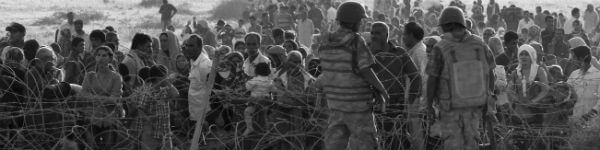
In an editorial, the New York Times says: The world is witnessing the largest exodus of refugees in generations, spawned by armed conflicts in the Middle East, North Africa and South Asia. But “witnessing” is perhaps the wrong word. Many world leaders, including those who run most of the richest countries, are choosing to look the other way. They are more interested in barricading their nations from the fallout of conflict than in investing in peacekeeping and stability.
This willful neglect was on display last week at the inaugural World Humanitarian Summit, convened to face the needs of the world’s most vulnerable people. Most heads of state from the richest nations — including the United States — didn’t bother to show up, drawing a rebuke from the United Nations secretary general, Ban Ki-moon.
“It’s disappointing that some world leaders could not be here, especially from the G-7 countries,” he said at a news conference on Tuesday. “We have reached a level of human suffering without parallel since the founding of the United Nations” 70 years ago. [Continue reading…]
Contrast Ki-moon’s words with the happy talk from Barack Obama two weeks ago when he gave the commencement address at Rutgers:
by almost every measure, America is better, and the world is better, than it was 50 years ago, or 30 years ago, or even eight years ago.
This assessment has I believe less to do with the dry statistical arguments made by the likes of Steven Pinker, than it has with the group-think inside the Obama administration.
The easiest way to counter criticism on Syria, with the refugee crisis, and elsewhere, is by insisting we did all that we could.
This self-administered anesthetic is designed to suppress remorse, guilt and a keen sense on personal responsibility.
Obama’s faith in inexorable progress derives from his refusal to “look backwards” — a conviction not unlike that of a hit-and-run driver who keeps his eyes firmly on the road ahead.
Likewise, the notion that the United States can extricate itself from its Middle East entanglements by simply walking away, is really no different from the attitude of a deadbeat father who thinks he can leave his past behind.
Our need to understand the past derives from our need to understand the present — it has nothing to do with (as Obama claims) a fear of the future.
The simplistic approach favored inside the White House reduces everything to a choice over which Obama had no control: the decision to invade Iraq.
Those who make that the beginning of history, have very often thereafter indulged in the conceit that by having personally opposed that misadventure, they can thereby shed any sense of collective responsibility for what followed — as though the neocons’ war never actually became America’s war.
What is ostensibly geographically circumscribed by a neat divide between domestic and foreign is really a separation between those things we claim as our own and those we don’t.
The convenient reflex to which most people are susceptible is simply to disown whatever becomes problematic.
We turn our backs on refugees because we prefer to believe that they are not our problem.
Hope and hype of Hiroshima can’t conceal Obama’s dismal record on nuclear disarmament

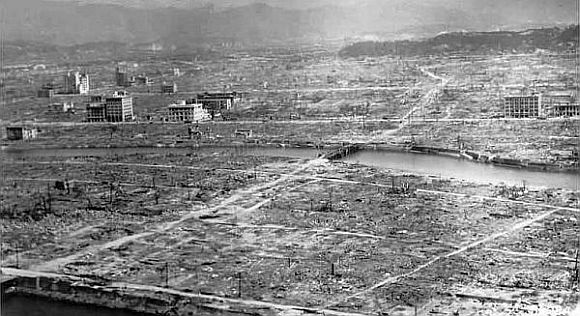
Setsuko Thurlow, who as a 13-year-old girl survived the atomic bombing of Hiroshima, writes: In [President Obama’s] famous speech in Prague, in 2009, he said, “As the only nuclear power to have used a nuclear weapon, the United States has a moral responsibility to act. We cannot succeed in this endeavor alone, but we can lead it, we can start it.”
Why then has the U.S. government, under the Obama administration, pledged $1 trillion over the next 30 years to modernize its nuclear arsenal? Exactly where is the moral responsibility and leadership in that?
Regarding disarmament, Obama stated, “Our efforts to contain these dangers are centered on a global nonproliferation regime, but as more people and nations break the rules, we could reach the point where the center cannot hold.” Why then are the U.S. and other nuclear weapon states actively boycotting the latest international nuclear negotiations? [Continue reading…]
Tim Wright writes: Under the Obama presidency, contrary to perceptions, the pace of nuclear warhead dismantlement has slowed, not hastened. Indeed, the two presidents Bush and Bill Clinton each made greater gains in downsizing the colossal US nuclear stockpile amassed during the cold war.
But more alarming than this failure to destroy old nuclear weapons has been the Obama administration’s aggressive pursuit of new, “smaller” ones, for which the threshold of use would be lower, according to former military commanders.
At great expense, the president has bolstered all three components of the nation’s “nuclear triad”: the strategic bombers, intercontinental ballistic missiles and submarine-launched missiles. This was the price paid for securing Republican support in 2010 for the ratification of a modest bilateral arms reduction treaty with Russia.
Obama’s much-publicised “nuclear security summits” largely ignored the greatest source of nuclear insecurity in the world today: 15,000 nuclear weapons, including 1,800 on hair-trigger alert. Instead, they focused on measures to keep “vulnerable nuclear material” out of terrorists’ hands – a vital endeavour, certainly, but for all the fanfare the results were small.
Now the United States is stridently resisting diplomatic moves by two-thirds of the world’s nations to declare nuclear weapons illegal. It boycotted UN talks in Geneva this month aimed at setting the stage for negotiations on a prohibition treaty. But it cannot veto this initiative, just as it could not veto the processes that led to bans on landmines in 1997 and cluster munitions in 2008.
While a prohibition on nuclear weapons will not result in disarmament overnight, it will powerfully challenge the notion that these weapons are acceptable for some nations. It will place them on the same legal footing as both other types of weapons of mass destruction – namely, chemical and biological weapons. [Continue reading…]
Debates about Hiroshima reduce the victims of 1945 to the role of extras in their own murders
Jeffrey Lewis writes: It’s not clear to me Truman had carefully thought through the implications of using the bomb or really understood that it might be a dramatic escalation from the enormous bombing campaign already underway. It is hard to assign simple motives to any large group of people, like “the United States.” Why “the United States” does anything is always a complicated story involving people working both with and against one other. In the case of Hiroshima, if anything, there was no decision to use the bomb, just an enormous amount of institutional momentum that rolled over haphazardly raised objections and qualms. I have a lot of objections to strategic bombing, and what John Hersey called the “material and spiritual evil” of total war, to say nothing of the racist propaganda required to facilitate killing on such a scale. But to postulate a geopolitical rationale for using the atomic bomb elides the awful human cruelty that was on display in 1945 and not just in Hiroshima.
And the revisionists have something else wrong, too. World War II was over — but it had not ended. If you study war and violence, you know that people continue killing each other even after the original justifications for the killing are obsolete. Japan’s leaders knew the war was lost, but that wasn’t quite enough to convince them to surrender. And Japan’s war cabinet was focused less on an imminent U.S. invasion than the more immediate problem of domestic subversion from the left if the conflict continued and from the right if it did not. The Japanese materials now available to scholars seem to show that Soviet entry into the war was the event that produced the biggest shock. And what turned the tide in Tokyo, which was divided over the issue of surrender, was the diplomatic note issued by U.S. Secretary of State James Byrnes that slightly softened the terms of Japan’s “unconditional” surrender. Even then, the story is a Japanese one. The historian Tsuyoshi Hasegawa argues that Japanese leaders interpreted the Byrnes note in a certain way because the translation into Japanese from the Foreign Ministry had been deliberately phrased to emphasize the possibility that Emperor Hirohito would remain in power.
But that’s a funny interpretation of Japan’s surrender, emphasizing people, places, and, above all, chance. Truman had his friend Jimmy Byrnes send a vague note, and a pair of obscure bureaucrats put a little English on the translation, so to speak. And that’s why your granddad didn’t die on some god-forsaken beach code-named after a car. That kind of account doesn’t really satisfy us, does it? Grand decisions require equally grand reasons. We want the story of the bomb to match the stakes in our own debates about who started the Cold War or the role that nuclear weapons played in our security. That’s because our debates about Hiroshima aren’t about understanding Truman, or the Japanese Foreign Ministry, or even the people who died. They are about ourselves.
Over time, the debate about the meaning of Hiroshima has shifted from responsibility for the Cold War to the question of whether we should plan, indefinitely, to base our security on the threat of nuclear destruction. Ward Wilson, in particular, has argued that the account of Hiroshima plays a central role in our modern myths about deterrence and the bomb as the winning weapon. [Continue reading…]
On nuclear weapons, nations must cooperate to avoid catastrophe
Sam Nunn writes: President Obama’s visit to Hiroshima comes almost 71 years after the conclusion of a world war that was fought and ended with tremendous sacrifice, huge casualties and immense devastation. Today, global nuclear arsenals are capable of destroying not only cities but also civilization itself. Albert Einstein’s prophesy bears repeating: “I do not know how the Third World War will be fought, but I can tell you what they will use in the Fourth — rocks!”
Since the end of World War II, the United States and our allies have relied on the ultimate threat of mutual assured destruction for our security, as the Soviet Union did and Russia does now. Today, with nine nations possessing nuclear arms and terrorists seeking them, this strategy has become increasingly hazardous and decreasingly effective.
Warren Buffett, a man who knows how to calculate risk, has reminded us that if the chance of an event occurring is 10 percent in a given year, and that same risk persists over 50 years, there is a 99.5 percent probability that it will happen during those 50 years. For more than 70 years, the United States and Russia have beaten the odds, avoiding a number of near-disasters. The recent deterioration in relations between the United States and Russia has greatly increased these risks.
The two nations still deploy thousands of nuclear weapons ready to fire on a moment’s notice, risking a catastrophic accident or miscalculation based on a false warning. Cold War dangers compelled dialogue between Washington and Moscow on nuclear security and strategic stability. This dialogue is dangerously absent now, even as our planes and ships have close encounters in Europe and the Middle East. [Continue reading…]
In Syria, a slow-motion genocide while diplomats chatter
Janine di Giovanni writes: The International Syria Support Group, consisting of 20 countries and organizations, met in Vienna earlier this month to once again attempt to decide the fate of the Syrian people. Predictably, the diplomats left the Austrian capital with little more than promises for a “cessation of hostilities.”
“The challenge we face now is to transform these possibilities into the reality of an agreement,” U.S. Secretary of State John F. Kerry declared, referring to a “basic framework” for a united, non-sectarian Syria.
Those words mean nothing to the fighters on the ground, who continue to push for more territory. In Aleppo, missiles fall and helicopters whir in the sky. In Daraya, a suburb of Damascus that has been besieged by Syrian government forces since 2012, 8,000 inhabitants are starving.
The Syria Campaign, an independent advocacy group, estimates that a Syrian dies every 51 minutes. On the day the diplomats gathered in Vienna, 28 civilians were killed, 94 rockets were launched and 40 barrel bombs dropped. There is a disconnect, to say the least, between the “peace process” and what is actually happening in real time. [Continue reading…]
Is the killing of militant leaders counterproductive?
The Wall Street Journal reports: Killing leaders of Islamist militant groups, such as the Saturday strike on Afghan Taliban chief Mullah Akhtar Mansour, has long been a signature strategy of the Obama administration—an alternative to massive troop deployments overseas.
But how effective are those “decapitations” in the long run? The verdict is far from clear and, to an extent, depends on the size and cohesion of the targeted group.
Both the 2011 raid on Osama bin Laden’s compound in Pakistan and the targeting of Mullah Mansour on a Pakistani road were major successes for U.S. intelligence and the Pentagon.
Al Qaeda’s central command, a relatively tight international terror network now led by Ayman al-Zawahiri, has been in decline since bin Laden’s death. It has been unable to fully recover from the blow or to mount major attacks against the West.
But the experience is less encouraging for wide-scale insurgencies such as the Afghan Taliban. While such decapitations can provide a short-term gain, they rarely change the course of the conflict — and frequently backfire if not accompanied by a much broader, resource-intensive involvement of a kind the White House has been loath to pursue.
Unlike al Qaeda, the Taliban enjoy support from a significant swath of the Afghan population. The group’s military advances in 2013-15 weren’t impeded by the fact that its leader, Mullah Mohammad Omar, was secretly dead at the time, or by the assassinations of scores of commanders.
In announcing Mullah Mansour’s death, President Barack Obama said his killing “gives the people of Afghanistan and the region a chance at a different, better future.”
That optimistic assessment isn’t shared by many, in the region or in the U.S., who closely follow the Taliban.
“I don’t think it will weaken the Taliban, and it may strengthen them,” said Barnett Rubin, a former U.S. State Department official who worked on peace negotiations with the Taliban and who is now associate director of the Center on International Cooperation at New York University.
It is also far from certain that removing Mullah Mansour would make such peace talks — an avowed U.S. goal — any easier to resume.
The minister of aviation in the pre-2001 Taliban government, Mullah Mansour belonged to the original generation of Taliban leaders, was involved in the political outreach, and could influence field commanders. His successor named on Wednesday, Maulavi Haibatullah, is believed to represent a more uncompromising cast.
“After this killing, the Taliban will be more hard-line and the people who think that the war will solve all the problems will be more powerful. This is a blow to peace,” said Waheed Muzhda, a Kabul political analyst who served in the Taliban regime’s foreign ministry before 2001.
U.S. officials have argued that, with Mr. Mansour, there wasn’t any peace process to derail anyway.
“It’s not as if he was going to open negotiations and this is going to stop that effort. He was not,” said James Cunningham, a fellow at the Atlantic Council who served as U.S. ambassador in Kabul in 2012-14.
Social scientists who examined the effect of such decapitations on militant groups have found little empirical evidence that the killings advance U.S. goals. [Continue reading…]
Vanda Felbab-Brown writes: Commenting on the death of Mullah Mansour during his visit to Vietnam this week, President Obama said, “Mansour rejected efforts by the Afghan government to seriously engage in peace talks and end the violence that has taken the lives of countless innocent Afghan men, women and children.”
So runs the official line from the White House: Because Mullah Mansour became opposed to negotiations, removing him became necessary for new peace talks. Yet the notion that the United States can drone-strike its way through the leadership of the Afghan Taliban until it finds an acceptable interlocutor seems optimistic, at best.
The revelation, last July, of the 2013 death in Pakistan of the Afghan Taliban’s previous leader and founder, Mullah Muhammad Omar, led to a competition for the succession that hurt the group’s willingness and capacity to negotiate. The Taliban’s subsequent military push has been its strongest in a decade, causing thousands of civilian casualties. In particular, suicide bombings by the Taliban’s most dangerous and violent faction, the Haqqani network, have struck at the heart of the nation’s capital.
Facing this onslaught, the whole country has been plunged into insecurity. The struggling Afghan National Security Forces have been hanging on, but the military momentum is on the Taliban’s side.
In quickly announcing on Wednesday that Mawlawi Haibatullah Akhundzada, a deputy to Mullah Mansour, would be their new leader, the Taliban is trying to avoid the chaos that surrounded Mr. Omar’s succession and to keep their military momentum. It’s likely the violence will continue. [Continue reading…]
Behind the barricades of Turkey’s hidden war against the Kurds
The New York Times reports: On the morning of Oct. 29, 2014, a long convoy of armored vehicles and trucks rolled northward in the shadow of Iraq’s Zagros Mountains and crossed a bridge over the Khabur River, which marks the border with Turkey. As the convoy rumbled past the border gate, the road for miles ahead was lined with thousands of ecstatic Kurds, who clapped, cheered and waved the Kurdish flag. Many had tears in their eyes. Some even kissed the tanks and trucks as they passed. The soldiers, Iraqi Kurds, were on their way through Turkey to help defend Kobani, a Syrian border city, against ISIS. Their route that day traced an arc from northern Iraq through southeastern Turkey and onward into northern Syria: the historical heartland of the Kurdish people. For the bystanders who cheered them on under a hazy autumn sky, the date was deliciously symbolic. It was Turkey’s Republic Day. What had long been a grim annual reminder of Turkish rule over the Kurds was transformed into rapture, as they watched Kurdish soldiers parade through three countries where they have long dreamed of founding their own republic.
Some who stood on the roadside that day have told me it changed their lives. The battle against the Islamic State had made the downtrodden Kurds into heroes. In the weeks and months that followed, the Kurds watched in amazement as fighters aligned with the Kurdistan Workers’ Party, or P.K.K. — long branded a terrorist group by Turkey and the United States — became the central protagonists in the defense of Kobani. The P.K.K.’s Syrian affiliate worked closely with the American military, identifying ISIS targets for airstrikes.
By the time ISIS withdrew from Kobani in January 2015, the Kurdish militants had paid a heavy price in blood. But they gained admirers all over the world. The Pentagon, impressed by their skill at guerrilla warfare, saw an essential new ally against ISIS. There was renewed talk in Europe of removing the P.K.K. from terrorism lists, often in news articles accompanied by images of beautiful female Kurdish soldiers in combat gear. For many Turkish Kurds, the lesson was unmistakable: Their time had come. I met a 27-year-old P.K.K. activist in Turkey, who asked not to be named, fearing reprisals from the government, and who first went to Kobani in 2012, when the Kurds began carving out a state for themselves in Syria called Rojava. “I remember talking to P.K.K. fighters, and I thought, They’re crazy to think they can do this,” she said. “Now I look back and think, If they can do it there, we can do it here.”
Nineteen months after that convoy passed, the feelings it inspired have helped to start a renewed war between Turkey and its Kurdish rebels. Turkish tanks are now blasting the ancient cities of the Kurdish southeast, where young P.K.K.-supported rebels have built barricades and declared “liberated zones.” More than a thousand people have been killed and as many as 350,000 displaced, according to figures from the International Crisis Group. The fighting, which intensified last fall, has spread to Ankara, the Turkish capital, where two suicide bombings by Kurdish militants in February and March killed 66 people. Another sharp escalation came in mid-May, when P.K.K. supporters released a video online seeming to show one of the group’s fighters bringing down a Turkish attack helicopter with a shoulder-fired missile, a weapon to which the Kurds have rarely had access. Yet much of the violence has been hidden from public view by state censorship and military “curfews” — a government word that scarcely conveys the reality of tanks encircling a Kurdish town and drilling it with shellfire for weeks or months on end.
The conflict has revived and in some ways exceeded the worst days of the P.K.K.’s war with the Turkish state in the 1990s. The fighting then was brutal, but it was mostly confined to remote mountains and villages. Now it is devastating cities as well and threatening to cripple an economy already burdened by ISIS bombings and waves of refugees from Syria. In Diyarbakir, the capital of a largely Kurdish province, artillery and bombs have destroyed much of the historic district, which contains Unesco world heritage sites. Churches, mosques and khans that have stood for centuries lie in ruins. Tourism has collapsed. Images of shattered houses and dead children are stirring outrage in other countries where Kurds live: Iraq, Syria and Iran. [Continue reading…]
Taliban leader was made to ‘face the consequences’ of refusing to negotiate
The Wall Street Journal reports: President Barack Obama secretly ordered the strike on Mullah Mansour after first trying to bring him to the negotiating table. Initially, there was hope in Washington that Mullah Mansour would be more open to negotiations than his predecessor, Mullah Mohammad Omar.
Obama administration officials were divided over whether the Pakistanis were capable or willing to deliver Mullah Mansour for the negotiations.
U.S. officials said the Pakistanis tried and grew frustrated in February by Mullah Mansour’s refusal to send representatives to meet with the Afghan government.
Around the same time, people who maintain contacts with the Taliban began to report that Mullah Mansour had left Pakistan and was spending time in Iran.
U.S. intelligence agencies received information that allowed them to track Mullah Mansour’s movements, including details about devices he used for communications, U.S. officials said.
That allowed the spy agencies to present policy makers with a choice: If and when Mullah Mansour were located in Pakistan, should the U.S. strike?
Mullah Mansour’s travels made it easier to find him. In contrast, the Central Intelligence Agency spent years looking in vain for an opportunity to kill the reclusive cleric he replaced, Mullah Omar.
An April 19 Taliban attack in Kabul targeted Afghanistan’s secret service, killing more than 60 people and underlining for the Americans the extent to which Mullah Mansour had chosen a military course. A decision was made that he should “face the consequences” of his refusal to negotiate, a senior administration official said. [Continue reading…]
Taliban name new leader after confirming predecessor died in U.S. strike
The New York Times reports: The Taliban broke their silence early Wednesday over the death of their leader, Mullah Akhtar Muhammad Mansour, confirming in a statement that he had been killed in an American drone strike.
Mawlawi Haibatullah Akhundzada, a deputy to Mullah Mansour, was selected as the new leader of the Taliban, and Sarajuddin Haqqani and Mullah Muhammad Yaqoub were chosen as his deputies, the movement’s leadership council said in the statement. Mullah Yaqoub is the son of the previous Taliban chief, Mullah Muhammad Omar, whose death was acknowledged in July 2015.
President Obama said Monday that Mullah Mansour had been killed in a drone strike Saturday in a restive province of Pakistan.
The Taliban’s spokesmen, who publish regular updates from battlefields across Afghanistan, had remained silent since Mullah Mansour’s killing, as the movement’s leaders convened in the Pakistani city of Quetta to discuss his burial, as well as his successor.
One of their first meetings was at the home of Mawlawi Haibatullah, a figure with deep religious credentials who had been a lesser-known deputy to Mullah Mansour. Over the past year, more attention had focused on another deputy, Mr. Haqqani, who increasingly had been running the day-to-day war for the Taliban as Mullah Mansour was occupied with a campaign of quashing internal dissent and with travel abroad.
Taliban commanders who were aware of the conversations in Quetta had described Mawlawi Haibatullah as a voice guiding the discussions of succession, but not as a front-runner for the leadership.
Many of the movement’s leaders had pushed for a relatively obscure figure to succeed Mullah Mansour — to avoid a divisive personality and for purposes of enhanced security, keeping in mind that Mullah Omar’s reclusive ways long protected him and even concealed his death for years. It appeared Wednesday that such criteria had served Mawlawi Haibatullah well. [Continue reading…]
For Washington, stability in Egypt matters more than human rights
The Wall Street Journal reports: After two years of cool relations between the U.S. and Egypt, the October terrorist attack on a Russian passenger plane over the Sinai Peninsula triggered a flurry of visits here by U.S. officials, who called for increased military aid to shore up President Abdel Fattah Al Sisi.
The downing of that jet was claimed by an Islamic State affiliate based in the Sinai. The possibility that the mysterious crash of an Egyptian airliner last week was another act of terrorism has only intensified worries that Mr. Sisi is unable to contain the threat, according to a U.S. official, a Western diplomat and other experts.
“An incident like this on the heels of another airline disaster is always going to speed up any cooperation on security even if the cause is not yet clear,” the Western diplomat said.
Regardless of what actually caused the EgyptAir flight from Paris to Cairo to crash, Michael Hanna, an Egypt expert at the Century Foundation, said recent traffic from Washington suggests the U.S. will seek to increase support for the Sisi regime despite deep concerns about its human-rights record.
The goal is to avoid having Egypt — long a U.S. ally under longtime authoritarian leader Hosni Mubarak — follow the downward spiral of Iraq, Syria and neighboring Libya, where terrorists have exploited security vacuums in recent years.
“Egypt is too big to fail in the eyes of the U.S. and Europe,” Mr. Hanna said. [Continue reading…]
Did Obama just carry out an experimental execution?
Reuters reports: U.S. President Barack Obama approved the drone strike that killed Mullah Akhtar Mansour because the Taliban leader was overseeing plans for new attacks on American targets in Kabul, the Afghan capital, U.S. officials said on Monday. [Continue reading…]
Drone strikes are always carried out in the name of necessity. From the president on down, everyone wants to be able to claim that the decision to launch a deadly attack was driven by an imminent threat, there being no legal basis for indiscriminate killing or vengeance.
In the case of the assassination of the Taliban leader, Mullah Akhtar Mansour, in Pakistan over the weekend, Obama’s comments on the killing suggest that this actually had less to do with preventing an imminent attack, than it was a kind of experiment.
No one knows what the consequence of killing Mansour will be, but Obama apparently thought that the potential benefits outweighed the risks.
An otherwise risk-averse president always seems confident about the bets he places when they involve Hellfire missiles.
The Wall Street Journal reports: Mr. Obama, speaking Monday during a visit to Hanoi, said the drone strike against Mr. Mansour did not constitute a “shift” in the U.S. mission. “We are not re-entering the day-to-day combat operations that are currently being conducted by Afghan forces,” he said.
He stressed Saturday’s airstrike was an opportunity for the Taliban to shift direction in favor of reconciliation talks, because Mr. Mansour for months has been against those talks.
Whether Mr. Mansour’s death changes things remains to be seen, according to those who track the group. Some believe his death could lead to a power struggle, accelerating the Taliban’s breakup. A main breakaway group already is being funded by the Afghan government as part of an effort to splinter the movement, The Wall Street Journal reported.
It was disclosed last year that the former Taliban leader, Mullah Mohammad Omar, had died two years earlier.
However, the infighting is unlikely to encourage the group to negotiate with the Afghan government, according to those familiar with its operations. Mr. Mansour’s death actually may make it difficult for moderates among the Taliban to negotiate. [Continue reading…]
William Hartung: How to disappear money, Pentagon-style
Colonel Mark Cheadle, a spokesman for U.S. Africa Command (AFRICOM), recently made a startling disclosure to Voice of America (VOA). AFRICOM, he said, is currently mulling over 11 possible locations for its second base on the continent. If, however, there was a frontrunner among them Cheadle wasn’t about to disclose it. All he would say was that Nigeria isn’t one of the countries in contention.
Writing for VOA, Carla Babb filled in the rest of the picture in terms of U.S. military activities in Africa. “The United States currently has one military base in the east African nation of Djibouti,” she observed. “U.S. forces are also on the ground in Somalia to assist the regional fight against al-Shabab and in Cameroon to help with the multinational effort against Nigeria-based Boko Haram.”
A day later, Babb’s story disappeared. Instead, there was a new article in which she noted that “Cheadle had initially said the U.S. was looking at 11 locations for a second base, but later told VOA he misunderstood the question.” Babb reiterated that the U.S. had only the lone military base in Djibouti and stated that “[o]ne of the possible new cooperative security locations is in Cameroon, but Cheadle did not identify other locations due to ‘host nation sensitivities.’”
U.S. troops have, indeed, been based at Camp Lemonnier in Djibouti since 2002. In that time, the base has grown from 88 acres to about 600 acres and has seen more than $600 million in construction and upgrades already awarded or allocated. It’s also true that U.S. troops, as Babb notes, are operating in Somalia — from at least two bases — and the U.S. has indeed set up a base in Cameroon. As such, the “second” U.S. base in Africa, wherever it’s eventually located, will actually be more like the fifth U.S. base on the continent. That is, of course, if you don’t count Chabelley Airfield, a hush-hush drone base the U.S. operates elsewhere in Djibouti, or the U.S. staging areas, cooperative security locations, forward operating locations, and other outposts in Burkina Faso, Central African Republic, Chad, Ethiopia, Gabon, Ghana, Kenya, Mali, Niger, Senegal, the Seychelles, Somalia, South Sudan, and Uganda, among other locales. When I counted late last year, in fact, I came up with 60 such sites in 34 countries. And just recently, Missy Ryan of the Washington Post added to that number when she disclosed that “American Special Operations troops have been stationed at two outposts in eastern and western Libya since late 2015.”
To be fair, the U.S. doesn’t call any of these bases “bases” — except when officials forget to keep up the fiction. For example, the National Defense Authorization Act for Fiscal Year 2016 included a $50 million request for the construction of an “airfield and base camp at Agadez, Niger.” But give Cheadle credit for pushing a fiction that persists despite ample evidence to the contrary.
It isn’t hard, of course, to understand why U.S. Africa Command has set up a sprawling network of off-the-books bases or why it peddles misinformation about its gigantic “small” footprint in Africa. It’s undoubtedly for the same reason that they stonewall me on even basic information about their operations. The Department of Defense, from tooth to tail, likes to operate in the dark.
Today, TomDispatch regular Bill Hartung reveals another kind of Pentagon effort to obscure and obfuscate involving another kind of highly creative accounting: think slush funds, secret programs, dodgy bookkeeping, and the type of financial malfeasance that could only be carried out by an institution that is, by its very nature, too big to fail (inside the Beltway if not on the battlefield).
Rejecting both accurate accounting and actual accountability — from the halls of the Pentagon to austere camps in Africa — the Defense Department has demonstrated a longstanding commitment to keeping Americans in the dark about the activities being carried out with their dollars and in their name. Luckily, Hartung is willing to shine a bright light on the Pentagon’s shady practices. Nick Turse
The Pentagon’s war on accountability
Slush funds, smoke and mirrors, and funny money equal weapons systems galore
By William D. HartungNow you see it, now you don’t. Think of it as the Department of Defense’s version of the street con game, three-card monte, or maybe simply as the Pentagon shuffle. In any case, the Pentagon’s budget is as close to a work of art as you’re likely to find in the U.S. government — if, that is, by work of art you mean scam.
The United States is on track to spend more than $600 billion on the military this year — more, that is, than was spent at the height of President Ronald Reagan’s Cold War military buildup, and more than the military budgets of at least the next seven nations in the world combined. And keep in mind that that’s just a partial total. As an analysis by the Straus Military Reform Project has shown, if we count related activities like homeland security, veterans’ affairs, nuclear warhead production at the Department of Energy, military aid to other countries, and interest on the military-related national debt, that figure reaches a cool $1 trillion.
The more that’s spent on “defense,” however, the less the Pentagon wants us to know about how those mountains of money are actually being used. As the only major federal agency that can’t pass an audit, the Department of Defense (DoD) is the poster child for irresponsible budgeting.
Afghan government secretly fosters Taliban splinter groups
The Wall Street Journal reports: The Afghan government is giving financial and military support to a breakaway Taliban faction, according to some Afghan and U.S. coalition officials, in an effort to sow rifts within the insurgency and nudge some of its leaders toward peace talks.
The effort comes as the U.S. military conducted an airstrike inside Pakistan that American officials said likely killed Taliban leader Mullah Akhtar Mansour, potentially setting the stage for another leadership struggle that could fragment the group further in the coming days. The Taliban, which usually respond promptly to requests for comment, hadn’t issued a statement by late Sunday.
Senior Afghan and U.S. diplomatic, military and intelligence officials, including several who had roles in creating the program, described its details and said that resources provided by the U.S. were used to support it.
The Afghan intelligence agency is leading the drive to recruit new Taliban assets, Afghan and U.S. officials said. The agency relies on the U.S. for most of its funding and is still mentored by the Central Intelligence Agency. The CIA declined to comment for this article.
Despite billions invested in reconstruction, Afghanistan still relies on aid for most of its funding and the U.S. pays more than $4 billion a year for its security forces.
The program’s goal, Afghan and U.S. officials said, is to exploit divisions that emerged after the Taliban’s longtime leader, Mullah Mohammad Omar, was revealed last July to have been dead for years, a disclosure that stunned local Taliban leaders and threw the group into disarray.
It targets southern Zabul, Helmand, eastern Paktika and western Farah and Herat provinces, where groups of insurgents and their commanders, unhappy with the Taliban’s leadership, have defected to a commander named Mullah Mohammad Rasool.
Afghan and U.S. officials said Mullah Rasool’s faction and other fractious Taliban groups have been receiving cash, ammunition and weapons from the Afghan government. [Continue reading…]
U.S. takes war back to Pakistan with drone strike aimed at Taliban leader
The Washington Post reports: The U.S. drone strike that killed Taliban chief Akhtar Mohammad Mansour represents another escalation of U.S. involvement in the war in Afghanistan by trying to cripple an insurgent group that has for years found refuge on Pakistani soil.
The strike early Saturday marks the most aggressive U.S. military action in Pakistan since the 2011 raid that killed Osama bin Laden. It is also thought to be the first time that the U.S. military has directly targeted the top leader of the Afghan Taliban, a potentially destabilizing action that could leave the group violently lashing out as it seeks to find a new leader.
President Obama called Mansour’s death “an important milestone.”
“We have a high-profile leader who has been consistently part of operations and plans to potentially harm U.S. personnel and has been resistant to the kinds of peace talks and reconciliation that could ultimately bring an end to decades of war in Afghanistan,” he said during a visit to Vietnam.
While Obama denied that the attack represented a shift in the U.S. approach, analysts see it as an escalation.
“This is an unprecedented move to decapitate the Taliban leadership in its safe haven of Pakistan,” said Bruce Riedel, a South Asia expert at the Brookings Institution. “It exposes Pakistan’s role in promoting and protecting the Taliban, and will provoke a crisis in U.S.-Pakistan relations.”
But unlike the bin Laden raid, which prompted outrage in Pakistan, the reported strike on Mansour drew a fairly muted reaction Sunday from Pakistani government and military leaders, even as Afghan officials cheered and described the attack as proof of the Afghan Taliban’s deep presence in Pakistan. [Continue reading…]
The Guardian reports: The killing of Mansoor represents a remarkable expansion of the programme because it happened well outside the tribal agencies of North and South Waziristan where nearly all known strikes have taken place, usually focusing on al-Qaida and allied groups.
US officials said the attack took place near Ahmad Wal, suggesting it was the first ever known strike in the vast southern province of Balochistan, where the insurgency’s “Quetta Shura” leadership council is thought to be based, and one of very few to target a senior member of the Afghan Taliban.
The drones were described as having been piloted by US special forces – suggesting it was not a CIA operation, as is usually the case with attacks inside Pakistan. [Continue reading…]
Pakistan denounces U.S. strike believed to have killed Afghan Taliban chief
Express Tribune reports: Pakistan on Sunday denounced the US drone strike believed to have killed the Taliban chief Mullah Akhtar Mansour as a violation of its air space and said only negotiations could bring a lasting peace to Afghanistan.
The statement, issued by the Foreign Office late Sunday, said one of the victims of the attack was a driver named Muhammad Azam while the identity of the second “is being verified”.
“On late Saturday 21st May, 2016, the United States shared information that a drone strike was carried out in Pakistan near the Pakistan-Afghanistan border area,” in which Mansour was targeted, it said.
“This information was shared with the Prime Minister and the Chief of Army Staff after the drone strike.”
The statement denounced the drone attack as a “violation of [Pakistan’s] sovereignty, an issue which has been raised with the United States in the past as well.”
It said that a four-country group comprising the United States, China, Afghanistan and Pakistan last met on Wednesday to discuss ways to restart stalled peace talks between Kabul and the Taliban and that the group had collectively decided “a politically negotiated settlement was the only viable option for lasting peace in Afghanistan”. [Continue reading…]
Check out my study on why killing the leaders of militant groups like the Taliban make them even more extreme: https://t.co/1QWOmFflee.
— Max Abrahms (@MaxAbrahms) May 22, 2016
Obama ‘pleased’ with Syria policy while Kerry warns Assad about unspecified ‘Plan B’
The New York Times reports: Secretary of State John Kerry and his Russian counterpart, Sergey V. Lavrov, said on Tuesday that if President Bashar al-Assad of Syria continues to block access of humanitarian aid to besieged cities and towns, they were prepared to help the World Food Program airdrop food and emergency supplies.
The very fact that they had to threaten the airdrops — which are expensive and often inaccurate — amounted to an admission of how little progress has been made in achieving either the lasting cease-fire or the regular humanitarian relief that European and Arab nations, along with Iran, laid out as the first steps toward a broader peace agreement.
The threat to conduct airdrops came after a meeting in Vienna of the International Syria Support Group, made up of the nations that drafted a largely unimplemented plan to end the country’s civil war. They gathered at a low point: A once-promising “cessation of hostilities” has largely collapsed, an effort to start negotiations between the opposition and the government broke down, and there has been no progress toward negotiating a “political transition” that was supposed to begin on Aug. 1.
Bolstered by Russia’s intervention to help prop him up, Mr. Assad is in a stronger position than he has been in years, many experts say, and has rejected the idea that any new government would have to exclude him. He has the strong support of Iran, his longtime provider of security, though Russian officials seem less concerned about whether Mr. Assad himself remains in power or is replaced by another leader from his Alawite Shiite sect.
At a news conference on Tuesday afternoon with Mr. Lavrov, Mr. Kerry rejected a suggestion that, in dealing with Mr. Assad, he was operating without the kind of leverage he had in Vienna last year during the Iran nuclear negotiations — when American sanctions and sabotage of the Iranian program created the pressure that led to a deal.
But Mr. Kerry — who White House aides say has complained in Situation Room meetings about the lack of clout to force Mr. Assad to make good on his commitments — argued that the Syrian leader would be making a mistake to believe he would pay no price for refusing to cooperate.
“If President Assad has come to a conclusion there’s no Plan B,” he said, referring to more coercive action to force him to comply, “then he’s come to a conclusion that is totally without any foundation whatsoever and even dangerous.”
Mr. Kerry added later that Mr. Assad “should never make a miscalculation about President Obama’s determination to do what is right at any given moment of time, where he believes that he has to make that decision.” Mr. Assad, he said, has “flagrantly violated” the United Nations resolution calling for a nationwide cease-fire and allowing humanitarian assistance.
Yet in making public a case that there would be consequences for Mr. Assad’s intransigence, Mr. Kerry was touching on one of the hardest issues facing Mr. Obama and his national security team in their last eight months in office. The president has repeatedly defended his decision not to authorize a military strike against Mr. Assad after he crossed what Mr. Obama had described as a “red line” against using chemical weapons. He also rejected a no-fly zone to protect fleeing civilians and opposition forces.[Continue reading…]
The Daily Beast reports: White House spokesman Josh Earnest said Monday that President Obama was “certainly pleased” with his administration’s policy on Syria, while simultaneously acknowledging that the country now poses a “heightened risk” to America and its interests.
“We’ve seen terrible violence in Syria, it’s an awful humanitarian situation, and it’s a genuine human tragedy. And it’s a dangerous place, and it’s a place that poses a heightened risk to the United States and to our allies and interests around the world,” Earnest said.
Earnest, who was asked by Yahoo’s Olivier Knox about The Daily Beast’s reporting, argued that the president’s Syria policy had “advanced the national security interests” of the U.S., placing the blame squarely on the Assad regime.
“There’s no denying that what has happened in Syria has changed millions of lives — and not for the better. And that’s a testament to the failed political leadership of Bashar al-Assad, it’s a testament to the way the political chaos in that country has propagated so much violence,” Earnest said at Monday’s White House press briefing.
The Daily Beast reported Friday that senior White House official Ben Rhodes allegedly told Syrian-American activists that he was “not proud” of the administration’s policy on Syria. [Continue reading…]
Afghanistan paid 11,000 militants to lay down their arms. Now the money has run out
The Washington Post reports: Faridoon Hanafi says he probably killed American soldiers as a Taliban commander in eastern Afghanistan from 2009 through 2014. And he’s certainly killed some Afghan troops.
But since then, Hanafi has joined a rare demographic here: reformed, de-radicalized Islamist militants.
After he handed over his assault rifles and grenade launchers to intelligence agents, Hanafi settled into a safe house and started collecting $200 a month. In return for those payments, funded with foreign aid, Hanafi worked with local officials in Nangahar province to try to lure other militants away from the fight.
Now, the money is drying up, and a central goal of the U.S.-led effort to rebuild Afghanistan — that Islamist militants can be rehabilitated or paid to reintegrate into the law-abiding public — is at a crossroads as the war drags into its 15th year.
“If the government stops paying, these people will find another way to get money, and negotiations will fail,” Hanafi said in an interview. [Continue reading…]