Fred Kaplan writes: The Standard Missile 3, or SM-3 as it’s called, is purely defensive; it works not by blowing up a missile in midair but by slamming into it with great force; in other words, it couldn’t be turned into an offensive weapon, even if some future Western leader wanted it to be.
But from Russia’s point of view, that’s not the issue. As one military adage has it, the only purely defensive weapon is a foxhole, and a battery of antimissile missiles doesn’t change this fact. In the odd world of nuclear strategy, a nation deters an attack by posing a credible threat of “retaliation in kind.” Side A attacks Side B; Side B strikes back against Side A; therefore, Side A doesn’t attack in the first place. But imagine that Side A has an effective missile-defense system. Side A attacks Side B; Side B strikes back, but most of its missiles get shot down before reaching their targets; therefore, Side B is unable to “retaliate in kind.” Both sides do the calculation and understand the strategic imbalance, and therefore (so goes the theory), Side A dominates Side B — intimidates it into doing certain things in A’s favor — without having to go to war.
This is why Russian officials see missile defense systems as a threat. It’s a concept they learned from the Americans. In the 1950s and early ’60s, many American nuclear strategists, notably Herman Kahn, author of the best-seller On Thermonuclear War, advocated anti-ballistic-missile systems as an explicit adjunct to an offensive first-strike strategy: The U.S. launches a nuclear attack on the USSR; the USSR strikes back with the few nuclear missiles that survived the first strike; the U.S. shoots them down with its antimissile missiles. Or, more to the point, the U.S. has the capability to do these things — which puts the U.S. in a dominant position in international confrontations.
In the mid-1960s, when Secretary of Defense Robert McNamara proposed a treaty banning anti-ballistic missiles in the United States and Soviet Union, some Russian officials were puzzled: Why ban defensive weapons, they asked? McNamara schooled them on nuclear strategy; he essentially wanted to avoid the destabilizing situation that Herman Kahn wanted to foster and exploit. The Russians learned the lesson. [Continue reading…]
Category Archives: Obama administration
Donald Trump is about to start getting intelligence briefings — ‘it could be a disaster’
NPR reports: Harry Truman had been vice president for only 82 days when Franklin Roosevelt died, so there was quite a lot he needed to learn when he became president in 1945.
“He didn’t even know the atomic bomb existed,” historian David Priess said. “He didn’t know about the Manhattan Project.”
Priess, a former CIA officer and author of The President’s Book of Secrets, a history of the president’s daily brief, said that experience made Truman resolve that no future president should come into office unprepared.
So in 1952, as the world grew accustomed to nuclear peril and other threats in the unfolding Cold War, Truman offered classified briefings about the global security situation to each of the major-party nominees running to replace him. That tradition has held up ever since.
Traditionally, the White House waits until Republicans and Democrats have formally nominated their candidates at their party conventions, Priess said, but not always. Georgia Gov. Jimmy Carter had no experience with foreign intelligence, so he asked President Gerald Ford for his briefings before he was nominated — and got them.
“Ultimately, it’s the president’s call,” Priess said, about who is briefed and when.
Although presidents typically try to accommodate candidates, even ones in the opposite party, they do not share everything. So, as the White House prepares to arrange briefings by the intelligence community, officials will likely hold back sensitive details about covert operations, secret nuclear and other defense programs, and other such details.
In fact, intelligence briefers this year may need to be more careful than ever, said former CIA analyst Aki Peritz. The de facto Republican nominee, Donald Trump, is “a man famously with no filter,” Peritz said of Trump, who has built his campaign upon what he calls straight talk.
“He’s never held public office before,” Peritz said. “He’s a business developer and a reality TV star. So if the United States starts giving Donald Trump classified briefings” with certain kinds of sensitive information, “it could be a disaster.” [Continue reading…]
French plan to hold Israel-Palestine conference postponed indefinitely
Middle East Eye reports: A conference on the peace process between Israelis and Palestinians, due to be held on 30 May in Paris, has been postponed, French President Francois Hollande said on Tuesday.
“[US Secretary of State] John Kerry cannot come on May 30 so it has been delayed. It will take place in the summer,” he told French radio.
Hollande said it was vital for France to take “a strong initiative” in the dispute.
“If not… what will happen? Settlement building, attacks,” he said.
The original date for the conference falls on the US Memorial Day holiday honouring members of the armed forces who died in combat.
“We’re in discussions right now with the French about any possible alternative date that might better work for the secretary,” State Department spokesman John Kirby said Monday, though he added that Kerry’s agenda is currently “jammed”.[Continue reading…]
Countering American anti-intellectualism involves more than challenging ignorance
The Washington Post reports on President Obama’s commencement address at Rutgers University on Sunday: The president throughout his speech decried a strain of anti-intellectualism in American politics that he said rejects science, reason and debate. “These are things you want in people making policy,” Obama said to laughter. “That might seem obvious.”
At one point, clearly referring to Trump and congressional Republicans who have decried efforts to combat global warming, Obama warned that “in politics and in life, ignorance is not a virtue.”
“It’s not cool to not know what you are talking about,” he said. “That’s not keeping it real or telling it like it is. That’s not challenging political correctness. That’s just not knowing what you are talking about.”
Throughout the year, Obama has turned again and again in speeches to the obligations that come with citizenship and the need for a more reasoned and respectful political debate at a moment when the country’s politics have never seemed more vulgar and poisonous. [Continue reading…]
Given Obama’s youthful audience, it’s hardly surprising that he would appeal to their desire to be cool, but that itself strikes me as being part of the problem.
Intellectual development hinges less on knowing what you are talking about, than it requires the cultivation of curiosity.
It’s got more to do with asking the right questions, than knowing the right answers.
To be cool, on the other hand, suggests never being caught by surprise — as though to be surprised (which means to encounter the unexpected) must be a bad thing.
But no one can become so seasoned in life that they actually never encounter anything new. On the contrary, where the sense of surprise has been lost, nothing more is being learned. The process of digesting new information and new perceptions that modify ones understanding of the world, has atrophied. Thought, once malleable, has become fixed.
Those who claim they’ve seen it all before, have more likely just stopped looking.
The rancor in political debate which Obama criticizes, is itself not simply representative of a fractious political environment. It isn’t just that discourse is lacking in civility; it’s a reflection of the fears that inhibit creative political thinking.
When politics is strictly factionalized, orthodoxies rule. No one wants to challenge the conventional wisdom inside the camp to which they are aligned. Politics is then simply a power struggle between competing camps.
The intransigence we project onto our opponents is mirrored by the inflexibility on our side.
Israel tells France it’s not interested in multilateral peace talks
The Washington Post reports: French officials said Sunday that they will continue to press ahead with plans to host a multilateral Middle East peace conference later this year, despite hearing, in blunt language, that Israel doesn’t really like the idea.
French Foreign Minister Jean-Marc Ayrault met with Prime Minister Benjamin Netanyahu on Sunday to promote what diplomats are calling the “French Initiative,” a still evolving and admittedly vague diplomatic project that seeks to bring global attention to the Israeli-Palestinian conflict and find consensus among the international community on how to move forward with a two-state solution.
The French are planning to host about 30 foreign ministers — from Europe and the Middle East as well as Russia, China and India — at a preparatory meeting at the end of this month, which could lead to a peace conference later this year.
Neither Israel nor the Palestinians, who support the French Initiative, will attend the May meeting in Paris.
U.S. Secretary of State John F. Kerry has not said whether he would be there.
Israeli officials have been pressing Washington to pour cold water on the French effort, which seeks to fill the vacuum left behind by the Obama administration, which declared that it would not be making any major move to bring Israel and the Palestinians back to the negotiating table. [Continue reading…]
Don’t blame Sykes-Picot for the Middle East’s mess

Steven A. Cook and Amr T. Leheta write: Sometime in the 100 years since the Sykes-Picot agreement was signed, invoking its “end” became a thing among commentators, journalists, and analysts of the Middle East. Responsibility for the cliché might belong to the Independent’s Patrick Cockburn, who in June 2013 wrote an essay in the London Review of Books arguing that the agreement, which was one of the first attempts to reorder the Middle East after the Ottoman Empire’s demise, was itself in the process of dying. Since then, the meme has spread far and wide: A quick Google search reveals more than 8,600 mentions of the phrase “the end of Sykes-Picot” over the last three years.
The failure of the Sykes-Picot agreement is now part of the received wisdom about the contemporary Middle East. And it is not hard to understand why. Four states in the Middle East are failing — Syria, Iraq, Yemen, and Libya. If there is a historic shift in the region, the logic goes, then clearly the diplomatic settlements that produced the boundaries of the Levant must be crumbling. History seems to have taken its revenge on Mark Sykes and his French counterpart, François Georges-Picot, who hammered out the agreement that bears their name.
The “end of Sykes-Picot” argument is almost always followed with an exposition of the artificial nature of the countries in the region. Their borders do not make sense, according to this argument, because there are people of different religions, sects, and ethnicities within them. The current fragmentation of the Middle East is thus the result of hatreds and conflicts — struggles that “date back millennia,” as U.S. President Barack Obama said — that Sykes and Picot unwittingly released by creating these unnatural states. The answer is new borders, which will resolve all the unnecessary damage the two diplomats wrought over the previous century.
Yet this focus on Sykes-Picot is a combination of bad history and shoddy social science. And it is setting up the United States, once again, for failure in the Middle East.
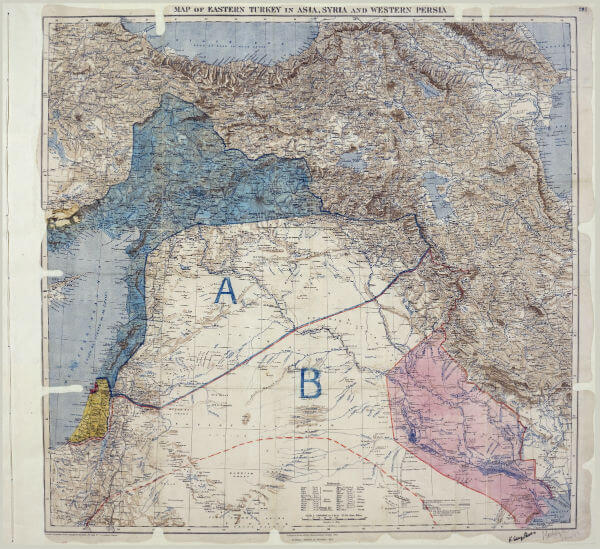
For starters, it is not possible to pronounce that the maelstrom of the present Middle East killed the Sykes-Picot agreement, because the deal itself was stillborn. Sykes and Picot never negotiated state borders per se, but rather zones of influence. And while the idea of these zones lived on in the postwar agreements, the framework the two diplomats hammered out never came into existence.
Unlike the French, British Prime Minister David Lloyd George’s government actively began to undermine the accord as soon as Sykes signed it — in pencil. The details are complicated, but as Margaret Macmillan makes clear in her illuminating book Paris 1919, the alliance between Britain and France in the fight against the Central Powers did little to temper their colonial competition. Once the Russians dropped out of the war after the Bolshevik Revolution in 1917, the British prime minister came to believe that the French zone that Sykes and Picot had outlined — comprising southeastern Turkey, the western part of Syria, Lebanon, and Mosul — was no longer a necessary bulwark between British positions in the region and the Russians.
Nor are the Middle East’s modern borders completely without precedent. Yes, they are the work of European diplomats and colonial officers — but these boundaries were not whimsical lines drawn on a blank map. They were based, for the most part, on pre-existing political, social, and economic realities of the region, including Ottoman administrative divisions and practices. The actual source of the boundaries of the present Middle East can be traced to the San Remo conference, which produced the Treaty of Sèvres in August 1920. Although Turkish nationalists defeated this agreement, the conference set in motion a process in which the League of Nations established British mandates over Palestine and Iraq, in 1920, and a French mandate for Syria, in 1923. The borders of the region were finalized in 1926, when the vilayet of Mosul — which Arabs and Ottomans had long associated with al-Iraq al-Arabi (Arab Iraq), made up of the provinces of Baghdad and Basra — was attached to what was then called the Hashemite Kingdom of Iraq.
On a deeper level, critics of the Middle East’s present borders mistakenly assume that national borders have to be delineated naturally, along rivers and mountains, or around various identities in order to endure. It is a supposition that willfully ignores that most, if not all, of the world’s settled borders are contrived political arrangements, more often than not a result of negotiations between various powers and interests. Moreover, the populations inside these borders are not usually homogenous.
The same holds true for the Middle East, where borders were determined by balancing colonial interests against local resistance. These borders have become institutionalized in the last hundred years. In some cases — such as Egypt, Iran, or even Iraq — they have come to define lands that have long been home to largely coherent cultural identities in a way that makes sense for the modern age. Other, newer entities — Saudi Arabia and Jordan, for instance — have come into their own in the last century. While no one would have talked of a Jordanian identity centuries ago, a nation now exists, and its territorial integrity means a great deal to the Jordanian people.
The conflicts unfolding in the Middle East today, then, are not really about the legitimacy of borders or the validity of places called Syria, Iraq, or Libya. Instead, the origin of the struggles within these countries is over who has the right to rule them. The Syrian conflict, regardless of what it has evolved into today, began as an uprising by all manner of Syrians — men and women, young and old, Sunni, Shiite, Kurdish, and even Alawite — against an unfair and corrupt autocrat, just as Libyans, Egyptians, Tunisians, Yemenis, and Bahrainis did in 2010 and 2011.
The weaknesses and contradictions of authoritarian regimes are at the heart of the Middle East’s ongoing tribulations. Even the rampant ethnic and religious sectarianism is a result of this authoritarianism, which has come to define the Middle East’s state system far more than the Sykes-Picot agreement ever did. [Continue reading…]
Activists claim: Ben Rhodes told us he’s ‘not proud of our Syria policy’
The Daily Beast reports: Senior White House official Ben Rhodes told Syrian-American activists at a gathering on Wednesday that he was “not proud” of the Obama administration’s Syria policy, according to three people who participated in the interchange.
But Rhodes waved off any suggestion that the United States should be responsible for a conflict that has left millions displaced and hundreds of thousands dead, those attendees said.
“We aren’t proud of our Syria policy — but we don’t have any good options… nothing we could have done would have made things better,” Rhodes said, according to three individuals present: Ibrahim Al-Assil, a fellow at the Middle East Institute; Kenan Rahmani, a policy adviser with the Coalition for a Democratic Syria, and a third individual, who requested to stay anonymous.
Ned Price, a spokesman for the National Security Council disputed the activists’ characterization of the conversation. Rhodes “in no way indicted or distanced himself from our Syria policy,” Price said.The three activists, as well as a fourth activist, the Syrian American Council’s Omar Hossino, were present for various parts of the conversation with Rhodes. Hossino told The Daily Beast that he began to weep as he told Rhodes about the cost in human life that had taken place as a result of the war, and excused himself from the conversation.
“We’re not the ones killing Syrians. [President Bashar al-]Assad is the one killing people,” Rhodes said, according to three of the individuals present.
It was, as one advocate said, a poor explanation. “It would be as if the Bush administration argued that ‘a hurricane destroyed New Orleans, so it’s not our responsibility,’” Al-Assil told The Daily Beast. [Continue reading…]
What happened to billions in U.S. military aid to Egypt?
Julian Pecquet writes: The Egyptian government is hindering Washington’s ability to track billions of dollars worth of anti-aircraft missiles and other US weapons, the US government watchdog said in a blistering report just as Congress gets ready to renew the annual $1.3 billion request.
The United States provided $6.5 billion in military assistance to Cairo between 2011 and 2015 with the understanding that it would be closely monitored and it would serve American interests. Instead, the Government Accountability Office (GAO) asserts that the Obama administration has often failed to meet those requirements due to resistance from their Egyptian counterparts, lack of guidance from Washington and insufficient staffing at the US Embassy in Cairo.
The State Department and the Defense Department (DOD) have established programs “to provide reasonable assurance that military equipment transferred or exported to foreign governments is used for its legitimate intended purposes and does not come into the possession of individuals or groups who pose a threat to the United States or its allies,” the GAO said in its May 12 report. “However, gaps in the implementation of these end-use monitoring programs — in part due to limited cooperation from the Egyptian government — hampers DOD’s and State’s ability to provide such assurances.” [Continue reading…]
Syria’s peace plan is flawed and Jabhat Al Nusra knows it
Hassan Hassan writes: If the United States and Russia do not see that Al Qaeda’s main Syrian franchise is benefiting from the peace process, they should look again. In recent months, Jabhat Al Nusra has led a number of battles against the forces of Bashar Al Assad in the north, while poorly-executed ceasefires are causing people to question the efficiency of nationalist forces.
The reactions of some Syrians in the opposition towards the regime losses, especially in the context of the government’s violations of the recent truces, were captured by one activist’s Facebook post: “Some of us take to the streets to protest against Jabhat Al Nusra and demand that it breaks away from Al Qaeda,” he wrote. “Had jihadist groups like Jabhat Al Nusra done everything we wanted them to do, the only place in which we could raise our revolution’s flag today would be in Taksim Square in Turkey.”
For Jabhat Al Nusra, the gains against the regime do not have to hold. Mr Al Assad can retake the areas, but the fact that it is battling the regime while other forces stand by watching weakens the latter’s stance in the eyes of some Syrians. Jabhat Al Nusra has even produced footage of its recent operations using drones, including an ambush against a foreign fighter, the blowing up of a Baath party building and the storming of a government base in Aleppo. [Continue reading…]
Four ideas about the crisis of the Arab world that need to be repudiated

An editorial in The Economist says: Arab states are suffering a crisis of legitimacy. In a way, they have never got over the fall of the Ottoman empire. The prominent ideologies — Arabism, Islamism and now jihadism — have all sought some greater statehood beyond the frontiers left by the colonisers. Now that states are collapsing, Arabs are reverting to ethnic and religious identities. To some the bloodletting resembles the wars of the former Yugoslavia in the 1990s. Others find parallels with the religious strife of Europe’s Thirty Years War in the 17th century. Whatever the comparison, the crisis of the Arab world is deep and complex. Facile solutions are dangerous. Four ideas, in particular, need to be repudiated.
First, many blame the mayhem on Western powers — from Sykes-Picot to the creation of Israel, the Franco-British takeover of the Suez Canal in 1956 and repeated American interventions. Foreigners have often made things worse; America’s invasion of Iraq in 2003 released its sectarian demons. But the idea that America should turn away from the region — which Barack Obama seems to embrace — can be as destabilising as intervention, as the catastrophe in Syria shows.
Lots of countries have blossomed despite traumatic histories: South Korea and Poland — not to mention Israel. As our special report (see article) sets out, the Arab world has suffered from many failures of its own making. Many leaders were despots who masked their autocracy with the rhetoric of Arab unity and the liberation of Palestine (and realised neither). Oil money and other rents allowed rulers to buy loyalty, pay for oppressive security agencies and preserve failing state-led economic models long abandoned by the rest of the world.
A second wrong-headed notion is that redrawing the borders of Arab countries will create more stable states that match the ethnic and religious contours of the population. Not so: there are no neat lines in a region where ethnic groups and sects can change from one village or one street to the next. A new Sykes-Picot risks creating as many injustices as it resolves, and may provoke more bloodshed as all try to grab land and expel rivals. Perhaps the Kurds in Iraq and Syria will go their own way: denied statehood by the colonisers and oppressed by later regimes, they have proved doughty fighters against IS. For the most part, though, decentralisation and federalism offer better answers, and might convince the Kurds to remain within the Arab system. Reducing the powers of the central government should not be seen as further dividing a land that has been unjustly divided. It should instead be seen as the means to reunite states that have already been splintered; the alternative to a looser structure is permanent break-up.
A third ill-advised idea is that Arab autocracy is the way to hold back extremism and chaos. In Egypt Mr Sisi’s rule is proving as oppressive as it is arbitrary and economically incompetent. Popular discontent is growing. In Syria Bashar al-Assad and his allies would like to portray his regime as the only force that can control disorder. The contrary is true: Mr Assad’s violence is the primary cause of the turmoil. Arab authoritarianism is no basis for stability. That much, at least, should have become clear from the uprisings of 2011.
The fourth bad argument is that the disarray is the fault of Islam. Naming the problem as Islam, as Donald Trump and some American conservatives seek to do, is akin to naming Christianity as the cause of Europe’s wars and murderous anti-Semitism: partly true, but of little practical help. Which Islam would that be? The head-chopping sort espoused by IS, the revolutionary-state variety that is decaying in Iran or the political version advocated by the besuited leaders of Ennahda in Tunisia, who now call themselves “Muslim democrats”? To demonise Islam is to strengthen the Manichean vision of IS. The world should instead recognise the variety of thought within Islam, support moderate trends and challenge extremists. Without Islam, no solution is likely to endure. [Continue reading…]
Struggling to fight ISIS in a fractured Libya
Frederic Wehrey writes from Sabratha, Libya: Ahmed “Amu” Dabbashi, the 28-year-old leader of a militia in this seaside town near the Tunisian border, proudly unfurls a black Islamic State flag, seized during late-February raids on safe houses of ISIS, as the group is also known. He shows me a captured arsenal, too: truck-borne explosives, detonators, crates of ammo, crew-served machine guns, and identification cards of foreign fighters.
Days earlier, American warplanes had bombed an Islamic State training site at a nearby house. Then, Amu tells me, “we decided to cleanse our town.” In the raids that followed, fighters for the so-called caliphate struck back, assaulting a police station and cutting the throats of several officers. Scores of youths perished in gunbattles.
Elsewhere across Libya, disparate factions are trying to hold the line against ISIS, often tenuously. The terrorist group is most entrenched in the central city of Sirte. Refugees fleeting Sirte tell me that ISIS extorts businesses and stops traffic to conduct executions.
In late March, a new presidential council — formed under the auspices of a U.N.-brokered unity agreement — arrived with great fanfare in the capital of Tripoli. Washington and its allies had hoped this would provide a foundation for a military campaign against ISIS. But after an initial burst of public enthusiasm, the council is struggling to exert its authority.
The fight against Islamic State faces daunting challenges. First, there still is no unified military structure through which the U.S. and Western allies can channel assistance. A powerful eastern faction allied with Gen. Khalifa Haftar remains hostile to the unity agreement and has tried to sell oil independently from Tripoli. Other militias, even if nominally supporting the new government, remain beholden to towns, tribes and power brokers.
Thus, Western special forces must work with militia surrogates in any operations against Islamic State. But this is risky: Assisting these armed groups could rekindle old rivalries and further reduce the incentives for national reconciliation.
Militias have figured out that signing up for the campaign against Islamic State is the best way to get legitimacy and attention. Whether or not they intend to use outside support solely against ISIS is another story. Many still regard their local rivals as the pressing concern. In some cases, the West may find them unsavory partners: traffickers, hard-line Salafists, tribal supremacists, military officers with authoritarian and anti-Islamist leanings.
This is evident in Sabratha, where Amu’s extended family has had longtime links with smugglers and jihadists. In the capital of Tripoli, a Salafist militia leader lets me tour his prison’s rehabilitation center, where Islamic State suspects are thrown in with drug addicts for undefined stretches with no due process. In a trip to Benghazi last fall, I saw how neighborhood militias carried out what amounts to personal and tribal vendettas, all under the cover of combating Islamic State. [Continue reading…]
U.S. establishes Libyan outposts with eye toward offensive against ISIS
The Washington Post reports: American Special Operations troops have been stationed at two outposts in eastern and western Libya since late 2015, tasked with lining up local partners in advance of a possible offensive against the Islamic State, U.S. officials said.
Two teams totaling fewer than 25 troops are operating from around the cities of Misurata and Benghazi to identify potential allies among local armed factions and gather intelligence on threats, according to the officials, who spoke on the condition of anonymity to discuss a sensitive mission overseas.
The insertion of a tiny group of U.S. personnel into a country rife with militant threats reflects the Obama administration’s worries about the Islamic State’s powerful Libyan branch and the widespread expectations of an expanded campaign against it. For months, the Pentagon has been developing plans for potential action against the group, which has at least several thousand fighters in the coastal city of Sirte and other areas. And the U.S. personnel, whose ongoing presence had not been previously reported, is a sign of the acceleration toward another military campaign in Libya.
The mission is also an illustration of President Obama’s reliance on elite units to advance counterterrorism goals in low-visibility operations. [Continue reading…]
Saudia Arabia and Iran: The Cold War of Islam
Der Spiegel reports: No previous US president had been made to suffer such an indignity when visiting America’s supposedly closest ally in the Arab world: When Barack Obama touched down at the airport in Riyadh in mid-April, King Salman opted to remain in his palace. The most powerful man in the world was received by the governor of Riyadh instead. There was no pomp or ceremonial reception and state-controlled television declined to broadcast the arrival. Obama seemed slightly at a loss on the tarmac before trying to cover up the affront with a broad smile.
The message was clear: Saudi Arabia feels as though it has been left in the lurch by America and is not afraid to show that it isn’t happy.
The story of the failed reception is more than just an anecdote from the international diplomatic stage. It serves to illustrate the massive geo-political shift and the growing conflict that has gripped the entire Middle East. It has become the Cold War of our era, pitting Saudi Arabia against Iran, the two rivals that are striving for supremacy in the region. And it is not entirely clear which side the US is on.
The Middle East as we have long known it is changing dramatically. And no matter where one looks, Tehran and Riyadh are standing behind at least one of the parties involved in the conflict. The kingdom of Saudi Arabia, host and protector of the holy sites in Mecca and Medina, sees itself as the home of Sunni Islam, to which the majority of the world’s Muslims belong. The Islamic Republic of Iran, a Shiite theocracy, claims leadership of the Shiites, which make up roughly 13 percent of Muslims worldwide. For both regimes, religion is an important tool of power.
Today’s bloodiest civil war, the conflict in Syria, is entering its sixth year and has thus far cost the lives of more than 250,000 people — and the cease-fire that has been in place for the last two months doesn’t look as though it will last much longer. In Syria, and also in the conflicts in Iraq and in Yemen, the fighting fronts run primarily along confessional lines: Sunnis against Shiites. A fragile peace holds in Lebanon and Bahrain, but it is one that could be shattered at any time by confessional unrest.
All of these proxy wars and confessional conflicts have unleashed a wave of migration among those who have been displaced: more than 6 million people from Syria and Iraq along with almost 3 million from Yemen. And out of the rubble of the Middle East, hydra-headed monster has risen that seeks to terrorize Brussels, Paris, Istanbul and the rest of the world: Islamic State. In an irony of history, the Sunni terror militia sees both Iran and Saudi Arabia as its enemies.
At its essence, the escalation in the Middle East also has to do with America and its changing role in the world. After decades of enmity with Iran, US President Barack Obama wanted to restart a dialogue with the country and he negotiated a nuclear treaty with Tehran. The hope is that the deal will limit Iran’s ability to pursue a nuclear weapon while making it possible for the country to do business with the West in return.
At the same time, though, the US would prefer to withdraw from this complicated, crisis-plagued region of the world. Current developments are also a product of this trend.
Iran, meanwhile, following decades of isolation, would like to revert to its former position of regional importance. The more Middle Eastern countries there are under the control of Shiites, the stronger Iran feels — and the more hard-pressed Saudi Arabia feels, a country whose rulers once rose to power by way of a pact with Sunni fundamentalists, the Wahhabis.
This new Cold War affects the entire world, making it vital to search out its causes and to scrutinize what is pushing Saudi Arabia and Iran to continue on the path of escalation. A team of SPIEGEL reporters went to both countries to investigate and spoke with politicians, religious leaders, activists, intellectuals and normal people on the streets. [Continue reading…]
Lack of plan for ISIS detainees raises human rights concerns
The New York Times reports: The Islamic State calls them “inghimasi” — zealous foot soldiers who intend to fight to their deaths. And as the American-backed coalition has reclaimed territory from the group in Iraq and Syria, that fervor has kept prisoners from being much of a problem: The shooting only stops when almost every Islamic State fighter has been killed.
But that could change as the coalition moves toward the Islamic State’s largest urban strongholds — Mosul, Iraq, and Raqqa, Syria — raising a potential problem for the United States. If the coalition is successful and thousands of ordinary members of a collapsing Islamic State have nowhere left to retreat, will they start to surrender in greater numbers? And if so, who will be responsible for imprisoning them?
After the experiences of the past decade in the wars in Afghanistan and Iraq, the Obama administration is determined not to revive large-scale detention operations. But it is far from clear whether allies on the ground — especially rebels in Syria — are prepared to hold large numbers of prisoners, raising the prospect of an ugly aftermath to any victory.
“If they’re not killed but detained, we are concerned about the standards of care, who would do it and how it would be done,” Peter Maurer, the president of the International Committee of the Red Cross, said in an interview. [Continue reading…]
U.S. activates Romanian missile defense site, angering Russia
Reuters reports: The United States switched on an $800 million missile shield in Romania on Thursday that it sees as vital to defend itself and Europe from so-called rogue states but the Kremlin says is aimed at blunting its own nuclear arsenal.
To the music of military bands at the remote Deveselu air base, senior U.S. and NATO officials declared operational the ballistic missile defense site, which is capable of shooting down rockets from countries such as Iran that Washington says could one day reach major European cities.
“As long as Iran continues to develop and deploy ballistic missiles, the United States will work with its allies to defend NATO,” said U.S. Deputy Defence Secretary Robert Work, standing in front of the shield’s massive gray concrete housing that was adorned with a U.S. flag.
Despite Washington’s plans to continue to develop the capabilities of its system, Work said the shield would not be used against any future Russian missile threat. “There are no plans at all to do that,” he told a news conference.
Before the ceremony, Frank Rose, deputy U.S. assistant secretary of state for arms control, warned that Iran’s ballistic missiles can hit parts of Europe, including Romania. [Continue reading…]
The fallacy that the destruction of Hiroshima and Nagasaki ended World War II

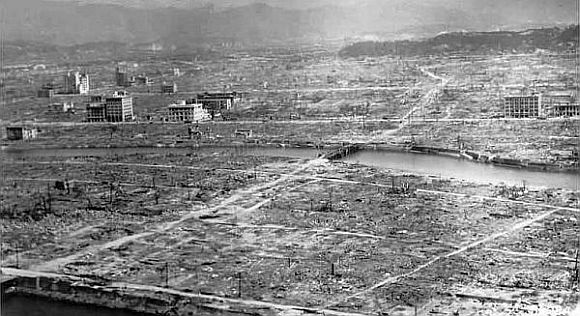
Hiroshima: the original Ground Zero
Whenever questions are raised about the moral justification for destroying Hiroshima and Nagasaki with atomic bombs in 1945, it’s generally assumed that President Truman’s decision to use these weapons was instrumental in ending World War II.
Given the staggering loss of life the war had already brought by that time, it’s hard to avoid imagining that almost any means possible — including the use of nuclear weapons — might have been justifiable if this would result in hastening the end of the war.
Hiroshima was bombed on August 6, 1945. Japan’s surrender was announced by Emperor Hirohito on August 15. For this reason, many Americans think that apologizing for the destruction of these two Japanese cities would make no more sense than wishing that the war had dragged on for longer with even more lives lost.
But in Five Myths about Nuclear Weapons published in 2013, Ward Wilson argues that it was Stalin’s decision to invade Japan — not the use of the bomb — that led to the Japanese surrender.
Wilson points out that while the nuclear attacks on Hiroshima and Nagasaki are typically viewed as extraordinary in the level of destruction they caused, during the U.S. air campaign at that time there was less reason than we imagine to draw a sharp distinction between conventional and nuclear bombing.
In the summer of 1945, the U.S. Army Air Force carried out one of the most intense campaigns of city destruction in the history of the world. Sixty-eight cities in Japan were attacked and all of them were either partially or completely destroyed. An estimated 1.7 million people were made homeless, 300,000 were killed, and 750,000 were wounded. Sixty-six of these raids were carried out with conventional bombs, two with atomic bombs. The destruction caused by conventional attacks was huge. Night after night, all summer long, cities would go up in smoke. In the midst of this cascade of destruction, it would not be surprising if this or that individual attack failed to make much of an impression — even if it was carried out with a remarkable new type of weapon.
Japan’s decision to surrender probably had less to do with the effect of nuclear weapons, than with Stalin’s decision to invade. Wilson writes:
The Japanese were in a relatively difficult strategic situation. They were nearing the end of a war they were losing. Conditions were bad. The Army, however, was still strong and well-supplied. Nearly 4 million men were under arms and 1.2 million of those were guarding Japan’s home islands.
Even the most hardline leaders in Japan’s government knew that the war could not go on. The question was not whether to continue, but how to bring the war to a close under the best terms possible. The Allies (the United States, Great Britain, and others — the Soviet Union, remember, was still neutral) were demanding “unconditional surrender.” Japan’s leaders hoped that they might be able to figure out a way to avoid war crimes trials, keep their form of government, and keep some of the territories they’d conquered: Korea, Vietnam, Burma, parts of Malaysia and Indonesia, a large portion of eastern China, and numerous islands in the Pacific.
They had two plans for getting better surrender terms; they had, in other words, two strategic options. The first was diplomatic. Japan had signed a five-year neutrality pact with the Soviets in April of 1941, which would expire in 1946. A group consisting mostly of civilian leaders and led by Foreign Minister Togo Shigenori hoped that Stalin might be convinced to mediate a settlement between the United States and its allies on the one hand, and Japan on the other. Even though this plan was a long shot, it reflected sound strategic thinking. After all, it would be in the Soviet Union’s interest to make sure that the terms of the settlement were not too favorable to the United States: any increase in U.S. influence and power in Asia would mean a decrease in Russian power and influence.
The second plan was military, and most of its proponents, led by the Army Minister Anami Korechika, were military men. They hoped to use Imperial Army ground troops to inflict high casualties on U.S. forces when they invaded. If they succeeded, they felt, they might be able to get the United States to offer better terms. This strategy was also a long shot. The United States seemed deeply committed to unconditional surrender. But since there was, in fact, concern in U.S. military circles that the casualties in an invasion would be prohibitive, the Japanese high command’s strategy was not entirely off the mark.
One way to gauge whether it was the bombing of Hiroshima or the invasion and declaration of war by the Soviet Union that caused Japan’s surrender is to compare the way in which these two events affected the strategic situation. After Hiroshima was bombed on August 8, both options were still alive. It would still have been possible to ask Stalin to mediate (and Takagi’s diary entries from August 8 show that at least some of Japan’s leaders were still thinking about the effort to get Stalin involved). It would also still have been possible to try to fight one last decisive battle and inflict heavy casualties. The destruction of Hiroshima had done nothing to reduce the preparedness of the troops dug in on the beaches of Japan’s home islands. There was now one fewer city behind them, but they were still dug in, they still had ammunition, and their military strength had not been diminished in any important way. Bombing Hiroshima did not foreclose either of Japan’s strategic options.
The impact of the Soviet declaration of war and invasion of Manchuria and Sakhalin Island was quite different, however. Once the Soviet Union had declared war, Stalin could no longer act as a mediator — he was now a belligerent. So the diplomatic option was wiped out by the Soviet move. The effect on the military situation was equally dramatic. Most of Japan’s best troops had been shifted to the southern part of the home islands. Japan’s military had correctly guessed that the likely first target of an American invasion would be the southernmost island of Kyushu. The once proud Kwangtung army in Manchuria, for example, was a shell of its former self because its best units had been shifted away to defend Japan itself. When the Russians invaded Manchuria, they sliced through what had once been an elite army and many Russian units only stopped when they ran out of gas. The Soviet 16th Army — 100,000 strong — launched an invasion of the southern half of Sakhalin Island. Their orders were to mop up Japanese resistance there, and then — within 10 to 14 days — be prepared to invade Hokkaido, the northernmost of Japan’s home islands. The Japanese force tasked with defending Hokkaido, the 5th Area Army, was under strength at two divisions and two brigades, and was in fortified positions on the east side of the island. The Soviet plan of attack called for an invasion of Hokkaido from the west.
It didn’t take a military genius to see that, while it might be possible to fight a decisive battle against one great power invading from one direction, it would not be possible to fight off two great powers attacking from two different directions. The Soviet invasion invalidated the military’s decisive battle strategy, just as it invalidated the diplomatic strategy. At a single stroke, all of Japan’s options evaporated. The Soviet invasion was strategically decisive — it foreclosed both of Japan’s options — while the bombing of Hiroshima (which foreclosed neither) was not.
In this case, even if the nuclear attacks hastened the end of the war, it may have only been by a matter of a few days or weeks. The assumption that some greater good had been served is much harder to sustain.
At the same time, having already chosen to use these weapons twice and chosen to use them to wipe out civilian populations, the United States was thereafter in a much harder position to assert moral authority in saying that nuclear weapons must never be used again.
When Barack Obama visits Hiroshima later this month, he will make no apology for the destruction of this city. He will again call for global nuclear disarmament, but his appeal won’t carry much weight, given his decision to spend $348 billion on upgrading the U.S. nuclear arsenal over the next decade.
To many observers, Obama’s nuclear aspirations do more than highlight his nuclear hypocrisy:
That declaration rings hollow to critics who believe Obama’s plan to overhaul and upgrade the U.S. nuclear arsenal is sparking a dangerous new arms race with China and Russia. The modernization program, including purchases of new bombers and ballistic missile submarines, could cost as much as $1 trillion over the next 30 years, said Lisbeth Gronlund, co-director of the Union of Concerned Scientists’ Global Security Program.
“The plan to rebuild and refurbish every weapon that we have basically sort of throws the gauntlet down, and Russia and China feel like they have to match it,” Gronlund said in an interview. “He has said really great things but his actions have not really been consistent with his words.”
As the Daily Beast reports, the “post-Cold War nuclear holiday is over” — a new nuclear arms race has already begun.

Russia’s new missile means the nuclear arms race is back on

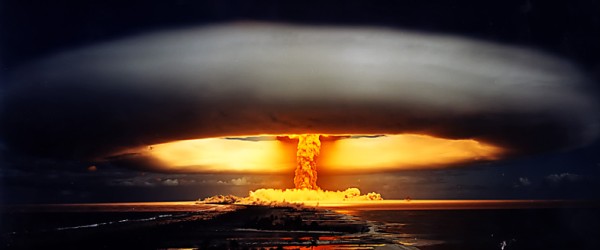
David Axe reports: Russia has a new nuclear missile — one that Zvezda, a Russian government-owned T.V. network, claimed can wipe out an area “the size of Texas or France.”
Actually, no, a single SS-30 rocket with a standard payload of 12 independent warheads, most certainly could not destroy Texas or France. Not immediately. And not by itself.
Each of the SS-30’s multiple independently targetable reentry vehicle warheads, or MIRVs, could devastate a single city. But Texas alone has no fewer than 35 cities of 100,000 people or more.
Which is not to say the instantaneous destruction of a dozen cities and the deaths of millions of people in a single U.S. state wouldn’t mean the end of the world as we know it.
Nobody nukes just Texas. And if Russia is disintegrating Texan cities, that means Russia is also blasting cities all over the United States and allied countries — while America and its allies nuke Russia right back.
Moscow’s arsenal of roughly 7,000 atomic weapons — 1,800 of which are on high alert — and America’s own, slighly smaller arsenal — again, only 1,800 of which are ready to fire at any given time — plus the approximately 1,000 warheads that the rest of the world’s nuclear powers possess are, together, more than adequate to kill every human being on Earth as well as most other forms of life.
One new Russian rocket doesn’t significantly alter that terrible calculus.
But that doesn’t mean you shouldn’t be alarmed. The SS-30 is only the latest manifestation of a worrying trend. After decades of steady disarmament, the United States and Russia are pouring tens of billions of dollars into building new and more capable nuclear weaponry that experts agree neither country needs, nor can afford.
The SS-30 by itself is just slightly more destructive than older Russian missiles. It’s what the new weapon represents that’s frightening. The post-Cold War nuclear holiday is over. And apocalyptic weaponry such as Russia’s new SS-30 are back at work making the world a very, very scary place. [Continue reading…]
How the New York Times Magazine botched its Iran story
Joe Cirincione writes: A devious president and his top aides trick the nation into a dangerous foreign entanglement with the help of a gullible press corps and complicit experts. George W. Bush and war with Iraq? No, Barack Obama and diplomacy with Iran. At least according to David Samuels’ telling in an instantly controversial article for this past Sunday’s New York Times Magazine about White House adviser Ben Rhodes.
Rhodes, whom I know, is very talented, but he is no modern-day Rasputin casting a spell over Obama, the press and public. The truth is that Samuels used his access to Rhodes to attack a deal he never liked and publicly campaigned against.
In his article, Samuels claims Obama was “actively misleading” the public about Iran. He says the president made up a story of how the 2013 election of pragmatic Iranian President Hassan Rouhani created a new opening with Iran. This, so Obama could win “broad public currency for the thought that there was a significant split in the regime.” This, in turn, claims Samuels, allowed Obama to avoid a “divisive but clarifying debate of the actual policy choices” and eliminate the “fuss about Iran’s nuclear program” so that Obama could pursue his real agenda: “a large-scale disengagement from the Middle East.”
Every element of this thesis falls apart under scrutiny.
Obama did not mislead the public about negotiations with Iran. Most of the talks the United States held with Iran under the previous, hard-line President Mahmoud Ahmadinejad were widely reported. Even the secret talks that opened up the engagement with the more pragmatic Rouhani government were disclosed by the dogged reporting of Laura Rozen and others well before the congressional vote last year. And the imagined plot to sell out our Middle East allies to Iran is a common talking point of the far right, without any supporting evidence.
But one of Samuels’ biggest fallacies is his claim that the world’s leading nuclear policy and national security experts were duped by Rhodes, the deputy national security adviser whom Samuels portrays as a digital Machiavelli spinning gullible reporters and compliant experts into accepting a bad deal.
Samuels says this is the only way to explain “the onslaught of freshly minted experts cheerleading for the deal.” He claims that in the spring of 2015, “legions of arms-control experts began popping up at think tanks and on social media and then became key sources for hundreds of often-clueless reporters.”
This is utter nonsense.
In London, Paris, Berlin and Washington the deal was evaluated on its merits, not on spin. Nor did we wait for the White House to fire the starting gun. Ploughshares Fund, the group I head, began our campaign to shut down Iran’s paths to a bomb six years ago. We helped fund a network of experts, advocates, faith leaders, military leaders and diplomats who trade views and coordinate efforts.
Samuels takes a swipe at our work directly, quoting Rhodes as saying, “In the absence of rational discourse, we are going to discourse the [expletive] out of this. … We had test drives to know who was going to be able to carry our message effectively, and how to use outside groups like Ploughshares, the Iran Project and whomever else.” [Continue reading…]