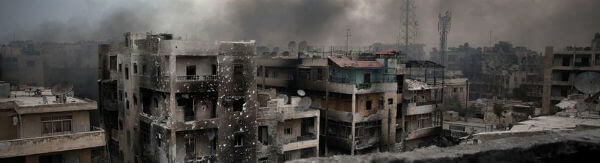
The Telegraph reports: If anywhere can show the consequences of American foreign policy under President Barack Obama, it may be the small town of Marea, north of Aleppo.
In the course of the last five years, it has seen Assad regime tanks roll through from the south, firing shells through its houses.
It has been repeatedly attacked from the east by Islamic State of Iraq and the Levant (Isil). On occasion it has been bombed from the air by the regime and shelled from the ground by Isil on the same day.
Now its rebel defenders are fighting Isil, the regime, Russian bombers, and a new enemy, the Syrian Kurdish militia the YPG, all at once.
America is calling for a ceasefire. But it is not clear whether even if one were declared, it would stop any of those enemies from attacking Marea. [Continue reading…]
Category Archives: Obama administration
In Libya, Obama chose to lead from behind; in Syria it’s now feed from behind
The New York Times reports: Most of the Russian and American aircraft traversing Syria have been warplanes firing missiles and dropping bombs. But under an international agreement to aid Syrians trapped in the fighting, Russian planes will soon be dropping food in an operation partly financed by the United States.
The United Nations World Food Program will start its first airdrops in Syria in coming days, relief officials said Thursday. The main focus is Deir al-Zour, an eastern Syrian city where more than 200,000 inhabitants are ringed by forces of the Islamic State, which has made land access impossible.
Under the emergency aid agreement, truck convoys began supplying food and medicine to five besieged towns in other parts of Syria on Wednesday. Staffan de Mistura, the United Nations special envoy for the Syrian conflict who helped to negotiate the final arrangements, had hinted that airdrops were an option for areas that are unreachable by land.
The World Food Program will use aircraft provided by a Russian contractor for the drops, which are conducted by parachute from high altitudes, said Bettina Luescher, a spokeswoman for the agency. [Continue reading…]
If the U.S. administration wanted to salvage a few crumbs of credibility among the Syrians who it has otherwise deserted, it could have seized this opportunity in public diplomacy — just as the Russians have.
It’s all very well to say that getting aid to those in need is more important than taking credit, but somehow, I doubt very much that U.S. decision-making at this juncture has been guided by humility. Moreover, Russia’s interest in taking the lead is surely guided by its own desire to do exactly what the Assad regime has in its long-running manipulation of UN aid distribution: support it’s military strategy by steering aid towards its own supporters.
Obama might persist in his passive approach to Syria because he sees himself as the choreographer of America’s departure from the Middle East, but walking away is much easier said than done.
Syria has become a global crisis precisely because so many governments and populations outside the conflict thought it could be ignored or viewed calmly from a comfortable distance.
Meanwhile, many of those who in the past argued most vehemently against Western intervention have since become cheerleaders of Russia’s intervention — erstwhile anti-militarists who turn out to be secret admirers of Vladamir Putin’s muscularity.
U.S. strikes ISIS in Libya, more than 40 dead
Reuters reports: U.S. warplanes carried out air strikes against Islamic State-linked militants in western Libya on Friday, killing as many as 40 people in an operation targeting a suspect linked to two deadly attacks last year in neighbouring Tunisia.
It was the second U.S. air strike in three months against Islamic State in Libya, where the hardline Islamist militants have exploited years of chaos following Muammar Gaddafi’s 2011 overthrow to build up a presence on the southern shores of the Mediterranean Sea.
The mayor of the Libyan city of Sabratha, Hussein al-Thwadi, told Reuters the planes struck at 3:30 a.m. (0130 GMT), hitting a building in the city’s Qasr Talil district, home to many foreign workers.
He said 41 people had been killed and six wounded. The death toll could not immediately be confirmed with other officials. [Continue reading…]
The Russian quagmire in Syria and other Washington fairy tales
Michael Kofman writes: Assad is not necessarily winning in Syria. The Russian-led coalition, together with Iran, Hezbollah, and what’s left of the Syrian army, is winning. That is a distinction with an important political difference for Assad to play out at the end of this conflict. While Saudi Arabia and Iran have intractable positions on Assad’s fate, Russia seems much more open-minded on alternative futures, though it will not condone regime change by discussing his removal publicly. It is difficult to see how Russian leaders could count on Syria being stable in the long term under his leadership. They’ve made a much larger political and military stake in the country, and Assad does not look like the man to keep it secure in the long term. Some are certain that Russia will never give up Assad, but who has a good track record in predicting events in the Middle East?
The Geneva negotiations are not just a ploy; Russia needs that settlement eventually in any scenario. It is simple battlefield reality. The more territory the Russian-led coalition regains, the more a political settlement is a necessity. If Assad’s forces could not hold the rapidly dwindling piece of Syria they had left in 2015 how can they defend much larger real estate, together with major cities? The answer is they can’t. We can see how the Assad regime might retake Aleppo, but what’s the plan for holding it along with other cities for the next decade or so? Gaining terrain is one thing, keeping it is another. Assad said he plans to retake the whole country — a dictator can dream. Russia started the negotiations precisely to avoid retracing America’s steps in Iraq and Afghanistan, where military victory is day one of the quagmire to come. Certainly Russian leaders remember the Soviet Union’s own fruitless struggle in Afghanistan. Political settlement is the only way for Russia to lock in any gains in Syria.
If this is so, then why have the Geneva talks been suspended through February, while Russia keeps bombing? The short answer is that the Russian-led coalition is not done capturing the territory they feel must be regained, especially the city of Aleppo, and as a result have no intention of giving rebel groups a respite. Russia’s intervention forced them to the table, but they are not weak enough and some of them Moscow does not want to see in Geneva at all. Aleppo is a hulking ruin, but its fall would be a colossal symbolic defeat. It could split the rebel groups Saudi Arabia worked hard to unite in Riyadh. Russia is pressing its advantage, hoping to secure the major cities for the Syria regime, while leaving the ISIL-held eastern part of the country as an “American problem.” [Continue reading…]
The war of Western failures: Hopes for Syria fall with Aleppo
Der Spiegel reports: Aleppo has been a horrific place for some time now and few thought that it could get much worse. But things can always get worse — that’s the lesson currently being learned by those who have stayed behind in an effort to outlast this brutal conflict. People who have become used to dead bodies in the streets, hunger and living a life that can end at any moment.
“For the last two weeks, we’ve been living a nightmare that is worse than everything that has come before,” says Hamza, a young doctor in an Aleppo hospital. At the beginning, in 2011, he was treating light wounds, stemming from tear gas or beatings from police batons. When the regime began dropping barrel bombs in 2012, the injuries got worse. But now, with the beginning of the Russian airstrikes, the doctors are facing an emergency. Every two or three hours, warplanes attack the city, aiming at everything that hasn’t yet been destroyed, including apartment buildings, schools and clinics. Often, they use cluster bombs, which have been banned internationally.
They used to get around 10 serious injuries per day, but that number has now risen to 50, says Hamza, adding that most of their time is spent sorting body parts so they can turn them over to family members for burial. Russian missiles, he says, tear everyone apart who is within 35 meters of the impact.
“On one day, we had 22 dead civilians. The day before that, it was 20 injured children. A seven-year-old died and an eight-year-old lost his left leg.” The Russians attacked in the morning, he says, as the children were on their way to school. “We are going to need years of therapy in order to be able to cope with all this.”
There are seven doctors still working in the hospital. “Since the Russians began bombing the city, even more doctors have fled,” Hamza says. There are only about 30 medical professionals left in all of Aleppo, he adds. His hospital too is under fire and Hamza’s voice can be heard trembling over the phone. The regime, he says, has targeted the hospital five times in the past several years, but always missed. “The Russian bombardment, though, is very accurate.” One recent bomb, he says, just barely missed them. [Continue reading…]
A Syria policy that dare not speak its name

Michael Ignatieff writes: Once President Barack Obama had let Bashar al-Assad cross his “red line” and use chemical weapons in 2013, America was left with a policy in Syria that dare not speak its name.
The policy is not what the US wants but, in light of the ceasefire plan agreed last week in Munich between Moscow and Washington, it appears to have become what it reluctantly accepts: to allow Mr Assad and Russian president Vladimir Putin to win by focusing attacks on anti-regime rebels in strongholds such as Aleppo — and then, after a decent interval, to join with them to crush the militants of Isis.
The consequences of this policy are becoming clearer by the day: free Aleppo is dying under continuing Russian bombardment and a civilian uprising that began in 2011 is collapsing for want of help. Mr Assad is re-establishing his tyranny and is certain to take vengeance on surviving insurgents.
This is where risk avoidance has led a conscientious, prudent American president — to a diabolical transaction in which he and his allies regretfully sacrifice the lives of innocent civilians in the name of the mistaken belief that the west’s only overriding strategic interest in Syria is the defeat of Isis.
If this is the actual policy of the US the consequences should be spelt out. Russia and Iran will consolidate control of a rump state in the Middle East but the millions of Syrians who have fled the fighting will never return home and the region will never know peace. [Continue reading…]
How Scalia’s death might help our planet
Eric Holthaus writes: Supreme Court Justice Antonin Scalia’s death at a remote Texas ranch has triggered a political earthquake and instantly changes the outlook for a host of high-profile issues the court is currently considering. But perhaps none of these are as consequential as the fate of the planet itself. As Climate Central’s John Upton wrote, “in dying, Scalia may have done more to support global climate action than most people will do in their lifetimes.”
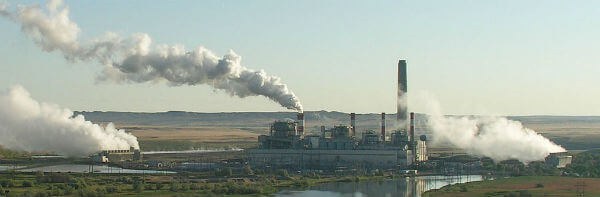
Scalia’s death comes just days after the Supreme Court issued an unprecedented stay that temporarily blocked the implementation of the Clean Power Plan, Obama’s centerpiece climate legislation. The Clean Power Plan isn’t perfect, but it was on pace to double the already accelerating rate of coal-fired power plant retirements by 2040. Last week’s surprising action by the Supreme Court — dubbed a “nightmare scenario” by the Hill — raised substantial fears among environmentalists that the court’s conservatives might eventually block the Clean Power Plan completely. At the very least, the stay buys some time for Republican hopefuls in this year’s presidential election; if one were to win, he could just cancel the executive order that launched the plan in the first place.
The stay is still in place, but the climate law experts I talked to say Scalia’s death greatly boosts the eventual survival chances of the Clean Power Plan. A 4-4 court would guarantee that the lower court ruling would stand—and the D.C. Circuit Court is expected to approve the plan. [Continue reading…]
Obama called Putin and Putin agreed to carry on taking calls from Obama
Following a phone conversation between President Obama and President Putin “to discuss the decisions and agreements made at the February 11 meeting of the International Syria Support Group (ISSG),” the White House said: “The leaders agreed that the United States and Russia will remain in communication on the important work of the ISSG.”
That’s it: they’ll remain in communication.
Obama can stress the importance, emphasize the importance, reiterate the importance, and do as much urging as he wants. To Putin, this is just yada yada yada.
The Washington Post reports: President Obama and Russian President Vladimir Putin have agreed to intensify diplomatic and military cooperation to implement a cease-fire and the delivery of aid in Syria, the Kremlin said early Sunday.
A statement from Putin’s office said that Obama initiated a telephone conversation between the two. The White House, which said the call took place Saturday, did not mention increased U.S.-Russia cooperation but said that Obama stressed the importance “of rapidly implementing humanitarian access to besieged areas.” Obama also urged Putin to cease Russia’s air campaign against “moderate opposition forces” in Syria, according to a White House statement released Sunday.
The call came amid reports that at least one siege had been broken with the first delivery of humanitarian aid to the rebel-held Douma area, east of the Syrian capital of Damascus. Douma had been cut off by government troops since 2013. A United Nations spokesperson said from Geneva, where a task force is organizing aid under an agreement reached Friday in Munich, that the Douma delivery was a previously scheduled shipment by the Syrian Red Crescent. [Continue reading…]
The Syrian government, with Russia’s help, is driving its own people into exile

Roy Gutman reports: The airstrikes began just after midnight one week ago, as four or more warplanes criss-crossed the skies and unleashed missiles into the small town just northwest of Aleppo. The targets were private residences and apartments on the outskirts of Haritan, and then the town center.
The windows in Salah Hawa’s four-room house had already been shattered by an airstrike nearby last month. The latest blasts blew out the nylon sheets used to cover the gaps.
After two days and nights of attacks — possibly 300 missiles or more — Hawa, a 40-year-old English teacher, and his wife and four children, aged 5 to 16, fled to the nearby countryside in a neighbor’s pickup truck.
During one airstrike, his wife, Hasna, 39, lay down, and for an hour, “she couldn’t stand up out of fear,” Hawa recounted in a Skype conversation from northern Syria. “My children clung to me, crying, and said we are going to die.”
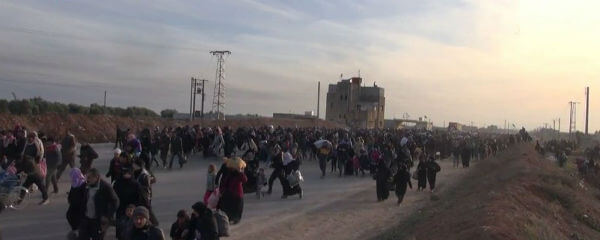
Hawa’s family, multiplied by 10,000, are the face of the latest mass displacement in Syria. They are now living in a village about 30 miles to the west, in Idlib province in a house shared with four other families. Tens of thousands of others displaced by the fighting headed to the closed border with Turkey, where accommodation was even more scarce.
It is the latest evidence of a dramatic shift in the war that began with the Russia air intervention last September 30. Russia claims to be bombing only “terrorists” and has told the Obama administration it is committed to a political settlement. But the real aim of the latest onslaught — which forced the United Nations to suspend peace talks before they even began — could be a lot more menacing.
The airstrikes cleared the way for Lebanon’s Hezbollah militia, Iraqi militias, and Afghan Hazara forces, which are officered by Iran’s Revolutionary Guard Corps and Syrian security forces, to make critical advances on the ground. Now Syrian President Bashar al-Assad is poised to surround Aleppo and besiege some 250,000 civilians living in the rebel-defended eastern sector.
If the military advances continue, Assad soon will also be able to block all military and humanitarian aid now flowing across the border from Turkey. But Assad is also in a position to drive millions of Syrians out of their country into Turkey, which will be hard pressed to stop them from continuing on to Europe. Mass displacement increasingly appears to be the aim of the military operation, and not just a side effect, humanitarian aid officials say.
“The Syrian government is driving its people into exile and the Russians are playing a major part, forcing civilians to Turkey which, caught between this violent exodus and pressure from Europe, risks being destabilized,” said Rae McGrath, head of the Mercy Corps program in Turkey and north Syria. “How can we talk about protecting civilians in the midst of this cynical disregard for the most basic humanitarian principles?” [Continue reading…]
Zachary Laub spoke to Noah Bonsey, senior Syria analyst for the International Crisis Group:
Do these sieges reflect the strategy of the Assad regime?The regime’s military strategy, supported and increasingly embraced by its backers, is based heavily on collective punishment, [which is] especially important given the regime’s manpower disadvantage. This is one of the reasons we see such heavy use of bombing that is not indiscriminate so much as it is discriminately targeting civilian areas and civilian infrastructure. This is also why we see the siege tactics, which in some cases bring rebel[-held] areas to the point of starvation.
As civilians leave areas, regime advances can become easier. These tactics are also applied as a means of raising the price of resistance to the communities as a whole, so that communities pressure the fighters in their area to accept what the regime offers as cease-fire terms, but also, effectively, to surrender.
The Feb. 11 meeting of the International Syria Support Group [ISSG] came as fledgling peace talks in Vienna appeared to be at an impasse. Where do these efforts on a political transition stand?
The political process is based on the premise of U.S.-Russian sponsorship in which the U.S. is the point man rallying the opposition and its backers to a serious negotiating process, and Russia is to do that for the regime side. The reason this current round of the political process is surrounded by such skepticism is that while the U.S. appears enthusiastic—almost desperate—to get some sort of political process moving, Russia appears far less interested in making the process viable at this stage. Russia’s decision to escalate dramatically its aerial attacks on Aleppo—areas with heavy civilian populations—the very day the opposition delegation arrived in Geneva for talks was the latest in a series of indications that Russia is happy to see this political process stall or, potentially, even derail. [Continue reading…]
The Syria ‘ceasefire’ deal is no such thing — it’s cover for the U.S. and Russia
By Scott Lucas, University of Birmingham
Headlines have been declaring a ceasefire in Syria’s conflict. Announced by US secretary of state John Kerry and Russian foreign minister Sergei Lavrov late on February 11, it was greeted as a ray of hope in the floundering efforts to end this seemingly intractable conflict.
What it isn’t, is a ceasefire. The International Syria Support Group (ISSG) – a coalition of 17 nations, among them Russia and the US, the Arab League, the European Union, and the UN – has not in fact used that term, preferring a “cessation of hostilities”. And it isn’t even that: it’s a proposal for a cessation of hostilities, one that will supposedly start soon, but only after a working group has met with representatives of countries supporting the Assad regime and those backing Syria’s opposition.
Nor is it a viable proposal. Instead, it’s best seen as political cover. It covers Kerry, in his remarkably zealous quest to secure the start of a resolution by the end of March, and Russia, in its mission to prop up the Assad regime by bombing the rebels and civilian areas in concert with both Lebanon’s Hezbollah and Iran.
As Europe faces worst crises since World War II, few expect help from Washington
Josh Rogin writes: Europe is facing a convergence of the worst crises since World War II, and the overwhelming consensus among officials and experts here is that the U.S. no longer has the will or the ability to play an influential role in solving them.
At the Munich Security Conference, the prime topics are the refugee crisis, the Syrian conflict, Russian aggression and the potential dissolution of the European Union’s very structure. Top European leaders repeatedly lamented that 2015 saw all of Europe’s problems deepen, and unanimously predicted that in 2016 they would get even worse.
“The question of war and peace has returned to the continent,” German Foreign Minister Frank-Walter Steinmeier told the audience, indirectly referring to Russian military interventions. “We had thought that peace had returned to Europe for good.”
What was missing from the conference speeches and even the many private discussions in the hallways, compared to previous years, was the discussion of what Europe wanted or even expected the U.S. to do. [Continue reading…]
Russia warns of new Cold War as east Ukraine violence surges and the U.S. is outmaneuvered in Syria
The Washington Post reports: Violence in eastern Ukraine is intensifying and Russian-backed rebels have moved heavy weaponry back to the front line, international monitors warned Saturday, as Moscow responded by accusing the West of dragging the world back 50 years.
Russian Prime Minister Dmitry Medvedev described East-West relations as having “fallen into a new Cold War” and said NATO was “hostile and closed” toward Russia, in the latest sign that peace efforts have made scant progress almost two years since Moscow annexed Crimea.
“I sometimes wonder — are we in 2016 or 1962?” Medvedev asked in a speech to the Munich Security Conference on Saturday.
Western governments say they have satellite images, video and other evidence to show that Russia is providing weapons to the Ukrainian rebels and that Moscow has troops engaged in the conflict. Russia denies such accusations. [Continue reading…]
The Observer reports: Moscow is back as a big player in the Middle East, while Washington looks humbled, a shadow of the great power that once dominated events in the region. The cold war is back, as the Russian prime minister, Dmitry Medvedev, said on Saturday – and for now Russia seems to be in the ascendancy.
Critics warned from the day the ceasefire was announced that Moscow had outmaneuvered Washington and was simply using the negotiations and the deal to consolidate gains, a tactic honed by Russian forces in Ukraine.
The US may have lost more than political capital. The ceasefire risks costing them the trust of the few moderate opposition groups left on the ground, who feel abandoned by a country that promised support.
“The people that the Americans had been trying to sponsor are now targets of an enemy that bombs without mercy or discretion, and the Americans don’t have a problem with that?” said one Free Syrian Army member in Aleppo, who declined to be named. “They never deserved our trust.”
Russia, by contrast, has doubled down on Assad. Around the time Lavrov was handing down his grim prognosis for the ceasefire, a missile cruiser left the naval base in Sevastopol in Crimea. It was heading towards the Mediterranean to join the Russian fleet there, a public shoring up of an already strong military presence. Refugees who had recently fled Isis rule said that the failure to challenge Assad and Russia could even put the west’s main goal in Syria – the routing of Isis – at risk. If other opposition groups are driven out, it will shore up the claim of Isis to be champions of the country’s Sunnis. “You will not find anyone in this camp, especially those who have arrived this month, who supports Isis,” said the man, who gave his name only as Jameel. “But most of them accept that at least they tried to protect us, Syrian Sunnis, who the world has abandoned. It is very dangerous to let them fill this role. And I think the world is blind to the immorality of it.” [Continue reading…]
Russia agrees to ‘ceasefire’ during which it will continue bombing Syria
Syria Deeply reports: World powers agreed Friday to the “cessation of hostilities” in Syria in one week and to redouble efforts to deliver humanitarian aid to civilians across the country, but failed to secure a nationwide ceasefire or an end to Russian bombing.
U.S. Secretary of State John Kerry announced the deal in Munich shortly after a marathon meeting with top diplomats from more than a dozen countries, including Russia, to push forward a ceasefire deal and to resurrect peace talks that collapsed last week.
“First, we have agreed to accelerate and expand the delivery of humanitarian aid beginning immediately,” Kerry told reporters.
“Second, we have agreed to implement a nationwide cessation of hostilities to begin in a target of one week’s time. That’s ambitious, but everybody is determined to move as rapidly as possible to try to achieve this.”
Kerry was quick to acknowledge that the meeting produced commitments on paper only.
“What we need to see in the next few days are actions on the ground, in the field,” he said, adding that “without a political transition, it is not possible to achieve peace.”
Russian foreign minister Sergei Lavrov said that Moscow would not halt its air raids in Syria, saying the cessation of hostilities did not apply to the Islamic State group (ISIS) and the al-Nusra Front, the al-Qaida affiliate in Syria.
Diplomats from the U.S. and the E.U. have said very few of Russia’s air raids have targeted Islamic extremist groups; instead, they have primarily targeted western-backed rebel groups seeking to oust President Bashar al-Assad. [Continue reading…]
The Washington Post reports: Russian warplanes resumed their bombardment of rebel positions across Syria within hours of the deal, striking areas in the countryside around the northern city of Aleppo in support of a 10-day-old government offensive to lay siege to the city.
In Brussels, Russian Foreign Minister Sergei Lavrov told reporters that Moscow would continue its attacks against groups including the Islamic State.
The Russians have repeatedly said that they consider a number of Islamist groups fighting within the opposition to be “terrorist,” and have used this formulation to justify air attacks that have largely targeted the anti-Assad opposition.
Under the agreement, the United States and Russia will chair a task force to adjudicate questions about where and when bombing is permitted. But it remains unclear how those decisions will be made. [Continue reading…]
U.S. State Department: Statement of the International Syria Support Group
Meeting in Munich on February 11 & 12, 2016, as the International Syria Support Group (ISSG), the Arab League, China, Egypt, the EU, France, Germany, Iran, Iraq, Italy, Jordan, Lebanon, the Organization of Islamic Cooperation, Oman, Qatar, Russia, Saudi Arabia, Turkey, United Arab Emirates, the United Kingdom, the United Nations, and the United States decided that humanitarian access will commence this week to besieged areas, and an ISSG task force will within one week elaborate modalities for a nationwide cessation of hostilities. [Continue reading…]
Aleppo airlift: Maybe the U.S. has not run out of options in Syria

After I posed the question, can the U.S. take action to protect Aleppo? a reader reasonably asked: What would a productive engagement look like? Indeed.
For several years, the off-the-shelf answer to this question has included imposing a no-fly zone. The frequency with which this option has been proposed — and then ignored or dismissed — has undermined its credibility. Even so, it’s worth remembering that the northern no-fly zone enforced following the First Gulf War in 1991 provided the basis for the development of enduring Kurdish self-rule in what has since become the most stable part of Iraq. American actions in the Middle East are not always destined to make things fall apart.
The U.S. and its allies could have imposed a no-fly zone in Syria. But President Obama delayed long enough for that option to get knocked off the table by Vladimir Putin.
The latest high-profile proponents of a no-fly zone, Michael Ignatieff and Leon Wieseltier, seem to be engaged in an exercise in wishful thinking.
I don’t doubt that their outrage over American inaction is heartfelt. Even so, they gloss over the fact that since Russia now controls Syrian airspace, there isn’t the faintest chance the Obama administration would be willing to try and impose a no-fly zone because — as officials keep on saying — the U.S. isn’t going to risk starting World War Three.
Does that mean, therefore, that U.S. Syria policy now rests in the hands of John Kerry and his efforts to breath life into a political track — an approach that has little more vitality than the Middle East peace process? If that’s true, then the conventional wisdom is probably right: nothing can be done.
Dualistic thinking is always convenient. Debate gets simplified if we only have to weigh up two options. Other options are easy to marginalize, not necessarily because they are unworthy of consideration but because the debate risks becoming open-ended if too much gets brought to the table. Thus the current debate has largely been reduced to military action versus diplomacy and with the former ruled out, Kerry ends up as the embodiment of U.S. Syria policy. Unfortunately for him, diplomatic successes are much harder to accrue than frequent flier miles — especially when the U.S. has no bargaining power.
The Russians now say that they intend to carry on bombing Syria through the rest of this month while proposing a truce in March. Translated into plain English, that means they will continue bombing until their current military objectives have been accomplished.
Russia’s UN Ambassador Vitaly Churkin says that their airstrikes are being conducted in a “transparent manner” and says Russia’s critics are politically exploiting humanitarian issues.
“They rather crudely use humanitarian matters in order to play, we believe, a destructive role as far as the political process is concerned,” he says.
So this is Russia’s position: It claims it’s military actions are constructive while it accuses the proponents of diplomacy of undermining the political process.
No one should be in any doubt: for Assad and his powerful allies, Geneva is now just a sideshow — a useful distraction and an occasional stage for diplomatic games.
With no military options and no effective diplomacy, it’s easy to see why so many have concluded that nothing can be done.
But there’s never nothing…
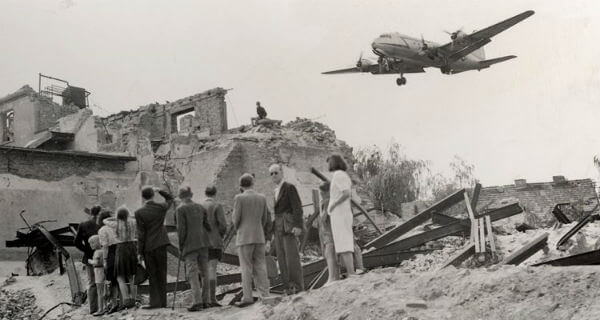
In 1948, having as many as one million soldiers based in Germany, the Soviet Union tightened a blockade around Berlin. At that time, the U.S. had 31,000 combat troops in West Germany. It seemed very reasonable to conclude that there was nothing the West could do to prevent the whole of Berlin coming under the control of the Soviets. The only way of preventing that outcome was to break the blockade and launch an airlift, unprecedented in scale.
The airlift began on June 24 and was anticipated to run for three weeks. The Communist press in East Berlin mocked the project, describing it as “the futile attempts of the Americans to save face and to maintain their untenable position in Berlin.”
Over the following weeks and months, the U.S., Britain, and France, succeeding in delivering up to 6,000 tons of supplies every day, as a result of which on May 12, 1949, the Soviets lifted the blockade. The operation continued through the end of September in order to amass a sufficient stockpile of supplies in the event that the airlift needed to be restarted.
In the course of the airlift’s operation, 2,326,406 tons of supplies were carried on 278,228 flights. And this was at a time that Europe was still weighed down by the economically crippling effects of World War Two.
The cost of the Berlin airlift was equivalent to less than the United States gives to Israel each year in military aid.
In August 2014, President Obama was persuaded to intervene in Iraq to provide humanitarian assistance to 40,000 Yazidis, trapped in the Sinjar Mountains, under threat from ISIS. The operation continued for a few days and the Yazidis were led to safety by Kurdish fighters from the PKK and YPG. This wasn’t reminiscent of 1948, but it was an emergency response.
At times of crisis the U.S. has often shown its willingness and capacity to make constructive interventions. (Acknowledging that fact doesn’t require we ignore America’s destructive impact on the world.)
What the U.S. did in Berlin and the Sinjar Mountains does not offer a template for humanitarian operations in Syria, although it might suggest new ways to consider the application of military resources to serve humanitarian goals.
Obama might be unwilling to risk direct conflict between American and Russian fighter jets patrolling the same skies, but when the U.S. started sending cargo planes into Berlin, in was on the assumption that the Soviets would not risk a war by attacking non-combatant aircraft. The same principle could apply to Syria. Whatever Churkin claims, delivering food, clothing, and medicine to those in need is a legitimate humanitarian endeavor.
UN Resolution 2165 was passed with Russia’s support to “ensure that humanitarian assistance, including medical and surgical supplies, reaches people in need throughout Syria through the most direct routes,” but the UN’s ability to make good on that promise is currently being obstructed by both Russia and the Assad regime.
Moreover, the UN has increasingly come under fire from Syrians who see humanitarian aid being used to support the Assad regime. “For many of us in Syria, the UN has turned from a symbol of hope into a symbol of complicity,” besieged Syrians wrote in a letter to Stephen O’Brien, the UN Undersecretary for Humanitarian Affairs.
There are cities across Syria under siege with populations facing starvation. If the U.S. was to start humanitarian airlift operations whose scope might initially be quite limited, it would send several important messages:
- Assad’s policy of siege warfare will not continue unchallenged
- The West has not turned its back on those Syrians now facing starvation
- Russia is not being given a free hand in shaping Syria’s future
This isn’t a political solution for the war in Syria and the logistical challenges would be huge, but facing emergencies has more to do with the willingness to act than it has with being able to construct the perfect plan.
Discovering what is possible often requires ignoring the many ways in which one risks failing. If the Berlin airlift had been proposed on the assumption that it would need to continue for 15 months, it would most likely have been dismissed as impossible and never undertaken.

Can the U.S. take action to protect Aleppo?

Michael Ignatieff and Leon Wieseltier write: Aleppo is an emergency, requiring emergency measures. Are we no longer capable of emergency action? It is also an opportunity, perhaps the last one, to save Syria. Aleppo is the new Sarajevo, the new Srebrenica, and its fate should be to the Syrian conflict what the fate of Sarajevo and Srebrenica were to the Bosnian conflict: the occasion for the United States to bestir itself, and for the West to say with one voice, “Enough.” It was after Srebrenica and Sarajevo — and after the air campaign with which the West finally responded to the atrocities — that the United States undertook the statecraft that led to the Dayton accords and ended the war in Bosnia.
The conventional wisdom is that nothing can be done in Syria, but the conventional wisdom is wrong. There is a path toward ending the horror in Aleppo — a perfectly realistic path that would honor our highest ideals, a way to recover our moral standing as well as our strategic position. Operating under a NATO umbrella, the United States could use its naval and air assets in the region to establish a no-fly zone from Aleppo to the Turkish border and make clear that it would prevent the continued bombardment of civilians and refugees by any party, including the Russians. [Continue reading…]
Any military strategy that’s designed “to recover our moral standing” is dubious — and not simply because there are those who doubt that the U.S. possessed much the moral standing in the first place.
The effectiveness of a military strategy can’t be assessed on the basis of the worthiness of its non-military goals.
The authors in their sweeping assertion that they are offering “a perfectly realistic path,” dodge the awkward details on how this would work.
Are they assuming that once the boundaries of this no-fly zone had been defined, Russian and Syrian aircraft would then obediently comply?
Or do they assume that as soon as a few jets had been shot down the intended lesson would have swiftly been learned?
Turkey already shot down a Russian jet on the edge of this arena. What lessons, if any, have been drawn from that incident and are they now being applied to this future scenario?
“If the Russians and Syrians sought to prevent humanitarian protection and resupply of the city, they would face the military consequences,” we are told by the armchair generals.
“Military consequences” is a phrase of political bluster — especially when coming from two writers who profess no military expertise. If pressed to spell out what these military consequences might be, I expect Ignatieff and Wieseltier would defer to the actual generals.
My point here is not to dismiss the idea that at this late hour there might be a constructive military intervention in Syria, but simply to say that such an argument needs more detail and substance and fewer passionate declarations. It needs to credibly show how this would work rather than simply why it should be undertaken.
Currently, Obama administration officials are cynically curtailing all discussion about their military options by claiming that they only have two choices: start World War III or do essentially nothing (beyond repeating their mantra that their is no military solution in Syria).
“What do you want me to do, go to war with Russia?” John Kerry is reported to have asked a Syrian NGO representative in London last week.
The choice is false but it is gladly being picked up by ideological anti-interventionists who are attracted by the rhetorical utility of this device when offered to those who have little interest in questioning its validity.
To those who insist on framing this crisis in terms of World War III, I would ask two questions: What makes you think it hasn’t already begun? And why do you think its defining attribute necessarily involves a clash between the U.S. and Russia?
A world war involves global instability and a contagion of violent conflict. There are active conflicts in Pakistan, Afghanistan, Yemen, Iraq, Syria, Turkey, Egypt, and Libya. There is unrest in Saudi Arabia, Bahrain, Palestine, Israel, and elsewhere.
As the EU struggles to handle the refugee crisis, European unity is being fractured, placing its future in jeopardy.
If through the power of inattention, Americans could indeed successfully insulate themselves from the effects of global strife, then perhaps this could endure as a land of blissful ignorance.
Instead, what is more predictable is that the more disengaged the U.S. becomes, the less influence it will have and the fewer options it can consider.
No one will benefit from America’s self-imposed paralysis.
France’s Fabius accuses U.S. of ‘ambiguous’ Syria policy
Reuters reports: French Foreign Minister Laurent Fabius on Wednesday questioned the commitment of the United States to resolving the crisis in Syria, saying its “ambiguous” policy was contributing to the problem.
“There are ambiguities, including among the actors of the coalition … I’m not going to repeat what I’ve said before about the main pilot of the coalition,” Fabius told reporters, in a clear reference to the United States.
“But we don’t have the feeling that there is a very strong commitment that is there.” [Continue reading…]
Syrian opposition see Obama’s support having been worthless
The New York Times reports: The United States and its allies have spent many millions of dollars backing Syrian opposition fighters they deem relatively moderate and secular, and civilian groups whose work on small businesses and local councils they billed as the cornerstone of Syria’s future.
But the very Syrians who benefited — and risked their lives in the process — now say that investment is in danger of going down the drain, and they see little urgency from Washington, diplomatic or military, to save it.
“What are you going to do, other than statements?” Zakaria Malahifji, the political chief of one of the largest rebel groups given weapons and salaries by the C.I.A. and its counterparts in several European and Arab states, demanded in a recent message to contacts at the French Embassy.
In nearly five years of war and insurrection, many Syrians have been repeatedly disillusioned by what they saw as a mismatch between tough American rhetoric against the Syrian government and comparatively modest efforts to aid some of its opponents. President Obama said President Bashar al-Assad must go, and drew a red line over the use of chemical weapons, but backed off on both, diminishing anti-government Syrians’ trust.
But the confusion and despair has reached a new level over the last week, as forces backing Mr. Assad have pushed farther north into Aleppo Province, sending tens of thousands of new refugees to the Turkish border. With insurgent groups losing troops and territory, their villages shattered by Russian warplanes, civilians and fighters have in recent days used phrases like “no hope,” “it’s finished” and “it’s over.”
“Bye-bye, revolution,” Abu al-Haytham, a spokesman for Thuwwar al-Sham, another rebel group supported through the C.I.A. program, said in a text message on Friday from Tal Rifaat, a town in northern Aleppo that is increasingly threatened by the government advance.
American-backed insurgents have long been used to the American stance in recent years, that the United States did not want them to actually win the war — lest a sudden toppling of Mr. Assad lead to Islamist rule — but wanted to prevent them from losing for long enough to pressure the government to negotiate for a political solution.
Now they fear that the United States and its allies may actually let them lose. [Continue reading…]
The Supreme Court halted Obama’s climate change plan. This doesn’t bode well

Scott Lemieux writes: Hours before New Hampshire’s primary voters made Donald Trump the favorite for the Republican presidential nomination Tuesday night – I can’t really believe this even as I type it – the US supreme court reminded us of why the upcoming presidential election is so important. On a party-line vote, the court temporarily stopped Barack Obama’s clean power plan from going into effect. This decision could well portend a future one that will have devastating consequences – not only for the climate but for the state of our lawmaking process.
The decision also underscores the urgency of the November elections in two ways: it will be a choice between a candidate who supports taking action against climate change and one who believes it should be ignored, and it will present a choice between a president who believes that the federal government has the authority to effectively regulate and one who believes that the supreme court should arbitrarily throw monkey wrenches into the political process. [Continue reading…]