The Wall Street Journal reports: President Barack Obama announced two years ago he would curtail eavesdropping on friendly heads of state after the world learned the reach of long-secret U.S. surveillance programs.
But behind the scenes, the White House decided to keep certain allies under close watch, current and former U.S. officials said. Topping the list was Israeli Prime Minister Benjamin Netanyahu.
The U.S., pursuing a nuclear arms agreement with Iran at the time, captured communications between Mr. Netanyahu and his aides that inflamed mistrust between the two countries and planted a political minefield at home when Mr. Netanyahu later took his campaign against the deal to Capitol Hill.
The National Security Agency’s targeting of Israeli leaders and officials also swept up the contents of some of their private conversations with U.S. lawmakers and American-Jewish groups. That raised fears — an “Oh-shit moment,” one senior U.S. official said — that the executive branch would be accused of spying on Congress.
White House officials believed the intercepted information could be valuable to counter Mr. Netanyahu’s campaign. They also recognized that asking for it was politically risky. So, wary of a paper trail stemming from a request, the White House let the NSA decide what to share and what to withhold, officials said. “We didn’t say, ‘Do it,’ ” a senior U.S. official said. “We didn’t say, ‘Don’t do it.’ ”
Stepped-up NSA eavesdropping revealed to the White House how Mr. Netanyahu and his advisers had leaked details of the U.S.-Iran negotiations — learned through Israeli spying operations — to undermine the talks; coordinated talking points with Jewish-American groups against the deal; and asked undecided lawmakers what it would take to win their votes, according to current and former officials familiar with the intercepts. [Continue reading…]
Category Archives: Obama administration
Could an end to Syria’s civil war be in sight?
By James L Gelvin, University of California, Los Angeles
If, as cliché has it, the definition of insanity is doing the same thing over and over and expecting different results, isn’t the recent flurry of diplomatic activity aimed at bringing about a negotiated settlement to the Syrian civil war insane?
None of the previous attempts to resolve the conflict among the warring parties through negotiations, such as the Geneva II talks in the beginning of 2014, has had a happy ending. And, in retrospect most observers would go so far as to say that they were doomed to failure.
But if, until now, there was zero chance for all principals, both external and internal, to work out a settlement, there currently exists a slender – a very slender – chance for success.
This is the straw at which Secretary of State John Kerry is grasping on the eve of talks in New York.
U.S. sees key goals met for Russia with bearable costs in Syria so far

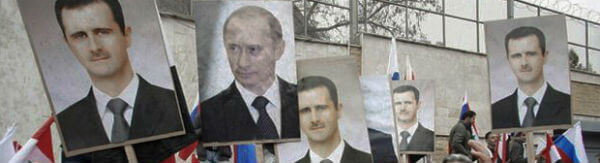
Reuters reports: Three months into his military intervention in Syria, Russian President Vladimir Putin has achieved his central goal of stabilizing the Assad government and, with the costs relatively low, could sustain military operations at this level for years, U.S. officials and military analysts say.
That assessment comes despite public assertions by President Barack Obama and top aides that Putin has embarked on an ill-conceived mission in support of Syrian President Bashar al-Assad that it will struggle to afford and that will likely fail.
“I think it’s indisputable that the Assad regime, with Russian military support, is probably in a safer position than it was,” said a senior administration official, who requested anonymity. Five other U.S. officials interviewed by Reuters concurred with the view that the Russian mission has been mostly successful so far and is facing relatively low costs.
The U.S. officials stressed that Putin could face serious problems the longer his involvement in the more than four-year-old civil war drags on.
Yet since its campaign began on Sept. 30, Russia has suffered minimal casualties and, despite domestic fiscal woes, is handily covering the operation’s cost, which analysts estimate at $1-2 billion a year. The war is being funded from Russia’s regular annual defense budget of about $54 billion, a U.S. intelligence official said. [Continue reading…]
Pentagon thwarts Obama’s effort to close Guantanamo
Reuters reports: In September, U.S. State Department officials invited a foreign delegation to the Guantanamo Bay detention center to persuade the group to take detainee Tariq Ba Odah to their country. If they succeeded, the transfer would mark a small step toward realizing President Barack Obama’s goal of closing the prison before he leaves office.
The foreign officials told the administration they would first need to review Ba Odah’s medical records, according to U.S. officials with knowledge of the episode. The Yemeni has been on a hunger strike for seven years, dropping to 74 pounds from 148, and the foreign officials wanted to make sure they could care for him.
For the next six weeks, Pentagon officials declined to release the records, citing patient privacy concerns, according to the U.S. officials. The delegation, from a country administration officials declined to identify, canceled its visit. After the administration promised to deliver the records, the delegation traveled to Guantanamo and appeared set to take the prisoner off U.S. hands, the officials said. The Pentagon again withheld Ba Odah’s full medical file.
Today, nearly 14 years since he was placed in the prison and five years since he was cleared for release by U.S. military, intelligence and diplomatic officials, Ba Odah remains in Guantanamo. [Continue reading…]
U.S. foreign arms deals surge by 35% in 2014
The New York Times reports: Foreign arms sales by the United States jumped by almost $10 billion in 2014, about 35 percent, even as the global weapons market remained flat and competition among suppliers increased, a new congressional study has found.
American weapons receipts rose to $36.2 billion in 2014 from $26.7 billion the year before, bolstered by multibillion-dollar agreements with Qatar, Saudi Arabia and South Korea. Those deals and others ensured that the United States remained the single largest provider of arms around the world last year, controlling just over 50 percent of the market.
Russia followed the United States as the top weapons supplier, completing $10.2 billion in sales, compared with $10.3 billion in 2013. Sweden was third, with roughly $5.5 billion in sales, followed by France with $4.4 billion and China with $2.2 billion.
South Korea, a key American ally, was the world’s top weapons buyer in 2014, completing $7.8 billion in contracts. It has faced continued tensions with neighboring North Korea in recent years over the North’s nuclear weapons program and other provocations. The bulk of South Korea’s purchases, worth more than $7 billion, were made with the United States and included transport helicopters and related support, as well as advanced unmanned aerial surveillance vehicles.
Iraq followed South Korea, with $7.3 billion in purchases intended to build up its military in the wake of the American troop withdrawal there. [Continue reading…]
Guantánamo Bay lawyers call bluff on Obama’s promise to close prison
The Guardian reports: Lawyers representing Guantánamo Bay detainees who have been held at the camp in Cuba for up to 14 years without charge or trial have accused President Obama of stalling on his promise to close the military prison.
As the US president enters his final year in office, pressure is mounting on him to stand by his pledge to shut down the detention center by the time he leaves the White House. Numerous defense lawyers working directly with Guantánamo detainees have told the Guardian that they hold Obama and his senior officials personally responsible for the lack of action.
Obama made his vow to close Guantánamo within a year on his second day in the White House in 2009. In recent months, he has stepped up the rhetoric, promising to redouble efforts to close the prison while also heavily criticising the Republican-controlled Congress for blocking moves to transfer prisoners out of the prison to the US mainland. [Continue reading…]
Refugees who had fled from murderers and drought will be forced to return home
The Washington Post reports: The Department of Homeland Security has begun preparing for a series of raids that would target for deportation hundreds of families who have flocked to the United States since the start of last year, according to people familiar with the operation.
The nationwide campaign, to be carried out by U.S. Immigration and Customs Enforcement (ICE) agents as soon as early January, would be the first large-scale effort to deport families who have fled violence in Central America, those familiar with the plan said. More than 100,000 families with both adults and children have made the journey across the southwest border since last year, though this migration has largely been overshadowed by a related surge of unaccompanied minors.
The ICE operation would target only adults and children who have already been ordered removed from the United States by an immigration judge, according to officials familiar with the undertaking, who spoke on the condition of anonymity because planning is ongoing and the operation has not been given final approval by DHS. The adults and children would be detained wherever they can be found and immediately deported. The number targeted is expected to be in the hundreds and possibly greater.
The proposed deportations have been controversial inside the Obama administration, which has been discussing them for several months. DHS Secretary Jeh Johnson has been pushing for the moves, according to those with knowledge of the debate, in part because of a new spike in the number of illegal immigrants in recent months. Experts say that the violence that was a key factor in driving people to flee Central America last year has surged again, with the homicide rate in El Salvador reaching its highest level in a generation. A drought in the region has also prompted departures. [Continue reading…]
The British Muslim family’s refused entry reveals America’s hypocrisy
Ali Gharib writes: The Mahmood family’s ordeal at Gatwick airport in London, where the Disneyland-bound group of 11 UK citizens was pulled out of the boarding line by American officials and had their tickets cancelled, speaks to more than just the apparent institutional prejudices of the American government’s security measures.
Also laid bare are the paradoxes of the fight over Islamophobia here at home. How can we ask Muslim communities the world over – including in the US – to forcefully reject the extremists among them and, more onerously, reveal themselves as the peace-loving people they are when at the same time we fail to treat them this way at our borders?
After the San Bernardino, California, attack, where armed assailants took the lives of 14 innocent people after reportedly being radicalized, Barack Obama demanded that Muslims take on more responsibility in the ideological fight against terrorists.
There is no, Obama said,
denying the fact that an extremist ideology has spread within some Muslim communities. This is a real problem that Muslims must confront, without excuse. Muslim leaders here and around the globe have to continue working with us to decisively and unequivocally reject the hateful ideology that groups like [the Islamic State] and al-Qaida promote; to speak out against not just acts of violence, but also those interpretations of Islam that are incompatible with the values of religious tolerance, mutual respect and human dignity.
That’s a nice thought. But how can one ask that of Muslims when one arbitrarily denies them entry to our country on the apparent basis of little more than their religion? Mutual respect and human dignity are not words that spring to mind when considering the recent spate of seemingly arbitrary denials of entry that barred British Muslims seeking to do no more than visit the US. [Continue reading…]
U.S. pursued secret contacts with Assad regime for years
The Wall Street Journal reports: At the center of that effort was a businessman and confidante of Mr. Assad, Khaled Ahmad, who has served as the Syrian leader’s main interlocutor in recent years with Western officials, including U.S. diplomats. Mr. Ahmad didn’t respond to questions sent by The Wall Street Journal.
“Assad was looking for ways to talk to the White House,” said Joshua Landis, a Syria expert and professor at the University of Oklahoma. Mr. Ahmad, a businessman from Homs province, was his point man.
In late 2013, the former ambassador to Damascus Mr. Ford—then a special administration envoy on Syria—met Mr. Ahmad in Geneva ahead of planned peace talks there. Mr. Ford told Mr. Ahmad the U.S. was still seeking a political transition away from Mr. Assad’s rule.
Mr. Ahmad countered that the U.S. and the West should help the Syrian government fight terrorism.
The rise of Islamic State in 2013 caught the U.S. administration off guard. Mr. Assad found in it a better opening to position himself as a partner in a fight against terror consuming the region, and rippling to the West.
By 2014, when the U.S. expanded airstrikes against the militants from Iraq to Syria, State Department officials were making phone calls to their counterparts at the Syrian foreign ministry to make sure Damascus steered clear of U.S. jets in Syrian skies, U.S. officials and others familiar the communications said.
Today, when Washington wants to notify Damascus where it is deploying U.S.-trained Syrian fighters to battle Islamic State so the fighters aren’t mistaken for rebels, Samantha Power, the U.S. envoy to the U.N., dispatches a deputy to talk to the Syrian envoy, Bashar Jaafari, these people said.
The White House says the notifications are not collaboration with the regime. But Mr. Assad has used them to his advantage.
“The regime was re-legitimized,” said Ibrahim Hamidi, a Syrian journalist who until 2013 ran the Damascus bureau for Al Hayat, a major pan-Arab newspaper. “Any communication with the U.S.—even the perception of it—gives them the upper hand.” [Continue reading…]
Saudi-led war in Yemen frays ties with the U.S.
The New York Times reports: The United States on Tuesday sponsored a United Nations Security Council session intended to draw attention to the dire consequences of the war in Yemen, but the meeting also raised questions about potential crimes committed by a Saudi-led military offensive that the Pentagon actively supports.
The United States refuels military jets and provides intelligence support to the military coalition, led by Saudi Arabia, that is trying to defeat Houthi insurgents in Yemen. Since those airstrikes began in March, more than 2,700 civilians have been killed, dozens of schools and hospitals have been attacked and the United Nations has warned of breaches of international law.
But during the session on Tuesday, the United Nations’ top human rights official said that the Saudi-led coalition bore the greatest responsibility for the civilian carnage. The official, Zeid Ra’ad al-Hussein, the high commissioner for human rights, said that while both sides in the conflict had engaged in attacks on civilians, “a disproportionate amount appeared to be the result of airstrikes carried out by coalition forces.”
The United Nations deputy emergency relief chief, Kyung-wha Kang, also warned of the suffering inflicted on civilians by the war, pointing out that two million Yemenis were malnourished and that the country’s health system “is close to collapse.”
All that has placed the United States in an awkward diplomatic tangle. But the fact that American officials invited Mr. al-Hussein to brief the Council on Tuesday was an indication that cracks in the relationship between the United States and Saudi Arabia are beginning to show. [Continue reading…]
Assad is reaching out to Washington insiders
Josh Rogin writes: Early this year, a former top White House official secretly went to Damascus and met with leaders of the Syrian regime. The visit is part of a broader effort by the Syrian government to reach out to Washington’s power brokers and gain influence.
The former official, Steven Simon, served as the National Security Council senior director for Middle Eastern and North African affairs from 2011 to 2012. He has not publicly disclosed his trip, but two senior Obama administration officials said he was not acting as a back channel between the two governments. He traveled there as a private citizen and was representing only himself. The officials said he met with the Syrian president, Bashar al-Assad.
Simon had been a paid consultant at the Middle East Institute, but the think tank ended their relationship after he made the Syria trip. Two employees there told me that the institute did not want to be associated with the trip, which they did not organize and were not consulted about.
Simon declined to comment for this article. MEI also declined to comment. Several Syria scholars who were aware of this visit told me that the trip was part of Assad’s broader recent outreach to Washington scholars and officials.
The timing of Assad’s courting of Washington’s elite makes sense. The Obama administration has been slowly altering its long-held stance that Assad must give up power immediately to make way for a transitional government in Syria and the end of the long civil war. Just last week, the U.S. endorsed a United Nations Security Council resolution that would establish an 18-month transition process during which Assad could stay as Syria’s president and even run for elections sometime in 2017. [Continue reading…]
Syria and surrealism

Muhammad Idrees Ahmad writes: Wishful thinking is the essence of Barack Obama’s Syria policy. In lieu of decisive action, the president opted for brave words. He has drawn red lines that he wasn’t willing to enforce. With no strategic interests at stake, he saw no reason to expend resources on mere humanitarian concerns. In an explicit break with the past decade’s neoconservative interventionism, he has chosen a policy of “realist” restraint.
This amoral policy of malleable principles and unsentimental reserve should warm the heart of any “realist.” But a recent issue of The New York Times carries a curious indictment by two luminaries of the “realist” school: Stephen Walt of Harvard and Gordon Adams of the American University. The authors deride Obama for basing his Syria policy on a wish and a prayer: “A wish that President Bashar al-Assad would leave and a prayer that the ‘moderate’ Syrian opposition would be more than it is.”
It would be brave for “realists” to admit that their prescriptions yielded a disaster: absent a deterrent, Assad bombed his opponents with impunity; the repression and slaughter precipitated a mass exodus; and with the US a mere spectator, Russia and Iran stepped in to shore up their ally. Meanwhile ISIS remains entrenched and blowback has reached Western capitals.
But “realists,” like their neoconservative counterparts, rarely admit error. They can, however, be relied upon to compound mistakes. [Continue reading…]
Russia endorsed and then immediately violated the UN resolution on Syria
An editorial in the Washington Post begins: The UN Security Council unanimously passed a resolution Friday demanding that “all parties immediately cease any attacks against civilians and civilian objects” as well as “any indiscriminate use of weapons, including through shelling and aerial bombardment.” Less than 48 hours later, Russian planes carried out at least six airstrikes on civilian targets in the northern Syrian provincial capital of Idlib, killing scores of people. It was a blatant violation of the resolution Russia had just voted for — and an indication of how Vladimir Putin actually regards the diplomatic deals on Syria the Obama administration has been pushing.
According to local sources cited by Reuters and The Post’s Hugh Naylor, the Russian bombing struck a marketplace in the heart of Idlib as well as a courthouse. Rescue workers told Reuters they had confirmed 43 dead and that dozens more bodies had yet to be identified or pulled from the rubble. While the town is controlled by a rebel alliance composed mostly of Islamist factions, it is nowhere near territory held by the Islamic State. And few would argue that a souq was not a civilian target.
Not just the Security Council’s ambassadors should be embarrassed by this outrage. There is also Secretary of State John F. Kerry, who just last Tuesday emerged from a meeting with Mr. Putin saying that the Russian ruler would “take on board” Mr. Kerry’s objections to airstrikes on Syrian targets outside Islamic State-held land. Perhaps Mr. Putin tossed the U.S. concerns back overboard once Mr. Kerry had left Moscow. More likely, he never had any intention of altering Russia’s policy of proclaiming war against the Islamic State while focusing its fire on the forces opposed to Syrian dictator Bashar al-Assad. [Continue reading…]
What really happened to the U.S. train-and-equip program in Syria?
McClatchy reports: When the first group of Syrians from a U.S.-trained force intended to combat the Islamic State crossed into their country from Turkey in mid-July, they arrived in uniform carrying M16 rifles, mortars and flak vests. But they had no expense money, little food and no clear idea of how they, just 54 men, were to do battle against the extremists.
Most had been in near-total isolation during their two months of training in Turkey and Jordan, and they wanted to see their families, many of whom had been under heavy government bombardment. And it was Ramadan, a month of fasting, so they voted to take a two-week break, according to their elected commander, a former Syrian army lieutenant colonel, Amin Ibrahim.
Disaster struck when the break was over and they were headed back to their base. On July 29, a day after U.S. aircraft had attacked an outpost of the Nusra Front, al Qaida’s Syrian affiliate, Nusra seized Col. Nedim Hassan – the commander of Division 30, the rebel unit in which the trainees were to be embedded – along with seven of his men.
Then on July 31, Nusra attacked the headquarters of the division in a battle that ended with U.S. airstrikes and ground intervention by Kurdish militias. As many as 50 Nusra members died in the fighting, according to some reports, but Nusra managed to seize 10 graduates of the so-called train-and-equip program.
Ten weeks later, the Pentagon announced that it had halted the program, which until that moment had been the keystone of the Obama administration’s policy to combat the Islamic State, also known as ISIS and ISIL, in Syria.
The program’s demise has been ascribed to a number of factors, including the participants, the Turkish intelligence agency MIT and a Syrian militia, the Kurdish People’s Protection Units, better known as the YPG.
But a McClatchy investigation shows that the primary factor may well have been the United States itself, which conceived of a program that didn’t have the support of the people it was intended to train and was viewed with deep skepticism by its key training partner, Turkey. [Continue reading…]
How ConocoPhillips won the fight for oil drilling in the Alaskan wilderness
By Alec MacGillis, ProPublica, December 21, 2015
This story was co-published with Politico Magazine.
From his seat in the small plane flying over the largest remaining swath of American wilderness, Bruce Babbitt thought he could envision the legacy of one of his proudest achievements as Interior Secretary in the Clinton administration.
Babbitt was returning in the summer of 2013 from four sunlit nights in Alaska’s western Arctic, where at one point his camp was nearly overrun by a herd of caribou that split around the tents at the last minute. Now, below him, Babbitt saw an oil field 2014 one carefully built and operated to avoid permanent roads and other scars on the vast expanse of tundra and lakes.
Under the deal he’d negotiated just before leaving Interior in 2000, that would be the only kind of drilling he thought would be allowed in the 23 million acres of the National Petroleum Reserve-Alaska, which, despite its name, is a pristine region home to one of the world’s largest caribou herds and giant flocks of migratory birds. The compromise was fair and, he hoped, enduring — clear-eyed about the need for more domestic oil but resolute in defense of the wilderness.
The deal lasted barely 15 years.
In February, the Obama administration granted the ConocoPhillips oil company the right to drill in the reserve. The Greater Mooses Tooth project, as it is known, upended the protections that Babbitt had engineered, saving the oil company tens of millions and setting what conservationists see as a foreboding precedent.
Ex-ambassador: Syria negotiations going to go ‘nowhere’
The Hill reports: A respected former career diplomat who served under the Obama administration doubts the U.S. can achieve a political resolution of the war in Syria without taking more dramatic measures — particularly imposing no-fly zones.
Retired Amb. Ryan Crocker, who President Obama picked as ambassador to Afghanistan in 2011, predicts the negotiations will go “nowhere” as long as Syrian President Bashar Assad, who is backed by Russia, believes he will prevail in the five-year civil war.
“I have the highest regard for Secretary Kerry, but this effort at a political negotiation is going to go nowhere because the Russians, the Iranians and Bashar Al-Assad think they’re on a roll — why should they negotiate?” Crocker said earlier this week at a breakfast in Washington.
The Obama administration has long insisted that Assad must leave in order for there to be peace in Syria, but the president seemed to soften his tone Friday during his last press conference of the year.In contrast to his 2011 declaration that “Assad must go,” the president said Friday that “I think that Assad is going to have to leave.” [Continue reading…]
Optimism on Syria is misplaced. Here’s why

Hassan Hassan writes: One of the common sentences repeatedly said by Syrians from the two main warring sides is that the solution to the conflict is attainable when the “big guys” decide to end it. Those big guys – at the UN Security Council – passed a unanimous decision on Friday calling for peace negotiations and a ceasefire to steer the country towards a political settlement.
“This council is sending a clear message to all concerned that the time is now to stop the killing in Syria and lay the groundwork for a government that the long-suffering people of that battered land can support,” the US secretary of state, John Kerry, proclaimed after the successful vote.
Both inside and outside Syria, the resolution has raised hopes that this may indeed mark the start of a serious process to find a solution. And much can be achieved, at least in preventing the conflict from spiralling further out of control.
But the optimism seems to be misplaced, mostly because it is not based on any progress or attainable objectives in the foreseeable future. Instead of the usual focus on the difficulty of rallying the opposition around one vision to end the conflict, one aspect related to the regime can help illuminate the intractability of the process: the fate of Bashar Al Assad. [Continue reading…]
In ISIS strategy, U.S. weighs risk to civilians
The New York Times reports: For months, the United States military has known that the Islamic State uses the city hall in Raqqa, Syria, as an administrative center and a dormitory for scores of fighters. Some American officials even believe that Abu Bakr al-Baghdadi, the group’s leader, may have been in the building at times.
Yet, despite the American air campaign against the Islamic State, the white, three-story building remains standing because it also houses a jail. Its inmates are mainly victims of the extremist group — men caught sneaking a cigarette, women spotted with clothes that reveal even a hint of skin, shop owners who failed to pay their bills — and for American officials, the risk of killing any of them in an airstrike is too high.
The same is true of six other nearby buildings, including a mosque and court complex, which, together with city hall, compose the closest thing the Islamic State has to a headquarters.
In the aftermath of the attacks in Paris in November and the shootings this month in San Bernardino, Calif., President Obama and European leaders pledged to intensify the campaign against the Islamic State, also known as ISIS or ISIL. Mr. Obama, speaking last week at the Pentagon, said that the United States-led coalition was hitting the Islamic State “harder than ever,” and added that warplanes were “going after ISIL from their stronghold right in downtown Raqqa.”
But Mr. Obama also acknowledged the dilemma the United States and its allies face in Raqqa and other urban areas in Syria and Iraq, noting that the Islamic State “is dug in, including in urban areas, and they hide behind civilians.” [Continue reading…]