Politico reports: There will be “no modifications” to the military’s transgender policy as a result of President Donald Trump’s declared ban on transgender men and women on Twitter, the chairman of the joint chiefs said in a message to top military officers on Thursday — the latest sign of the disarray following the commander in chief’s abrupt announcement.
Marine Gen. Joe Dunford also wrote in the message, which was sent to the chiefs of the military branches and senior enlisted leaders, that the military will continue to “treat all of our personnel with respect.”
“I know there are questions about yesterday’s announcement on the transgender policy by the President,” Dunford wrote in the internal communication, a copy of which was provided to POLITICO. “There will be no modifications to the current policy until the President’s direction has been received by the Secretary of Defense and the Secretary has issued implementation guidance.”
“In the meantime, we will continue to treat all of our personnel with respect. As importantly, given the current fight and the challenges we face, we will all remain focused on accomplishing our assigned missions,” he continued. [Continue reading…]
Category Archives: Entities
Cost of transgender medical services in military, minimal; cost of an imbecile as commander-in-chief, incalculable
The New York Times reports: The president, Ms. Sanders said, had concluded that allowing transgender people to serve openly “erodes military readiness and unit cohesion, and made the decision based on that.”
Mr. Mattis, who was on vacation, was silent on the new policy. People close to the defense secretary said he was appalled that Mr. Trump chose to unveil his decision in tweets, in part because of the message they sent to transgender active-duty service members, including those deployed overseas, that they were suddenly no longer welcome.
The policy would affect only a small portion of the approximately 1.3 million active-duty members of the military. Some 2,000 to 11,000 active-duty troops are transgender, according to a 2016 RAND Corporation study commissioned by the Pentagon, though estimates of the number of transgender service members have varied widely, and are sometimes as high as 15,000.
The study found that allowing transgender people to serve openly in the military would “have minimal impact on readiness and health care costs” for the Pentagon. It estimated that health care costs would rise $2.4 million to $8.4 million a year, representing an infinitesimal 0.04 to 0.13 percent increase in spending. Citing research into other countries that allow transgender people to serve, the study projected “little or no impact on unit cohesion, operational effectiveness or readiness” in the United States.
Lt. Commander Blake Dremann, a Navy supply corps officer who is transgender, said he found out his job was in danger when he turned on CNN on Wednesday morning. Commander Dremann came out as transgender to his commanders in 2015, and said they had been supportive of him.
He refused to criticize Mr. Trump — “we don’t criticize our commander in chief,” he said — but said the policy shift “is singling out a specific population in the military, who had been assured we were doing everything appropriate to continue our honorable service.”
He added: “And I will continue to do so, until the military tells me to hang up my boots.”
The announcement came amid the debate on Capitol Hill over the Obama-era practice of requiring the Pentagon to pay for medical treatment related to gender transition. Representative Vicky Hartzler, Republican of Missouri, has proposed an amendment to the spending bill that would bar the Pentagon from spending money on transition surgery or related hormone therapy, and other Republicans have pressed for similar provisions.
Mr. Mattis had worked behind the scenes to keep such language out of legislation, quietly lobbying Republican lawmakers not to attach the prohibitions, according to congressional and defense officials. [Continue reading…]
I served for 25 years and never served with a Trump … pathetic for 5-Deferment @realDonaldTrump to ban anyone with patriotism he lacked. pic.twitter.com/1NN31MXOF0
— Col. Morris Davis (@ColMorrisDavis) July 26, 2017
Scaramucci still stands to profit from SkyBridge from the White House
Politico reports: Anthony Scaramucci finally has his White House job, but he still stands to profit from an ownership stake in his investment firm SkyBridge Capital.
The incoming White House communications director earned $4.9 million from his ownership stake in SkyBridge in addition to more than $5 million in salary between Jan. 1, 2016, and the end of June, when he joined the Export-Import Bank, according to a financial disclosure filed with the Office of Government Ethics.
The disclosure form, which is publicly available upon request, hasn’t been previously reported.
The disclosure highlights the extensive wealth Scaramucci has accumulated in his career — much like many of Trump’s other top advisers and Cabinet secretaries — and also the challenge he faces in extracting himself from the potential conflicts his investments could pose. [Continue reading…]
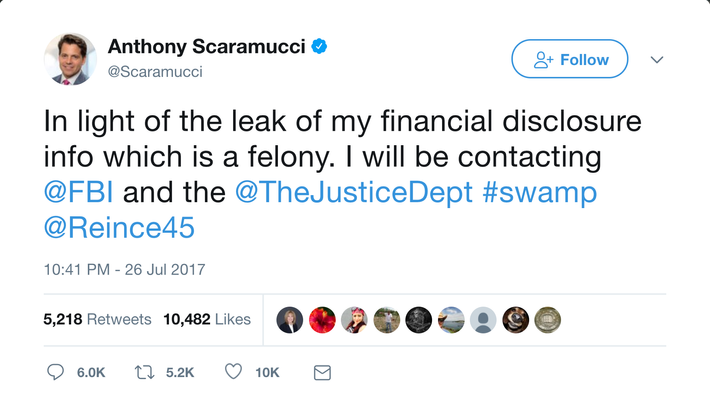
Scaramucci then appears to have threatened White House chief of staff Reince Priebus in a tweet he later deleted — as though he actually has the power to cover his tracks:
![]()
Trump’s Russia pardons would be an obstruction of justice
Bennett Gershman writes: Barely six months in office, President Donald Trump has unleashed more unresolved constitutional questions than any president in history.
Can Trump be indicted for federal crimes such as obstruction of justice? A federal investigation of Trump by Special Counsel Robert Mueller is considering exactly that question, but the Constitution does not give a definitive answer.
Short of impeachment, can Trump be removed from office? The Constitution’s 25th Amendment says he can be if he is “unable to discharge the powers and duties of his office.” But what if he is perfectly capable of discharging his duties, even if he is doing it corruptly? The Constitution does not provide a clear answer. Can Trump receive “emoluments” from foreign governments? Article II, section 1 of the Constitution says he cannot, but what exactly is an emolument? Does Trump’s retention of his business empire, which he refuses to disgorge, prohibit his continued receipt of financial gain from foreign governments, as a recent lawsuit by attorney generals from the District of Columbia and Maryland allege?
And finally, can Trump issue pardons, even to himself, in order to undermine Mueller’s investigation? The question has never before been squarely considered. To be sure, Article II section 2 of the Constitution gives a president extremely broad pardoning power, and presidents historically have used that power broadly, without needing to justify its use. But can a president’s grant of pardons be so extreme, and so detrimental to the integrity of the Republic as to constitute by itself an obstruction of justice? Indeed, that this question is being raised is a sign of how low this country has sunk since Trump became president. [Continue reading…]
Trump talks privately about the idea of a recess appointment to replace Sessions
The Washington Post reports: President Trump has discussed with confidants and advisers in recent days the possibility of installing a new attorney general through a recess appointment if Jeff Sessions leaves the job, but he has been warned not to move to push him out because of the political and legal ramifications, according to people briefed on the conversations.
Still raging over Sessions’s recusal from the Justice Department’s escalating Russia investigation, Trump has been talking privately about how he might replace Sessions and possibly sidestep Senate oversight, four people familiar with the issue said.
Two of those people, however, described Trump as musing about the idea rather than outlining a plan of action, and a senior White House official said no action is imminent. Several people familiar with the discussions said that Trump’s fury peaked over the weekend and that he and Sessions now seem to be heading toward an uneasy detente.
When asked Wednesday about the president’s discussions of a recess appointment, the White House released a one-sentence denial from Trump: “More fake news from the Amazon Washington Post.” The Washington Post is owned by Jeffrey P. Bezos, the founder and chief executive of Amazon.
Those who have discussed Sessions this week with Trump or with top West Wing officials have drawn different conclusions from their conversations — in part because the president ruminates aloud and floats hypotheticals, often changing his views hour to hour. [Continue reading…]
The military spends five times as much on Viagra as it would on transgender troops’ medical care
Christopher Ingraham writes: On Twitter this morning, President Trump announced a ban on transgender people serving in the military, citing “medical costs” as the primary driver of the decision.
“Our military must be focused on decisive and overwhelming victory and cannot be burdened with the tremendous medical costs and disruption that transgender in the military would entail,” the president wrote.
While Trump didn’t offer any numbers to support this claim, a Defense Department-commissioned study published last year by the Rand Corp. provides exhaustive estimates of transgender servicemembers’ potential medical costs.
Considering the prevalence of transgender servicemembers among the active duty military and the typical health-care costs for gender-transition-related medical treatment, the Rand study estimated that these treatments would cost the military between $2.4 million and $8.4 million annually.
The study didn’t include estimates of these costs for reservists, because of their “highly limited military health care eligibility.” It also didn’t include estimates for retirees or military family members, because many of those individuals may also have “limited eligibility” for care via military treatment facilities.
“The implication is that even in the most extreme scenario that we were able to identify … we expect only a 0.13-percent ($8.4 million out of $6.2 billion) increase in health care spending,” Rand’s authors concluded.
By contrast, total military spending on erectile dysfunction medicines amounts to $84 million annually, according to an analysis by the Military Times — 10 times the cost of annual transition-related medical care for active duty transgender servicemembers.
The military spends $41.6 million annually on Viagra alone, according to the Military Times analysis — roughly five times the estimated spending on transition-related medical care for transgender troops. [Continue reading…]
We’ve been here before: Discriminating against those who volunteer to serve
Bishop Garrison writes: On the anniversary of the day President Harry Truman desegregated the military, President Donald Trump announced, via Twitter, that the United States military would no longer welcome or support the service of transgender American citizens. As a nation, we have been here before. For generations, the military marginalized minorities, forcing them to serve separately or even in secret, before it finally got it right. And even in those tumultuous times, they still served and did so with honor and dignity. My family’s history and its service in the military is a testament to this. We have watched, over three generations, as the military stamped out discrimination and internalized this lesson: Your race, class, gender or sexual orientation has nothing to do with your fitness to serve.
During my first deployment in Iraq, I was stationed at Al Asad airbase in Anbar Province in Iraq. Part of my unit’s mission was to maintain security along one of the main supply routes so that convoys, which mostly traveled under the cover of darkness at night, could safely operate. We worked well with local police and sheikhs, and for many months things remained generally quiet. Then we began finding bombs on the side of the road. We didn’t have a name for them then, but later the technical term of Improvised Explosive Device, or IED, would emerge, and our time in the desert would never be same. After my first tour, almost a full year in the Iraqi desert, my father wanted to discuss what my time was like there.
My dad, Bishop Sr., or “Big Bishop,” was a gregarious, funny, and charming man. He was drafted into the Army to fight in Vietnam in the late 1960s, and was forced to leave early from, what was then, South Carolina State College. For his service in Vietnam, he received a Bronze Star as a young Specialist with the First Calvary Division. Given his abilities and performance, he was asked to remain in the Army and become an officer. My father respectfully declined. At that time, the Army was a very different place, and the U.S. was only a few years removed from the signing of the Civil Rights Act. He also wanted to get home to his family and marry his high school sweetheart, my mother, whom he’d left behind to go to Vietnam. He eventually would go on to serve as a veteran employment specialist with the state of South Carolina for the next 32 years, helping veterans transition to civilian jobs as they exited military service.
After I returned from Iraq, and was alone with my father, we began sharing stories we’d never told any of our family members about our military experiences. We discussed our fears, our concerns, and the issues we had to deal with as young men deployed to combat zones. There was one thing we both had learned during our time at war: Nothing was more important than the ability to trust the person fighting next to you. Given what was going on in the U.S. in the 1960s, my father told me it was hard for an enlisted black man from the Deep South to trust that the white men serving next to him had his best interests at heart, and that they would have his back. Our country was just beginning to recognize people of color as full-fledged citizens at the same time my father fought to protect its interests and the interests of its allies. As time progressed, he matured and his beliefs evolved thanks to his experience fighting and training with those same men he first met with suspicion. He learned they were no different from him. They all feared not making it home. They each had parents, wives, and high school sweethearts waiting for them. If you could zero your rifle, or drive a jeep, or work on a towable Howitzer fire team, or man the door gun on a Huey, no one had the time or the interest to worry about the rest. That focus and dedication led him to making lifelong friends, who still occasionally send me their condolences on his passing in 2012. Those same experiences taught him that at the end of the day, it was character and shared values that drives us as soldiers and Americans. [Continue reading…]
Defeated anti-Muslim amendment a sign of Trump’s normalizing of Islamophobia
Faiza Patel, Margot Adams and Emily Hockett write: Recently, the House of Representatives narrowly voted down an amendment to the annual defense spending bill that targeted the Islamic faith. Sponsored by Arizona Republican Trent Franks, the amendment instructed Defense Secretary James Mattis to conduct a strategic assessment of the use of “violent or unorthodox Islamic religious doctrine to support extremist or terrorist messaging and justification.” The Defense Department would have been required to identify “Islamic religious doctrines, concepts, or schools of thought” used by various extremist groups, and provide recommendations for identifying “key thought leaders or proponents” of these doctrines. The amendment failed in the face of strenuous opposition by every House Democrat as well as 27 Republicans and numerous advocacy organizations.
It is, of course, sensible for the government to study the motivations of terrorist groups that seek to harm us. Indeed, the U.S. government has been studying the belief systems of terrorists for years. The Franks amendment is fundamentally flawed, however, in that it assumes that “unorthodox Islamic religious doctrine” is the motive, to the exclusion of all others. It’s not unique in this regard. Government officials from both parties have long sought to frame political violence in the Muslim world as primarily one of religious “extremism” or “radicalization,” to avoid a broader evaluation of U.S. foreign policy and U.S. support for autocratic, and often brutally suppressive, regimes in the region as sources of instability and anti-American sentiment.
Coming on the heels of President Donald Trump’s speech in Warsaw, which described terrorism carried out in the name of Islam and the refugee crisis as an assault on “Western values,” and combined with the overall anti-Muslim tenor of the current administration, the Franks amendment simply continues the narrative of counterterrorism as a civilizational struggle—a narrative that Franks himself has long embraced—laying the blame for the violence of a relative few at the doorstep of a faith practiced by almost two billion people around the world. As Rep. Ruben Gallego (a former Marine infantryman), speaking against the Franks amendment on the House floor, said, “By singling out a faith tradition…we are sending a dangerous message and signal that America is at war with Islam.” [Continue reading…]
Palestine envoy to UN: Al-Aqsa crisis at tipping point
Al Jazeera reports: The Palestinian envoy to the UN has told the Security Council that al-Aqsa Mosque compound crisis in East Jerusalem is at a tipping point, urging the council members to help protect Palestinians and their holy sites from Israel’s “reckless and destructive agenda”.
Riyad Mansour warned in his speech to the Council on Tuesday that “the stoking of a religious conflict is rapidly unfolding as Israel persists its illegal actions in occupied East Jerusalem”.
He accused Israel of “aggressive behaviour and provocative violation” of the historic status quo at the Muslim-administered al-Aqsa Mosque compound, referring to a brief closure of the holy site after a deadly shooting there that was followed by installation of CCTV cameras and metal detectors.
“We are clearly at the tipping point,” he said. “We must therefore again warn against the dangers of such provocations and incitement, and fuelling of yet another cycle of violence which will surely have far-reaching consequences.” [Continue reading…]
Poles fought the nationalist government with mass protests — and won
Anne Applebaum writes: If an illiberal government — democratically elected, but determined to change the rules — tries to do something unconstitutional, what can the public do? What can the political opposition do? This is a dilemma we now know from several countries — Russia, Venezuela, Turkey, Hungary, Poland, and possibly soon Greece. The prospects are pretty gloomy, as I’ve argued before, for those who want to stay within the bounds of the law.
One partial answer is peaceful street demonstrations, though that is a frustrating path. Most people don’t have time to stand in a crowd every day or every evening; the chants and speeches can be repetitive; and, more to the point, the government has no obligation to listen. The effort can seem pointless, and it often is — unless it can move the hearts and minds of the leaders of the ruling party. In Poland, over the past week, that’s exactly what just happened. [Continue reading…]
How Jared Kushner helped the Russians get inside access to the Trump campaign
Ryan Lizza writes: If you read Jared Kushner’s statement to congressional committees looking for evidence of a crime, there isn’t much there. But if you read it from the perspective of the Russians trying to gain a toehold—or more—inside the Trump campaign, you realize how easy he made it for them. As the evidence mounted last year that the Russian government launched an unprecedented hacking and influence campaign to affect the 2016 election in Donald Trump’s favor, the Trump team, including Kushner, became increasingly more solicitous to high-level Russians offering information and requesting meetings.
Kushner’s first meeting with Sergey Kislyak, the Russian Ambassador to the United States, seems relatively innocuous. According to Kushner’s account, they met in April, 2016, at the Mayflower Hotel, in Washington, D.C., during a reception before a speech that Trump delivered on foreign policy. Dimitri Simes, the publisher of The National Interest and the organizer of the event, introduced Kushner to Kislyak and three other ambassadors. To Kushner, the introduction was forgettable. Without specifying which ones, he noted that some of the ambassadors invited him to lunch but that he “never took them up on any of these invitations.”
For Kislyak, it was clearly an important moment. The Russian Ambassador represents a country whose intelligence services had hacked their way into the Democratic National Committee’s networks ten months earlier and hacked the e-mail account of John Podesta, Hillary Clinton’s campaign chairman, the previous month. At Trump’s speech, Kislyak was honored with an invitation to the reception and a front-row seat. Trump’s speech itself extended an olive branch to Vladimir Putin, calling for “improved relations with Russia” and an effort to “make a deal that’s great” for “America, but also good for Russia.”
By May, Russia’s General Staff Main Intelligence Directorate—the G.R.U.—“had exfiltrated large volumes of data from the DNC,” according to the U.S. intelligence community’s unclassified report on Russian meddling. In June, the Russian government adopted “a clear preference” for Trump, according to the report. “Beginning in June, Putin’s public comments about the U.S. presidential race avoided directly praising President-elect Trump, probably because Kremlin officials thought that any praise from Putin personally would backfire in the United States. Nonetheless, Putin publicly indicated a preference for President-elect Trump’s stated policy to work with Russia, and pro-Kremlin figures spoke highly about what they saw as his Russia-friendly positions on Syria and Ukraine.”
That same month, Russian associates of the Trump family reached out to offer the Trump campaign some direct assistance. On June 3rd, Rob Goldstone, a British music publicist and former tabloid journalist, e-mailed Donald Trump, Jr., offering “some official documents and information that would incriminate Hillary and her dealings with Russia and would be very useful to your father,” and noted that the offer was “part of Russia and its government’s support for Mr. Trump.” A meeting was set for June 9th, and Trump’s oldest child forwarded the full e-mail exchange to Kushner and Paul Manafort, who at the time was the campaign chairman. The subject line was “Russia – Clinton – private and confidential.”
Yesterday, Kushner insisted, “I did not read or recall this e-mail exchange before it was shown to me by my lawyers.” Whether or not that’s true, he attended the meeting. According to Kushner’s account of the meeting, it was uneventful. He got there late, some Russians he never heard of were discussing adoption policy, and he quickly messaged his assistant to call him so he had an excuse to bail. Longtime intelligence officials have a more jaundiced view. Michael Hayden, the former head of the Central Intelligence Agency and National Security Agency, told me that he was convinced the meeting was a classic “soft approach” by Russian intelligence. He cited a recent Washington Post article, by Rolf Mowatt-Larssen, that argued that the meeting “is in line with what intelligence analysts would expect an overture in a Russian influence operation to look like,” and that it may have been the “green light Russia was looking for to launch a more aggressive phase of intervention in the U.S. election.”
Hayden told me, “My god, this is just such traditional tradecraft.” He said that he has talked to people in the intelligence community about Mowatt-Larssen’s theory and that “every case officer I’ve pushed on this” agreed with it. “This is how they do it.” [Continue reading…]

The standoff between Trump and Sessions escalates
The Washington Post reports: The public standoff between the White House and the nation’s senior law enforcement official took another strange turn Tuesday as President Trump escalated his verbal attacks on Attorney General Jeff Sessions, who was urged by fellow conservatives to stand his ground.
Trump was asked at a Rose Garden news conference if he would fire the attorney general, who angered the president by recusing himself from the criminal probe into possible connections between the Trump campaign and Russia.
“We’ll see what happens,’’ said Trump — a potentially ominous choice of phrase, considering the president used the same expression when talking to FBI Director James B. Comey before he was fired. [Continue reading…]
Why the scariest nuclear threat may come from inside the White House
Michael Lewis writes: On the morning after the election, November 9, 2016, the people who ran the U.S. Department of Energy turned up in their offices and waited. They had cleared 30 desks and freed up 30 parking spaces. They didn’t know exactly how many people they’d host that day, but whoever won the election would surely be sending a small army into the Department of Energy, and every other federal agency. The morning after he was elected president, eight years earlier, Obama had sent between 30 and 40 people into the Department of Energy. The Department of Energy staff planned to deliver the same talks from the same five-inch-thick three-ring binders, with the Department of Energy seal on them, to the Trump people as they would have given to the Clinton people. “Nothing had to be changed,” said one former Department of Energy staffer. “They’d be done always with the intention that, either party wins, nothing changes.”
By afternoon the silence was deafening. “Day 1, we’re ready to go,” says a former senior White House official. “Day 2 it was ‘Maybe they’ll call us?’ ”
“Teams were going around, ‘Have you heard from them?’ ” recalls another staffer who had prepared for the transition. “ ‘Have you gotten anything? I haven’t got anything.’ ”
“The election happened,” remembers Elizabeth Sherwood-Randall, then deputy secretary of the D.O.E. “And he won. And then there was radio silence. We were prepared for the next day. And nothing happened.” Across the federal government the Trump people weren’t anywhere to be found. Allegedly, between the election and the inauguration not a single Trump representative set foot inside the Department of Agriculture, for example. The Department of Agriculture has employees or contractors in every county in the United States, and the Trump people seemed simply to be ignoring the place. Where they did turn up inside the federal government, they appeared confused and unprepared. A small group attended a briefing at the State Department, for instance, only to learn that the briefings they needed to hear were classified. None of the Trump people had security clearance—or, for that matter, any experience in foreign policy—and so they weren’t allowed to receive an education. On his visits to the White House soon after the election, Trump’s son-in-law, Jared Kushner, expressed surprise that so much of its staff seemed to be leaving. “It was like he thought it was a corporate acquisition or something,” says an Obama White House staffer. “He thought everyone just stayed.”
Even in normal times the people who take over the United States government can be surprisingly ignorant about it. As a longtime career civil servant in the D.O.E., who has watched four different administrations show up to try to run the place, put it, “You always have the issue of maybe they don’t understand what the department does.” To address that problem, a year before he left office, Barack Obama had instructed a lot of knowledgeable people across his administration, including 50 or so inside the D.O.E., to gather the knowledge that his successor would need in order to understand the government he or she was taking charge of. The Bush administration had done the same for Obama, and Obama had always been grateful for their efforts. He told his staff that their goal should be to ensure an even smoother transfer of power than the Bush people had achieved. [Continue reading…]
Climate change denier Rick Perry wants to learn more about making biofuel from moonshine and pig manure
The Washington Post reports: It was a winding, wonkish and occasionally obscure conversation about foreign coal exploration, natural-gas pipelines and pig manure as a power source.
But only one of the men on the line — Energy Secretary Rick Perry — held sway over his nation’s energy policy. On the other end of the conversation were Vladimir “Vovan” Kuznetsov and Alexei “Lexus” Stolyarov, who had just added Perry to their list of high-profile hoax victims.
“Secretary Perry is the latest target of two Russian pranksters,” DOE Spokeswoman Shaylyn Hynes said in an email to The Washington Post. “These individuals are known for pranking high level officials and celebrities, particularly those who are supportive of an agenda that is not in line with their governments. In this case, the energy security of Ukraine.”
During the conversation, which was posted in its entirety on Vesti, a Russian news site, Perry was convinced he was talking to the Ukrainian Prime Minister Volodymyr Groysman, who appears to speak through a translator. Perry talked about a potential pipeline across the Baltic sea for Russian gas, cyber attacks on the U.S. power grid, natural-gas exploration in Ukraine and the U.S. withdrawal from the Paris Climate Accord.
“I hope that stepping away from the Paris accord will not have any negative impact with our relationship with the Ukraine,” Perry said. “We tried to divorce the politics from this and really just let our record stand, one that I’m very proud of.”
He also talked about a meeting scheduled for August where they’d let American business executives talk about extracting oil and natural gas in Ukraine.
“What we have seen in Texas is the great increase of productivity, particularly in shale gas because of hydraulic fracturing and the directional drilling,” Perry said.
Perhaps the only giveaway about the true nature of the call was a statement the “Ukrainian prime minister” made about a new biofuel invented by Ukrainian President Petro Poroshenko, according to the Pravda Report newspaper.
The fuel was made from a mix of home-brewed alcohol and pig manure.
Perry said he’d like to get more information about the “scientific development.” [Continue reading…]
Trump finds reason for the U.S. to remain in Afghanistan: To plunder natural resources
The New York Times reports: President Trump, searching for a reason to keep the United States in Afghanistan after 16 years of war, has latched on to a prospect that tantalized previous administrations: Afghanistan’s vast mineral wealth, which his advisers and Afghan officials have told him could be profitably extracted by Western companies.
Mr. Trump has discussed the country’s mineral deposits with President Ashraf Ghani, who promoted mining as an economic opportunity in one of their first conversations. Mr. Trump, who is deeply skeptical about sending more American troops to Afghanistan, has suggested that this could be one justification for the United States to stay engaged in the country.
To explore the possibilities, the White House is considering sending an envoy to Afghanistan to meet with mining officials. Last week, as the White House fell into an increasingly fractious debate over Afghanistan policy, three of Mr. Trump’s senior aides met with a chemical executive, Michael N. Silver, to discuss the potential for extracting rare-earth minerals. Mr. Silver’s firm, American Elements, specializes in these minerals, which are used in a range of high-tech products.
Stephen A. Feinberg, a billionaire financier who is informally advising Mr. Trump on Afghanistan, is also looking into ways to exploit the country’s minerals, according to a person who has briefed him. Mr. Feinberg owns a large military contracting firm, DynCorp International, which could play a role in guarding mines — a major concern, given that some of Afghanistan’s richest deposits are in areas controlled by the Taliban. [Continue reading…]
North Korea promises nuclear strike on U.S. if regime is threatened
CNN reports: North Korea threatened a nuclear strike on “the heart of the US” if it attempts to remove Kim Jong Un as Supreme Leader, Pyongyang’s state-run Korean Central News Agency (KCNA) reported Tuesday.
The threat was in response to comments from CIA Director Mike Pompeo, who said last week that the Trump administration needed to find a way to separate Kim from his growing nuclear stockpile.
“As for the regime, I am hopeful we will find a way to separate that regime from this system,” Pompeo said. “The North Korean people I’m sure are lovely people and would love to see him go.”
KCNA reported that a spokesman from the North Korean Foreign Ministry said, “The DPRK legally stipulates that if the supreme dignity of the DPRK is threatened, it must preemptively annihilate those countries and entities that are directly or indirectly involved in it, by mobilizing all kinds of strike means including the nuclear ones.” [Continue reading…]
The Washington Post reports: North Korea will be able to field a reliable, nuclear-capable intercontinental ballistic missile as early as next year, U.S. officials have concluded in a confidential assessment that dramatically shrinks the timeline for when Pyongyang could strike North American cities with atomic weapons.
The new assessment by the Pentagon’s Defense Intelligence Agency (DIA), which shaves a full two years off the consensus forecast for North Korea’s ICBM program, was prompted by recent missile tests showing surprising technical advances by the country’s weapons scientists, at a pace beyond which many analysts believed was possible for the isolated communist regime.
The U.S. projection closely mirrors revised predictions by South Korean intelligence officials, who also have watched with growing alarm as North Korea has appeared to master key technologies needed to loft a warhead toward targets thousands of miles away.
The finding further increases the pressure on U.S. and Asian leaders to halt North Korea’s progress before it can threaten the world with nuclear-tipped missiles. President Trump, during his visit to Poland earlier this month, vowed to confront Pyongyang “very strongly” to stop its missile advances. [Continue reading…]
Newsweek reports: While North Korea’s leadership celebrates its successful testing of a missile that it claims can strike the United States with a nuclear warhead, its citizens are facing the prospect of its worst drought in 16 years, which could lead to even greater food shortages in the isolated country.
A report from the United Nations Food and Agriculture Organization (FAO) released last week said that rainfall between the critical period of April to June was lower than for the same period in 2001, when cereal production reached an unprecedented low.
“More rains are urgently needed to avoid significant decreases in the main 2017 cereal production season,” the report said. “Should drought conditions persist, the food security situation is likely to further deteriorate.”
North Korea has long been criticized for spending a large proportion of its budget on developing weapons while failing to provide adequate food for its people. Between 2004 and 2014, it spent nearly a quarter of its gross domestic product on the military, by far the highest percentage relative to GDP of any country in the world. Meanwhile, two in five North Koreans are undernourished with more than two-thirds relying on food aid, according to the United Nations. [Continue reading…]
Jeff Sessions is growing ‘pissed’ at Trump, his allies say. And he doesn’t plan to quit
The Daily Beast reports: Attorney General Jeff Sessions has no plans to leave office, as friends say he’s grown angry with President Donald Trump following a series of attacks meant to marginalize his power and, potentially, encourage his resignation.
“Sessions is totally pissed off about it,” said a Sessions ally familiar with his thinking. “It’s beyond insane. It’s cruel and it’s insane and it’s stupid.”
Sessions’ allies say the president’s criticism of the attorney general is counterproductive. Perhaps more than any other member of Trump’s Cabinet, Sessions has been an uncompromising advocate for Trump’s agenda. [Continue reading…]
McClatchy reports: President Donald Trump is getting a bitter Washington lesson when he messes with Jeff Sessions – you don’t pick a fight with one of the Senate’s guys.
It’s a lesson that could cost him politically in a Senate where he badly needs Republican support for his lengthy agenda, starting with healthcare on Tuesday.
“I don’t understand it. There’s no more honorable person I’ve ever met in my life than Jeff Sessions,” said Sen. James Inhofe, R-Okla., a close friend of Sessions and his wife. “The only person who is more upset with Trump about this than me, is my wife.”
Sessions spent 20 years in the Senate, winning a reputation for affability and party loyalty. He understood and doggedly practiced the code of what’s been called the world’s most exclusive club: You can disagree without being disagreeable, but you protect the institution and its members. [Continue reading…]
Trump’s unsurprising endorsement of illegal solicitation
Fred Wertheimer writes: It’s not surprising that President Donald Trump believes that “most politicians would have gone to a meeting like the one Don Jr. attended in order to get info on an opponent” – his reference, of course, is to the infamous June 9 meeting organized by Donald Trump Jr. to obtain incriminating information on Hillary Clinton offered, as he knew, by the Russian government.
President Trump and his supporters keep trying to spin the line that there was nothing illegal about what Trump Jr. did.
That’s plain wrong.
Setting aside the question of criminal intent, the public record shows that Trump Jr. knowingly solicited “something of value” for the Trump campaign from a foreign source. Doing so was a violation on the federal ban on soliciting foreign support for a campaign. The fact that this was a foreign government, hostile to US democratic institutions, is not relevant to this legal analysis, though it is relevant to what we think of his actions as an ethical matter. Whether Trump Jr. actually received valuable information is irrelevant to the “solicitation” violation that occurred. In other words, the solicitation of a contribution, i.e. something of value to the campaign, from a foreign national is itself illegal, whether a contribution is or is not actually received in response to the solicitation.
According to an AP article a folder of information reportedly was given to Trump Jr. by the Russian government lawyer at the meeting. A participant in the meeting, Rinat Akhmetshin, said that the attorney brought with her a plastic folder with printed-out documents that detailed what she believed was the flow of illicit funds to the Democrats. Akhmetshin recalled the attorney saying “This could be a good issue to expose how the DNC is accepting bad money,” according to the AP.
This was just one account of the meeting and we do not know what was in the folder or what happened to the documents.
Whether that information in the folder was something “of value” to the campaign is a question that requires investigation. If it was and it was taken, then Trump Jr. and the campaign committed a second violation of not only soliciting but also receiving a contribution from a foreign national.
President Trump’s claim that “most politicians” would do what his son did means that the President thinks that most politicians would engage in illegal conduct by soliciting opposition research of value to the campaign from a foreign source, including a foreign adversary that has no respect for free and open elections.
The President’s position is not surprising, however, since his campaign knowingly and repeatedly violated the same statutory solicitation prohibition during the 2016 presidential election — by soliciting illegal campaign contributions multiple times from multiple foreign sources. [Continue reading…]