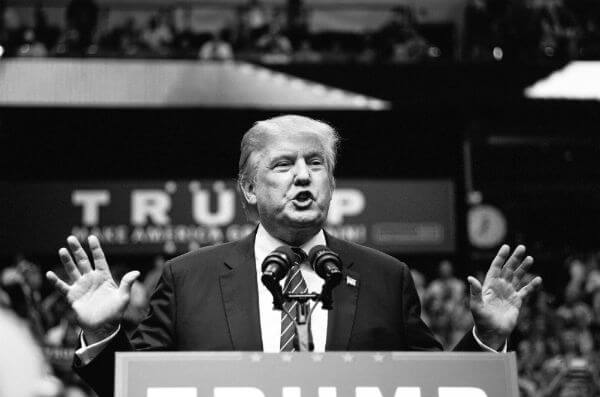
The New York Times reports: One attorney general, Eric T. Schneiderman, is already investigating Donald J. Trump over possible violations of New York State law at his charity foundation.
Another, Maura Healey of Massachusetts, has joined Mr. Schneiderman in an investigation into whether Exxon Mobil — whose chief executive, Rex W. Tillerson, is Mr. Trump’s choice for secretary of state — lied to investors and the public about the threat of climate change.
Ms. Healey also has a new fund-raising pitch: “I won’t hesitate to take Donald Trump to court if he carries out his unconstitutional campaign promises,” she recently wrote to supporters.
A third, Representative Xavier Becerra, who was chosen this month to become California’s attorney general, has dared the Trump administration to “come at us” over issues including immigration, climate change and health care.
As Democrats steel themselves for the day next month when the White House door will slam on their backs, some of the country’s more liberal state attorneys general have vowed to use their power to check and balance Mr. Trump’s Washington. [Continue reading…]
Category Archives: Donald Trump
Nine ways to oppose Donald Trump
John Cassidy writes: er the past few weeks, a number of anguished friends and acquaintances, and even some strangers, have got in touch with me to ask what they might do to oppose Donald Trump. Being a fellow sufferer from OATS — Obsessing About Trump Syndrome — my first instinct has been to tell people to get off social media and take a long walk. It won’t do anybody much good, except possibly Trump, if large numbers of people who voted against him send themselves mad by constantly reading about him, cursing him, and recirculating his latest outrages.
But, of course, taking a mental-health break is only a first step toward preserving the Republic. As a daily columnist, I see my role as trying to analyze and critique the Trump program, while also trying to understand some of the phenomena that allowed him to blag his way to the verge of the White House. But for those who want to take a more direct approach, here are some suggestions, starting with something you can do immediately:
1. Go to change.org and join the 4.9 million people who have signed a petition calling on members of the Electoral College to reject Trump. Then contact the electors for your state directly and tell them your concerns. On Monday, the five hundred and thirty eight electors will choose a new President. According to the Harvard law professor Lawrence Lessig, between twenty and thirty Republican electors are ready to vote against Trump. To deny him a majority, the number would need to reach thirty-seven. Most observers think that won’t happen, and, even if it did, the task of electing a President would pass to the Republican-dominated House of Representatives, which would almost certainly vote for Trump. But a big protest vote in the Electoral College could still have great deal of symbolic importance. [Continue reading…]
China says U.S. is ‘appropriately handling’ seizure of marine research robot — a lesson for Trump?
Reuters reports: China and the United States are using military channels to “appropriately handle” the seizure by the Chinese navy of a U.S. underwater drone in the South China Sea, China said on Saturday, and a Chinese state-run newspaper said it expected a smooth resolution.
The drone was taken on Thursday, the first seizure of its kind in recent memory, about 50 nautical miles northwest of Subic Bay off the Philippines, just as the USNS Bowditch was about to retrieve the unmanned underwater vehicle (UUV), U.S. officials said.
“It is understood that China and the United States are using military channels to appropriately handle this issue,” China’s Foreign Ministry said in a brief statement sent to Reuters, without elaborating. [Continue reading…]
Given Donald Trump’s focus on attending victory rallies and his lack of interest in receiving intelligence briefings, it’s possible that this brief diplomatic incident escaped his attention. At least we can surmise at this point that the president-elect did not deem this matter tweet-worthy.
Nevertheless, I have to wonder whether the Chinese had the intention of providing Trump with a teachable moment so that he can understand that it’s possible to deal with a small provocation without starting World War III.
Let’s hope this isn’t the last time we hear a foreign power saying that the U.S. is appropriately handling an unexpected situation.
But given that even before Trump has entered office he has rocked U.S.-Chinese relations, his destabilizing influence on global affairs seems much more likely to grow before or if it can be held in check.
I spoke too soon!
Literally as I was writing this, Trump tweeted this:
China steals United States Navy research drone in international waters – rips it out of water and takes it to China in unpresidented act.
— Donald J. Trump (@realDonaldTrump) December 17, 2016
I don’t know if Trump corrects his tweets, so just in case, here’s a screenshot:
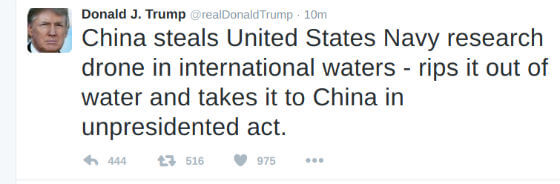
Unpresidented?
I guess Trump could be coining an expression that means an action unworthy of a president. Much more likely, it just means that early on a Saturday morning he doesn’t have any staff nearby to tell him how to spell unprecedented.
As for the substance, Trump is incorrect in claiming that China’s action is unprecedented. Moreover, from China’s point of view it is the U.S. surveillance operations which are the provocation as it has previously made clear.
In 2002, the same U.S. ship was involved in a flare of tensions between the U.S. and China. As the Associated Press reported at the time:
Chinese patrol planes buzzed an unarmed U.S. Navy ship several times while it was conducting what the Pentagon called routine military surveys in the Yellow Sea, and Beijing demanded that it cease “illegal operations” inside China’s 200-mile economic exclusion zone.
The incidents happened over a period of weeks starting in early September. After Chinese officials lodged private protests at least twice, the United States responded Thursday with a note that asserted its right to conduct such activities inside any nation’s economic exclusion zone.
In Beijing, Foreign Ministry spokeswoman Zhang Qiyue said, “We think it violates the international maritime law, and we have made several representations to the U.S. side.”
The report also said:
This was not the first time the Bowditch’s work has rankled the Chinese. On March 23, 2001, just nine days before the EP-3 collision, a Chinese warship chased the Bowditch out of the Yellow Sea.
That collision being between a Chinese fighter plane and a U.S. Navy surveillance aircraft over the South China Sea — an incident that caused much of the world to hold its breath as it waited to see whether an inexperienced and brash American president, George W. Bush, would over-react.
Who could imagine that 16 years later, Bush would, in retrospect, look like a seasoned statesman compared to the man who is about to enter the White House!?
Of course, Bush’s test with China was a prelude to a much greater test six months later whose consequences still reverberate around the world.
The prospect of Trump facing a similar test are too horrific to imagine.
Stay informed. Click below to sign up for daily email updates from War in Context:

Trump’s swaggering sparks war talk from China
Newsweek reports: In mid-summer 2015, the Pentagon deployed a vast fleet to the Western Pacific with an invasion force of 33,000 troops. The little reported exercise was supported by warplanes and attack helicopters, along with 21 ships, including the aircraft carrier George Washington and three nuclear missile-bearing submarines.
It was only a game, the Navy said. But it looked very much like practice for the real thing on or near Chinese shores. On the night of July 4 — Independence Day in the U.S. — Operation Talisman Saber kicked off with U.S. high-altitude paratroopers dropping from the sky near Fog Bay, in Australia’s Northern Territory. Naval artillery boomed. Tanks rolled ashore. The invasion was on.
A U.S. Navy press release made it sound routine, an “exercise [that] illustrates the closeness of the Australian and U.S. alliance…” But Military Times, a close observer of the Defense Department, put its finger on what it was really about: “Talisman Sabre: Trying to Deter China,” its headline said. [Continue reading…]
Russia’s fear of Hillary Clinton eclipsed any affection for Donald Trump
Max Fisher writes: Russia’s unprecedented intervention in the United States election came amid more than United States-Russia tension and Donald J. Trump’s praise of Vladimir V. Putin, the Russian president. It also coincided with a growing belief, in Moscow, that Russia faced an imminent threat in Hillary Clinton’s candidacy.
Mrs. Clinton is viewed in Moscow as innately hostile to Russia. Widely held conspiracy theories portray her as seeking to foment unrest that will return Russia to the chaos and depression of the 1990s. Even many government technocrats view her with suspicion that at times verges on paranoia.
She referred to these views at an event on Thursday, telling donors that Mr. Putin’s “personal beef” with her had driven Russia’s intervention in the American election.
Mark Galeotti, a Russia expert at the Institute of International Relations, based in Prague, said the Kremlin was consumed by something more urgent than petty revenge: self-preservation.
“It’s not just they didn’t like Clinton, but they actually thought that she represented a threat,” he said, describing Russia’s actions as a matter of “policy, not pique.”
No one factor can fully explain Russia’s decision to hack and pass on Democratic emails, analysts say, and intelligence agencies appear divided on assessing Russian motives. But, in Moscow, fear of Mrs. Clinton has loomed as large or larger than any warmth for Mr. Trump. [Continue reading…]
Is Donald Trump a threat to democracy?
Steven Levitsky and Daniel Ziblatt write: Donald J. Trump’s election has raised a question that few Americans ever imagined asking: Is our democracy in danger? With the possible exception of the Civil War, American democracy has never collapsed; indeed, no democracy as rich or as established as America’s ever has. Yet past stability is no guarantee of democracy’s future survival.
We have spent two decades studying the emergence and breakdown of democracy in Europe and Latin America. Our research points to several warning signs.
The clearest warning sign is the ascent of anti-democratic politicians into mainstream politics. Drawing on a close study of democracy’s demise in 1930s Europe, the eminent political scientist Juan J. Linz designed a “litmus test” to identify anti-democratic politicians. His indicators include a failure to reject violence unambiguously, a readiness to curtail rivals’ civil liberties, and the denial of the legitimacy of elected governments.
Mr. Trump tests positive. In the campaign, he encouraged violence among supporters; pledged to prosecute Hillary Clinton; threatened legal action against unfriendly media; and suggested that he might not accept the election results.
This anti-democratic behavior has continued since the election. With the false claim that he lost the popular vote because of “millions of people who voted illegally,” Mr. Trump openly challenged the legitimacy of the electoral process. At the same time, he has been remarkably dismissive of United States intelligence agencies’ reports of Russian hacking to tilt the election in his favor. [Continue reading…]
Donald Trump’s rigged election
The New York Times reports: President Obama said on Thursday that the United States would retaliate for Russia’s efforts to influence the presidential election, asserting that “we need to take action,” and “we will.”
The comments, in an interview with NPR, indicate that Mr. Obama, in his remaining weeks in office, will pursue either economic sanctions against Russia or perhaps some kind of response in cyberspace.
Mr. Obama spoke as President-elect Donald J. Trump on Thursday again refused to accept Moscow’s culpability, asking on Twitter why the administration had waited “so long to act” if Russia “or some other entity” had carried out cyberattacks.
The president discussed the potential for American retaliation with Steve Inskeep of NPR for an interview to air on Friday morning. “I think there is no doubt that when any foreign government tries to impact the integrity of our election,” Mr. Obama said, “we need to take action. And we will — at the time and place of our choosing.”
The White House strongly suggested before the election that Mr. Obama would make use of sanctions authority for cyberattacks that he had given to himself by executive order. But he did not, in part out of concern that action before the election could lead to an escalated conflict.
If Mr. Obama invokes sanctions on Russian individuals or organizations, Mr. Trump could reverse them. But that would be politically difficult, as his critics argue that he is blind to Russian behavior. [Continue reading…]
NBC News reports: [In this tweet] Trump was no longer disputing, as he has for months, that Russia was involved. And his top transition aide, Anthony Scaramucci, went even further Wednesday night in an interview with MSNBC’s Brian Williams.
“I don’t think anybody thinks that you’re wrong,” he said of the NBC News report. “Our position right now is that we’re waiting for more information. We reject the notion that people would cyber attack our institutions. We are very upset about it.”
Scaramucci went on to suggest that Trump needed time to digest the intelligence.
“I wonder whether the tweet the president-elect sent out today is the beginning of his pivot, the beginning of his acknowledgement of the intelligence that Russia has been hacking our institutions,” said Rep. Adam Schiff, the ranking Democrat on the House Intelligence Committee.
In an exclusive report Wednesday, U.S. intelligence officials told NBC News they now believe with “a high level of confidence” that Putin became personally involved in the covert Russian campaign in October.
Two senior officials with direct access to the information say new intelligence shows that Putin personally directed how hacked material from Democrats was leaked and otherwise used. The intelligence came from diplomatic sources and spies working for U.S. allies, the officials said. [Continue reading…]
The New York Times reports: It remains to be seen whether Mr. Trump’s stated doubts about Russia’s involvement will subside after Monday’s Electoral College vote. He and his allies have been concerned that the reports of Russian hacking have been intended to peel away votes from him, although even Democrats have not gone so far as to say the election was illegitimate.
“Right now, certain elements of the media, certain elements of the intelligence community and certain politicians are really doing the work of the Russians — they’re creating this uncertainty over the election,” Representative Peter T. King, Republican of New York, told reporters on Thursday after meeting with Mr. Trump.
But many other Republicans, including Senator Mitch McConnell of Kentucky, the majority leader, and Senator John McCain of Arizona, have publicly argued that the evidence leads straight to Russia. They have called for a full investigation, and Senator Dianne Feinstein, Democrat of California, who sits on the Senate Intelligence Committee, urged Mr. Obama on Thursday to complete an administration review quickly.
Mr. Trump’s Twitter post was his latest move to accuse the intelligence agencies he will soon control of acting with a political agenda and to dispute the well-documented conclusion that Moscow carried out a meticulously planned series of attacks and releases of information to interfere in the presidential race.
But as he repeated his doubts, Mr. Trump seized on emerging questions about the Obama administration’s response: Why did it take months after the breaches had been discovered for the administration to name Moscow publicly as the culprit? And why did Mr. Obama initially opt not to openly retaliate, through sanctions or other measures?
White House officials have said that the warning to Mr. Putin at the September summit meeting in China constituted the primary American response so far. When the administration decided to go public with its conclusion a month later, it did so in a statement from the director of national intelligence and the Homeland Security secretary, not in a prominent presidential appearance.
Officials said they were worried that any larger public response would have raised doubts about the election’s integrity, something Mr. Trump was already seeking to do during the campaign when he insisted the election was “rigged.” [Continue reading…]
Fake news is a convenient scapegoat, but the big 2016 problem was the real news
Matthew Yglesias writes: Speaking in early December at a ceremony to honor Harry Reid’s retirement from the US Senate, Hillary Clinton took aim at a target that would have been totally unfamiliar to audiences as recently as the summer of 2016: fake news.
She spoke of “an epidemic” of the stuff that has “flooded social media” over the past year and “can have real-world consequences.”
This was reported largely as commentary on the Pizzagate conspiracy theory, which had recently led to an alarming armed standoff at DC’s Comet Ping Pong restaurant. But it was also pretty clearly an allusion to her own recently failed presidential campaign, especially because she spoke favorably of the idea of bipartisan legislation to curb foreign propaganda news, arguing that “it is imperative that leaders in both the private and public sector step up to protect our democracy and innocent lives.”
While it’s true that fake news appears to have circulated widely in Trump-friendly corners of the internet — possibly with some assistance from the Russian government — the idea that fake news was central to the outcome of the campaign has little basis in fact. The very nature of viral fake news is that it’s mostly likely to be shared by people who have already bought into a partisan or ideological worldview, with pro-Trump fake news largely shared by Trump supporters to other Trump supporters. [Continue reading…]
Iran sanctions extended, but without Obama’s irrelevant signature
The Washington Post reports: Sanctions against Iran were officially extended for another decade Thursday, even though President Obama did not sign the legislation, a symbolic move intended to show the White House’s disapproval of the bill.
The sanctions renewal, which passed Congress with enough votes to be veto-proof, has triggered complaints from Tehran. The Iranian government views the nuclear agreement as entailing a promise of no new sanctions. The White House, by not signing the bill, is trying to alleviate Iran’s concerns.
Secretary of State John F. Kerry said the nuclear deal is still a “top strategic objective” for the United States. With or without the sanctions renewed, he said, the United States could snap sanctions back into place if Iran were to violate the Joint Comprehensive Plan of Action (JCPOA), the formal name for the nuclear deal. Kerry said that even though he considers it unnecessary to renew the existing waivers, he had done so anyway “to ensure maximum clarity” that the United States will meet its obligations under the deal.
He also said he had contacted Iran’s foreign minister, Mohammad Javad Zarif, and U.S. allies to reassure them that the United States remains committed to the deal that gave Iran sanctions relief once it pared back its nuclear program.
“As long as Iran adheres to its commitments under the JCPOA, we remain steadfastly committed to maintaining ours as well,” he said.
But with President-elect Donald Trump just five weeks away from taking office, Kerry’s guarantees may be short-lived if the new administration takes a tougher approach to Iran, as is expected. [Continue reading…]
The Putin paradigm: How Trump will rule America

Masha Gessen writes: Over the last few days, concerns about some kind of a hidden alliance between Donald Trump and Vladimir Putin have exploded. There is the president-elect with his apparently fawning regard for the Russian leader. There are Trump’s top cabinet picks, with their unusual Russian ties: as national security advisor, Lt. General Mike Flynn, who has met Putin and done paid events for a Kremlin-sponsored TV station; and as secretary of state, ExxonMobil CEO Rex Tillerson, who has done billions of dollars of business in Russia and received an award from Putin. And then there is the revelation, from the CIA, that Russia may have actively interfered in the US election to get Trump elected.
Of course, Putin may well have reasons for wanting Trump to be president — not least Trump’s apparent skepticism toward NATO and his lack of opposition to Russia’s military interventions in Ukraine and Syria. But a more important connection between the two men may be their common approach to leadership, which will almost certainly outlast any friendship that may form between them. During his campaign, Donald Trump repeatedly expressed admiration for the way Putin governed. “The man has very strong control over his country,” Trump said at one point. “He’s been a leader far more than our president has been a leader.” That revealed a lot about Trump’s concept of the presidency—he seems to believe that effectiveness is measured by the extent to which the leader “controls” the country. But how might that play out in practice? To what extent can Putin provide insight into Trump’s understanding of power?
There is still much we don’t know about how Trump will rule. But in the month since his election, some characteristic patterns have emerged — and they bear some instructive similarities to the style Putin has practiced over many years. [Continue reading…]
White House: Trump may have known Russia behind hacking before Election Day
Politico reports: The White House on Wednesday suggested Donald Trump knew Russia was behind a series of hacks that interfered with the U.S. presidential election when he invited Russia to find Hillary Clinton’s missing emails.
The president-elect has continued to deny U.S. intelligence assessments that highlight Russia as the culprit behind infiltrations of Democratic institutions, including the Democratic National Committee, the Democratic Senatorial Campaign Committee and Clinton campaign chairman John Podesta’s personal email account.
But White House press secretary Josh Earnest contended Wednesday that it’s entirely feasible that Trump was well aware of Russia’s interference well before the intelligence community confirmed as much in October, a month before the election.
“There’s ample evidence that was known long before the election and in most cases long before October about the Trump campaign and Russia — everything from the Republican nominee himself calling on Russia to hack his opponent,” Earnest told reporters. “It might be an indication that he was obviously aware and concluded, based on whatever facts or sources he had available to him, that Russia was involved and their involvement was having a negative impact on his opponent’s campaign.” [Continue reading…]
Government ethics office says Trump should divest himself of his businesses
NPR reports: President-elect Donald Trump should divest himself of his vast business interests in order to avoid conflicts of interest while in the White House, according to a letter from the U.S. Office of Government Ethics.
Moreover, transferring ownership of his businesses to his grown children wouldn’t go far enough to address the conflicts, the letter said.
“Transferring operational control of a company to one’s children would not constitute the establishment of a qualified blind trust, nor would it eliminate conflicts of interest” under federal statutes governing conflicts of interest, said the letter, written by OGE Director Walter M. Shaub, Jr. [Continue reading…]
Russia, NATO, Trump: The shadow world
Robert Cottrell writes: NATO and Russia are close to war, according to General Sir Richard Shirreff, recently NATO’s second-in-command. In 2017: War with Russia, he writes that Russia could invade the Baltic states, which are NATO members, while NATO does nothing. When crisis strikes, the British prime minister is at the pub, the Germans are paralyzed by anxiety, and the Greeks and Hungarians are in Russia’s pocket. The Americans are raring to go, but three countries have to fall before they can persuade their European partners to share their sense of urgency.
And one could almost now say that Shirreff’s alarmism has been overtaken by events, which are conspiring to demolish even the outward show of solidarity on which NATO relies for its deterrence. Britain’s vote to leave the European Union and Turkey’s post-coup crackdown call into question the strategic direction of two of NATO’s major military powers. As for Donald Trump’s argument during the presidential campaign that America’s richer allies should pay adequately for their protection, it was a fair point in principle, but a fatal thing to say in public. It made clear that America’s commitment to NATO would not be unconditional under President Trump; and if America’s commitment is not unconditional, then fairly obviously it will not extend to nuclear war. The cat is out of the bag. Seen from Moscow, the West has not been in such inviting disarray since the Suez crisis of 1956. Whatever constraints Putin may now feel upon his land-grabbing instincts, they must be entirely domestic in nature. NATO is no longer one of them.
Shirreff was Deputy Supreme Allied Commander Europe, NATO’s second-ranking military officer, from 2011 to 2014. Before that he was commander of NATO’s Allied Rapid Reaction Corps. He should know of what he speaks. He writes his book in the manner of a popular thriller, full of stock characters and military jargon. But he insists upon its truth to life. He says in his preface: “This is not fiction as such. This is fact-based prediction, very closely modelled on what I know, based on my position as a very senior military insider at the highest and best-informed level.”
2017 begins with a new Russian invasion of Ukraine. [Continue reading…]
Fmr. CIA Acting Dir. Michael Morell on Russian interference: ‘This is the political equivalent of 9/11’
Suzanne Kelly interviewed former CIA Acting Director Michael Morell: Tell me about the significance of these allegations if they are true, what’s the overall significance to national security if Russia was successful in doing something like this?
I think the first point is it’s really interesting, and you said this earlier, this is not a new story. We knew back in October that Russia was meddling in the election. In October, the Obama Administration said publicly that Russia was interfering with the election and that the knowledge and direction of that went to the highest levels of the Russian government. This was, in my mind, the first time in American history that our government has accused another government of meddling in our election. This is huge. What was new in The Washington Post story, if its right—we still don’t know whether its right, and whether the rest of the IC agrees or not—but that the CIA believes the intent of the meddling was to help Mr. Trump and hurt Mrs. Clinton’s chances. That meddling went way beyond just stealing the DNC and Podesta information and giving it to WikiLeaks, that’s what’s new.
But what’s important to me is, it’s less important that they had picked the winner and loser, which I thought all along they had done. What’s most important is that they did indeed meddle. I think the implications of that are just absolutely huge, and I think there are three of them:
The first is, we need to see this for what it is. It is an attack on our very democracy. It’s an attack on who we are as a people. A foreign government messing around in our elections is, I think, an existential threat to our way of life. To me, and this is to me not an overstatement, this is the political equivalent of 9/11. It is huge and the fact that it hasn’t gotten more attention from the Obama Administration, Congress, and the mainstream media, is just shocking to me.
The second is that I agree with a whole bunch of people on the Hill, Democrats and Republicans, Sen. John McCain, that we need a bi-partisan commission to look into exactly what the Russians did and what we can do here at home to make sure that no foreign government can ever do this again to us. That’s why that commission is so important. The commission shouldn’t look into what is an unknowable thing – which is: did they affect the outcome or not – we’ll never know that. We’ll never know what the Russians did, whether it affected a single vote or not. But what we can do is figure out exactly what they did and make changes here at home as to how information is handled, how we protect information, and make sure they never do this again.
The third implication is we need to respond to the Russian attack. We need to deter the Russians and anyone else who is watching this—and you can bet your bottom dollar that the Chinese, the North Koreans, the Iranians are all watching. We need to deter all of those folks from even thinking about doing something like this in the future.
I think that our response needs to have two key pieces to it. One is it’s got to be overt. It needs to be seen. A covert response would significantly limit the deterrence effect. If you can’t see it, its not going to deter the Chinese and North Koreans and Iranians and others, so it’s got to be seen.
The second, is that it’s got to be significant from Putin’s perspective. He has to feel some pain, he has to pay a price here or again, there will be no deterrence, and it has to be seen by the rest of the world as being significant to Mr. Putin so that it can be a deterrant. [Continue reading…]
Stay informed. Click below to sign up for daily email updates from War in Context:

McConnell announces Senate probe of suspected Russian election interference
The Washington Post reports: Senate Majority Leader Mitch McConnell (R-Ky.) on Monday strongly condemned any foreign interference with U.S. elections and announced that the Senate intelligence panel will investigate Russia’s suspected election interference.
“The Russians are not our friends,” he told reporters at a scheduled year-end news conference.
McConnell’s announcement came a day after a group of senators called for a thorough, bipartisan investigation of Russian interference. Some have endorsed the idea of a special select committee to lead an inquiry, but McConnell stopped short of endorsing that, saying that any congressional probe would follow “regular order” through the current committee structure.
“This simply cannot be a partisan issue,” he said, before adding that the Intelligence Committee “is more than capable of conducting a complete review of this matter.”
McConnell declined to address his role in a September briefing for lawmakers, where he reportedly dismissed intelligence assessments suggesting that Russia was trying to sway the presidential election in favor of Donald Trump. Instead, he credited Senate Republicans for standing firm against Russia and blamed President Obama for Russian encroachment around the globe. [Continue reading…]
Trump’s ideological affinity with Putin
Peter Beinart writes: Through his public statements and presidential appointments, Donald Trump is remaking Republican foreign policy in two fundamental ways. The first concerns Russia. Previous GOP leaders like Mitt Romney and John McCain described Moscow as an adversary. Trump describes it as a partner. The second concerns Islam. Previous GOP leaders — most notably George W. Bush — insisted that the U.S. had no beef with Islam, or with the vast majority of Muslims worldwide. Trump and his top advisors disagree. They often describe Islam itself as a hostile force, and view ordinary Muslims as guilty of jihadist sympathies until proven innocent.
On the surface, these two shifts seem unrelated. But they’re deeply intertwined. Before Trump, Republican leaders generally described the United States as fighting an ideological struggle against the enemies of freedom. Now, Trump and his advisors describe America as fighting a civilizational struggle against the enemies of the West. Seen through that very different lens, Muslims look more nefarious and Vladimir Putin looks more benign. [Continue reading…]
The Kremlin gloats over Trump’s CIA tantrum
Anna Nemtsova reports: The news that U.S. President-elect Donald Trump called CIA claims about Russia’s involvement in the election process “ridiculous” was cause for celebration in Russia.
“Finally, the U.S. president does not trust CIA!” exclaimed one of Trump’s many Russian fans.
Authorities, who just a few weeks ago were busy training people to hide in bunkers in case the Americans dropped nuclear bombs, now applauded the U.S. president-elect and welcomed his incoming administration’s “a dream team.”
To Moscow officials every step Trump takes, including his harsh criticism of the Central Intelligence Agency, sounds like a victory for President Vladimir Putin.
But wait, was Moscow in fact behind the hackers who attacked the Democratic National Committee and leaked their goodies to Wikileaks, among others (and also attacked the Republican National Committee, but kept that stuff to themselves)?
In Russia, many people are blasé about such charges. This is a country where opposition politicians and journalists are gunned down in the streets. This is a government that has annexed Crimea, and backed rebels in the war in Ukraine. It is also the government, that called the international investigation into the catastrophe of a civilian airliner, MH17, blown out of the sky: “biased.” It’s also the same government that insists it never had ++a state-sponsored doping system for its athletes. Plausible deniability — and even implausible deniability — is its standard operating procedure.
It’s also a country with vast and deep criminal organizations well versed in cyber crimes. [Continue reading…]
Trump risks war by turning the One China question into a bargaining chip
Steven Goldstein writes: President-elect Donald Trump has just said that he considers America’s One China policy a bargaining chip, to be traded off against other things that the United States wants from China. In his description:
I don’t know why we have to be bound by a One China policy unless we make a deal with China having to do with other things, including trade. … I mean, look … we’re being hurt very badly by China with devaluation; with taxing us heavy at the borders when we don’t tax them; with building a massive fortress in the middle of the South China Sea, which they shouldn’t be doing; and, frankly, with not helping us at all with North Korea.
In other words, the One China policy isn’t a big deal — it’s a bargaining issue, like many other issues. So is Trump right?
No. The big deal is this: The relationship between the People’s Republic of China (PRC) and Taiwan is an ambiguous one, where the People’s Republic claims Taiwan as part of its national territory but is prepared for the present to let Taiwan continue in existence, while Taiwan also has an interest in not clarifying its relationship with the People’s Republic too precisely. Both the PRC and the United States adhere to the notion of One China, but they mean very different things by it. Undermining the status quo could lead to full-scale military conflict between the United States and China over an island that both see as vital to their national interests and whose unique status they have managed well up to this point. [Continue reading…]