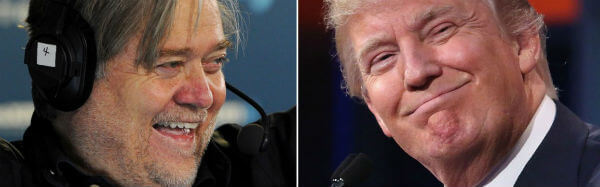
Eliot A. Cohen writes: I am a national security Never-Trumper who, after the election, made the case that young conservatives should volunteer to serve in the new administration, warily, their undated letters of resignation ready. That advice, I have concluded, was wrong.
My about-face began with a discreet request to me from a friend in Trumpworld to provide names — unsullied by having signed the two anti-Trump foreign policy letters — of those who might be willing to serve. My friend and I had agreed to disagree a while back about my taking an uncompromising anti-Trump stand; now, he wanted assistance and I willingly complied.
After an exchange about a senior figure who would not submit a résumé but would listen if contacted, an email exchange ensued that I found astonishing. My friend was seething with anger directed at those of us who had opposed Donald Trump — even those who stood ready to help steer good people to an administration that understandably wanted nothing to do with the likes of me, someone who had been out front in opposing Trump since the beginning.
This friend was someone I liked and admired, and still do. It was a momentary eruption of temper, and we have since patched up our relationship. I surmise that he has been furious for some time, knowing that supporting Trump has been distinctly unpopular in his normal circles. He is in the midst of a transition team that was never well-prepared to begin with and is now torn by acrimony, resignations and palace coups. And then there are the pent-up resentments against a liberal intellectual and media establishment that scorned his ilk for years. [Continue reading…]
Category Archives: Trump administration
Growing tumult in Trump’s national security transition team
The Washington Post reports: President-elect Donald Trump, who clashed with leading Republicans throughout his campaign, faced growing tumult in his national security transition team on Monday as key members of his own party appeared to question his views and personnel choices.
Former congressman Mike Rogers (R-Mich.), a respected voice on national security thought to be a leading candidate to run the CIA, was among those pushed out of the team over the past two days, two individuals with direct knowledge said, in a series of moves that have added to the anxiety across the upper ranks of U.S. intelligence agencies.
The changes came as Trump met Tuesday with incoming Vice President Mike Pence to discuss Cabinet and top White House personnel choices. Pence last week replaced New Jersey Gov. Chris Christie (R) as head of Trump’s overall transition efforts, and Christie’s associates — who had been Trump’s link to the GOP mainstream for months — now find themselves losing influence.
A number of Christie allies have been told they were no longer in line for top posts, according to several people familiar with the transition, who spoke on condition of anonymity to speak candidly.
Also on Tuesday, perhaps the most influential Republican on national security matters, Sen. John McCain (R-Ariz.), weighed in on Trump’s efforts to work with Russian President Vladimir Putin, saying any efforts to “reset” relations with Russia are unacceptable.
McCain, the Senate Armed Services Committee chairman who had a difficult relationship with Trump during the campaign, issued a statement blasting Putin as “a former KGB agent who has plunged his country into tyranny, murdered his political opponents, invaded his neighbors, threatened America’s allies and attempted to undermine America’s elections.’’
A former U.S. official with ties to the Trump team described the ousters of Rogers and others as a “bloodletting of anybody that associated in any way on the transition with Christie,” and said that the departures were engineered by two Trump loyalists who have taken control of who will get national security posts in the administration: retired Lt. Gen. Michael Flynn and Trump’s son-in-law, Jared Kushner. [Continue reading…]
The New York Times reports: Mr. Pence took the helm of the transition on Friday after Mr. Trump unceremoniously removed Gov. Chris Christie of New Jersey, who had been preparing with Obama administration officials for months to put the complex transition process into motion. That effort is now frozen, senior White House officials say, because Mr. Pence has yet to sign legally required paperwork to allow his team to begin collaborating with President Obama’s aides on the handover.
An aide to Mr. Trump’s transition team who insisted on anonymity to discuss internal matters said that the delay was taking place because the wording of the document was being altered and updated, and that it was likely to be signed later Tuesday.
Still, the slow and uncertain start to what is normally a rapid and meticulously planned transfer of power could have profound implications for Mr. Trump’s nascent administration. It challenges the president-elect’s efforts to gain control of the federal bureaucracy and to begin building a staff fully briefed on what he will face in the Oval Office on Day 1. [Continue reading…]
There’s no such thing as a good Trump voter
Jamelle Bouie writes: Millions of Americans are justifiably afraid of what they’ll face under a Trump administration. If any group demands our support and sympathy, it’s these people, not the Americans who backed Trump and his threat of state-sanctioned violence against Hispanic immigrants and Muslim Americans. All the solicitude, outrage, and moral telepathy being deployed in defense of Trump supporters — who voted for a racist who promised racist outcomes — is perverse, bordering on abhorrent.
It’s worth repeating what Trump said throughout the election. His campaign indulged in hateful rhetoric against Hispanics and condemned Muslim Americans with the collective guilt of anyone who would commit terror. It treated black America as a lawless dystopia and spoke of black Americans as dupes and fools. And to his supporters, Trump promised mass deportations, a ban on Muslim entry to the United States, and strict “law and order” as applied to those black communities. Trump is now president-elect. Judging from his choices for the transition — figures like immigration hardliner Kris Kobach and white nationalist Stephen Bannon — it’s clear he plans to deliver on those promises.
Whether Trump’s election reveals an “inherent malice” in his voters is irrelevant. What is relevant are the practical outcomes of a Trump presidency. Trump campaigned on state repression of disfavored minorities. He gives every sign that he plans to deliver that repression. This will mean disadvantage, immiseration, and violence for real people, people whose “inner pain and fear” were not reckoned worthy of many-thousand-word magazine feature stories. If you voted for Trump, you voted for this, regardless of what you believe about the groups in question. That you have black friends or Latino colleagues, that you think yourself to be tolerant and decent, doesn’t change the fact that you voted for racist policy that may affect, change, or harm their lives. And on that score, your frustration at being labeled a racist doesn’t justify or mitigate the moral weight of your political choice. [Continue reading…]
The challenge for anti-racists looking for solutions in Trump’s America
German Lopez writes: In 2016, researchers stumbled on a radical tactic for reducing another person’s bigotry: a frank, brief conversation.
The study, authored by David Broockman at Stanford University and Joshua Kalla at the University of California Berkeley, looked at how simple conversations can help combat anti-transgender attitudes. In the research, people canvassed the homes of more than 500 voters in South Florida. The canvassers, who could be trans or not, asked the voters to simply put themselves in the shoes of trans people — to understand their problems — through a 10-minute, nonconfrontational conversation. The hope was that the brief discussion could lead people to reevaluate their biases.
It worked. The trial found not only that voters’ anti-trans attitudes declined but that they remained lower three months later, showing an enduring result. And those voters’ support for laws that protect trans people from discrimination increased, even when they were presented with counterarguments for such laws.
I’ve been thinking a lot about this research since Election Day. After Donald Trump’s victory last week, it is clear that the prejudiced views of a lot of Americans helped elect to the White House a man who’s repeatedly made racist, offensive statements. Not only did Trump build his campaign largely on fears of immigrants and Muslims, but based on a lot of polls and surveys, he also attracted the voters who reported, by far, the highest levels of racial resentment and other prejudiced views. [Continue reading…]
Israel’s right, cheering Donald Trump’s win, renews calls to abandon two-state solution
The New York Times reports: Emboldened by the Republican sweep of last week’s American elections, right-wing members of the Israeli government have called anew for the abandonment of a two-state solution to the conflict with the Palestinians.
“The combination of changes in the United States, in Europe and in the region provide Israel with a unique opportunity to reset and rethink everything,” Naftali Bennett, Israel’s education minister and the leader of the pro-settlement Jewish Home party, told a gathering of the Foreign Press Association in Jerusalem on Monday.
Mr. Bennett, who advocates annexing 60 percent of the occupied West Bank to Israel, exulted on the morning after Donald J. Trump’s victory: “The era of a Palestinian state is over.”
That sentiment was only amplified when Jason Greenblatt, a lawyer and co-chairman of the Trump campaign’s Israel Advisory Committee, told Israel’s Army Radio that Mr. Trump did not consider West Bank settlements to be an obstacle to peace, in a stark reversal of longstanding American policy. [Continue reading…]
White nationalists see Steve Bannon as advocate who will hold Trump to his campaign promises
CNN reports: White nationalist leaders are praising Donald Trump’s decision to name former Breitbart executive Steve Bannon as his chief strategist, telling CNN in interviews they view Bannon as an advocate in the White House for policies they favor.
The leaders of the white nationalist and so-called “alt-right” movement — all of whom vehemently oppose multiculturalism and share the belief in the supremacy of the white race and Western civilization — publicly backed Trump during his campaign for his hardline positions on Mexican immigration, Muslims, and refugee resettlement. Trump has at times disavowed their support. Bannon’s hiring, they say, is a signal that Trump will follow through on some of his more controversial policy positions.
“I think that’s excellent,” former Ku Klux Klan leader David Duke told CNN’s KFile. “I think that anyone that helps complete the program and the policies that President-elect Trump has developed during the campaign is a very good thing, obviously. So it’s good to see that he’s sticking to the issues and the ideas that he proposed as a candidate. Now he’s president-elect and he’s sticking to it and he’s reaffirming those issues.” [Continue reading…]
The Hill reports: Conservative commentator Glenn Beck called President-elect Donald Trump’s choice for a top adviser a “nightmare” who has ties to the white nationalist movement.
“You know, if people really want to in the press would like to call Donald Trump a racist, you might want to stop on that one and spend a little time on [Steve] Bannon,” Beck said on his radio broadcast Monday.
“Bannon has a clear tie to white nationalists — clear tie,” Beck added of the former Breitbart News executive and Trump campaign CEO. “He’s built Breitbart as a platform for the alt-right.
“He’s on record saying that. He’s on record defining the alt-right. He knows what it is. He’s a guy that wants to tear this system down and wants to replace it with a new system.”
Beck said Bannon’s role in Trump’s future administration should inspire fear about the pair’s intentions for America.
“He’s a nightmare,” Beck said of Bannon. “And he’s the chief adviser to the president of the United States now.
“He is a frightening — no, no, no, he is a terrifying man, terrifying man. … It speaks volumes.” [Continue reading…]
In an editorial, the New York Times says: Anyone holding out hope that Donald Trump would govern as a uniter — that the racism, sexism, anti-Semitism and nativism of his campaign were just poses to pick up votes — should think again.
In an ominous sign of what the Trump presidency will actually look like, the president-elect on Sunday appointed Stephen Bannon as his chief White House strategist and senior counselor, an enormously influential post.
Many if not most Americans had never heard of Mr. Bannon before this weekend, and for good reason: He has kept a low profile, even after taking over Mr. Trump’s campaign in August. Before that, he worked as the executive chairman of the Breitbart News Network, parent company of the far-right website Breitbart News, which under Mr. Bannon became what the Southern Poverty Law Center has called a “white ethno-nationalist propaganda mill.”
Mr. Bannon himself seems fine with that description, telling Mother Jones last summer that Breitbart was now “the platform for the alt-right,” a loosely organized group of mostly young men who believe in white supremacy; oppose immigration, feminism and multiculturalism; and delight in harassing Jews, Muslims and other vulnerable groups by spewing shocking insults on social media.
To scroll through Breitbart headlines is to come upon a parallel universe where black people do nothing but commit crimes, immigrants rape native-born daughters, and feminists want to castrate all men. Here’s a sample:
“Hoist It High and Proud: The Confederate Flag Proclaims a Glorious Heritage” (This headline ran two weeks after a white supremacist massacred nine black churchgoers in Charleston, S.C.)
“Birth Control Makes Women Unattractive and Crazy”
“Gabby Giffords: The Gun Control Movement’s Human Shield”
If you don’t find the headlines alarming, check the reader comments. Or take a look at who’s rejoicing over Mr. Bannon’s selection. The white nationalist Richard Spencer said on Twitter that Mr. Bannon was in “the best possible position” to influence policy, since he would “not get lost in the weeds” of establishment Washington. The chairman of the American Nazi Party said the pick showed that Mr. Trump might be “for ‘real.’” David Duke, former imperial wizard of the Ku Klux Klan, called the choice “excellent” and said Mr. Bannon was “basically creating the ideological aspects of where we’re going.”
Mr. Bannon is in some ways a perplexing figure: a far-right ideologue who made his millions investing in “Seinfeld”; a former Goldman Sachs banker who has reportedly called himself a “Leninist” with a goal “to destroy the state” and “bring everything crashing down.” He has also called progressive women “a bunch of dykes” and, in a 2014 email to one of his editors, wrote of the Republican leadership, “Let the grassroots turn on the hate because that’s the ONLY thing that will make them do their duty.”
A few conservatives have spoken out against Mr. Bannon. Ben Shapiro, a former Breitbart News editor who resigned in protest last spring, said Mr. Bannon was a “vindictive, nasty figure.” Glenn Beck called him a “nightmare” and a “terrifying man.”
But most Republican officeholders have so far remained silent. Some have dismissed fears about Mr. Bannon. Other Republicans have praised him, like Reince Priebus, the chairman of the Republican National Committee, whom Mr. Trump announced as his chief of staff on Sunday, and who said Mr. Bannon could not be such a bad guy because he served in the Navy and went to Harvard Business School. Some saw the pick of Mr. Priebus as evidence that Mr. Trump would not be leaning so much on Mr. Bannon. But don’t be fooled by Mr. Priebus’s elevated title; in the press release announcing both hires, Mr. Bannon’s name appeared above Mr. Priebus’s. In a little more than two months Mr. Bannon, and his toxic ideology, will be sitting down the hall from the Oval Office.
‘Knife fight’ as Trump builds dysfunctional national security team
CNN reports: Donald Trump’s transition is being marked by sharp internal disagreements over key cabinet appointments and direction, both for internal West Wing positions and key national security posts, sources involved in the transition team tell CNN.
One source with knowledge of the transition described it as a “knife fight.”
The split has put traditional Republican operatives such as Reince Priebus — named Trump’s chief of staff Sunday — against more non-traditional influences such as Steve Bannon — the alt-right leader of Breitbart News — who will be Trump’s chief strategist. A particular challenge is lack of clarity about the division of power among Priebus, Bannon and Trump’s son-in-law Jared Kushner, who also has a key role in transition decisions. Another source tied to the transition described the resulting confusion as “buffoonery.”
Vice President-elect Mike Pence, the new leader of the transition operation, will be at Trump Tower in New York Tuesday to meet with Trump and discuss possible nominees. [Continue reading…]
The Wall Street Journal reports: Friday’s reorganization of the transition team increased the influence of Mr. Pence and Sen. Jeff Sessions (R., Ala.), who now has several allies holding top staff positions. The role for New Jersey Gov. Chris Christie, who had been in charge of the transition, has been diluted.
The slower decision-making process is also amplified by Mr. Trump’s lack of public appearances since the election, even as protests erupt around the country following his election.
While Mr. Obama and his predecessor, Republican George W. Bush in 2000, used constant news conferences after their victories to speak to Americans, Mr. Trump has held none, only doing a Wall Street Journal interview and the “60 Minutes” appearance.
During their private White House meeting on Thursday, Mr. Obama walked his successor through the duties of running the country, and Mr. Trump seemed surprised by the scope, said people familiar with the meeting. Trump aides were described by those people as unaware that the entire presidential staff working in the West Wing had to be replaced at the end of Mr. Obama’s term. [Continue reading…]
The Wall Street Journal reports: Former New York Mayor Rudy Giuliani is the leading candidate to be President-elect Donald Trump’s nominee for secretary of state, people familiar with the matter said, a move that would elevate a well-known national figure to become the U.S.’s chief diplomat.
Mr. Trump’s aides have also considered former U.S. Ambassador to the United Nations John Bolton as a possible candidate, but the close relationship between Messrs. Giuliani and Trump was a major consideration, the people said.
Asked at The Wall Street Journal CEO Council meeting in Washington on Monday evening if his title would soon be “Secretary,” Mr. Giuliani responded, “One never knows.”
Mr. Giuliani also said that Mr. Bolton would be a good choice for secretary of state. He was then asked if there was a better choice than Mr. Bolton and he replied, “Maybe me, I don’t know.”
For Mr. Trump, it is a choice between a longtime friend and ally in New York, Mr. Giuliani, and a hawkish conservative diplomat, Mr. Bolton, who called last year for the U.S. to bomb Iran. A final decision could be several weeks away, these people said, and other candidates could still emerge. [Continue reading…]
How America got Trumped
Kenan Malik writes: Trump can be seen as an agent of change only because real agents of change, progressive social movements that can truly transform people’s lives, have largely eroded.
What we are witnessing is a crisis both of the political class and of progressive opposition to it. The political elite is so disengaged from the electorate that it failed to recognize the depth of anger and disaffection from mainstream institutions and its party machines have become so rusty that they could not check the Trump surge. And oppositional movements are so weakened that Trump can be seen by many as an agent of change.
It is this dual crisis that is unstitching politics, and not just in America. The same phenomenon is at play in Europe, driving the success of the reactionary populist groups from the Sweden Democrats to the Front National in France. And globally, too, from Turkey to India, from Egypt to South Africa, the old order is coming unstitched while opposition movements that have emerged to give voice to that disaffection are often rooted in religious or ethnic identity, and are often sectarian or separatist in form. As in Europe and the USA there is a hole where progressive social movements should be.
There have been many apocalyptic prognostications in the wake of Trump’s success. His victory, many claim, will lead to everything from the rise of fascism to the end of the West. The real issue lies less with Trump himself, than with the dual crisis of the elite and of opposition movement. It is how we address this, and in particular whether we are able to build real movements for change, that will shape the future, and not just in the USA. [Continue reading…]
Trump’s win may be just the beginning of a global populist wave
The Washington Post reports: Not long before Americans shocked the world by selecting Donald Trump to be their next president, a wealthy Brazilian businessman who played a reality-star boss on television became mayor of South America’s largest city.
On the other side of the globe, in Southeast Asia, a gun-slinging vigilante who vowed to kill all criminals and dump their bodies until the “fish will grow fat” was elected to lead a nation of 100 million.
And in Britain, voters with a centuries-long streak of moderation and pragmatism opted to ignore the overwhelming advice of experts by leaping into the abyss of life outside the European Union.
The populist wave of 2016 that carried Trump to the pinnacle of international power and influence didn’t start in the United States. And it certainly won’t end there.
Instead, the biggest prize yet for a global movement built on a seemingly bottomless reserve of political, economic and cultural grievance is likely to be an accelerant to even more victories for people and causes bent on upending the existing world order.
“Success breeds success,” said Mark Leonard, director of the European Council on Foreign Relations. “Right now, everyone is susceptible to it. The drivers seem to be universal.”
And unless something dramatic changes to curb the populist appeal, a scattering of surprise victories this year could soon turn into a worldwide rout — the triumph of those who preach strong action over rule of law, unilateralism instead of cooperation and the interests of the majority above the rights of ethnic and religious minorities. [Continue reading…]
Steve Bannon will lead Trump’s White House
Ryan Lizza writes: “I’m a Leninist,” Steve Bannon told a writer for The Daily Beast, in early 2014. “Lenin wanted to destroy the state, and that’s my goal, too. I want to bring everything crashing down, and destroy all of today’s establishment.”
At the time, Bannon was the executive chairman of Breitbart News, the far-right news site. When he became the C.E.O. of Donald Trump’s campaign, in August, he told the writer that he had no recollection of the conversation. On Sunday, Trump, in his first personnel decisions as President-elect, named Bannon as his chief strategist and senior counselor and Reince Priebus, the Republican National Committee Chairman, his chief of staff.
The press release from the Trump transition staff said that Bannon and Priebus would be “equal partners.” This is a signal to Washington that Bannon will be the most powerful person in Trump’s White House. On November 6, 2008, the day after his election, Barack Obama made just one personnel announcement: that Congressman Rahm Emanuel would be his chief of staff. Every staff member in the Obama White House reported to Emanuel, including political advisers such as David Axelrod. Even in the George W. Bush White House, which at first had a weak chief of staff, Andy Card, and a powerful political adviser, Karl Rove, everyone, including Rove, formally reported to Card.
Trump has indicated that, in his White House, Bannon will be first among equals. [Continue reading…]
The Washington Post reports: neither Bannon nor staff members at Breitbart have spelled out what their relationship will be after candidate Trump becomes President Trump. But even if Bannon and the website sever all ties, they will face an unusual, and awkward, situation: Bannon would be the former executive of a media organization that openly supported his political patron who will serve the president in a senior capacity while his media organization continues to cover him and his new boss.
“Breitbart will now go from being the propaganda arm of the Trump campaign to effectively becoming a state-run medium,” said Kurt Bardella, Breitbart’s former spokesman. “They will exist to tell the narrative of the Trump presidency to their audience to ensure their alternate reality they successfully ran on stays intact regardless of the situational reality and condition of this country. There is no separation between Breitbart and the Trump White House.” [Continue reading…]
Syrian rebels brace for a Trump cutoff, and look for a silver lining
The New York Times reports: The hours are ticking down to what the Syrian government and its main ally, Russia, say could be the most devastating aerial assault yet on besieged rebel-held districts in the Syrian city of Aleppo.
The Obama administration has offered no military lifeline even to rebel groups it has vetted and backed.
But Donald J. Trump, the American president-elect, has gone a step further, at least in his remarks, suggesting that he will end all support to rebels and perhaps even treat the Syrian and Russian governments as allies in the fight against the Islamic State.
Some rebels and civilian supporters say such a move might not make much practical difference, and would at least put the American position out in the open, instead of hiding it behind condemnations of Bashar al-Assad, the Syrian president.
Seeking a silver lining, some rebels express hope that American allies like Saudi Arabia and Turkey would then go it alone and defy United States orders not to provide more sophisticated weapons to rebels — though in the short term, such a cutoff could mean losing supplies of American antitank guided missiles. [Continue reading…]
ISIS commander says Trump’s ‘utter hate towards Muslims will make our job much easier because we can recruit thousands’
Reuters reports: From Afghanistan to Algeria, jihadists plan to use Donald Trump’s shock U.S. presidential victory as a propaganda tool to bring new fighters to their battlefields.
Taliban commanders and Islamic State supporters say Trump’s campaign trail rhetoric against Muslims – at one point calling for a total shutdown of Muslims entering the United States – will play perfectly in their recruitment efforts, especially for disaffected youth in the West.
“This guy is a complete maniac. His utter hate towards Muslims will make our job much easier because we can recruit thousands,” Abu Omar Khorasani, a top IS commander in Afghanistan, told Reuters.
Trump has talked tough against militant groups on the campaign trail, promising to defeat “radical Islamic terrorism just as we won the Cold War.” [Continue reading…]
The global ambitions of Trump’s Goebbels-like chief strategist, Steve Bannon

The Daily Beast reports: [On Sunday, Steve Bannon, publisher of Breitbart, was appointed by Donald Trump as his chief strategist.] Bannon’s support for European far-right parties runs far deeper than his interest in Marion Maréchal-Le Pen or the National Front. He brags about his international Breitbart operation as “the platform” for the American alt-right, and has for years been thinking globally, with an affinity for the United Kingdom Independence Party (UKIP), Alternative for Germany (AfD), and the Party for Freedom Party (PVV) in the Netherlands, all of which have earned glowing coverage on the pages of Breitbart.
But the election of Bannon’s man Donald Trump as president of the United States has made the globalization of Breitbart and its message infinitely more plausible than it ever was before, and politicians once considered Europe’s deplorables are now rushing to bask in the gilded glow of Trump and Bannon.
On Saturday, Britain’s Nigel Farage, whose blatant and acknowledged lies helped convince his countrymen to opt out of the European Union in the Brexit vote, visited the president-elect in his eponymous Fifth Avenue tower.
Farage emerged from the meeting looking like he’d just won the jackpot at one of the pre-bankruptcy Trump casinos, suggesting that the new president’s “inner team” was not too happy with Tory Prime Minister Theresa May, since she’d been skeptical of Brexit before the vote. Would that “inner team” be Bannon? In our post-factual world, maybe we can say, “People say…”
Breitbart, which currently has operations in London and Jerusalem, certainly has plans to expand in France and Germany with new bureaus to cultivate and promote the populist-nationalist lines there. [Continue reading…]
The Washington Post reports: The Southern Poverty Law Center, a hate-watch group, has accused Breitbart of explicitly embracing ethno-nationalism. After Bannon’s elevation was announced, the law center tweeted several controversial stories written by Breitbart under Bannon’s control, including a piece published two weeks after a mass killing at a black church in Charleston, S.C., last year: “Hoist it high and proud: the confederate flag proclaims a glorious heritage.”
“Stephen Bannon was the main driver behind Breitbart becoming a white ethno-nationalist propaganda mill,” the law center wrote via Twitter in its first statements on Bannon’s elevation. “Trump should rescind this hire. In his victory speech, Trump said he intended to be president for ‘all Americans.’ Bannon should go.” [Continue reading…]
Berenberg Bank: Politics right now ‘evokes memories of the dreadful 1930s’
Business Insider reports: German investment bank Berenberg believes that “some aspects of Donald Trump’s successful election campaign evoke memories of the dreadful 1930s.”
The bank’s chief economist Holger Schmieding says in a note sent out on Monday that: “After the Brexit vote and the triumph of Trump, the echo of the early 1930s sounds a little less faint than it did before.”
Schmieding highlights populism, rising protectionism and nationalism, isolationism, and the erosion of the political middle ground as key features of both the current political climate and the 1930s.
“Populist” leaders — often dictators such as Hitler and Mussolini — came to power across Europe in the 1930s with promises to restore glory and honour to their countries, often blaming foreign races and religions for the problems.
Both recent the Brexit and Trump campaigns blamed outsiders for problems at home (the EU, Mexicans, Muslims) and had strong nationalist streaks (Make America Great Again, Take Back Control).
International trade tailed off in the wake of the 1929 Wall Street Crash as the US turned inwards. Schmieding says: “Two major policy mistakes turned the financial crisis into a depression” — the US fed tightening monetary policy and the 1930 Smoot-Hawley tariff act, which enacted protectionist taxes on imports.
Both Trump and the current pro-Brexit UK government have promised to reverse the rising tide of globalism. Trump plans to do this by scrapping or significantly changing a trade deal with Mexico and putting tariffs on imports from China. UK Prime Minister Theresa May has promised to reign in globalisation.
Schmieding calls the 1930s “dreadful” because the Great Depression, triggered by policy mistakes, led to widespread poverty. The potent economic and political cocktail of depression and nationalism also led to World War II.
But Schmieding says that “the [current] situation is very different in at least three key respects.” These are:
- Rising employment: “Despite widespread anger at the establishment, we are not quite living in pitchfork times again.”
- Lack of ideology: “Trump and some other leading populists today come across as opportunistic self-promoters rather than incorrigible ideologues.”
- International cooperation: “Institutions of international co-operation and the rule of law at home are much stronger in the developed world than they were in Europe in the 1930s.”
As a result, he does not think we are hurtling towards another major global conflict or serious economic crisis. Still, there are significant risks. [Continue reading…]
What could the rest of the world do if Trump pulls the U.S. out of the Paris Agreement on climate change?
By Henrik Selin, Boston University and Adil Najam, Boston University
Climate change negotiators from around the world – now meeting at the COP22 conference in Marrakech, Morocco – continue steadfastly with the task of putting meaning and action into the landmark 2015 Paris Agreement to bring down global greenhouse gas emissions.
Yet, the tone in Marrakech has suddenly become more subdued. While many conversations remain staunchly defiant, others have assumed a funeral-like quality, as national delegates and civil society representatives try to assess the ramifications of the U.S. presidential election.
Elections have consequences for global climate change negotiations and the future of the planet.
President-elect Donald Trump has repeatedly stated he does not believe in human-induced climate change. He has argued that climate change is an expensive hoax that was created by the Chinese to make U.S. manufacturing noncompetitive. He has also declared his intent to roll back federal climate change and renewable energy policy. Most poignantly for Marrakech, he has loudly declared an intention to “cancel the Paris climate agreement.”
Some cling to the hope that President Trump will forget pronouncements made by Candidate Trump just as Candidate Trump had ignored the pontifications of Citizen Trump. An important indicator of why this may not be the case is the appointment of Myron Ebell as head of the transition team for the U.S. Environmental Protection Agency (EPA). Ebell, also a front-runner to be appointed as head of the EPA, is an outspoken climate change denier who flat out rejects the Paris Agreement as unconstitutional.
China threatens to cut sales of iPhones and U.S. cars if ‘naive’ Trump pursues trade war
The Guardian reports: US president-elect Donald Trump would be a “naive” fool to launch an all-out trade war against China, a Communist party-controlled newspaper has claimed.
During the acrimonious race for the White House Trump repeatedly lashed out at China, vowing to punish Beijing with “defensive” 45% tariffs on Chinese imports and to officially declare it a currency manipulator.
“When they see that they will stop the cheating,” the billionaire Republican, who has accused Beijing of “the greatest theft in the history of the world”, told a rally in August.
On Monday the state-run Global Times warned that such measures would be a grave mistake.
“If Trump wrecks Sino-US trade, a number of US industries will be impaired. Finally the new president will be condemned for his recklessness, ignorance and incompetence,” the newspaper said in an editorial.
The Global Times claimed any new tariffs would trigger immediate “countermeasures” and “tit-for-tat approach” from Beijing.
“A batch of Boeing orders will be replaced by Airbus. US auto and iPhone sales in China will suffer a setback, and US soybean and maize imports will be halted. China can also limit the number of Chinese students studying in the US.”
“Making things difficult for China politically will do him no good,” the newspaper warned. [Continue reading…]
How Obama left the door open for Trump to resume torture
The New York Times reports: As a presidential candidate, Donald J. Trump vowed to refill the cells of the Guantánamo Bay prison and said American terrorism suspects should be sent there for military prosecution. He called for targeting mosques for surveillance, escalating airstrikes aimed at terrorists and taking out their civilian family members, and bringing back waterboarding and a “hell of a lot worse” — not only because “torture works,” but because even “if it doesn’t work, they deserve it anyway.”
It is hard to know how much of this stark vision for throwing off constraints on the exercise of national security power was merely tough campaign talk. But if the Trump administration follows through on such ideas, it will find some assistance in a surprising source: President Obama’s have-it-both-ways approach to curbing what he saw as overreaching in the war on terrorism.
Over and over, Mr. Obama has imposed limits on his use of such powers but has not closed the door on them — a flexible approach premised on the idea that he and his successors could be trusted to use them prudently. Mr. Trump can now sweep away those limits and open the throttle on policies that Mr. Obama endorsed as lawful and legitimate for sparing use, like targeted killings in drone strikes and the use of indefinite detention and military tribunals for terrorism suspects.
And even in areas where Mr. Obama tried to terminate policies from the George W. Bush era — like torture and the detention of Americans and other people arrested on domestic soil as “enemy combatants” — his administration fought in court to prevent any ruling that the defunct practices had been illegal. The absence of a definitive repudiation could make it easier for Trump administration lawyers to revive the policies by invoking the same sweeping theories of executive power that were the basis for them in the Bush years. [Continue reading…]
Is Trump reaching out to Europe’s far right before he talks with the heads of state?
The Washington Post reports: Marion Maréchal-Le Pen — a rising star in France’s far-right National Front and the niece of the party’s leader, Marine Le Pen — wrote on Twitter on Saturday that representatives of President-elect Donald Trump had invited her to “work together.”
Le Pen, 26, became the youngest member of France’s Parliament in 2012. She was elected to represent Vaucluse, a region in southern France with heavy ties to the National Front, a party founded by her grandfather, the 88-year-old Jean-Marie Le Pen. He once referred to the Nazi concentration camps as a “detail of history.”
Je réponds oui à l'invitation de Stephen Bannon, directeur de la campagne #Trump, à travailler ensemble. https://t.co/tPSoY5A2vS
— Marion Le Pen (@Marion_M_Le_Pen) November 12, 2016
“I answer yes to the invitation of Stephen Bannon, CEO of @realDonaldTrump presidential campaign, to work together,” Marion Maréchal-Le Pen tweeted.Bannon — the former executive chairman of Breitbart News Network with ties to the so-called alt-right — is rumored to be among the possible candidates for Trump’s chief of staff. [On Sunday, Bannon was named as chief strategist and senior counselor to the president.]
Her tweet reflected a highly unusual phenomenon: an American president-elect seeking to forge relationships with ultranationalist and populist factions overseas that are often sharply critical of their countries’ governments. It also raised the question of whether Trump and his representatives have been reaching out to foreign populist parties before first reaching out to foreign heads of state. [Continue reading…]