Category Archives: Trump administration

Anthony Scaramucci loved Hillary, gave to Obama, and deleted anti-Trump tweets

The Daily Beast reports: Anthony Scaramucci deleted tweets in which he previously criticized Donald Trump hours after accepting his new job as White House communications director on Friday.

Scaramucci also previously expressed support for his boss’s old rivals, Hillary Clinton and Barack Obama—even donating money to their campaigns.

In December 2011, Scaramucci referred to the “Trump spectacle” in a tweet about Mitt Romney. Two months later, the new White House pick tweeted a National Journal article about Trump endorsing Newt Gingrich in the 2012 race: “Odd guy. So smart with no judgment.”

The deleted tweets were spotted by freelance journalist Josh Billinson, who Scaramucci briefly blocked.

“I’m just shocked he hadn’t deleted them earlier,” Billinson told The Daily Beast. “That he could’ve been in the running for communications director and not even thought to check what he had publicly said about Trump in the past is wild to me.” [Continue reading…]

Facebooktwittermail

Sessions discussed Trump campaign-related matters with Russian ambassador, U.S. intelligence intercepts show

The Washington Post reports: Russia’s ambassador to Washington told his superiors in Moscow that he discussed campaign-related matters, including policy issues important to Moscow, with Jeff Sessions during the 2016 presidential race, contrary to public assertions by the embattled attorney general, according to current and former U.S. officials.

Ambassador Sergey Kislyak’s accounts of two conversations with Sessions — then a top foreign policy adviser to Republican candidate Donald Trump — were intercepted by U.S. spy agencies, which monitor the communications of senior Russian officials both in the United States and in Russia. Sessions initially failed to disclose his contacts with Kislyak and then said that the meetings were not about the Trump campaign.

One U.S. official said that Sessions — who testified that he has no recollection of an April encounter — has provided “misleading” statements that are “contradicted by other evidence.” A former official said that the intelligence indicates that Sessions and Kislyak had “substantive” discussions on matters including Trump’s positions on Russia-related issues and prospects for U.S.-Russia relations in a Trump administration.

Sessions has said repeatedly that he never discussed campaign-related issues with Russian officials and that it was only in his capacity as a U.S. senator that he met with Kislyak.

“I never had meetings with Russian operatives or Russian intermediaries about the Trump campaign,” Sessions said in March when he announced that he would recuse himself from matters relating to the FBI probe of Russian interference in the election and any connections to the Trump campaign.

Current and former U.S. officials said that assertion is at odds with Kislyak’s accounts of conversations during two encounters over the course of the campaign, one in April ahead of Trump’s first major foreign policy speech and another in July on the sidelines of the Republican National Convention.

The apparent discrepancy could pose new problems for Sessions at a time when his position in the administration appears increasingly tenuous. [Continue reading…]

Facebooktwittermail

Congress likely to tie Trump’s hands on Russia sanctions

Politico reports: A White House effort to secure changes to a Russia sanctions bill constraining President Donald Trump appears likely to fall short, in a major rebuff by the GOP-led Congress to the leader of its own party.

Senior Republican lawmakers and aides gave their clearest comments yet Thursday that the bill would ultimately move forward without changes sought by the White House, potentially undermining Trump’s ability to warm relations with Moscow.

The Senate already passed the bill on a 98-2 vote. And while it’s stalled in the House amid partisan finger-pointing, most Republicans are joining Democrats to support adding new sanctions while curbing Trump’s power to roll back the penalties against Russia.

Secretary of State Rex Tillerson has pushed back against the bill for not providing the administration with “flexibility” to deal with Vladimir Putin’s government, but his words don’t appear to be resonating. GOP lawmakers are loath to be seen as watering down efforts to punish Putin for meddling in the 2016 election, even if many brush off the growing controversy over the Trump campaign’s ties to Russia.

Tillerson is “a good friend, and I really love my relationship with him, but that’s not likely to occur,” Senate Foreign Relations Chairman Bob Corker said Thursday when asked about the White House’s request for changes to the sanctions bill.

Language empowering Congress to block Trump from any attempt to ease or end sanctions “is going to stay in this bill,” Corker told reporters. “And we’ve had very constructive meetings with the House — there’s no attempt whatsoever to move away from” that provision, the Tennessee Republican added. [Continue reading…]

Facebooktwittermail

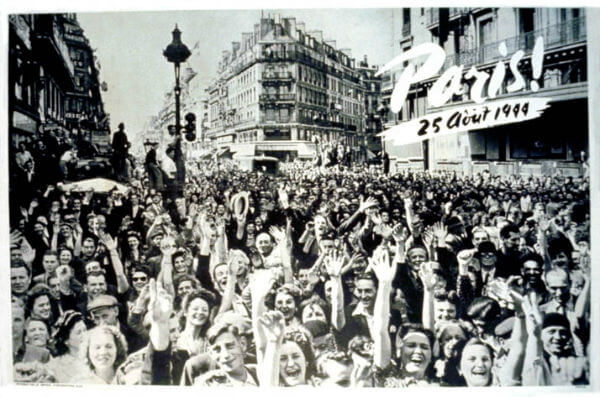
Trump in Paris — biggest celebration ever?

1944 liberation from Nazi occupation saw the biggest celebrations in Paris — prior to Donald Trump’s arrival


On MSNBC this morning, the New York Times’ Michael Schmidt described Trump as often being “hard to follow” during their White House interview on Wednesday.

As a reporter, Schmidt might feel obliged to maintain a facade of neutrality — as though he has no opinion about the state of this president’s mental health.

And yet, an insistent unwillingness to make judgments can mask a fear of making meaningful observations. In everyday life, as we read other people — through their words, demeanor, body language, and other indications — we use our powers of discernment to discriminate between delusion and deception.

A journalist doesn’t have to claim the capacity to read Trump’s mind in order to convey his or her sense of whether Trump actually believes the ridiculous things he so often says.

Trump is hard to follow because he’s hard to swallow.

The occasional probing interjection might provide some clarity during his otherwise meandering stream of consciousness. For instance, pointing out that the history of the Eiffel Tower stretches back to the Nineteenth Century would suggest that it had been the location of bigger celebrations than the one Trump claims he recently witnessed — leaving aside the fact that the throngs in question may have simply been the swell of tourists typically found in central Paris on a midsummer evening.

Does Trump generally assume that any crowd in his vicinity is most likely a crowd of admirers?

TRUMP: We had dinner at the Eiffel Tower, and the bottom of the Eiffel Tower looked like they could have never had a bigger celebration ever in the history of the Eiffel Tower. I mean, there were thousands and thousands of people, ’cause they heard we were having dinner.

[crosstalk/garbled]

HABERMAN: You must have been so tired at, by that point.

TRUMP: Yeah. It was beautiful. We toured the museum, we went to Napoleon’s tomb …

[crosstalk]

TRUMP: Well, Napoleon finished a little bit bad. But I asked that. So I asked the president, so what about Napoleon? He said: “No, no, no. What he did was incredible. He designed Paris.” [garbled] The street grid, the way they work, you know, the spokes. He did so many things even beyond. And his one problem is he didn’t go to Russia that night because he had extracurricular activities, and they froze to death. How many times has Russia been saved by the weather? [garbled]

[crosstalk/unintelligible]

TRUMP: Same thing happened to Hitler. Not for that reason, though. Hitler wanted to consolidate. He was all set to walk in. But he wanted to consolidate, and it went and dropped to 35 degrees below zero, and that was the end of that army.

[crosstalk]

But the Russians have great fighters in the cold. They use the cold to their advantage. I mean, they’ve won five wars where the armies that went against them froze to death. [crosstalk] It’s pretty amazing.

So, we’re having a good time. The economy is doing great.

And this snippet of Wednesday’s interview leads to another question about Trump’s second conversation with Putin at the G-20 — the one that Trump recounted as having amounted to little more than an exchange of pleasantries.

If the New York Times reporters found Trump hard to follow, how clear was he to the Russian president and his translator?

The fact that Trump initiated the contact — evident in hand gestures and a nod that were videoed — appear to show he knew what he wanted to say. An indication, perhaps, that Trump’s appearance of confusion may have less to do with his garbled thinking than with his desire to sow confusion.

Facebooktwittermail

Sean Spicer resigns as White House press secretary

The New York Times reports: Sean Spicer, the White House press secretary, resigned on Friday after denouncing chaos in the West Wing and telling President Trump he vehemently disagreed with the appointment of the New York financier Anthony Scaramucci as communications director.

After offering Mr. Scaramucci the communications job Friday morning, Mr. Trump asked Mr. Spicer to stay on as press secretary. But Mr. Spicer told Mr. Trump that he believed the appointment of Mr. Scaramucci was a major mistake and said he was resigning, according to a person with direct knowledge of the exchange.

In one of his first official acts, Mr. Scaramucci, who founded the global investment firm SkyBridge Capital and is a Fox News contributor, joined Sarah Huckabee Sanders, Mr. Spicer’s chief deputy, in the White House briefing room and announced that she would succeed Mr. Spicer as press secretary.

He said he had great respect for Mr. Spicer, adding, “I hope he goes on to make a tremendous amount of money.” But he acknowledged the awkwardness of Mr. Spicer’s resignation. “This is obviously a difficult situation to be in,” Mr. Scaramucci said. [Continue reading…]

Facebooktwittermail

Steve Bannon’s disappearing act

Politico reports: Steve Bannon has largely disappeared from the White House’s most sensitive policy debates — a dramatic about-face for an operative once characterized as the most powerful man in Washington.

Bannon, chastened by internal rivalries and by President Donald Trump’s growing suspicion that he is looking out for his own interests, is in a self-imposed exile, having chosen to step back from Trump’s inner circle for the sake of self-preservation, according to several White House advisers who spoke to POLITICO on the condition of anonymity to avoid angering a colleague.

He was absent from Trump’s recent trips to Europe for the G-20 summit and from his visit with French President Emmanuel Macron. Bannon’s non-attendance is all the more noteworthy given his interest in European history and politics, particularly his antipathy to the European Union. [Continue reading…]

Facebooktwittermail

Syrian rebels feel betrayed by U.S. decision to end CIA support: ‘It will weaken America’s influence.’

The Washington Post reports: Syrian rebel commanders said Thursday that they were disappointed in the Trump administration’s decision to end a covert CIA weapons and training program for opposition fighters, an initiative that began under President Barack Obama but fizzled out amid battlefield losses and concerns about extremism within rebel ranks.

“We definitely feel betrayed,” said Gen. Tlass al-Salameh of Osoud al-Sharqiya, a group affiliated with the Free Syrian Army. Salameh and his deputies say that they have received CIA support to rout the Islamic State from areas of eastern Syria but that they have also fought battles against pro-government ­forces.

“It feels like we are being abandoned at a very difficult moment,” Salameh said. “It feels like they only wanted to help when we were fighting [the Islamic State]. Now that we are also fighting the regime, the Americans want to withdraw.” [Continue reading…]

Facebooktwittermail

Trump’s lawyers and aides look for ways to undermine the Mueller investigation

The New York Times reports: President Trump’s lawyers and aides are scouring the professional and political backgrounds of investigators hired by the special counsel Robert S. Mueller III, looking for conflicts of interest they could use to discredit the investigation — or even build a case to fire Mr. Mueller or get some members of his team recused, according to three people with knowledge of the research effort.

The search for potential conflicts is wide-ranging. It includes scrutinizing donations to Democratic candidates, investigators’ past clients and Mr. Mueller’s relationship with James B. Comey, whose firing as F.B.I. director is part of the special counsel’s investigation.

The effort to investigate the investigators is another sign of a looming showdown between Mr. Trump and Mr. Mueller, who has assembled a team of high-powered prosecutors and agents to examine whether any of Mr. Trump’s advisers aided Russia’s campaign to disrupt last year’s presidential election.

Some of the investigators have vast experience prosecuting financial malfeasance, and the prospect that Mr. Mueller’s inquiry could evolve into an expansive examination of Mr. Trump’s financial history has stoked fears among the president’s aides. Both Mr. Trump and his aides have said publicly they are watching closely to ensure Mr. Mueller’s investigation remains narrowly focused on last year’s election.

During an interview with The New York Times on Wednesday, Mr. Trump said he was aware that members of Mr. Mueller’s team had potential conflicts of interest and would make the information available “at some point.” [Continue reading…]

Politico reports: The spokesman for President Donald Trump’s legal team has resigned within two months of being on the job, according to people familiar with the matter.

Mark Corallo, the spokesman, had grown frustrated with the operation and the warring factions and lawyers, these people said. Corallo also was concerned about whether he was being told the truth about various matters, one of these people said.

Corallo has been close to special counsel Robert Mueller, who is leading the Russia investigation, and has praised him publicly. He didn’t like the strategy to attack his credibility, one person who spoke to him said. [Continue reading…]

Facebooktwittermail

Bannon and Kushner want to outsource Afghanistan to mercenaries

Mark Perry writes: On July 10, the New York Times revealed that the Trump White House had recruited Erik Prince, the founder of the notorious private security firm Blackwater, and wealthy Trump backer Steve Feinberg, the owner of the high-profile military contractor DynCorp International, to “devise alternatives to the Pentagon’s plan to send thousands of additional troops to Afghanistan.” The story suggested that the president and his top advisers were dissatisfied with the military’s thinking on the conflict, the subject of an intense series of a consultations between senior military officers and Trump’s national security team over the last several months.

While the recruitment of Prince and Feinberg, who are close friends, was intended to provide new options for winning the 16-year war, the administration has been hesitant to describe their role. Both men are controversial for their advocacy of the U.S. government contracting out the Afghan conflict to a private company that would build Afghan state capacity, provide logistical support to the Afghan army, and battle the Taliban. At the very least, the new arrangement would mean a lighter footprint for the U.S. military (or perhaps none at all); at the most it would mean that corporate America, and not the U.S. government, would be responsible for running an overseas war—a kind of “War Inc.”

“Dyncorp has its hands all over Afghanistan anyway, and I mean they’re just everywhere,” a high-level former intelligence officer who is privy to the administration’s thinking told me, “so [senior White House adviser Steve] Bannon and crew figure, ‘What the hell, let’s just turn the whole country over to them.’”

But the proposal has shocked the handful of senior Pentagon and CIA officials familiar with it, who point out the difficulty the United States has had in controlling private armies—and those who run them. This was particularly true of Blackwater, whose contractors gave the U.S. military fits in Iraq’s Anbar Province in the aftermath of Operation Iraqi Freedom, where both national security adviser H.R. McMaster and Defense Secretary James Mattis served in key command positions. Senior military officers blame Blackwater for destabilizing Fallujah in 2004 (forcing Mattis to send his Marines into the city in “Operation Vigilant Resolve”) and for the deaths of 20 Iraqi civilians in Baghdad (the “Nisour Square Massacre”) in 2007. [Continue reading…]

Facebooktwittermail

Trump’s fury erodes his relationship with Sessions, an early ally

The New York Times reports: President Trump’s staff is used to his complaints about Attorney General Jeff Sessions, but the Republican senators who attended a White House dinner on Monday were stunned to hear him criticize the man who was once Mr. Trump’s most loyal supporter in the Senate.

It turned out to be a preview of even more cutting remarks Mr. Trump would make two days later in an interview with The New York Times: an extraordinary public expression of dissatisfaction with one of his top aides based on Mr. Sessions’s decision in March to recuse himself from the expanding federal investigation into whether the Trump campaign colluded with Russia.

Despite Mr. Trump’s avowal in the interview that he would not have picked Mr. Sessions if he had known he would recuse himself, Mr. Sessions said on Thursday that he intended to serve “as long as that is appropriate.” And a spokeswoman for Mr. Trump, Sarah Huckabee Sanders, tried to moderate her boss’s remarks, telling reporters later, “Clearly, he has confidence in him, or he would not be the attorney general.”

But even if Mr. Sessions remains in his job, the relationship between him and Mr. Trump — the Alabama lawyer and the Queens real estate developer, an odd couple bound by a shared conviction that illegal immigration is destroying America — is unlikely to ever be the same, according to a half-dozen people close to Mr. Trump. And this is not the typical Trump administration feud. [Continue reading…]

David Graham writes: [Trump] expects absolute personal loyalty from his aides, but aides cannot expect that the president will return the favor. Perhaps no humiliation is as great as Sessions—the long-time backer thrown to the wolves in an interview with the press—but Trump has repeatedly undercut other top aides.

For example, Trump has repeatedly made public statements at odds with Secretary of State Rex Tillerson’s effort to broker a resolution between Qatar and several other Gulf States.

When Trump fired Comey, the administration initially claimed that he had been fired for his handling of the investigation into Hillary Clinton’s emails. Comey’s approach had been widely criticized as improperly harsh, but Trump had said it was unduly easy, making the excuse nonsensical. Nonetheless, Vice President Pence went out and publicly insisted that Comey was fired because the Justice Department had recommended it in light of the Clinton case. The following day, Trump told Holt that actually he’d decided to fire Comey on his own, because of the Russia case.

After meeting with Putin at the G20, the U.S. and Russia announced the creation of a joint cybersecurity task force. Given Russian interference in the election, the idea was widely mocked—like partnering with Bashar al-Assad to stop chemical weapons, quipped Senator Marco Rubio. Treasury Secretary Steven Mnuchin nonetheless played the good soldier, appearing on ABC’s This Week to defend the idea. That evening, Trump torpedoed the joint push with a tweet.

Trump’s willingness to humiliate his aides seems to connected to the same lack of interest in principle that animates his fury at the ones he believes have betrayed them. Just as he sees no excuse for prioritizing rule of law, longstanding alliances, or treasured norms over personal loyalty to him, his policy positions seem to be grounded not in ideology but in a simple calculus: What’s best for Donald J. Trump? [Continue reading…]

Facebooktwittermail

Mueller investigating possible money laundering by Paul Manafort

The Wall Street Journal reports: Special Counsel Robert Mueller is investigating possible money laundering by Paul Manafort, Donald Trump’s former campaign manager, as part of his criminal investigation into what U.S. intelligence agencies say was a Kremlin-backed campaign to meddle in the 2016 presidential election, according to a person familiar with the matter.

The inquiry into the issue by Mr. Mueller, a former director of the Federal Bureau of Investigation, and his team began several weeks ago, this person said. A spokesman for Mr. Manafort, Jason Maloni, declined to comment, as did a spokesman for Mr. Mueller. [Continue reading…]

Facebooktwittermail

Mueller expands probe to Trump business transactions

Bloomberg reports: The U.S. special counsel investigating possible ties between the Donald Trump campaign and Russia in last year’s election is examining a broad range of transactions involving Trump’s businesses as well as those of his associates, according to a person familiar with the probe.

FBI investigators and others are looking at Russian purchases of apartments in Trump buildings, Trump’s involvement in a controversial SoHo development in New York with Russian associates, the 2013 Miss Universe pageant in Moscow and Trump’s sale of a Florida mansion to a Russian oligarch in 2008, the person said.

The investigation also has absorbed a money-laundering probe begun by federal prosecutors in New York into Trump’s former campaign chairman Paul Manafort.

John Dowd, one of Trump’s lawyers, said on Thursday that he was unaware of the inquiry into Trump’s businesses by the two-months-old investigation and considered it beyond the scope of what Special Counsel Robert Mueller should be examining.

“Those transactions are in my view well beyond the mandate of the Special counsel; are unrelated to the election of 2016 or any alleged collusion between the Trump campaign and Russia and most importantly, are well beyond any Statute of Limitation imposed by the United States Code,” he wrote in an email. [Continue reading…]

Facebooktwittermail

Here’s the chain reaction Trump could set off by trying to fire Mueller

Bloomberg reports: President Donald Trump’s interview with the New York Times on Wednesday has stirred speculation he may consider firing Special Counsel Robert Mueller for investigating Trump’s business dealings as part of the Russia probe.

But Trump can’t fire Mueller directly, according to the law that authorizes Mueller’s probe. If he tried, he could set off a chain-reaction that would throw the Justice Department into upheaval.

Only the person acting as attorney general, currently Rod Rosenstein on matters related to the probe, can fire Mueller, and he’s said he won’t do it without “good cause.” So Trump would first have to purge the upper ranks of the Justice Department until he finds someone willing to follow his orders and dismiss the special counsel.

He’d almost certainly begin by dismissing Rosenstein, whose political loyalties Trump questioned in the Times interview on Wednesday in which he also warned Mueller against broadening his investigation. Such a scenario would parallel President Richard Nixon’s 1973 “Saturday Night Massacre,” when Nixon forced out the top two officials in the Justice Department in order to oust the Watergate special counsel.

“I don’t think that’s politically survivable, and it’s not clear how much collateral damage he has to do to in order to put himself into a position to have somebody fire Mueller,” said Senator Sheldon Whitehouse, a Democrat from Rhode Island. [Continue reading…]

Facebooktwittermail

Exxon sues U.S. over fine levied for Russia deal under Tillerson

Reuters reports: Exxon Mobil Corp sued the U.S. government on Thursday, blasting as “unlawful” and “capricious” a $2 million fine levied against it for a three-year-old oil joint venture with Russia’s Rosneft.

The U.S. Treasury Department on Thursday morning slapped the world’s largest publicly traded oil producer with the fine for “reckless disregard” of U.S. sanctions in dealings with Russia in 2014 when Secretary of State Rex Tillerson was Exxon’s chief executive.

The lawsuit and the Treasury’s unusually detailed statement on Exxon’s conduct represented an extraordinary confrontation between a major American company and the U.S. government, made all the more striking because Exxon’s former CEO is now in President Donald Trump’s Cabinet.

Exxon took the government to court despite the fact that the fine, the maximum allowed, would have a minor impact on the company, which made $7.84 billion in profit last year.

The fine came after a U.S. review of deals Exxon signed with Rosneft, Russia’s largest oil producer, weeks after Washington imposed sanctions on Moscow for annexing Ukraine’s Crimea region. [Continue reading…]

Facebooktwittermail

Is the nuclear deal with Iran slipping away?

Robin Wright writes: On Monday, the White House hastily organized a press teleconference on the Iranian nuclear deal. The accord—brokered by the world’s six major powers two years ago—is to President Trump’s foreign policy what Obamacare is to his domestic policy: he is determined to destroy it, without a coherent or viable strategy, so far, to replace it. It’s also not clear that Trump fully understands its details, complex diplomatic process, or long-term stakes any more than he does health care.

During the White House briefing, I asked the three senior Administration officials whether, after months of inflammatory declarations about the “bad deal” and the “bad” government in Tehran, the Trump Administration is moving toward a policy of regime change. It often sounds like it. Secretary of State Rex Tillerson told Congress in June that U.S. policy includes “support of those elements inside Iran that would lead to a peaceful transition of that government.” Last month, the Defense Secretary, James Mattis, described Iran as “a country that is acting more like a revolutionary cause, not to the best interests of their own people,” and added, “until the Iranian people can get rid of this theocracy.” Shortly after Trump’s Inauguration, a memo circulated by hawks within the Administration suggested that Iran was susceptible to “coerced democratization,” a euphemism for regime change. Authored by Mark Dubowitz, of the Foundation for Defense of Democracies, the memo argued that “the very structure of the regime invites instability, crisis and possibly collapse,” and urged the White House to work against the reëlection this year of President Hassan Rouhani, the chief sponsor of the nuclear deal on the Iranian side. [Continue reading…]

Facebooktwittermail

The U.S. is not ready to clean up an arctic oil spill, warns Coast Guard

ClimateWire reports: The United States is not ready to clean up an oil spill in the Arctic, the head of the Coast Guard said yesterday.

The warning comes as Congress prepares to open up more drilling in a region quickly being transformed by climate change.

Adm. Paul Zukunft said that the challenges of cleaning up the BP PLC Deepwater Horizon oil spill in 2010 in the Gulf of Mexico—where the conditions were much more favorable—show the extreme difficulty of Arctic oil spill recovery.

“We saw during Deepwater Horizon, whenever the seas are over 4 feet, our ability to mechanically remove oil was virtually impossible,” he said at a Washington symposium yesterday hosted by the U.S. Arctic Research Commission. “Four-foot seas up there [in the Arctic] would probably be a pretty darned good day, so certainly environmental conditions weigh heavily in addition to just the remoteness.” [Continue reading…]

Facebooktwittermail

Interior Dept. ordered Glacier park chief, other climate expert pulled from Zuckerberg tour

The Washington Post reports: Facebook chief executive Mark Zuckerberg flew to Glacier National Park on Saturday to tour the melting ice fields that have become the poster child for climate change’s effects on Montana’s northern Rockies.

But days before the tech tycoon’s visit, the Trump administration abruptly removed two of the park’s top climate experts from a delegation scheduled to show him around, telling a research ecologist and the park superintendent that they were no longer going to participate in the tour.

The decision to micromanage Zuckerberg’s stop in Montana from 2,232 miles east in Washington, made by top officials at the Interior Department, the National Park Service’s parent agency, was highly unusual — even for a celebrity visit.

It capped days of internal discussions — including conference calls and multiple emails — among top Interior Department and Park Service officials about how much the park should roll out the welcome mat for Zuckerberg, who with the broader tech community in Silicon Valley has positioned himself as a vocal critic of President Trump, particularly of his withdrawal from the Paris climate accord. [Continue reading…]

Facebooktwittermail

Manafort was in debt to pro-Russia interests, Cyprus records show

The New York Times reports: Financial records filed last year in the secretive tax haven of Cyprus, where Paul J. Manafort kept bank accounts during his years working in Ukraine and investing with a Russian oligarch, indicate that he had been in debt to pro-Russia interests by as much as $17 million before he joined Donald J. Trump’s presidential campaign in March 2016.

The money appears to have been owed by shell companies connected to Mr. Manafort’s business activities in Ukraine when he worked as a consultant to the pro-Russia Party of Regions. The Cyprus documents obtained by The New York Times include audited financial statements for the companies, which were part of a complex web of more than a dozen entities that transferred millions of dollars among them in the form of loans, payments and fees.

The records, which include details for numerous loans, were certified as accurate by an accounting firm as of December 2015, several months before Mr. Manafort joined the Trump campaign, and were filed with Cyprus government authorities in 2016. The notion of indebtedness on the part of Mr. Manafort also aligns with assertions made in a court complaint filed in Virginia in 2015 by the Russian oligarch, Oleg V. Deripaska, who claimed Mr. Manafort and his partners owed him $19 million related to a failed investment in a Ukrainian cable television business.

After The Times shared some of the documents with representatives of Mr. Manafort, a spokesman, Jason Maloni, did not address whether the debts might have existed at one time. But he maintained that the Cyprus records were “stale and do not purport to reflect any current financial arrangements.”

“Manafort is not indebted to Mr. Deripaska or the Party of Regions, nor was he at the time he began working for the Trump campaign,” Mr. Maloni said. “The broader point, which Mr. Manafort has maintained from the beginning, is that he did not collude with the Russian government to influence the 2016 election.” (Mr. Manafort resigned as campaign manager last August amid questions about his past work in Ukraine.)

Still, the Cyprus documents offer the most detailed view yet into the murky financial world inhabited by Mr. Manafort in the years before he joined the Trump campaign. [Continue reading…]

Facebooktwittermail
